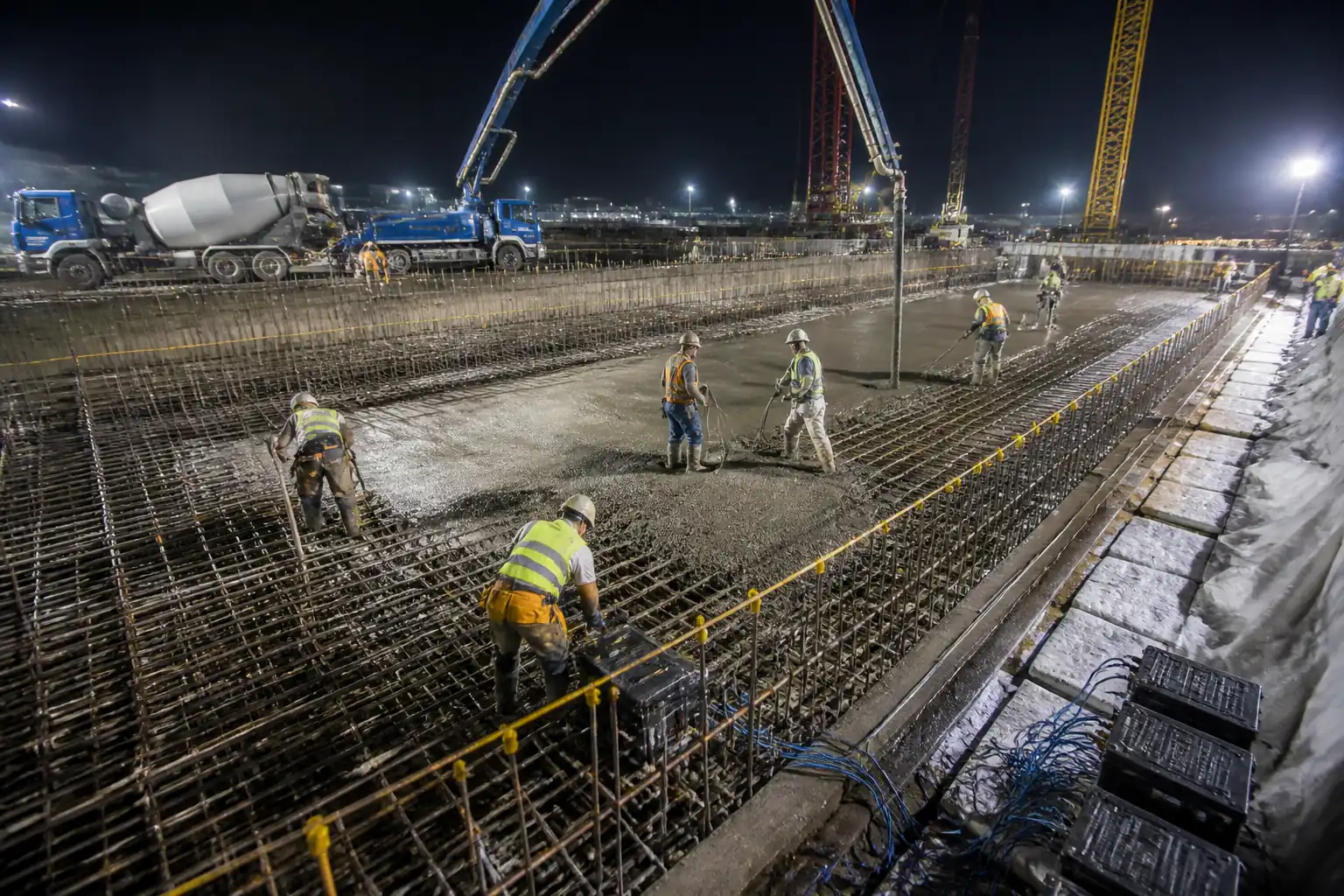

Method Statement: Mass Concrete Pour for Heavy Raft/Mat Foundations – Method Statement
AI-assisted method statement with matching ITP, PDF download, and Excel export.
More than a static template
Unlike a downloadable Word or PDF template, this method statement is an AI-assisted editable starting point connected directly to a matching Inspection and Test Plan. Every section is structured, project-adaptable, and ready to export.
- AI-assisted drafting — Customize every section with AI for your specific project scope.
- Linked ITP — A matching inspection and test plan is generated alongside the method statement.
- Multiple export formats — Download as a formatted PDF or editable Excel spreadsheet.
- Editable starting point, not a final document — Review, verify, and adjust all content against your project requirements before use.
Static template vs. Quollnet workflow
| Feature | Static template | Quollnet |
|---|---|---|
| Project-specific content | Manual fill-in required | AI-assisted customization |
| Linked ITP | Separate document, no link | Matching ITP included |
| Export formats | Usually PDF only | PDF and Excel |
| Structured sections | Free-form layout | 13 standardized sections |
| Saved to your account | Local file only | Cloud-saved, reusable |
| Content accuracy | You verify everything | AI-assisted, you still verify |
| Cost | Often free but time-intensive | Free to customize and download |
What you can customize
When you save this method statement to your account, every section becomes editable. The following 13 sections are included:
- Scope — Defines the activity and its boundaries.
- References — Standards, specifications, and drawings.
- Responsibilities — Roles and accountabilities.
- Resources — Labour, plant, and equipment summary.
- Materials — Materials and compliance requirements.
- Equipment — Tools and equipment details.
- Prerequisites — Hold points and pre-conditions.
- Method sequence — Step-by-step construction sequence.
- Safety controls — HSE risk controls and PPE.
- Environmental controls — Environmental mitigation measures.
- QA/QC — Quality inspection and test requirements.
- ITP — Inspection and Test Plan table (has its own page).
- Attachments — Referenced drawings and documentation.
Why this method statement is used
This method statement is used to define and communicate the approved procedure for carrying out method statement: mass concrete pour for heavy raft/mat foundations on site. It ensures the work is planned in advance, the correct resources and controls are in place, and all personnel understand responsibilities, sequence, quality requirements, and safety controls before work begins. It aligns site execution with the documented scope and acceptance expectations.
Who uses this method statement
This method statement is used by contractors, site supervisors, project engineers, QA/QC engineers, HSE officers, consultants, and client representatives. It serves as a shared reference for planning, execution, supervision, inspection, and approval of the activity on site.
When it is prepared and submitted
The method statement is prepared before the work activity starts and submitted as part of the pre-construction documentation package for review and approval.
Who reviews or approves it
The method statement is usually submitted to the client representative, consultant, resident engineer, or project management consultant for review and approval before the work commences.
Important approval note
This method statement is an AI-assisted editable starting point, not a pre-approved document. Before use on any project, all content must be reviewed and approved by the relevant parties (superintendent, principal contractor, or client representative) in accordance with your contract and project quality plan.
For example: if your specification requires a departure from a referenced standard, that departure must be documented and approved separately — this method statement will not capture that automatically. Always verify against your applicable drawings, specifications, and regulatory requirements.
Method statement content
Scope
Work Summary
- Construction of heavy raft/mat foundations including:
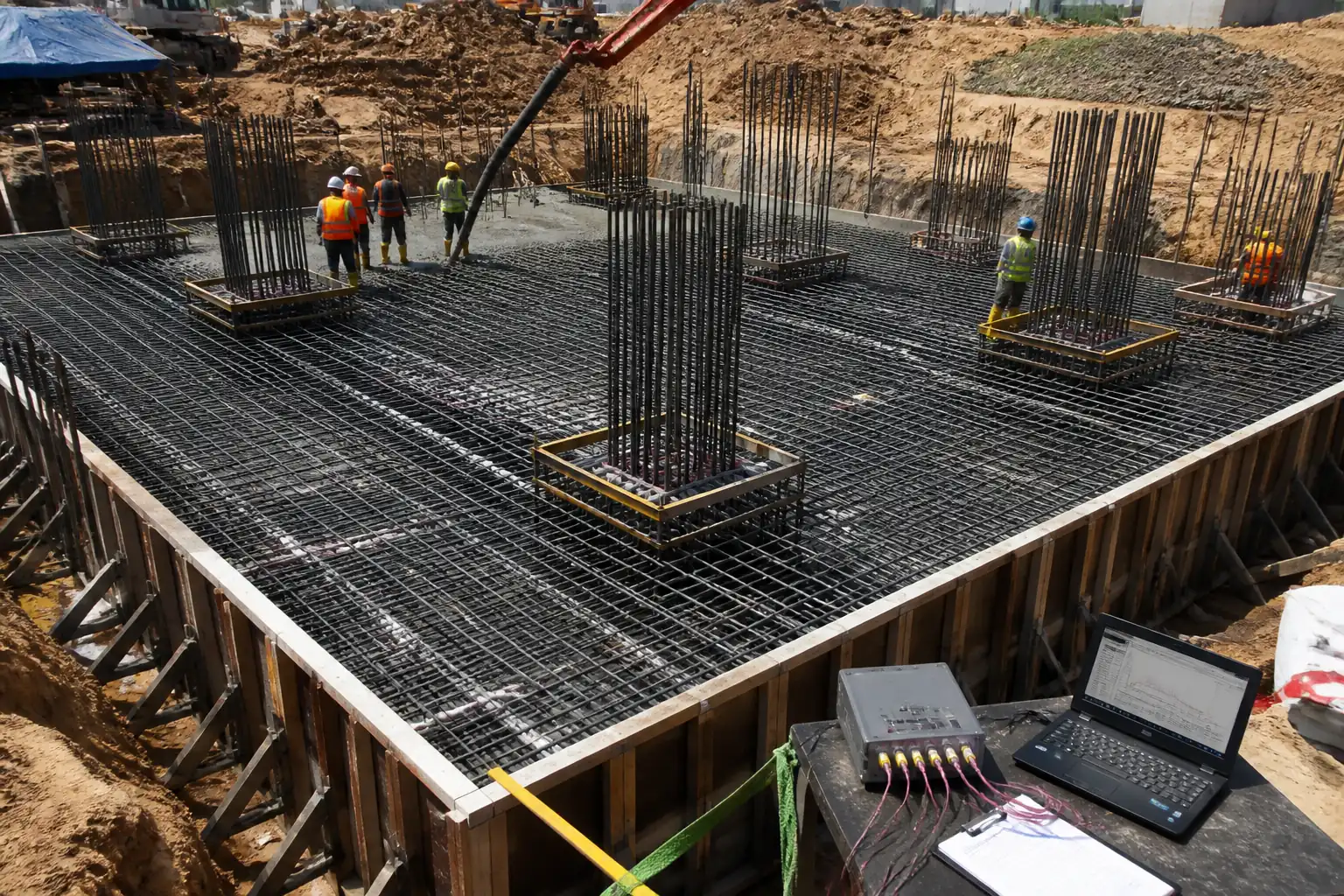
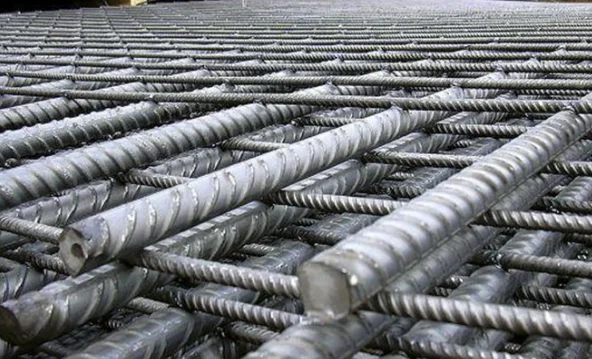
- Multi-layer reinforcement installation (bottom, mid, and top mats), chairs/spacers, couplers, and embeds.
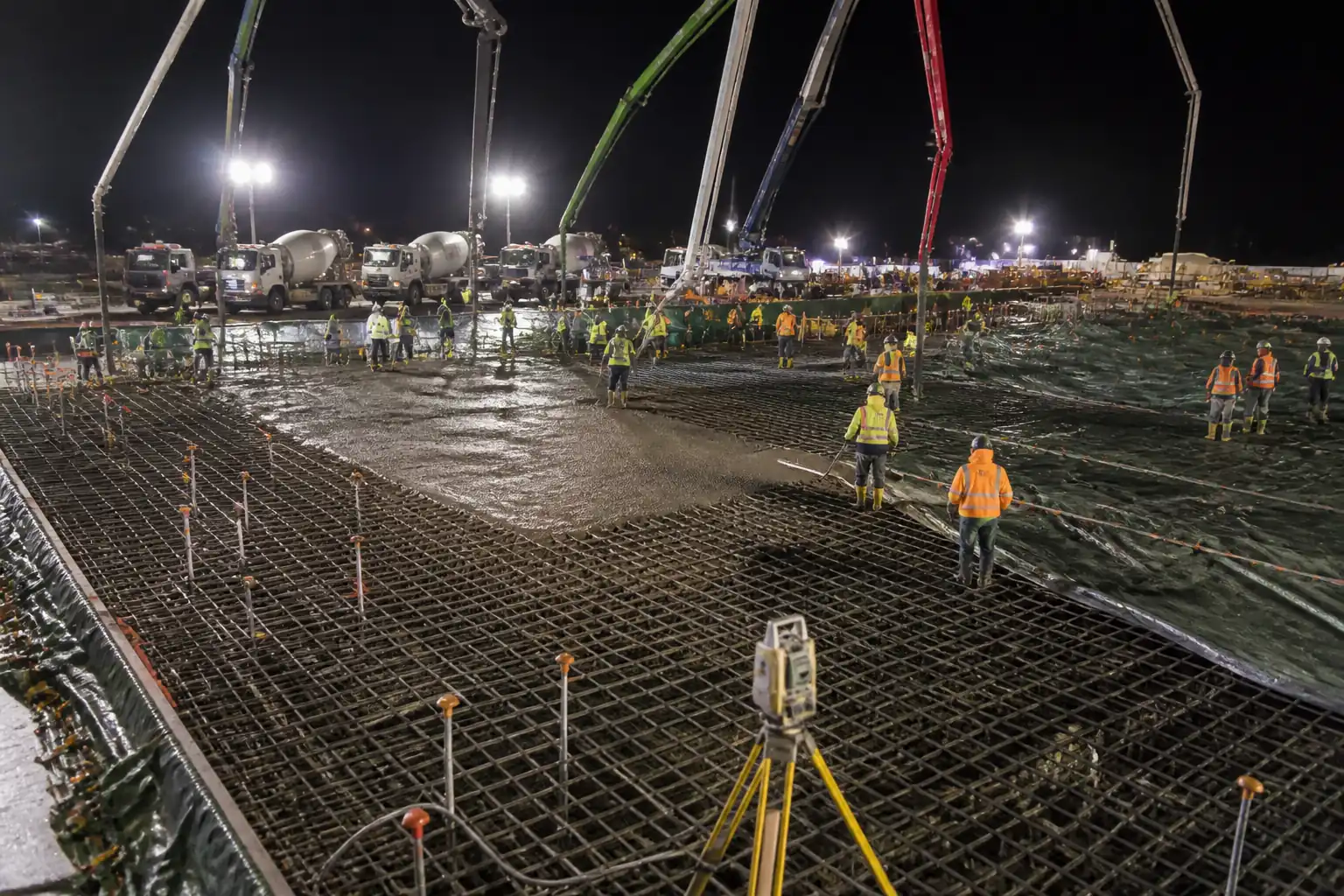
- Concrete supply coordination, pump/crane placing logistics, and continuous sequential placement in controlled layers.
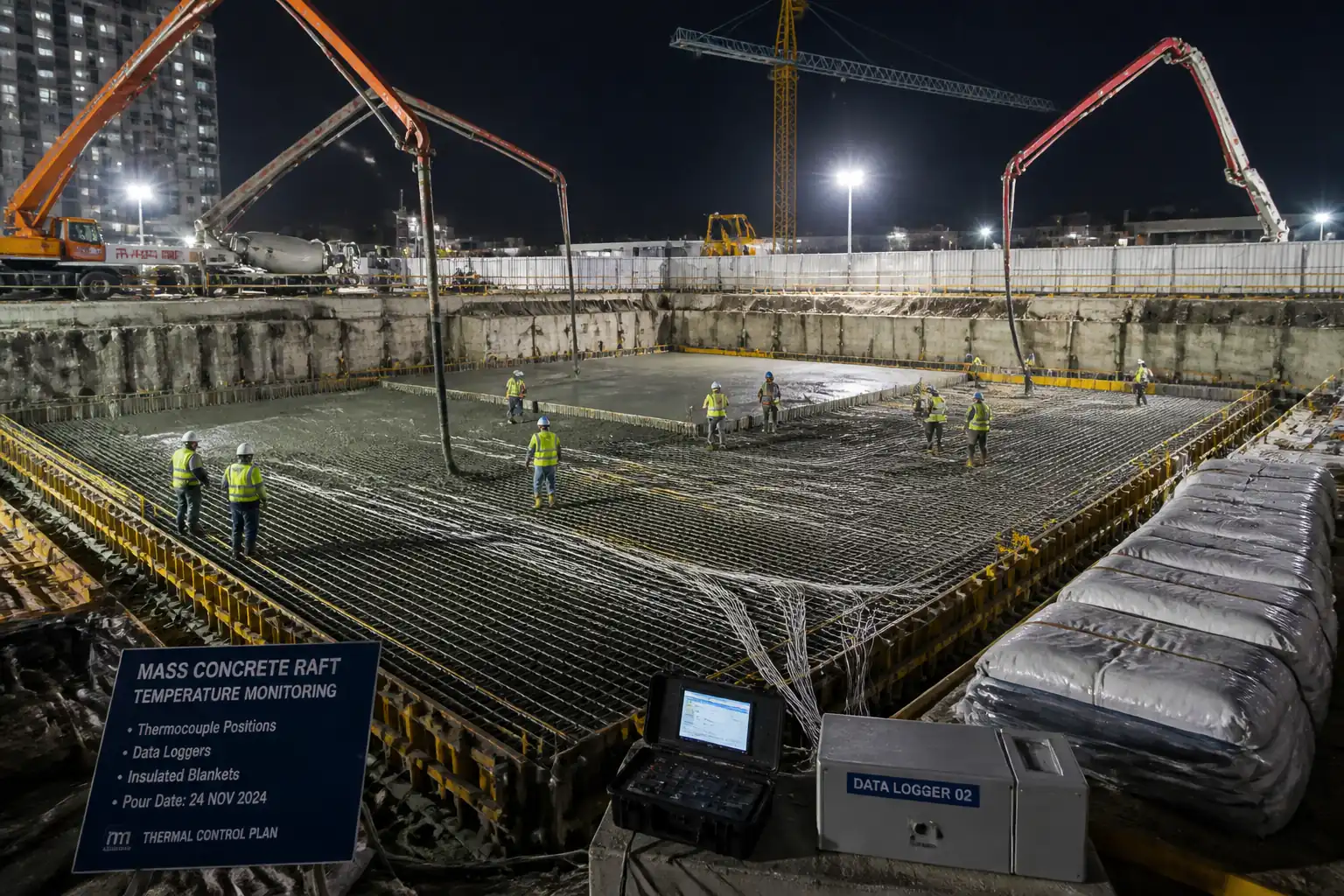
- Thermal control plan implementation for mass concrete (pre-cooling, insulation, optional cooling pipes) and placement temperature control.
- Installation and commissioning of thermocouples and data loggers; temperature monitoring and reporting.
- Measures to prevent cold joints (pour strip planning, edge management, admixture strategy) and surface finishing.
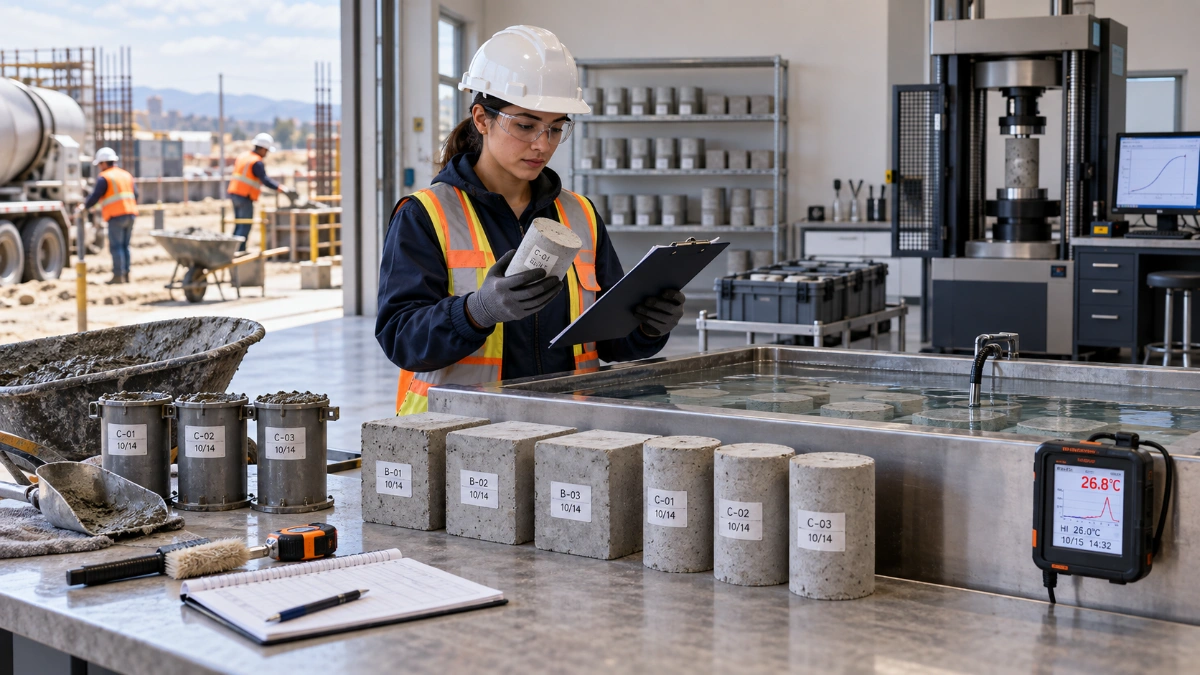
- Wet curing and insulation management; maturity monitoring (if adopted) and compressive strength testing.
- QA/QC inspections, ITP compliance, records, and as-built documentation.
Inclusions
- Pre-pour coordination and approvals, pre-placement trial mix verification, and thermal model/plan approval.
- Working platform certification for cranes/pumps, lift plans, traffic management, and night-work provisions (if applicable).
- Installation of embedded items (sleeves, anchor plates/bolts, grounding) and survey checks.
Exclusions [Verify per contract]
- Permanent works design, geotechnical excavation/dewatering, waterproofing system installation/testing, and utility diversions unless specifically stated elsewhere.
Location
- – Raft/Mat foundation areas as shown on approved drawings.
Objectives
- Achieve monolithic placement without cold joints, meet specified strength and durability, control temperature rise and core-surface differential cracking risk, and deliver a level, properly cured surface ready for subsequent works.
Key Performance Metrics
- Placement temperature: typically ≤ 28–30°C at discharge [Verify per project specifications].
- Temperature differential (core-to-surface): typically ≤ 20°C [Verify per project specifications].
- Maximum internal peak temperature: typically ≤ 65–70°C [Verify per project specifications].
- Continuous placement rate sufficient to maintain live edge before initial set.
- Surface level tolerance: typically ±10 mm over 3 m straightedge [Verify per project specifications].
- Compressive strength: f'c as per design at 28 days; early-age targets as required for loading/sequencing [Verify per project specifications].
References
| Document Type | Reference / Number | Revision | Notes |
|---|---|---|---|
| Standard | ACI 207 | Use with project-specific thermal analysis [Verify]. | |
| Standard | ACI 301 | ||
| Standard | ACI 305/306 | Apply seasonally as relevant [Verify per project HSE plan and local regulations]. | |
| Standard | ACI 304 | ||
| Standard | ACI 318 / EC2 | Apply per project design basis. | |
| Standard | BS EN 13670 / BS EN 206 | ||
| Standards | ASTM C31/C39/C94/C143/C231/C138/C1064/C403/C1074/C150/C494 | ||
| Standards | ISO 9001/14001/45001 | ||
| Manufacturer Data | N/A | Follow storage, dosage, installation, and calibration instructions. |
Responsibilities
| Role | Responsibility | Name / Party |
|---|---|---|
| Project Manager | Contractor | |
| Construction Manager | Contractor | |
| QA/QC Engineer | Contractor | |
| Site Engineer | Contractor | |
| HSE Manager | Contractor | |
| Surveyor | Contractor | |
| Rebar Foreman | Contractor | |
| Appointed Person / Lifting Supervisor | Contractor | |
| Pump Operator | Concrete Supplier/Contractor | |
| Batch Plant QC Representative | Concrete Supplier | |
| Third-Party Testing Laboratory | Independent | |
| Thermal Control Engineer | Contractor |
Resources
| Resource Type | Description | Quantity | Remarks |
|---|---|---|---|
| Labor | 16–28 persons (per shift) [Verify] | ||
| Labor | 12–20 persons [Verify] | ||
| Supervision | 4–6 (incl. QA/QC, HSE) [Verify] |
Materials
| Material | Specification / Grade | Quantity | Remarks |
|---|---|---|---|
| Ready-Mix Mass Concrete | ACI 207 / BS EN 206 / Project Spec | As per BOQ | |
| Admixtures | ASTM C494 / Manufacturer Data | As required | |
| Reinforcement & Accessories | Project Rebar Schedules / BS 4449 / ASTM A615 | As per BOQ | |
| Thermal Monitoring Kit | ACI 207 Guidance / Manufacturer | Per thermal plan | |
| Curing & Insulation Materials | Project Spec / ASTM | As required | |
| Water (Curing/Pre-cooling) | BS EN 1008 / ASTM C1602 | As required |
Equipment
| Equipment | Capacity / Type | Quantity | Inspection Required |
|---|---|---|---|
| Mobile Crane | SWL per lift plan | 1–2 | Daily/Pre-use + Third-party cert valid |
| Concrete Pump | Output 80–120 m3/h [Verify] | 1 + 1 standby | Pre-pour check |
| Poker Vibrators | 6–10 incl. spares | Pre-use function test | |
| Levelling Tools | As required | Calibration check | |
| Thermal Monitoring Equipment | Per thermal plan | Calibration certs | |
| Lighting/Power | As required | PAT/inspection records | |
| Curing & Insulation | As required | Pre-use check |
Prerequisites
Approvals & Documentation
- Approved construction drawings, bar bending schedules, pour layout/strip drawings, thermal control plan, method statement, and ITP.
- Approved mix design(s) including trial results and, if applicable, thermal model predictions covering peak core temperature and differential limits.
- Lift plans and ground bearing capacity verification for cranes/pumps; working platform certificate [Verify per project HSE plan and local regulations].
- Calibrations: thermocouples/data loggers, concrete testing equipment, surveying instruments (within validity).
- Pre-pour meeting minutes covering sequencing, logistics, HSE, contingency, and emergency arrangements.
Site Readiness
- Raft formation prepared and blinding complete to line/level; surface clean, dry (or SSD per spec), and free from loose materials.
- Waterproofing (if within scope) installed, inspected, and protected; penetrations sealed. Protection boards in place.
- Rebar delivery inspected and stored off-ground; mill certs and coupler certificates available.
- Pump access routes, washout area containment, lighting, power, and water supply arranged.
- Standby pump confirmed; spare vibrators and hoses ready.
- Traffic management plan and concrete delivery schedule agreed with supplier (rate, spacing, and contingency for delays).
- Weather forecast checked (24–72 h outlook) and hot/cold weather provisions mobilized.
Permits & Notices
- Permit to Pour, Permit to Lift, and Permit to Work at Height (where required). Utility clearance for any ground anchors/temporary fixings [Verify per project HSE plan and local regulations].
- Third-party testing laboratory notified and on standby. Engineer/Client inspection notifications issued within contract timeframes.
Method Sequence
| Step | Activity | Description | Responsibility | Inspection / Hold Point |
|---|---|---|---|---|
| 1 | Pre-pour coordination and thermal planning | Confirm pour volume, target rate, strip sequence, and uninterrupted supply. Finalize thermal plan: placement temp target (e.g., ≤28–30°C [Verify]), insulation strategy, sensor layout (top/mid/bottom arrays), and response actions if limits approach. | Project Manager / Thermal Control Engineer | Review and approval of plans |
| 2 | Survey and base preparation | Set reference benchmarks; check blinding/formation level (±5 mm typical [Verify]). Clean surface; install edge forms/shutters and keyways/stop-ends where detailed. | Surveyor / Site Engineer | ITP hold for base level/cleanliness |
| 3 | Install chairs/spacers and bottom mat reinforcement | Place non-corrosive spacers at grid to maintain cover (typ. ≥75–100 mm for rafts [Verify]). Fix bottom mat bars to schedule; maintain bar spacing tolerances (±10 mm typical [Verify]). | Rebar Foreman | ITP witness |
| 4 | Erection of upper reinforcement layers and couplers | Install mid/top mats using rebar stools/chairs; ensure vertical separation matches drawings (±10 mm [Verify]). Install mechanical couplers to manufacturer torque with calibrated wrenches; record torque values. | Rebar Foreman / QA/QC | ITP hold for dense reinforcement zones |
| 5 | Install embeds and penetrations | Fix anchor bolts, plates, ducts, sleeves, earthing per drawings. Coordinate with MEP. Brace to resist flotation and movement during vibration. | Site Engineer / Surveyor | ITP witness |
| 6 | Thermocouple and conduit installation | Fix thermocouples at top (~75 mm below surface), mid-depth, and bottom (~75 mm above blinding) at representative locations and critical zones; protect leads in conduits to data loggers; label sensors. | Thermal Control Engineer | ITP witness |
| 7 | Pre-placement checks and trial | Toolbox talk, HSE brief, pump line pressure/leak test, slump/temperature checks on first truck, trial placement at waste box if required. Confirm delivery ticket conformity. | QA/QC / Pump Operator | ITP hold |
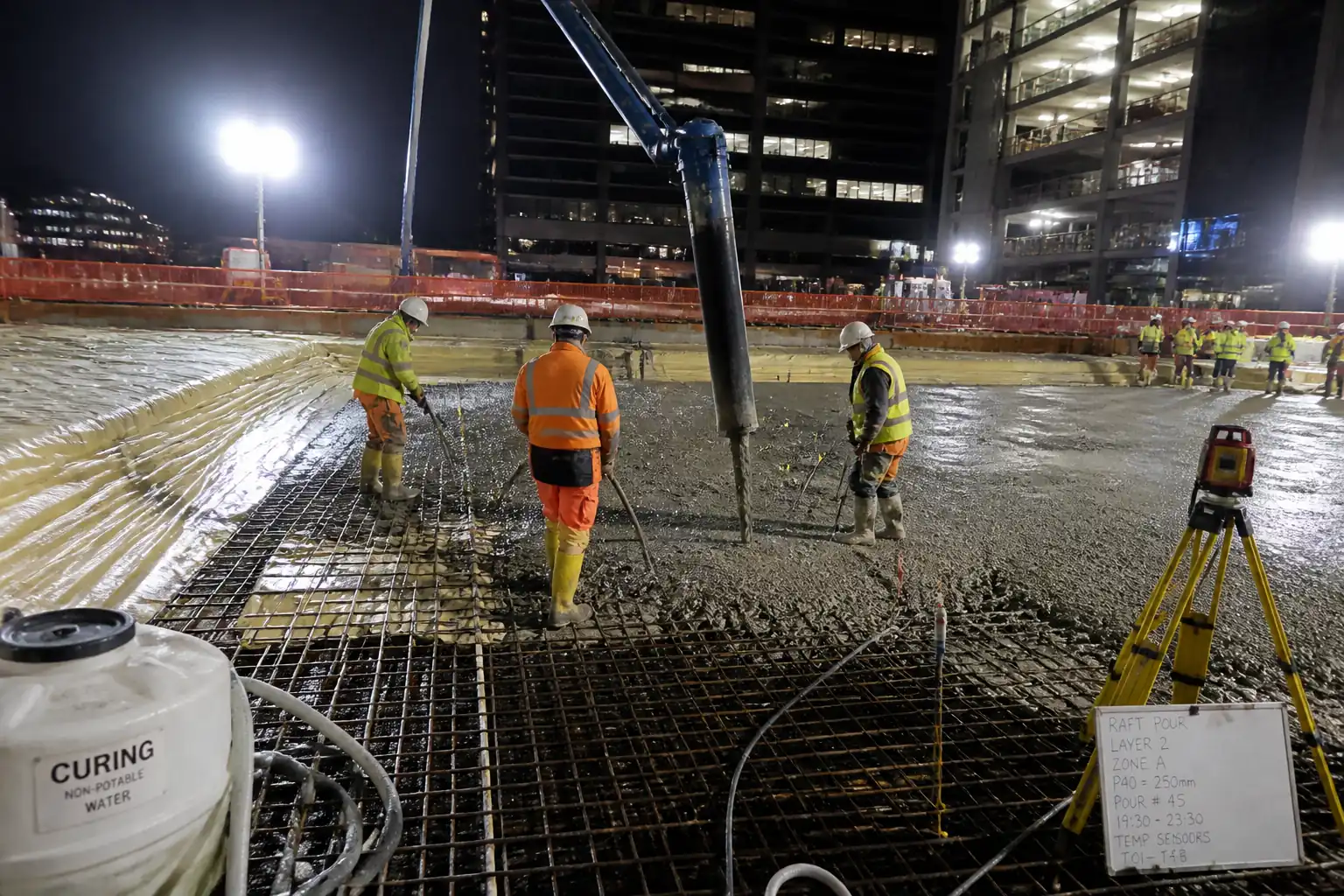
| 8 | Concrete placement – Layered pouring | Place in strips/panels to plan. Layer thickness typically 300–450 mm [Verify]. Maintain live edge; return time before initial set (per ASTM C403 curve). Max free-fall 1.5 m; use elephant trunk if higher. Avoid rebar displacement. | Site Engineer / Placing Crew | Continuous supervision |
| 9 | Vibration and consolidation | Insert vibrators vertically at ~300–450 mm spacing, penetrate 50–100 mm into previous layer, 5–15 s per insertion or until air release ceases. Avoid over-vibration near congested steel/embeds. | Placing Crew / QA/QC | Spot checks |
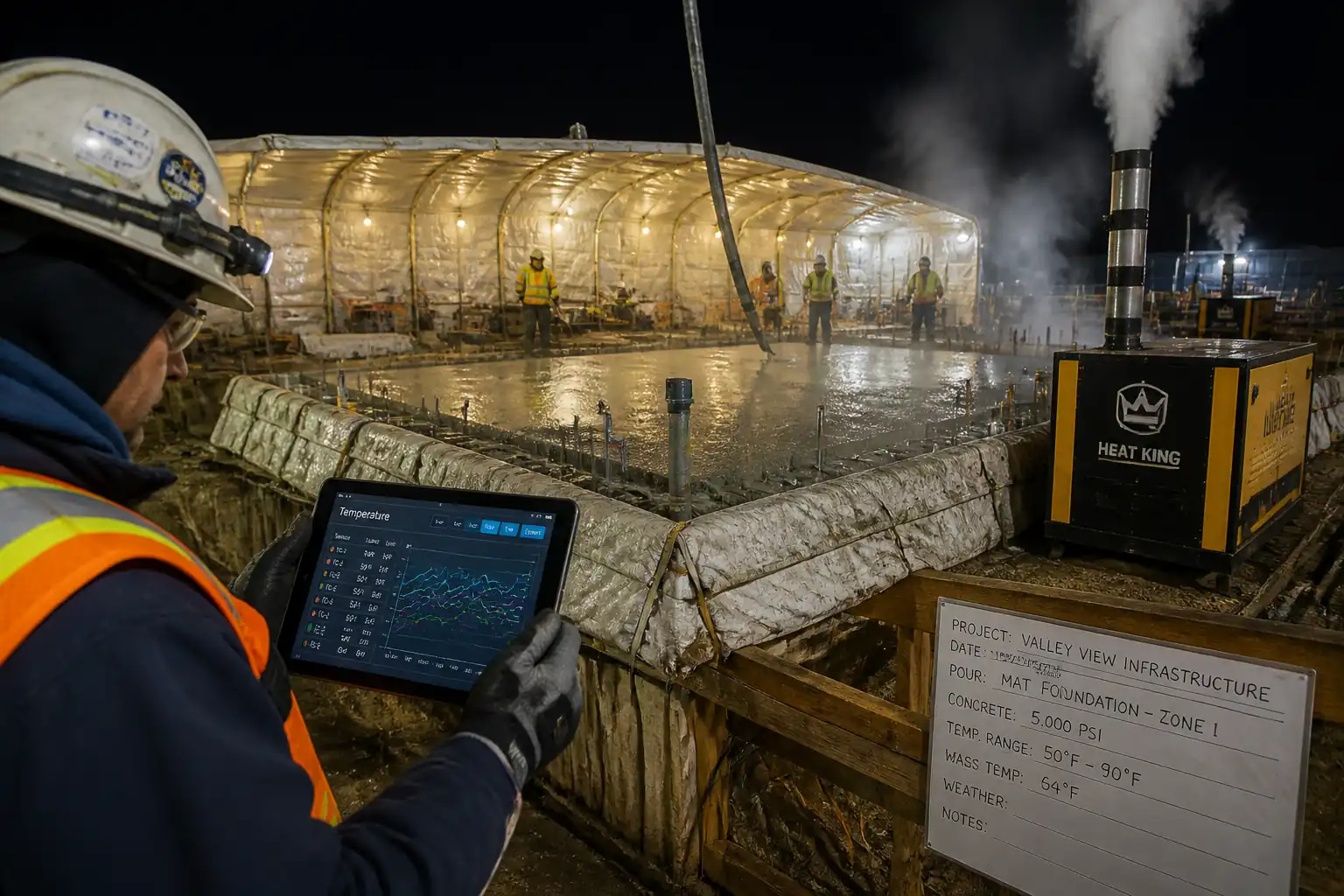
| 10 | Hot/cold weather controls (as applicable) | Hot: shade lines, chilled water/ice dosing, misting, evaporation retarder, placement temp control. Cold: heated materials, insulated formwork/surface, do not place on frozen base. | Thermal Control Engineer / HSE | Environmental checks |
| 11 | Surface strike-off and finishing | Strike to level using laser/straightedge; avoid hard trowelling of mass pour surface if not required. Apply early evaporation control (fogging) as needed. | Placing Crew | Supervisor check |
| 12 | Initial curing and insulation | Immediately after sheen loss, commence wet curing (sprinklers/wet burlap) and cover with polyethylene; apply insulating blankets/boards to control cooling rate and surface-core differential. | Site Engineer | QA/QC witness |
| 13 | Temperature monitoring and response | Start data logging at placement; record at 10–60 min intervals. If differential approaches limit (e.g., 18–20°C threshold), increase insulation, extend wet curing, or deploy additional measures. Remove insulation gradually once differential <10°C and cooling rate acceptable. | Thermal Control Engineer | Daily review |
| 14 | Concrete testing and maturity (if used) | Sample per lot frequency (e.g., 1 set/50 m3, min 1 set/shift [Verify]). Cure and test per ASTM C31/C39 at 7 & 28 days; maturity per ASTM C1074 if adopted with prior calibration. | QA/QC / Third-Party Lab | Witness by Engineer (as required) |
| 15 | Extended wet curing | Maintain wet curing typically ≥7–14 days depending on cement/SCM content and spec [Verify]. Keep surface continuously moist; avoid thermal shock when removing insulation. | Site Engineer | Daily |
| 16 | Joint contingency (if placement interrupted) | If unavoidable joint forms: stop-end, remove laitance, green-cut/roughen ≥6 mm amplitude, pressure wash, apply bonding grout or epoxy per spec before resuming. Sequence to minimize restraint. | Construction Manager / QA/QC | Hold point before restart |
| 17 | As-built and demobilization | Survey finished levels and embed locations; compile QC and thermal records; remove temporary works; reinstate access routes; secure curing area until completion. | Surveyor / QA/QC | Final inspection |
Health, Safety & Environment – Safety Controls
Task-Specific Hazards and Controls
- Hazard: Crane or pump overturn due to inadequate ground bearing.
- Consequence: Catastrophic collapse, serious injury/fatality.
- Engineering/Procedural Control: Geotechnical verification and working platform design; lift/plant outrigger mats sized per load; exclusion zones; real-time load charts and slew limits.
- Required PPE: Hard hat, hi-vis, safety boots, gloves.
- Collective Measure: Barriers and spotters; banksman control; plant-people separation ≥3 m or per site rules.
-
Inspection/Permit: Appointed Person lift plan; Permit to Lift; daily plant inspection; ground certificate [Verify per project HSE plan and local regulations].
-
Hazard: Pump hose whip/line failure under pressure.
- Consequence: Struck-by injuries, concrete spray/chemical burns.
- Control: Secure end-hose with safety strap; use priming procedures; pressure test; keep personnel clear of end-hose arc; relieve pressure before moving lines.
- PPE: Eye/face protection, concrete-resistant gloves, long sleeves.
- Collective: Physical barriers at discharge areas; tag lines.
-
Inspection/Permit: Pre-pour pump/line checklist; competent operator sign-off.
-
Hazard: Falls and trips on congested rebar mats/working at height on top mat.
- Consequence: Fractures, serious injury.
- Control: Temporary access platforms/boards with anti-slip; fall protection when edges >2 m; dedicated walkways; housekeeping.
- PPE: Fall arrest (if required), anti-slip boots, gloves.
- Collective: Handrails/edge protection; safety nets where feasible.
-
Inspection/Permit: Work at Height permit; daily scaffold/edge checks.
-
Hazard: Struck-by/suspended loads (rebar bundles, embeds, pump booms).
- Consequence: Serious injury/fatality.
- Control: Exclusion zones; tag lines; no standing under loads; certified rigging and slinging; clear communications.
- PPE: Helmet with chin strap, gloves, steel-toe boots.
- Collective: Radios/hand signals; banksman authority to stop work.
-
Inspection/Permit: Lifting gear certificates; pre-lift briefing.
-
Hazard: Concrete chemical burns and dermatitis.
- Consequence: Skin/eye injury.
- Control: Avoid direct contact; use neutralizing skin products and wash stations.
- PPE: Alkali-resistant gloves, goggles/face shield, long sleeves, waterproof footwear.
- Collective: Eyewash stations; safety data sheets accessible.
-
Inspection/Permit: COSHH/chemical assessment; toolbox talk.
-
Hazard: Early-age thermal cracking due to uncontrolled temperature differential.
- Consequence: Structural durability issues.
- Control: Enforce thermal plan, continuous monitoring, insulation/wet curing, adjust measures on alerts.
- PPE: Standard site PPE.
- Collective: Daily coordination with thermal engineer; escalation triggers.
-
Inspection/Permit: Permit to Pour includes thermal control approval.
-
Hazard: Night works—poor visibility, fatigue.
- Consequence: Incidents, quality defects.
- Control: Lighting ≥150–200 lux at workface; shift rotation; rest breaks; noise controls.
- PPE: Hi-vis (night-rated), hearing protection.
- Collective: Light towers positioned to avoid glare; supervisor checks.
-
Inspection/Permit: Night-work permit; lux level checks.
-
Hazard: Hand-arm vibration from vibrators.
- Consequence: HAVS risk.
- Control: Rotation of operators; low-vibration handles; exposure monitoring.
- PPE: Anti-vibration gloves.
- Collective: Task time limits posted.
-
Inspection/Permit: HAV monitoring records.
-
Hazard: Heat/cold stress.
- Consequence: Illness, reduced performance.
- Control: Hydration/cooling or warming shelters; schedule during cooler periods.
- PPE: Weather-appropriate layers; sun protection.
- Collective: Buddy system and first aid on site.
-
Inspection/Permit: Environmental monitoring; HSE rounds.
-
Hazard: Confined foundation pit edges and access.
- Consequence: Falls, entrapment.
- Control: Edge barriers; safe access/egress; rescue plan.
- PPE: Standard PPE, fall arrest if required.
- Collective: Controlled access points.
- Inspection/Permit: Daily edge inspections; excavation/entry permits as applicable.
[Verify per project HSE plan and local regulations]
Environmental Controls
- Concrete washout management: Designated lined washout pits; no discharge to ground/surface water. pH neutralization if required; monitor after pours.
- Water use: Metered curing water; avoid ponding/runoff beyond footprint; use recirculating sprinklers where possible.
- Noise and hours: Schedule pumps/trucks within permitted hours; fit acoustic shrouds where near-sensitive receptors.
- Dust/air: Cover aggregates in transit; maintain site speed limits; no dry cutting. Control diesel emissions; avoid excessive idling.
- Light spill: Aim lights away from receptors; use shields for night works.
- Waste: Segregate steel offcuts for recycling; collect packaging; manage spill kits for oils/chemicals.
- Materials footprint: Prioritize SCMs (GGBFS/FA) to reduce cement content where approved; consider chilled water/ice over LN2 for practicality and emissions [Verify].
- Stormwater: Perimeter controls, protect drains; install silt socks; no slurry to drains.
- Incident response: Spill response plan and kits; reportable incident thresholds defined in project EMP.
[Verify per project HSE plan and local regulations]
Quality Assurance & Quality Control
Inspection & Testing
- Rebar Inspection: Verify sizes, spacing, supports, and cover (±10 mm typical [Verify]); check coupler type and torque per manufacturer. Clean steel (no oil/loose rust). Records: Rebar Checklist, Coupler Torque Log.
- Embedment Survey: Tolerances typically ±5–10 mm position; plumb ≤1:1000 [Verify]. Record: Survey report/as-built.
- Concrete Delivery Checks (each truck): ASTM C1064 temp (target ≤ 28–30°C [Verify]); ASTM C143 slump (or C1611 slump flow for SCC); C231 air (where applicable); C138 density/unit weight. Reject if outside approved limits without authorized adjustments.
- Sampling Frequency: Minimum 1 set of 3 cylinders (or cubes) per 50 m3, min 1 set per shift and per mix source change [Verify]. Tests per ASTM C39 at 7 and 28 days (and 56 days if SCMs specified) [Verify].
- Maturity (if adopted): Establish calibration per ASTM C1074 before pour; correlate to compressive strength; use for early decisions only if approved.
- Placement Controls: Max free fall 1.5 m; layer thickness 300–450 mm; vibrator spacing 300–450 mm; penetrate previous lift 50–100 mm. Avoid segregation and rebar displacement.
- Surface Level/Finish: Level tolerance typically ±10 mm over 3 m straightedge [Verify]. Record: Level survey.
- Curing: Wet curing continuous typically ≥7–14 days [Verify]; maintain moisture—no visible drying. If curing compound used, apply per ASTM C309/C1315 at manufacturer’s rate.
- Thermal Monitoring: Start at placement; logging interval 10–60 min; alarm threshold set per thermal plan (e.g., 18°C); limits: differential ≤20°C typical; peak ≤65–70°C [Verify]. Daily thermal report; implement response measures when thresholds reached.
- Nonconformance: If test results fall below requirements or honeycombing observed, notify Engineer; propose corrective action (core testing per spec, epoxy injection, or removal/repair) [Verify per project specifications].
Documentation & Records
- Delivery tickets (cement type, SCM %, batch time, water added on site, admixtures), test results, calibration certs, pour logs, thermal data, curing logs, inspection checklists, RFIs, NCRs/CARs, as-builts.
Hold/Witness Points [Indicative]
- Hold: Base/pre-pour inspection; dense rebar/embedded inspection; pre-placement test results approval; restart after unplanned joint preparation.
- Witness: Thermocouple installation; initial concrete truck testing; compressive strength testing; final handover inspection.
Attachments
- Approved Pour Layout & Sequencing Drawings
- Thermal Control Plan and Thermal Model Summary
- Rebar Inspection Checklist and Coupler Torque Log (templates)
- Pre-Pour Checklist and Permit to Pour
- Concrete Test Forms (ASTM C1064/C143/C231/C138/C31) and Sample Labels
- Daily Pour Log Template and Panel Map
- Temperature Monitoring Log and Daily Thermal Report Template
- Curing Log Template
- Lift Plan, Crane/Pump Certificates, Working Platform Certificate
- Manufacturer Data Sheets (admixtures, couplers, thermocouples, curing compounds)
- Calibration Certificates (loggers, thermometers, survey equipment)
- Environmental Method (Washout Management) and Spill Response Plan
- Risk Assessment/Job Hazard Analysis (JHA) specific to mass pour
- As-Built Survey Template and Handover Dossier Index
This content is a read-only public reference. Download or customize to get an editable version.
ITP preview
The first inspection activities from the linked ITP for Method Statement: Mass Concrete Pour for Heavy Raft/Mat Foundations:
| Activity | Inspection / Test | Acceptance Criteria | Responsibility | Record |
|---|---|---|---|---|
| Base/blinding level and cleanliness | Survey level check; visual cleanliness | Level within ±5 mm [Verify]; surface clean, dry/SSD as specified | QA/QC Engineer / Engineer | Base Inspection Checklist; Survey Report |
| Reinforcement installation (multi-layer) | Size/spacing/cover checks; coupler torque verification | Bars per schedule; cover ≥ specified (e.g., 75–100 mm) [Verify]; torque per manufacturer | QA/QC Engineer / Engineer | Rebar Inspection & Torque Log |
| Embeds and penetrations survey | Position/plumb/level survey | Position ±5–10 mm; plumb ≤1:1000 [Verify] | Surveyor / QA/QC / Engineer | Embed Survey Report; RFI (if any) |
Showing 3 of 10 inspection activities. View full ITP →
Related Inspection and Test Plan
An Inspection and Test Plan (ITP) is available for Method Statement: Mass Concrete Pour for Heavy Raft/Mat Foundations. The ITP defines the inspection activities, acceptance criteria, hold and witness points, responsible parties, and records required to verify the work described in this method statement.
View the Method Statement: Mass Concrete Pour for Heavy Raft/Mat Foundations ITP →Frequently asked questions
Continue with related Quollnet resources connected to this method statement.