
Method Statement – Raft Foundation Mass Concrete Placement Works – Method Statement
AI-assisted method statement with matching ITP, PDF download, and Excel export.
More than a static template
Unlike a downloadable Word or PDF template, this method statement is an AI-assisted editable starting point connected directly to a matching Inspection and Test Plan. Every section is structured, project-adaptable, and ready to export.
- AI-assisted drafting — Customize every section with AI for your specific project scope.
- Linked ITP — A matching inspection and test plan is generated alongside the method statement.
- Multiple export formats — Download as a formatted PDF or editable Excel spreadsheet.
- Editable starting point, not a final document — Review, verify, and adjust all content against your project requirements before use.
Static template vs. Quollnet workflow
| Feature | Static template | Quollnet |
|---|---|---|
| Project-specific content | Manual fill-in required | AI-assisted customization |
| Linked ITP | Separate document, no link | Matching ITP included |
| Export formats | Usually PDF only | PDF and Excel |
| Structured sections | Free-form layout | 13 standardized sections |
| Saved to your account | Local file only | Cloud-saved, reusable |
| Content accuracy | You verify everything | AI-assisted, you still verify |
| Cost | Often free but time-intensive | Free to customize and download |
What you can customize
When you save this method statement to your account, every section becomes editable. The following 13 sections are included:
- Scope — Defines the activity and its boundaries.
- References — Standards, specifications, and drawings.
- Responsibilities — Roles and accountabilities.
- Resources — Labour, plant, and equipment summary.
- Materials — Materials and compliance requirements.
- Equipment — Tools and equipment details.
- Prerequisites — Hold points and pre-conditions.
- Method sequence — Step-by-step construction sequence.
- Safety controls — HSE risk controls and PPE.
- Environmental controls — Environmental mitigation measures.
- QA/QC — Quality inspection and test requirements.
- ITP — Inspection and Test Plan table (has its own page).
- Attachments — Referenced drawings and documentation.
Why this method statement is used
This method statement is used to define and communicate the approved procedure for carrying out method statement – raft foundation mass concrete placement works on site. It ensures the work is planned in advance, the correct resources and controls are in place, and all personnel understand responsibilities, sequence, quality requirements, and safety controls before work begins. It aligns site execution with the documented scope and acceptance expectations.
Who uses this method statement
This method statement is used by contractors, site supervisors, project engineers, QA/QC engineers, HSE officers, consultants, and client representatives. It serves as a shared reference for planning, execution, supervision, inspection, and approval of the activity on site.
When it is prepared and submitted
The method statement is prepared before the work activity starts and submitted as part of the pre-construction documentation package for review and approval.
Who reviews or approves it
The method statement is usually submitted to the client representative, consultant, resident engineer, or project management consultant for review and approval before the work commences.
Important approval note
This method statement is an AI-assisted editable starting point, not a pre-approved document. Before use on any project, all content must be reviewed and approved by the relevant parties (superintendent, principal contractor, or client representative) in accordance with your contract and project quality plan.
For example: if your specification requires a departure from a referenced standard, that departure must be documented and approved separately — this method statement will not capture that automatically. Always verify against your applicable drawings, specifications, and regulatory requirements.
Method statement content
Scope
Work Summary
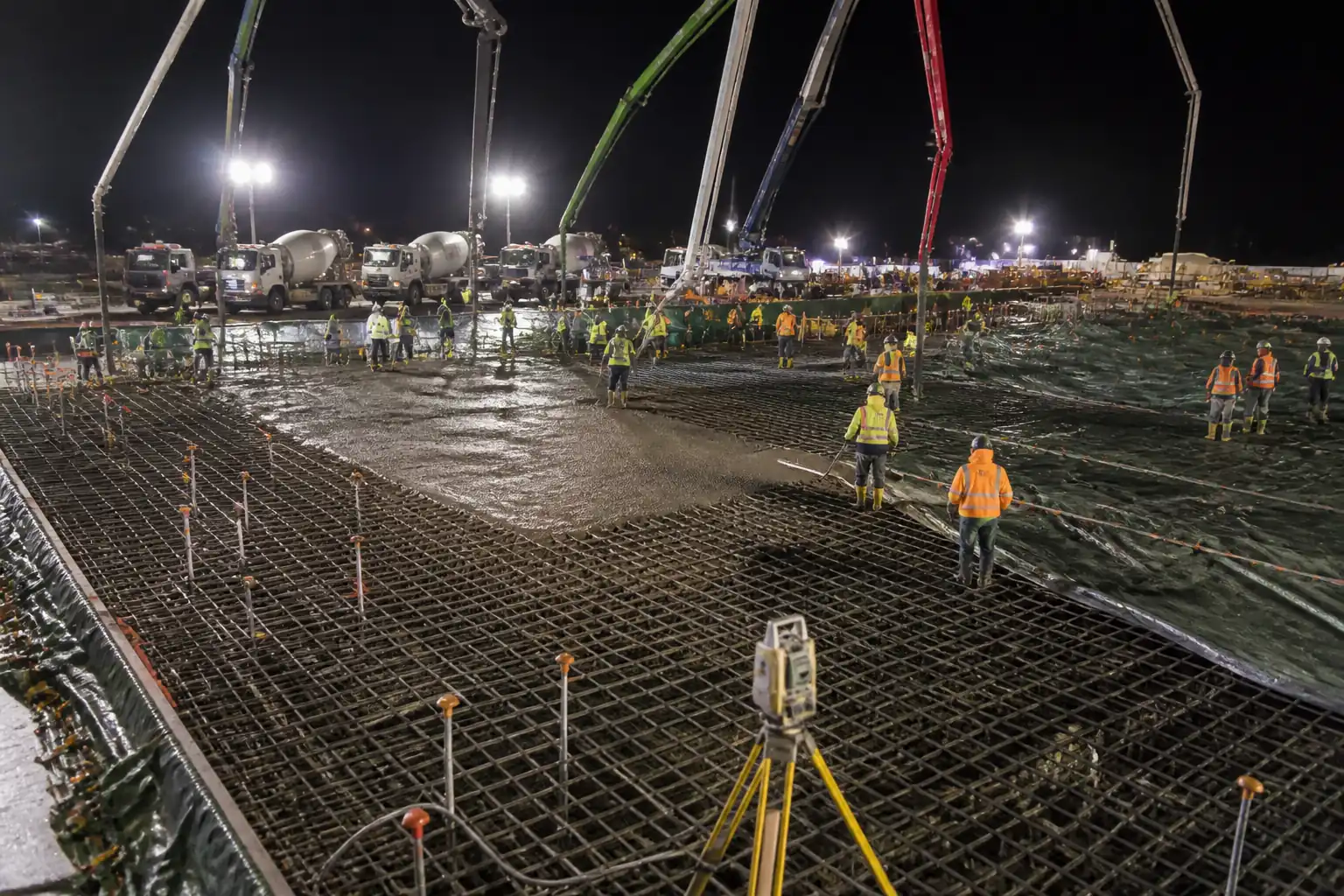
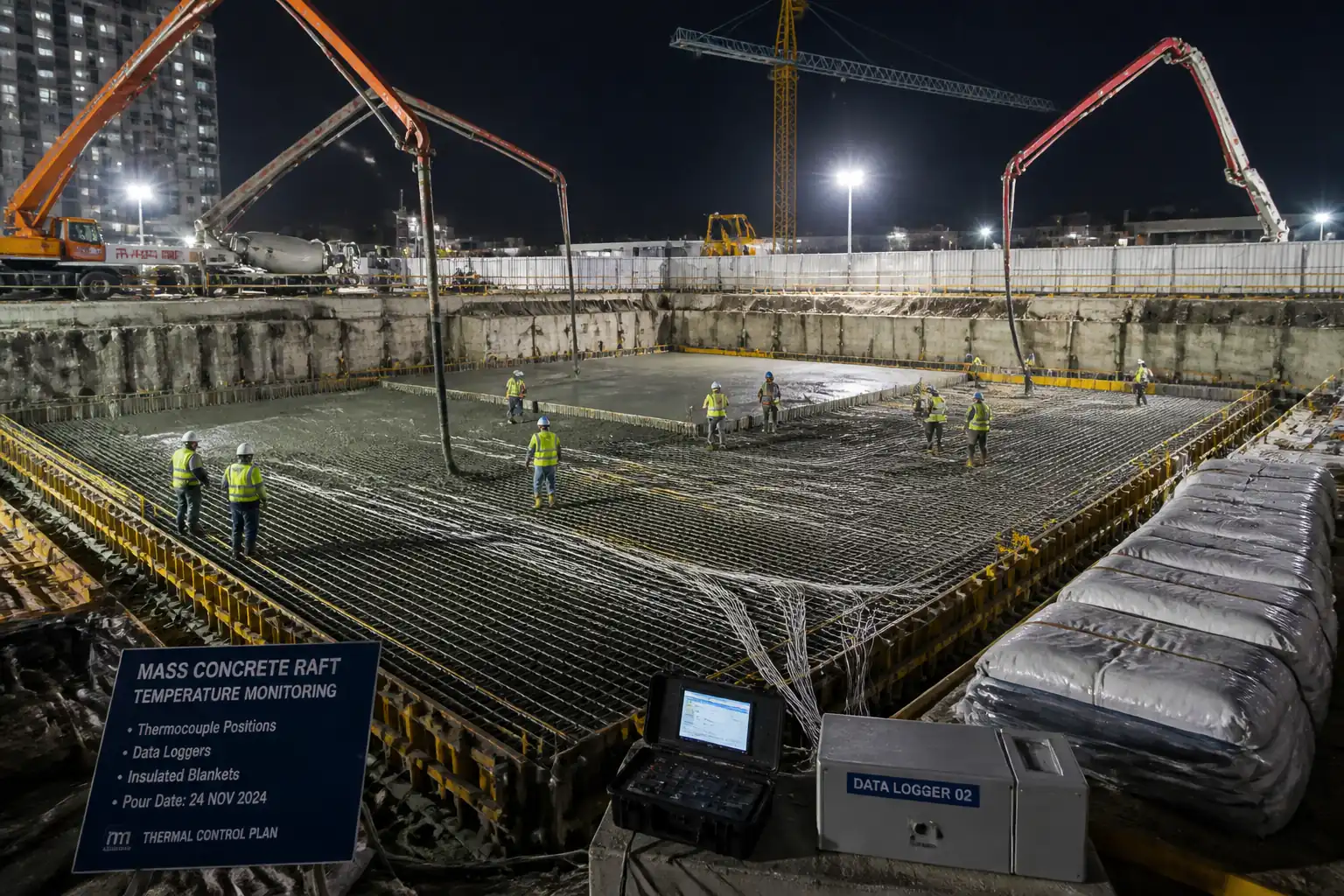
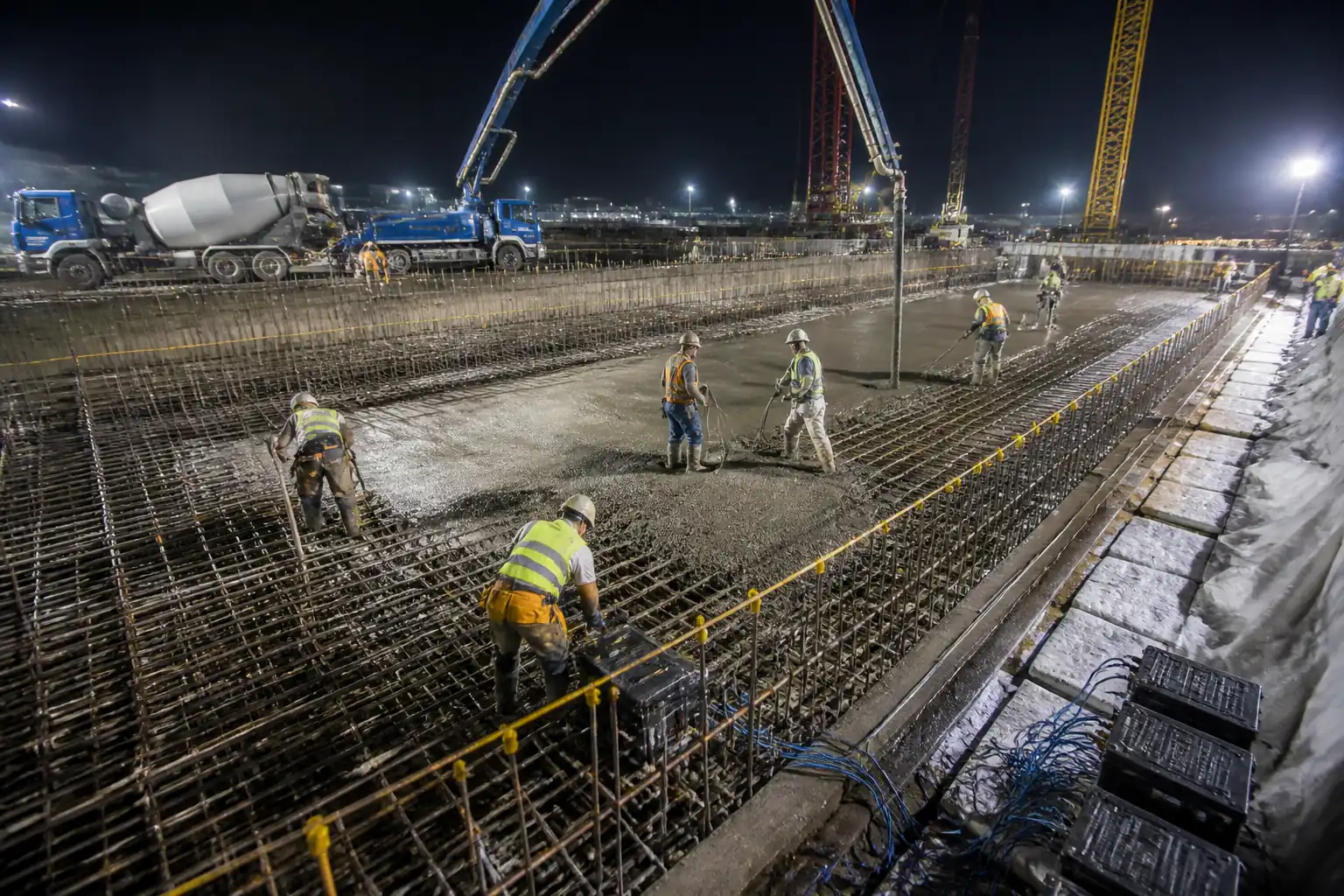
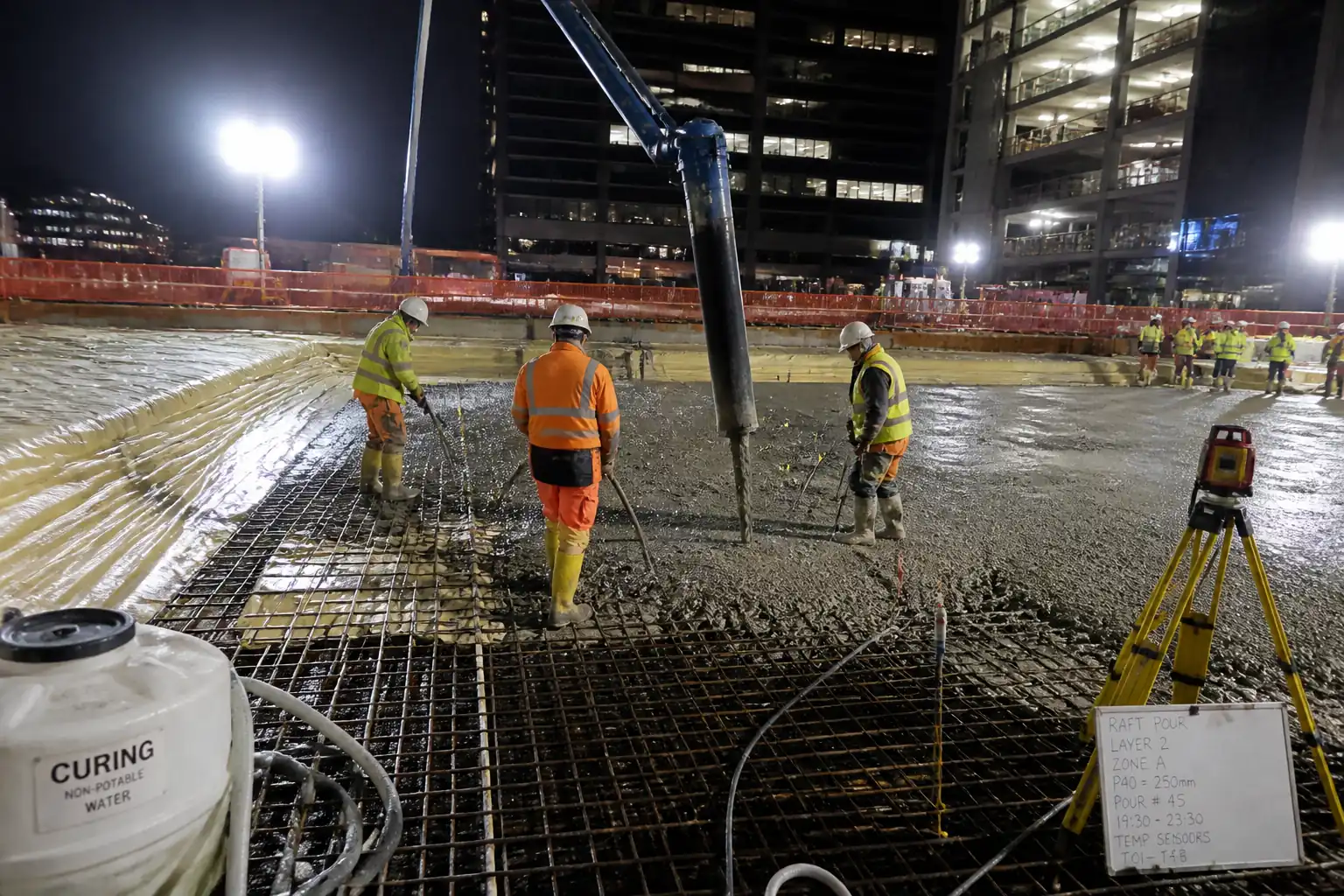
This method statement covers end-to-end execution of raft foundation mass concrete placement including: batching coordination, logistics and pump setup, layer-by-layer placement and compaction, temperature control and thermal crack prevention, curing compound application, installation and monitoring of embedded temperature sensors, inspection hold/witness points, compressive strength testing, records, and final acceptance.
Deliverables
- Approved pour plan, pump and pipeline layout, manpower and equipment allocations.
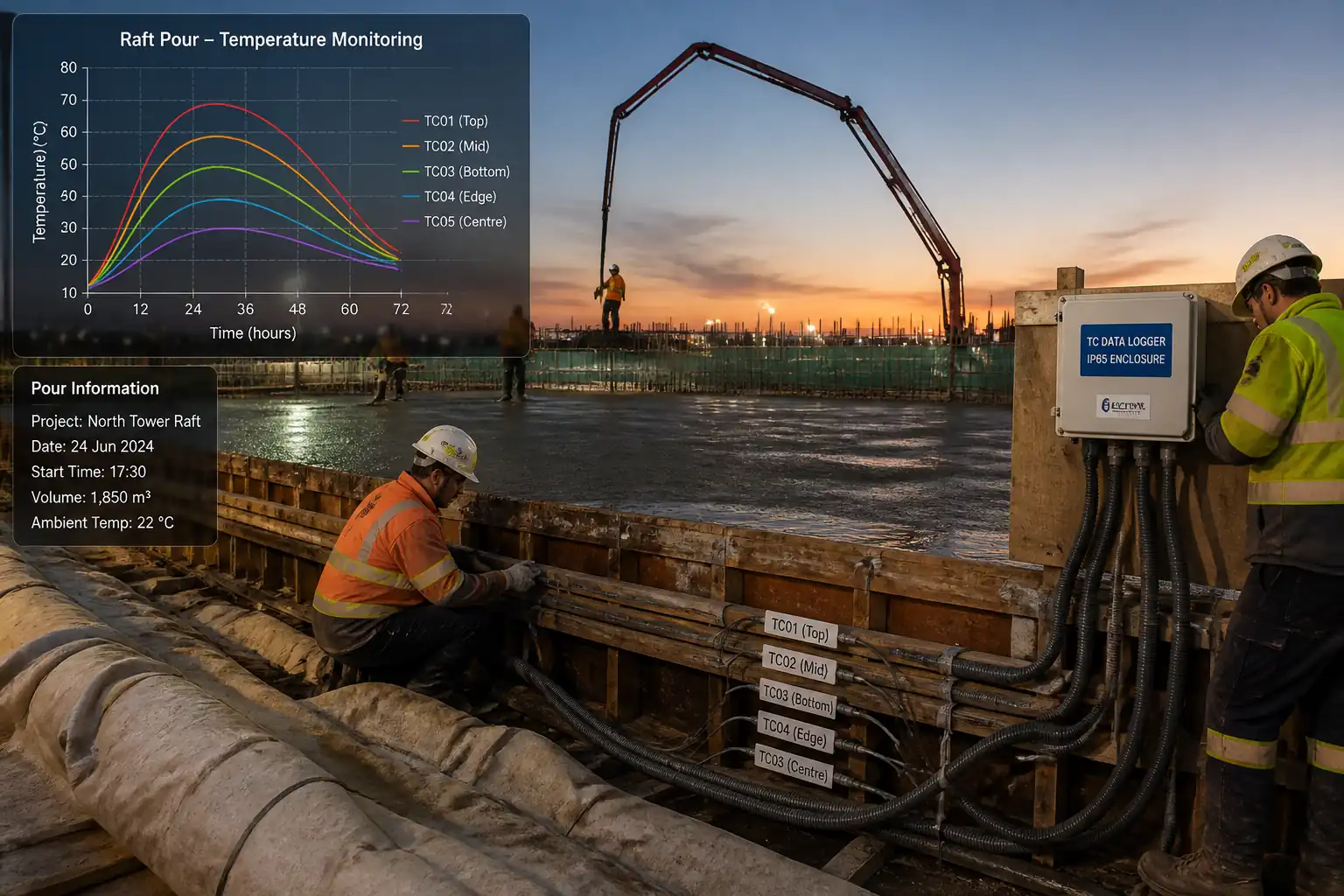
- Installed and commissioned temperature sensors with data logging plan.
- Executed mass concrete pour with controlled lift thickness and verified consolidation.
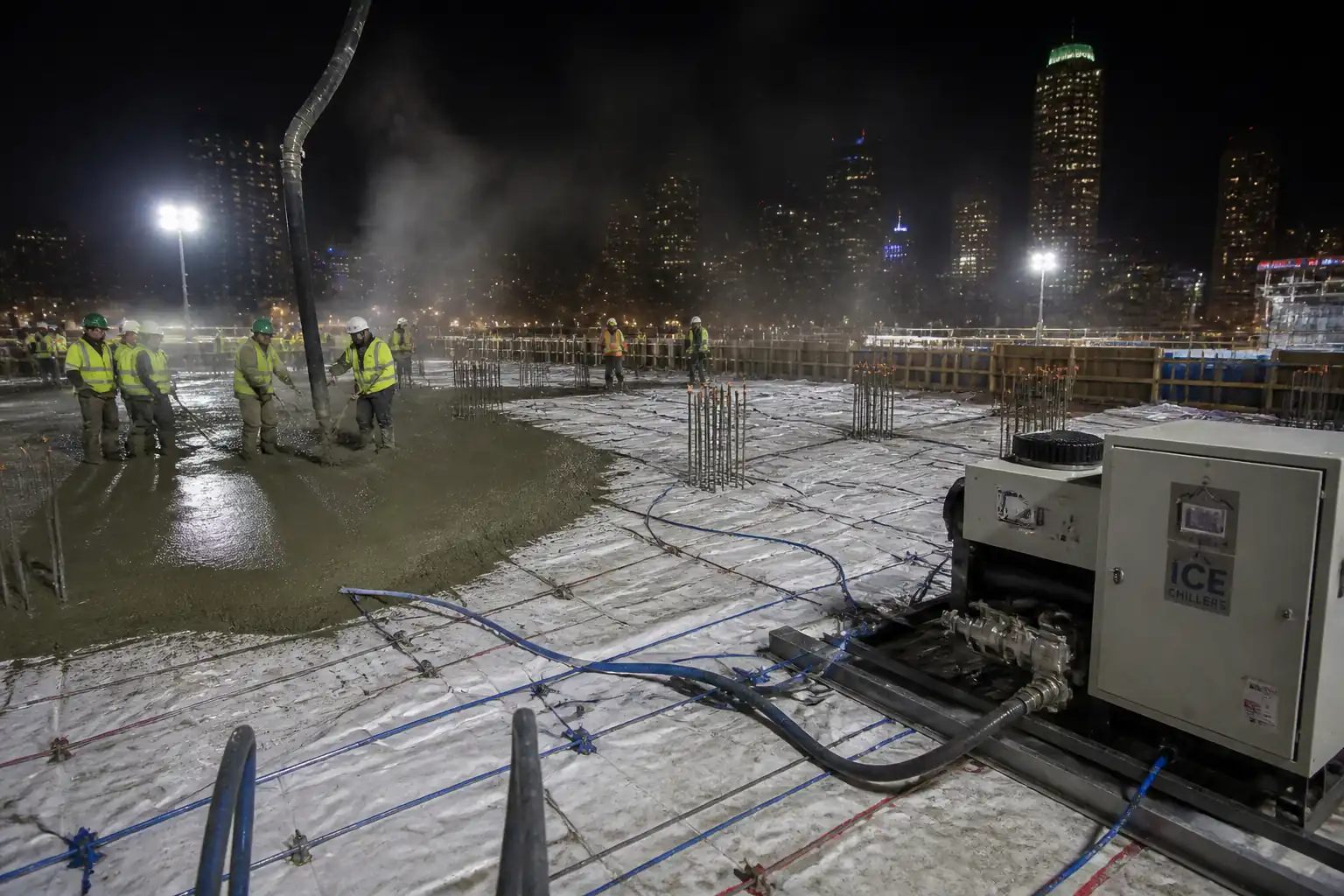
- Implemented thermal control (pre-cooling, insulation, curing) and temperature differential monitoring.
- Completed fresh and hardened concrete testing, temperature logs, and QA/QC records.
- Achieved final acceptance per specifications and ITP.
Exclusions
- Excavation, blinding, waterproofing, permanent formwork construction, reinforcement fabrication (covered under separate methods). Interfaces are controlled via prerequisites and hold points.
References
| Document Type | Reference / Number | Revision | Notes |
|---|---|---|---|
| Standard | ACI 207 (Mass Concrete) and ACI 207.1R – Guide to Mass Concrete | Thermal control, temperature differential limits, planning. | |
| Standard | ACI 301 – Specifications for Structural Concrete; ACI 318 – Building Code | General quality requirements, placing, curing. | |
| Report/Guide | ACI 305R – Hot Weather Concreting; ACI 306R – Cold Weather Concreting | Temperature controls, placing temperature, protection. | |
| Report | ACI 308R – Guide to Curing Concrete; ACI 309R – Guide for Consolidation of Concrete | Curing compound types, curing duration; vibration procedures. | |
| Standard | ASTM C94/C94M – Ready-Mixed Concrete | Batching, delivery tickets, discharge time limits. | |
| Standard | ASTM C143 (Slump); ASTM C1064 (Temperature); ASTM C231/C173 (Air); ASTM C138 (Density) | Sampling per ASTM C172. | |
| Standard | ASTM C31 (Making & Curing); ASTM C39 (Compressive Strength) | Testing frequency as per spec; curing conditions control. | |
| Standards | BS EN 206; BS 8500; BS EN 13670; BS EN 12350 (fresh tests); BS EN 12390 (hardened tests) | Apply when project baseline is BS/EN. | |
| Standard/Guide | ASTM C1074 – Maturity Method; ACI 207 guidance on thermal control | For embedded sensors and temperature differential monitoring. | |
| Standards | ISO 9001 (QMS); ISO 14001 (EMS); ISO 45001 (OHSMS) | Project system governance [Verify per project HSE plan and local regulations]. |
Responsibilities
| Role | Responsibility | Name / Party |
|---|---|---|
| Project Manager | Project Manager | Contractor |
| Construction Manager | Construction Manager | Contractor |
| QA/QC Engineer | QA/QC Engineer | Contractor |
| HSE Manager | HSE Manager | Contractor |
| Site Engineer | Site Engineer | Contractor |
| Batching Plant Supervisor | Batching Plant Supervisor | Ready-Mix Supplier |
| Pump Operator | Pump Operator | Specialist Subcontractor |
| Concrete Foreman | Concrete Foreman | Contractor |
| Lab Technician | Lab Technician | Contractor/Third-Party Lab |
| Surveyor | Surveyor | Contractor |
| Engineer/Client | Engineer/Client Representative | Engineer/Client |
Resources
| Resource Type | Description | Quantity | Remarks |
|---|---|---|---|
| Manpower | Concrete finishers, pump crew, vibrators | 15–30 persons [Verify per pour size] | Shifted for continuous pour |
| Manpower | Engineers, foremen, QA/QC, HSE, surveyors | 6–10 persons | |
| Equipment | Transit mixers 8–10 m³ | 10–20 units staged [Verify] | Cycle time balanced to pump output |
| Equipment | Tower lights for night pour | As required to achieve ≥150 lux [Verify] | Glare-controlled |
| Material/Tools | Blankets, polythene sheets, curing compound sprayers | Sufficient for full surface coverage |
Materials
| Material | Specification / Grade | Quantity | Remarks |
|---|---|---|---|
| Ready-mixed concrete | ASTM C94 or BS EN 206/BS 8500 compliant; ACI 207 guidance for mass concrete | As per approved pour volume + 3% contingency | Max w/c ratio, cement type, SCMs per approved mix |
| Chemical admixtures | ASTM C494 or BS EN 934 | Per mix design | Manufacturer’s TDS/MSDS attached |
| Cooling media | ACI 305R guidance | As calculated in thermal plan | |
| Membrane-forming curing compound | ASTM C309 Type 2, Class A or ASTM C1315 | 5–7 m²/L coverage rate [Verify per TDS] | |
| Insulation blankets/boards | Thermal resistance as per thermal model [Verify] | Full surface + edges | |
| Formwork release agent | Compatible with curing compound and waterproofing [Verify] | As required | |
| Thermocouples/maturity sensors | ASTM C1074 for maturity method; accuracy ±0.5°C [Verify] | Minimum 6 per pour or per 500 m³ [Verify] | Include data loggers and cables |
Equipment
| Equipment | Capacity / Type | Quantity | Inspection Required |
|---|---|---|---|
| Concrete boom pump | 90–120 m³/h [Verify] | 1 | |
| Static pump with pipeline | 80–100 m³/h [Verify] | 1 (standby) | |
| Needle vibrators 38–50 mm | 12,000–15,000 vpm | 6–10 units [Verify] | |
| Laser level | 1 set | ||
| Concrete field test equipment | Complete set | ||
| Hand tools/Power screed [if specified] | As required | ||
| Sprayers | 2–4 units | ||
| Temporary power and lighting | As required |
Prerequisites
- Approved drawings, mix designs, method statement, and ITP.
- Risk assessment, permits (night work, pump operation near edges, hot/cold weather plan) [Verify per project HSE plan and local regulations].
- Pre-pour coordination meeting: scope, sequence, pour rate, breaks, contingencies, communications, truck cycle time, backup pump, weather forecast, maximum allowable placing temperature and thermal differential targets.
- Batching plant readiness and calibration certificates (≤6 months old or per spec) [Verify]. Ice/chilled water stock if required.
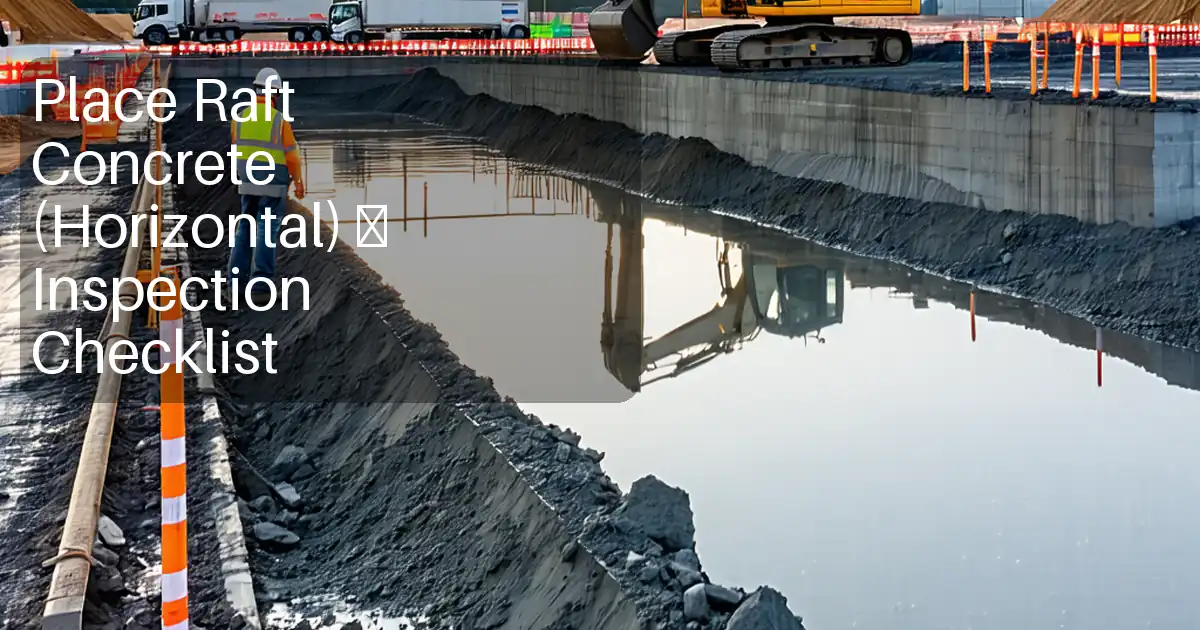
- Substrate cleaned, formwork tight, penetrations sealed, reinforcement fixed with correct cover blocks/spacers, embeds/inserts inspected and approved.
- Screed rails/benchmarks installed and surveyed; survey report available.
- Pump and pipeline routed, supported, secured; exclusion zones and outrigger bearing checks completed; end-hose safety leash fitted.
- Temperature control plan: sensor layout, elevations, calibration, logger setup, sampling interval (e.g., every 15 min), alarm thresholds, insulation quantity.
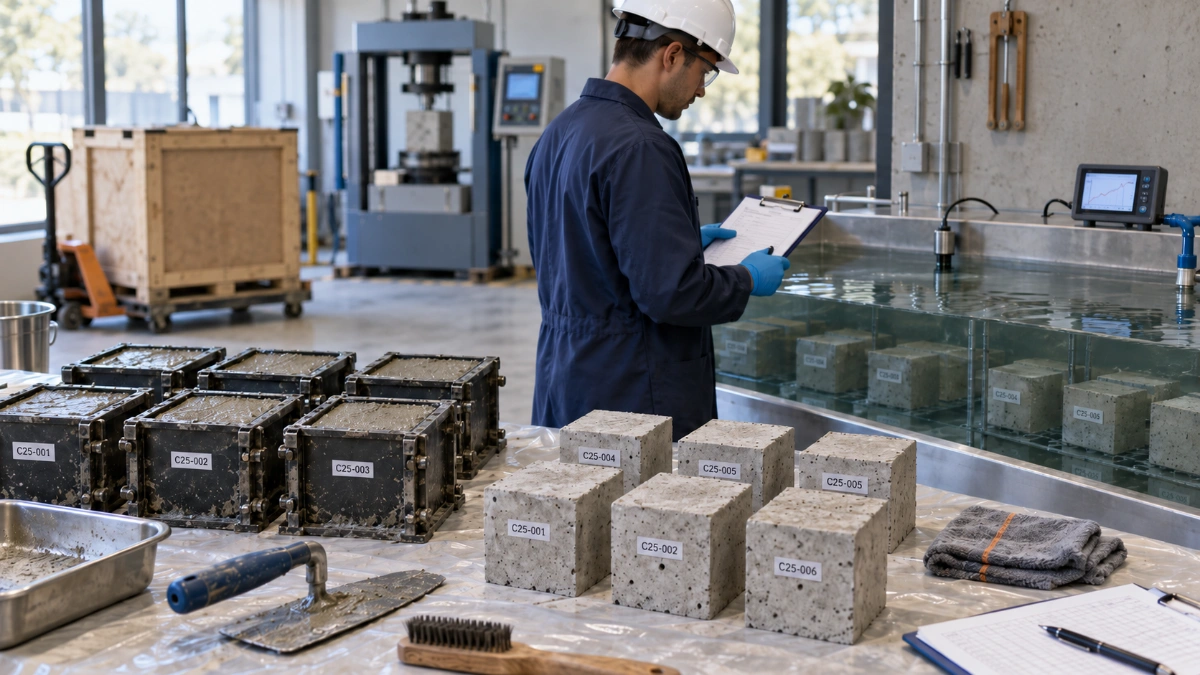
- Testing arrangements: field lab set up, third-party lab availability, molds, curing tanks, sample identification system.
- Curing materials on site (compound, blankets, sheets) sufficient for entire pour area.
- Hold Points agreed and listed in ITP; RFI/IR for pre-pour release signed.
Method Sequence
| Step | Activity | Description | Responsibility | Inspection / Hold Point |
|---|---|---|---|---|
| 1 | Pre-pour meeting and pour plan | Confirm pour sequence, start/stop points, layer thickness, estimated pour duration, target pour rate (e.g., 60–100 m³/h [Verify]), truck cycle time, contingency (standby pump/trucks). | Project Manager / Construction Manager | ITP review; attendance log |
| 2 | Base and reinforcement release (Hold Point) | Inspect blinding, cleanliness, free water removal, formwork tightness, reinforcement cover blocks/chairs, embeds/penetrations, screed rails, survey benchmarks. | QA/QC Engineer & Engineer/Client | Visual, cover checks, survey check |
| 3 | Pump and pipeline setup | Install boom/static pump; route DN125 pipeline with clamps and supports; fit end-hose safety leash; install blowout adapter; pressure test line before pouring. | Pump Operator / Site Engineer | Line support/spool inspection |
| 4 | Temperature sensors installation | Fix thermocouples/maturity sensors at top, mid-depth, and near bottom; at core and edge zones; protect leads in conduits; label and connect to data loggers; verify readings prior to pour. | Site Engineer / QA/QC / Supplier Rep | Function test; calibration certs |
| 5 | First truck approval (Hold Point) | Sample first load; test slump, temperature, air (if specified), density; make strength specimens. Confirm pump priming with cement grout (not water). | QA/QC Engineer | Field tests per ASTM/EN |
| 6 | Layered placement | Place concrete starting at farthest point; maintain continuous front. Lift thickness 300–400 mm per pass [Verify]. Avoid drop height >1.5 m. Limit interval between adjacent layers to prevent cold joints. | Concrete Foreman | Supervisor patrol |
| 7 | Internal vibration | Insert vibrators vertically; spacing at 1.0–1.5× radius of action (~300–450 mm for 38–50 mm heads); penetrate 50–100 mm into previous layer; hold 5–15 s until air ceases; avoid over-vibration and contact with rebar/form. | Concrete Foreman | Spot checks by QA/QC |
| 8 | Fresh concrete routine testing | Perform tests at specified frequency; additional tests if temperature or slump drifts. Cast specimens. | Lab Technician | Field testing |
| 9 | Surface finishing and level control | Strike off to level using screed rails/laser; bull-float to close; provide edge chamfers if specified; check finished elevation and flatness as required. | Site Engineer / Finishers | Level survey |
| 10 | Curing and thermal control | Within 30 minutes of finishing, apply curing compound uniformly; cover with poly sheeting and insulation as per thermal plan; protect edges; maintain curing ≥7 days or per spec; monitor internal and ambient temps at defined intervals (e.g., 15–30 min automatically, review 2×/day). | Site Engineer / QA/QC | Curing inspection; temperature review |
| 11 | Cold or hot weather adjustments | If ambient out of range, implement pre-agreed controls: adjust placing temperature via ice/chilled water; windbreaks/shading; night pouring; additional insulation; controlled removal of insulation not exceeding 1–2°C/hour surface cooling [Verify]. | Construction Manager / QA/QC | HSE and QA review |
| 12 | Specimen curing and strength testing | Cure field specimens in controlled environment; test at 7 and 28 days or per spec. Consider maturity correlation if approved. | Third-Party Lab | Lab accreditation check |
| 13 | Post-pour inspection | Inspect for surface defects, honeycombing, cracking; repair per approved method if required; verify as-built levels and embed locations. | QA/QC Engineer | Visual and hammer tap |
| 14 | Final acceptance (Hold Point) | Submit complete dossier: delivery tickets, field/lab tests, temperature logs, curing records, surveys, approvals, NCR closures. | Project Manager / QA/QC / Engineer | Document review & site walk |
Safety Controls
Task-Specific Hazards and Controls
1) Hazard: Pump outrigger/rig instability on soft ground
- Likely consequence: Overturning, crushing injuries
- Engineering/procedural control: Verify bearing capacity; use mats/cribbing; keep outriggers clear of voids/services; establish exclusion zones equal to boom reach.
- Required PPE: Helmet, hi-vis, safety boots, gloves
- Collective measures: Barriers and spotters; traffic management plan
- Inspection/permit/supervision: Pre-use inspection; permit-to-work near edges; supervisor sign-off [Verify per project HSE plan and local regulations]
2) Hazard: Hose whipping/blockage release
- Likely consequence: Struck-by injuries, loss of control
- Engineering/procedural control: Fit end-hose safety leash; secure line supports; restrict access under boom; clear blockages per manufacturer SOP with line depressurized.
- PPE: Helmet with chin strap, eye/face protection, gloves
- Collective measures: Exclusion zone at discharge; trained pump crew only
- Inspection/permit/supervision: Pump setup checklist; competent operator; toolbox talk on blockage response
3) Hazard: Concrete chemical burns and dermatitis
- Consequence: Skin/eye injuries
- Control: Provide wash stations; barrier cream; avoid direct contact; eyewash bottles at point of use
- PPE: Alkali-resistant gloves, long sleeves, goggles/face shield, rubber boots
- Collective: Safety data sheets available; first-aid trained person on shift
- Inspection/permit/supervision: MSDS briefing; HSE inspections
4) Hazard: Rebar impalement and trips on congested reinforcement
- Consequence: Puncture wounds, falls
- Control: Cap protruding rebar; maintain designated walkways and working platforms; housekeeping of pump lines and cables
- PPE: Helmet, gloves, anti-slip boots
- Collective: Temporary edge protection; rebar caps/mesh
- Inspection/permit/supervision: Daily prestart inspection; work-at-height permit if near edges
5) Hazard: Night operations and fatigue
- Consequence: Errors, accidents
- Control: Adequate lighting ≥150 lux on workface; task rotation; scheduled breaks; caffeine/water provision
- PPE: Hi-vis, headlamps where needed
- Collective: Light tower placement to avoid glare; noise-reduced units
- Inspection/permit/supervision: Night work permit; HSE night audits
6) Hazard: Manual handling of vibrators/hoses
- Consequence: Musculoskeletal injuries
- Control: Team lifts; sling supports for hoses; rotate tasks; limit vibrator runtime per operator
- PPE: Anti-vibration gloves, hearing protection
- Collective: Mechanical aids; ergonomic briefing
- Inspection/permit/supervision: Supervisor monitoring
7) Hazard: Electrical hazards from temporary power/lighting
- Consequence: Shock, fire
- Control: RCD-protected circuits; PAT testing; cables elevated above wet zones
- PPE: Dielectric gloves for electricians
- Collective: Lockout/tagout for maintenance
- Inspection/permit/supervision: Electrical permit; inspection by qualified electrician
8) Hazard: Heat/cold stress during extreme weather
- Consequence: Heatstroke/hypothermia
- Control: Shaded rest areas/heaters; hydration plan; acclimatization; thermal PPE
- PPE: Weather-appropriate clothing, sun protection
- Collective: Adjust work hours (night pour/hot weather); warm shelters (cold)
- Inspection/permit/supervision: Hot/cold weather plan approval
9) Hazard: Slips on wet concrete surfaces
- Consequence: Sprains/fractures
- Control: Non-slip mats/boardwalks; staged access; immediate spill cleanup
- PPE: Non-slip boots
- Collective: Barricade finished zones
- Inspection/permit/supervision: Supervisory checks
10) Hazard: Noise from pumps/vibrators
- Consequence: Hearing damage
- Control: Use compliant equipment; limit exposure time
- PPE: Ear protection (SNR per assessment)
- Collective: Noise mapping and signage
- Inspection/permit/supervision: Periodic noise monitoring
11) Hazard: Vehicle/pedestrian interface from mixer trucks
- Consequence: Collision
- Control: One-way flow; banksmen; speed limit 10 km/h
- PPE: Hi-vis
- Collective: Segregated walkways; barriers
- Inspection/permit/supervision: Traffic management plan audit
Note: All permits and controls to be verified per project HSE plan and local regulations.
Environmental Controls
- Concrete washout: Designated lined washout pit ≥110% capacity of expected washout volume; no discharge to surface water or drainage. Inspect daily.
- Spillage management: Drip trays under pumps; spill kits within 25 m; immediate cleanup; contaminated waste segregated.
- Noise and light spill: Position lighting to avoid residential glare; use low-noise generators; comply with allowable hours [Verify].
- Dust and mud on access roads: Wheel wash for exiting trucks; road sweeper standby; water bowsers as required (avoid runoff).
- Water management: Prevent groundwater infiltration into pour area; pump to sedimentation tank before discharge; sampling if required by permit.
- Curing compound and admixtures: Store in bunded area; prevent overspray beyond workface; use white-pigmented compound to reduce heat absorption where suitable.
- Waste: Segregate packaging, sample concrete, and cured waste; dispose per waste codes; recycle wooden formwork where possible.
- Carbon considerations: Optimize SCM content (e.g., fly ash/slag) per mix approvals; continuous pours to reduce rework; monitor idle time of equipment.
- Flora/fauna and heritage: Follow site environmental constraints and exclusion zones [Verify per project EMS].
QA/QC
Quality Controls
- Approvals: Mix designs, MS/ITP, thermal plan, sensor layout approved prior to pour.
- Calibrations: Pumps, pressure gauges, thermometers, air meters, slump cones, data loggers—valid certificates on file.
- Batching verification: Delivery tickets checked for time, mix code, slump target, admixture dosages; reject non-conforming loads per NCR process.
- Fresh concrete testing: Frequencies per spec (typ. each truck for slump/temp; 1 set of strength specimens per 50–75 m³ or per day per grade minimum) [Verify].
- Temperature monitoring: Automatic logging; daily review against target differential; corrective actions recorded.
- Consolidation checks: Supervisor and QA spot checks; rectify honeycombing immediately.
- Curing: Continuous curing ≥7 days or per spec; compound coverage per TDS; curing log maintained.
- Documentation: Pour log (times, location, layer depth), field test sheets, cube/cylinder results, temperature logs, survey reports, checklists, RFIs/IRs, NCR/CCR.
- Acceptance: 28-day strength ≥ design; internal-to-surface/ambient differential within limit (typ. ≤20°C) [Verify]; level and dimensional tolerances achieved; defects repaired per approved procedures.
- Change control: Deviations or stoppages managed via IR and agreed joint measures; resume only after Engineer approval.
Attachments
- Pour plan and sequence sketch
- Pump and pipeline layout drawing with exclusion zones
- Thermal control plan and temperature sensor layout
- Approved mix design certificates and materials submittals (cement, SCMs, admixtures)
- Batching plant calibration certificates and delivery ticket template
- Pre-pour checklist; Pump setup/pressure test checklist; Consolidation checklist; Curing log; Temperature data review form
- Risk assessment and permits (night work, hot/cold weather)
- MSDS/TDS for admixtures and curing compounds
- ITP with hold/witness points and test frequency matrix
- Concrete testing plan and sample identification register
- As-built survey of top-of-raft elevations
- NCR/CCR templates and close-out records
This content is a read-only public reference. Download or customize to get an editable version.
ITP preview
The first inspection activities from the linked ITP for Method Statement – Raft Foundation Mass Concrete Placement Works:
| Activity | Inspection / Test | Acceptance Criteria | Responsibility | Record |
|---|---|---|---|---|
| Pre-pour base and reinforcement inspection | Check cleanliness, dryness, reinforcement cover/tying, embeds, screed rails; survey benchmarks (H) | Clean/dry base; reinforcement secured; covers per drawings; embeds in position/tight; surveys accepted. | QA/QC Engineer; Engineer/Client | Pre-pour checklist; RFI/IR signed |
| Pump and pipeline setup/pressure test | Line supports, clamps, end-hose leash; pressure test to 1.25–1.50× working pressure (W) [Verify] | No leaks/pressure loss; exclusion zones established. | Pump Operator; QA/QC | Pump setup checklist; pressure test record |
| Temperature sensor installation and commissioning | Location/level check; baseline reading vs reference thermometer (W) | Operational sensors; layout per approved drawing; calibration certificates valid. | Site Engineer; QA/QC | Sensor commissioning sheet; layout markups |
Showing 3 of 12 inspection activities. View full ITP →
Related Inspection and Test Plan
An Inspection and Test Plan (ITP) is available for Method Statement – Raft Foundation Mass Concrete Placement Works. The ITP defines the inspection activities, acceptance criteria, hold and witness points, responsible parties, and records required to verify the work described in this method statement.
View the Method Statement – Raft Foundation Mass Concrete Placement Works ITP →Frequently asked questions
Continue with related Quollnet resources connected to this method statement.