
Method Statement: Mass Concrete Foundation Mat Pouring Works – Method Statement
AI-assisted method statement with matching ITP, PDF download, and Excel export.
More than a static template
Unlike a downloadable Word or PDF template, this method statement is an AI-assisted editable starting point connected directly to a matching Inspection and Test Plan. Every section is structured, project-adaptable, and ready to export.
- AI-assisted drafting — Customize every section with AI for your specific project scope.
- Linked ITP — A matching inspection and test plan is generated alongside the method statement.
- Multiple export formats — Download as a formatted PDF or editable Excel spreadsheet.
- Editable starting point, not a final document — Review, verify, and adjust all content against your project requirements before use.
Static template vs. Quollnet workflow
| Feature | Static template | Quollnet |
|---|---|---|
| Project-specific content | Manual fill-in required | AI-assisted customization |
| Linked ITP | Separate document, no link | Matching ITP included |
| Export formats | Usually PDF only | PDF and Excel |
| Structured sections | Free-form layout | 13 standardized sections |
| Saved to your account | Local file only | Cloud-saved, reusable |
| Content accuracy | You verify everything | AI-assisted, you still verify |
| Cost | Often free but time-intensive | Free to customize and download |
What you can customize
When you save this method statement to your account, every section becomes editable. The following 13 sections are included:
- Scope — Defines the activity and its boundaries.
- References — Standards, specifications, and drawings.
- Responsibilities — Roles and accountabilities.
- Resources — Labour, plant, and equipment summary.
- Materials — Materials and compliance requirements.
- Equipment — Tools and equipment details.
- Prerequisites — Hold points and pre-conditions.
- Method sequence — Step-by-step construction sequence.
- Safety controls — HSE risk controls and PPE.
- Environmental controls — Environmental mitigation measures.
- QA/QC — Quality inspection and test requirements.
- ITP — Inspection and Test Plan table (has its own page).
- Attachments — Referenced drawings and documentation.
Why this method statement is used
This method statement is used to define and communicate the approved procedure for carrying out method statement: mass concrete foundation mat pouring works on site. It ensures the work is planned in advance, the correct resources and controls are in place, and all personnel understand responsibilities, sequence, quality requirements, and safety controls before work begins. It aligns site execution with the documented scope and acceptance expectations.
Who uses this method statement
This method statement is used by contractors, site supervisors, project engineers, QA/QC engineers, HSE officers, consultants, and client representatives. It serves as a shared reference for planning, execution, supervision, inspection, and approval of the activity on site.
When it is prepared and submitted
The method statement is prepared before the work activity starts and submitted as part of the pre-construction documentation package for review and approval.
Who reviews or approves it
The method statement is usually submitted to the client representative, consultant, resident engineer, or project management consultant for review and approval before the work commences.
Important approval note
This method statement is an AI-assisted editable starting point, not a pre-approved document. Before use on any project, all content must be reviewed and approved by the relevant parties (superintendent, principal contractor, or client representative) in accordance with your contract and project quality plan.
For example: if your specification requires a departure from a referenced standard, that departure must be documented and approved separately — this method statement will not capture that automatically. Always verify against your applicable drawings, specifications, and regulatory requirements.
Method statement content
Scope
Work Included
- Planning, preparation, and execution of mass concrete foundation mat pour for a high-rise or industrial structure.
- Pour sequencing, set-out, formwork/edge shutters, blinding checks, reinforcement and embedded items coordination.
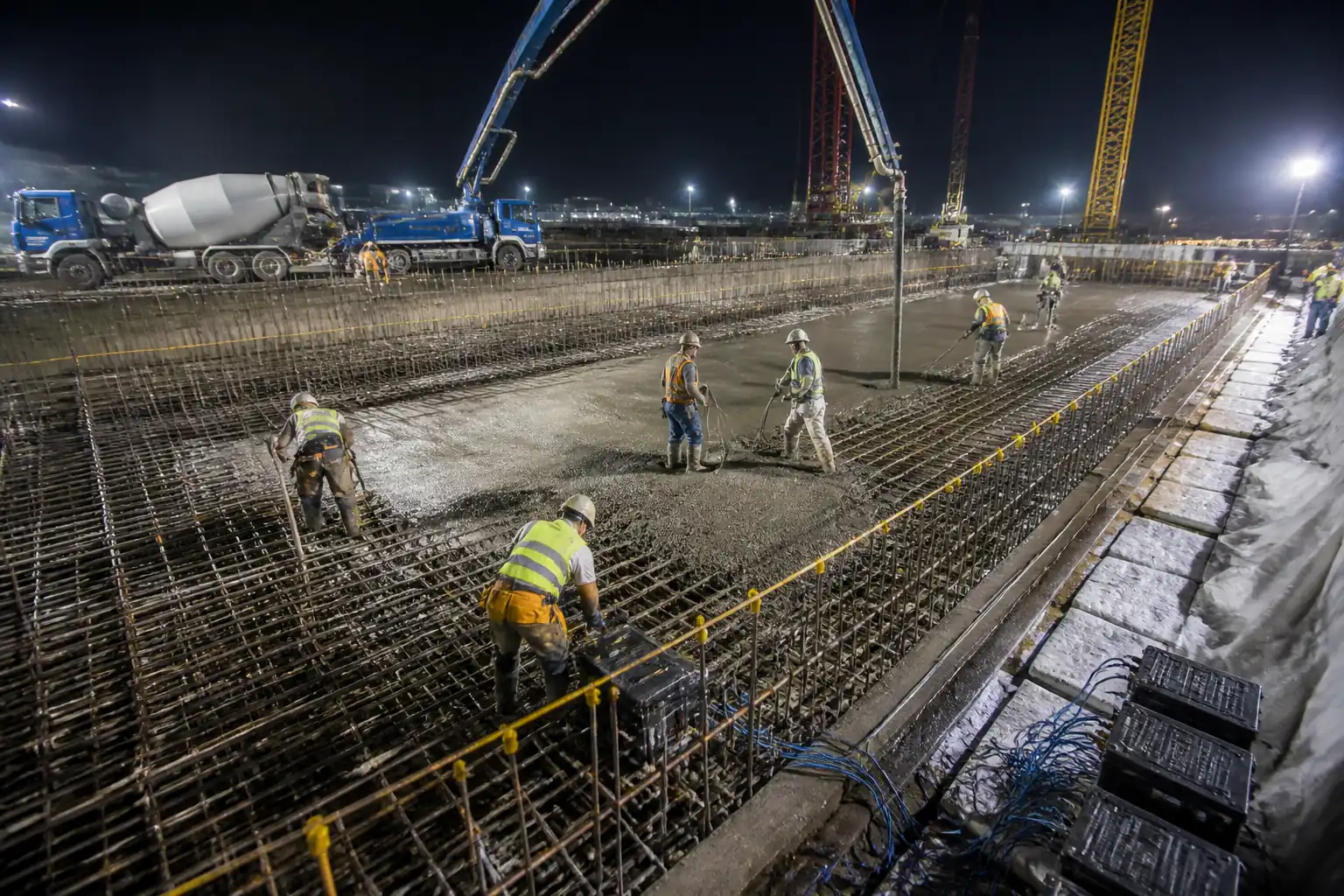
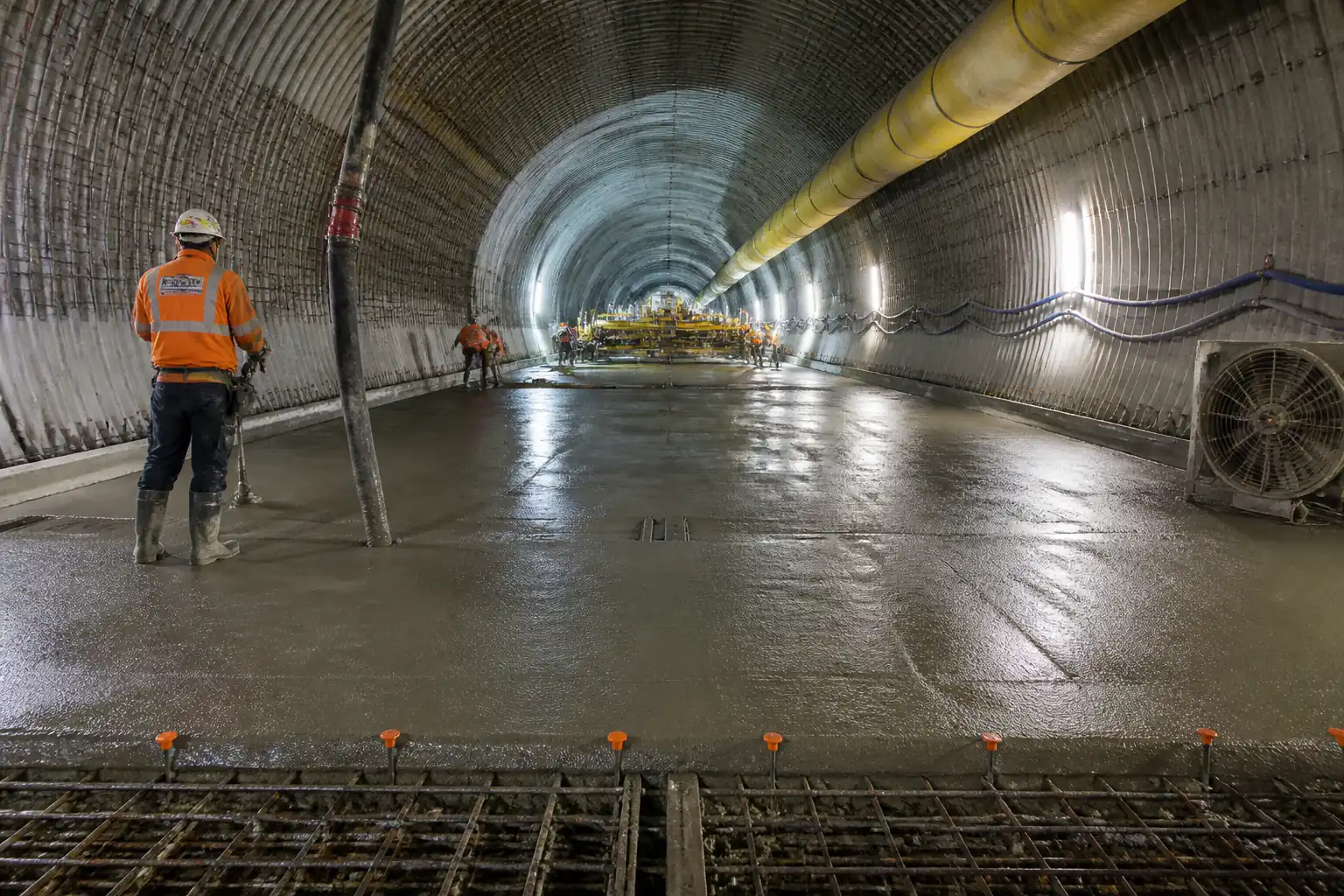
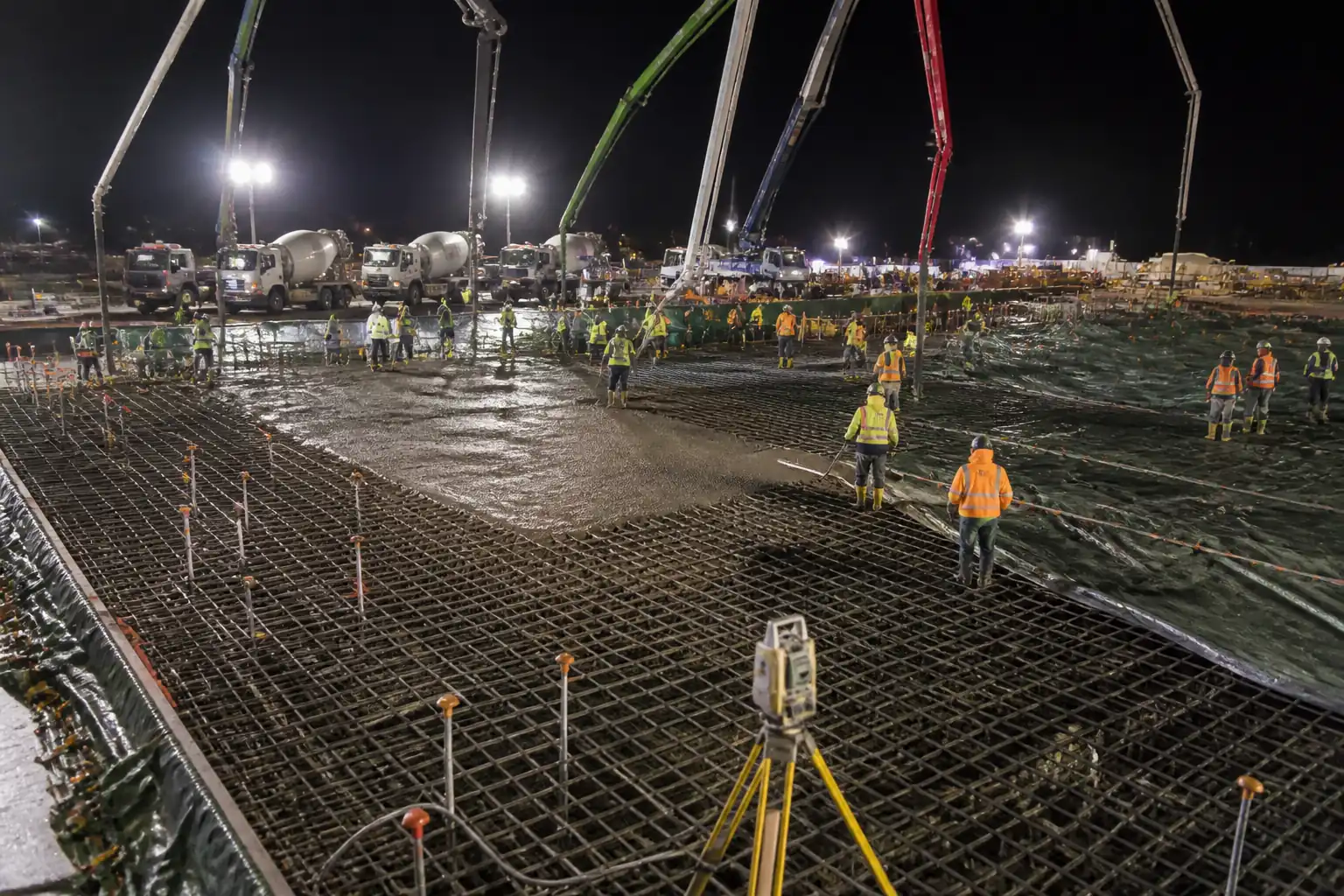
- Concrete production logistics, delivery, pump placement, placement sequence, vibration/compaction, finishing.
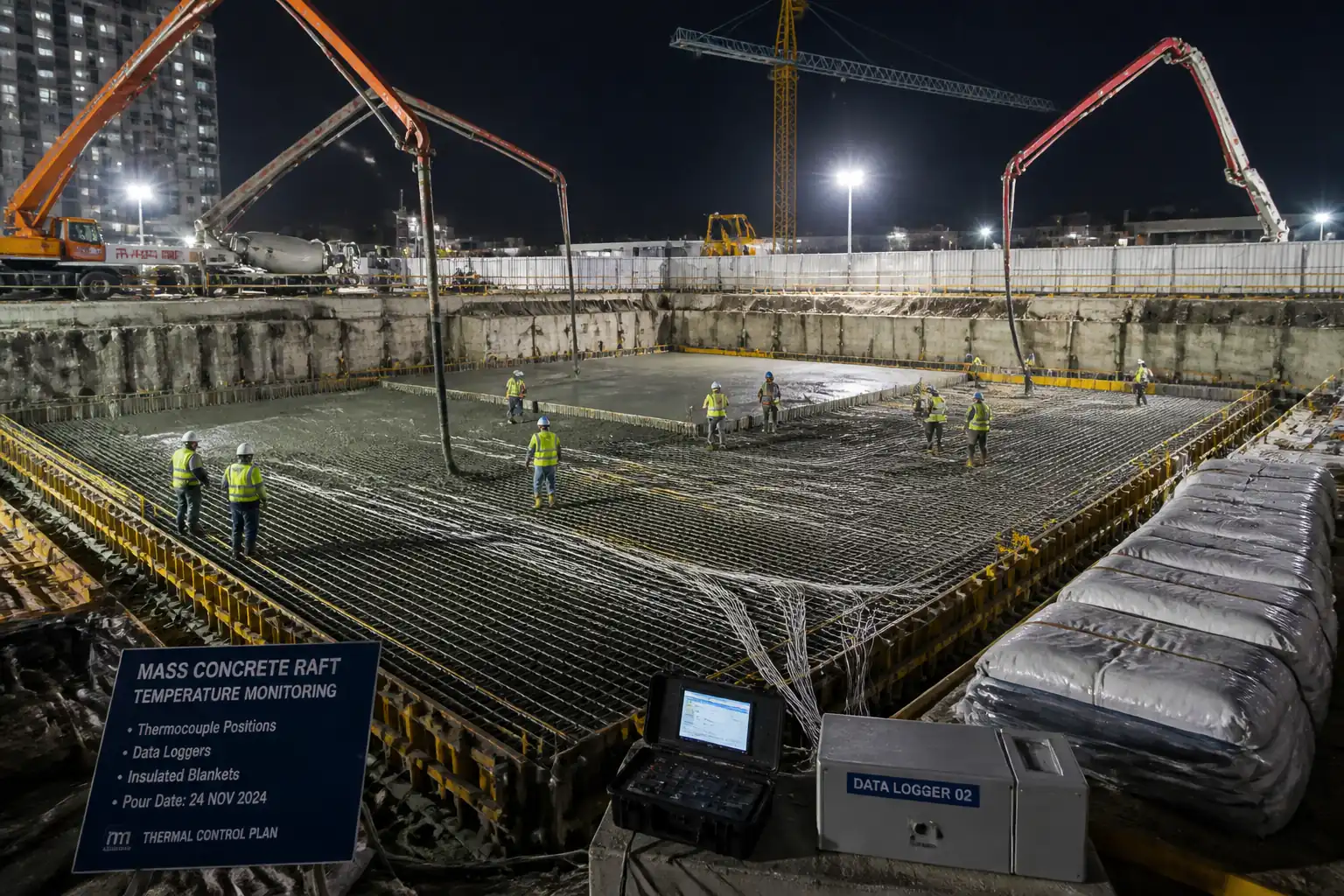
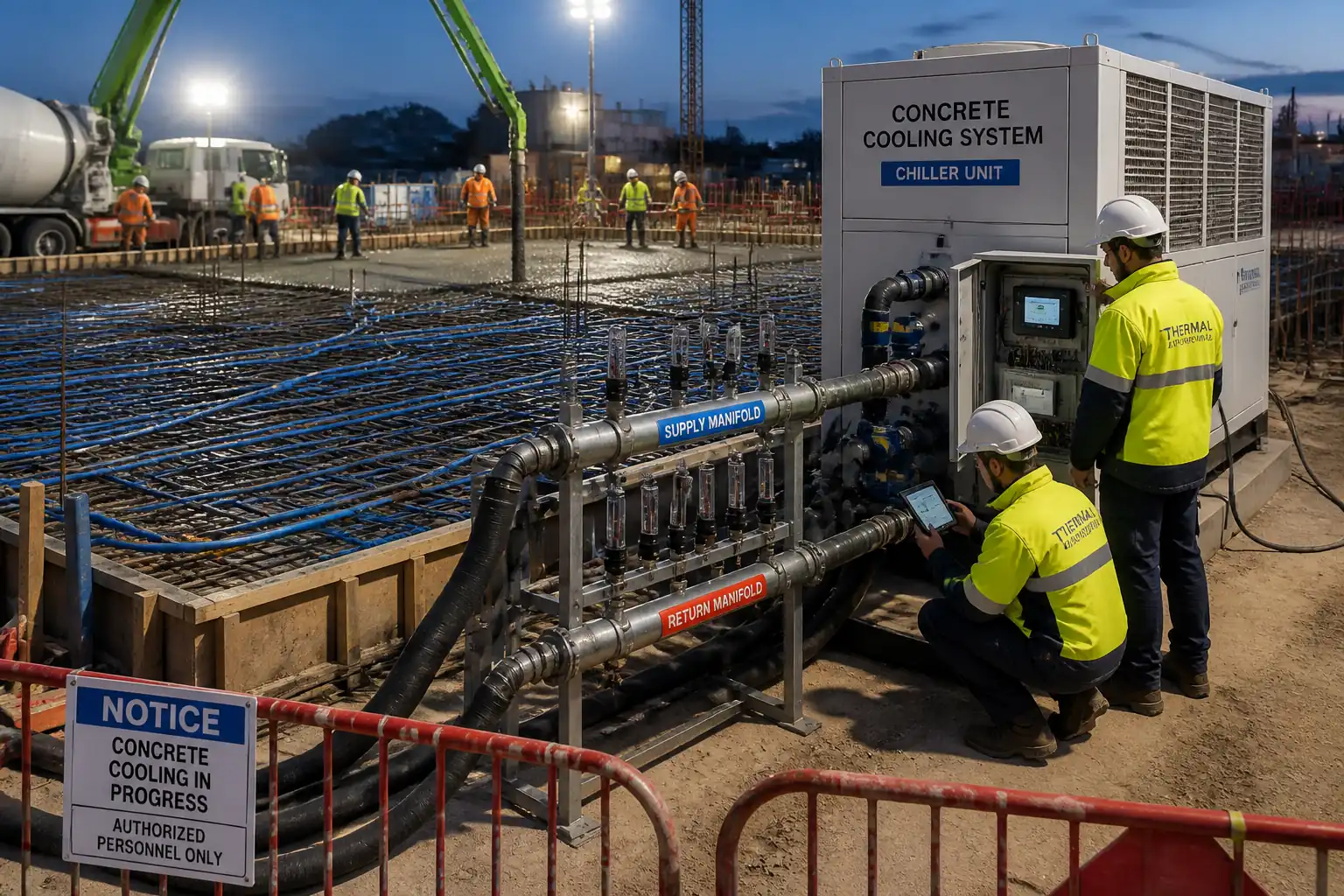
- Thermal control: pre-cooling options, placement temperature limits, insulation, cooling pipes (if specified), and monitoring.
- Curing and protection, including hot/cold weather measures.
- In-situ temperature monitoring, logging, and differential temperature control.
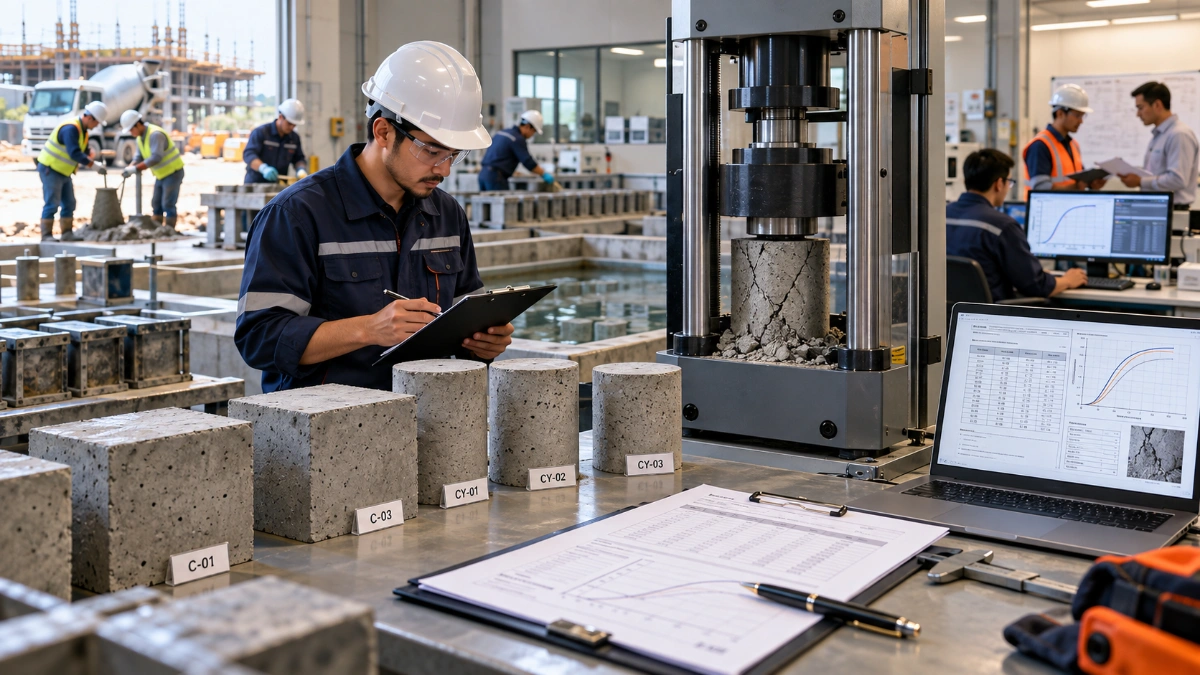
- QA/QC inspections, fresh concrete testing (slump, temperature, air, density), sampling for compressive strength, and recordkeeping.
- ITP with hold/witness points, NCR management, and close-out documentation.
Exclusions
- Permanent dewatering systems and ground improvement works unless noted.
- Structural design changes, rebar detailing revisions beyond coordination.
Key Assumptions
- Approved mix design suitable for mass concrete with supplementary cementitious materials (e.g., fly ash/slag) to reduce heat of hydration [Verify per project specifications].
- Thermal control plan approved prior to pour.
- Continuous pour feasible within plant/trucking/pumping capacities.
- All values not provided herein are typical industry benchmarks and must be verified per project specifications.
References
| Document Type | Reference / Number | Revision | Notes |
|---|---|---|---|
| Standard | ACI 207 Series | Thermal limits, cooling strategies, monitoring guidance. | |
| Standard | ACI 301 | Delivery time, temperature limits, curing, testing frequencies [Verify per project specifications]. | |
| Standard | ACI 304 | Placement and pumping best practices. | |
| Standard | ACI 305/306 | Temperature control during placement and curing. | |
| Standard | ASTM C94 | Batching, delivery, discharge time, mixing revolutions. | |
| Standard | ASTM suite | Testing and acceptance procedures. | |
| Standard | BS EN 206 | If project follows Eurocode/UK specs [Verify]. | |
| Standard | ISO | Management system framework for QA/QC and HSE. |
Responsibilities
| Role | Responsibility | Name / Party |
|---|---|---|
| Project Manager | Authorize method, allocate resources, lead coordination with Client/Engineer | Contractor |
| Construction Manager | Sequencing, shift planning, logistics, supervision | Contractor |
| QA/QC Engineer | ITP implementation, hold/witness coordination, test management, records | Contractor |
| Site Engineer | Setting out, verification of levels/tolerances, embeds coordination | Contractor |
| HSE Manager | Risk assessments, permits, monitoring, toolbox talks, incident response | Contractor |
| Supplier QC | Ensure mix compliance, delivery scheduling, truck certifications, tickets | Supplier |
| Laboratory | Sampling, testing, and reporting as per ITP | Independent |
| Engineer/Consultant | Review/approve method, ITP, thermal plan; witness hold points | Client/Engineer |
Resources
| Resource Type | Description | Quantity | Remarks |
|---|---|---|---|
| Manpower | Operators, hosemen, signalers | 6–12 persons/shift [Verify] | |
| Manpower | Adjust/secure rebar and embeds during pour | 8–16 persons/shift [Verify] | |
| Manpower | Set out and as-built checks | 2–3 surveyors + 2 assistants/shift [Verify] | |
| Manpower | Sampling and tests | 4–8/shift [Verify] | |
| Manpower | Traffic and exclusion zones | 2–4/shift [Verify] |
Materials
| Material | Specification / Grade | Quantity | Remarks |
|---|---|---|---|
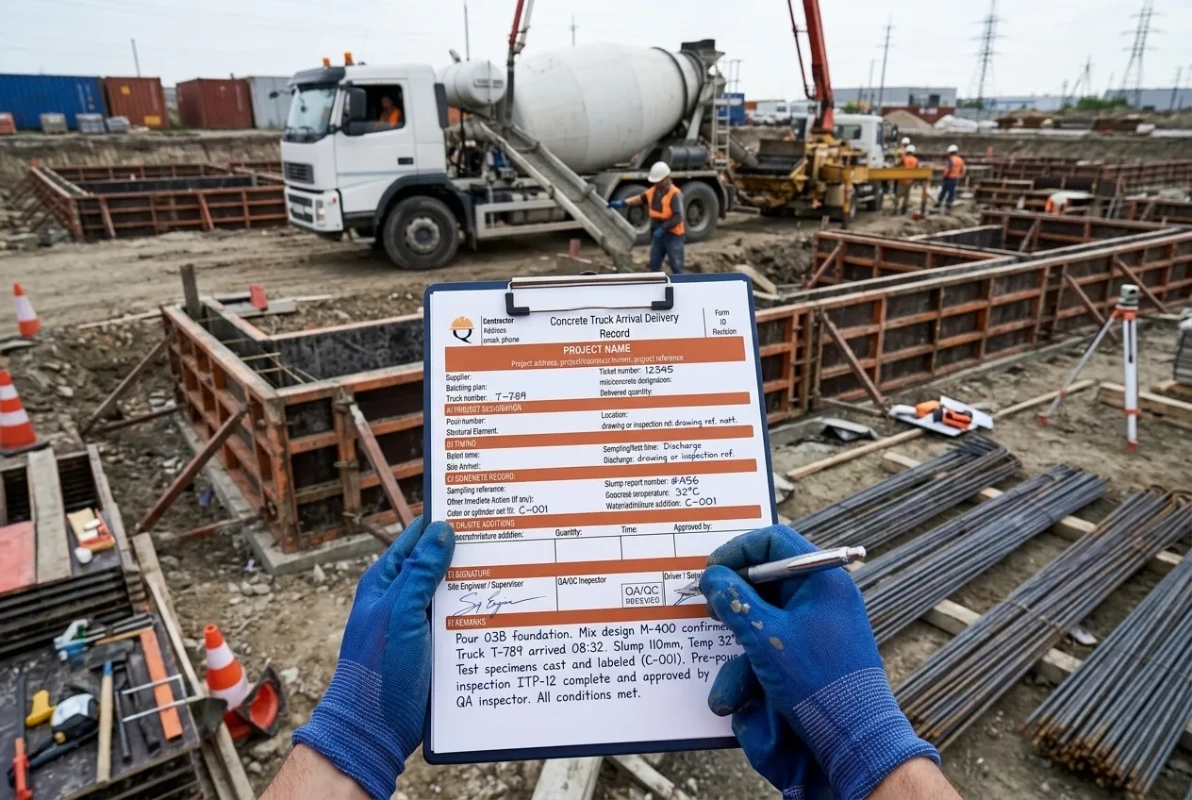
| Ready-mix concrete | Per approved mix design; ACI 301, ASTM C94 | ||
| Rebar & embedded items | ASTM A615/A706 or BS; waterstop PVC/TPV | ||
| Curing/Insulation materials | Per ACI 301 and Thermal Plan | ||
| Cooling pipes & fittings | Per thermal control design [Verify] |
Equipment
| Equipment | Capacity / Type | Quantity | Inspection Required |
|---|---|---|---|
| Transit mixers | 8–10 m³ each | As per rate [Verify] | Pre-pour checks; calibration certs [Verify] |
| Concrete pumps | 60–120 m³/h per pump [Verify] | 2–3 operating + 1 standby [Verify] | Daily inspection; pressure test per manufacturer |
| Poker vibrators | 1 per pump + 2 standby [Verify] | Pre-use functional check | |
| Screeds & finishing tools | As required | Pre-use check | |
| Sensors & loggers | Per monitoring plan | Calibration records | |
| Lighting towers | As required | Pre-use inspection, PAT [Verify] |
Prerequisites
- Approved IFC drawings, method statement, ITP, Thermal Control Plan, and concrete mix design.
- Pre-pour coordination meeting (Contractor/Engineer/Supplier/Testing/HSE) completed with minutes and action close-out.
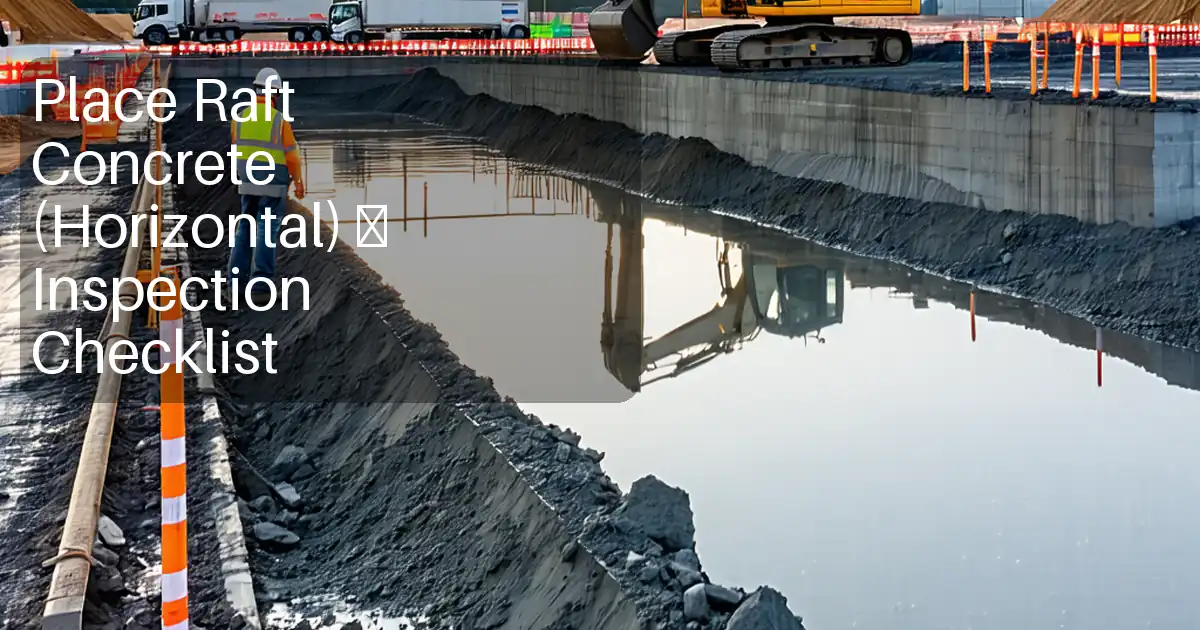
- Survey control established; blinding checked for level, cleanliness, and strength; edge forms/shutters installed and braced.
- Rebar and embedded items fixed, tagged, and inspected; templates/jigs for anchor bolts; MEP sleeves and conduits cleared; waterstops spliced/secured.
- Lift plan and traffic management plan approved; pump and boom locations set out; exclusion zones marked.
- Batch plant and fleet audit complete; trial pour (if required) accepted; delivery route confirmed; staging/queuing plan approved.
- Cooling system (if specified) installed, pressure tested, and signed off.
- Thermocouples/data loggers installed and pre-commissioned; monitoring points labeled and recorded on layout.
- Weather forecast checked; hot/cold weather measures prepared; curing/insulation materials staged.
- Permits: hot work (if any), night work, noise variance, concrete pour permit, confined space (if any) [Verify per project HSE plan and local regulations].
- Emergency response plan and spill kits in place; washout area prepared and lined.
Method Sequence
| Step | Activity | Description | Responsibility | Inspection / Hold Point |
|---|---|---|---|---|
| SEQ-01 | Pre-Pour Inspection (Hold Point) | Joint inspection of substrate, forms, rebar, embeds, waterstops, cleanliness, access/egress, lighting, permits. | QA/QC Engineer + Engineer/Consultant | ITP HP-1 Pre-pour |
| SEQ-02 | Verification of Thermal Controls | Confirm placement temperature limit, insulation readiness, sensors live, cooling pipes (if any) pressure tested. | QA/QC + Thermal Specialist | ITP W-1 Witness |
| SEQ-3 | Concrete Delivery Control | Check tickets for mix ID, batching time, truck revolutions, admixtures; stage trucks per TMP; continuous pour maintained. | Supplier QC + Contractor QC | On-receipt check |
| SEQ-04 | Fresh Concrete Testing | Perform slump, temp, air (if specified), density; make cylinders per frequency. | Independent Lab + Contractor QC | ITP N-1 Normal |
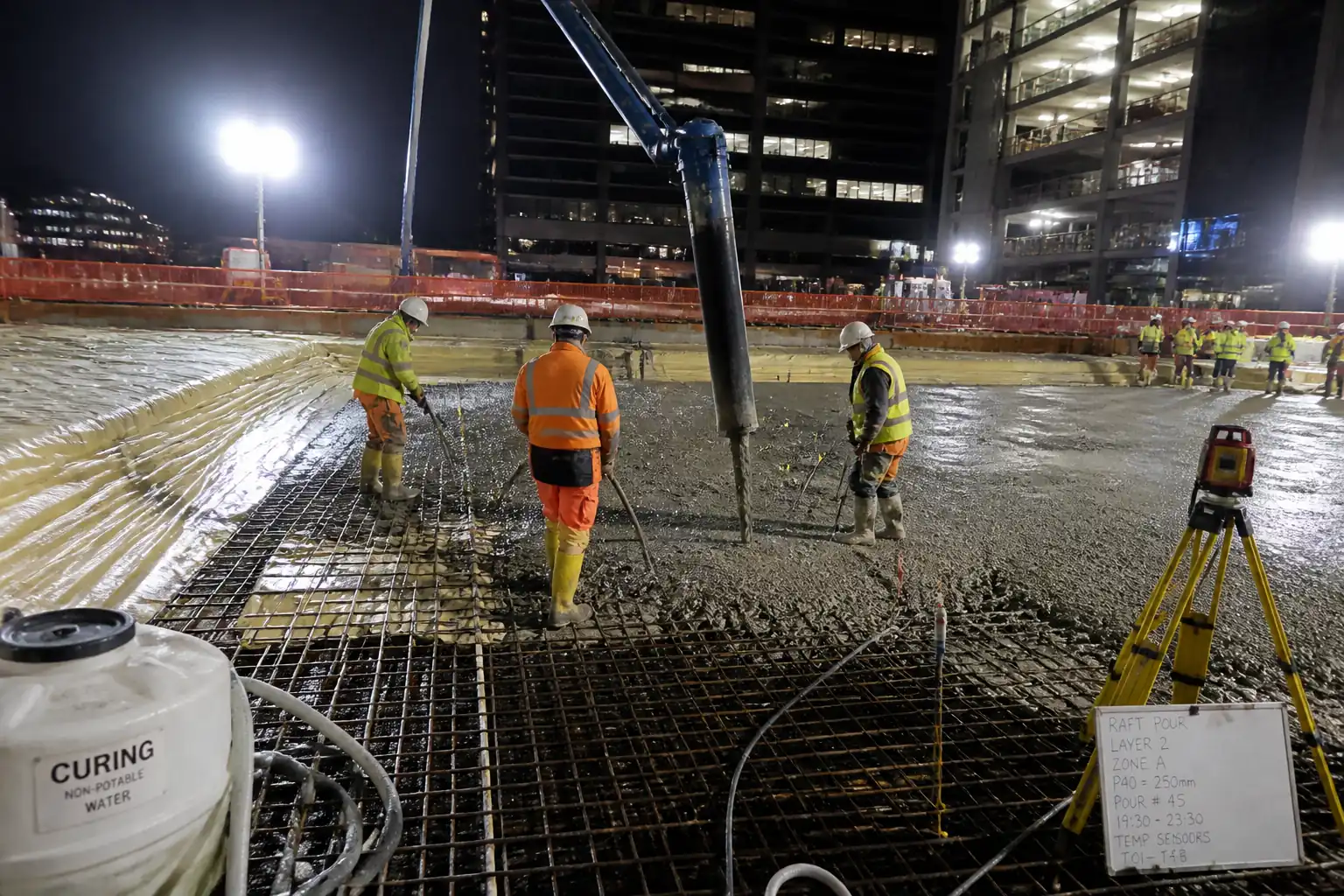
| SEQ-05 | Placement Sequencing | Place in planned strips/blocks from far extremities toward access, maintain head; lift thickness 300–500 mm; avoid cold joints. | Construction Manager + Pump Operators | Continuous supervision |
| SEQ-06 | Vibration/Compaction | Insert vibrators vertically, 300–500 mm spacing; penetrate 50–100 mm into previous layer; 5–15 s per insertion; avoid contact with rebar/waterstops/embeds. | Foreman + Trained Vibrator Operators | Spot checks |
| SEQ-07 | Embedded Items Control | Survey and re-check anchors/plates/sleeves during placement using jigs; protect threads; maintain tolerance. | Site Engineer + Embed Team | ITP W-2 Witness |
| SEQ-08 | Finishing & Screeding | Screed to design level with guide rails; bull float; provide specified surface texture (e.g., light broom) or roughened for toppings. | Finishing Crew | Surface checks |
| SEQ-09 | Curing & Insulation | Begin immediately after finishing; apply curing compound or wet burlap + plastic; install insulation blankets per thermal plan; maintain moisture. | Construction Manager + QC | ITP N-2 |
| SEQ-10 | Thermal Monitoring | Log temperatures at top/mid/bottom/edge at 1 h intervals first 24–48 h, then ≤ 4 h until peak and cool-down; adjust insulation/cooling as needed. | Thermal Specialist + QC | ITP W-3 Witness (spot) |
| SEQ-11 | Joint Preparation (if construction joint) | When resuming pour, expose green surface, remove laitance by light hydro-demolition or mechanical scabbling; clean and pre-wet; apply bonding grout if specified. | Site Engineer + Crew | ITP N-3 |
| SEQ-12 | Post-Pour Inspection (Hold Point) | Remove loose formwork; inspect for defects, honeycombing; check as-built levels; verify curing ongoing; confirm thermal gradients within limits. | QA/QC + Engineer/Consultant | ITP HP-2 |
Health, Safety, and Environment - Safety Controls
Task-Specific Hazards and Controls
1) Hazard: Concrete pump hose whipping or line blockage
- Consequence: Impact injuries, loss of control, concrete blowout
- Engineering/Procedural Control: Secure hose with safety sling; maintain line pressure within manufacturer limits; use priming grout; stop/start only on signal; purge lines away from personnel
- Required PPE: Hard hat, eye protection/face shield, cut-resistant gloves, rubber boots
- Collective Measure: Exclusion zone 3 m around hose end; barriers and spotters
- Inspection/Permit/Supervision: Daily pump inspection; competent pump operator; lifting/hoisting permit if boom over public/roads [Verify per project HSE plan and local regulations]
2) Hazard: Working near open excavation/mat edges
- Consequence: Falls to lower level, crush injuries
- Engineering/Procedural Control: Edge protection with guardrails or toe boards; designated walkways; lighting ≥ 200 lux for night pours [Verify]
- PPE: Fall protection where required, hi-vis clothing, safety boots
- Collective Measure: Physical barriers and signage; banksman for vehicle movements
- Inspection/Permit/Supervision: Daily edge protection inspection; permit-to-work for night operations
3) Hazard: Rebar impalement and trip hazards
- Consequence: Puncture wounds, falls
- Engineering/Procedural Control: Rebar caps on protrusions; keep walkways clear; use vibration platforms/bridges
- PPE: Long sleeves, gloves, knee protection
- Collective Measure: Temporary decking over congested rebar zones
- Inspection/Permit/Supervision: Pre-pour inspection checklist to include rebar capping
4) Hazard: Heat stress/hot weather concreting
- Consequence: Heat exhaustion/heat stroke
- Engineering/Procedural Control: Night pour where feasible; shaded rest areas; work/rest regimen; chilled fluids; monitor WBGT
- PPE: Cooling towels, breathable PPE
- Collective Measure: Hydration stations; canopy tents
- Inspection/Permit/Supervision: HSE monitoring WBGT; record rest breaks [Verify]
5) Hazard: Cold weather exposure/thermal burns from hot water/steam (if using heated materials)
- Consequence: Hypothermia, burns
- Engineering/Procedural Control: Heated shelters; insulated lines; slow controlled heating; follow ACI 306R
- PPE: Thermal gloves, cold-weather gear
- Collective Measure: Windbreaks; insulated blankets staged
- Inspection/Permit/Supervision: Temperature log; supervisor sign-off prior to pour
6) Hazard: Vehicle–pedestrian interface (trucks, pumps, telehandlers)
- Consequence: Struck-by, run-over
- Engineering/Procedural Control: Traffic Management Plan; one-way flow; reversing alarms; spotters; marshal-controlled gates
- PPE: Hi-vis class 3, steel-toe boots
- Collective Measure: Barriers; segregated walkways; lighting
- Inspection/Permit/Supervision: Daily TMP checklist; licensed drivers only
7) Hazard: Manual handling/awkward postures
- Consequence: Musculoskeletal injuries
- Engineering/Procedural Control: Use mechanical aids (vibrator suspenders, hose supports); team lifts; rotate tasks
- PPE: Gloves, back support if prescribed
- Collective Measure: Pre-task briefings; stretch-and-flex
- Inspection/Permit/Supervision: Supervisor verification
8) Hazard: Chemical exposure (wet concrete)
- Consequence: Skin irritation/alkaline burns
- Engineering/Procedural Control: Avoid skin contact; washing stations; pH-neutralizing wipes available
- PPE: Alkali-resistant gloves, long sleeves, eye protection, rubber boots
- Collective Measure: Safety data sheets on site; training
- Inspection/Permit/Supervision: HSE spot checks; first-aid provisions
9) Hazard: Noise and vibration
- Consequence: Hearing loss, hand–arm vibration syndrome
- Engineering/Procedural Control: Select low-vibration tools; limit trigger time; maintain equipment
- PPE: Hearing protection (SNR per noise survey), anti-vibration gloves
- Collective Measure: Noise barriers where practicable
- Inspection/Permit/Supervision: Noise monitoring records
10) Hazard: Electrical hazards from temporary power/lighting
- Consequence: Shock, electrocution
- Engineering/Procedural Control: RCD/GFCI protection; IP-rated cables; keep connections elevated/dry
- PPE: Dielectric gloves for electricians; general PPE for others
- Collective Measure: Cable management; lockout/tagout for maintenance
- Inspection/Permit/Supervision: PAT and weekly inspections; electrical permit as required
[Controls to be validated against project HSE plan and local regulations].
Environmental Controls
- Concrete Washout Management: Use lined, bunded washout pit ≥ 110% of expected volume; no discharge to storm drains; pump out to licensed facility. Inspect daily.
- Noise and Light: Schedule night pours within permitted hours; directional lighting away from residences; comply with noise limits [Verify].
- Dust and Air: Cover aggregate stockpiles at batch plant; restrict idling; maintain vehicles; use wheel wash at site exits.
- Water Management: Prevent runoff from curing water; collect and dispose per permit; protect watercourses with silt fences/berms.
- Materials and Waste: Segregate waste; store admixtures in bunded areas; spill kits at pumps and fuel points; immediate cleanup of leaks.
- Energy/Carbon: Optimize truck cycles; avoid unnecessary standby of pumps; consider SCMs to reduce cement content [Verify per specifications].
- Ecology: Keep works within demarcated footprint; no night-time high mast lighting near sensitive habitats unless approved.
- Reporting: Log any spills, exceedances, or complaints; implement corrective actions and report to the Engineer within 24 h [Verify per project EMS].
Quality Assurance and Quality Control
Testing and Inspection Frequencies
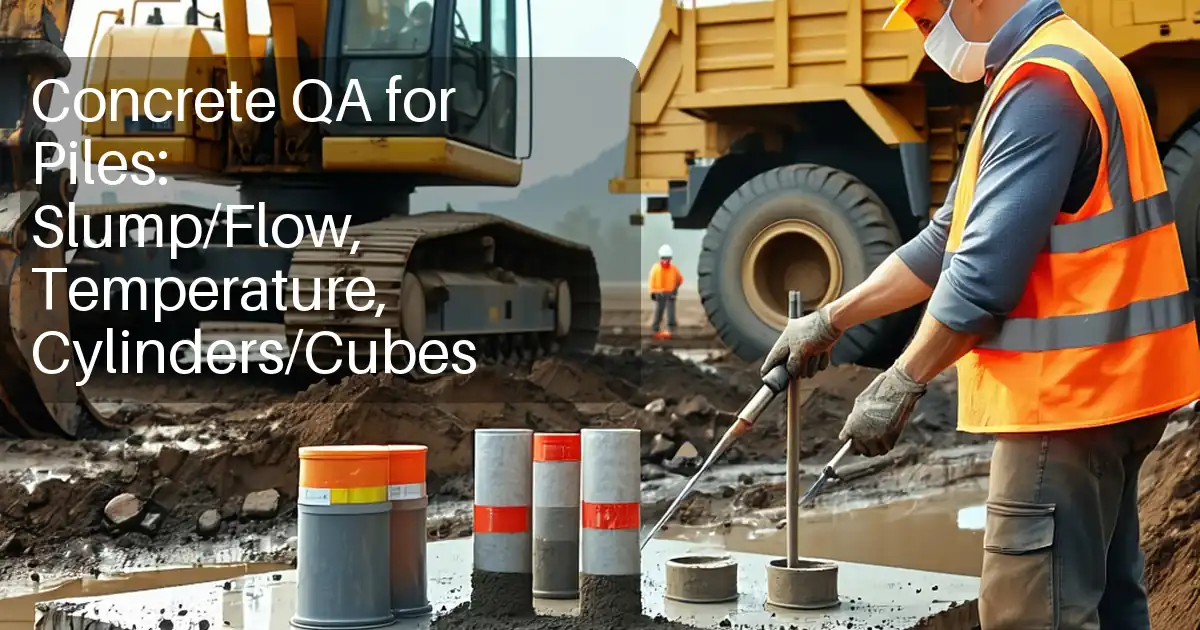
- Slump (ASTM C143) and Temperature (ASTM C1064): Each truck on arrival for first 10 trucks, then at least every truck or every ≤ 50 m³, whichever is more frequent [Verify per project specifications].
- Air Content (ASTM C231/C173): If air-entrained, each truck initially, then at least every 100 m³ [Verify].
- Density/Yield (ASTM C138): At least once per 100 m³ [Verify].
- Sampling/Cylinders (ASTM C31; Testing ASTM C39): One set (≥ 2 specimens) per 100 m³ per strength class and per pour day minimum one set [Verify]. Test ages: 7 and 28 days (and 56 days if SCMs high) [Verify].
Acceptance Criteria
- Fresh Properties: Within approved mix tolerances (slump, temp ≤ 28–30°C at discharge/placement [Verify], air content per mix design).
- Strength: Acceptance per ACI 318/BS EN 206 or project spec [Verify]. Typical ACI: Average of any three consecutive tests ≥ f'c; no individual test < f'c − 3.5 MPa (500 psi) [Verify].
- Thermal: Core–surface ΔT ≤ 20°C; cooling rate ≤ 1°C/h; peak ≤ modelled limit to avoid delayed ettringite or cracking [Verify].
- Surface: Level tolerance ±10 mm over 3 m and within specified datum [Verify].
Records and Documentation
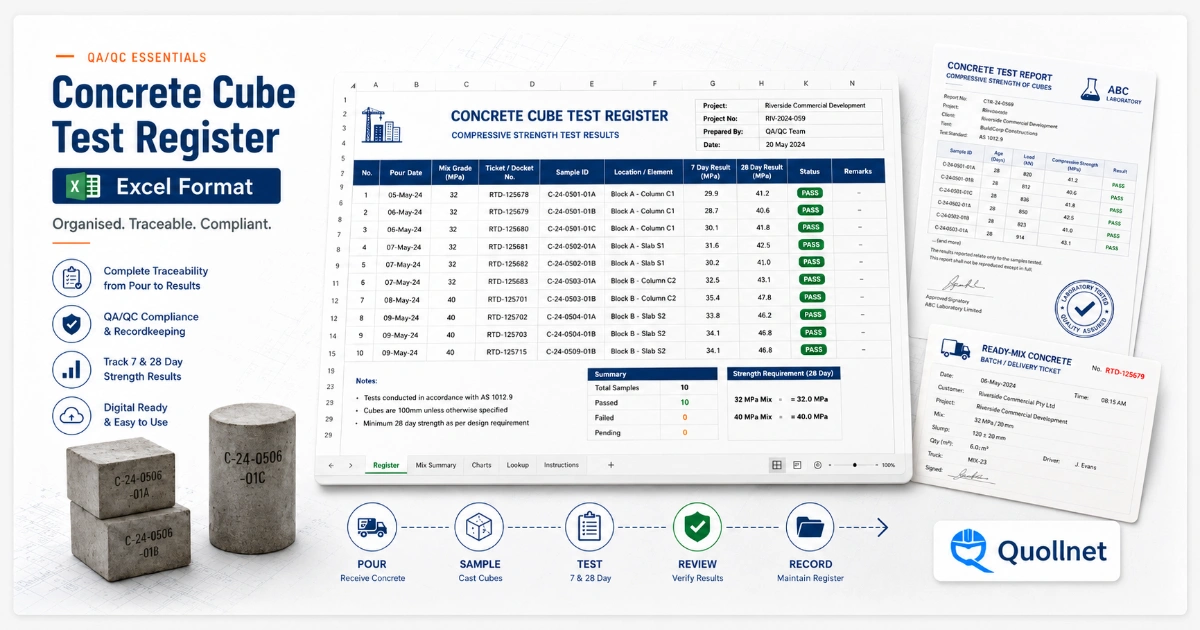
- Concrete delivery tickets, test reports, temperature logs, curing logs, pour sequence maps, ITP checklists, nonconformance reports (NCRs), corrective actions, as-built survey.
Nonconformance and Corrective Action
- If test fails or ΔT limits are exceeded: Notify Engineer; implement mitigation (increase insulation/cooling; controlled cooling; surface rework). Root cause analysis and NCR closure prior to next pour segment.
Calibration and Competency
- All testing equipment calibrated within 6–12 months [Verify]; technicians certified as per applicable standards.
Hold/Witness Points Summary
- HP-1: Pre-pour readiness
- W-1: Thermal system readiness
- W-2: Embedded items survey during pour
- HP-2: Post-pour inspection and thermal compliance
Attachments
- Pour sequence drawings and block layout with access routes
- Thermal Control Plan and thermal model output (allowable ΔT, peak temps, insulation strategy)
- Temperature Monitoring Plan with sensor map and IDs
- ITP and checklists; Pre-pour checklist; Post-pour checklist
- Approved concrete mix design(s), trial mix reports, and supplier certifications
- Logistics Plan: pump/truck layout, traffic management plan, night work plan
- Cooling system diagrams and pressure test certificates (if applicable)
- HSE documents: risk assessment, method statement sign-off, permits, toolbox talk records
- Material data sheets: admixtures, curing compounds, insulation blankets
- As-built survey plan and records; photographic records
This content is a read-only public reference. Download or customize to get an editable version.
ITP preview
The first inspection activities from the linked ITP for Method Statement: Mass Concrete Foundation Mat Pouring Works:
| Activity | Inspection / Test | Acceptance Criteria | Responsibility | Record |
|---|---|---|---|---|
| Pre-pour substrate/forms/rebar/embeds inspection (HP-1) | Checklist; visual; cover gauge; survey | Clean, dry (no standing water); rebar cover and spacing per drawings; embeds fixed within tolerance; forms stable | Contractor QC + Engineer | Signed pre-pour checklist; photos; survey log |
| Thermal control readiness (W-1) | Sensor calibration/ID; cooling pipe pressure test (if any) | Sensors functional and labeled; baseline temps recorded; no leaks at test pressure duration [Verify] | Contractor QC + Thermal Specialist + Engineer | Thermal readiness record; pressure test certificate |
| Concrete delivery verification | Ticket review per ASTM C94 (time, revolutions, admixtures) | Mix ID correct; discharge within time/rotation limits; no unauthorized water addition | Contractor QC + Supplier QC | Ticket stamp/log |
Showing 3 of 10 inspection activities. View full ITP →
Related Inspection and Test Plan
An Inspection and Test Plan (ITP) is available for Method Statement: Mass Concrete Foundation Mat Pouring Works. The ITP defines the inspection activities, acceptance criteria, hold and witness points, responsible parties, and records required to verify the work described in this method statement.
View the Method Statement: Mass Concrete Foundation Mat Pouring Works ITP →Frequently asked questions
Continue with related Quollnet resources connected to this method statement.