G
Guest

Concrete Cube Test Register Excel Format – PDF & Excel Sample

Download a concrete inspection and test register Excel and PDF sample / template - generated by QMix Logbook. Use the free tool to create your own concrete QA/QC log and save the project file on your own drive.

Concrete Cube Test Register Excel Format – PDF & Excel Sample
English version

Concrete Cube Test Register Excel Format – PDF & Excel Sample

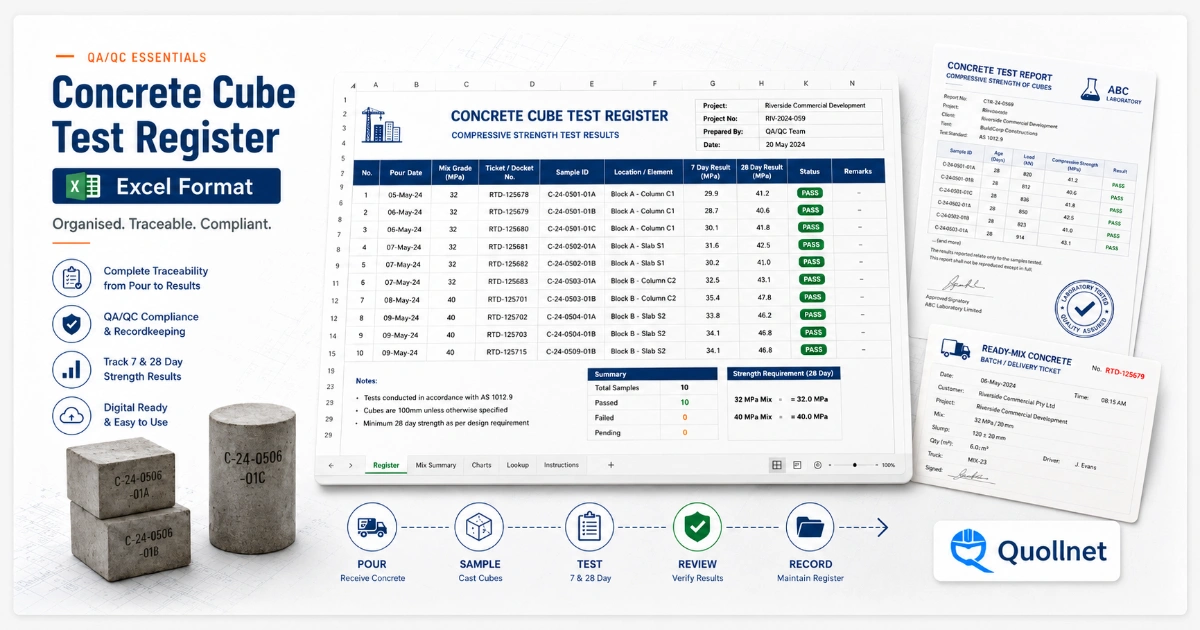
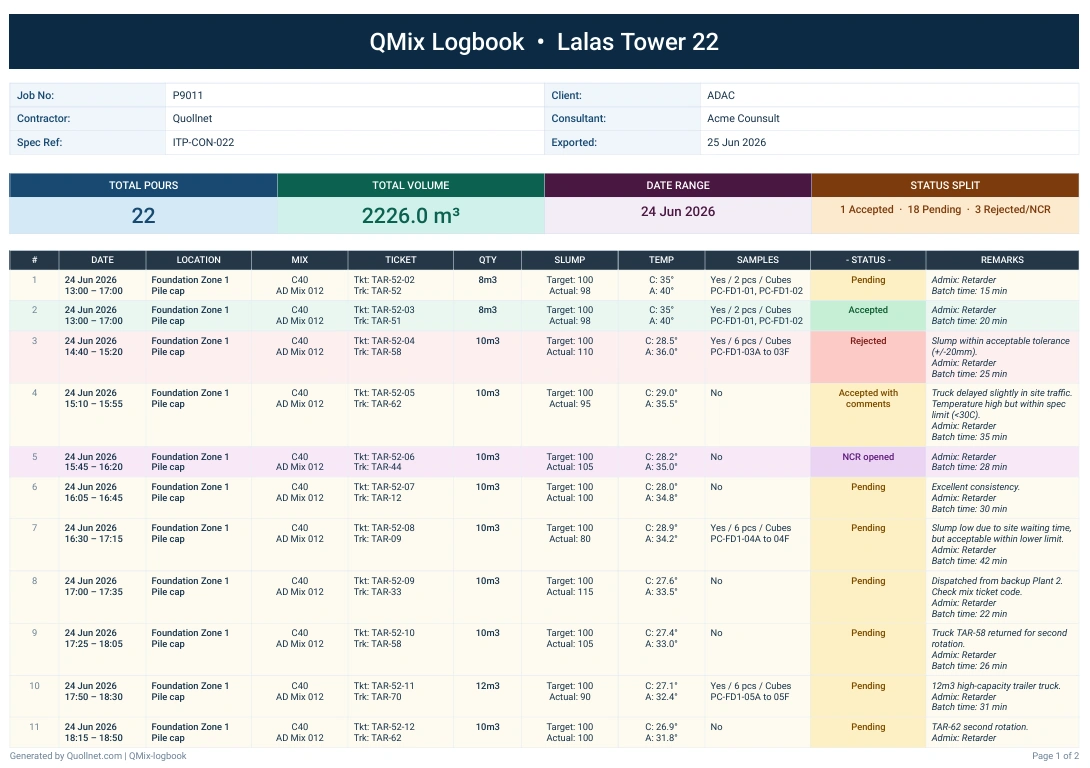
Download a sample concrete cube test register in Excel and PDF format. This log was generated using QMix Logbook, a free browser-based concrete QA/QC log tool for recording ready-mix concrete pours, batch tickets, samples, and test results.

The sample can be used as a reference format for project QA/QC records, concrete testing follow-up, and ready-mix concrete documentation.
Download sample files

This is generate by QMix logbook
concrete crushing test log sample


What this concrete test register includes

The sample log includes the main fields normally needed to follow up concrete pours and crushing test results in a clear project register:

  • Project name, job number, client, consultant, contractor, and specification reference
  • Pour date and time
  • Location or structural element
  • Concrete grade or mix code
  • Batch ticket and truck number
  • Concrete quantity
  • Slump and concrete temperature
  • Sample information and sample IDs
  • 7-day and 28-day test result follow-up
  • Acceptance status and QA/QC remarks

Generated by QMix Logbook

This Excel and PDF sample was generated by QMix Logbook. Instead of starting from a blank spreadsheet, you can use the tool to create your own concrete QA/QC log, add pour records, and export updated reports when needed.

Your project file stays with you. QMix Logbook lets you save the log as a project file on your own drive, reload it later, continue adding pour records, and export Excel or PDF reports without storing the project log in the cloud.

Create your own concrete QA/QC log

Use QMix Logbook to record concrete pours, sample references, test result follow-up, and acceptance status for your project.

Open Free QMix Logbook Tool

When to use this format

Use this concrete cube test register format when you need a simple record for ready-mix concrete pours, sample tracking, and concrete strength test follow-up. It is suitable as a sample QA/QC log format for contractors, consultants, site engineers, and quality engineers.

For a more detailed explanation of slump, sample records, 7-day strength, 28-day strength, and why concrete logs matter, see the related ready-mix concrete QA/QC guide when available.

Related tools and resources


Elie Saad's photo
Elie Saad
Jun 27, 2026
1
4
767
918

Related Checklists


Concrete Batch Ticket & Mix Verification – QA/QC Inspection
✅ 26 items
Concrete Batch Ticket & Mix Verification ensures the delivered ready-mix matches the approved mix design before placement. This QA/QC concrete inspection focuses on batch ticket review, mix proportions, yield, and water–cement ratio confirmation, along with onsite adjustments and traceability. You will verify ticket fields, batching tolerances, admixture dosages, aggregate moisture corrections, and time stamps, then validate field parameters like temperature and slump per approved project specifications and authority requirements. By catching discrepancies early—such as excess water, incorrect admixture, or a mismatched mix ID—you prevent strength loss, durability issues, and repair costs while maintaining a defensible audit trail. The checklist keeps scope tight: verifying batch tickets, mix compliance, and any onsite additions. It does not cover structural design, finishing, or curing beyond recording required values. Use this interactive tool to tick steps, add comments for exceptions, attach photos, and export signed records to PDF/Excel with a secure QR code.
How to Perform a Concrete Slump Test: ASTM / EN Checklist
✅ 22 items
How to perform concrete slump test is the focus of this practical, field-ready checklist for site engineers and technicians. It walks you through slump testing, slump measurement, and shape classification using the test standard required by the project specification, ITP or approved procedure, while keeping ASTM C143/C143M and BS EN 12350-2 requirements clearly identified. The procedure begins after a representative sample has been taken; for that prerequisite, use the linked Fresh Concrete Sampling Checklist. Here you will set the apparatus, place the cone correctly, fill in the required layers, rod each layer, strike off, lift the cone in the specified time, measure the slump, identify true/shear/collapse shape, and record results. Staying within scope, we do not decide acceptance, adjust trucks, or make cubes/cylinders. Following this sequence avoids unstable cones, uneven compaction, delayed measurements, and unverifiable records—leading to reproducible, defensible results. Use interactive mode to tick items, add comments with photos or short videos, and export as PDF/Excel secured by a QR code.
Fresh Concrete Sampling Checklist for QA/QC on Site
✅ 26 items
Fresh Concrete Sampling Checklist ensures field teams obtain, handle, and identify a representative fresh-concrete sample before testing. This practical guide focuses on concrete sampling operations only—choosing a suitable sampling point, collecting a spot or composite fresh concrete sample, and safeguarding it for immediate testing. It emphasises clean equipment, prevention of contamination or segregation, correct timing during discharge, and clear identification so the representative sample links back to the truck/load and forward to slump, temperature, and cube/cylinder records. It does not cover performing the slump test, temperature measurement, casting/curing specimens, acceptance decisions, or placement/finishing. By following project specifications and the applicable sampling standard, site engineers, QA/QC inspectors, and technicians avoid biased results, rework, and disputes, delivering traceable, defensible outcomes on site. Use this interactive checklist to tick items, add comments, attach photos, and export PDF/Excel reports secured by QR for quick verification.
Verify Secant Pile Wall Concrete Classes | QA Checklist
✅ 23 items
Verify secant pile wall concrete classes is a focused quality-assurance checklist for confirming hard/soft pile assignments, strength classes, and overlap continuity in secant piling works. It supports site engineers and QA/QC teams verifying primary (soft) and secondary (hard) piles, concrete class compliance, and the continuity of the interlock between overlapping piles. The scope covers documentation, delivery ticket control, fresh concrete checks, sequencing, bite depth into primary piles, volume reconciliation, and compressive strength testing—while avoiding mix design re-engineering and structural design changes. By following these steps, teams reduce risks such as misassigned concrete classes, inadequate bite, loss of groundwater control, and nonconforming compressive strength that jeopardizes wall performance. Acceptance cues include verified design revisions, ticket-to-pile mapping, measured concrete properties, recorded cut-in depths, continuous pour logs, and test results tied to pile IDs. Use this interactive checklist to tick off tasks, add comments with photos, and export your evidence as PDF/Excel with a QR-secured audit trail.
Substructure Handover Dossier Checklist: QA/QC & Approvals
✅ 29 items
Substructure handover dossier is the definitive closeout package for foundations, piles, pile caps, rafts, basement slabs, and retaining structures. It consolidates quality records, inspection and test plans (ITPs), as-built documentation, laboratory test reports, warranties, and approvals while explicitly excluding O&M manuals. Within this focused scope, you’ll assemble material certificates, mix design approvals, concrete strength results in MPa, waterproofing test evidence, survey as-builts in metres, and closeout of NCRs/CARs. The objective is a complete, traceable record proving the substructure is built per approved project specifications and authority requirements. Done well, the dossier prevents delayed practical completion, rework, and claims arising from undocumented variances or missing tests. It also accelerates payments and sets a reliable baseline for superstructure works. Use this interactive, commentable checklist to guide collection, verification, and sign-off; then export your dossier index and evidence register to PDF/Excel with a secured QR link for authentication.

Related Articles


Itp Inspection Test Plan Construction
⏳ 7 min read
Inspection & Test Plan (itp) In Construction — Complete Guide, Templates & Legal Essentials
Learn how to write an ITP (Inspection & Test Plan) for construction—templates, hold/witness points, acceptance criteria, ISO 9001 alignment, and FIDIC legal implications.
High Low Concrete Slump Result
⏳ 6 min read
High Or Low Concrete Slump: Retest, Hold, Adjust Or Reject?
What to do when concrete slump is high or low: confirm test validity, compare with project requirements, hold, retest, adjust only if authorized, and record disposition.
Ncr Log Template E46
⏳ 2 min read
Ncr Log Template (register & Ncr Tracker) – Excel/pdf Download
Download an NCR log template (NCR register) to track non-conformance reports by ID, date, status, location, references, actions, and closure. Includes an empty template and a filled example in Excel and PDF.
Concrete Slump Test Report Template
⏳ 8 min read
Concrete Slump Test Report Template
Download a concrete slump test report template in Excel and PDF for recording truck and mix traceability, specified and measured slump, retests, samples and final disposition.
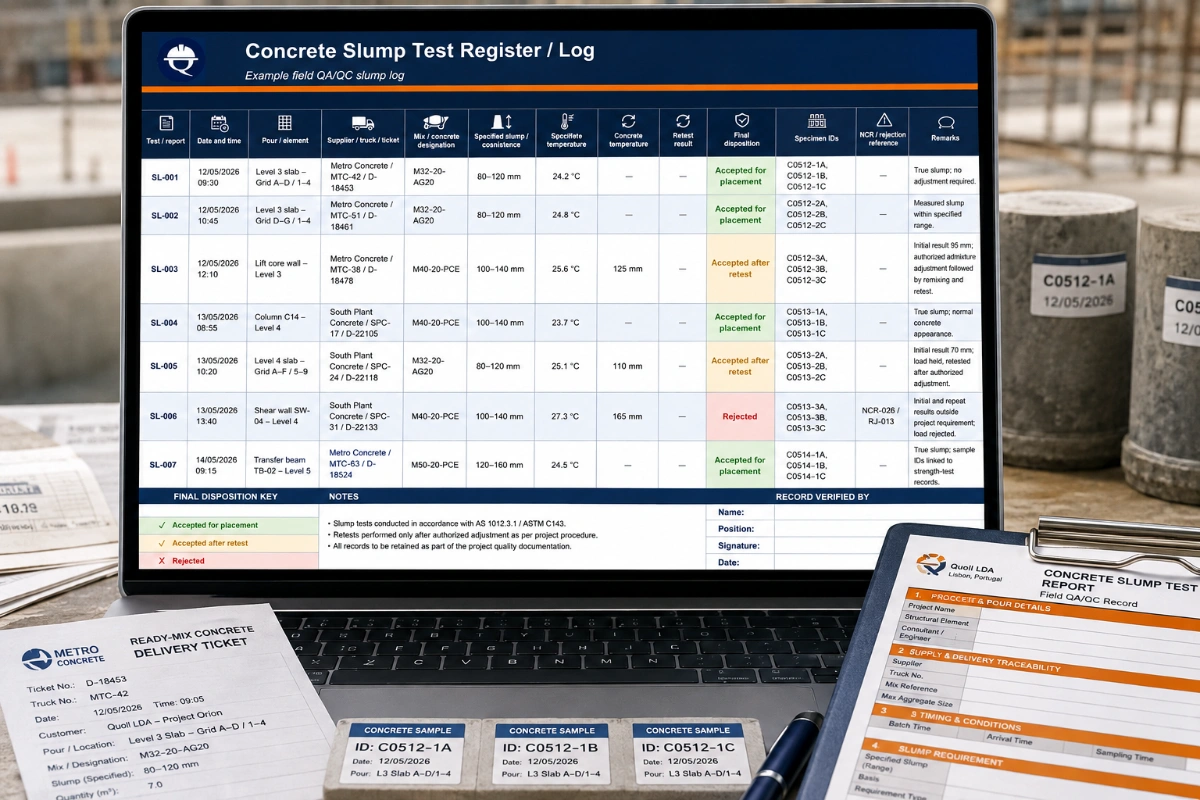
Concrete Slump Test Register Template
⏳ 8 min read
Concrete Slump Register & Log Template
Download a concrete slump register and log template for tracking multiple slump tests, truck and mix details, results, retests, samples, disposition and NCR references.