Download a Concrete Truck Arrival & Delivery Record in Excel & PDF
A concrete delivery record is the site QA/QC record that connects each ready-mix truck and delivery ticket to the concrete placement, fresh-concrete tests, cube or cylinder specimens, inspection records and final load disposition. It should preserve traceability without replacing the supplier ticket, slump report, specimen register or ITP record.
Concrete Delivery Record Downloads
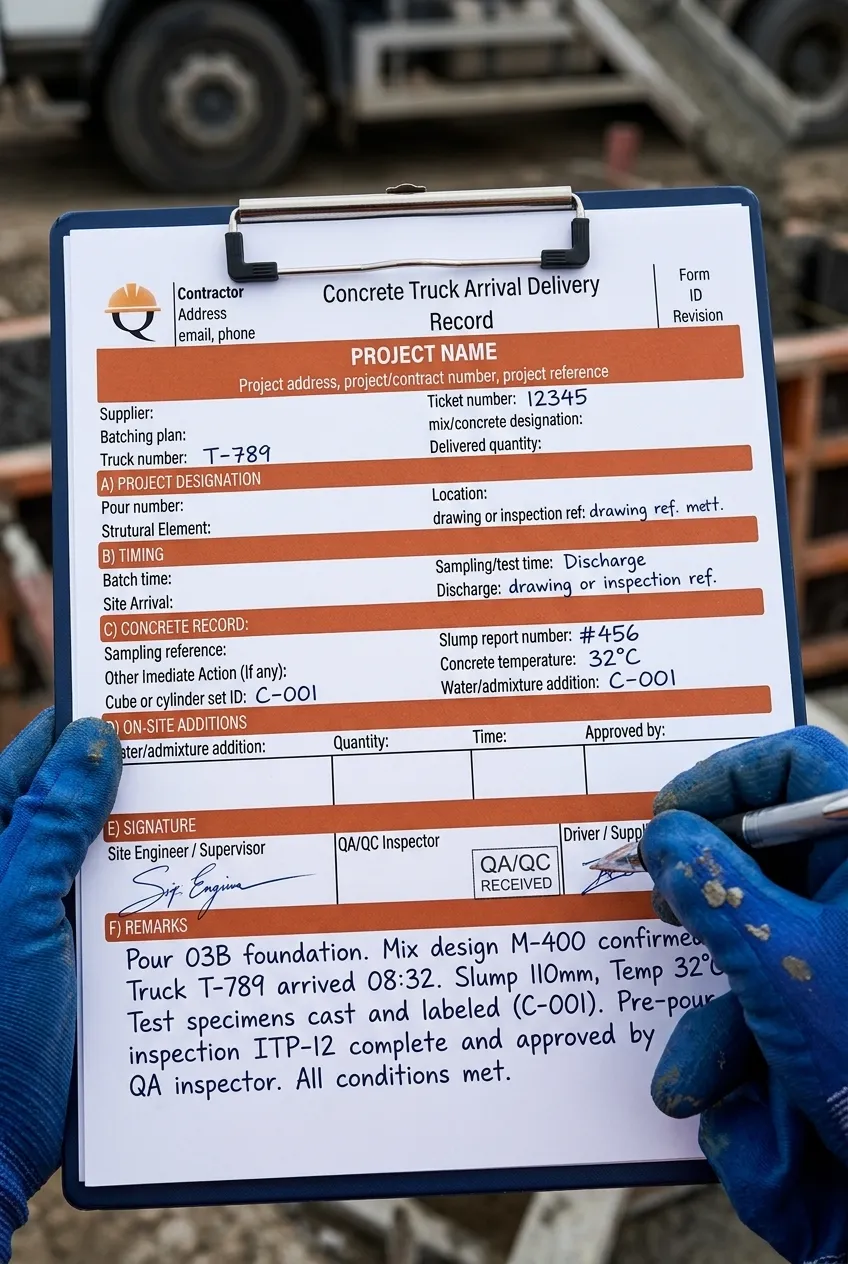
Use the blank record for live site deliveries, and refer to the completed form preview below when adapting the record to your project QA/QC system.
Download the Concrete Truck Arrival & Delivery Record in Excel
Download the Concrete Truck Arrival & Delivery Record in PDF
Set project-specific timing, testing, hold and acceptance requirements from the approved specification, mix, ITP and applicable procedures before use.
What is a concrete delivery record?
A concrete delivery record is a project field record for one ready-mix delivery or load. It starts with the truck and batch ticket, then carries the references needed to follow that concrete through sampling, slump and temperature testing, strength specimens, inspection and final disposition.
Its value is not that it duplicates every other form. Its value is that it creates the link between them.
For example, a reviewer should be able to start with one truck record and retrieve the related delivery ticket, Concrete Slump Test Report, cube or cylinder set, ITP inspection reference and any NCR or rejection record raised for that load.
Concrete delivery record vs delivery ticket
The supplier's delivery ticket and the project delivery record are not the same document.
| Record | Main purpose |
|---|---|
| Ready-mix delivery ticket | Supplier/batch record identifying the delivered concrete and production information. |
| Concrete delivery record | Project-side control record linking that delivery to its destination, tests, specimens, inspections, additions and disposition. |
The ticket remains a source document. The delivery record should capture its key identifiers and reference or attach the ticket rather than trying to reproduce every batching field.
What should a concrete truck arrival and delivery record include?
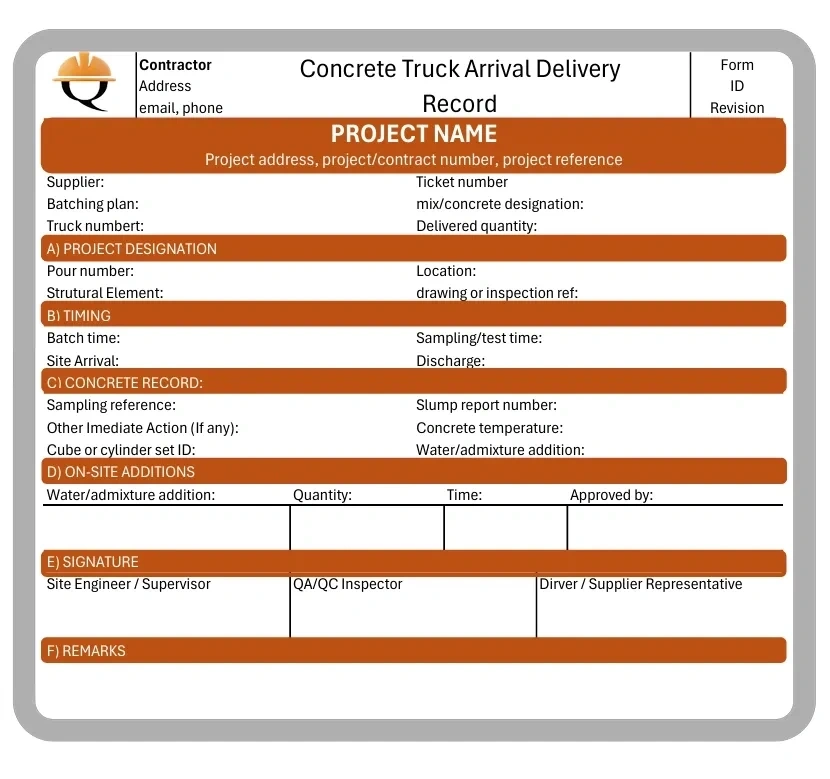
A practical record can be arranged around five groups: delivery identification, project destination, arrival controls, linked testing and final disposition.
| Field group | Typical fields |
|---|---|
| Delivery identification | Supplier, batching plant, truck number, ticket number, mix/concrete designation and delivered quantity. |
| Project destination | Pour number, structural element, location, drawing or inspection reference. |
| Timing | Batch time, site arrival, sampling/test time and start/end of discharge where required by the project. |
| Fresh-concrete records | Sampling reference, slump report number, concrete temperature reference and other project-required field tests. |
| Strength specimens | Cube or cylinder set IDs linked to the load or representative sample. |
| On-site additions | Water/admixture addition, quantity, time and authorization where permitted and separately controlled. |
| Inspection / ITP | Inspection request, ITP activity, witness/hold reference or release record as applicable. |
| Disposition | Released for placement, held, retested, returned or rejected, plus NCR/rejection reference where applicable. |
Start with the truck and batch ticket
The first job of the record is to prevent loss of identity. Record the truck and ticket reference before the delivery becomes mixed into the wider pour documentation.
Quollnet's Concrete Batch Ticket & Mix Verification QA/QC checklist can be used for the detailed verification step. The delivery record should capture the identifiers and outcome needed for later retrieval rather than repeat the whole inspection checklist.
Link the delivery to the actual pour
A truck number alone is not enough. The record should identify where the concrete went: pour number, level, grid, element, pile, foundation, slab zone or another controlled project location.
Where an inspection request, pour card or ITP release is used, record that reference as well. This creates a direct chain between the delivered load and the authorized placement activity.
Keep sampling and slump testing as linked records
The delivery record should show whether the load was sampled and tested, but it does not need to reproduce the full test procedure.
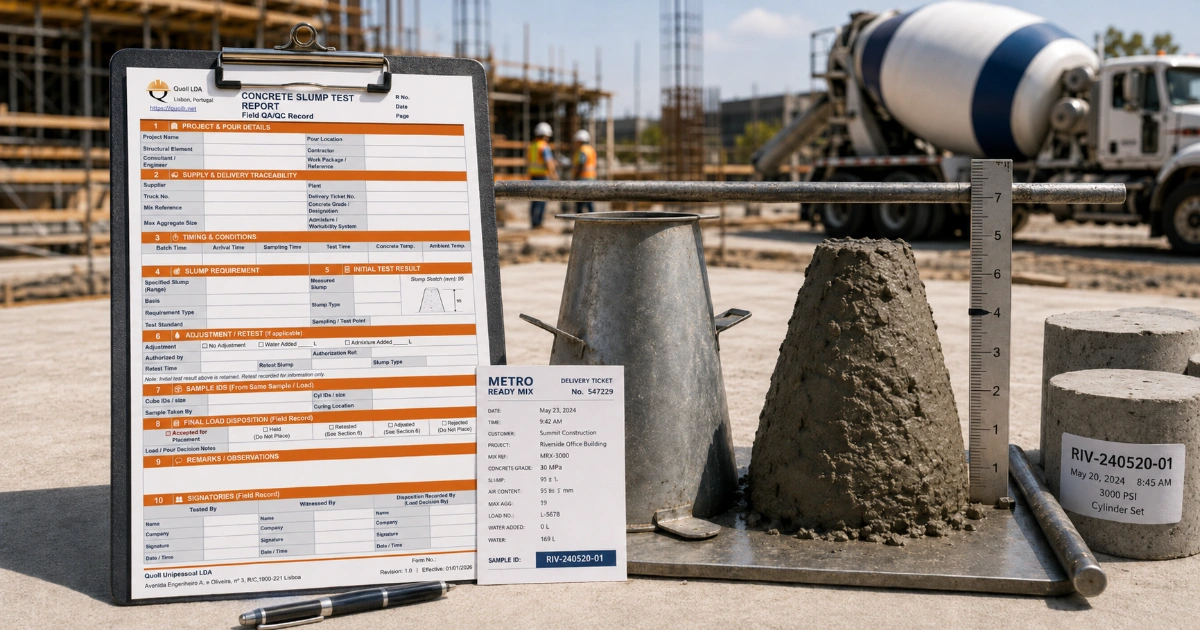
For representative sampling, use the Fresh Concrete Sampling Checklist. For the physical cone test, use the Concrete Slump Test Procedure Checklist.
Once the test is complete, enter the slump-test report number or other controlled reference. The detailed result belongs in the Concrete Slump Test Report Template; the delivery record simply makes the connection visible.
Link cubes or cylinders to the same load
When strength specimens are made from a sample associated with the delivery, enter the specimen set IDs before closing the truck record. This avoids a common traceability gap where the laboratory can identify the specimen but the site team cannot quickly identify the original delivery.
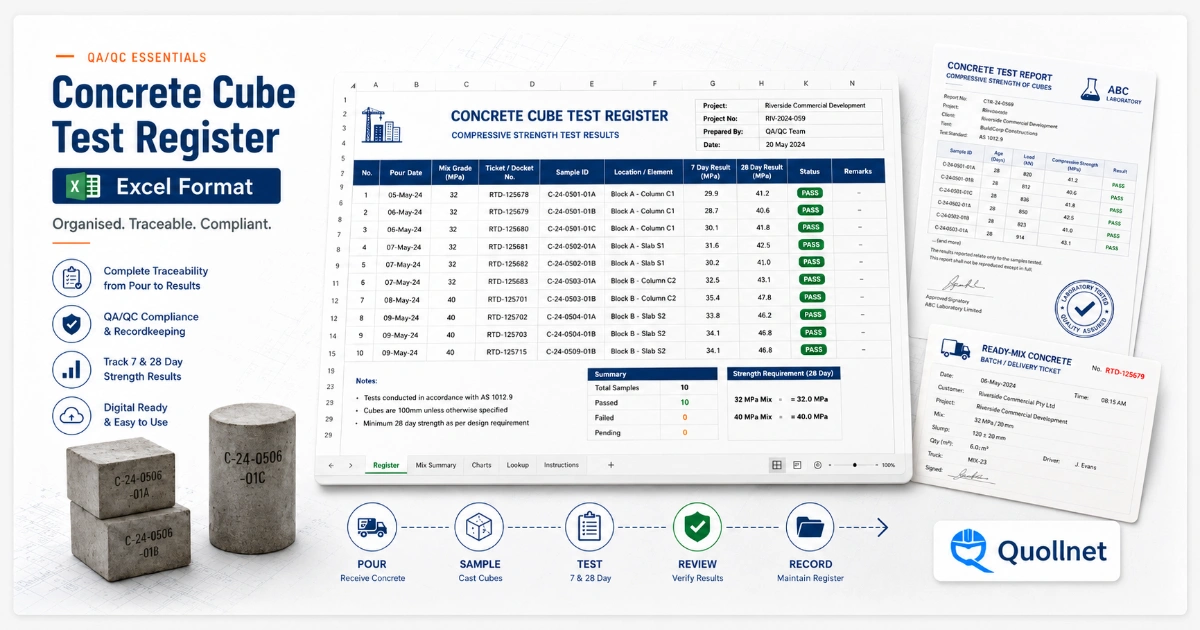
The specimen IDs can then continue into the Concrete Cube Test Register or the project's laboratory database. The delivery record should not copy later compressive-strength results unless the project intentionally uses a combined concrete log.
Connect the delivery to the slump register
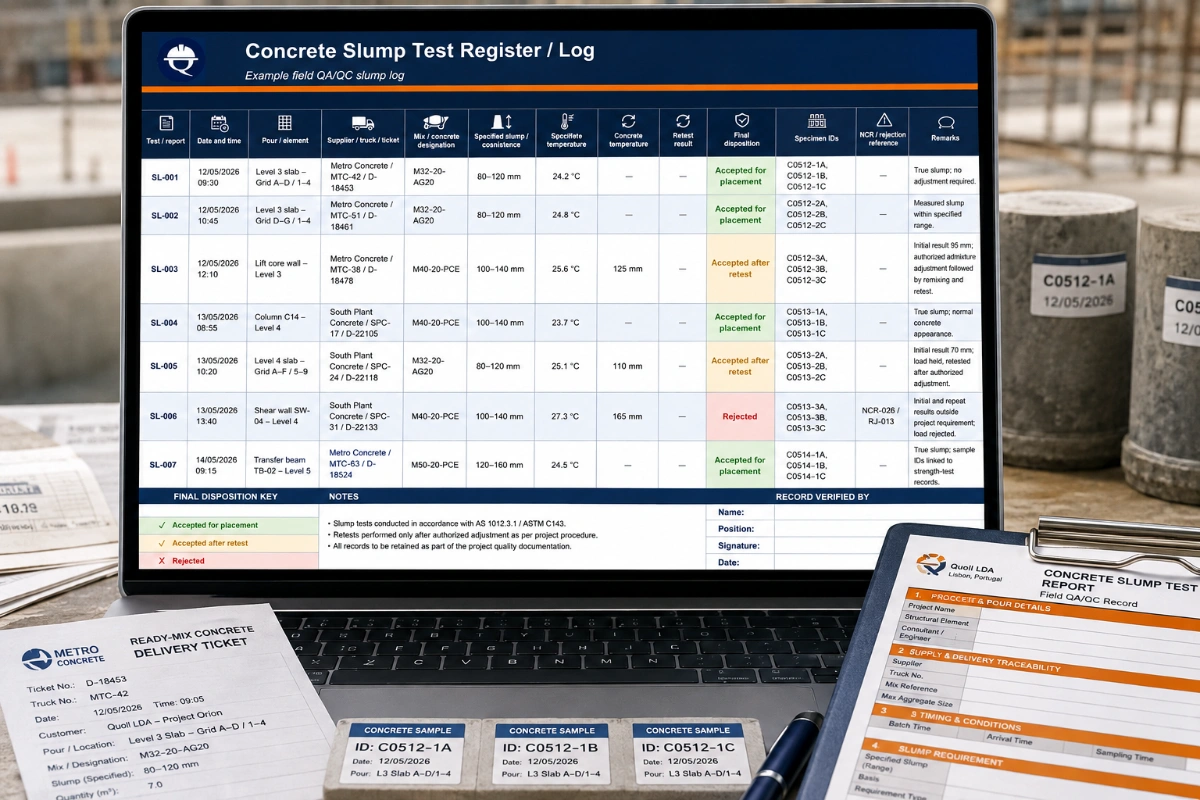
The delivery record is load-specific. The project Concrete Slump Register & Log is the running summary used to retrieve and review many slump tests over time.
Where the load has a slump-test record, use the same report/test identifier in both documents. That makes it possible to move from truck → test report → register entry without creating separate unrelated numbering systems.
Record timing without inventing a universal delivery limit
Batch, arrival and discharge times can be important project controls, but the form should not hard-code one universal maximum time for every concrete mix, climate or project.
Record the actual times and let the project specification, approved mix, producer requirements, applicable code and authorized project procedure determine whether a time limit has been exceeded.
For the broader delivery and point-of-discharge sequence, Quollnet's Method Statement: Ready-Mix Concrete Delivery Ticket Inspection and Point-of-Discharge Quality Testing provides a practical workflow that can be adapted to project requirements.
Record water or admixture additions as controlled events
If an on-site addition is permitted, the record should make that event visible. Useful fields include the type of addition, quantity, time, who authorized it and the related retest or instruction reference.
The record should never imply that the site team can add water or admixture merely because the slump is outside an expected value. The approved mix, supplier controls and project procedure govern whether an adjustment is permitted.
If a slump result is outside the entered project requirement, the separate guide High or Low Concrete Slump: Retest, Hold, Adjust or Reject? explains the decision sequence without treating the test result as an automatic rejection.
Use the ITP reference to show the inspection path
The delivery record should identify the relevant inspection/test activity when the project ITP controls ready-mix receipt, testing or release. For a concrete-specific workflow, see the ITP – Ready-Mix Concrete Point-of-Discharge Inspection and Testing.
The ITP determines the required inspection points, responsibilities and project acceptance basis; the delivery record provides the load-level traceability back to that process.
Separate test results from load disposition
A measured slump, concrete temperature or delivery time is a recorded fact. The final decision on the load is a separate project action.
The disposition field should therefore record what actually happened, for example:
- released for placement;
- held for review;
- retested;
- released after authorized action;
- returned; or
- rejected.
Where the load is rejected or a formal nonconformance is raised, include the NCR or rejection reference rather than trying to recreate the entire corrective-action process inside the delivery form.
One record per truck or one record per pour?
For truck-level traceability, one record per delivery is normally the cleanest arrangement because each supplier ticket and truck remains independently identifiable. A project can combine deliveries on a pour summary, but that summary should not destroy the underlying load references.
On high-volume pours, the individual delivery records can feed a separate concrete pour log or project register so that QA/QC can review the sequence without opening every source record.
What this record should not replace
The concrete delivery record should connect the project QA/QC documents, not absorb all of them.
- Ready-mix delivery ticket
- Approved concrete mix design
- Sampling record or checklist
- Detailed slump test report
- Temperature or other fresh-concrete test records
- Cube/cylinder specimen and laboratory records
- ITP / inspection request
- Slump register or concrete test register
- NCR, rejection or corrective-action record
Standards and project requirements
The delivery record itself is a project control form. It does not replace the standards governing the tests linked to it.
ASTM lists ASTM C172/C172M-25 as the active practice for obtaining representative samples of freshly mixed concrete and ASTM C143/C143M-26a as the active slump-test method. BSI lists BS EN 12350-1:2019 as current for sampling and common apparatus and BS EN 12350-2:2019 as current for the slump test.
Use the project specification, approved mix, ITP, applicable standard and authorized project procedure to set the actual testing frequency, limits, timing controls and disposition requirements.
References
ASTM C172/C172M-25 – Standard Practice for Sampling Freshly Mixed Concrete
ASTM C143/C143M-26a – Standard Test Method for Slump of Concrete
BS EN 12350-1:2019 – Testing fresh concrete: Sampling and common apparatus