Download a Concrete Slump Test Register / Log in Excel & PDF
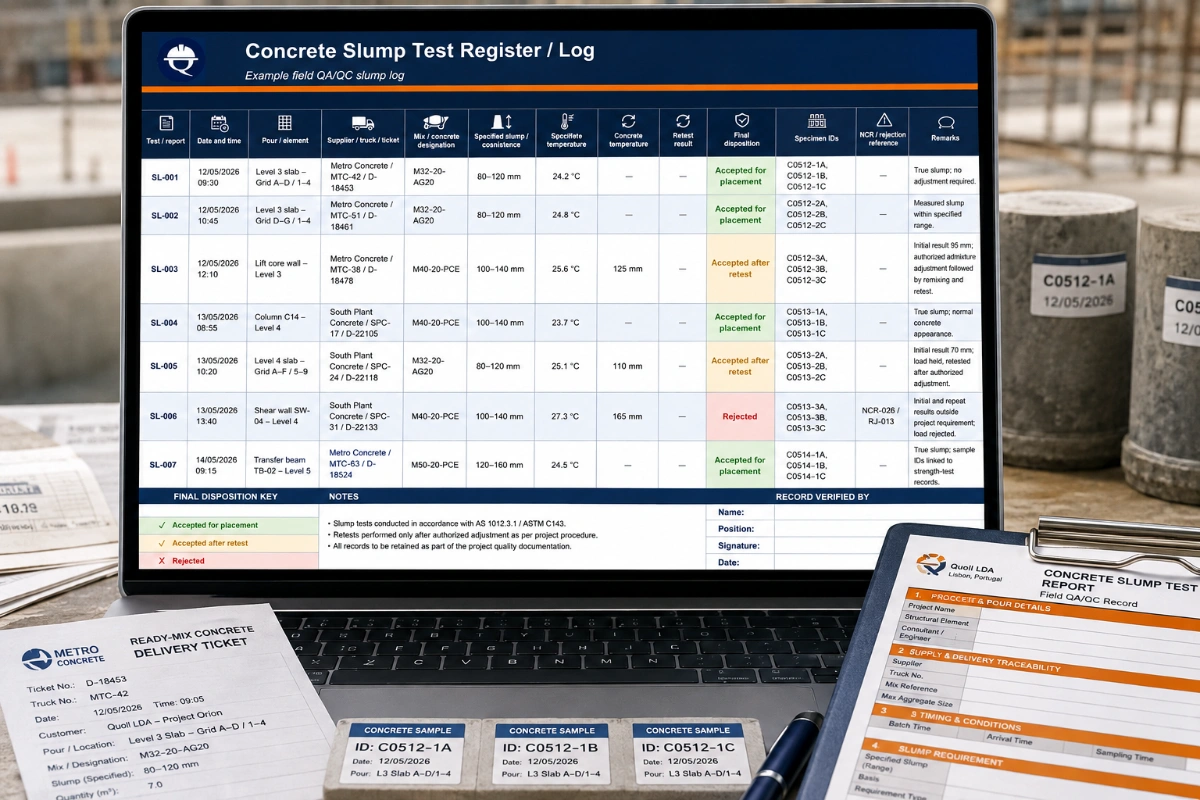
A concrete slump register—also commonly called a concrete slump log, slump test register or slump test log—is the project-level record used to track multiple concrete slump tests over time. It summarizes each test or load, links it to the detailed report and delivery records, and makes outside-range results, retests, specimen IDs and final dispositions easier to retrieve and review.
Concrete Slump Register / Log Downloads
The downloadable files will include a blank project register and a completed example in Excel and PDF. The Excel version is intended for filtering, sorting and ongoing project use; the PDF version is suitable for printing or reference.
Download the blank Concrete Slump Register in Excel
Download the blank Concrete Slump Register in PDF
Download the completed Concrete Slump Register example in Excel
Download the completed Concrete Slump Register example in PDF
What is a concrete slump register?
A concrete slump register is a running project record that summarizes many slump tests in one place. Instead of opening individual test reports one by one, a QA/QC engineer can use the register to find the relevant pour, truck, mix, measured slump, retest, sample IDs and load disposition.
On some projects the same document may be called a concrete slump log, slump test log, slump register or slump test register. The name matters less than the function: it should provide one consistent index of the project’s slump-test history.
Concrete slump register vs slump test report
The two records should work together rather than duplicate each other.
| Record | Purpose | Level of detail |
|---|---|---|
| Slump test report | Documents one test, sample or load | Detailed field record including timing, adjustment, retest and sign-off |
| Slump register / log | Tracks many tests across the project | Summary row with references back to the detailed records |
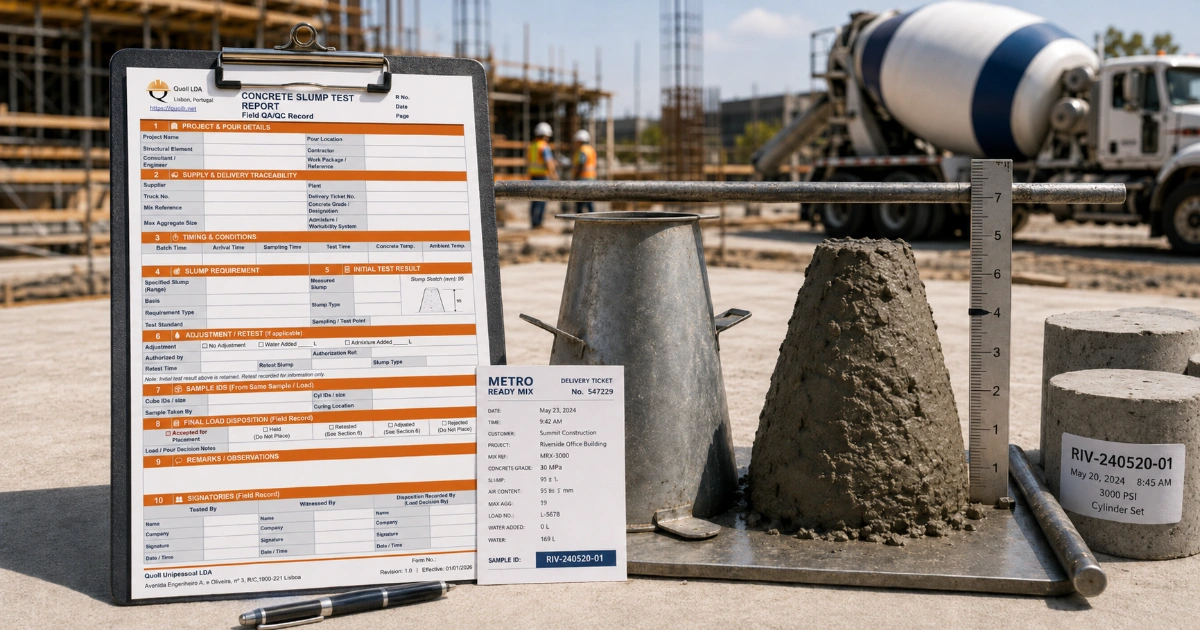
If you need the detailed one-test form, use the Concrete Slump Test Report Template. The register should contain the report number or other reference needed to retrieve that detailed record.
Recommended columns for a concrete slump log
A useful register should contain enough information to identify the test and review its status without copying every field from the detailed report. For delivery-ticket and mix traceability before placement, the Concrete Batch Ticket & Mix Verification – QA/QC Inspection checklist covers the source information that commonly feeds these register fields.
| Register column | What it should show |
|---|---|
| Test / report number | Unique reference to the individual slump report |
| Date and time | Test date and, where useful, sampling or test time |
| Pour / element | Pour reference, structural element and location |
| Supplier / truck / ticket | Delivery traceability for the tested concrete |
| Mix / concrete designation | Approved mix reference, grade or concrete class used by the project |
| Specified slump / consistence | Target, range, maximum or consistence class stated by the project documents |
| Initial result | Original measured slump with units |
| Concrete temperature | Temperature where it is measured as part of the project’s fresh-concrete testing |
| Retest result | Repeat result, kept separately from the initial value |
| Final disposition | Accepted, held, retested, adjusted, returned or rejected as recorded by the project |
| Specimen IDs | Related cube or cylinder set references |
| NCR / rejection reference | Reference to any formal quality record raised for the load |
| Remarks | Short note needed to understand the entry without repeating the full report |
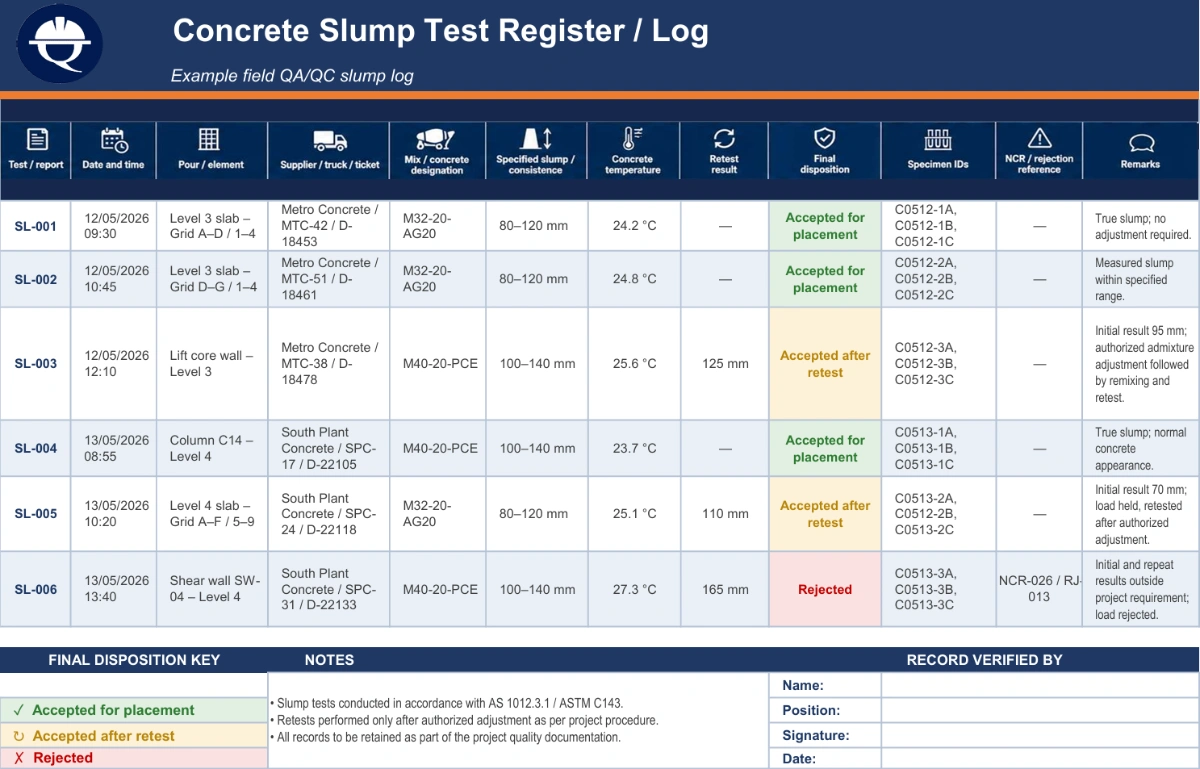
Should each truck have one row?
Not automatically. The register should reflect the project’s actual testing and recording system.
If one slump test represents one truck or load, a one-row-per-load arrangement is straightforward. If the project samples at another defined frequency, the row should represent the actual test or sample and identify the delivery or deliveries it relates to. The register should not create the impression that every truck was tested when the approved ITP or specification required another frequency. The underlying field sequence can be coordinated with a project procedure such as Quollnet’s Method Statement: Receiving and Acceptance Testing of Ready-Mix Concrete on Site.
The testing frequency itself should come from the project specification, approved ITP or applicable concrete-testing plan. For a concrete-specific example, see the ITP – Ready-Mix Concrete Point-of-Discharge Inspection and Testing. Quollnet’s guide to the Inspection & Test Plan in construction explains the wider role of inspection frequency, witness points and project records.
Use a numbering system that links directly to the report
A simple numbering system makes the log easier to audit. The register entry should use the same test or report number shown on the individual field report, or a clearly mapped reference.
For example, a project might use a sequence such as SL-0001, SL-0002, SL-0003. A larger project may add a zone, structure or package prefix if that genuinely improves retrieval.
Avoid creating separate unrelated numbers for the register and the report unless the project document-control system requires them. The objective is to make the source record easy to find.
Keep the initial result and retest in separate columns
The register should preserve the test history in the same way as the detailed report. Do not replace an initial outside-range result with a later value and leave only the final number visible.
Use separate columns for:
- initial slump result;
- adjustment or retest indicator;
- repeat slump result; and
- final disposition.
This allows the QA/QC team to filter the register for loads that required additional action even when the final retest was within the project requirement.
Link the slump register to cube or cylinder records
Where cubes or cylinders are made from the related fresh-concrete sample, include the specimen set ID in the register. That creates a direct path from the field consistency result to the later strength-test records.
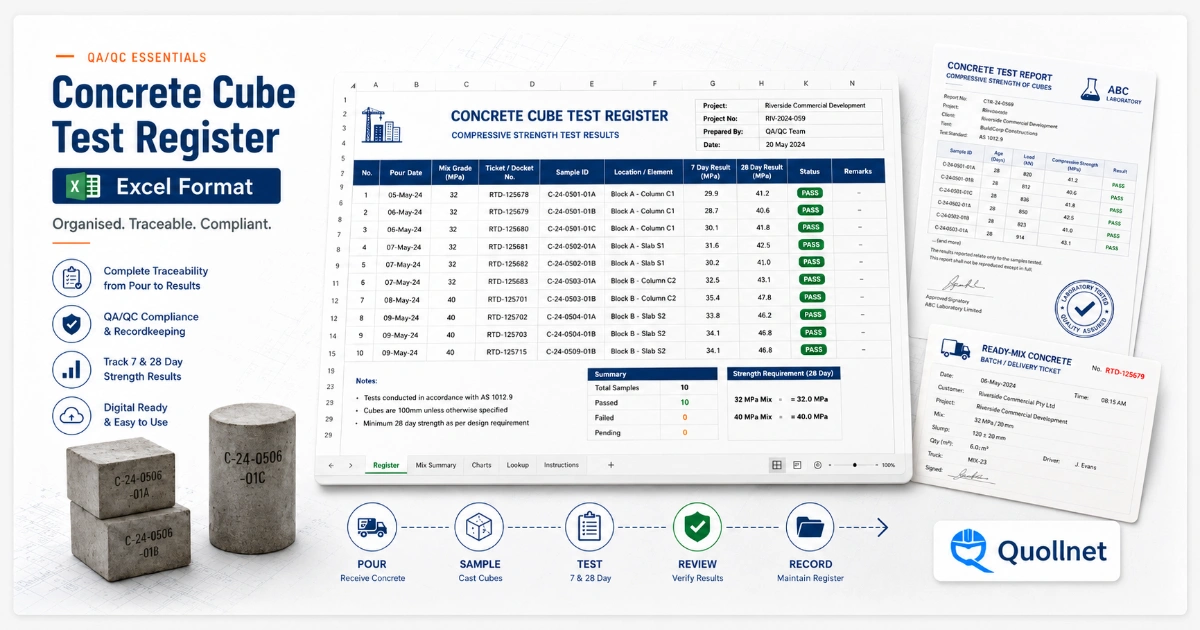
The same reference can then be carried into a Concrete Cube Test Register or laboratory system. The slump register should not copy the later compressive-strength results unless the project intentionally combines those records.
Use Excel filters and validation without turning the sheet into an acceptance engine
The Excel version of the register is most useful when it is designed as a working project log rather than a static table.
Useful spreadsheet controls include:
- filters on every principal column;
- date formatting;
- drop-down validation for common disposition values;
- consistent units for slump and temperature;
- conditional formatting to highlight incomplete fields or entries requiring review; and
- protected headings or formula cells where appropriate.
How to use the register for trend review
The register becomes more useful as the project accumulates tests. Filters and summaries can help the quality team identify recurring patterns that would be difficult to see from individual reports.
Useful review questions include:
- Are outside-range results recurring for the same mix?
- Are they associated with a particular supplier, plant, truck sequence or time of day?
- Are low-slump results appearing after longer transport or waiting periods?
- Are repeated adjustments or retests becoming common?
- Are particular structural elements or placement methods associated with repeated workability issues?
- Are specimen IDs and report references consistently complete?
The register identifies patterns that deserve review; it does not establish the technical cause by itself. Cause assessment should use the detailed reports, delivery tickets, approved mix information, weather and timing records, and other relevant evidence.
Who should maintain the concrete slump register?
The project quality system should assign one owner for the register. Depending on the organization, this may be the QA/QC engineer, concrete coordinator, laboratory coordinator or another designated member of the site team.
The important controls are consistency and timely updating. Entries should be added from the completed field records rather than reconstructed later from memory or partial delivery information.
For active concrete works, the register should be reviewed often enough to catch missing reports, missing specimen references and recurring abnormal results while the underlying records are still easy to retrieve. The exact review frequency is a project-management decision rather than a universal testing requirement.
What the slump register should not replace
A compact register is useful because it summarizes information. It becomes unreliable when it is expected to replace the source records.
Keep the register linked to, but separate from:
- the individual concrete slump test report;
- the concrete delivery ticket;
- the approved concrete mix design;
- the applicable inspection and test record;
- cube or cylinder reports;
- water or admixture adjustment records where separately controlled; and
- any NCR, rejection or corrective-action record.
If an outside-range test leads to a formal nonconformance, the register should carry the NCR number rather than attempting to reproduce the entire NCR workflow in one row. For the follow-up process after an NCR is raised, see the What to Do When the Contractor Receives an NCR: Action Guide.
Standards and the slump register
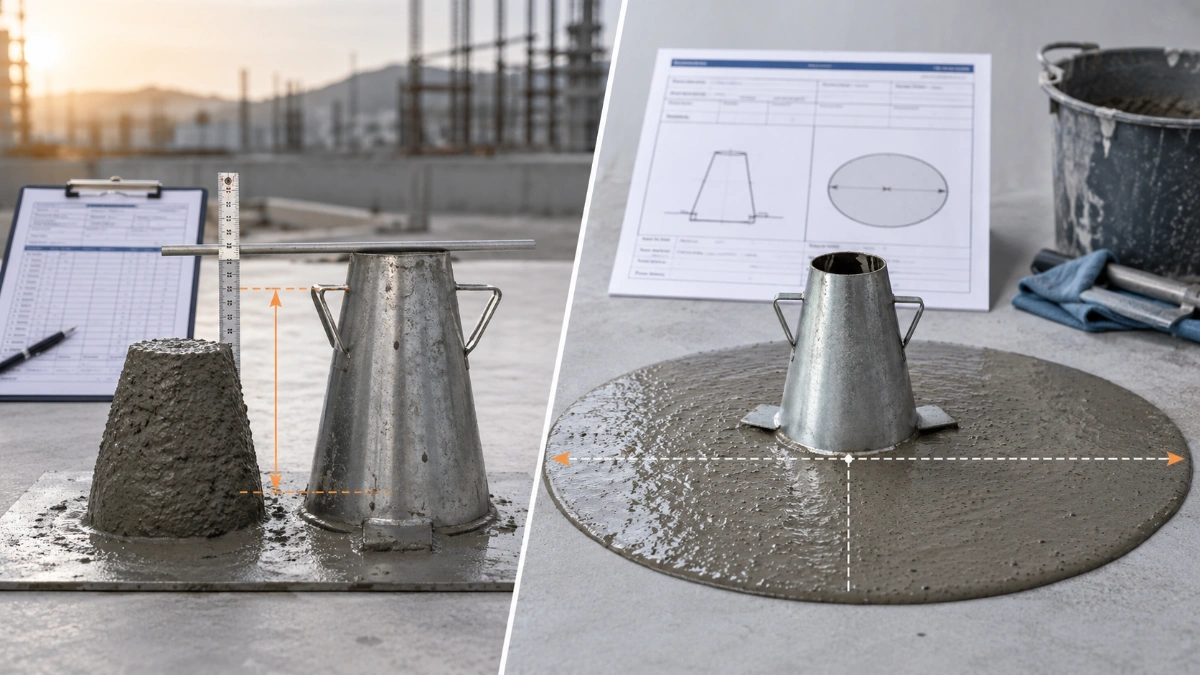
The slump register itself is a project QA/QC record; it is not the document that defines how the slump test is physically performed. The underlying sampling and testing should follow the standard and project requirements applicable to the work.
As of August 2026, ASTM lists ASTM C143/C143M-26a as the active slump test method and ASTM C172/C172M-25 as the active practice for sampling freshly mixed concrete. BSI lists BS EN 12350-2:2019 as current for slump testing and BS EN 12350-1:2019 as current and under review for sampling and common apparatus.
The register should therefore capture references and results needed by the project without attempting to reproduce the copyrighted test procedures.
References
ASTM C143/C143M-26a – Standard Test Method for Slump of Concrete
ASTM C172/C172M-25 – Standard Practice for Sampling Freshly Mixed Concrete
BS EN 12350-2:2019 – Testing fresh concrete: Slump test
BS EN 12350-1:2019 – Testing fresh concrete: Sampling and common apparatus