Slump Test vs Slump Flow Test: When to Use Each
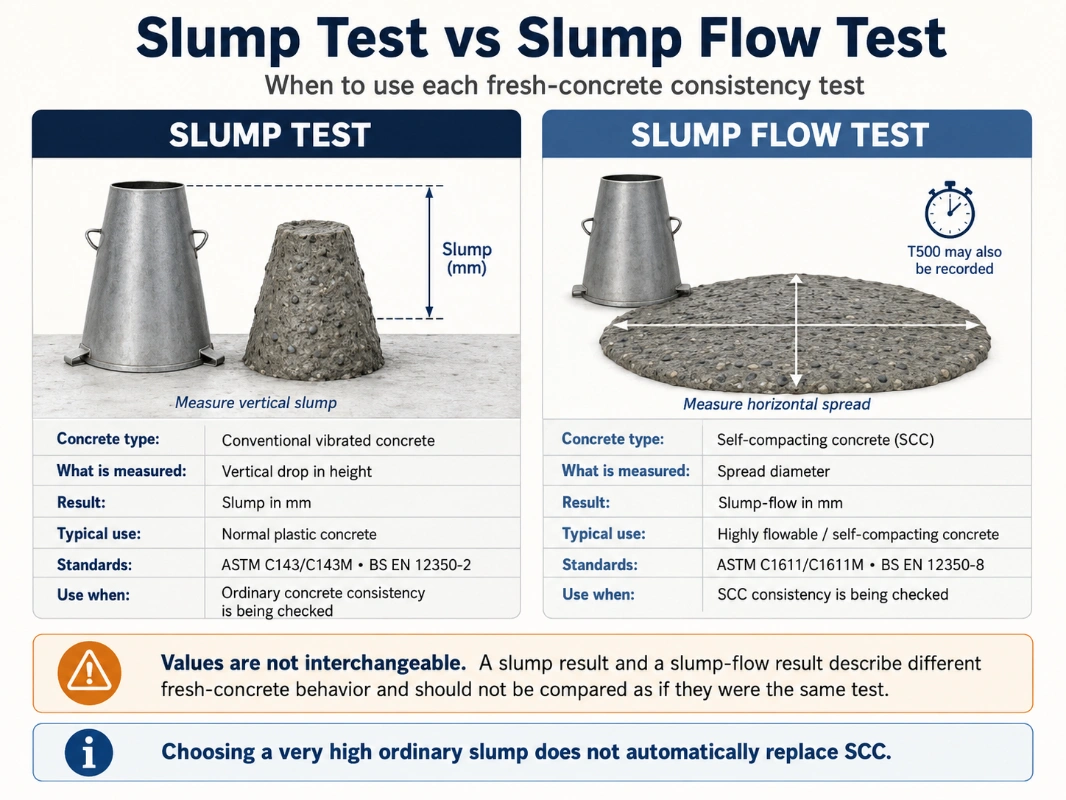
The slump test and slump flow test are not interchangeable. Use the conventional slump test for plastic concrete when the project specifies ordinary slump, and use the slump flow test for self-compacting or self-consolidating concrete when the project specifies SCC flowability. The two tests use similar cone-shaped apparatus but measure different fresh-concrete behavior and produce results that must be interpreted under different specification systems.
Slump test vs slump flow test: quick comparison
| Item | Slump test | Slump flow test |
|---|---|---|
| Concrete type | Conventional plastic concrete | Self-compacting / self-consolidating concrete |
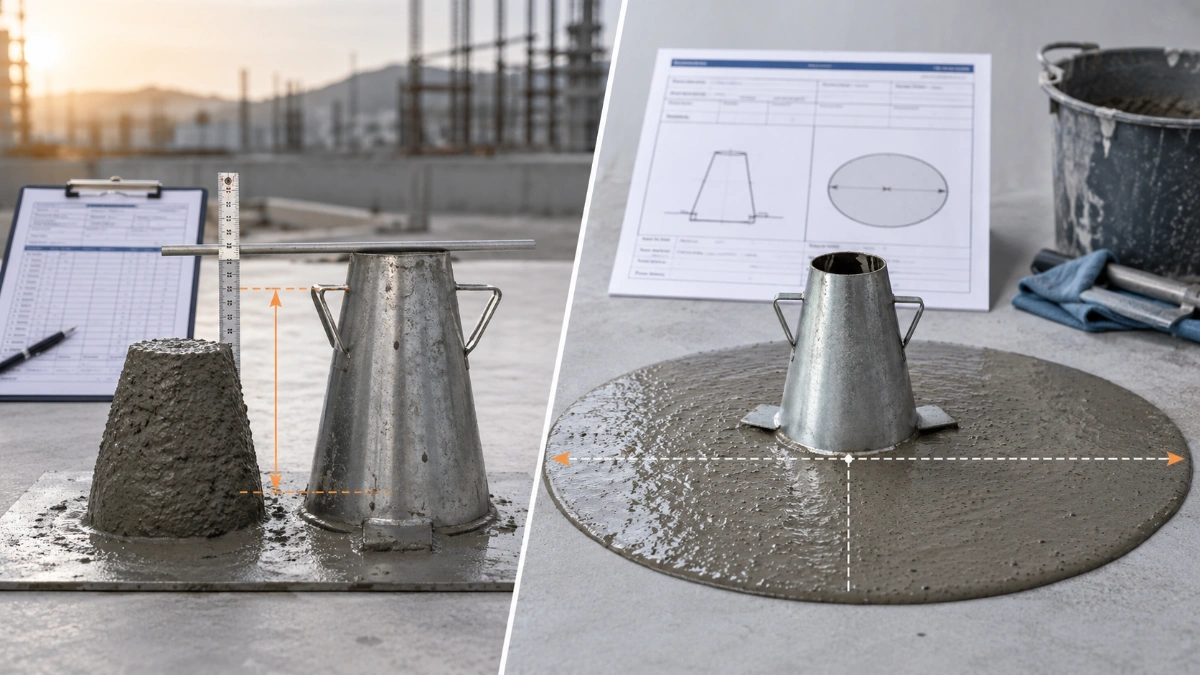
| Main behavior measured | Consistency expressed by vertical slump | Unconfined horizontal flowability; some systems also use flow time such as T500 |
| Typical result | Slump in millimetres | Spread diameter in millimetres, with additional time/visual observations where required |
| ASTM route | ASTM C143/C143M-26b | ASTM C1611/C1611M-21 |
| EN / BS route | BS EN 12350-2:2019 | BS EN 12350-8:2019 |
What does the conventional concrete slump test measure?
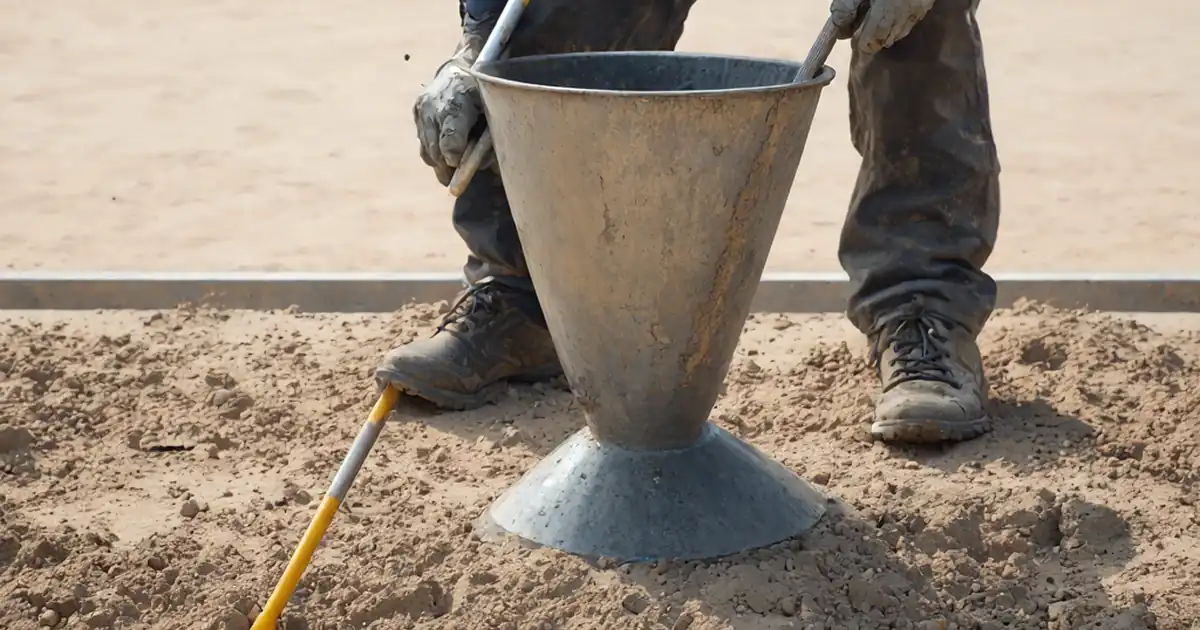
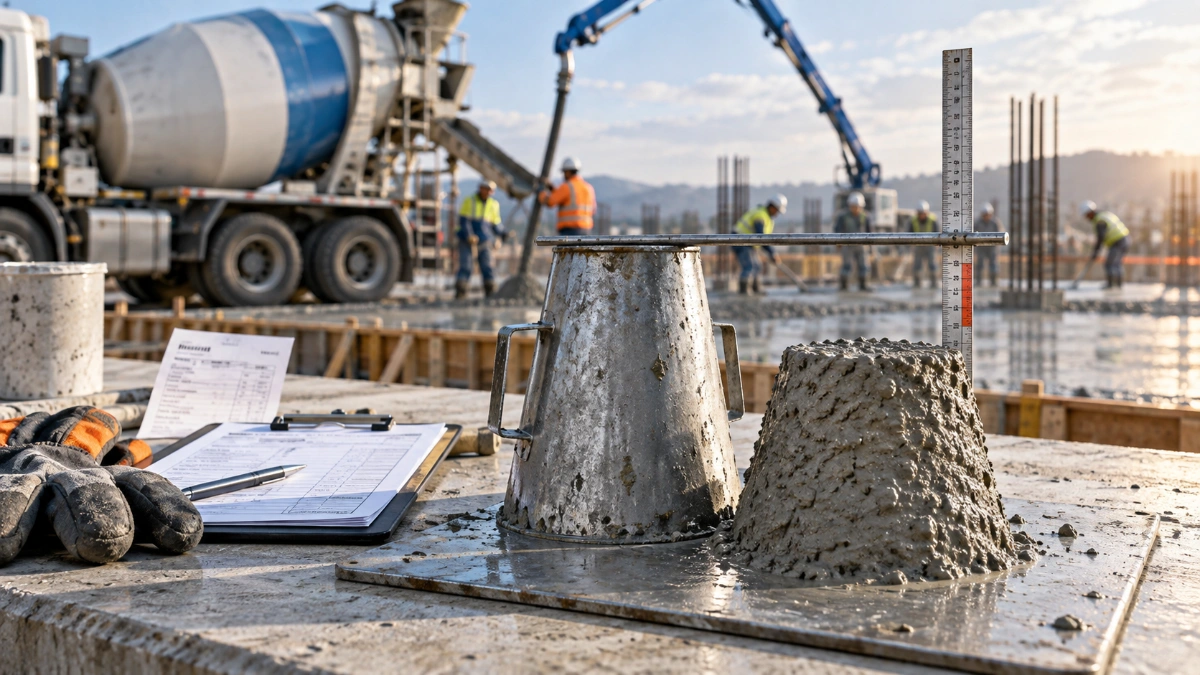
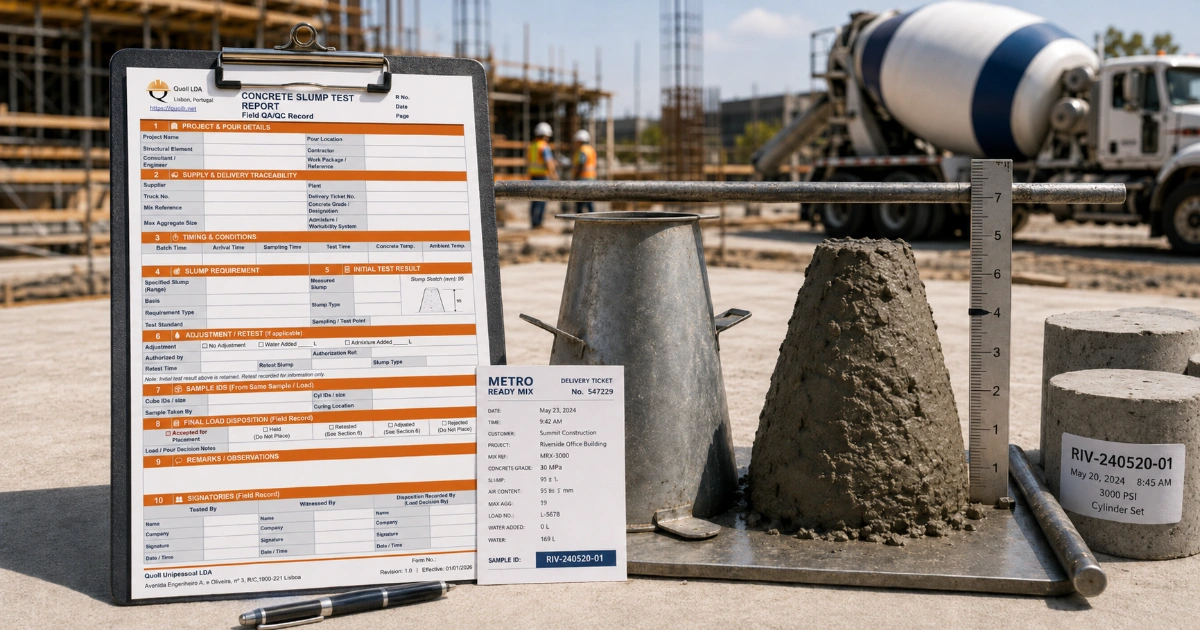
The conventional slump test is used to determine the slump of plastic concrete. Fresh concrete is placed and compacted in the prescribed cone, the cone is lifted vertically, and the vertical reduction in the concrete height is measured.
The result is a consistency measurement. It is useful for checking uniformity and comparing the delivered concrete with the project-specified slump requirement, but it should not be treated as a direct measurement of compressive strength, water-cement ratio, pumpability or segregation resistance.
ASTM C143/C143M-26b is the current ASTM slump test method. Under the EN route, BS EN 12350-2:2019 covers slump testing of fresh concrete.
For the step-by-step site procedure, use the How to Perform a Concrete Slump Test: ASTM / EN Checklist.
What does the slump flow test measure?
The slump flow test is used for self-compacting concrete (SCC), also called self-consolidating concrete in ASTM terminology. Instead of measuring how far the concrete drops vertically, the test measures how far the SCC spreads horizontally after the cone is lifted.
ASTM C1611/C1611M-21 describes the slump flow test as a way to monitor the consistency and unconfined flow potential of fresh self-consolidating concrete. BS EN 12350-8:2019 uses slump flow and T500 time to assess the flowability and flow rate of self-compacting concrete in the absence of obstructions.
That distinction is important: slump flow is intended for concrete that is designed to flow and consolidate under its own weight, not for conventional concrete that relies on vibration for consolidation.
Why slump and slump flow values are not interchangeable
A conventional slump value and a slump-flow diameter may both be expressed in millimetres, but they describe different physical behavior.
- Slump: a vertical deformation measurement.
- Slump flow: a horizontal spread measurement.
For example, a project requirement written as an ordinary slump must not be converted into a slump-flow requirement by simply changing the number. Likewise, an SCC slump-flow result must not be judged against a conventional slump range.
When should the ordinary slump test be used?
Use the ordinary slump test when the concrete is conventional plastic concrete and the project has specified slump as the relevant consistency measure.
Typical project conditions include:
- concrete that will be compacted by vibration;
- approved mixes with a stated slump target, range or consistence class;
- delivery and placement operations where ordinary slump is an established project control; and
- project specifications referencing ASTM C143/C143M or EN 12350-2.
The element type alone does not decide whether the slump test is appropriate. A slab, beam, column or wall may use conventional concrete or SCC depending on the design and placement constraints.
When should slump flow be used?
Use slump flow when the concrete is specified as self-compacting or self-consolidating concrete and the project uses an SCC flowability requirement.
SCC may be considered where conventional placement and vibration become difficult because of:
- heavy reinforcement congestion;
- restricted vibrator access;
- thin or complex sections;
- architectural formwork or surface requirements;
- difficult vertical placement zones; or
- a project strategy specifically developed around self-compaction.
For design guidance on choosing the fresh-concrete consistency rather than copying generic values, see How to Specify Concrete Slump for Slabs, Beams, Columns and Walls.
Do not solve every placement problem by increasing ordinary slump
Increasing the specified slump of conventional concrete can improve mobility, but it does not automatically provide the passing ability, stability or self-compaction needed for very congested or difficult geometry.
If conventional vibration cannot be performed reliably, the engineering question should shift from “How high should the slump be?” to “Is conventional vibrated concrete still the right concrete system?” In some situations, an SCC mix with an appropriate slump-flow requirement is the more technically coherent solution.
This decision should be made during specification and mix approval, not improvised when the truck arrives on site.
ASTM C143 vs ASTM C1611
ASTM C143/C143M-26b covers the determination of slump of concrete in the laboratory and field. Its purpose is to provide a standardized procedure for conventional slump measurement.
ASTM C1611/C1611M-21 covers slump flow of self-consolidating concrete. ASTM states that the test is used to monitor the consistency and unconfined flow potential of fresh SCC. It also includes non-mandatory visual stability guidance and notes that the rate of spread can provide information related to relative viscosity.
Neither test method creates the project acceptance requirement. The project specification and approved concrete requirements determine what result must be achieved.
BS EN 12350-2 vs BS EN 12350-8
BS EN 12350-2:2019 is the current BSI standard for the ordinary slump test. It describes the fresh-concrete slump procedure and allows the report to include a specified slump class or target value.
BS EN 12350-8:2019 is the current BSI standard for the SCC slump-flow test. It includes slump flow and T500 time, and it permits reporting against a specified slump-flow class or target value.
The two standards therefore belong to the same fresh-concrete testing family but serve different concrete systems.
What is T500 in a slump flow test?
T500 is the time taken for the spreading SCC to reach a 500 mm diameter during the slump-flow test under the relevant EN procedure. It provides additional information about the rate at which the concrete flows.
A slump-flow diameter alone describes the extent of unconfined spread. T500 adds information about flow rate. The project may require one or both depending on the adopted specification and SCC performance requirements.
Can ordinary slump be used for very high-workability concrete?
Only when the test remains suitable for the concrete being assessed and the project specification actually uses ordinary slump. A high numerical slump should not automatically be assumed to represent SCC.
Where the concrete behavior no longer fits the assumptions of the ordinary slump method, or where the concrete is intentionally designed to self-compact, the appropriate SCC test system should be used instead.
How acceptance should be handled
A measured slump or slump-flow result should always be compared with the requirement that applies to that specific mix and project.
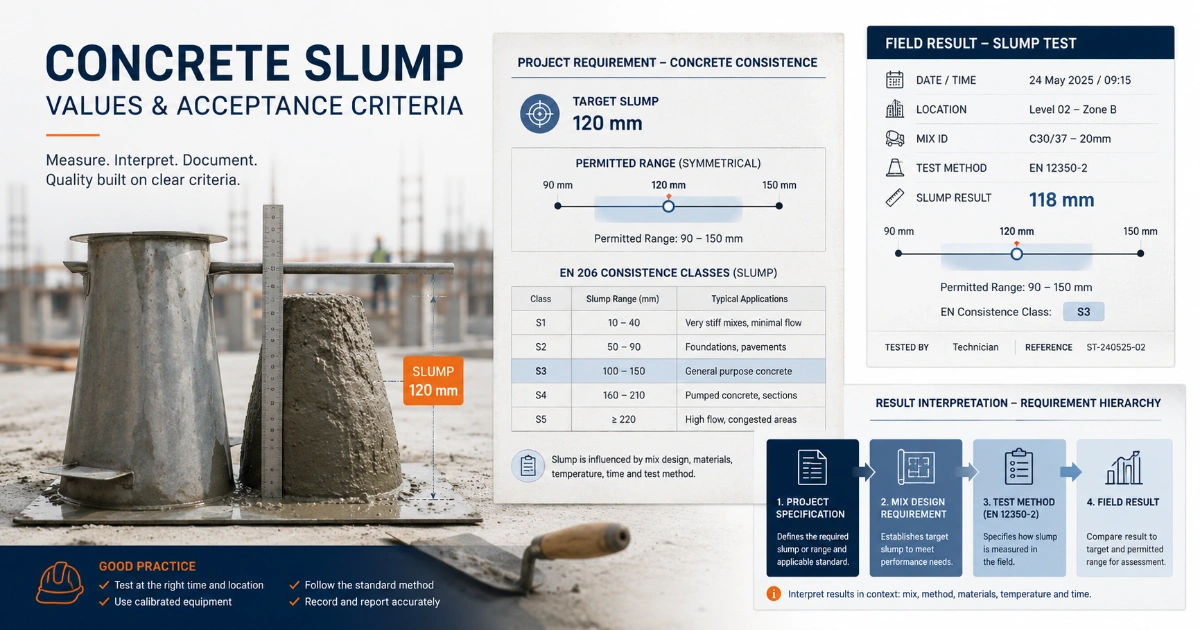
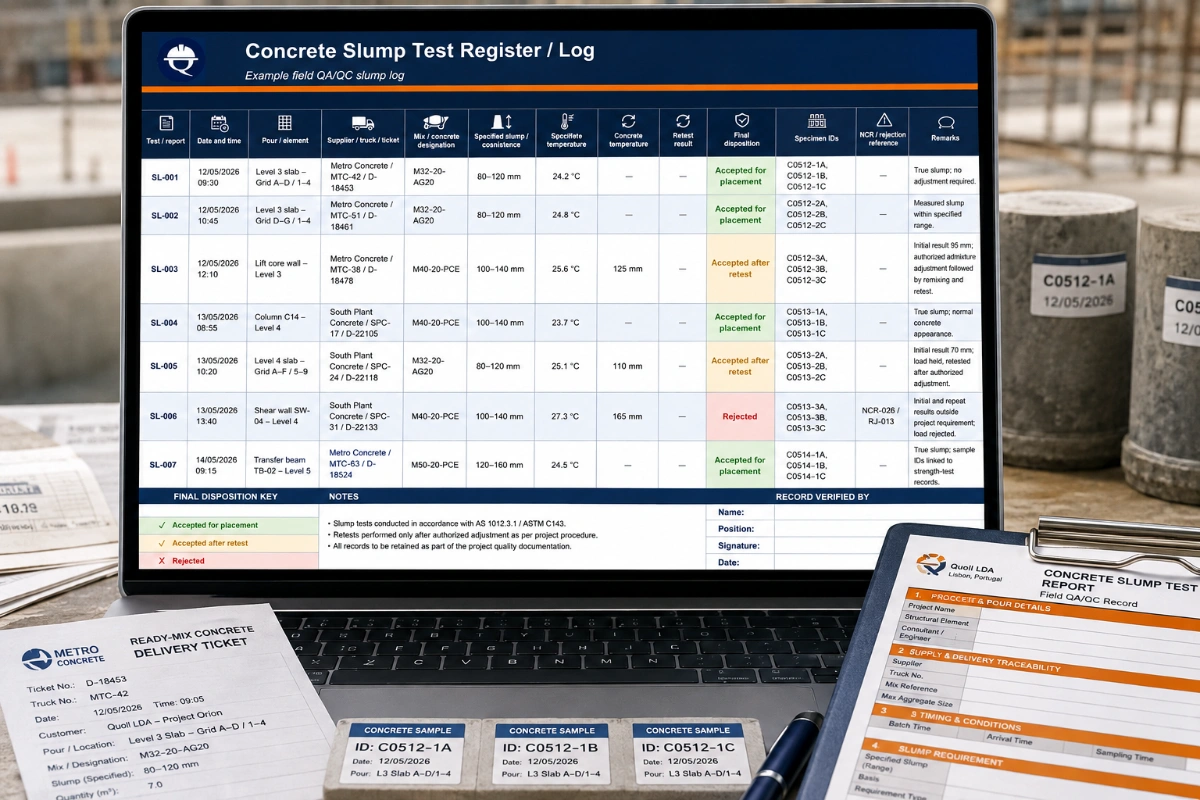
The Concrete Slump Values & Acceptance Criteria article explains the difference between target values, ranges, classes, tolerances and project acceptance rules.
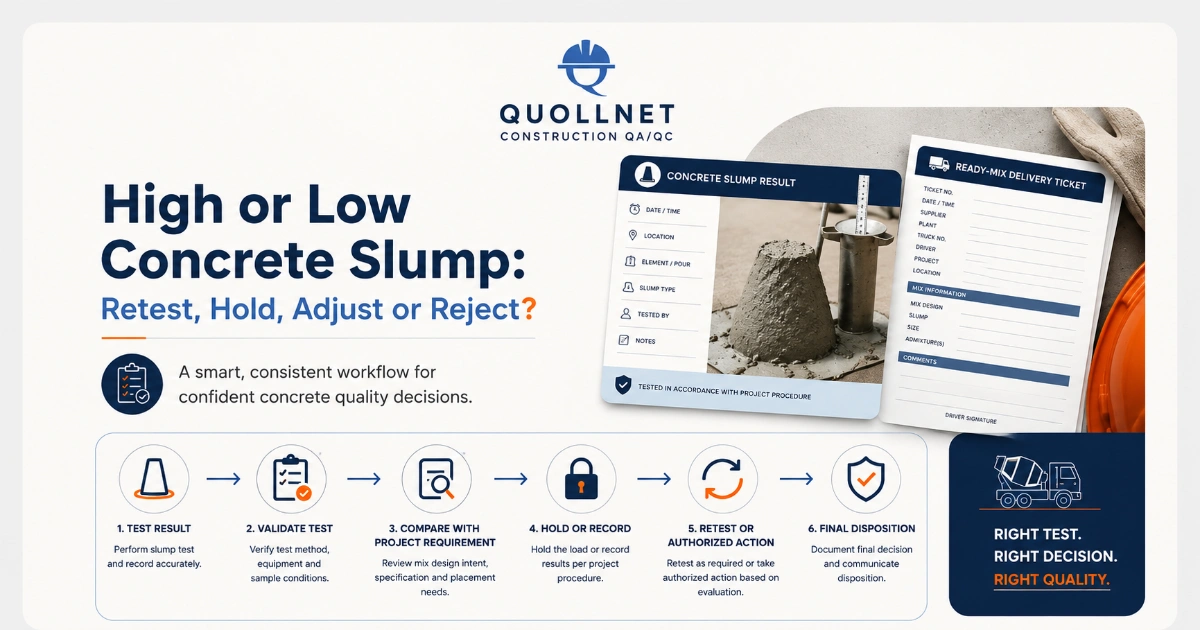
If a conventional slump result is outside the project requirement, use the decision workflow in High or Low Concrete Slump: Retest, Hold, Adjust or Reject?. An outside-range result does not by itself authorize water addition, admixture adjustment, placement or rejection.
Common mistakes when comparing slump and slump flow
- Using the terms “slump” and “slump flow” as if they mean the same test.
- Comparing an SCC spread diameter with a conventional slump requirement.
- Calling very high-slump conventional concrete “SCC” without an approved SCC mix and SCC performance requirements.
- Using ASTM C143 for self-consolidating concrete when the project requires ASTM C1611.
- Using EN 12350-2 where the approved SCC specification calls for EN 12350-8.
- Assuming a high slump-flow diameter alone proves that SCC has adequate stability or passing ability.
- Choosing the test from the structural element name rather than the actual concrete type.
- Treating the test method as the source of project acceptance criteria.
Site decision guide: which test should you use?
- Identify the approved concrete type. Is the mix conventional vibrated concrete or SCC?
- Read the project consistency requirement. Does it specify slump, slump class, slump flow, slump-flow class or a target value?
- Use the matching test method. Apply ASTM C143 / EN 12350-2 for ordinary slump or ASTM C1611 / EN 12350-8 for SCC slump flow, as required by the project.
- Record the result in the correct units and format. Do not convert one result into the other.
- Compare only with the applicable project requirement. Do not use generic internet tables as acceptance criteria.
- Follow the approved disposition process for an outside-range result.
References
ASTM C143/C143M-26b – Standard Test Method for Slump of Concrete
ASTM C1611/C1611M-21 – Standard Test Method for Slump Flow of Self-Consolidating Concrete
BS EN 12350-2:2019 – Testing fresh concrete: Slump test
BS EN 12350-8:2019 – Testing fresh concrete: Self-compacting concrete slump-flow test