High or Low Concrete Slump: Retest, Hold, Adjust or Reject?
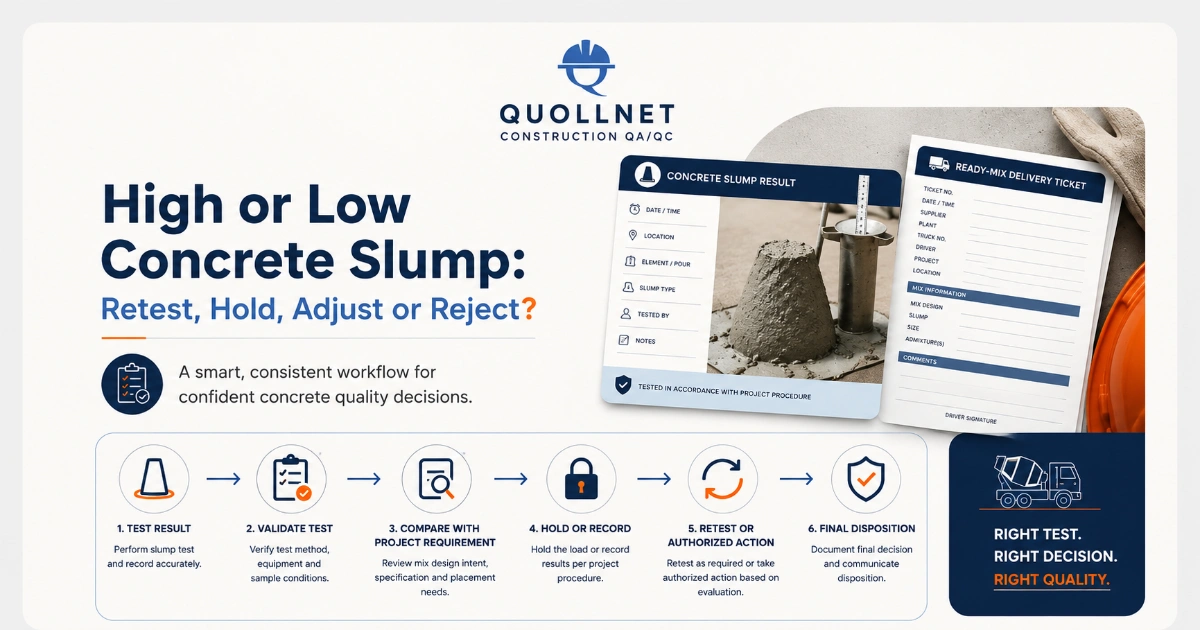
A high or low concrete slump result should not trigger an automatic accept-or-reject decision. First confirm the test is valid, compare the measured result with the project requirement, preserve the original result, and follow the approved project procedure for holding, retesting, authorized adjustment and final disposition.
Use the Concrete Slump Result Action Tool
Enter the actual project requirement and the measured result below. The tool compares the result only with the requirement you provide. It does not create acceptance criteria or authorize placement, adjustment or rejection.
Concrete Slump Result Action Tool
Record the entered project requirement, slump result, validity, retest and authorized-action details for a clear QA/QC review note.
Record workflow
Result summary
This tool compares recorded results with the project requirement you enter. It does not establish contractual acceptance criteria or authorize water/admixture adjustment, placement, acceptance or rejection.
Start by checking whether the slump test itself is valid
Before treating a result as high or low, confirm that the sample and test were obtained and performed correctly. An unrepresentative sample, unstable test base, incorrect filling or rodding, improper cone withdrawal, delayed testing or an invalid slump shape can make the measured value unsuitable for a disposition decision.
For the sampling stage, use the Fresh Concrete Sampling Checklist. For the cone test itself, use the Concrete Slump Test Procedure Checklist.
If the test is invalid under the governing procedure, record why and repeat the test as required. Do not treat the invalid number as though it were a valid acceptance result.
Compare the measured slump with the actual project requirement
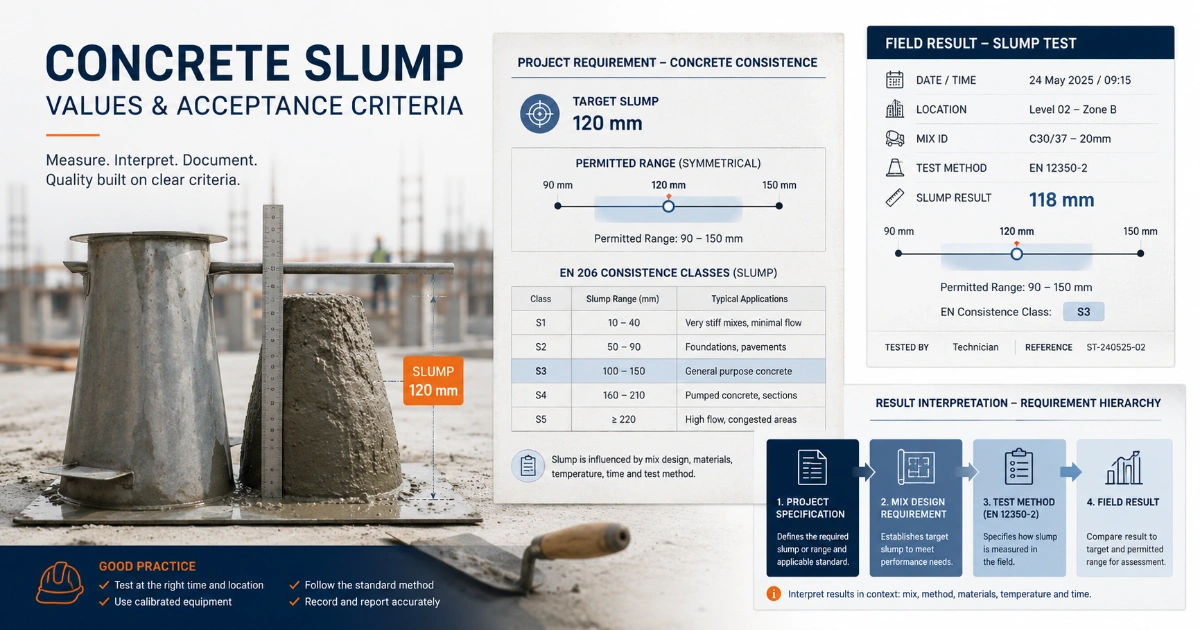
The relevant comparison is not a generic slump chart from the internet. Use the requirement stated by the project documents. Depending on the specification system, this may be a target slump, permitted range, maximum value, minimum value or consistence class.
The project requirement may come from the approved concrete mix, project specification, concrete order, ITP or another controlled document. If the requirement is unclear, obtain clarification before deciding what the measured result means for the load.
What to do when concrete slump is lower than required
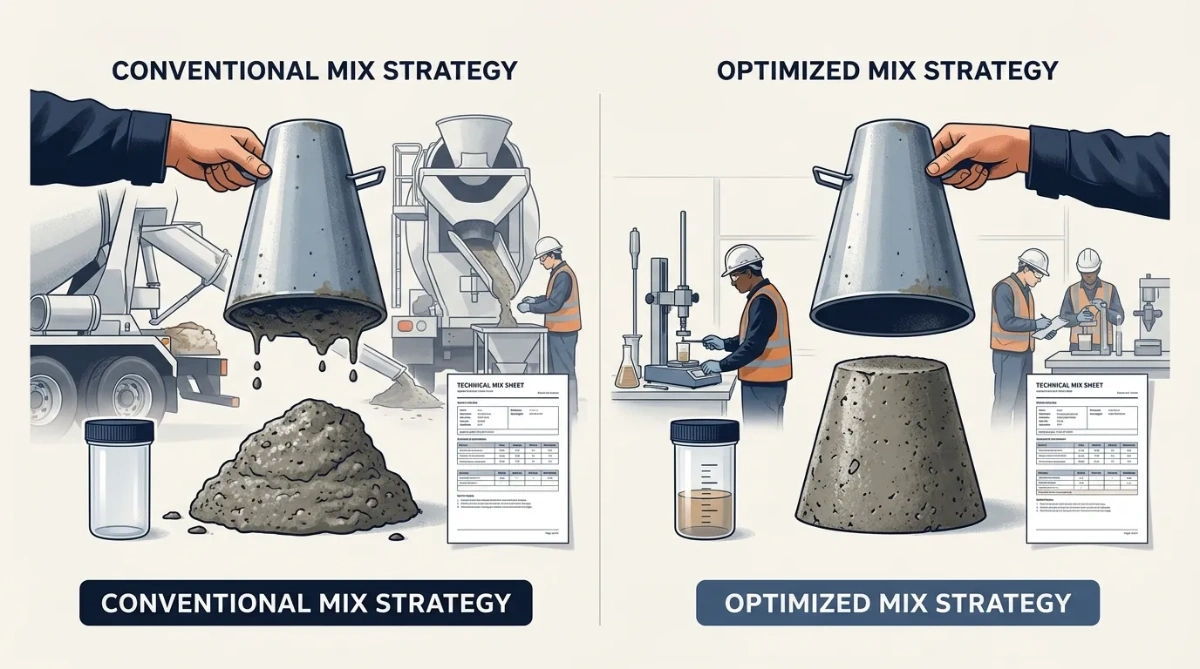
A low slump result means the measured consistency is below the project requirement entered for that concrete. The immediate response should normally be control and review rather than improvisation at the truck.
- Preserve the original measured result.
- Check the test validity and test timing.
- Confirm the correct mix, truck and delivery ticket.
- Confirm the specified slump or consistence requirement.
- Hold the load where the project procedure requires a decision before placement.
- Follow the approved route for any retest or authorized adjustment.
- Record the repeat result and final project disposition separately.
Possible causes may include time-related slump loss, temperature, mix variability, delayed discharge or other factors, but the slump result alone does not prove the cause. Review the delivery ticket, batch and arrival times, approved mix information and site records before drawing conclusions.
What to do when concrete slump is higher than required
A high slump result should also be treated as a controlled quality issue rather than an automatic rejection. Confirm that the correct concrete has been delivered and that the test was valid before deciding what action is required.
Do not assume that high slump automatically proves unauthorized added water. A higher result can arise from several mix, admixture, timing or testing factors. If unauthorized water addition is suspected, review the delivery ticket and site records and deal with the evidence separately.
Where the measured result is outside the permitted requirement, the load may need to be held for review while the project team applies the approved retest or disposition procedure.
Should an outside-range slump result be retested?
Retesting is appropriate only where the governing standard or project procedure calls for it. A retest should not be used simply to keep testing until a more convenient number appears.
Where a repeat test is required, preserve the complete chronology:
- initial result;
- reason for repeat testing;
- whether the same sample or a new representative sample was required;
- any authorized action before the retest;
- repeat result; and
- final disposition.
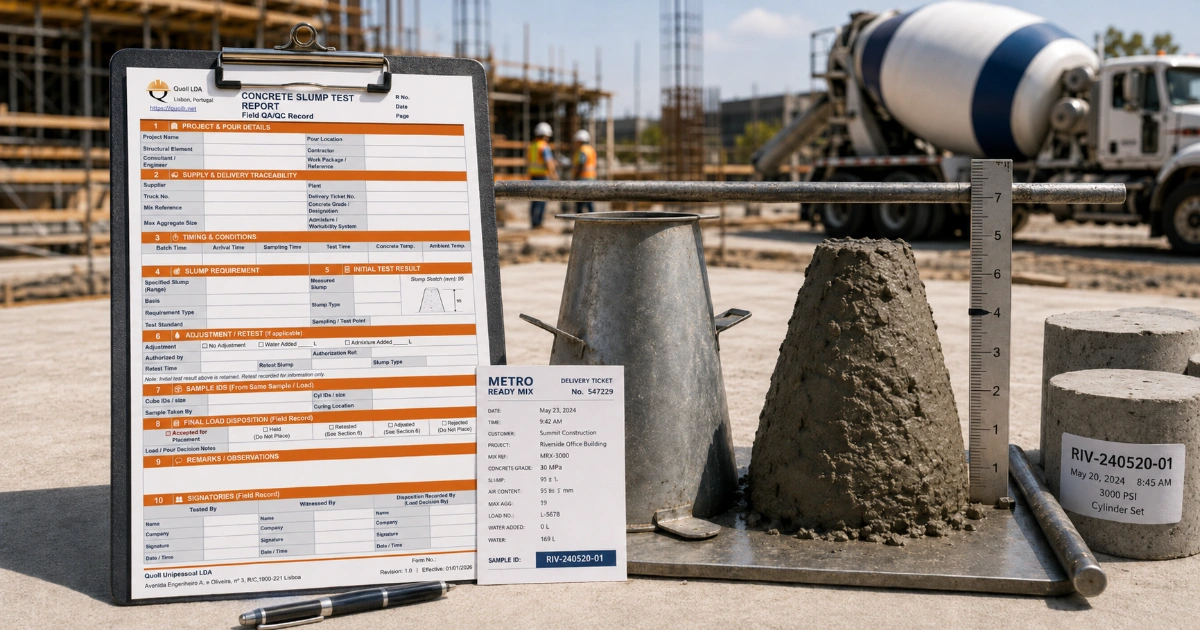
The Concrete Slump Test Report Template is designed to retain this initial-result and retest history rather than overwriting the first value.
Can water or admixture be added to adjust slump?
Do not add water or admixture merely because a measured slump is outside the desired range. Any on-site adjustment must be permitted by the project requirements and producer controls and must be authorized by the person or procedure responsible for that decision.
Where an adjustment is allowed, record at least the type of addition, quantity or dosage, time, authorization, remixing requirement and repeat-test result. The Concrete Batch Ticket & Mix Verification – QA/QC Inspection is useful for checking the delivery and any controlled site additions.
For the wider site sequence, including receipt, testing and load disposition, see Quollnet’s Method Statement: Receiving and Acceptance Testing of Ready-Mix Concrete on Site.
Hold is not the same as reject
Holding a load creates time for the project team to review the test, verify the requirement, check supporting records and apply the approved procedure. Rejection is a final disposition and should be made only by the person or process authorized under the project documents.
A practical status sequence may include:
- result recorded;
- held for review;
- retest required;
- authorized adjustment permitted;
- repeat test recorded;
- accepted or released by the authorized person;
- returned or rejected; or
- NCR raised where required.
If the project uses formal hold and witness points, the ITP – Ready-Mix Concrete Point-of-Discharge Inspection and Testing provides a concrete-specific example of that control structure.
When should a nonconformance or rejection record be raised?
An outside-range slump result does not automatically mean an NCR is required on every project. The quality procedure may allow immediate resolution through an approved retest or other controlled action. Where the event meets the project’s definition of a nonconformance, record the NCR or rejection reference and keep it linked to the affected load.
If an NCR is raised, the What to Do When the Contractor Receives an NCR: Action Guide covers containment, factual review, corrective action and closeout.
Record the result even when the load is eventually accepted
Do not erase the initial high or low result because a later action or retest allows the load to proceed. The original measurement is part of the concrete delivery history and may be important during later QA/QC review.
The detailed report should preserve the event, while the Concrete Slump Register & Log Template can summarize the initial result, retest, final disposition, specimen IDs and NCR or rejection reference across the project.
A simple site decision sequence
- Record the measured result.
- Confirm the test is valid.
- Confirm the correct project requirement.
- Compare the result with that requirement.
- If outside the requirement, hold for review where required.
- Apply only the approved retest or adjustment procedure.
- Preserve both the initial and repeat results.
- Record the final authorized disposition.
Standards and project requirements
As of August 2026, ASTM lists ASTM C143/C143M-26a as the active standard test method for slump of concrete. ASTM C172/C172M-25 covers sampling freshly mixed concrete. BSI lists BS EN 12350-2:2019 as current for slump testing and BS EN 12350-1:2019 as current for sampling and common apparatus.
These standards govern testing and sampling procedures. Acceptance, adjustment and rejection criteria also depend on the applicable concrete specification, approved mix, contract documents and project quality procedure. The article and embedded tool therefore do not provide one universal high/low slump limit.
References
ASTM C143/C143M-26a – Standard Test Method for Slump of Concrete
ASTM C172/C172M-25 – Standard Practice for Sampling Freshly Mixed Concrete
BS EN 12350-2:2019 – Testing fresh concrete: Slump test
BS EN 12350-1:2019 – Testing fresh concrete: Sampling and common apparatus