How to Specify Concrete Slump for Slabs, Beams, Columns and Walls
To specify concrete slump, do not choose a value from a generic slab, beam, column or wall table. Define the required fresh-concrete consistency from the placement method, reinforcement congestion, section geometry, compaction and finishing needs, mix/admixture system and applicable specification, then state the requirement as a target, range or class with the test method and measurement point. For self-compacting concrete, specify the appropriate slump-flow requirement instead of ordinary slump where applicable.
Why slabs, beams, columns and walls do not have universal slump values
It is tempting to create a table that assigns one slump to slabs, another to beams and another to columns or walls. That approach is usually too simplistic for a project specification.
Two columns can need very different fresh-concrete behavior if one has widely spaced reinforcement and direct bucket placement while the other is heavily congested and pumped through a long line. Likewise, one slab may be conventionally vibrated and power-finished while another is placed by pump around dense post-tensioning ducts and embedded services.
The element type is therefore only one input. The designer or specifier should begin with the placement problem and then define the consistency requirement that the approved concrete mix must satisfy.
Use the helper below to explore an indicative starting consistency based on the element and placement constraints.
Concrete Slump Specification Helper
Element type is secondary; placement and consolidation constraints drive the result.
Indicative specification starting point — not an acceptance criterion.
Confirm the final requirement against the approved mix, project specification, producer/contractor and applicable concrete specification system.
Start with the placement method
The first practical question is how the concrete will reach and fill the form. Pumping, chute placement, crane-and-bucket placement, direct discharge and other methods impose different demands on the fresh concrete.
A specification should therefore be coordinated with the intended delivery and placement method rather than assuming that a slump suitable for one operation will automatically suit another.
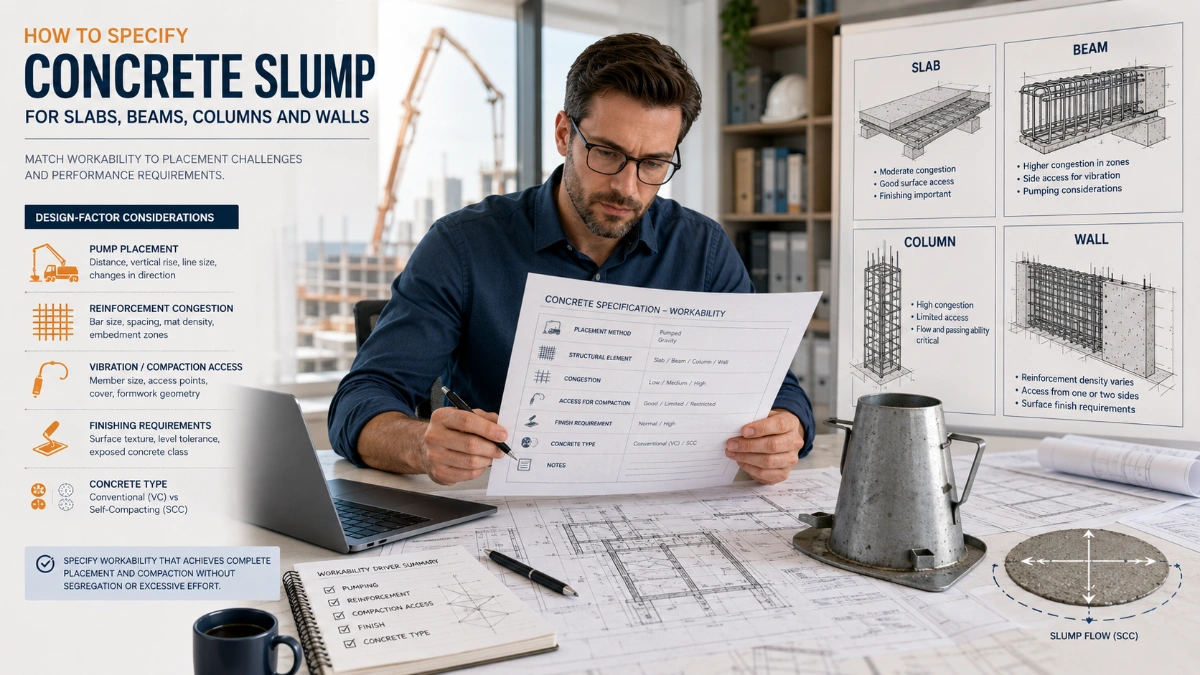
| Design factor | Why it matters to the consistency requirement |
|---|---|
| Placement method | The concrete must be transportable through the selected route without blocking, excessive segregation or uncontrolled loss of consistency. |
| Reinforcement congestion | Closely spaced bars, couplers and embedded items reduce the available path for coarse aggregate and make consolidation more demanding. |
| Section geometry | Thin walls, deep beams, narrow columns and complex shapes may need different flow and stability characteristics. |
| Compaction access | The ability to insert and operate vibrators affects how easily conventional concrete can be consolidated without voids. |
| Finishing requirement | Slabs and exposed surfaces may require a balance between placeability, surface finishing and resistance to bleeding or segregation. |
| Mix and admixture system | Modern admixtures can provide high consistency without relying on uncontrolled water addition, but the selected performance must be demonstrated by the approved mix. |
| Delivery and retention | Travel time, ambient conditions and expected waiting time can affect the consistency required at the specified measurement point. |
Concrete slump considerations for slabs, beams, columns and walls
The table below is a design checklist, not a table of universal slump values. It identifies the questions that should drive the specification for each common element.
| Element | Main consistency considerations |
|---|---|
| Slabs | Pumpability or discharge method, finishing method, slab depth, reinforcement/services congestion, screeding and vibration approach, and the need to avoid excessive bleeding or segregation. |
| Beams | Depth, bar spacing, beam-column joints, couplers, embedded items, access for vibration and whether the beam is placed monolithically with a slab. |
| Columns | Vertical placement height, reinforcement congestion, section size, form access, vibrator access, pumping method and the risk of segregation during placement. |
| Walls | Wall thickness, reinforcement spacing, openings and embeds, lift height, pump hose access, consolidation access, architectural finish and whether self-compacting concrete would be more appropriate. |
For pumped concrete, specify performance rather than simply asking for a higher slump
Pumping can require a mixture with adequate mobility and cohesion, but simply increasing a slump number is not a complete pumpability specification. Aggregate grading, paste volume, admixture system, pump line configuration and the approved mix proportions all contribute to successful pumping.
The designer should define the required fresh-concrete consistency and performance outcome, then require the producer and contractor to demonstrate that the approved mix can be delivered and pumped without uncontrolled water addition, segregation or loss of required properties.
Reinforcement congestion and section geometry can govern the choice
Where reinforcement, couplers, ducts, anchors or embedded items restrict the flow path, the specifier should assess whether conventional vibrated concrete can be placed and consolidated reliably. Increasing ordinary slump may help mobility, but it does not automatically solve passing ability or segregation risk.
If the geometry and access make vibration difficult, a properly designed self-compacting concrete system may be more appropriate than attempting to push conventional concrete to an unsuitable consistency.
Compaction and finishing requirements must be considered together
Conventional concrete relies on proper consolidation. If the specification assumes vibration, there must be enough access to perform it effectively. Where the element cannot be reliably vibrated, the design should address that constraint rather than leaving the site team to compensate through ad-hoc changes to the delivered concrete.
For slabs, the consistency requirement should also be coordinated with the finishing process. Excessive fluidity can create different problems from insufficient mobility, so the objective is not to maximize slump but to select a workable and stable consistency for the actual placement and finishing system.
Do not use slump as a shortcut for water content or strength
Slump is primarily a measure of the consistency of fresh concrete under the applicable test method. It should not be treated as a direct field measurement of water-cement ratio, compressive strength or durability.
ASTM C143/C143M notes that although controlled laboratory mixtures may show relationships between water content, slump and strength, that relationship is not consistently demonstrated under field conditions. The specification should therefore control concrete performance through the approved mix requirements and relevant strength, durability and production provisions rather than using slump as a substitute for those properties.
High consistency achieved with a suitable admixture system is not the same thing as uncontrolled water addition. Conversely, a low measured slump does not by itself prove high strength or better durability.
Specify conventional slump or self-compacting concrete deliberately
Ordinary slump and slump flow are not interchangeable measures.
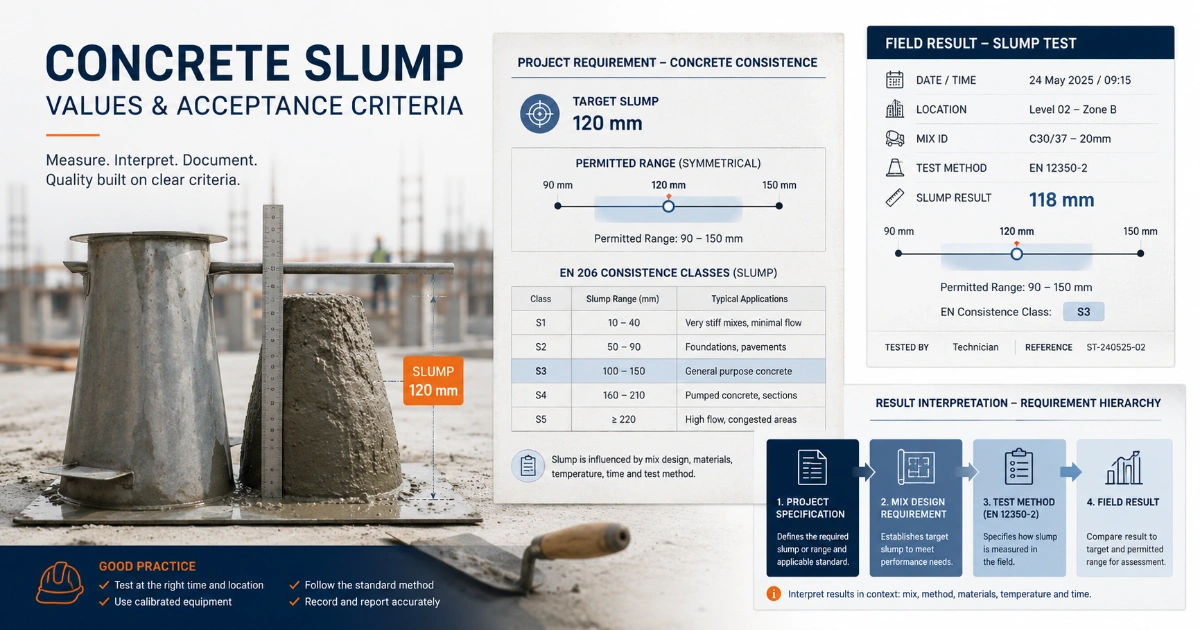
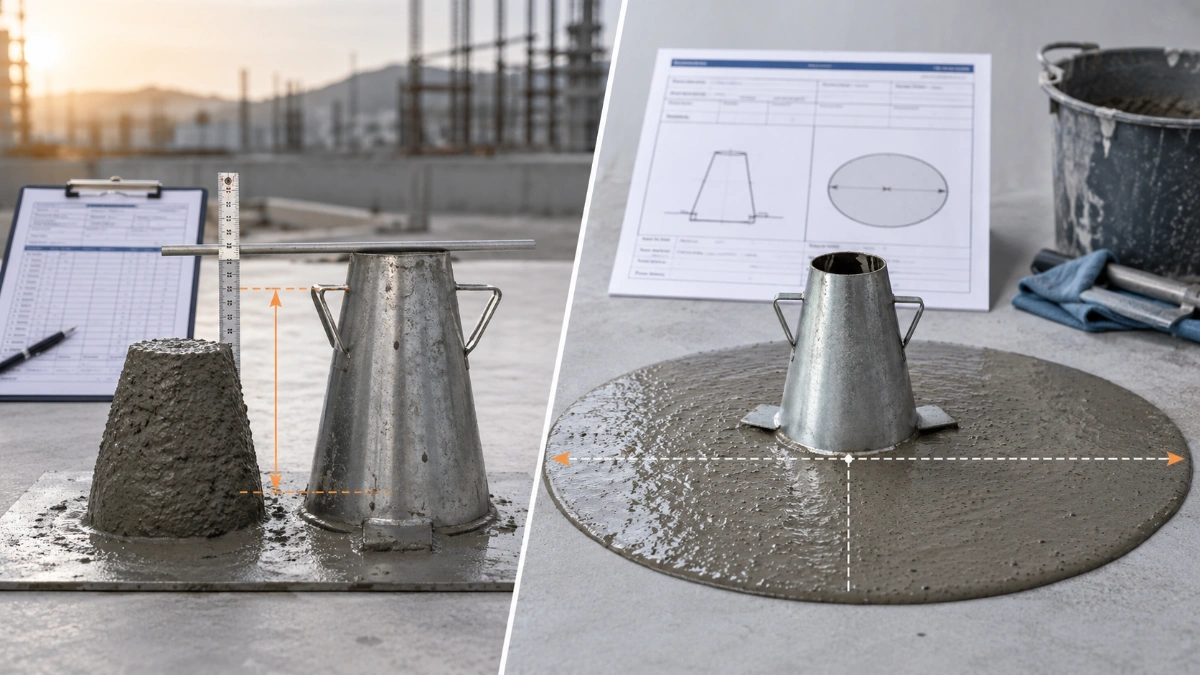
For conventional plastic concrete, a project may specify a slump target, range or other permitted consistency requirement and test it using the applicable slump-test standard. ASTM C143/C143M-26b is the current ASTM slump test for plastic concrete, while BS EN 12350-2:2019 is the current BSI slump-test standard.
For self-compacting or self-consolidating concrete, the project should use the appropriate SCC consistency system instead of forcing the material into an ordinary slump requirement. ASTM C1611/C1611M-21 covers slump flow of self-consolidating concrete, and BS EN 12350-8:2019 covers the slump-flow test for self-compacting concrete.
How should the slump requirement be written?
The requirement should be written in the same system used by the governing project standard and concrete specification. Depending on that system, the designer may state:
- a target slump;
- a permitted slump range;
- a maximum or minimum where the governing specification uses one;
- a consistence class; or
- a slump-flow class or target for self-compacting concrete.
The specification should also identify the applicable test method and define where the requirement applies, for example at the point of discharge or another project-defined test location. If the project relies on a target plus tolerance, the basis for that tolerance should come from the governing specification rather than being invented on site.
ASTM specification route: separate the concrete order from the slump test
ASTM C94/C94M-26c is the current ASTM specification for ready-mixed concrete. It covers ready-mixed concrete supplied to a purchaser and recognizes that purchaser requirements stated in the order may govern where they differ from the standard's general requirements.
ASTM C143/C143M-26b is different: it is the test method used to determine slump of plastic concrete. It tells the project how to measure the slump; it does not, by itself, tell the designer what slump to specify for a slab, beam, column or wall.
The practical sequence is therefore:
- the designer/specifier establishes the required concrete performance and consistency;
- the requirement is incorporated into the concrete specification/order and approved mix process;
- the project identifies the applicable slump-test method and test location; and
- site QA/QC compares the measured result with the actual project requirement.
EN / BS specification route: use the concrete specification system first
BS EN 206-1:2026 is the current BSI standard covering specification, performance, production and conformity of concrete. It applies to normal, heavy and lightweight concrete and includes both compacted and self-compacting concrete within its scope.
Under this route, the specifier should establish the concrete requirement using the applicable EN 206 system and national provisions, then use the relevant fresh-concrete test standard to verify the specified consistency. BS EN 12350-2:2019 covers ordinary slump testing, while BS EN 12350-8:2019 covers slump flow for self-compacting concrete.
The important distinction is the same as under ASTM: the test method measures the concrete; the concrete specification defines what the project requires.
Example of project specification wording
A project clause can be concise while still making the engineering intent clear. The following is an illustrative structure, not a universal specification:
Example only — project requirements govern.
Fresh-concrete consistency for each approved mix shall be specified as the project-defined target, range or consistence class appropriate to the intended placement method and element. The requirement shall be verified at the project-defined test location using the applicable standard test method. Self-compacting concrete shall use the project-specified slump-flow requirement and corresponding SCC test method. Any site adjustment, retest or disposition shall follow the approved project procedure.
The final project wording should identify the actual mix, consistency requirement, test standard and test location. It may also reference the approved method statement or ITP for site verification without turning the specification clause into an inspection procedure.
Coordinate the specified slump with the approved mix and concrete supplier
The consistency requirement should be technically achievable by the approved mix throughout the expected delivery and placement window. The producer should not first discover the project requirement when the truck arrives on site.
During mix approval and trial work, coordinate:
- the specified consistency system;
- placement and pumping method;
- aggregate size and grading constraints;
- admixture type and dosage strategy;
- slump or slump-flow retention required for expected delivery and placing time;
- temperature and environmental conditions where relevant; and
- the procedure for any permitted adjustment before placement.
This is where the specification becomes a practical concrete requirement rather than a number copied from a generic table.
How the site team should verify the specified requirement
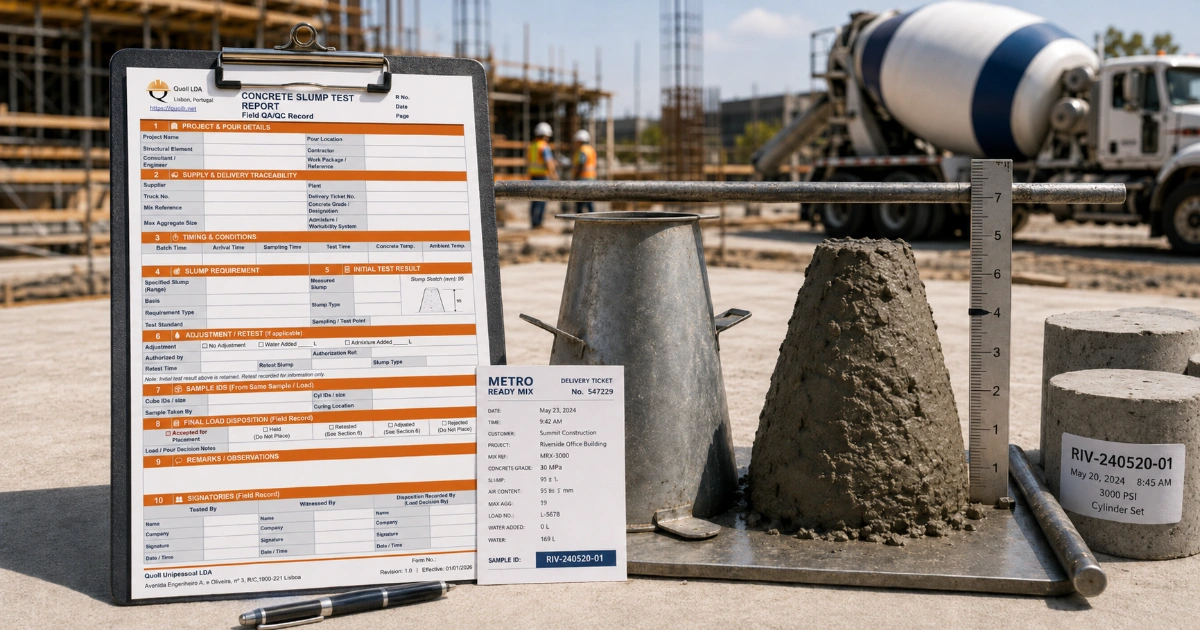
Once the consistency requirement is established, site QA/QC should record the project requirement and the measured result separately. The Concrete Slump Test Report Template is designed for that detailed field record, while the Concrete Slump Register & Log provides project-level tracking across many tests.
The truck/load can be linked to the test and specimen records using the Concrete Truck Arrival & Delivery Record Template.
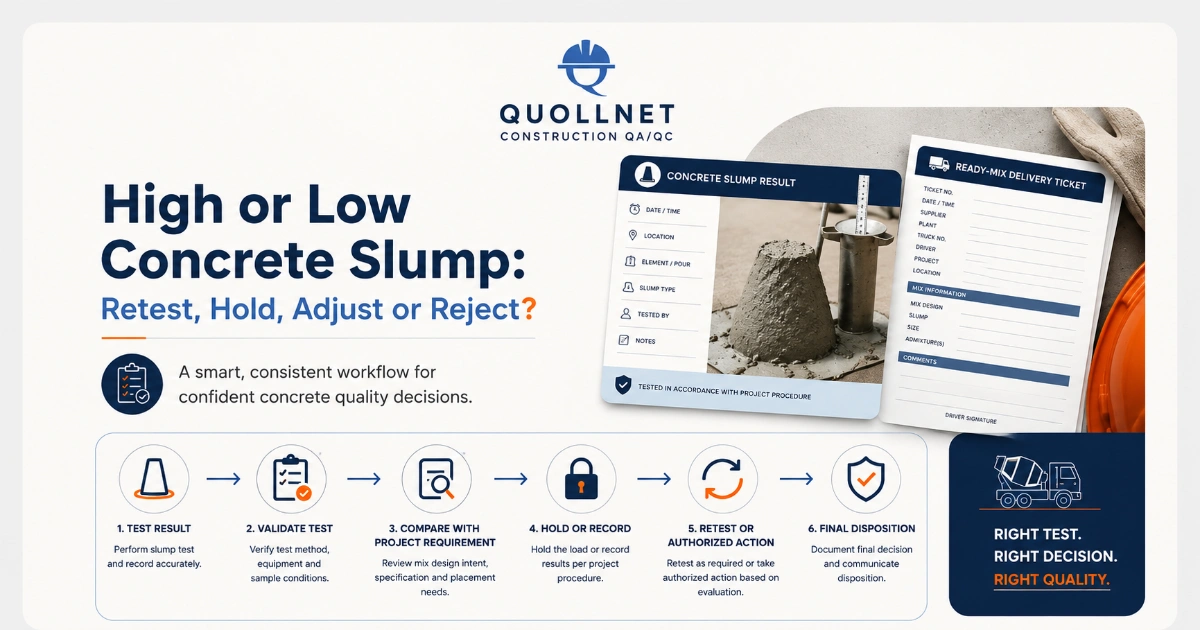
If the measured result is outside the specified project requirement, use the decision sequence in High or Low Concrete Slump: Retest, Hold, Adjust or Reject?. An outside-range result does not itself authorize water addition, adjustment, placement or rejection.
For the broader site execution workflow, the Method Statement: Receiving and Acceptance Testing of Ready-Mix Concrete on Site and the ITP – Ready-Mix Concrete Point-of-Discharge Inspection and Testing show how the specified requirement can be integrated into delivery, testing and inspection controls.
Common concrete slump specification mistakes
- Assigning one universal slump to every slab, beam, column or wall.
- Specifying slump without considering the actual placement method.
- Using a high slump requirement to compensate for reinforcement congestion when self-compacting concrete or another mix strategy may be more appropriate.
- Assuming higher slump automatically means lower strength.
- Allowing the site team to achieve the specified slump by uncontrolled water addition.
- Failing to distinguish ordinary slump from slump flow for self-compacting concrete.
- Specifying a target but not identifying the applicable test method or measurement point.
- Copying a generic tolerance or acceptance range that is not supported by the governing project specification.
- Ignoring slump retention where transport and placement time are significant.
- Writing the consistency requirement independently of the approved mix and supplier's demonstrated performance.
Concrete slump specification checklist for designers
Before issuing the concrete specification, confirm that the following questions have been answered:
- Is the concrete conventional vibrated concrete or self-compacting concrete?
- How will the concrete be transported and placed?
- How congested is the reinforcement and what is the clear path for aggregate?
- Can the element be compacted reliably with the proposed equipment?
- Are there finishing requirements that affect the desired fresh-concrete behavior?
- Has the approved mix/admixture strategy been coordinated with the required consistency?
- Does the requirement need to be retained over a defined delivery or placing period?
- Is the requirement expressed as the correct target, range, class or slump-flow parameter?
- Is the applicable test standard identified?
- Is the measurement location clear?
- Are retest, adjustment and disposition procedures controlled elsewhere in the project documents rather than improvised in the specification?
References
ASTM C94/C94M-26c – Standard Specification for Ready-Mixed Concrete
ASTM C143/C143M-26b – Standard Test Method for Slump of Concrete
BS EN 206-1:2026 – Concrete: Specification, performance, production and conformity
BS EN 12350-2:2019 – Testing fresh concrete: Slump test
ASTM C1611/C1611M-21 – Standard Test Method for Slump Flow of Self-Consolidating Concrete
BS EN 12350-8:2019 – Testing fresh concrete: Self-compacting concrete slump-flow test