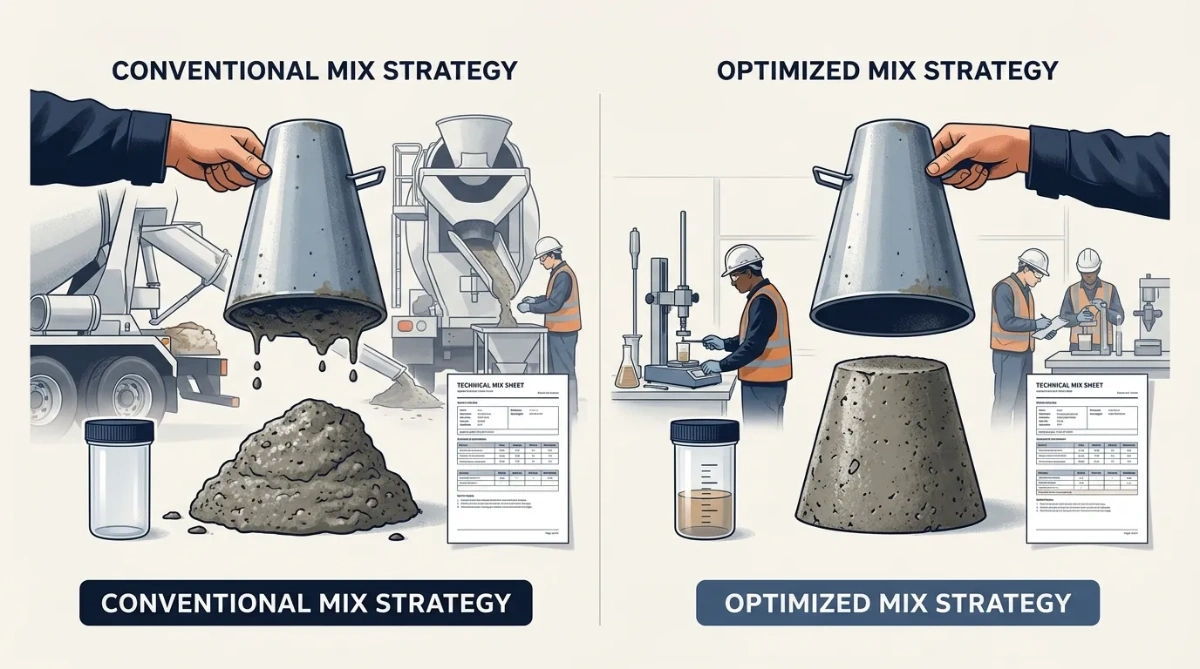
Plasticizers and Superplasticizers: How They Affect Concrete Slump
Plasticizers and superplasticizers can increase concrete slump or reduce water demand by improving cement-particle dispersion, so a high slump does not automatically mean that extra water was added or that the concrete will be weak. Their effect depends on admixture type and formulation, cement and supplementary cementitious materials, dosage, temperature, time and the approved mix. Use the product and dosage established by the concrete producer and approved mix, and treat site redosing or water addition as controlled changes rather than informal corrections.
Planned as a technical reference to admixture families, common chemistries, functions, slump-retention characteristics, applications, compatibility considerations and standard classifications. It is not a dosage or mix-design table.
What plasticizers and superplasticizers do in concrete
Plasticizers and superplasticizers are chemical admixtures used to change the fresh-concrete behavior without relying only on additional mixing water. In practice, they are used to achieve one or both of two different objectives:
- Increase workability at similar water content. The concrete may become easier to place, pump or compact while the designed water content is broadly maintained.
- Reduce water at similar workability. The required slump or flow can be maintained with less water, which can support a lower water-to-cementitious-materials ratio when the mix is designed accordingly.
Those two objectives are related but not identical. The concrete producer needs to know whether the priority is greater initial workability, lower water demand, longer retention, higher early strength, SCC performance, or another defined property.
Plasticizer vs superplasticizer: what is the difference?
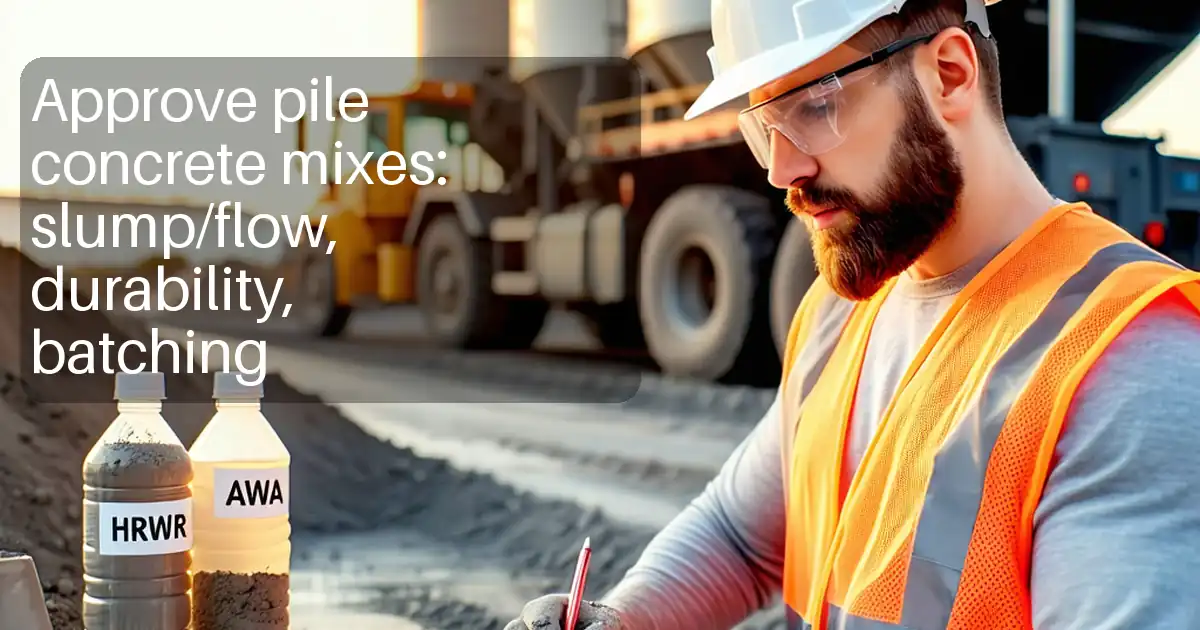
The terminology varies between standards, regions and manufacturers. In general construction use, a plasticizer usually means a conventional water-reducing admixture, while a superplasticizer means a high-range water-reducing admixture capable of producing a larger change in water demand or workability.
ASTM C494/C494M-24 classifies chemical admixtures by performance. Relevant categories include Type A water-reducing admixtures, Type D water-reducing and retarding admixtures, Type E water-reducing and accelerating admixtures, Type F high-range water-reducing admixtures, and Type G high-range water-reducing and retarding admixtures. The standard classification describes required performance rather than prescribing one chemical family.
Under the European route, BS EN 934-2:2009+A1:2012 covers definitions and performance requirements for concrete admixtures, including water-reducing/plasticizing and high-range water-reducing/superplasticizing functions.
| Admixture concept | Typical engineering objective | Important note |
|---|---|---|
| Conventional water reducer / plasticizer | Moderate water reduction or improved workability | Performance depends on product, dosage and mix constituents |
| High-range water reducer / superplasticizer | Large water reduction, high workability, high-performance mixes | Higher workability must still be compatible with stability and placement needs |
| Slump-retaining formulation | Maintain workability over haul or waiting time | Retention is not the same thing as set retardation |
| Water-reducing retarder | Water reduction plus delayed setting | Useful where placement time is a concern, but setting effect must be planned |
| Accelerating admixture | Faster setting or early-strength development | A separate functional objective; not every superplasticizer is an accelerator |
How can superplasticizer increase slump without adding more water?
Fresh cement particles tend to form flocculated clusters that trap part of the mixing water and increase internal resistance to flow. Water-reducing admixtures adsorb onto the cementitious particles and improve dispersion. Modern polycarboxylate ether (PCE) superplasticizers can use steric effects, together with electrostatic effects depending on the formulation, to keep particles more effectively separated.
Better dispersion releases more of the existing mixing water to contribute to workability. That is why an approved concrete mix can show a substantial increase in slump even though the water content has not been increased.
This mechanism is also why two concretes with similar measured slump can have very different water contents, water-binder ratios and hardened-concrete potential.
Same slump does not mean the same water-cement ratio
Consider two mixes that arrive at site with similar slump:
- Mix A may rely on a relatively higher water content for mobility.
- Mix B may use lower water content with an effective water-reducing admixture to reach similar workability.
The slump test sees the fresh consistency. It does not tell the inspector which of those mix-design strategies produced that consistency.
This is one reason a measured high slump should not automatically be diagnosed as “too much water.” The batch ticket, approved mix design, permitted additions and any recorded site adjustment matter. Conversely, a low slump does not prove that the concrete has a low water-cement ratio or superior strength.
Slump increase and water reduction are different design choices
A superplasticizer can be used in more than one way. The mix designer may use it mainly to increase slump at the original water content, mainly to reduce water while preserving a target slump, or to achieve a balance of both.
For example, a high-strength mix may use a high-range water reducer so that a low water-binder ratio remains placeable. A ready-mix concrete intended for a difficult pump line may instead prioritize pumpability and workability retention. The same general admixture family can therefore be used for different performance objectives, but the approved mix and trial data should establish how it is being used.
Why concrete loses slump with time
Slump commonly changes between batching and placement because the fresh concrete is not chemically static. Cement hydration begins, particles continue interacting, water is absorbed by constituents, temperature affects reaction rate, and the effectiveness of the admixture changes with time.
Important influences include:
- concrete and ambient temperature;
- haul and waiting time;
- cement chemistry and fineness;
- supplementary cementitious materials such as fly ash, GGBS or silica fume;
- aggregate moisture and fines;
- admixture chemistry and dosage;
- mixing sequence and mixing energy; and
- interaction with other admixtures.
Hot weather and long delivery periods can make retention particularly important. Modern PCE formulations can be engineered for different balances of initial water reduction, retention, setting behavior and early-strength development. That is why “PCE” alone is not a complete product specification.
Slump retention is not the same as set retardation
Slump retention describes the ability of the concrete to preserve useful workability over time. Retardation describes a delay in setting. They can occur together, but they are not the same property.
A retention-oriented superplasticizer may be designed to maintain workability without creating a large delay in setting. A retarding admixture, by contrast, intentionally changes setting behavior. Some commercial formulations combine water reduction and retardation, which is why the product classification and approved mix data should be checked rather than inferred from the word “superplasticizer.”
Plasticizers, superplasticizers and pumped concrete
Pumped concrete needs more than a high slump number. Pumpability depends on the overall rheology of the mix, including paste volume, grading, cohesion, lubrication of the pipeline, segregation resistance and workability retention.
A superplasticizer can improve mobility and reduce the pressure needed to move a well-proportioned mix, but excessive fluidity or poor cohesion can create segregation and instability. The target should therefore be a pumpable, stable concrete system rather than simply the highest achievable slump.
When specifying fresh concrete for difficult placement, use the broader approach in How to Specify Concrete Slump for Slabs, Beams, Columns and Walls: placement method, reinforcement congestion, section geometry and compaction access matter more than element name alone.
How superplasticizers relate to self-compacting concrete
High-range water-reducing admixtures, especially PCE-based systems, are widely used in self-compacting concrete (SCC). SCC, however, is not simply conventional concrete with a very high ordinary slump. It is a deliberately designed concrete system that must flow, fill and consolidate under its own weight while maintaining appropriate stability.
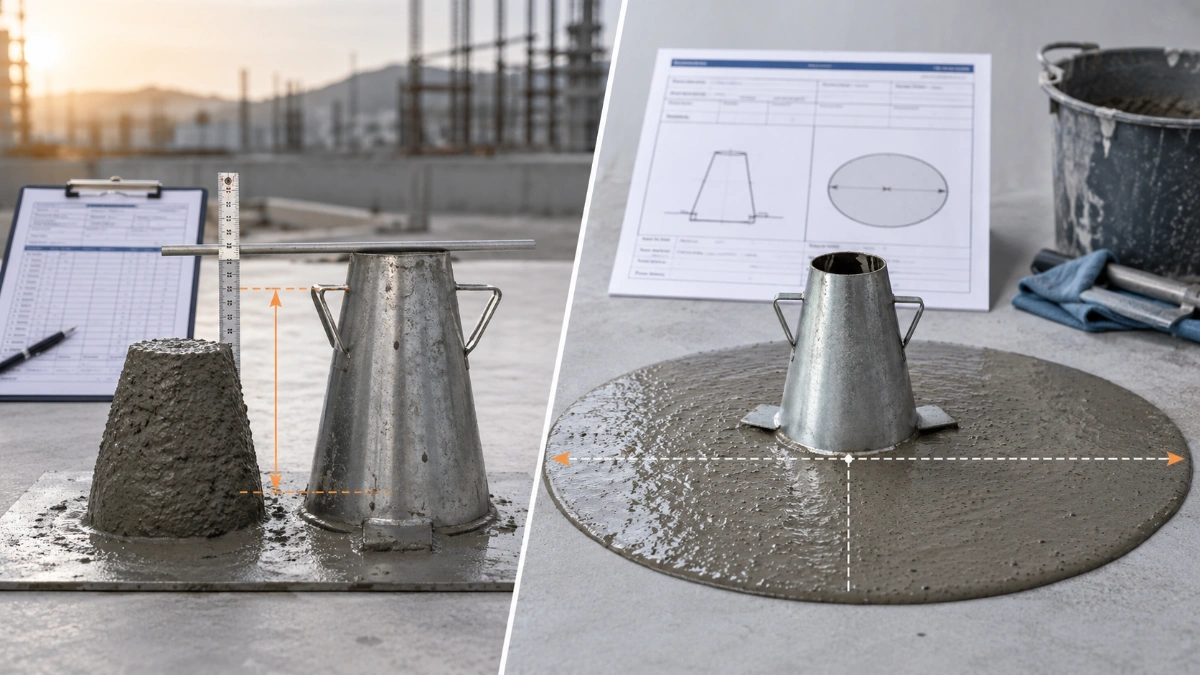
Where SCC is specified, the project should use the appropriate SCC performance requirements and tests. The Slump Test vs Slump Flow Test article explains why ordinary slump and SCC slump-flow measurements are not interchangeable.
Can superplasticizer increase concrete strength?
A superplasticizer does not guarantee strength simply because it is present. Its most important contribution to strength can occur when the mix designer uses the water-reducing capability to lower the water-binder ratio while maintaining workable concrete.
If the cementitious system, curing, compaction and other factors remain appropriate, lower water demand can support higher strength and lower permeability. But strength remains a property of the complete concrete system, not of the admixture in isolation.
Some admixture formulations are also selected to support rapid strength development, while others prioritize retention or retardation. Those objectives need to be distinguished during mix approval.
Does high slump mean weak concrete?
No. High slump can result from excess water, but it can also result from an approved high-range water reducer, an intentionally high-workability mix, or an SCC system. The slump value by itself cannot identify the cause.
The correct site question is not simply “Is the slump high?” It is “Does this measured result comply with the approved requirement for this mix, and is the delivered concrete traceable to the approved batching and adjustment process?”
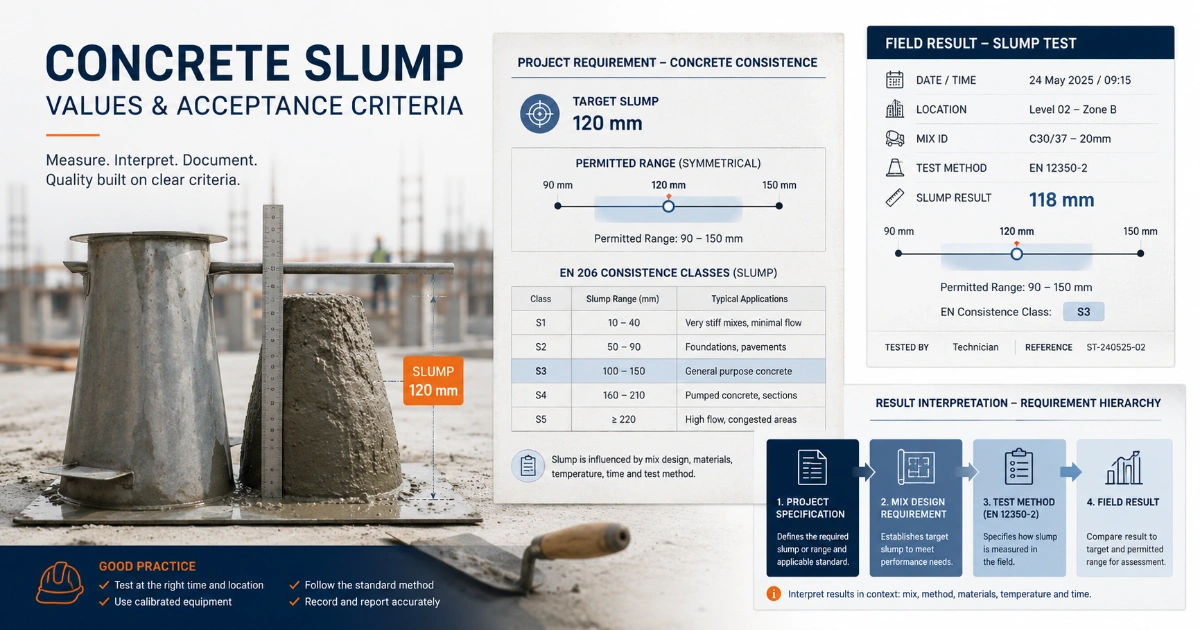
For target values, ranges, classes and acceptance logic, see Concrete Slump Values & Acceptance Criteria.
Does low slump mean stronger concrete?
No. A lower slump is not automatically evidence of lower water content, lower water-cement ratio or higher strength. Low slump may result from time loss, temperature, under-dosing, cement-admixture incompatibility, insufficient paste, aggregate effects or another production issue.
A low-slump load can therefore still be nonconforming or difficult to consolidate. A low measured value should be investigated against the approved mix and project requirement, not celebrated as evidence of strength.
Can admixture be added at site?
Site addition or redosing may be permitted under some ready-mix specifications and producer procedures, but it should be treated as a controlled modification to the delivered concrete. The applicable project specification, approved mix, producer instructions, relevant standard and authorized personnel should govern whether an addition is allowed, what material may be added, how it is measured, how long the concrete is remixed and what retesting or documentation is required.
Informal dosing by site personnel is not a substitute for this process. Adding an unknown quantity of superplasticizer can change workability, setting, air content, stability and later performance.
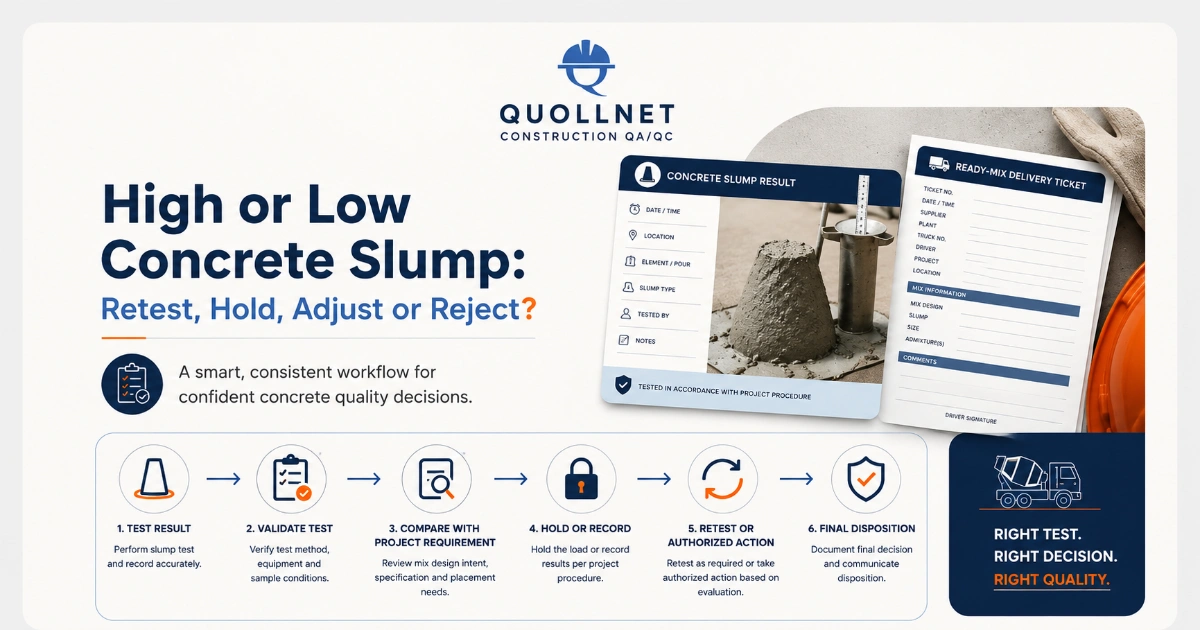
If a conventional slump result is outside the project requirement, follow the controlled workflow in High or Low Concrete Slump: Retest, Hold, Adjust or Reject? rather than correcting the truck by instinct.
Why unauthorized water addition is different
Water and chemical admixture both affect workability, but they do not have the same effect on the concrete system. Additional water directly changes the water content and can increase the water-binder ratio unless the mix was proportioned to allow that addition within a controlled limit.
A water-reducing admixture is intended to modify particle dispersion and rheology. That does not make unlimited admixture addition acceptable; it means the engineering mechanism is different. Both water and admixture additions should therefore be controlled, recorded and evaluated under the approved procedure.
Early strength, accelerators and superplasticizers are not the same thing
If the project needs higher early strength, the appropriate solution depends on why. A high-range water reducer may support early strength by enabling a lower water-binder ratio while preserving workability. An accelerating admixture may be used when faster setting or early-strength development is the actual objective. A different superplasticizer formulation may be selected to avoid unwanted retardation.
This distinction matters because “I need early strength” does not automatically translate to “add more superplasticizer.” The requirement should first be converted into a concrete performance objective.
Compatibility can matter as much as admixture type
The same admixture can behave differently when cement, supplementary cementitious materials, aggregate fines, temperature or other admixtures change. ACI 212.3R-16 emphasizes that successful admixture use depends on compatibility, setting behavior and early strength being appropriate to the placing environment.
Compatibility issues may appear as:
- unexpectedly rapid slump loss;
- delayed or accelerated setting;
- excessive stickiness or poor finishing;
- segregation or bleeding;
- air-content changes;
- inconsistent response to dosage; or
- different behavior after a cement or SCM source changes.
This is why trial mixes and producer data are more reliable than copying a dosage from another project.
Common plasticizer and superplasticizer chemistries
Common water-reducing and high-range water-reducing technologies include lignosulfonate-based systems, sulfonated naphthalene-formaldehyde (SNF), sulfonated melamine-formaldehyde (SMF) and polycarboxylate ether (PCE) systems. Modern PCE technology is especially flexible because polymer structure can be adjusted to target different balances of water reduction, initial flow, retention, rheology and strength development.
Chemistry alone does not tell the full performance story. Two PCE products can behave differently because the polymer design, concentration, formulation and intended application differ.
Practical selection questions before choosing an admixture strategy
Concrete Admixture Strategy Selector
Choose the main performance change you need from the concrete.
Selection aid — not a product, dosage or mix-design recommendation.
Final selection and dosage depend on the approved mix, compatibility and trial data, temperature, concrete producer and project specification. Any site addition or redosing must follow the approved producer/project procedure.
Before choosing an admixture family or asking the supplier for a product, define the actual need:
- Do I need more initial workability? Consider a suitable water reducer or high-range water reducer.
- Do I need lower water at the same slump? Focus on water-reduction performance and the target water-binder ratio.
- Do I need the slump to last longer? Focus on workability retention, haul time, temperature and placing sequence.
- Do I need slower setting as well? Retarding performance may be a separate requirement.
- Do I need faster setting or early strength? Consider whether acceleration, lower water demand, a different binder strategy or a combination is required.
- Do I need SCC? Use an SCC mix-design approach and the relevant slump-flow requirements rather than simply increasing ordinary slump.
- Do I need better pumping? Review total rheology and stability, not slump alone.
These questions are also the point where a small admixture-selection aid may be useful. Any such tool should suggest an admixture strategy, not a brand, dosage or automatic mix-design decision.
Common field mistakes
- Assuming high slump automatically means too much water.
- Assuming low slump automatically means high strength.
- Increasing water because the concrete has lost slump without checking the approved adjustment procedure.
- Redosing superplasticizer without authorization or measured control.
- Assuming every PCE product has the same retention and setting behavior.
- Confusing slump retention with setting retardation.
- Selecting a product from a generic dosage table rather than the approved mix and supplier data.
- Using ordinary slump as the control for SCC instead of the specified SCC test system.
- Chasing pumpability by slump alone while ignoring cohesion and segregation resistance.
- Treating the admixture as an isolated ingredient instead of part of the full cementitious system.
What should be recorded when admixtures affect site workability?
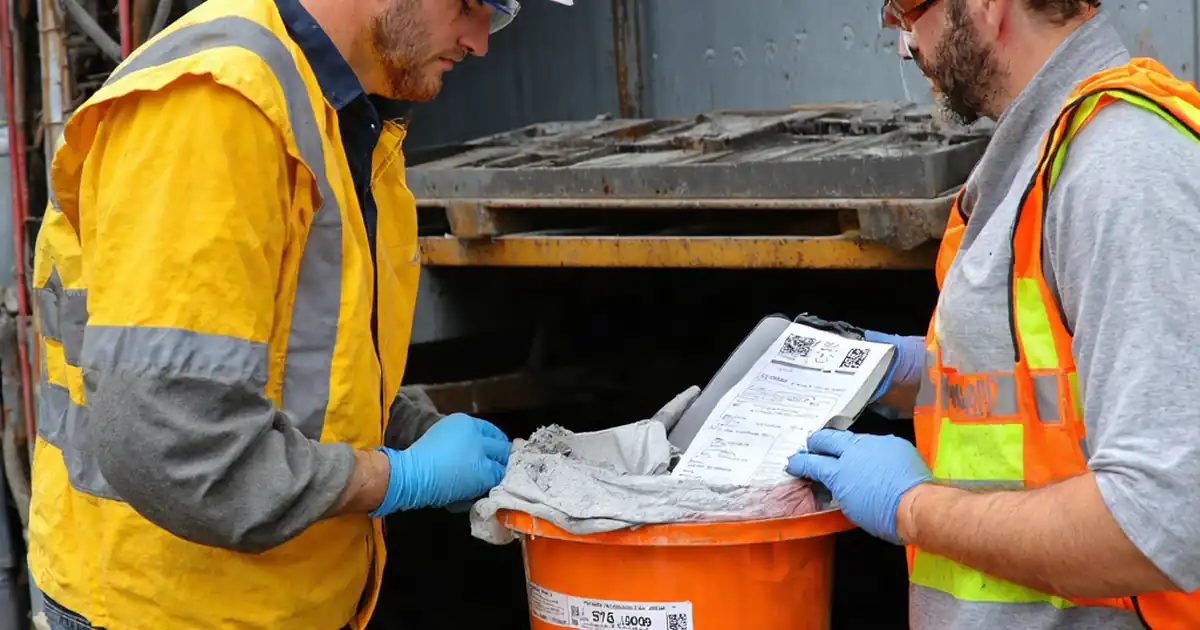
Where workability, redosing or site adjustment becomes important, the quality record should preserve traceability. Useful records include the approved mix ID, batch and truck identification, admixture product and batch where required, original and adjusted quantities when an authorized addition occurs, time of addition, remixing time, test location, measured slump or slump flow, and the final disposition.
The measured result should still be assessed against the applicable project requirement rather than against a generic expectation about what a superplasticized mix “should” look like.
References
ASTM C494/C494M-24 – Standard Specification for Chemical Admixtures for Concrete
ASTM C94/C94M – Standard Specification for Ready-Mixed Concrete