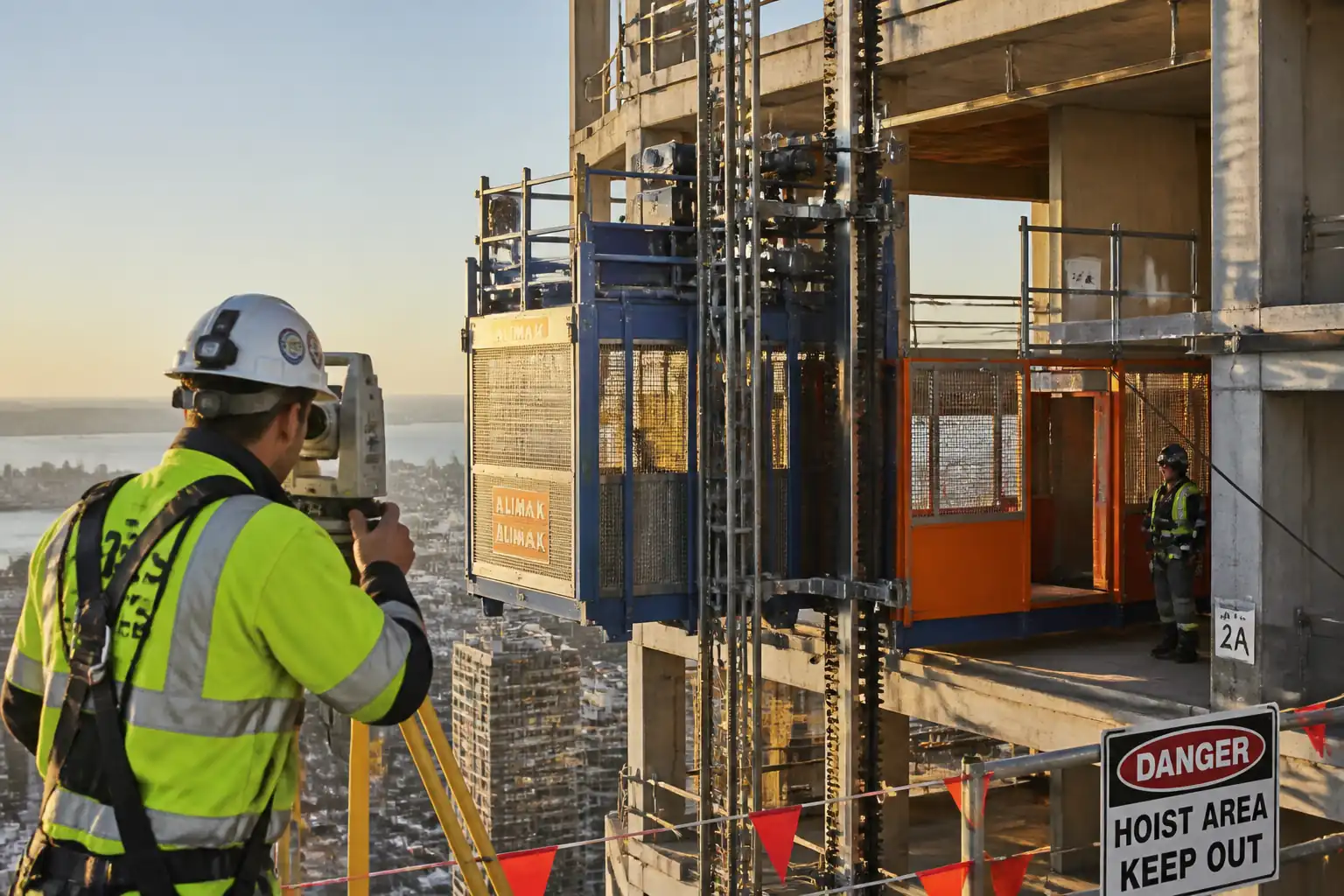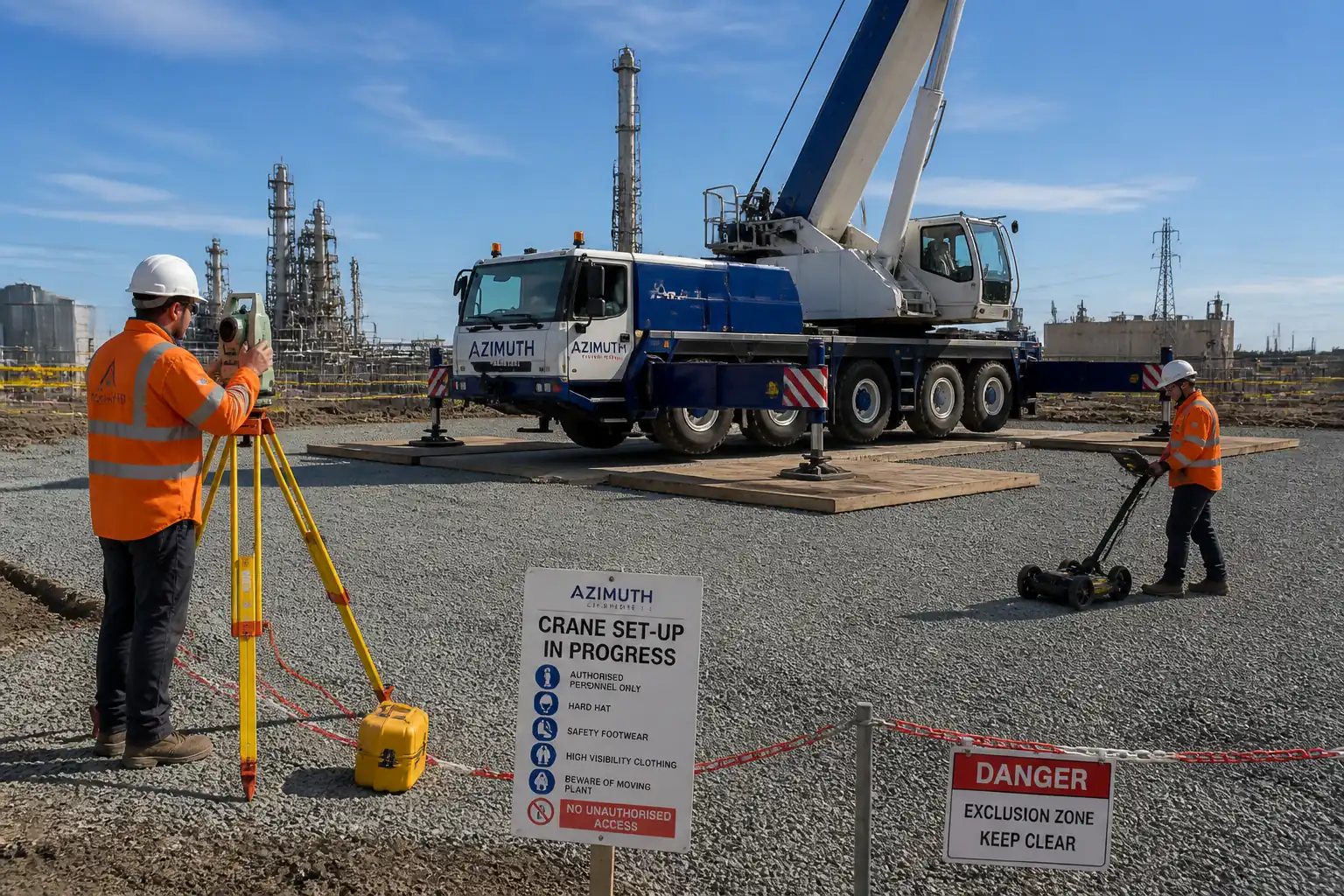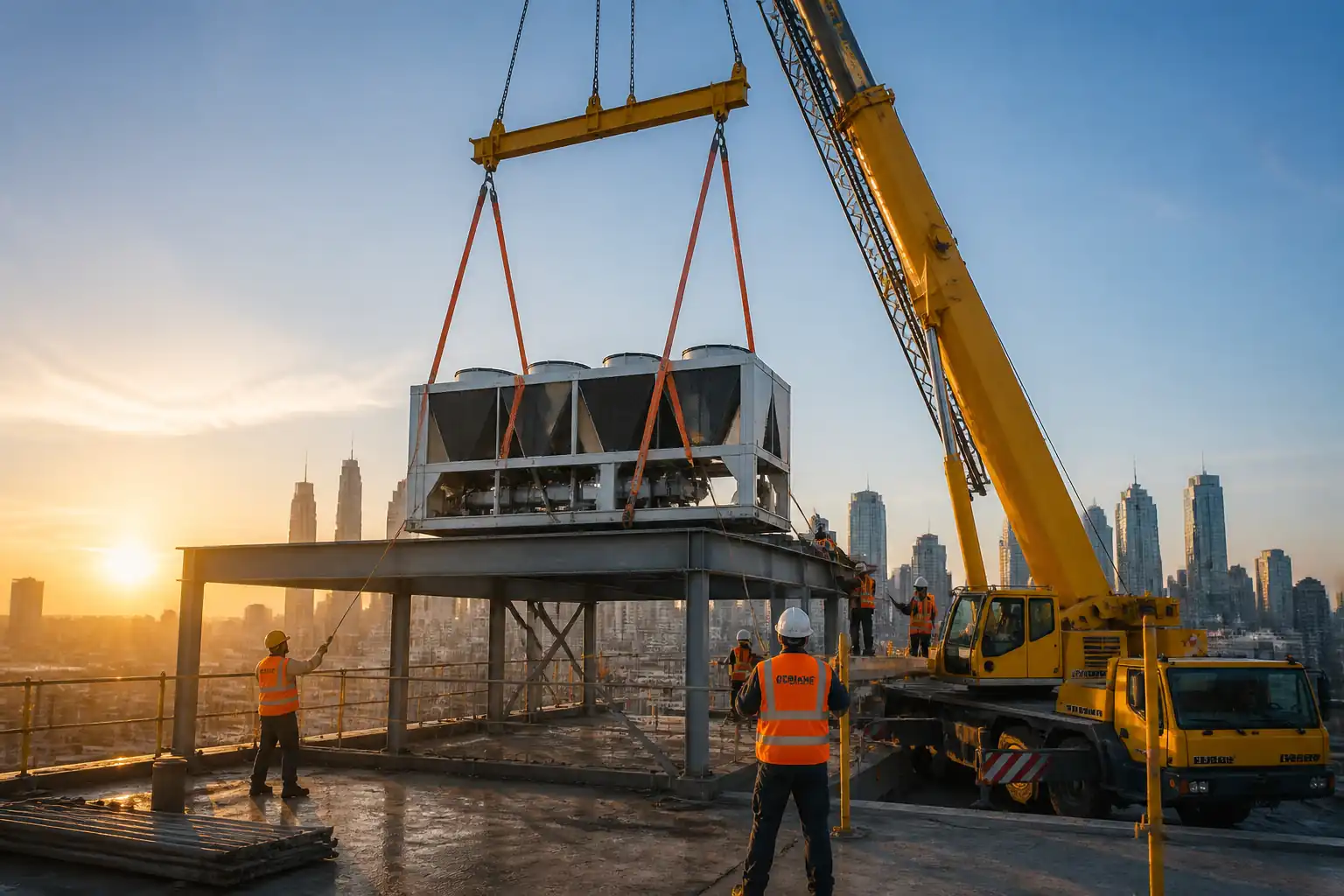

Method Statement – Material Delivery Intake via Elevated Tower Crane Loading Platforms – Method Statement
AI-assisted method statement with matching ITP, PDF download, and Excel export.
More than a static template
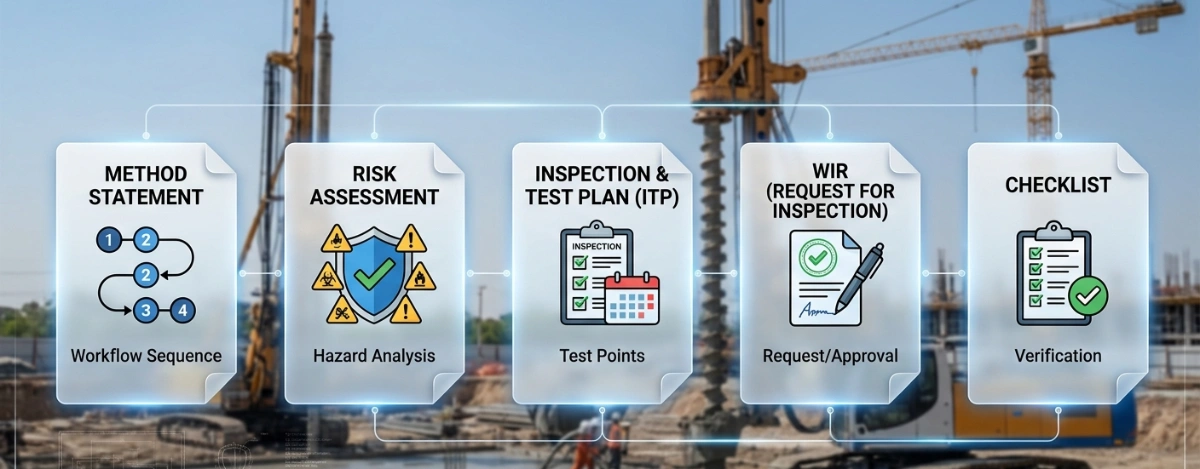
Unlike a downloadable Word or PDF template, this method statement is an AI-assisted editable starting point connected directly to a matching Inspection and Test Plan. Every section is structured, project-adaptable, and ready to export.
- AI-assisted drafting — Customize every section with AI for your specific project scope.
- Linked ITP — A matching inspection and test plan is generated alongside the method statement.
- Multiple export formats — Download as a formatted PDF or editable Excel spreadsheet.
- Editable starting point, not a final document — Review, verify, and adjust all content against your project requirements before use.
Static template vs. Quollnet workflow
| Feature | Static template | Quollnet |
|---|---|---|
| Project-specific content | Manual fill-in required | AI-assisted customization |
| Linked ITP | Separate document, no link | Matching ITP included |
| Export formats | Usually PDF only | PDF and Excel |
| Structured sections | Free-form layout | 13 standardized sections |
| Saved to your account | Local file only | Cloud-saved, reusable |
| Content accuracy | You verify everything | AI-assisted, you still verify |
| Cost | Often free but time-intensive | Free to customize and download |
What you can customize
When you save this method statement to your account, every section becomes editable. The following 13 sections are included:
- Scope — Defines the activity and its boundaries.
- References — Standards, specifications, and drawings.
- Responsibilities — Roles and accountabilities.
- Resources — Labour, plant, and equipment summary.
- Materials — Materials and compliance requirements.
- Equipment — Tools and equipment details.
- Prerequisites — Hold points and pre-conditions.
- Method sequence — Step-by-step construction sequence.
- Safety controls — HSE risk controls and PPE.
- Environmental controls — Environmental mitigation measures.
- QA/QC — Quality inspection and test requirements.
- ITP — Inspection and Test Plan table (has its own page).
- Attachments — Referenced drawings and documentation.
Why this method statement is used
This method statement is used to define and communicate the approved procedure for carrying out method statement – material delivery intake via elevated tower crane loading platforms on site. It ensures the work is planned in advance, the correct resources and controls are in place, and all personnel understand responsibilities, sequence, quality requirements, and safety controls before work begins. It aligns site execution with the documented scope and acceptance expectations.
Who uses this method statement
This method statement is used by contractors, site supervisors, project engineers, QA/QC engineers, HSE officers, consultants, and client representatives. It serves as a shared reference for planning, execution, supervision, inspection, and approval of the activity on site.
When it is prepared and submitted
The method statement is prepared before the work activity starts and submitted as part of the pre-construction documentation package for review and approval.
Who reviews or approves it
The method statement is usually submitted to the client representative, consultant, resident engineer, or project management consultant for review and approval before the work commences.
Important approval note
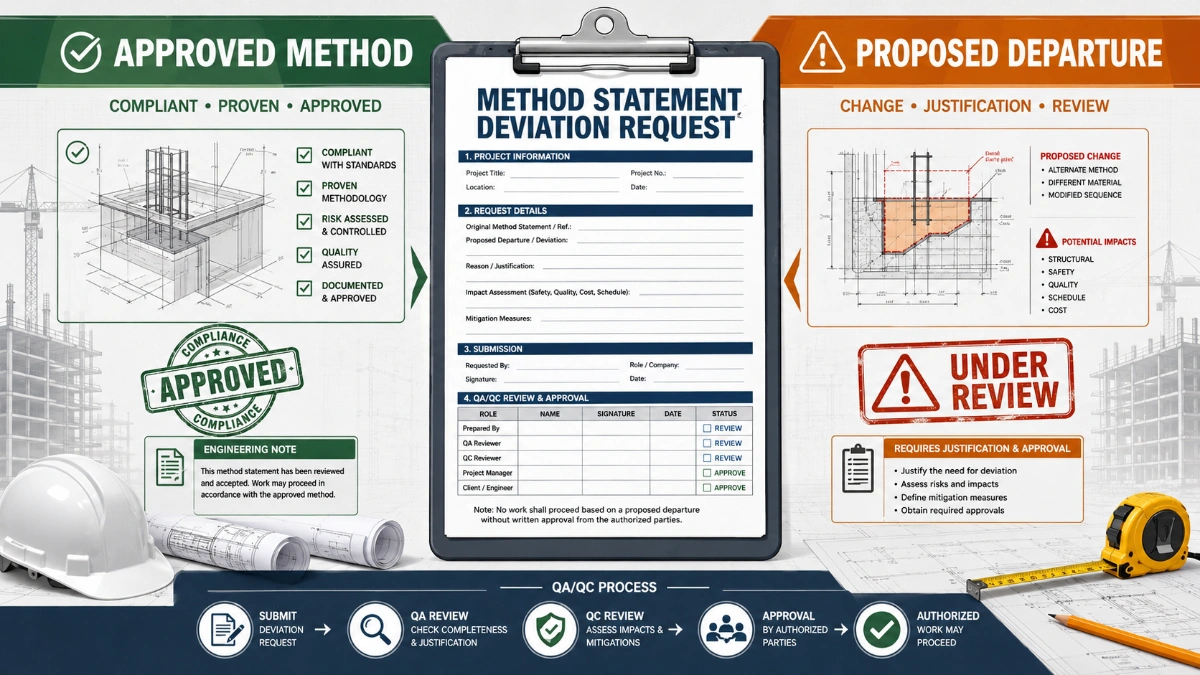
This method statement is an AI-assisted editable starting point, not a pre-approved document. Before use on any project, all content must be reviewed and approved by the relevant parties (superintendent, principal contractor, or client representative) in accordance with your contract and project quality plan.
For example: if your specification requires a departure from a referenced standard, that departure must be documented and approved separately — this method statement will not capture that automatically. Always verify against your applicable drawings, specifications, and regulatory requirements.
Method statement content
Scope
Work Summary
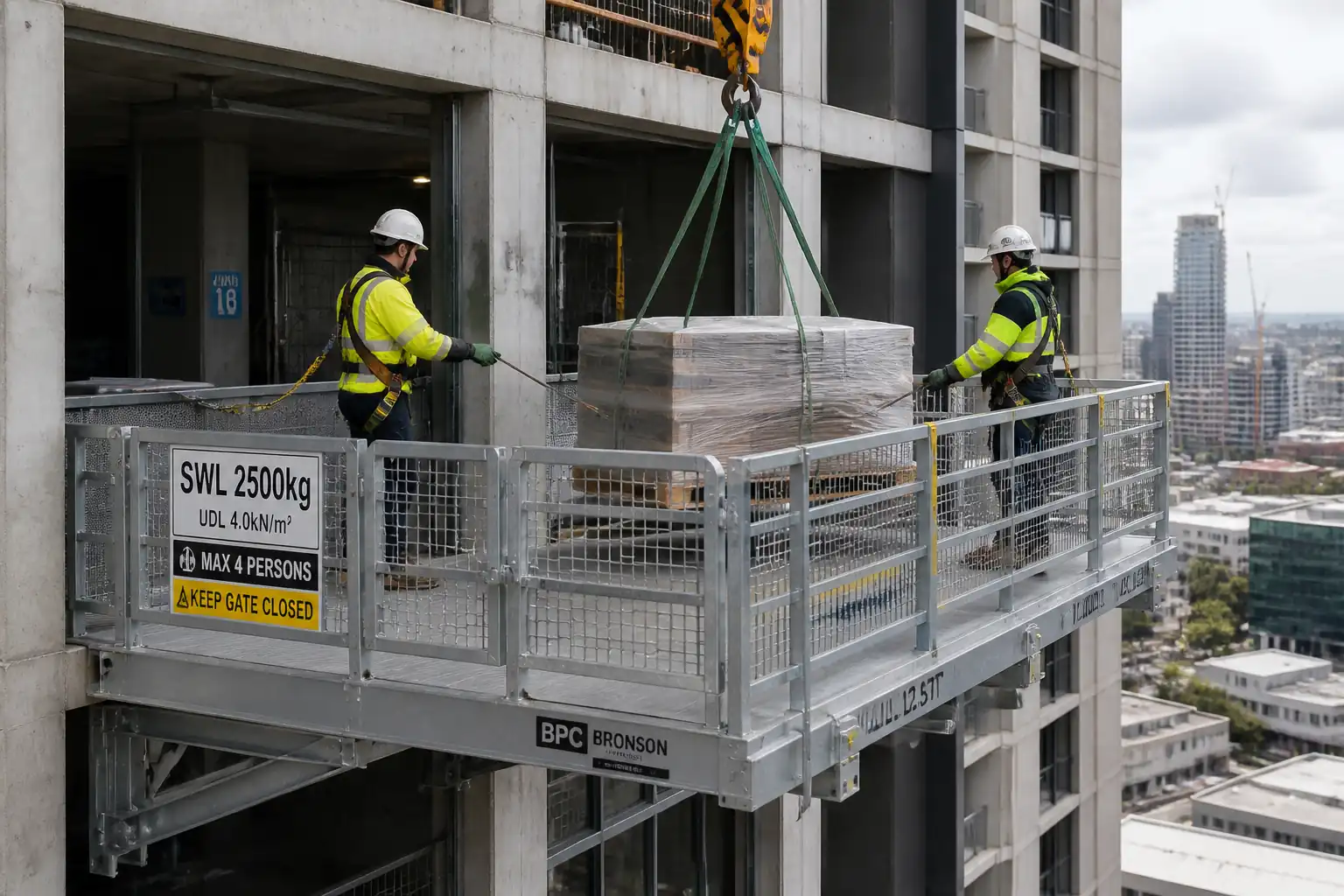
This method statement covers planning, control, and execution of material delivery intake via elevated cantilever loading platforms served by a tower crane. It includes:
- Pre-planning, permits, and temporary works coordination.
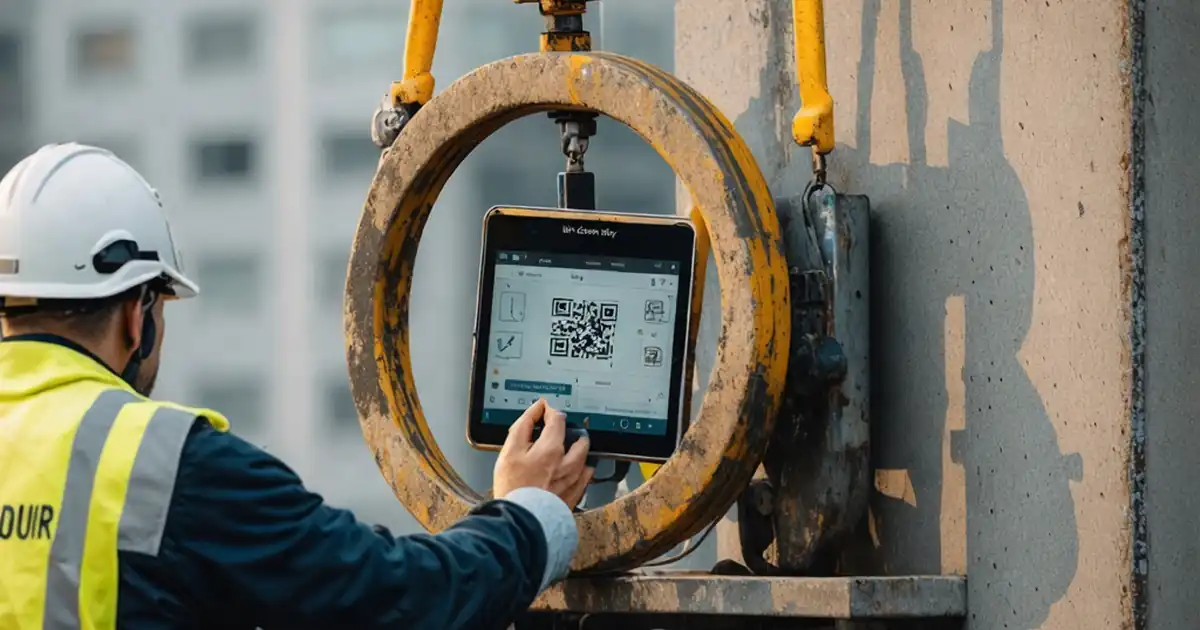
- Pre-use inspection and functional testing of loading platforms, including perimeter gate interlocks and SWL/UDL signage.
- Structural anchor point proof/pull-out testing of platform fixings.
- Setup and verification of delivery vehicle lorry-loader/mobile crane outriggers and landing plates (where used) including level and bearing checks.
- Lifting, landing, and offloading of materials at elevated platforms, including load distribution controls.
- Communications, exclusion zones, and wind/weather limits.
- QA/QC, ITP, documentation, and record keeping.
Inclusions
- All floors/levels with installed cantilever loading platforms.
- Tower crane lifting activities to/from platforms.
- Ground delivery interface with mobile cranes/lorry-loaders (if used) for feeding tower crane.
Exclusions
- Permanent works design of the building structure.
- Initial installation and structural design of the loading platforms beyond pre-use checks (separate TWD/TWC method applies).
- Dismantling/removal of platforms (separate method applies).
References
| Document Type | Reference / Number | Revision | Notes |
|---|---|---|---|
| BS 5975 – Code of practice for temporary works procedures and the permissible stress design of falsework (Temporary Works, TWC/TWD, categories) | Temporary works governance for loading platforms and anchor verification. | ||
| BS 7121 series / ISO 12480-1 – Safe use of cranes (planning of lifting operations, appointed person, signalling) [Use ASME B30.3/B30.5 where applicable] | Lift planning and execution. | ||
| EN 14439 / ASME B30.3 – Tower cranes (safety and operation) | Operational limits and safety requirements. | ||
| BS EN 1992-4 and BS 8539 – Design, selection, and installation of anchors in concrete; on-site testing guidance | Anchor design and proof/pull-out testing principles. | ||
| ASTM E488/E488M – Strength of anchors in concrete elements (tension/shear field tests) | Field pull-out testing procedures and acceptance evaluation. | ||
| ISO 13849-1 and EN ISO 14119 – Safety of machinery; safety-related control systems and interlocking devices | Performance level (PL) and functional testing basis for gate interlocks [Verify per supplier]. | ||
| EN 1991-1-1 – Actions on structures (loads); Manufacturer O&M for platform SWL/UDL and point loads | Load distribution limits and signage content. | ||
| EN 13374 – Temporary edge protection systems (where applicable to platform edge barriers) | Edge protection performance classes and inspection. |
Responsibilities
| Role | Responsibility | Name / Party |
|---|---|---|
| PM | Project Manager | Main Contractor |
| TWC | Temporary Works Coordinator (TWC) | Main Contractor |
| Designer | Temporary Works Designer (TWD) | Designer/Supplier |
| AP (Lifting) | Appointed Person (Lifting) / Lift Planner | Main Contractor |
| Operator | Tower Crane Operator | Crane Supplier |
| Slinger/Signaller | Slinger/Signaller (Certified) | Main Contractor |
| Supervisor | Platform Supervisor | Main Contractor |
| QA/QC | QA/QC Engineer | Main Contractor |
| HSE | HSE Manager/Officer | Main Contractor |
| Technician | Electrical/Controls Technician (if powered interlocks) | Platform Supplier/MC |
Resources
| Resource Type | Description | Quantity | Remarks |
|---|---|---|---|
| Tower Crane Operator (certified) | 1 per shift | ||
| Slinger/Signaller (certified) | 2 per lift zone | ||
| Platform Supervisor | 1 per active platform | ||
| Temporary Works Coordinator | Shared | ||
| QA/QC Engineer | Shared | ||
| HSE Officer | Shared |
Materials
| Material | Specification / Grade | Quantity | Remarks |
|---|---|---|---|
| Structural anchors for platforms (cast-in, through-bolts, or post-installed) | Design to BS EN 1992-4 / BS 8539; pull-test per TWD; stainless or galvanized as specified [Verify per project specifications]. | ||
| Deck bearers and spreaders | Hardwood/engineered timber or steel spreaders sized to achieve UDL/point load limits [Verify per TWD]. | ||
| SWL/UDL/Point Load signage | Minimum 50 mm letter height; show UDL (kN/m²), max point load (kN), max pallet weight (kg), and number of pallets allowed [Verify per TWD]. | ||
| Gate interlock assemblies, switches, and cabling | Compliant with EN ISO 14119 and ISO 13849-1 PL rating as specified by supplier [Verify]. | ||
| Lifting accessories (slings, shackles, spreader beams) | EN 818/EN 1492/EN 1677; WLL adequate; current certificates; color-coded. |
Equipment
| Equipment | Capacity / Type | Quantity | Inspection Required |
|---|---|---|---|
| Tower crane | Per crane chart; hook path to platform clear | Daily pre-use; periodic thorough examination in date | |
| Lorry-loader/mobile crane with outriggers | Per lift plan | Operator daily checks; LOLER/Thorough Examination in date [Verify local equivalent] | |
| Anchor pull-test apparatus (e.g., Hydrajaws) with calibrated gauge | ≥ design proof load | Calibration certificate ≤ 12 months [Verify per QA plan] | |
| Anemometer at crane; handheld at platform | 0–40 m/s | Calibration/functional check | |
| Digital level/laser level and inclinometer | ±0.1° | Pre-use check | |
| Outrigger mats/landing plates | Sized per ground bearing calc | Visual integrity; dimensions verified | |
| Two-way radios with dedicated channel | One per lifting team member | Radio check before lifting |
Prerequisites
Approvals and Documentation
- Approved Temporary Works Design (TWD) for each platform, including anchor type, quantity, layout, proof-test regime, UDL/point load limits, and load path to structure. Checked/approved by TWC per BS 5975.
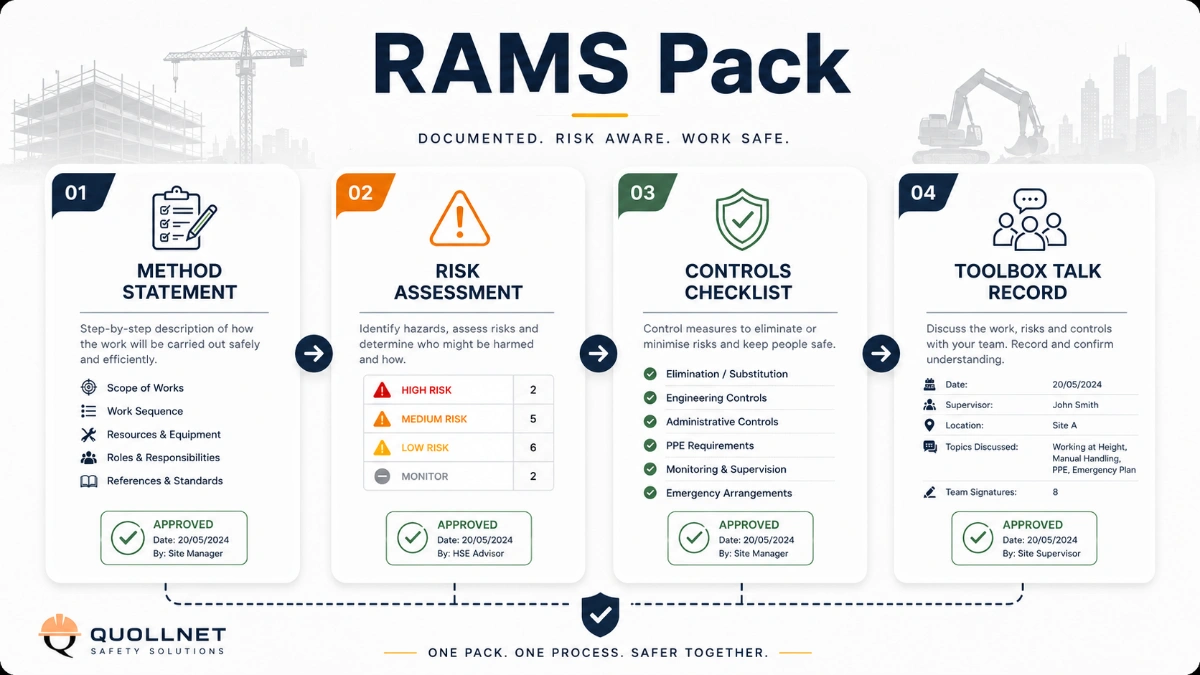
- Approved Lift Plan and Risk Assessment/Method Statement (RAMS) per BS 7121/ISO 12480-1, signed by Appointed Person (Lifting).
- Permit to Lift and Permit to Load (platform) issued daily by Supervisor/TWC.
- Current certificates for crane, lifting accessories, anchor pull-tester calibration, and interlock devices (if applicable).
Site Readiness
- Exclusion zones and edge protection installed; platform installed, identified, and barricaded.
- Ground bearing capacity verified for any mobile crane/lorry-loader outrigger positions; calculation of mat sizes prepared and approved [Verify per project specifications].
- Access/egress routes clear; traffic management in place; lighting adequate for shift.
- Weather forecast checked; wind monitoring available at crane and platform.
- Utilities check completed in outrigger areas [Verify per project HSE plan and local regulations].
Briefings
- Toolbox talks on platform hazards, interlocks, pinch/crush points, suspended loads, and wind limits.
- Pre-lift coordination meeting: operator, slinger/signaller, platform supervisor, QA/QC, HSE.
Method Sequence
| Step | Activity | Description | Responsibility | Inspection / Hold Point |
|---|---|---|---|---|
| 1 | Pre-start brief and documentation check | Confirm TWD and Lift Plan approvals; verify certificates (crane, gear, pull-tester, radios). Issue Permit to Lift and Permit to Load. | AP (Lifting) / Platform Supervisor | Document check |
| 2 | Platform pre-use inspection | Inspect structural components, anchors visible parts, tie-backs, welds, deck, guardrails, toeboards, anti-slip, drainage, and identification. Confirm SWL/UDL/point load signage installed and legible. Check housekeeping and access. | Platform Supervisor / QA/QC | Visual inspection |
| 3 | Perimeter gate interlock functional test | Test mechanical/electrical interlocks and E-stops. Verify gate cannot be opened without authorized action; fails to safe on power loss; alarm/indicator operates; emergency release functional. Cycle test ≥5 times. | Platform Supervisor / Technician | Function test |
| 4 | Structural anchor pull-out proof testing | Select anchors for testing per TWD (e.g., 100% on first platform type, ≥25% thereafter, min 3 per platform) [Verify]. Fit pull-tester with appropriate bridge; apply proof load gradually and hold for ≥60 s while recording displacement. | QA/QC with Supplier/TWC witness | Load test per ASTM E488/BS 8539 principles |
| 5 | Ground delivery setup and outrigger landing plate level checks (if used) | Position delivery vehicle/mobile crane per lift plan. Install mats sized by reaction and allowable bearing. Verify mats fully bearing; level using laser/inclinometer; confirm no voids/instability. Re-check after first pick. | AP (Lifting) / Operator / HSE | Level and bearing check |
| 6 | Communication and wind checks | Radio check on dedicated channel. Confirm exclusion zones. Read wind speed at crane jib and platform; compare to lift plan limits. | Slinger/Signaller / Operator / Supervisor | Functional and environmental check |
| 7 | Load preparation and rigging | Confirm load weight from docket; ensure packaging secure, COG known; install bearers/spreaders on platform to achieve UDL/point load limits. Select certified lifting gear with adequate WLL; attach tag lines. | Slinger/Signaller | Visual and weight verification |
| 8 | Hoisting and approach to platform | Operator lifts smoothly; maintain load clear of structure; final approach perpendicular to platform; maintain tag line control; stop with hook centered over landing position. | Operator / Slinger/Signaller | Operational control |
| 9 | Gate operation and landing | With authorization, open perimeter gate per interlock procedure when load is within safe landing envelope. Land load onto pre-placed bearers; confirm load distribution within marked zones. Keep hands clear; remove tag lines after stable. | Platform Supervisor / Slinger/Signaller | Observation |
| 10 | De-rigging and gate re-securement | Release slings only when load stable and at rest. Close and lock gate; confirm interlock status restored. Clear deck and update load map/signage if pallet remains. | Platform Supervisor / Slinger/Signaller | Visual/function check |
| 11 | Post-lift review and housekeeping | Inspect platform for damage; remove debris; verify anchors and tie-backs visually; record any issues and raise NCR if required. | Platform Supervisor / QA/QC | Visual inspection |
| 12 | Periodic inspections and revalidation | Weekly platform inspection; monthly interlock function re-test; after abnormal events (overload, impact, high winds) perform special inspection and, if required, re-test anchors per TWD. | Platform Supervisor / TWC / QA/QC | Scheduled inspection/tests |
Health, Safety, and Environment (HSE) – Safety Controls
Task-specific Hazards and Controls
1) Hazard: Fall of persons from platform edge or through open gate
- Likely consequence: Serious injury/fatality
- Engineering/procedural control: Perimeter guardrails and self-closing/interlocked gates; controlled gate opening only during landing; lifelines/anchorage where specified; exclusion of non-essential personnel.
- Required PPE: Helmet with chin strap, harness with double lanyard where required by TWD, safety footwear, gloves, high-vis.
- Collective measure: Edge protection per EN 13374 Class A/B as applicable; toe boards; netting where specified.
- Inspection/permit/supervision: Daily platform checklist; interlock function test; Permit to Load; Supervisor present.
2) Hazard: Falling objects during hoisting/landing
- Likely consequence: Struck-by injuries, property damage
- Engineering/procedural control: Secure packaging; secondary retention for loose items; use of tag lines; exclusion zones below; no personnel under suspended loads.
- PPE: Helmet with chin strap, eye protection, gloves, safety footwear.
- Collective measure: Barricades and signage; debris nets if specified.
- Inspection/permit/supervision: Pre-lift rigging inspection; HSE monitoring.
3) Hazard: Platform overload or uneven load distribution
- Likely consequence: Excessive deflection, structural failure
- Engineering/procedural control: Adhere to posted UDL (kN/m²) and max point load (kN); pre-placement of bearers; load zoning marks on deck; single-layer pallet limit as posted.
- PPE: Standard site PPE.
- Collective measure: SWL/UDL signage; Supervisor authorization for each landing.
- Inspection/permit/supervision: QA/QC to verify signage; TWC audits; Permit to Load references TWD limits.
4) Hazard: Anchor failure due to inadequate fixings
- Likely consequence: Platform collapse/partial detachment
- Engineering/procedural control: Proof/pull-out testing per TWD/ASTM E488; correct installation torque; traceability of anchor type and lot.
- PPE: Standard site PPE; eye protection during testing.
- Collective measure: Temporary propping/secondary ties during first load if required by TWD.
- Inspection/permit/supervision: Hold point for pull-test; TWC witness.
5) Hazard: Crane collision or load striking façade/platform
- Likely consequence: Structural damage, injury
- Engineering/procedural control: Lift path planning; approach perpendicular; keep slewing limits if available; competent signalling; anti-collision system where multiple cranes [Verify per project].
- PPE: Standard site PPE.
- Collective measure: Exclusion zone; banksman control.
- Inspection/permit/supervision: Operator daily checks; AP oversight.
6) Hazard: Wind and weather effects on suspended loads/platform operations
- Likely consequence: Loss of control, pendulum effects
- Engineering/procedural control: Observe wind limits from Lift Plan/manufacturer; stop work in rain/ice that reduces grip; de-ice deck.
- PPE: Weather-appropriate PPE; anti-slip footwear.
- Collective measure: Anemometers, weather alerts.
- Inspection/permit/supervision: Record gusts; Supervisor authority to stop.
7) Hazard: Outrigger instability (lorry-loader/mobile crane)
- Likely consequence: Crane overturn, ground failure
- Engineering/procedural control: Ground bearing calculation; mat sizing; level checks; re-check after initial loading; no setup near trenches/voids without engineered solution.
- PPE: Standard PPE.
- Collective measure: Physical barriers around outriggers; no public access.
- Inspection/permit/supervision: Setup inspection with level readings; Permit to Lift.
8) Hazard: Pinch/crush points at gates and during landing
- Likely consequence: Hand injuries
- Engineering/procedural control: Hands-off policy; tag lines; open gates fully latched; keep clear of pinch points.
- PPE: Cut-resistant gloves.
- Collective measure: Signage and painted hazard zones on deck.
- Inspection/permit/supervision: Supervisor vigilance; incident-ready first aid kit.
9) Hazard: Electrical/controls failure of interlocks
- Likely consequence: Gate opens unsafely; loss of safeguarding
- Engineering/procedural control: Fail-safe design; routine function testing; lock-out/tag-out of defective interlocks; no bypass except under written permit for maintenance.
- PPE: As task requires, insulated gloves for technicians if applicable.
- Collective measure: Physical secondary latch/chain when interlock out of service (only if risk-assessed).
- Inspection/permit/supervision: Technician sign-off; TWC approval before return to service.
[Verify per project HSE plan and local regulations]
Environmental Controls
- Noise and vibration: Schedule deliveries to minimize disturbance; avoid sudden impacts when landing. Use rubber bearers where feasible.
- Dust/debris: Keep platform deck clean; capture packaging; no sweeping over edges; use sealed bins.
- Waste management: Segregate pallets, plastics, metals; remove waste daily; maintain spill kits for hydraulic equipment.
- Light spill: Provide task lighting aimed away from public areas; switch off when not in use.
- Stormwater: Prevent debris falling from platforms; install netting/mesh if required by TWD; no washing down over edges.
- Traffic and community: Implement traffic management for delivery vehicles; avoid idling; inform neighbours for out-of-hours deliveries.
- Material storage time limits: Do not store materials beyond durations or weights set in TWD; remove empty pallets promptly.
Quality Assurance and Quality Control (QA/QC)
QA/QC Controls
- Hold points: (H1) Anchor pull-out proof testing; (H2) Return-to-service after critical repair or interlock failure; (H3) First use of each platform type (TWC sign-off).
- Witness points: (W1) Outrigger setup and level/bearing verification (if applicable); (W2) Load signage installation and verification; (W3) Monthly gate interlock function tests.
Tolerances and Acceptance
- Gate interlocks: Functional in 5 consecutive cycles; cannot be opened without authorization; fails safe on power loss.
- Signage: UDL and point load values match TWD; lettering ≥50 mm; weatherproof; positioned at eye level at platform entrance.
- Anchor proof tests: Proof load 1.25–1.5 × max service tension, 60 s hold; displacement within 0.4–1.0 mm (TWD to state definitive value) [Verify per project specifications].
- Outrigger landing plates: Level within ≤1° and differential level ≤5–10 mm across plate; bearing pressure ≤ allowable with FoS ≥1.5 [Verify].
- Lifts: Hook landing within ±150 mm of intended placement; no contact with façade.
Testing Frequency
- Anchors: As per TWD; typical 100% first-of-type, then ≥25% sample each platform, minimum 3 tests [Verify].
- Interlocks: Daily pre-use check; monthly documented function test; after any repair.
- Signage: At installation and weekly visual check.
- Crane/radio checks: Daily pre-use.
Records
- Anchor test reports with gauge serial/calibration; platform checklists; interlock test sheets; permits; lift plans; pre-start brief attendance; photographs; NCR/CAR where applicable.
Attachments
- Example Permit to Lift and Permit to Load templates
- Platform pre-use inspection checklist (daily/weekly)
- Gate interlock function test sheet
- Anchor pull-out test record (with gauge serial and calibration)
- Outrigger setup checklist with level/bearing verification
- Signage template showing UDL (kN/m²), max point load (kN), max pallet weight (kg)
- Extracts from TWD: anchor layout, tie-back details, load distribution diagram
- Lift Plan and rigging drawings
- Emergency response plan and contact list
This content is a read-only public reference. Download or customize to get an editable version.
ITP preview
The first inspection activities from the linked ITP for Method Statement – Material Delivery Intake via Elevated Tower Crane Loading Platforms:
| Activity | Inspection / Test | Acceptance Criteria | Responsibility | Record |
|---|---|---|---|---|
| Temporary Works Design acceptance | Approved TWD, calculations, drawings, and method; category check per BS 5975. | TWC (H) / QA/QC | TWD approval, TWC permit-to-load file | |
| Platform pre-use inspection | No defects; guardrails, toe boards, deck sound; ID and signage present. | Platform Supervisor / QA/QC | Daily platform checklist | |
| Perimeter gate safety interlock function test | Interlock prevents unsafe opening; failsafe; 5-cycle pass; alarms/indicators operational. | Supervisor / Technician / QA Witness (W) | Interlock test sheet; maintenance log |
Showing 3 of 10 inspection activities. View full ITP →
Related Inspection and Test Plan
An Inspection and Test Plan (ITP) is available for Method Statement – Material Delivery Intake via Elevated Tower Crane Loading Platforms. The ITP defines the inspection activities, acceptance criteria, hold and witness points, responsible parties, and records required to verify the work described in this method statement.
View the Method Statement – Material Delivery Intake via Elevated Tower Crane Loading Platforms ITP →Frequently asked questions
Continue with related Quollnet resources connected to this method statement.