
Method Statement: Intumescent Fire-Protective Coating to Internal Structural Steelwork – Method Statement
AI-assisted method statement with matching ITP, PDF download, and Excel export.
More than a static template
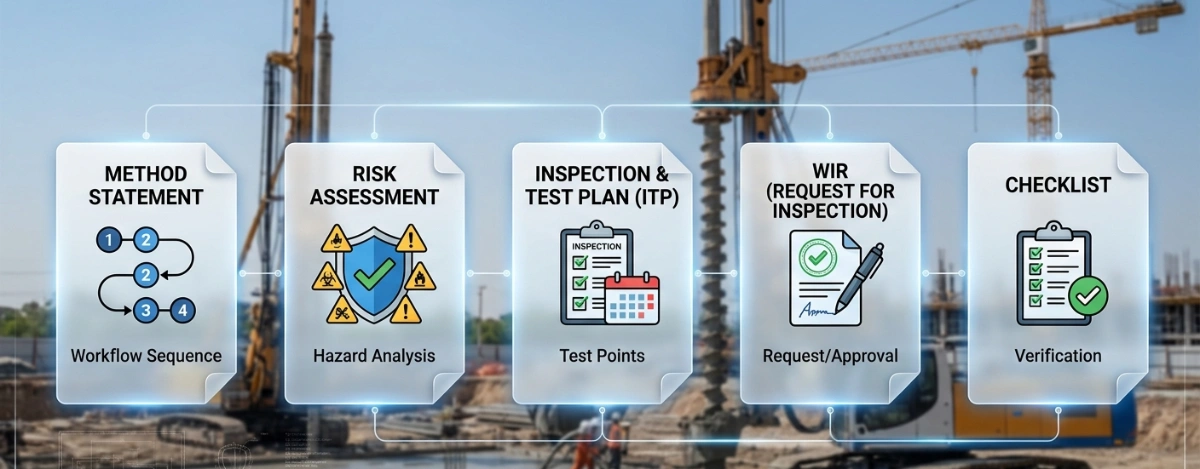
Unlike a downloadable Word or PDF template, this method statement is an AI-assisted editable starting point connected directly to a matching Inspection and Test Plan. Every section is structured, project-adaptable, and ready to export.
- AI-assisted drafting — Customize every section with AI for your specific project scope.
- Linked ITP — A matching inspection and test plan is generated alongside the method statement.
- Multiple export formats — Download as a formatted PDF or editable Excel spreadsheet.
- Editable starting point, not a final document — Review, verify, and adjust all content against your project requirements before use.
Static template vs. Quollnet workflow
| Feature | Static template | Quollnet |
|---|---|---|
| Project-specific content | Manual fill-in required | AI-assisted customization |
| Linked ITP | Separate document, no link | Matching ITP included |
| Export formats | Usually PDF only | PDF and Excel |
| Structured sections | Free-form layout | 13 standardized sections |
| Saved to your account | Local file only | Cloud-saved, reusable |
| Content accuracy | You verify everything | AI-assisted, you still verify |
| Cost | Often free but time-intensive | Free to customize and download |
What you can customize
When you save this method statement to your account, every section becomes editable. The following 13 sections are included:
- Scope — Defines the activity and its boundaries.
- References — Standards, specifications, and drawings.
- Responsibilities — Roles and accountabilities.
- Resources — Labour, plant, and equipment summary.
- Materials — Materials and compliance requirements.
- Equipment — Tools and equipment details.
- Prerequisites — Hold points and pre-conditions.
- Method sequence — Step-by-step construction sequence.
- Safety controls — HSE risk controls and PPE.
- Environmental controls — Environmental mitigation measures.
- QA/QC — Quality inspection and test requirements.
- ITP — Inspection and Test Plan table (has its own page).
- Attachments — Referenced drawings and documentation.
Why this method statement is used
This method statement is used to define and communicate the approved procedure for carrying out method statement: intumescent fire-protective coating to internal structural steelwork on site. It ensures the work is planned in advance, the correct resources and controls are in place, and all personnel understand responsibilities, sequence, quality requirements, and safety controls before work begins. It aligns site execution with the documented scope and acceptance expectations.
Who uses this method statement
This method statement is used by contractors, site supervisors, project engineers, QA/QC engineers, HSE officers, consultants, and client representatives. It serves as a shared reference for planning, execution, supervision, inspection, and approval of the activity on site.
When it is prepared and submitted
The method statement is prepared before the work activity starts and submitted as part of the pre-construction documentation package for review and approval.
Who reviews or approves it
The method statement is usually submitted to the client representative, consultant, resident engineer, or project management consultant for review and approval before the work commences.
Important approval note
This method statement is an AI-assisted editable starting point, not a pre-approved document. Before use on any project, all content must be reviewed and approved by the relevant parties (superintendent, principal contractor, or client representative) in accordance with your contract and project quality plan.
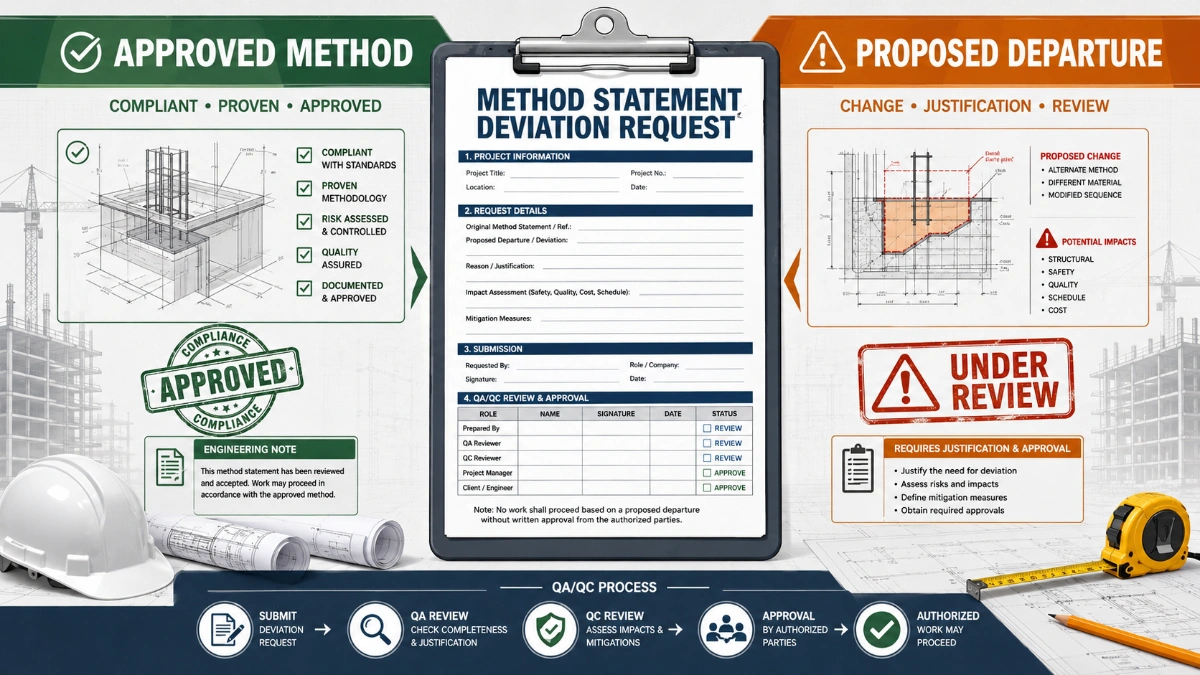
For example: if your specification requires a departure from a referenced standard, that departure must be documented and approved separately — this method statement will not capture that automatically. Always verify against your applicable drawings, specifications, and regulatory requirements.
Method statement content
Scope
Works Included
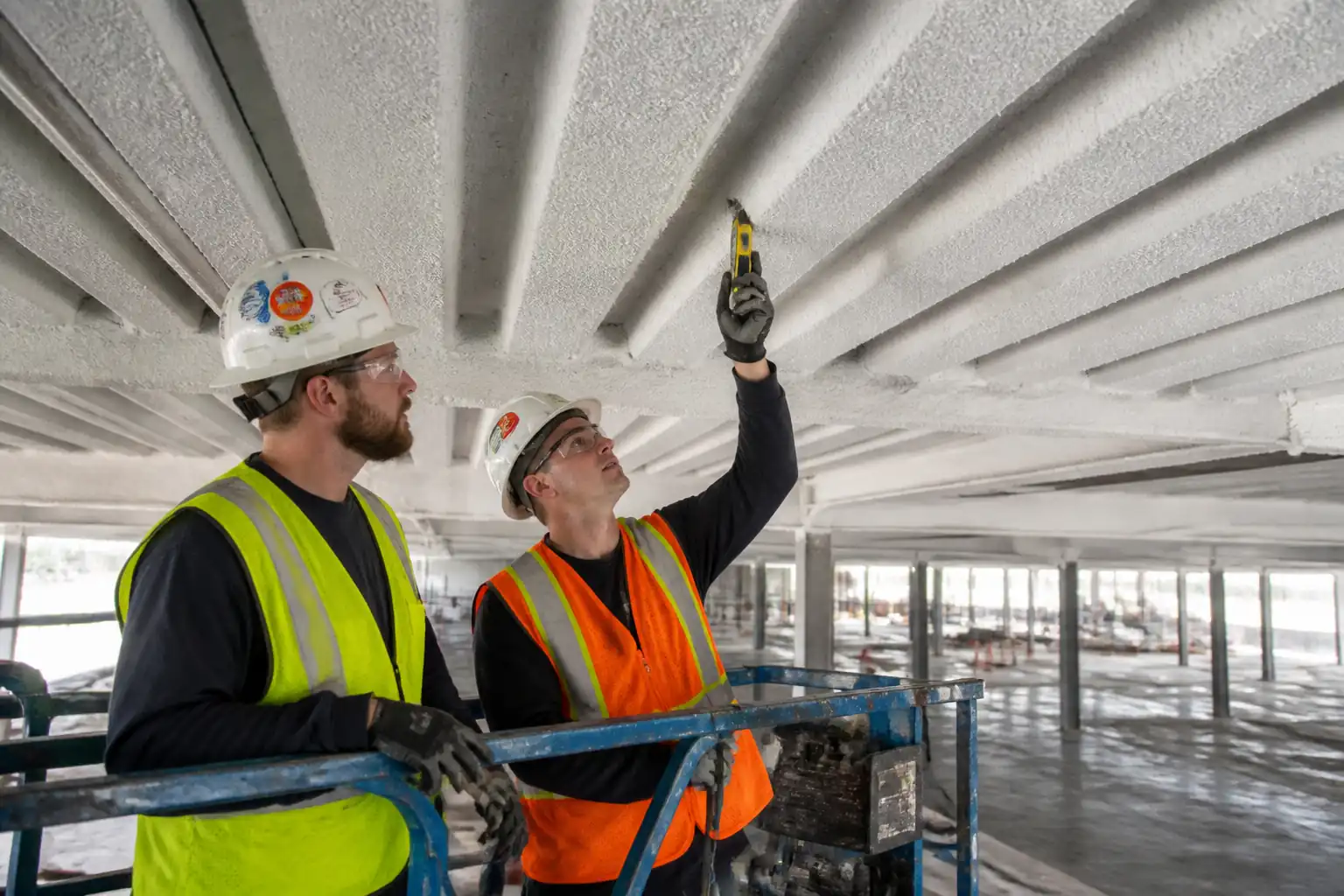
- Intumescent fire-protective coating application to internal structural steelwork (columns, beams, braces, and connections) to achieve the specified fire resistance period (e.g., R30–R120) based on section factor (Hp/A) and design critical steel temperature. [Verify per project specifications]
- Surface preparation: degreasing, mechanical preparation or abrasive blast-cleaning where required, verification of surface cleanliness, soluble salts, dust levels, and profile.
- Primer compatibility verification, touch-up of damaged shop primer, and application of tie-coat where required by the intumescent manufacturer.
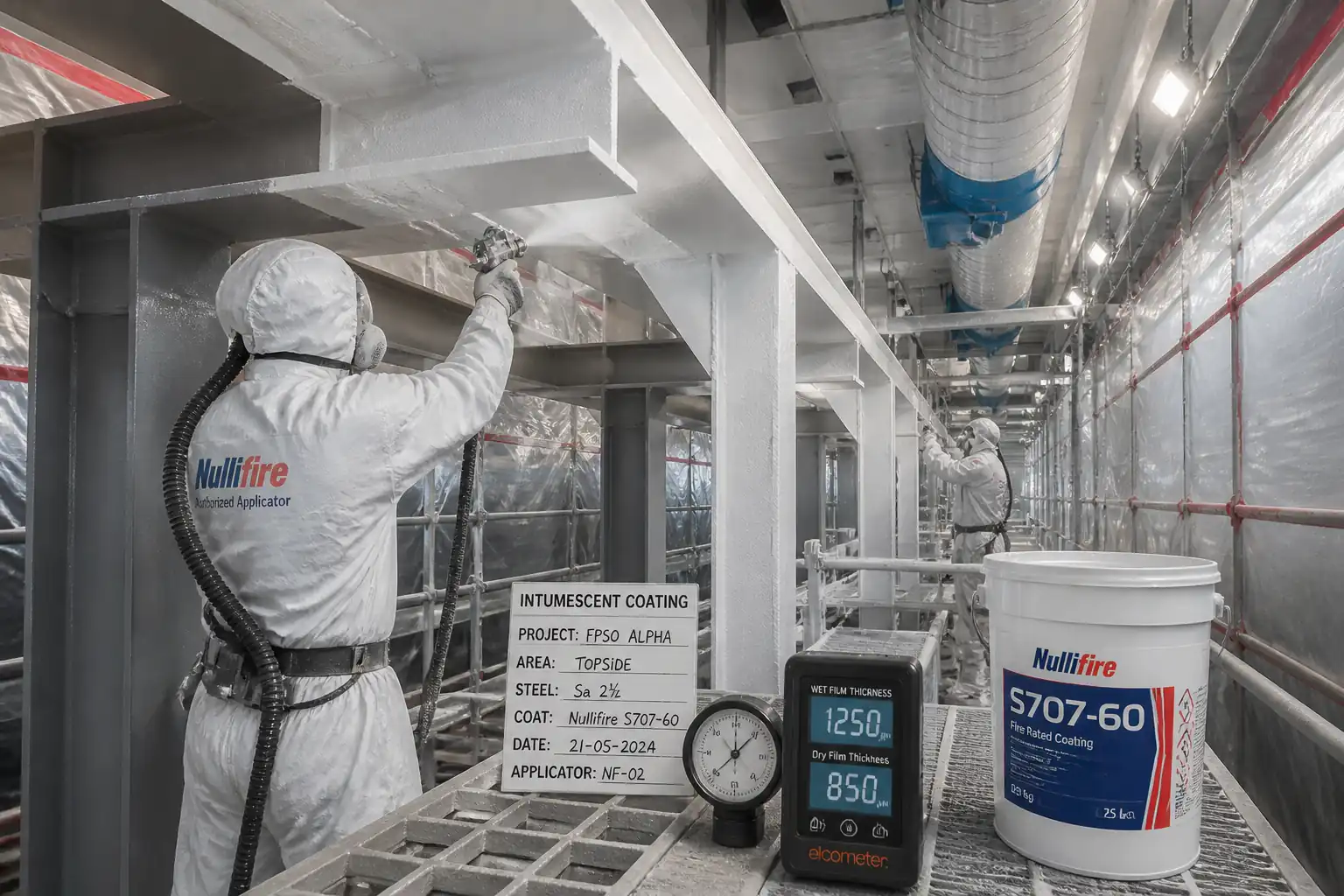
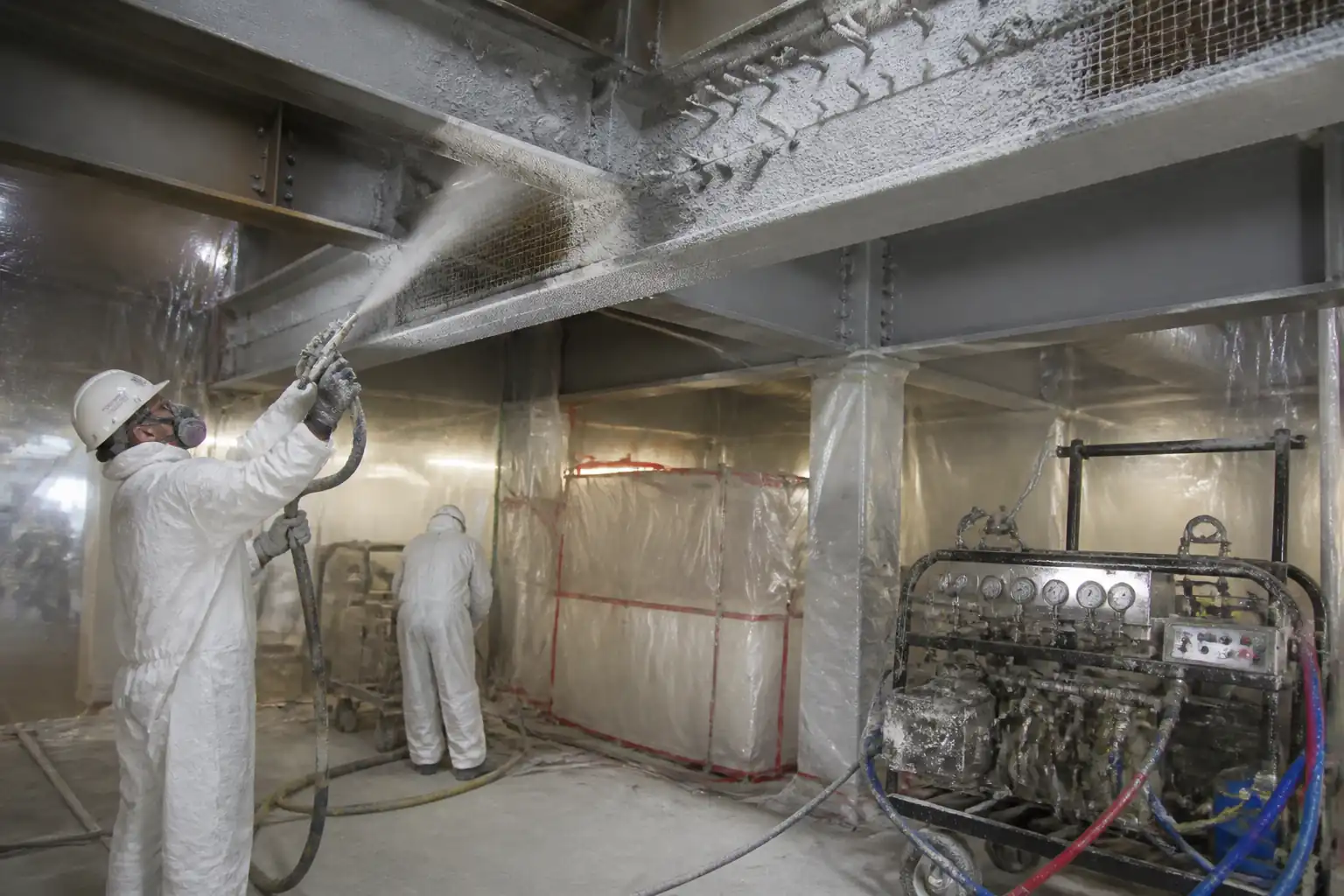
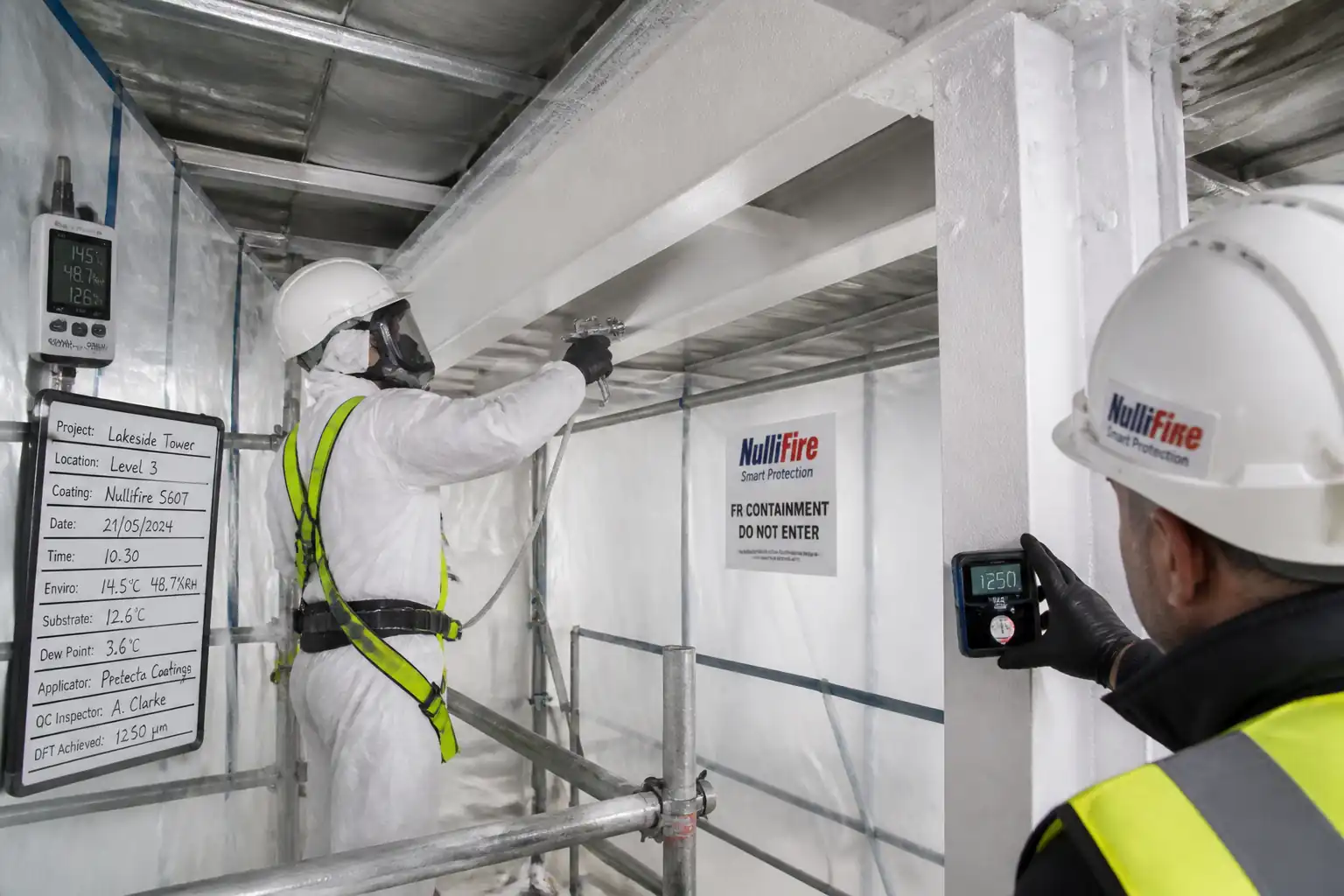
- Multi-layer airless-spray application of intumescent coating, including stripe coats to edges, bolts, and complex details, and application of sealer/topcoat if specified.
- Quality control: ambient climate monitoring (air/steel temperature, RH, dew point), wet film thickness (WFT) and dry film thickness (DFT) measurements, cure/recoat interval checks, adhesion (if specified), repairs, and final acceptance.
- Documentation: batch traceability, inspection and test records, data-logged climate reports, as-built thickness maps, and issue of manufacturer/third-party fire protection certificate of conformity.
Works Excluded
- External steelwork and galvanized/stainless steel unless specifically noted.
- Passive fire protection by boards, cementitious sprays, or vermiculite systems.
- Structural repair or modification to steelwork.
Location & Access
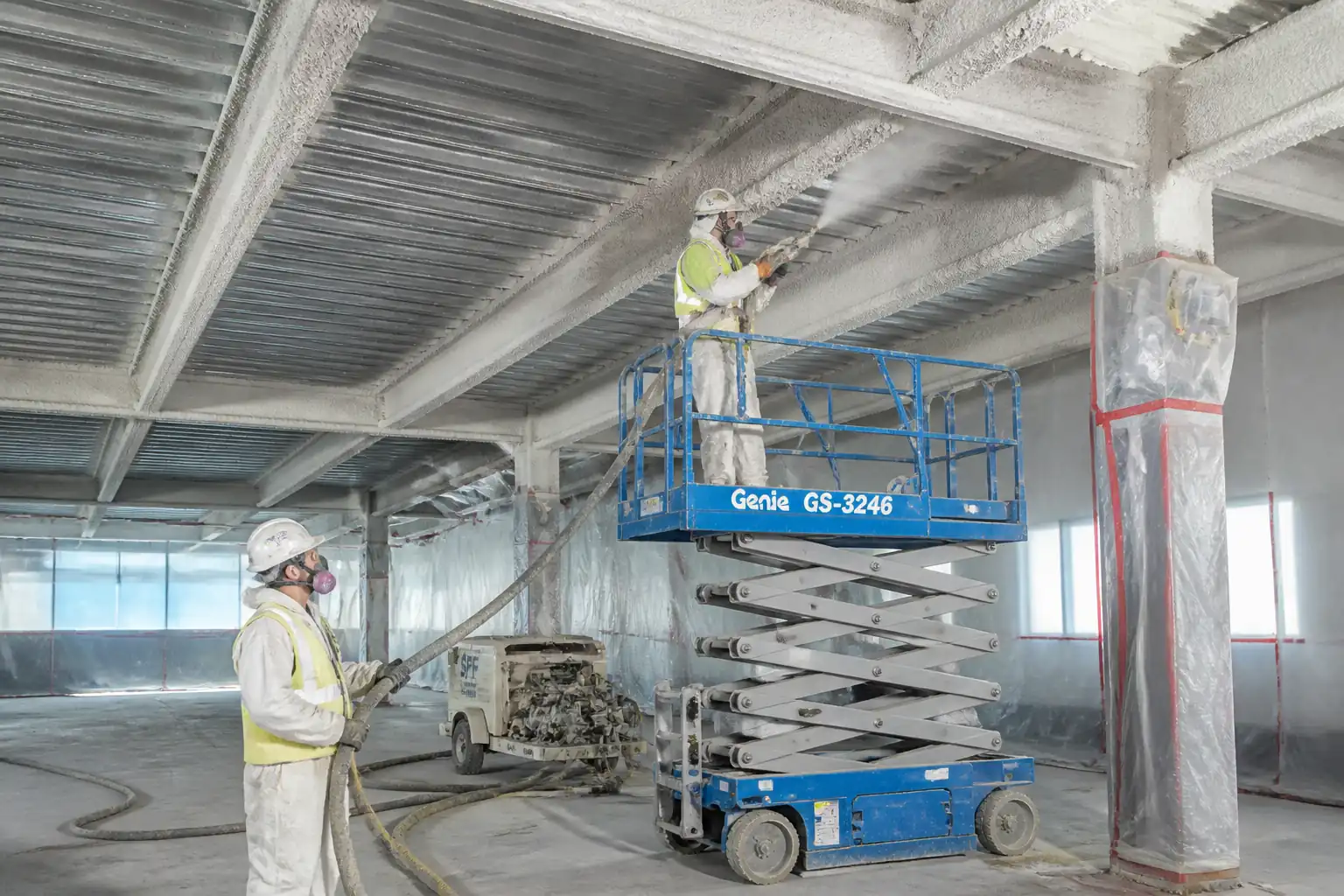
- Internal areas only, with scaffolds/MEWPs, local containment, lighting, and forced ventilation as required.
Interfaces
- With structural steel erection, MEP supports, and architectural finishes. Coordinate masking/protection and access sequencing to prevent damage and overspray.
Deliverables
- Approved method statement and ITP, material submittals, calibration certificates, daily climate logs, WFT/DFT logs and maps, non-conformance and corrective action records, final fire protection certification, and O&M data sheets.
References
| Document Type | Reference / Number | Revision | Notes |
|---|---|---|---|
| Standard | ISO 8501-1 | ||
| Standard | ISO 8502-3/4/6/9 | ||
| Standard | ISO 8503-1/-2 | ||
| Standard | ISO 19840 | May be supplemented by ASTM D7091/SSPC-PA 2 [Verify per project specifications]. | |
| Standard | ASTM D4414 | ||
| Standard | EN 13381-8; BS 476-21 | Use the test standard applicable to the project jurisdiction. | |
| Standard | EN 13501-2 | ||
| Guidance | ASFP TGD 001 et al. | Use latest edition applicable to region. | |
| Standard | ISO 12944-7 | ||
| Product Data | Per approved submittal | Mandatory for final acceptance. |
Responsibilities
| Role | Responsibility | Name / Party |
|---|---|---|
| PM | Approve method/ITP, ensure qualified personnel and approved materials. | Contractor |
| SE | Verify prerequisites and drawings/specs on site. | Contractor |
| QC | Hold/Witness coordination; instruments calibration check. | Contractor |
| Supervisor | Ensure TDS compliance, safety, housekeeping. | Contractor |
| HSE | Implement task-specific controls and emergency response. | Contractor |
| Specialist | Attend hold points; endorse fire rating certification. | Third Party |
| Engineer | Approve key hold points and final acceptance. | Client/Consultant |
Resources
| Resource Type | Description | Quantity | Remarks |
|---|---|---|---|
| Labour | Abrasive blasting or mechanical prep (as applicable) | 4-6 | |
| Labour | Airless spray operators | 4-5 | |
| Staff | ICorr/NACE L2 or equivalent | 1 | |
| Staff | Site safety oversight | 1 | |
| Labour | Install/maintain access and containment | 2-3 | |
| Staff | Batch tracking, storage, temperature control | 1 |
Materials
| Material | Specification / Grade | Quantity | Remarks |
|---|---|---|---|
| Garnet 30/60 | ISO 11126 compliant [Verify] | ||
| Approved cleaner | Per TDS | ||
| Epoxy primer | ISO 12944 system class [Verify] | ||
| Approved tie-coat | Per TDS | ||
| Approved brand/system | Manufacturer load tables | ||
| PU/Acrylic topcoat | DFT 40–80 µm [Verify] | ||
| Approved thinner | Per TDS | ||
| Polythene, tape | Flame-retardant where required [Verify] |
Equipment
| Equipment | Capacity / Type | Quantity | Inspection Required |
|---|---|---|---|
| Blast pot + compressor | Pressure 7–8 bar, 10–12 m3/min | 1 set | Yes |
| 185–375 CFM | 1-2 | Yes | |
| Max 4000 psi | 2 | Yes | |
| ATEX rated where required | 2 | Yes | |
| ISO 8502-4 compliant | 2 sets | Yes | |
| 3 | Yes | ||
| ISO 2178/2360/ASTM D7091 | 2 | Yes | |
| 1 | Yes | ||
| 1 | Yes | ||
| As req'd | Yes | ||
| As req'd | Yes |
Prerequisites
- Approvals: Method Statement, ITP, material submittals (primer/tie-coat/intumescent/topcoat), and manufacturer confirmation of compatibility, approved by Client/Consultant.
- Fire Rating Basis: Confirm required fire resistance period (e.g., R60/R90) and design critical steel temperature (e.g., 500–620°C for internal beams/columns) and derive target DFT from manufacturer’s load tables using section factor Hp/A for each member. [Verify per project specifications]
- Access & Protection: Erect scaffold/MEWP with valid tags; install FR containment sheeting and masking to protect adjacent finishes/services.
- Storage & Conditioning: Store materials in dry area at 5–30°C; acclimatize to site temperature. Rotate stock FIFO. Keep from freezing/overheating.
- Calibration: Current calibration certificates for DFT gauge, climate meters, micrometers, and verification shims (≤12 months or per QA plan). Pre-use verification daily.
- Training: Spray operators competent and, where required, product manufacturer-trained. HSE inductions and specific toolbox talks for airless spraying, solvents, and working at height.
- Permits: Painting/spraying permit, work at height/MEWP, confined space (if applicable), and isolation of ignition sources. [Verify per project HSE plan and local regulations]
- Mock-Up: Apply to a representative steel member/panel to confirm finish, build strategy, WFT/DFT correlation, and cure times. Obtain approval before production.
- Surface Condition: Steel erection complete; welds dressed, sharp edges ground to ≥2 mm radius, spatter removed, holes tight, and surfaces dry and clean.
- Primer Review: Identify existing shop primer type and DFT; obtain written compatibility statement from intumescent manufacturer. Plan for tie-coat or removal if incompatible.
- Ventilation Plan: Calculate air changes to maintain RH/solvent vapour below OEL; set fan locations and exhaust routes; monitor and record.
- Emergency Preparedness: Fire extinguishers (foam/CO2), spill kits, first-aid kit, and emergency contacts available. SDS accessible at point of use.
Method Sequence
| Step | Activity | Description | Responsibility | Inspection / Hold Point |
|---|---|---|---|---|
| 1 | Verification & Set-Out | Confirm member IDs, Hp/A, required FR rating, and target DFT per manufacturer schedule. Mark each steel member with unique ID and target DFT. | Site Engineer/QC | Document check |
| 2 | Access, Containment, and Ventilation | Install scaffold/MEWPs, edge protection, lighting, FR sheeting, and fans/dehumidifiers as planned. Establish exclusion zones and signage. | Supervisor/HSE | Surveillance |
| 3 | Degreasing & Pre-Clean | Remove oil/grease/contaminants with approved cleaner; wipe until clean cloth shows no staining. Vacuum dust/debris. | Painting Crew | Surveillance |
| 4 | Surface Preparation (as specified) | Option A: Abrasive blast to Sa 2½, achieve surface profile 30–75 µm Rz. Option B: Mechanical prep to St 3 for local repairs. Remove dust per ISO 8502-3 (tape method). | Blasting Crew/QC | HOLD POINT H1 |
| 5 | Soluble Salts Test (if blasting or required) | Bresle method on representative areas/panels after prep but before coating. | QC | Witness |
| 6 | Primer Inspection/Repair | Inspect existing primer for damage/adhesion; feather edges; repair to specified DFT. Obtain manufacturer confirmation of primer compatibility or apply tie-coat as required. | QC/Supervisor | Witness |
| 7 | Stripe Coating | Brush/roller apply intumescent (or compatible intermediate) to edges, welds, bolts, stiffeners, and re-entrant details. | Applicator | Surveillance |
| 8 | Ambient Check Before Spraying | Measure air/steel temp, RH, and dew point. Confirm steel temp ≥3°C above dew point; RH ≤80–85% (per TDS); substrate dry. | QC | HOLD POINT H2 |
| 9 | Mixing & Induction (if required) | Stir/ mix per TDS. For 2-part systems, mix full kits; allow induction time if specified; strain through mesh. | Applicator | Surveillance |
| 10 | Determine Target WFT per Coat | Calculate WFT = Target DFT per coat / (Solids by Volume). Plan number of coats to avoid sagging/cracking. | QC/Applicator | Surveillance |
| 11 | Spray Application (Coat 1..n) | Apply by airless spray using recommended tip/pressure and passes to achieve planned WFT; maintain gun distance/angle; control overlap; avoid runs/sags. | Applicator/Supervisor | Surveillance |
| 12 | Intercoat Cure & Recoat Window | Allow to dry/cure per TDS; verify through-dry using thumb-twist/solvent rub or manufacturer’s method; ensure within min/max recoat window. | QC | Witness |
| 13 | Intermediate DFT Gauging | After each 1–2 coats, measure DFT at defined sampling points per ISO 19840; adjust next coats accordingly. | QC | Witness |
| 14 | Repairs/Touch-ups | Feather and build insufficient areas; remove runs/sags; reapply as needed respecting overcoat intervals. | Applicator/QC | Surveillance |
| 15 | Final DFT Survey | Measure final DFT per ISO 19840 sampling plan. Create DFT map per member/face with locations and readings. | QC | HOLD POINT H3 |
| 16 | Adhesion/Hardness (if specified) | Conduct adhesion test (ISO 2409 cross-cut GT ≤2 or ASTM D4541 pull-off ≥1.5 MPa) at inconspicuous areas or mock-up only to avoid damage. | QC/Third Party | Witness |
| 17 | Sealer/Topcoat (if required) | Apply sealer/topcoat after final DFT acceptance and within recoat window. Verify WFT/DFT and finish/colour. | Applicator/QC | Witness |
| 18 | Marking & Protection | Stencil/label members with system, fire rating, and date. Protect coated steel from damage until handover. | Supervisor | Surveillance |
| 19 | Documentation & Certification | Compile inspection records, batch logs, climate logs, DFT maps, NCR/CAR closeouts, and manufacturer/third-party certificate confirming required fire rating achieved. | QC/PM/Manufacturer Rep | Review |
Health, Safety and Environment (HSE) – Safety Controls
Task-Specific Hazards and Controls
- Hazard: High-pressure airless spray injection injury
- Consequence: Deep tissue injection, amputation risk
- Engineering/Procedural Control: Use tip guards and trigger locks; never point gun at body; depressurize before maintenance; only trained operators
- Required PPE: Cut-resistant gloves, eye/face shield, coveralls, safety boots
- Collective Preventive Measure: Exclusion zones with barriers/signage
-
Inspection/Permit/Supervision: Pre-use equipment checks; Supervisor authorization; incident response plan; medical emergency protocol posted
-
Hazard: Solvent vapour and VOC exposure (for solvent-borne systems)
- Consequence: Dizziness, respiratory irritation, fire/explosion risk
- Engineering/Procedural Control: Forced ventilation (calculated air changes); intrinsically safe equipment where required; no ignition sources; decant in ventilated area
- Required PPE: Organic vapour respirator (A2P3) or air-fed hood per SDS, goggles, nitrile gloves
- Collective Preventive Measure: Local extraction with ducted exhaust; LEL monitoring if applicable
-
Inspection/Permit/Supervision: Spraying permit; SDS review; atmospheric monitoring logs [Verify per project HSE plan and local regulations]
-
Hazard: Dust from abrasive blasting/mechanical prep
- Consequence: Respiratory illness, eye injury, poor visibility
- Engineering/Procedural Control: Enclose area with FR sheeting; vacuum recovery; use low-dust abrasives; wet-scrubbers where feasible
- Required PPE: P3 particulate respirator or air-fed helmet, goggles, gloves, long-sleeve FR coveralls
- Collective Preventive Measure: Negative pressure containment; de-dusting stations
-
Inspection/Permit/Supervision: Daily containment inspection; blasting permit; HSE monitoring
-
Hazard: Working at height (scaffold/MEWP)
- Consequence: Falls leading to serious injury/fatality
- Engineering/Procedural Control: Green-tagged scaffold; MEWP harness with short lanyard; keep both feet in basket; avoid overreaching; secure hoses
- Required PPE: Full body harness with lanyard, hard hat with chin strap, non-slip footwear
- Collective Preventive Measure: Edge protection, toe boards, fall arrest anchor points
-
Inspection/Permit/Supervision: Daily scaffold inspection; MEWP pre-use check; operator IPAF/certification; permit to work at height
-
Hazard: Manual handling of paint pails/hoses
- Consequence: Strains, sprains
- Engineering/Procedural Control: Use trolleys/hoists; split loads; team lifts; proper hose routing
- Required PPE: Gloves, supportive footwear
- Collective Preventive Measure: Material staging areas near workface
-
Inspection/Permit/Supervision: Manual handling training verification
-
Hazard: Electrical and lighting for enclosed areas
- Consequence: Shock, ignition
- Engineering/Procedural Control: 110V or RCD-protected circuits; explosion-proof lights in solvent areas; cable management
- Required PPE: Electrical-rated gloves when required, safety boots
- Collective Preventive Measure: Isolation and lockout where maintenance is performed
-
Inspection/Permit/Supervision: Electrical inspection/tagging
-
Hazard: Chemical contact (skin/eyes)
- Consequence: Dermatitis, chemical burns
- Engineering/Procedural Control: Closed mixing; splash guards; emergency eyewash within 10 seconds travel distance
- Required PPE: Chemical goggles/face shield, nitrile/chemical gloves, coveralls
- Collective Preventive Measure: SDS at station; hygiene/wash facilities
-
Inspection/Permit/Supervision: HSE inspections; first-aid logs
-
Hazard: Noise from compressors/blasting
- Consequence: Hearing loss
- Engineering/Procedural Control: Use silencers/locate compressors away; time limits for exposure
- Required PPE: Ear defenders (SNR ≥ 25 dB)
- Collective Preventive Measure: Noise mapping and signage
-
Inspection/Permit/Supervision: Noise monitoring records
-
Hazard: Confined or poorly ventilated internal spaces
- Consequence: Hypoxia, accumulation of vapours
- Engineering/Procedural Control: Confined space assessment if criteria met; forced ventilation and gas testing
- Required PPE: Air-fed respirator as required, portable gas monitor for sentry
- Collective Preventive Measure: Standby attendant and rescue plan
-
Inspection/Permit/Supervision: Confined space permit, gas test logs [Verify per project HSE plan and local regulations]
-
Hazard: Fire from overspray/solvents
- Consequence: Burns, property damage
- Engineering/Procedural Control: Control ignition sources; hot works segregation; bonding/grounding of metallic containers
- Required PPE: FR coveralls, gloves
- Collective Preventive Measure: Fire watch during and 30 min after work; extinguishers on hand
-
Inspection/Permit/Supervision: PTW system; weekly fire equipment checks
-
Hazard: Trip and entanglement by hoses/cables
- Consequence: Falls, sprains
- Engineering/Procedural Control: Overhead hose routing; cable trays; housekeeping every break
- Required PPE: Safety boots
- Collective Preventive Measure: Barricades around hose paths
- Inspection/Permit/Supervision: Supervisor walkdowns, 5S audits
Environmental Controls
- Overspray and Dust Containment: Use fire-retardant sheeting, negative pressure, and filtered extraction to prevent migration to adjacent areas. Inspect containment daily.
- Waste Management: Collect spent abrasive, masking, and overspray debris. Segregate hazardous waste (paint/solvent) from general waste. Dispose via licensed contractor with manifests. [Verify per local regulations]
- VOC and Odour Control: Prefer water-borne intumescent for internal areas where acceptable. Use low-VOC cleaners. Maintain ventilation/air changes and route exhaust away from occupied zones.
- Spill Prevention and Response: Secondary containment/bunding for liquids. Spill kits on site. Train crew in immediate containment and reporting. Prohibit drain discharge.
- Noise and Energy: Position compressors away from sensitive receptors; use acoustic enclosures where feasible; shut down idling equipment when not in use.
- Housekeeping: Daily clean-up; no material to enter drainage; wipe rather than wash-down where possible; capture wash water for proper disposal.
- Resource Control: Order materials per rolling programme to minimize expired stock; maintain material temperature within TDS to reduce rework/waste.
Quality Assurance and Quality Control
General
- Apply works in accordance with approved TDS, ISO standards, and this method statement/ITP. Where conflicts occur, the stricter requirement prevails. [Verify per project specifications]
Instruments and Calibration
- Verify DFT gauge using certified foils at start/end of each shift and when changing surface/geometry. Record verification in gauge log.
- Check climate instruments against a reference annually and before use on site; record serial numbers on logs.
Sampling and Test Frequencies (typical – Verify per project specifications)
- Surface cleanliness: 100% visual comparison to ISO 8501-1 reference photographs.
- Surface profile: 1 reading per 10 m² per surface or min 5 readings per member, whichever yields more data.
- Soluble salts: 1 test per 50 m² or per area change; more if marine/contaminated environments.
- Ambient conditions: At start of shift, every 2 hours, and whenever conditions change; at each workface.
- WFT: Each pass/start-up, then every 5–10 m²; additional checks at edges/bolts.
- DFT interim: Minimum 5 readings per member face per 10 m length; increase for complex members.
- Final DFT: As per ISO 19840 grouping and sampling; typical 3–5 spot measurements per 10 m² per face with each spot being the mean of 3 gauge readings.
Acceptance Criteria (typical – Verify per product/spec)
- Ambient: Steel temperature ≥3°C above dew point; RH ≤80–85%; substrate dry; temperature within product limits (e.g., 5–40°C).
- Cleanliness/Dust/Salts: Sa 2½ (or St 3 if allowed); dust rating ≤2; salts ≤20 mg/m².
- Thickness: Conform to manufacturer’s derived DFT for each member’s Hp/A and fire rating. Apply ISO 19840 principles for acceptance where applicable; individual readings not less than 80–90% of nominal depending on product approval; mean per area ≥ nominal. Do not exceed maximum single-coat or total DFT limits set by manufacturer to prevent cracking/sagging.
- Cure/Overcoat: Respect min/max recoat windows; confirm through-dry per TDS method.
- Defects: No runs, sags, pinholes, uncured/soft spots, holidays at edges/bolts.
Non-Conformance and Corrective Action
- Record NCR for any out-of-tolerance parameter; define corrective actions (e.g., additional coats, sanding/removal/re-application). Re-inspect and close NCR before proceeding.
Documentation and Traceability
- Maintain batch numbers, expiry dates, mixing ratios, and operators per member ID.
- Produce DFT maps indexed to member IDs and grid locations.
- Compile turnover package including certificates, logs, test reports, approvals, and final certification from manufacturer/third-party confirming fire rating achieved.
Attachments
- Template: CLIMATE-LOG-01 (Air/steel temp, RH, dew point datalog)
- Template: WFT-LOG-01 (Per coat WFT measurements)
- Template: DFT-INT-01 and DFT-FINAL-01 (Spot/area readings and DFT maps by member ID)
- Template: SURF-PREP-01 (Cleanliness/profile/dust/salts)
- Template: PRIMER-COMP-01 (Compatibility and repair record)
- Certificates: Calibration certificates for gauges/meters; compressor/MEWP/scaffold tags
- Product Data: Approved TDS/SDS for primer, tie-coat, intumescent, topcoat
- Schedules: Member Hp/A, critical temperature, target DFT table; programme and manpower histogram
- HSE: Risk assessment, COSHH assessments, permits to work, toolbox talk records
- Manufacturer/Third-Party: Statement of compatibility and final fire protection certificate of conformity
This content is a read-only public reference. Download or customize to get an editable version.
ITP preview
The first inspection activities from the linked ITP for Method Statement: Intumescent Fire-Protective Coating to Internal Structural Steelwork:
| Activity | Inspection / Test | Acceptance Criteria | Responsibility | Record |
|---|---|---|---|---|
| Material receipt and storage | Review COA/SDS; visual check | Approved submittals; within shelf life; undamaged | QC/Storekeeper | MAT-REC-01 log |
| Mock-up/application trial | Apply to sample member/panel; verify finish/DFT | Meets agreed appearance and DFT trend | QC/Client/Manufacturer Rep | MOCK-APP-01 |
| Surface cleanliness and preparation | ISO 8501-1 visual; ISO 8503 profile; ISO 8502-3 dust | Sa 2½ (or St 3 where allowed); profile 30–75 µm; dust ≤ Grade 2 [Verify] | QC/Client | SURF-PREP-01 with photos |
Showing 3 of 13 inspection activities. View full ITP →
Related Inspection and Test Plan
An Inspection and Test Plan (ITP) is available for Method Statement: Intumescent Fire-Protective Coating to Internal Structural Steelwork. The ITP defines the inspection activities, acceptance criteria, hold and witness points, responsible parties, and records required to verify the work described in this method statement.
View the Method Statement: Intumescent Fire-Protective Coating to Internal Structural Steelwork ITP →Frequently asked questions
Continue with related Quollnet resources connected to this method statement.