
Method Statement – Intumescent Paint Application to Structural Steelwork – Method Statement
AI-assisted method statement with matching ITP, PDF download, and Excel export.
More than a static template
Unlike a downloadable Word or PDF template, this method statement is an AI-assisted editable starting point connected directly to a matching Inspection and Test Plan. Every section is structured, project-adaptable, and ready to export.
- AI-assisted drafting — Customize every section with AI for your specific project scope.
- Linked ITP — A matching inspection and test plan is generated alongside the method statement.
- Multiple export formats — Download as a formatted PDF or editable Excel spreadsheet.
- Editable starting point, not a final document — Review, verify, and adjust all content against your project requirements before use.
Static template vs. Quollnet workflow
| Feature | Static template | Quollnet |
|---|---|---|
| Project-specific content | Manual fill-in required | AI-assisted customization |
| Linked ITP | Separate document, no link | Matching ITP included |
| Export formats | Usually PDF only | PDF and Excel |
| Structured sections | Free-form layout | 13 standardized sections |
| Saved to your account | Local file only | Cloud-saved, reusable |
| Content accuracy | You verify everything | AI-assisted, you still verify |
| Cost | Often free but time-intensive | Free to customize and download |
What you can customize
When you save this method statement to your account, every section becomes editable. The following 13 sections are included:
- Scope — Defines the activity and its boundaries.
- References — Standards, specifications, and drawings.
- Responsibilities — Roles and accountabilities.
- Resources — Labour, plant, and equipment summary.
- Materials — Materials and compliance requirements.
- Equipment — Tools and equipment details.
- Prerequisites — Hold points and pre-conditions.
- Method sequence — Step-by-step construction sequence.
- Safety controls — HSE risk controls and PPE.
- Environmental controls — Environmental mitigation measures.
- QA/QC — Quality inspection and test requirements.
- ITP — Inspection and Test Plan table (has its own page).
- Attachments — Referenced drawings and documentation.
Why this method statement is used
This method statement is used to define and communicate the approved procedure for carrying out method statement – intumescent paint application to structural steelwork on site. It ensures the work is planned in advance, the correct resources and controls are in place, and all personnel understand responsibilities, sequence, quality requirements, and safety controls before work begins. It aligns site execution with the documented scope and acceptance expectations.
Who uses this method statement
This method statement is used by contractors, site supervisors, project engineers, QA/QC engineers, HSE officers, consultants, and client representatives. It serves as a shared reference for planning, execution, supervision, inspection, and approval of the activity on site.
When it is prepared and submitted
The method statement is prepared before the work activity starts and submitted as part of the pre-construction documentation package for review and approval.
Who reviews or approves it
The method statement is usually submitted to the client representative, consultant, resident engineer, or project management consultant for review and approval before the work commences.
Important approval note
This method statement is an AI-assisted editable starting point, not a pre-approved document. Before use on any project, all content must be reviewed and approved by the relevant parties (superintendent, principal contractor, or client representative) in accordance with your contract and project quality plan.
For example: if your specification requires a departure from a referenced standard, that departure must be documented and approved separately — this method statement will not capture that automatically. Always verify against your applicable drawings, specifications, and regulatory requirements.
Method statement content
Scope of Works
Overview
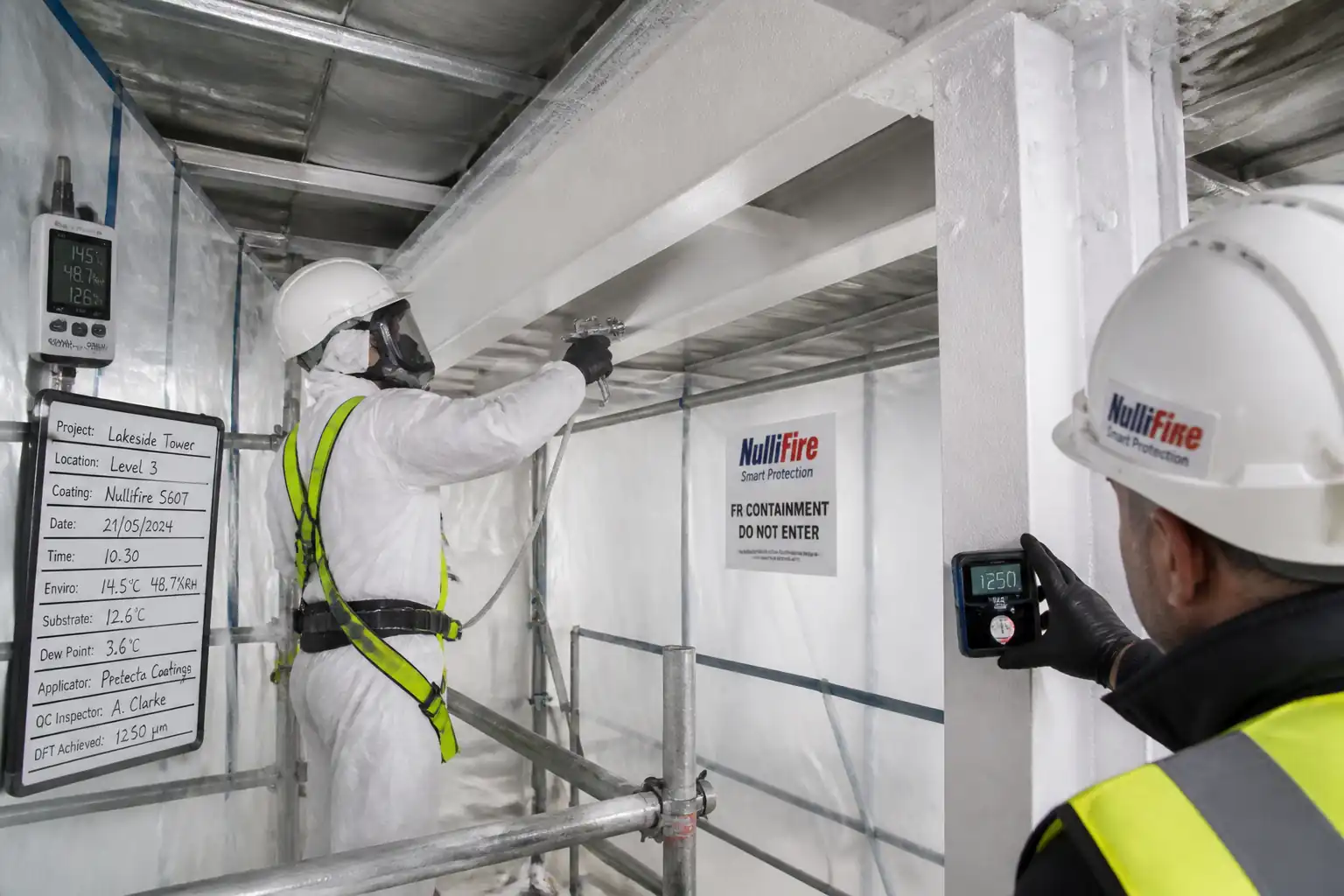
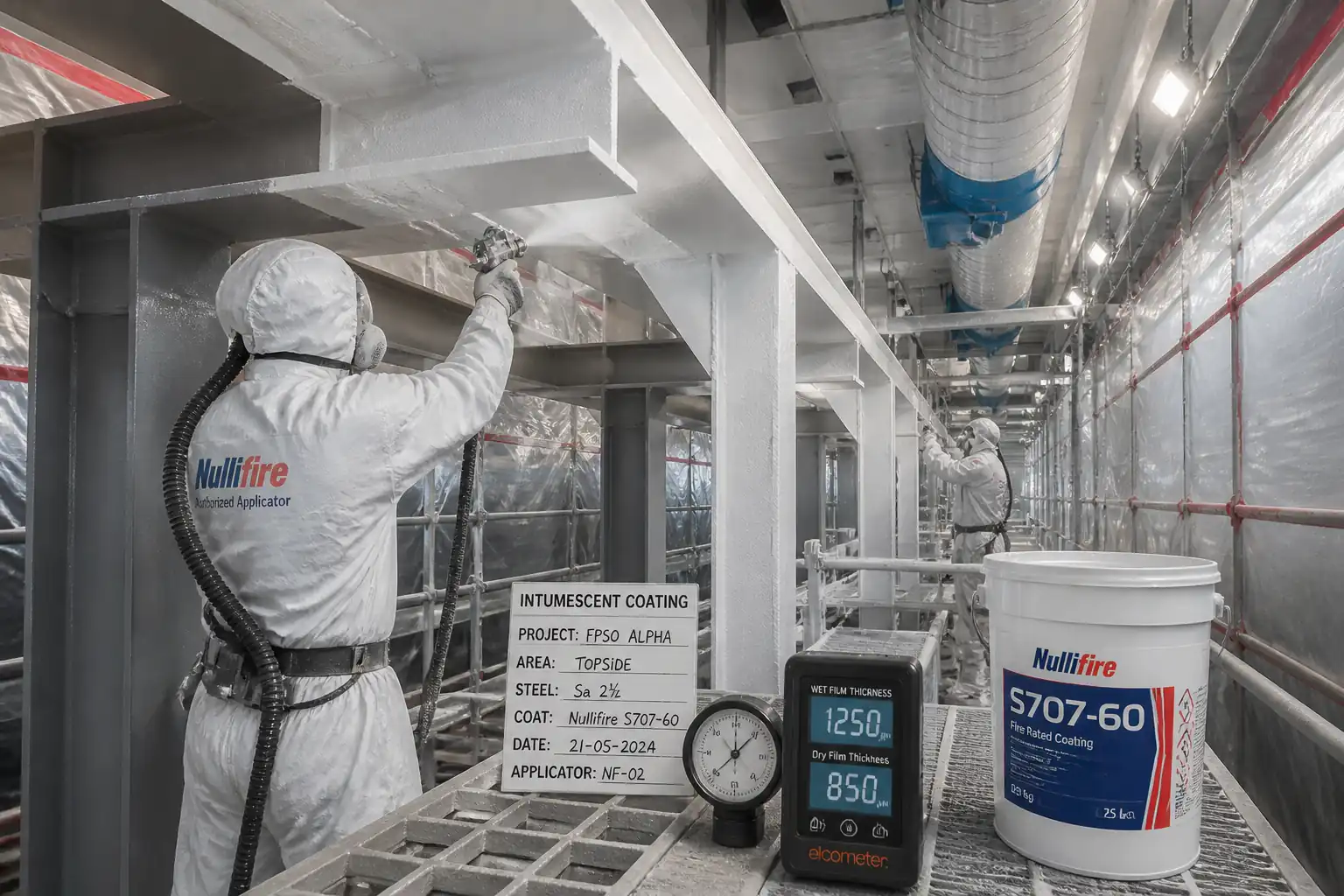
This method covers the complete process for application of intumescent paint systems to structural steelwork, including: surface preparation to Sa 2½; verification of surface profile and contamination; compatible primer application; intumescent basecoat application with wet film and dry film thickness (WFT/DFT) control; stripe coats to edges, welds, and bolt arrays; environmental monitoring; curing; adhesion testing; topcoat/sealer application; repair of defects; and QA/QC records.
Included Elements
- Primary and secondary structural steel members (beams, columns, braces, trusses, plate girders, connections).
- Shop or site application (as specified).
- Protection to achieve the fire resistance rating per the Fire Engineering design and manufacturer’s calculations.
Exclusions
- Passive fire protection by boards, spray plasters, or cementitious systems.
- Structural repairs or alterations to steelwork.
Key Objectives
- Achieve the specified fire rating with verified intumescent DFT per member based on section factor (Hp/A) and exposure type.
- Deliver a coating system free from runs, sags, pinholes, cracks, and contamination, with documented traceability and inspection records.
References and Standards
| Document Type | Reference / Number | Revision | Notes |
|---|---|---|---|
| Standard | ISO 8501-1: Preparation of steel substrates – Visual assessment of surface cleanliness (Sa 2½). | ||
| Standard | ISO 8502 (series): Tests for surface cleanliness – including ISO 8502-3 (dust), ISO 8502-4 (dew point), ISO 8502-6/9 (Bresle method for soluble salts). | ||
| Standard | ISO 8503 (series): Surface roughness characteristics of blast-cleaned steel substrates. | ||
| Standard | ISO 19840 / SSPC-PA 2 / ASTM D7091: Measurement of DFT on ferrous substrates (sampling and acceptance). | ||
| Standard | ASTM D4414: Measurement of wet film thickness by notch gauges. | ||
| Standard | ASTM D4541 / ISO 4624: Pull-off strength (adhesion) of coatings. | ||
| Standard | ISO 12944 (relevant parts): Corrosion protection of steel structures by protective paint systems (edge preparation, durability concepts). | ||
| Standard | SSPC-SP 1: Solvent Cleaning. | ||
| PDS/SDS | Manufacturer’s Product Data Sheets (PDS) and Safety Data Sheets (SDS) for primer, intumescent basecoat, and topcoat. | ||
| Project Document | Project Specifications, Fire Strategy Report, and Intumescent Thickness Calculation Sheets per member (Hp/A, critical DFT). |
Responsibilities
| Role | Responsibility | Name / Party |
|---|---|---|
| Project Manager | Overall delivery, resources, approvals, programme integration, coordination with Fire Engineer and Architect. | |
| Construction/Site Engineer | Setting out, access/containment planning, environmental monitoring, daily interface with inspectors and applicators. | |
| QA/QC Manager | Inspection/Test coordination, ITP implementation, NCR/CAR management, records compilation, final dossier. | |
| Coating Inspector (AMPP/NACE Level 2 or equivalent) | Hold/witness inspections, surface cleanliness/profile checks, WFT/DFT verification, adhesion testing oversight, acceptance sign-off. | |
| Painting Supervisor | Execution planning, crew briefings, method adherence, mixing/application control, recoat/cure management, repairs. | |
| HSE Manager/Officer | Task-specific risk assessments, permits, ventilation, monitoring of VOC/isocyanate exposure [Verify per project HSE plan], emergency preparedness. | |
| Procurement/Materials Controller | Batch traceability, storage per PDS, shelf-life control, delivery of calibrated gauges and test kits. | |
| Third-Party Inspector (if specified) | Independent verification at hold points per ITP and contract. |
Resources (Manpower)
| Resource Type | Description | Quantity | Remarks |
|---|---|---|---|
| 2–4 [Verify per scope] | |||
| 3–6 [Verify] | |||
| 2–3 | |||
| 1 | |||
| 1 | |||
| 2–4 | |||
| As required |
Materials
| Material | Specification / Grade | Quantity | Remarks |
|---|---|---|---|
| Degreaser/Solvent (SSPC-SP1 compliant) | Non-residue, compatible with subsequent coating. | ||
| Abrasive Media (e.g., Garnet 30/60) | Clean, dry, free from contaminants; profile target 40–75 µm Rz [Verify per PDS]. | ||
| Compatible Primer (e.g., epoxy zinc phosphate or zinc-rich/epoxy as approved) | Manufacturer-approved for intumescent; typical DFT 50–75 µm [Verify]. | ||
| Intumescent Basecoat (water-borne/solvent-borne/epoxy intumescent) | Selected to meet required fire rating; supplied with manufacturer’s thickness schedule per Hp/A [Verify]. | ||
| Stripe Coat Material | Same intumescent basecoat or compatible primer as per manufacturer’s guidance. | ||
| Sealer/Topcoat (if specified) | UV/weathering protection; manufacturer-approved and compatible; typical DFT 40–60 µm [Verify]. | ||
| Thinners/Cleaners | As per PDS; controlled use only. | ||
| Masking/Protection | Poly sheeting, tape, tarps for overspray containment. |
Equipment
| Equipment | Capacity / Type | Quantity | Inspection Required |
|---|---|---|---|
| Abrasive Blasting Pot & Nozzles | Nozzle size 6–8 mm; moisture separator and air dryer required. | ||
| Air Compressor | >= 250 cfm with aftercooler/dryer [Verify]. | ||
| Dust Extraction/Containment | Vacuum recovery or enclosure with filters to control emissions. | ||
| Airless Spray Pump | 45:1–68:1 ratio, min 4–6 L/min; tip 0.027–0.035 in for intumescent [Verify per PDS]. | ||
| Mixers (Paddle/High-torque) | For uniform dispersion; timer for mixing duration per PDS. | ||
| Hygrometer/Dew Point Meter | Measures air temp, RH, dew point; with calibration certificate. | ||
| Infrared Thermometer/Contact Thermometer | Substrate temperature readings. | ||
| WFT Gauges (ASTM D4414) | Notched comb type; suitable for high-build coatings. | ||
| DFT Gauge (ISO 19840/ASTM D7091) | Magnetic induction/eddy current; current calibration certificate. | ||
| Bresle Kits & Conductivity Meter | ISO 8502-6/9 soluble salt testing. | ||
| Dust Tape Test Kit | ISO 8502-3 assessment cards. | ||
| Surface Profile Replica Tape/Profilometer | ISO 8503 measurement. | ||
| Access Equipment | Certified scaffolding, MEWPs with fall protection. | ||
| Ventilation/Extraction Fans | Maintain safe solvent vapor levels and drying conditions. | ||
| Lighting | 500–1000 lux in containment areas for inspection. | ||
| PPE & Safety Gear | Air-fed respirators (as needed), gloves, coveralls, eye and hearing protection. |
Prerequisites
Approvals and Submittals
- Approved Method Statement, ITP, Risk Assessment/Method Statement (RAMS).
- Manufacturer approvals: primer, intumescent, topcoat compatibility letters.
- Fire design calculations: Hp/A, target DFT per member and fire rating, coating schedule.
- Calibration certificates for all gauges and meters (within validity).
Site Readiness
- Access and containment installed; ventilation plan verified.
- Ambient condition control feasible (heating/dehumidification if required).
- Substrate free from fabrication oils; welds inspected and accepted.
- Edges prepared to a minimum 2 mm radius where practicable to improve coating retention [Verify per project specs/ISO 12944 guidance].
- Protection to adjacent finishes and equipment installed.
Training & Trials
- Toolbox talk for spraying hazards, injection injury, confined spaces, isocyanates (if applicable).
- Mock-up/panel trial to confirm finish and achievable WFT/DFT (if specified).
Hold/Witness Points
- Pre-blast inspection; post-blast before priming; pre-intumescent; post-DFT each coat; adhesion test; final acceptance.
Method Sequence
| Step | Activity | Description | Responsibility | Inspection / Hold Point |
|---|---|---|---|---|
| 1 | Receipt, Storage, and Batch Control | Receive materials with COAs/SDS. Store between manufacturer’s min/max temperatures (e.g., 5–30°C) and off the floor; rotate stock FIFO. Record batch/expiry on Material Control Log. | Materials Controller / QA/QC | Visual; temperature log |
| 2 | Surface Degreasing | Remove oil/grease per SSPC-SP1 using approved degreaser; rinse/wipe dry. Verify no residues. | Painting Supervisor | Random wipe test/visual |
| 3 | Abrasive Blasting to Sa 2½ | Blast clean to ISO 8501-1 Sa 2½ with angular profile 40–75 µm Rz [Verify per PDS]. Maintain clean, dry compressed air. Contain and collect abrasive. | Blasting Supervisor | Visual comparator vs ISO 8501-1; profile measurement ISO 8503 |
| 4 | Surface Cleanliness Testing | Check dust (ISO 8502-3, max Class 2 quantity/size [Verify]); soluble salts via Bresle (ISO 8502-6/9, ≤20 mg/m² chloride as NaCl [Verify]). | Coating Inspector | Dust tape test; conductivity conversion to mg/m² |
| 5 | Environmental Check (Pre-Prime) | Record air temp, RH, dew point, steel temp. Ensure steel temp ≥ 3°C above dew point; RH ≤ 85% [Verify]. | Coating Inspector | Hygrometer/dew point meter |
| 6 | Primer Application | Apply compatible primer to target DFT 50–75 µm [Verify] within allowable window post-blast (typically ≤4 hours or before visible rusting). | Painting Supervisor | WFT checks ASTM D4414; DFT checks per ISO 19840/ASTM D7091 |
| 7 | Primer Cure & Recoat Window | Allow to cure per PDS (time/temp/RH). If exceeded recoat window, abrade/clean as per PDS before intumescent. | Painting Supervisor | Time/ambient log; surface cleanliness |
| 8 | Stripe Coats to Details | Brush-apply stripe coats to edges, welds, bolt heads, stiffeners using same intumescent basecoat or as specified by manufacturer. | Painting Supervisor | Visual coverage; WFT spot checks |
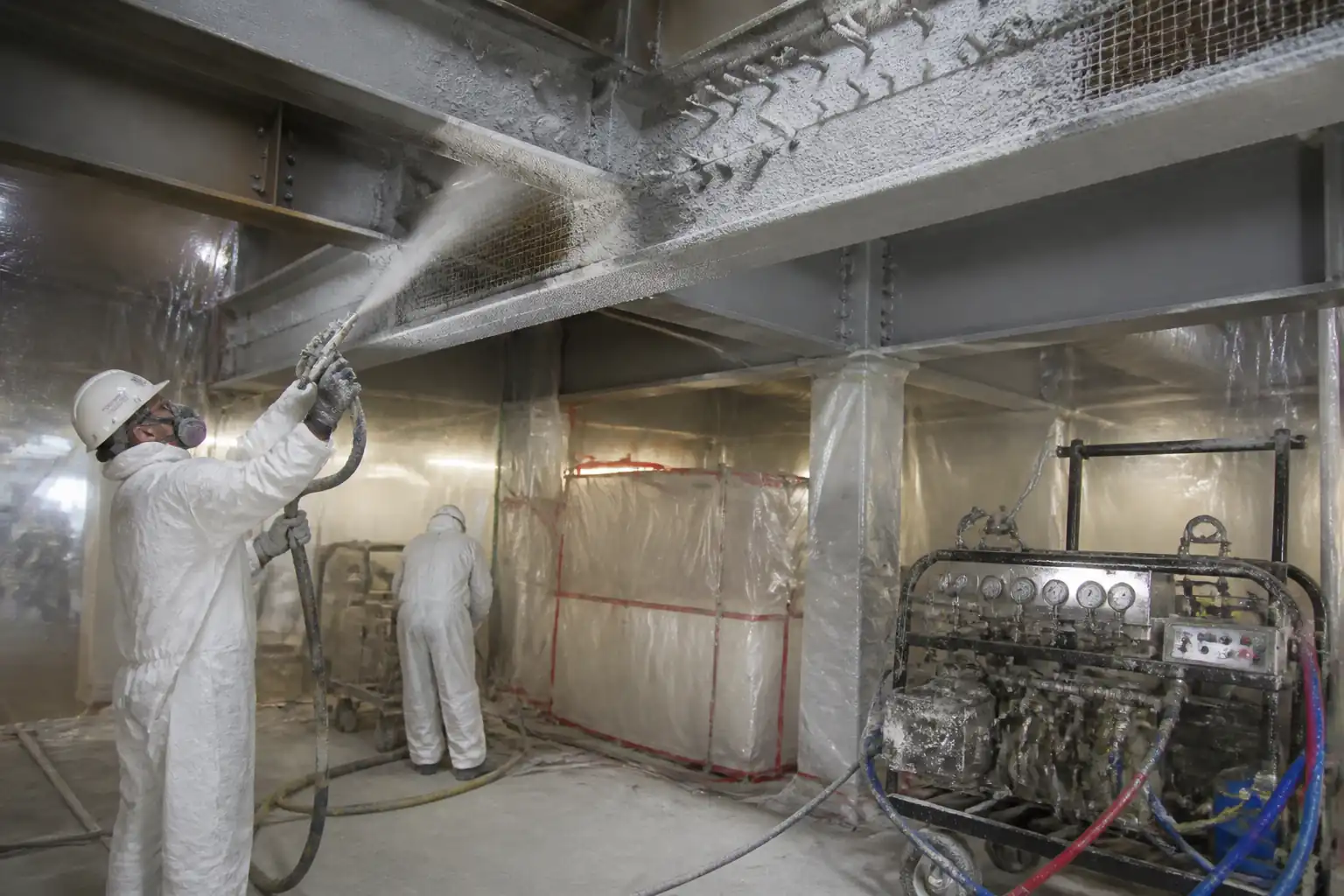
| 9 | Intumescent Basecoat – First Pass | Confirm target total DFT per member from approved schedule (often 1.0–3.5 mm for 60–120 min ratings) [Verify]. Apply by airless spray in multiple passes; do not exceed per-coat WFT per PDS (typ. 800–1500 µm). Avoid runs/sags. | Painting Supervisor | WFT checks; visual for defects; ambient log |
| 10 | Curing Between Coats | Allow each coat to reach minimum recoat condition per PDS (time/temp/RH/ventilation). Confirm surface is firm, non-tacky, and supports subsequent coats without damage. | Painting Supervisor | Touch/visual; time/ambient records |
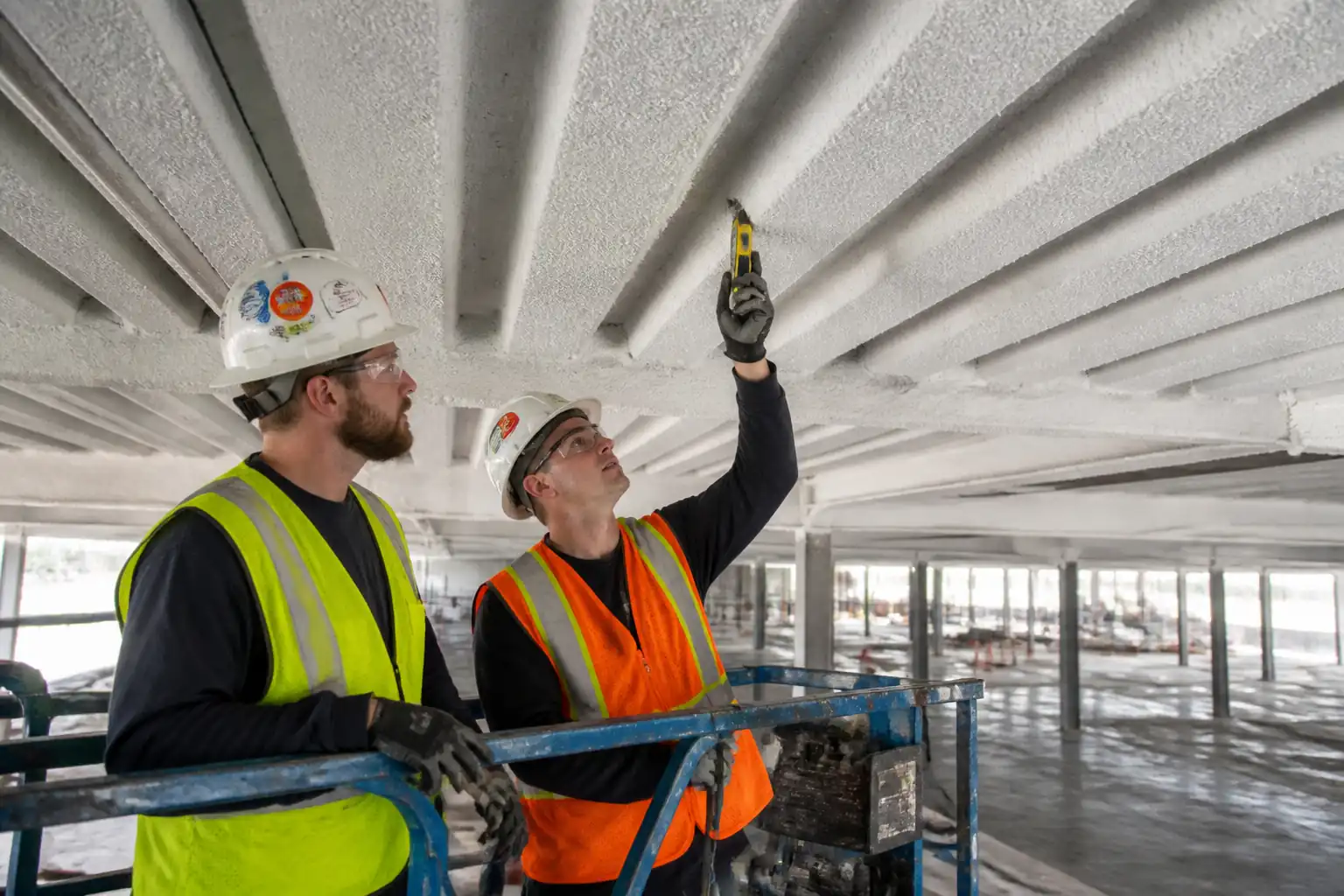
| 11 | Subsequent Intumescent Coats | Repeat application/inspection cycles until scheduled total DFT achieved for each member. Maintain identification and mapping of readings per member/face. | Painting Supervisor / Coating Inspector | DFT per ISO 19840 sampling; map and record |
| 12 | Adhesion Testing (Representative Areas) | Perform pull-off adhesion tests (ASTM D4541 or ISO 4624) at agreed frequency (e.g., 1 test per 500 m² or per 50 members, min 3 tests) [Verify]. Repair dollies locations after test. | Coating Inspector | Pull-off tester; record MPa and failure mode |
| 13 | Repairs and Touch-ups | Address low DFT by additional coats. For runs/sags/mud cracking: sand back or remove to sound layer and reapply per PDS. Feather edges; re-measure DFT. | Painting Supervisor | DFT re-check; visual finish |
| 14 | Topcoat/Sealer (If Specified) | Apply compatible sealer/topcoat within recoat window after basecoat fully cured. Typical DFT 40–60 µm [Verify]. Confirm gloss/colour if architectural. | Painting Supervisor | WFT/DFT; compatibility confirmation |
| 15 | Final Inspection and Handover | Comprehensive DFT mapping, adhesion results, environmental logs, batch traceability, NCR close-outs, manufacturer’s compliance letter (if required). Protect finished works. | QA/QC Manager / Coating Inspector | Document review; visual walkthrough |
Health & Safety Controls
Task-Specific Hazards and Controls
- Hazard: Abrasive blasting dust and rebound.
- Consequence: Respiratory injury, eye injury, silicosis (if improper media), skin lacerations.
- Engineering/Procedural Control: Use low-dust garnet; enclosed/curtained blasting with dust extraction; deadman controls; trained operators; exclusion zones.
- PPE: Blast hood with Grade D breathing air; gloves; cut-resistant coveralls; hearing protection; safety boots.
- Collective Measure: Negative-pressure containment with filtration; debris netting.
-
Inspection/Permit/Supervision: Containment integrity checks; compressor moisture traps inspected daily; HSE supervision.
-
Hazard: Solvent/flammable vapors from coatings and thinners.
- Consequence: Fire/explosion, toxic exposure.
- Engineering/Procedural Control: Use intrinsically safe lighting/ventilation; eliminate ignition sources; decant in ventilated areas; bonding/earthing of containers; hot-work exclusion.
- PPE: Chemical-resistant gloves; goggles/face shield; organic vapor respirators or air-fed respirators as required by SDS.
- Collective Measure: Mechanical ventilation achieving target air changes; LEL monitoring where warranted.
-
Inspection/Permit/Supervision: Flammable liquids storage per approved cabinets; daily LEL/ventilation checks; permit-to-work for confined/controlled areas [Verify per project HSE plan and local regulations].
-
Hazard: Isocyanate exposure (certain polyurethane topcoats).
- Consequence: Sensitization, asthma.
- Engineering/Procedural Control: Substitute non-isocyanate where possible; otherwise, closed spray systems, ventilation, restricted access.
- PPE: Air-fed respirator; chemical coveralls; nitrile gloves.
- Collective Measure: Health surveillance/fit testing.
-
Inspection/Permit/Supervision: SDS review; exposure monitoring as required by law [Verify].
-
Hazard: High-pressure airless spray injection injury.
- Consequence: Tissue necrosis/amputation.
- Engineering/Procedural Control: Tip guards, trigger locks, safe distance, do not wipe tips under pressure; emergency response plan with immediate hospital referral.
- PPE: Gloves, goggles/face shield, coveralls.
- Collective Measure: Exclusion zones; equipment lockout/tagout for maintenance.
-
Inspection/Permit/Supervision: Daily equipment inspection; operator training records; supervisor sign-off.
-
Hazard: Working at height on steel frames.
- Consequence: Falls leading to serious injury/fatality.
- Engineering/Procedural Control: Certified scaffolds/MEWPs; double lanyard fall arrest; edge protection; tethered tools.
- PPE: Full-body harness with shock-absorbing lanyard; helmet with chinstrap.
- Collective Measure: Guardrails and toe boards; rescue plan.
-
Inspection/Permit/Supervision: Pre-use checks; statutory scaffold inspections; MEWP operator certification.
-
Hazard: Noise and vibration from blasting/compressors.
- Consequence: Hearing loss, HAVS.
- Engineering/Procedural Control: Selection of quieter plant; isolation; exposure time management.
- PPE: Hearing protection (SNR per noise map).
- Collective Measure: Acoustic screens where feasible.
-
Inspection/Permit/Supervision: Noise surveys; health surveillance per regulations.
-
Hazard: Confined/poorly ventilated spaces (enclosures).
- Consequence: Asphyxiation, solvent overexposure.
- Engineering/Procedural Control: Confined space assessment; forced ventilation; gas monitoring; standby attendant.
- PPE: Respiratory protection per monitoring results.
- Collective Measure: Permit-to-work with rescue plan.
-
Inspection/Permit/Supervision: Confined Space Permit; continuous monitoring.
-
Hazard: Manual handling of drums and equipment.
- Consequence: Musculoskeletal injuries.
- Engineering/Procedural Control: Use drum trolleys/hoists; team lifts; decant to smaller containers.
- PPE: Gloves, safety footwear.
- Collective Measure: Mechanical aids.
-
Inspection/Permit/Supervision: Supervisor to enforce lift plans.
-
Hazard: Electrical equipment in damp/paint environments.
- Consequence: Electric shock.
- Engineering/Procedural Control: 110V center-tapped transformers or RCDs; IP-rated equipment; cable management.
- PPE: Dielectric gloves as needed; dry gloves.
- Collective Measure: PAT testing.
- Inspection/Permit/Supervision: Daily visual checks; formal inspections per schedule.
Environmental Controls
Controls for Environmental Impact
- Dust and Abrasive Containment: Fully enclose blasting zones with sheeting; use vacuum recovery. Daily cleanup; prevent migration to drains.
- Waste Management: Segregate spent abrasive and paint debris as potentially hazardous waste; test and dispose per licensed facility requirements. Maintain waste transfer notes.
- VOC and Odor Management: Choose low-VOC options where feasible; mechanical ventilation to maintain concentrations below occupational limits; schedule high-VOC works off-peak.
- Overspray and Drift: Use shrouds, windscreens, and correct tip/pressure; halt spraying above safe wind thresholds [Verify per site limit].
- Noise: Fit silencers; schedule noisy tasks during permitted hours; provide acoustic barriers as needed.
- Water Protection: Block stormwater inlets near work; deploy spill kits; prohibit washing tools into drains.
- Energy Efficiency: Use properly sized compressors with dryers; shut down idling equipment.
- Material Efficiency: Mix only required quantities; track pot life to reduce waste.
QA/QC Requirements
Inspection and Testing
- Implement ITP with defined hold/witness points.
- Calibration: DFT/WFT gauges, hygrometers, conductivity meters, and pull-off testers with valid certificates.
- Sampling Frequency (typical) [Verify per ITP/spec]:
- DFT: per ISO 19840/SSPC-PA 2 – e.g., min 5 measurement areas per 10 m² or per member flange/web; each area = ≥3 gauge readings.
- Salts: at least 1 Bresle test per 50 m² per shift per substrate condition change.
- Dust: at least 1 test per 50 m².
- Adhesion: 1 set per 500 m² or per 50 members, min 3 pulls.
Acceptance Criteria (typical – verify project/manufacturer)
- Cleanliness: ISO 8501-1 Sa 2½, free from visible dust/oil/grease.
- Salts: ≤20 mg/m² chloride as NaCl (Bresle) [Verify].
- Dust: ISO 8502-3 max Class 2 (quantity/size) [Verify].
- Profile: 40–75 µm Rz [Verify].
- Primer DFT: 50–75 µm, uniform; within manufacturer’s limits for overcoating.
- Environmental: Steel temp ≥3°C above dew point; RH ≤85%; substrate/application temperatures within PDS.
- Intumescent DFT: Per approved schedule; acceptance per ISO 19840/SSPC-PA 2 – mean ≥ NDFT; no individual reading <80% NDFT unless otherwise permitted by standard/manufacturer [Verify].
- Adhesion: ≥1.5 MPa average; no individual <1.0 MPa; predominantly cohesive failure in coating or adhesive acceptable [Verify/manufacturer].
Documentation and Traceability
- Coating Inspection Reports (CIRs), DFT maps per member, WFT logs, environmental logs, salt/dust/profile records, adhesion test reports.
- Batch records (primer/intumescent/topcoat), COAs/SDS, equipment calibration.
- NCR/CARs and corrective actions; final MDR/hand-over dossier with manufacturer’s compliance letter (if required).
Attachments
- Approved product data sheets and SDS for primer/intumescent/topcoat.
- Coating schedule by member (Hp/A, required DFT and fire rating).
- DFT maps and WFT logs.
- Environmental monitoring logs.
- Bresle salt test and dust test records.
- Surface profile measurement records.
- Adhesion test reports with locations and photos.
- Equipment calibration certificates.
- Material batch and storage logs.
- NCR/CAR register and close-out evidence.
- Manufacturer’s compatibility/approval letters and any site visit reports.
This content is a read-only public reference. Download or customize to get an editable version.
ITP preview
The first inspection activities from the linked ITP for Method Statement – Intumescent Paint Application to Structural Steelwork:
| Activity | Inspection / Test | Acceptance Criteria | Responsibility | Record |
|---|---|---|---|---|
| Material receipt and storage | Verify PDS/SDS, batch numbers, shelf-life, storage temperatures | Conforms to approved submittals; storage within PDS limits; no damaged containers | QA/QC + Materials Controller | Material Receipt & Storage Log |
| Surface degreasing (pre-blast) | Visual and wipe test per SSPC-SP1 | No oil/grease residues; clean, dry surface | Coating Inspector | Pre-blast Inspection Report |
| Abrasive blasting | Visual vs ISO 8501-1; profile ISO 8503 | Sa 2½; profile 40–75 µm Rz [Verify] | Coating Inspector | Post-blast Report; Profile Measurements |
Showing 3 of 15 inspection activities. View full ITP →
Related Inspection and Test Plan
An Inspection and Test Plan (ITP) is available for Method Statement – Intumescent Paint Application to Structural Steelwork. The ITP defines the inspection activities, acceptance criteria, hold and witness points, responsible parties, and records required to verify the work described in this method statement.
View the Method Statement – Intumescent Paint Application to Structural Steelwork ITP →Frequently asked questions
Continue with related Quollnet resources connected to this method statement.