
Method Statement: Fireproofing Inspection and ITP for Composite Steel Deck Floor Systems (Soffit of Trapezoidal Galvanized Deck) – Method Statement
AI-assisted method statement with matching ITP, PDF download, and Excel export.
More than a static template
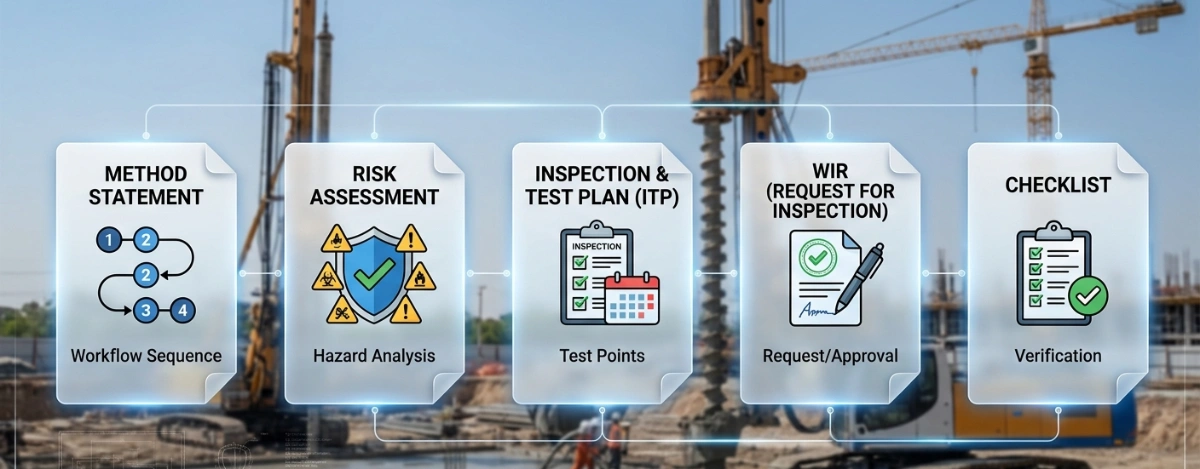
Unlike a downloadable Word or PDF template, this method statement is an AI-assisted editable starting point connected directly to a matching Inspection and Test Plan. Every section is structured, project-adaptable, and ready to export.
- AI-assisted drafting — Customize every section with AI for your specific project scope.
- Linked ITP — A matching inspection and test plan is generated alongside the method statement.
- Multiple export formats — Download as a formatted PDF or editable Excel spreadsheet.
- Editable starting point, not a final document — Review, verify, and adjust all content against your project requirements before use.
Static template vs. Quollnet workflow
| Feature | Static template | Quollnet |
|---|---|---|
| Project-specific content | Manual fill-in required | AI-assisted customization |
| Linked ITP | Separate document, no link | Matching ITP included |
| Export formats | Usually PDF only | PDF and Excel |
| Structured sections | Free-form layout | 13 standardized sections |
| Saved to your account | Local file only | Cloud-saved, reusable |
| Content accuracy | You verify everything | AI-assisted, you still verify |
| Cost | Often free but time-intensive | Free to customize and download |
What you can customize
When you save this method statement to your account, every section becomes editable. The following 13 sections are included:
- Scope — Defines the activity and its boundaries.
- References — Standards, specifications, and drawings.
- Responsibilities — Roles and accountabilities.
- Resources — Labour, plant, and equipment summary.
- Materials — Materials and compliance requirements.
- Equipment — Tools and equipment details.
- Prerequisites — Hold points and pre-conditions.
- Method sequence — Step-by-step construction sequence.
- Safety controls — HSE risk controls and PPE.
- Environmental controls — Environmental mitigation measures.
- QA/QC — Quality inspection and test requirements.
- ITP — Inspection and Test Plan table (has its own page).
- Attachments — Referenced drawings and documentation.
Why this method statement is used
This method statement is used to define and communicate the approved procedure for carrying out method statement: fireproofing inspection and itp for composite steel deck floor systems (soffit of trapezoidal galvanized deck) on site. It ensures the work is planned in advance, the correct resources and controls are in place, and all personnel understand responsibilities, sequence, quality requirements, and safety controls before work begins. It aligns site execution with the documented scope and acceptance expectations.
Who uses this method statement
This method statement is used by contractors, site supervisors, project engineers, QA/QC engineers, HSE officers, consultants, and client representatives. It serves as a shared reference for planning, execution, supervision, inspection, and approval of the activity on site.
When it is prepared and submitted
The method statement is prepared before the work activity starts and submitted as part of the pre-construction documentation package for review and approval.
Who reviews or approves it
The method statement is usually submitted to the client representative, consultant, resident engineer, or project management consultant for review and approval before the work commences.
Important approval note
This method statement is an AI-assisted editable starting point, not a pre-approved document. Before use on any project, all content must be reviewed and approved by the relevant parties (superintendent, principal contractor, or client representative) in accordance with your contract and project quality plan.
For example: if your specification requires a departure from a referenced standard, that departure must be documented and approved separately — this method statement will not capture that automatically. Always verify against your applicable drawings, specifications, and regulatory requirements.
Method statement content
Scope
Overview
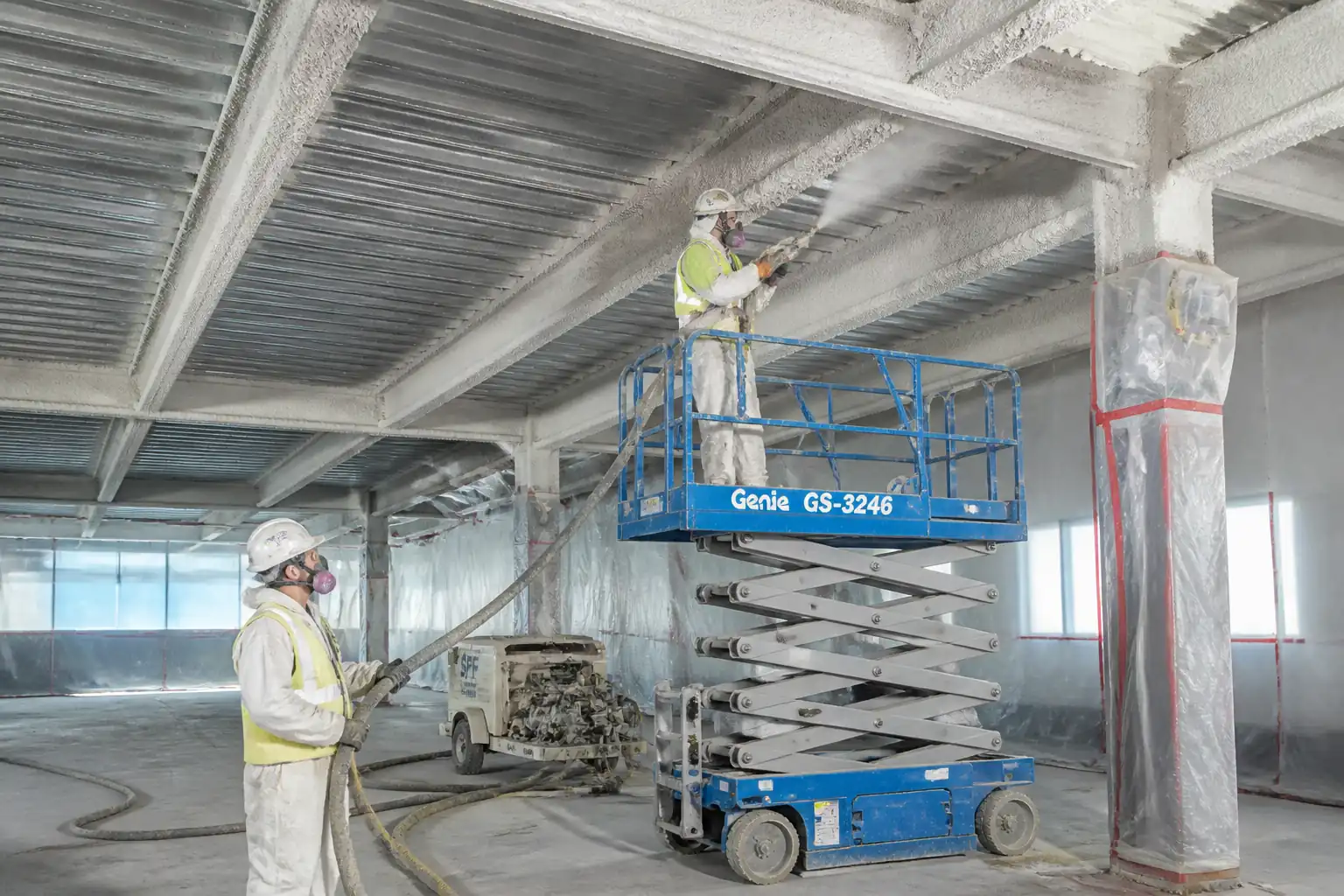
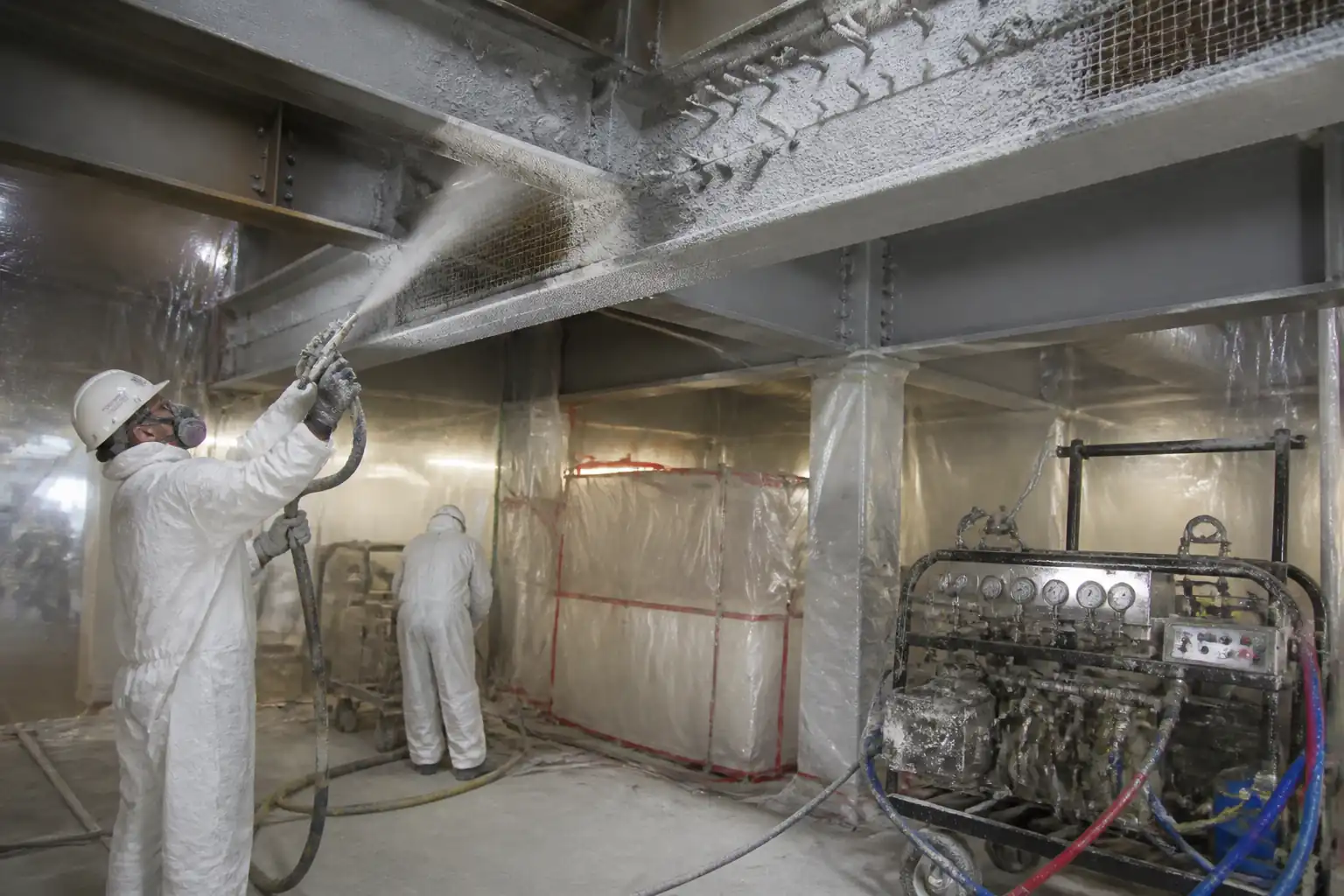
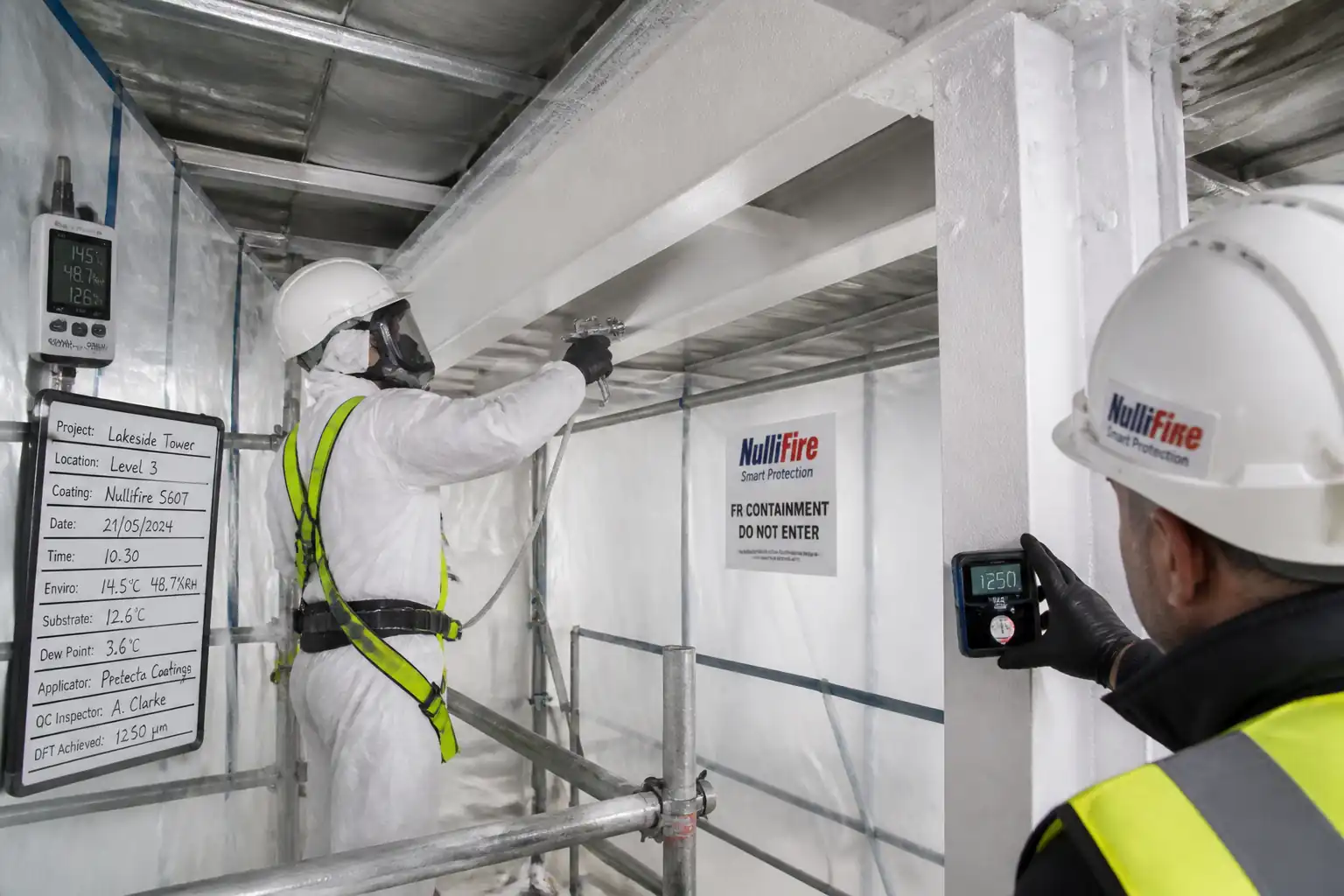
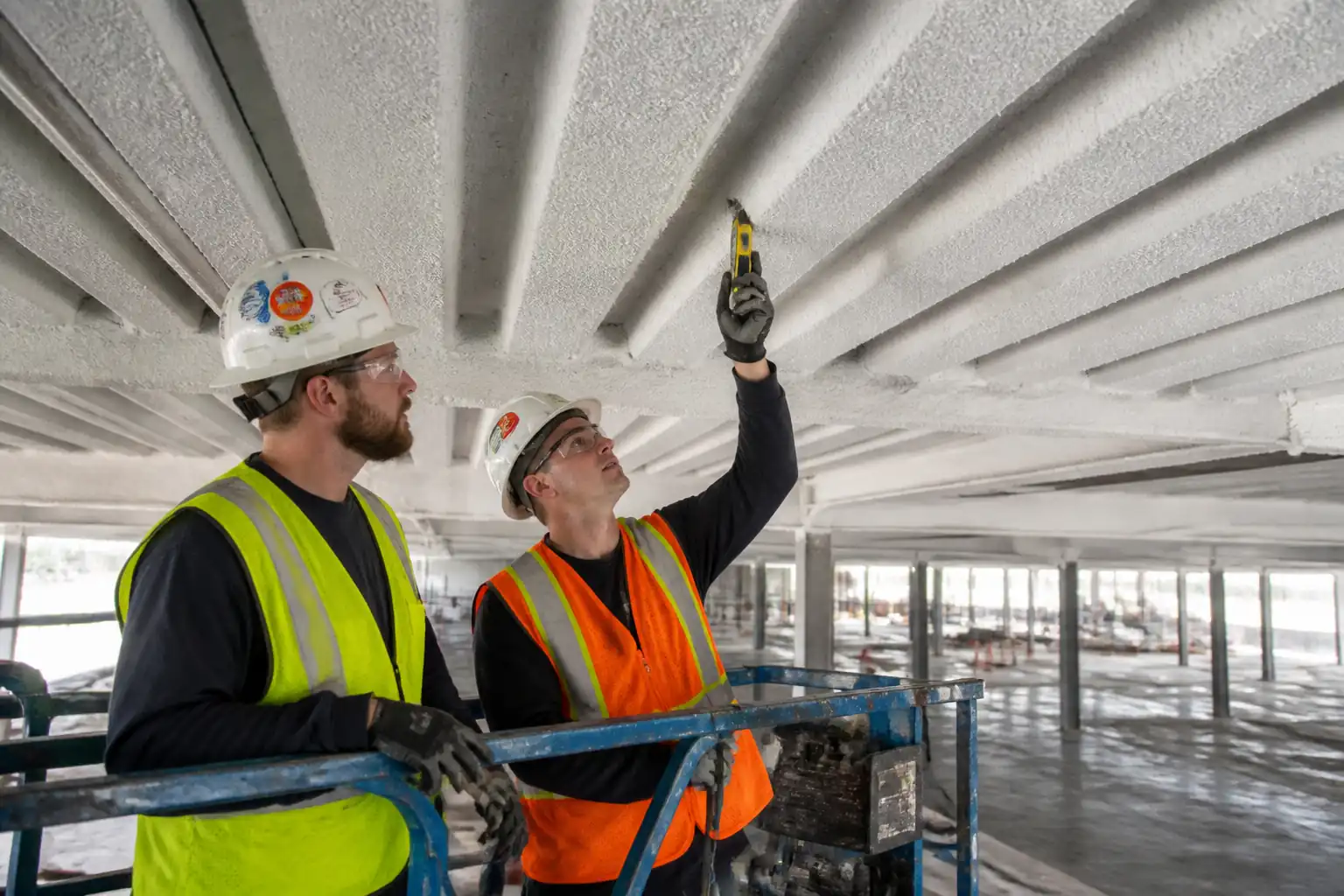
This method statement covers inspection and testing of passive fire protection applied to the soffit (underside) of composite steel deck floor systems with trapezoidal galvanized steel decking, including: surface preparation and cleanliness, bonding/adhesion to galvanized substrate, spray application quality, keying into trapezoidal profiles, target thickness verification, repairs, and final release prior to concealment by ceilings or service installations.
Inclusions
- Verification of substrate readiness: galvanized deck condition, fixing integrity, moisture/dryness, oil/contaminant removal, access and protection.
- Application oversight for spray-applied fire-resistive materials (SFRM) or approved equivalent per UL/EN tested assembly.
- Thickness, density, and cohesion/adhesion testing per applicable ASTM methods.
- Control of soffit profile continuity on trapezoidal geometry; treatment of arrises, edges, service penetrations, and interfaces.
- Documentation: ITP compliance, test reports, inspection checklists, as-built records, nonconformance and corrective actions.
- Coordination and hold points before ceiling grid or MEP/services conceal fireproofing.
Exclusions
- Firestopping at service penetrations through fire-rated assemblies (handled under separate method).
- Structural remediation of deck or framing (by structural contractor).
References
| Document Type | Reference / Number | Revision | Notes |
|---|---|---|---|
| ASTM E119 / UL 263 – Standard Fire Tests of Building Construction and Materials | Select UL Design/EN assessment matching project assembly [Verify]. | ||
| ASTM E605/E605M – Thickness and Density of SFRM Applied to Structural Members | |||
| ASTM E736/E736M – Cohesion/Adhesion of SFRM | |||
| ASTM D7803 – Preparation of Zinc-Coated (Galvanized) Steel Surfaces for Painting | Use with manufacturer instructions for bonding agents/primers. | ||
| SSPC-SP 1 – Solvent Cleaning | Removal of oils/grease prior to bonding. | ||
| SSPC-SP 7/NACE No. 4 – Brush-Off Blast Cleaning [Verify suitability for galvanized] | Only if permitted by deck manufacturer and PFP supplier. | ||
| ISO 8502-3 – Assessment of dust on steel surfaces (tape method) | Where dust may impair adhesion. | ||
| BS EN 13381-4 – Contribution of applied passive fire protection to steel members; BS EN 13381-8 – Reactive coatings on steel | Reference where project uses Eurocode/EN assessed systems. | ||
| Manufacturer’s Technical Data Sheets (TDS), Safety Data Sheets (SDS), and UL/EN design listings for the approved PFP system | Product-specific application limits and acceptance values govern [Verify]. |
Responsibilities
| Role | Responsibility | Name / Party |
|---|---|---|
| Project Manager | Contractor – Project Manager | Contractor |
| PFP Superintendent/Engineer | Contractor – PFP Superintendent/Engineer | Contractor |
| QA/QC Engineer | Contractor – QA/QC Engineer | Contractor |
| HSE Manager | Contractor – HSE Manager | Contractor |
| Applicator Crew | Approved PFP Applicator | Specialist Subcontractor |
| Testing Agency | Independent Testing Agency | Independent |
| EOR/Consultant | Designer/Engineer of Record (EOR) / Consultant | Engineer |
Resources
| Resource Type | Description | Quantity | Remarks |
|---|---|---|---|
| Manpower | Qualified crew experienced with SFRM on galvanized deck | 4–8 | |
| Manpower | IPAF/MEWP certified | 2–3 | |
| Manpower | ASTM E605/E736 trained for sampling and measurements | 1–2 | |
| Manpower | Third-party sampling and lab density tests | As required |
Materials
| Material | Specification / Grade | Quantity | Remarks |
|---|---|---|---|
| SFRM | Density and thickness per UL/EN listing [Verify] | Low/medium density cementitious or mineral-fiber SFRM | |
| Adhesive/Primer | Type and coverage per TDS [Verify] | Required where specified by SFRM manufacturer | |
| Water | As per SFRM TDS [Verify] | For mixing/cleaning | |
| Polythene, tape | Site grade | Protect adjacent finishes/services | |
| Galv. mesh/lath | Gauge/mesh per design [Verify] | Mechanically fixed per TDS |
Equipment
| Equipment | Capacity / Type | Quantity | Inspection Required |
|---|---|---|---|
| SFRM Pump | As per TDS [Verify] | ||
| Compressor | ≥ 250–350 cfm @ 100 psi [Verify] | ||
| Paddle mixer, weighing scale | |||
| MEWP/Scaffold | SWL per equipment [Verify] | ||
| Depth gauge per ASTM E605, calipers, straightedge | |||
| ASTM E736 kit | |||
| Core cutter & precision scale | |||
| Thermo-hygrometer, IR thermometer, dew point meter | |||
| HEPA vacuums, brooms, waste bins |
Prerequisites
Approvals and Documentation
- Approved PFP product submittals, UL/EN design listing, TDS/SDS.
- Approved Method Statement and ITP; risk assessment and permits [Verify per project HSE plan and local regulations].
- Coordination drawings indicating areas to receive PFP and exclusion/expansion joints.
Site Readiness
- Galvanized steel deck fully fixed, clean, dry, and accessible. No leaks from above; slab cured without active dripping.
- Services and ceiling works not commenced in areas under inspection; protect adjacent installations.
- Ambient and substrate conditions within product limits: typically 4–40°C substrate temperature, substrate ≥3°C above dew point, RH ≤85% [Verify per TDS].
Equipment and Calibration
- Spray equipment, gauges, adhesion kits, and environmental meters calibrated/checked; certificates available.
Mock-Up
- Execute and approve a representative mock-up (min. 2 m²) on trapezoidal deck including ribs, edges, and penetrations to confirm profile, keying, and adhesion prior to main works.
Training/Briefings
- Toolbox talk covering hazards (MEWPs, silica dust, adhesives), controls, waste handling, emergency procedures.
Method Sequence
| Step | Activity | Description | Responsibility | Inspection / Hold Point |
|---|---|---|---|---|
| 1 | Pre-Inspection of Substrate | Inspect galvanized deck: verify fixings complete, surfaces free of oil, laitance, wetness, and debris. Conduct SSPC-SP 1 solvent clean where oil is present; assess dust per ISO 8502-3 if blasting/grinding occurred. | PFP Superintendent / QA-QC | Visual and touch check; solvent wipe test; moisture check |
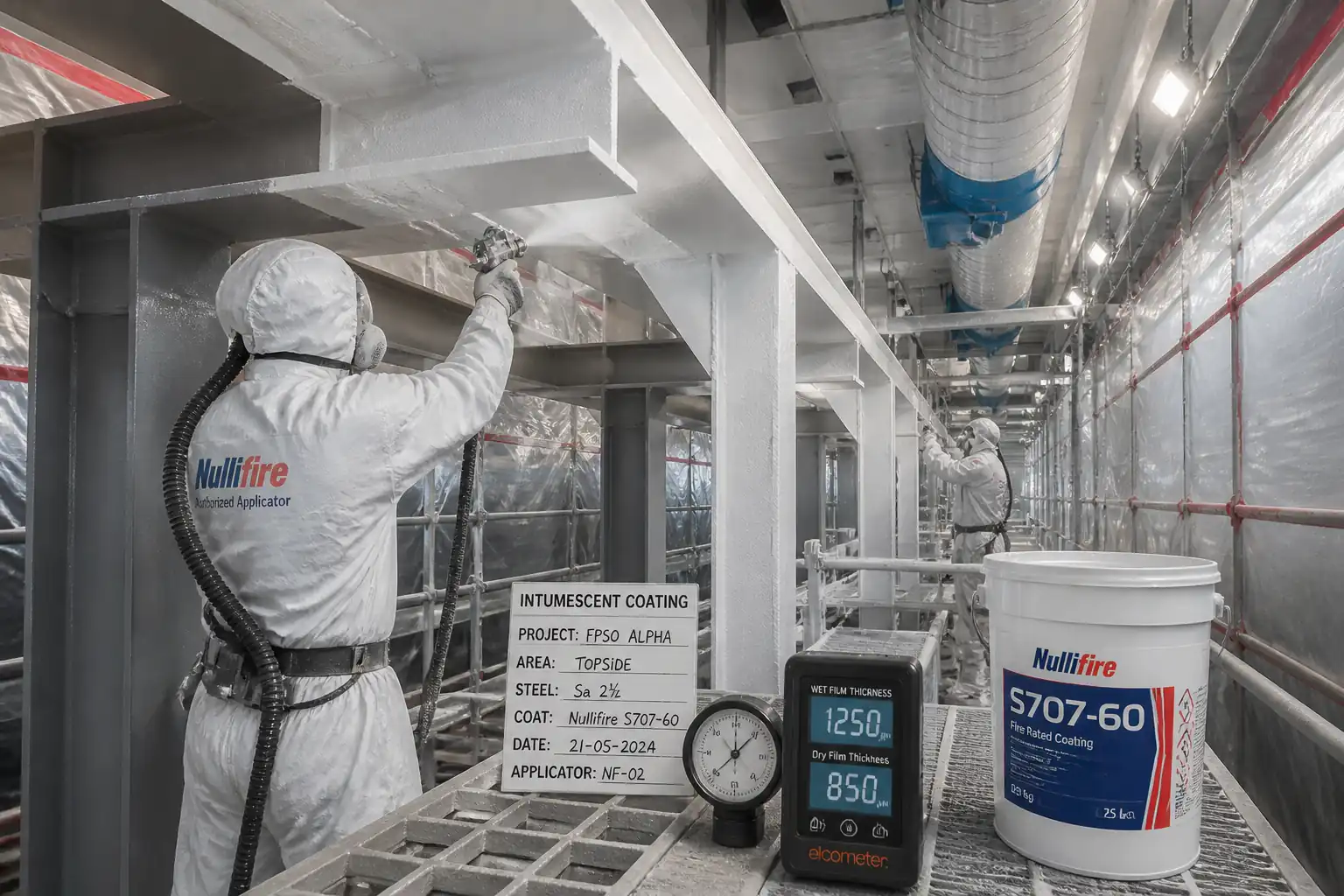
| 2 | Surface Preparation for Galvanized Substrate | Prepare surface per ASTM D7803 and TDS: solvent clean; if required by manufacturer, apply compatible bonding agent/primer uniformly to all soffit surfaces of deck including ribs/flutes. Light abrasive sweep (SSPC-SP 7) only if permitted by deck and PFP manufacturers. | Applicator | Wet film thickness (WFT) spot checks for bonding agent; coverage verification |
| 3 | Environmental Controls | Measure ambient and substrate temperatures, RH, and dew point before and during application. Ensure ventilation; prevent condensation, water spray, or freezing conditions. | QA/QC | Meter readings every 2 hours and on change of shift/area |
| 4 | Masking and Protection | Protect adjacent elements (glazing, equipment, MEP) with poly sheeting and tape. Establish drip control at perimeter; isolate live electrics. | Applicator | Visual |
| 5 | Mixing and Pump Setup | Batch SFRM per TDS using clean water; maintain consistent water ratio and mixing time. Verify pump pressure and nozzle configuration suitable for deck ribs to achieve keying without rebound. | Applicator | Batch tickets and observation |
| 6 | Application—Scratch/Key Coat | Apply initial pass aimed into rib flutes at 30–60° nozzle angle to ensure keying; build thin scratch layer across webs and crests. Control rebound and shadowing by cross-pass technique. | Applicator | In-process visual; supervisor sign-off |
| 7 | Application—Build to Thickness | Build SFRM in multiple passes to achieve specified dry thickness over trapezoidal profile: measure at rib valleys, webs, and crests. Avoid heavy single-pass application leading to slumping or cracking. | Applicator | Spot depth checks during application |
| 8 | Detailing—Edges, Penetrations, and Interruptions | Treat edges, terminations at beams/walls, hangers, and openings. Install lath/mesh only where specified to maintain thickness. Provide neat arrises without feathering below minimum thickness. | Applicator | Visual check of details |
| 9 | Initial Cure and Protection | Maintain area free from impact, water spray, condensation, and freezing. Provide ventilation; prevent premature concealment. | Applicator / Site Team | Periodic check |
| 10 | Thickness Testing (ASTM E605) | After sufficient cure, perform dry thickness measurements across representative areas: for trapezoidal decks include readings at crests, webs, and valleys. Establish test lots per floor/zone. | QA/QC / Testing Agency | Randomized sampling |
| 11 | Density Testing (ASTM E605) | Obtain cores/scrapings per ASTM E605 to verify dry density where required by UL/EN design. | Testing Agency | Sampling witnessed by QA/QC |
| 12 | Cohesion/Adhesion Testing (ASTM E736) | Conduct pull-off tests at representative locations, including on galvanized deck ribs/valleys. Patch test locations after testing. | Testing Agency | Witness by QA/QC/Consultant |
| 13 | Defect Rectification | Identify and repair voids, delamination, cracks, or thin spots using same product and method. Re-test repaired areas as required. | Applicator / QA/QC | Follow-up inspection |
| 14 | Final Inspection and Hold Point Before Concealment | Comprehensive walkdown confirming coverage, thickness, adhesion results, cleanliness, and interfaces. Establish hold point prior to installation of ceilings or services that would obstruct inspection. | QA/QC, Consultant/Client | Final inspection |
Health, Safety, and Environment (HSE) – Safety Controls
Task-Specific Hazards, Consequences, and Controls
1) Hazard: Work at height under deck (MEWPs/scaffolds)
- Likely consequence: Falls, entrapment, dropped objects.
- Engineering/procedural control: Use certified MEWPs with daily pre-use checks; define exclusion zones; toe-boards and tool lanyards; competent operators; emergency lowering drill.
- Required PPE: Helmet with chin strap, full-body harness with appropriate lanyard, safety boots, gloves.
- Collective measure: Properly erected scaffold or MEWP with guardrails; barricades below.
- Inspection/permit/supervision: MEWP inspection tags current; work-at-height permit; supervisor spot checks. [Verify per project HSE plan and local regulations]
2) Hazard: Silica/mineral dust from SFRM mixing/spraying and surface prep
- Likely consequence: Respiratory irritation, silicosis risk, eye injury.
- Engineering/procedural control: Wet mixing; enclosed mixing station with local exhaust; HEPA vacuums; avoid dry sweeping; limit cutting/grinding.
- PPE: Fit-tested RPE (P2/P3), safety goggles/face shield, gloves, disposable coveralls.
- Collective measure: Ventilation and dust suppression; designated mixing area downwind.
- Inspection/permit/supervision: Air monitoring as required; SDS availability; toolbox talks.
3) Hazard: Chemical exposure to bonding agents/primers (solvents/VOCs)
- Likely consequence: Dermal/eye irritation, inhalation hazard, fire risk.
- Engineering/procedural control: Use low-VOC, non-flammable products where possible; ensure ventilation; no ignition sources; decanting in drip trays; spill kits available.
- PPE: Chemical-resistant gloves, goggles, RPE as per SDS.
- Collective measure: Storage in ventilated, bunded cabinets; flammable liquids cabinet if applicable.
- Inspection/permit/supervision: COSHH assessment; permit to use chemicals; SDS briefing.
4) Hazard: Manual handling of SFRM bags and equipment
- Likely consequence: Musculoskeletal injuries.
- Engineering/procedural control: Use mechanical lifts; split loads; team lifting; staging platforms at MEWP basket height.
- PPE: Gloves with grip, safety footwear, back support if prescribed.
- Collective measure: Material hoists; delivery sequencing to reduce handling.
- Inspection/permit/supervision: Manual handling training; supervision of lifting practices.
5) Hazard: Compressed air and pressurized lines
- Likely consequence: Hose whip, injection injury, noise-induced hearing loss.
- Engineering/procedural control: Secure hose couplings with safety pins/whip checks; depressurize before maintenance; route hoses away from access paths.
- PPE: Hearing protection (SNR/NRR per risk), gloves, eye protection.
- Collective measure: Barriers and signage; mufflers where practicable.
- Inspection/permit/supervision: Pressure equipment inspection; lockout/tagout for maintenance.
6) Hazard: Overhead spraying—overspray and visibility
- Likely consequence: Eye injury, slips from wet overspray.
- Engineering/procedural control: Controlled spray pattern; protective sheeting; housekeeping during breaks; anti-slip mats.
- PPE: Goggles/face shield, non-slip footwear.
- Collective measure: Frequent clean-ups; drip trays.
- Inspection/permit/supervision: Housekeeping inspections; maintain clear egress routes.
7) Hazard: Electrical interfaces (lighting, active services)
- Likely consequence: Shock, arcing.
- Engineering/procedural control: Isolate/shroud live services; use 110V or battery tools where practicable; test before touch.
- PPE: Dielectric gloves where required, eye protection.
- Collective measure: Lockout/tagout.
- Inspection/permit/supervision: Electrical isolation permit; supervisor verification.
8) Hazard: Noise and vibration
- Likely consequence: Hearing damage, hand-arm vibration.
- Engineering/procedural control: Select low-noise equipment; limit exposure time; rotate tasks.
- PPE: Hearing protection sized to measured dB.
- Collective measure: Noise barriers where feasible.
- Inspection/permit/supervision: Noise monitoring; HAVS records.
Note: Where exact controls depend on local law or project HSE requirements, verify and comply with the project HSE plan and local regulations.
Environmental Controls
Controls and Good Practice
- Overspray/waste containment: Use ground protection and polythene sheeting; collect rebound and overspray; prohibit discharge to drains or soil.
- Wash water and slurry: Collect and dispose of as construction waste per local regulations; never discharge to stormwater. [Verify per project HSE plan and local regulations]
- VOC/odour management: Select low-VOC products; ventilate work areas; schedule during off-peak hours if required by permit.
- Dust control: HEPA vacuums and damp wiping; no dry sweeping.
- Noise control: Maintain equipment, fit silencers, and limit noisy operations to permitted hours.
- Resource efficiency: Batch materials to reduce waste; return unopened bags.
- Packaging waste: Segregate for recycling where facilities exist.
- Spill prevention: Store chemicals in bunded trays; spill kits available; trained responders.
- Wildlife and community: Prevent visual contamination and nuisance; maintain clean site boundaries and covered transport of waste.
Quality Assurance / Quality Control
QA/QC Strategy
- Submittals: Approve UL/EN design listing, product TDS/SDS, and manufacturer qualifications before works.
- Mock-Up: Achieve and document approval for profile, keying, and adhesion on trapezoidal deck.
- Inspection Frequencies [Verify per project specifications]:
- Thickness (ASTM E605): Minimum 1 test set per 100 m² per floor zone, with readings distributed over rib crests, webs, and valleys; minimum 5 locations per 100 m².
- Adhesion (ASTM E736): Minimum 1 test per 250–500 m² per floor, minimum 3 per floor; additional tests in suspect areas (oily/condensed).
- Density (ASTM E605): Minimum 1 sample per product per floor or per 1,000 m², whichever is more frequent.
- Environmental logs: Every 2 hours during application.
- Acceptance Criteria [Verify]:
- Thickness: Lot average ≥ specified; no single reading < 80–90% of specified or < design minus 3 mm.
- Adhesion: ≥ manufacturer/UL design minimum; typical 150–200 psf (≈7–10 kPa).
- Density: Within product/UL design range.
- Soffit profile: Uniform following trapezoidal geometry; no shadowing or voids; edges not feathered below minimum thickness.
- Records: Substrate acceptance forms, batch logs, WFT checks for adhesive, thickness/adhesion/density reports, environmental logs, NCRs/Corrective Actions, final acceptance certificate.
- Nonconformance: Stop work in affected area, raise NCR, investigate cause (surface contamination, curing/condensation, application technique), implement corrective action plan, re-test.
- Calibration: Verify calibration status of gauges/meters within 12 months; keep certificates on file.
- Traceability: Link batch numbers to areas applied; as-built plans showing tested locations.
- Interfaces: Establish hold point release prior to ceiling grid or MEP installation in each area; any damage by follow-on trades to be reported and repaired with re-inspection.
Attachments
Attachments (to be appended)
- UL/EN Design listings for composite deck floor assembly [Project-specific].
- Manufacturer’s TDS/SDS for SFRM and bonding agent/primer.
- Substrate Acceptance Checklist (Form SA-01).
- Bonding Agent Inspection Log (Form BA-01).
- Environmental Monitoring Log (Form EM-01).
- Thickness Test Report Template (Form TH-01) per ASTM E605.
- Adhesion Test Report Template (Form AD-01) per ASTM E736.
- Density Test Report Template (Form DN-01) per ASTM E605.
- NCR/Corrective Action Form (Form NCR-01).
- Final Acceptance Certificate (Form FA-01).
- As-built area plans showing test locations and lot boundaries.
This content is a read-only public reference. Download or customize to get an editable version.
ITP preview
The first inspection activities from the linked ITP for Method Statement: Fireproofing Inspection and ITP for Composite Steel Deck Floor Systems (Soffit of Trapezoidal Galvanized Deck):
| Activity | Inspection / Test | Acceptance Criteria | Responsibility | Record |
|---|---|---|---|---|
| Documentation and design verification | Review of approvals, UL/EN design, TDS/SDS | Approved submittals and matching design thickness/density requirements | Contractor QA/QC; Consultant (W) | Approved Submittals Register (W) |
| Substrate readiness (Hold Point HP-1) | Cleanliness and dryness check; deck fixings verification | Surface free of oil/dust/moisture; fixings per deck spec | PFP Superintendent; QA/QC; Consultant (W) | Substrate Acceptance Form (HP-1) |
| Environmental conditions | Temp/RH/dew point readings | Within TDS limits; substrate ≥3°C above dew point [Verify] | QA/QC | Environmental Log (W) |
Showing 3 of 12 inspection activities. View full ITP →
Related Inspection and Test Plan
An Inspection and Test Plan (ITP) is available for Method Statement: Fireproofing Inspection and ITP for Composite Steel Deck Floor Systems (Soffit of Trapezoidal Galvanized Deck). The ITP defines the inspection activities, acceptance criteria, hold and witness points, responsible parties, and records required to verify the work described in this method statement.
View the Method Statement: Fireproofing Inspection and ITP for Composite Steel Deck Floor Systems (Soffit of Trapezoidal Galvanized Deck) ITP →Frequently asked questions
Continue with related Quollnet resources connected to this method statement.