
Method Statement – Bored Cast-in-Place Concrete Piles (Dry Drilling Method) – Method Statement
AI-assisted method statement with matching ITP, PDF download, and Excel export.
More than a static template
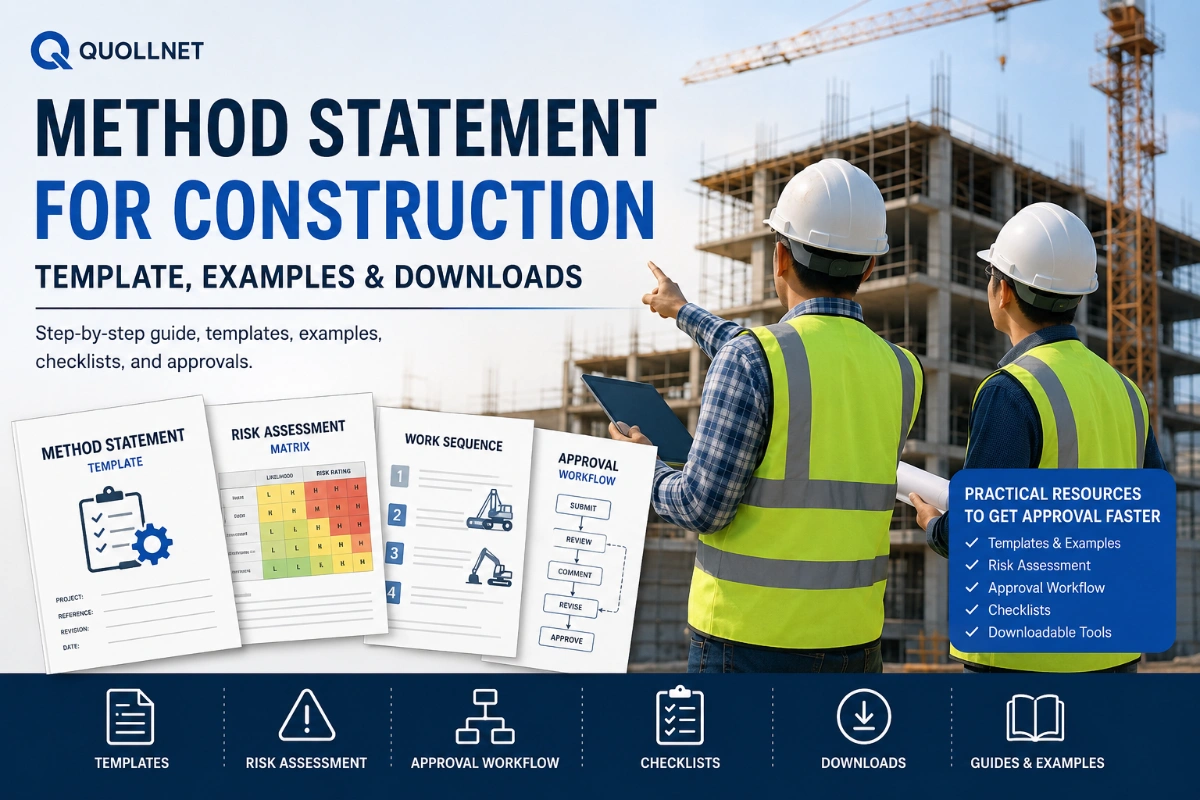
Unlike a downloadable Word or PDF template, this method statement is an AI-assisted editable starting point connected directly to a matching Inspection and Test Plan. Every section is structured, project-adaptable, and ready to export.
- AI-assisted drafting — Customize every section with AI for your specific project scope.
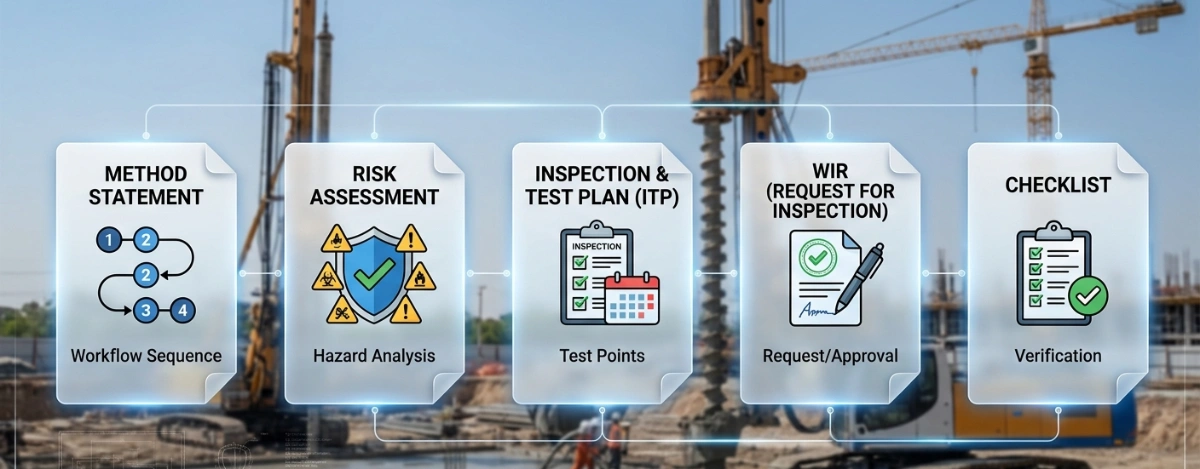
- Linked ITP — A matching inspection and test plan is generated alongside the method statement.
- Multiple export formats — Download as a formatted PDF or editable Excel spreadsheet.
- Editable starting point, not a final document — Review, verify, and adjust all content against your project requirements before use.
Static template vs. Quollnet workflow
| Feature | Static template | Quollnet |
|---|---|---|
| Project-specific content | Manual fill-in required | AI-assisted customization |
| Linked ITP | Separate document, no link | Matching ITP included |
| Export formats | Usually PDF only | PDF and Excel |
| Structured sections | Free-form layout | 13 standardized sections |
| Saved to your account | Local file only | Cloud-saved, reusable |
| Content accuracy | You verify everything | AI-assisted, you still verify |
| Cost | Often free but time-intensive | Free to customize and download |
What you can customize
When you save this method statement to your account, every section becomes editable. The following 13 sections are included:
- Scope — Defines the activity and its boundaries.
- References — Standards, specifications, and drawings.
- Responsibilities — Roles and accountabilities.
- Resources — Labour, plant, and equipment summary.
- Materials — Materials and compliance requirements.
- Equipment — Tools and equipment details.
- Prerequisites — Hold points and pre-conditions.
- Method sequence — Step-by-step construction sequence.
- Safety controls — HSE risk controls and PPE.
- Environmental controls — Environmental mitigation measures.
- QA/QC — Quality inspection and test requirements.
- ITP — Inspection and Test Plan table (has its own page).
- Attachments — Referenced drawings and documentation.
Why this method statement is used
This method statement is used to define and communicate the approved procedure for carrying out method statement – bored cast-in-place concrete piles (dry drilling method) on site. It ensures the work is planned in advance, the correct resources and controls are in place, and all personnel understand responsibilities, sequence, quality requirements, and safety controls before work begins. It aligns site execution with the documented scope and acceptance expectations.
Who uses this method statement
This method statement is used by contractors, site supervisors, project engineers, QA/QC engineers, HSE officers, consultants, and client representatives. It serves as a shared reference for planning, execution, supervision, inspection, and approval of the activity on site.
When it is prepared and submitted
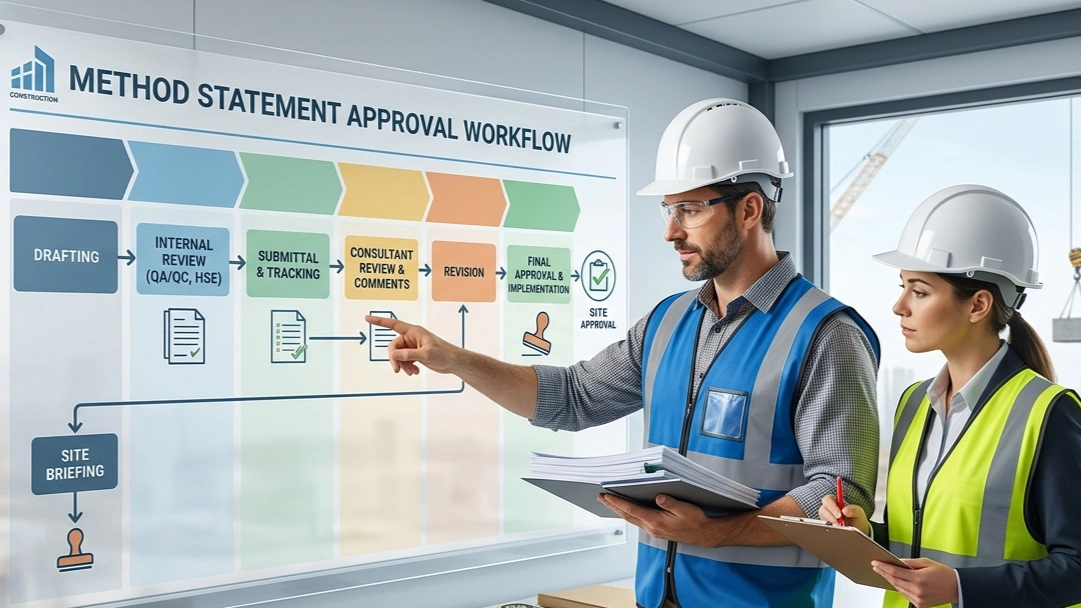
The method statement is prepared before the work activity starts and submitted as part of the pre-construction documentation package for review and approval.
Who reviews or approves it
The method statement is usually submitted to the client representative, consultant, resident engineer, or project management consultant for review and approval before the work commences.
Important approval note
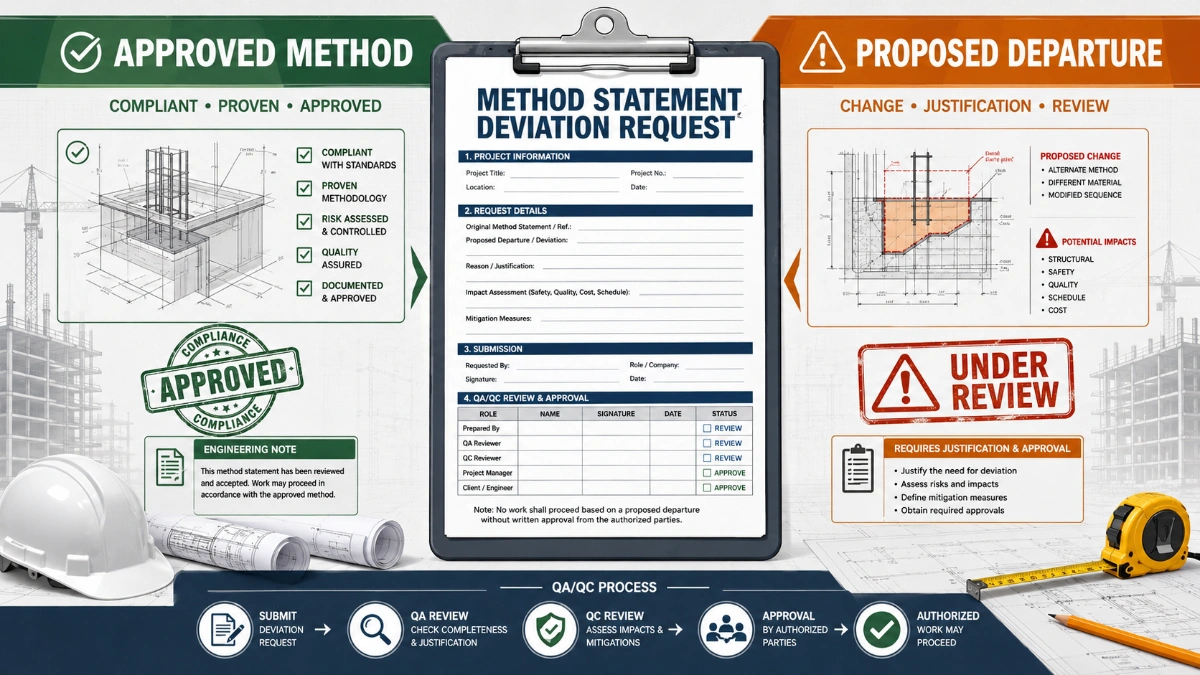
This method statement is an AI-assisted editable starting point, not a pre-approved document. Before use on any project, all content must be reviewed and approved by the relevant parties (superintendent, principal contractor, or client representative) in accordance with your contract and project quality plan.
For example: if your specification requires a departure from a referenced standard, that departure must be documented and approved separately — this method statement will not capture that automatically. Always verify against your applicable drawings, specifications, and regulatory requirements.
Method statement content
Scope
Work Summary
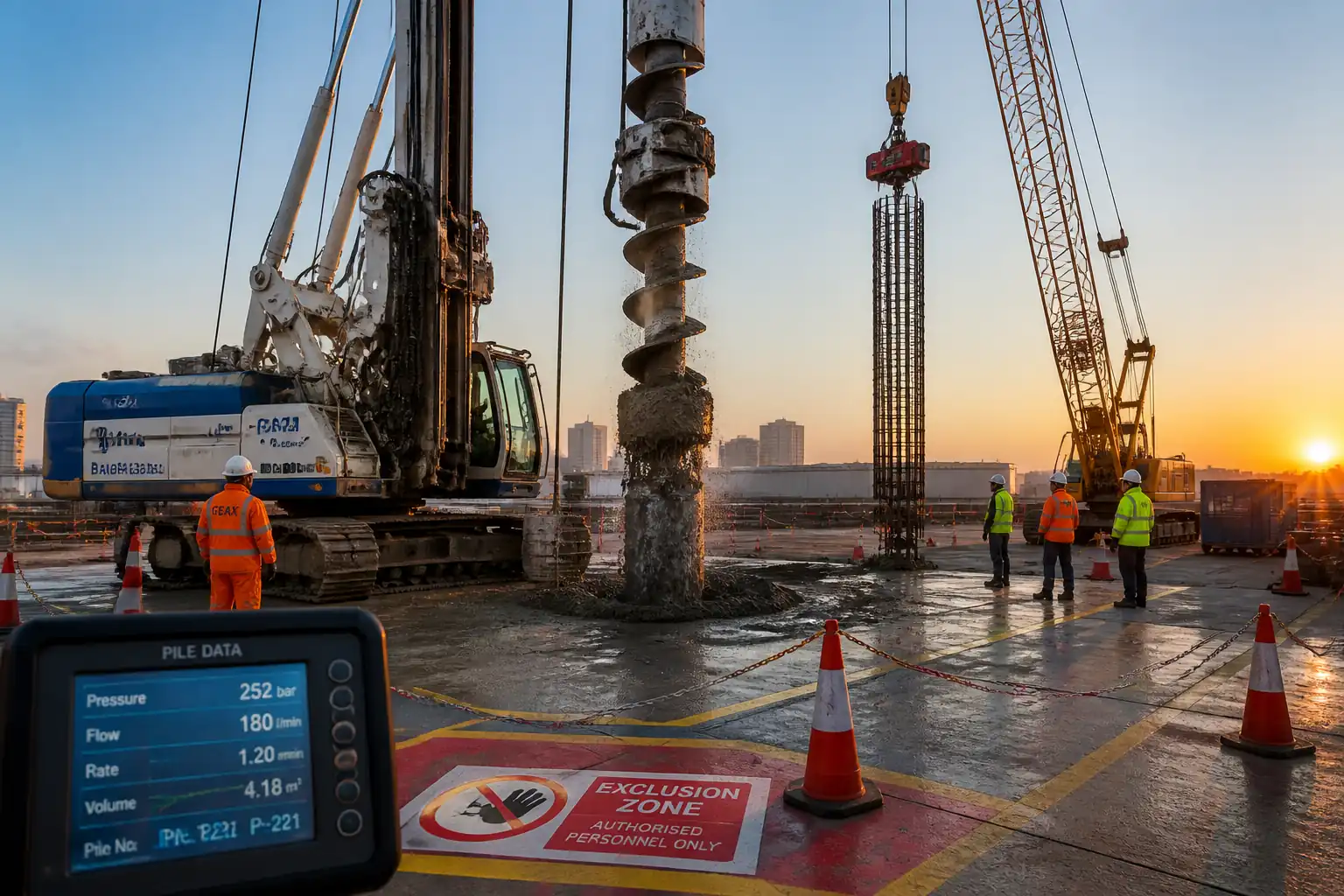
This method covers the complete execution of bored cast-in-place reinforced concrete piles using the dry drilling method, including:
- Site establishment, piling platform preparation, and setting out
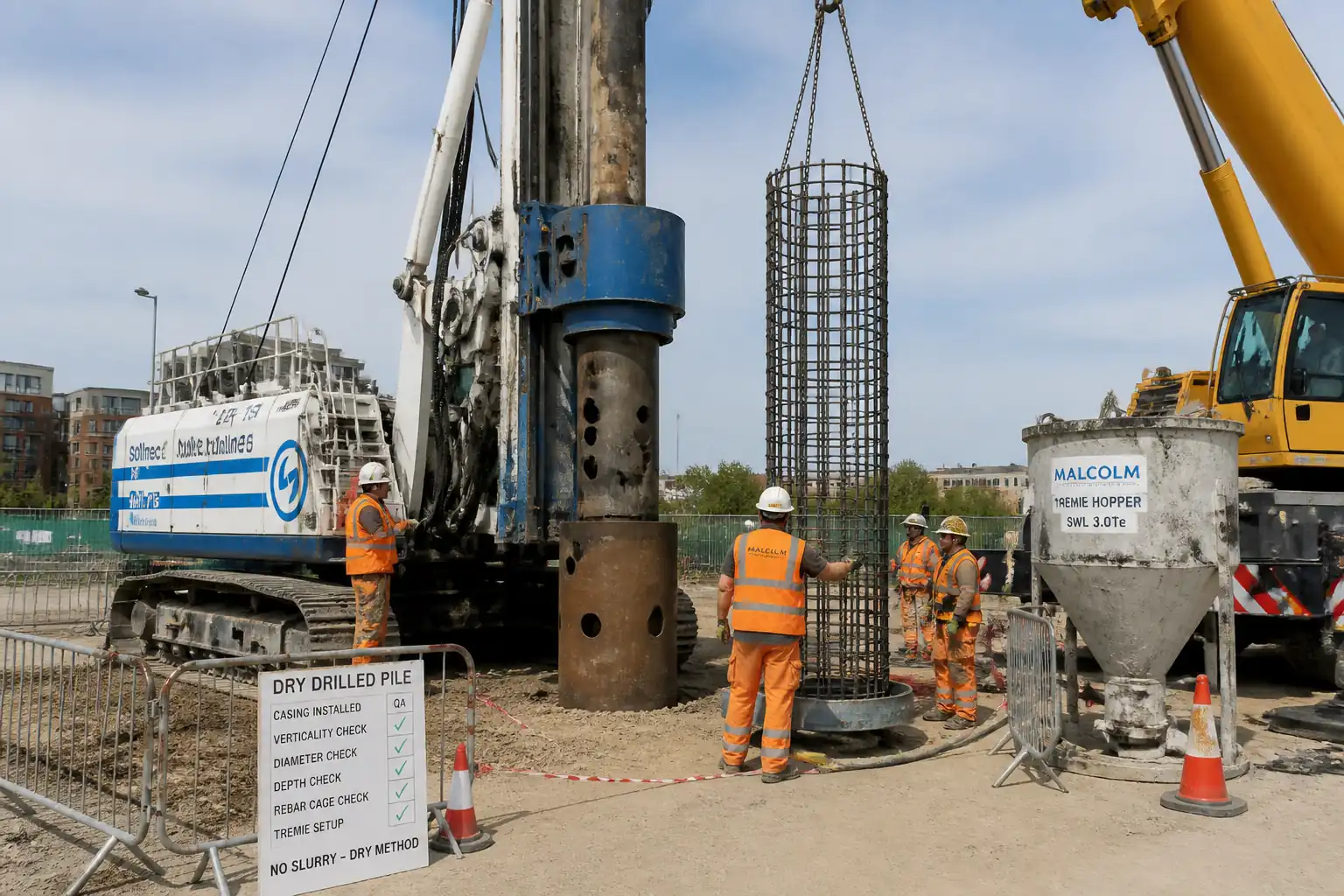
- Positioning of piling rig/crane, installation of partial temporary casing as needed
- Dry drilling and spoil removal without slurry use
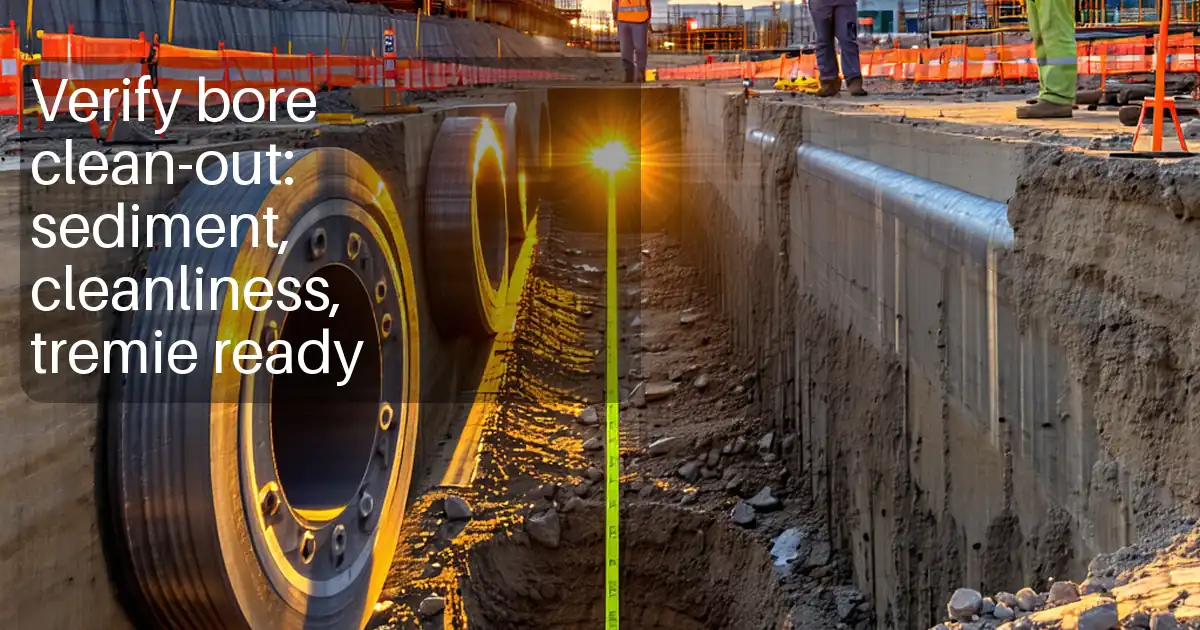
- Base cleaning and verification of dryness/cleanliness
- Reinforcement cage fabrication checks and placement with spacers/centralizers
- Tremie or rigid trunk concrete placement to avoid segregation (no slurry)
- Pile head overcasting and subsequent trimming to cut-off level
- Concrete sampling, testing, and post-concreting integrity testing where specified
- Compilation of pile records and as-built documentation
Exclusions
- Slurry-supported bores (bentonite/polymer) – not covered in this method.
- Full-length permanent casing piles – covered under a separate method.
Key Performance Requirements [Verify per project specifications]
- Pile layout tolerance: ≤ ±75 mm from design centerline (tighter if specified)
- Verticality tolerance: ≤ 1:200 (0.5%) or as specified
- Pile toe level: within +0.1/−0.0 m of design
- Diameter tolerance: +50/−0 mm (temporary casing not to reduce diameter)
- Concrete cover to reinforcement: ≥ 75 mm
- Base cleanliness: loose debris at toe ≤ 50 mm thickness; dry condition with standing water at base ≤ 50 mm (or inflow < 20–50 L/min) at time of pour
- Concrete slump for tremie/trunk: typically 150–220 mm; max aggregate size usually 20 mm
- Continuous, uninterrupted concreting from start to finish per pile
- Pile head overcast above cut-off: 300–600 mm to be trimmed later
- Concrete strength: as per design class (e.g., C35/45 or 35–50 MPa at 28 days)
Interfaces
- Survey control and setting out
- Geotechnical design verification and any trial pile program
- Adjacent structures/utilities protection, access, and traffic management
- Concrete supply logistics and testing laboratory coordination
- HSE permits to work (excavation, lifting, hot works if cage welding on site) [Verify per project HSE plan and local regulations]
References
| Document Type | Reference / Number | Revision | Notes |
|---|---|---|---|
| Standard | BS EN 1536 | Adopt project-specified standard where different (e.g., local code). | |
| Standards | ACI 336.3R, ACI 318, ACI 301 | Use where ACI governs; acceptance tolerances per project. | |
| Standard | BS 8004, EN 1997-1 | ||
| ASTM/EN | ASTM C94, C31, C39, C143, C231, C1064; EN 206 | Adopt EN 12350/12390 series where EN governs. | |
| Standard | ASTM A615/A706 or BS 4449; AWS D1.4 for welding | Use couplers per ISO 15835 where specified. | |
| ISO | ISO 9001, ISO 14001, ISO 45001 |
Responsibilities
| Role | Responsibility | Name / Party |
|---|---|---|
| Project Manager | Project Manager | Contractor |
| QA/QC Manager | QA/QC Manager | Contractor |
| HSE Manager | HSE Manager | Contractor |
| Surveyor | Land Surveyor | Contractor |
| Piling Superintendent | Piling Superintendent | Contractor |
| Engineer | Engineer/Employer’s Representative | Engineer |
Resources
| Resource Type | Description | Quantity | Remarks |
|---|---|---|---|
| Personnel | PM, Construction Manager, Piling Superintendent, QA/QC Manager, HSE Manager | 5-6 | [Verify per project] |
| Personnel | Rig operator, assistant, banksman/signalman, 2–4 rig men, 2 steel fixers, 2 concreting crew | 8-12 | [Verify per shift] |
| Personnel | 1 Surveyor, 1 Materials Technician (concrete), 1 Document Controller | 3 | |
| Personnel | Crane operator and rigger for cage handling | 2 |
Materials
| Material | Specification / Grade | Quantity | Remarks |
|---|---|---|---|
| Ready-mix concrete | As per BOQ | ||
| Rebar and accessories | As per bar schedule | ||
| Steel casing | As required | ||
| Placement accessories | 1 set |
Equipment
| Equipment | Capacity / Type | Quantity | Inspection Required |
|---|---|---|---|
| Rotary piling rig | As per design depth/diameter | 1–2 | Daily pre-use check |
| Crawler/rough-terrain crane | ≥ 50 t [Verify] | 1 | Lift plan & checklist |
| Steel casing | Sets as needed | Pre-use visual check | |
| Drilling tools | As required | Daily check | |
| Clean-out bucket | 1 | Pre-use | |
| Tremie/trunk | 1 set | Pre-use | |
| Boom/line pump, mixers | As required | Daily check | |
| Total station/level | 1 set | Calibration valid | |
| Camera | 1 | Function test | |
| Generators, tower lights | As required | Daily check |
Prerequisites
Approvals and Documentation
- Approved IFC drawings, geotechnical report, design calculations, bar schedules
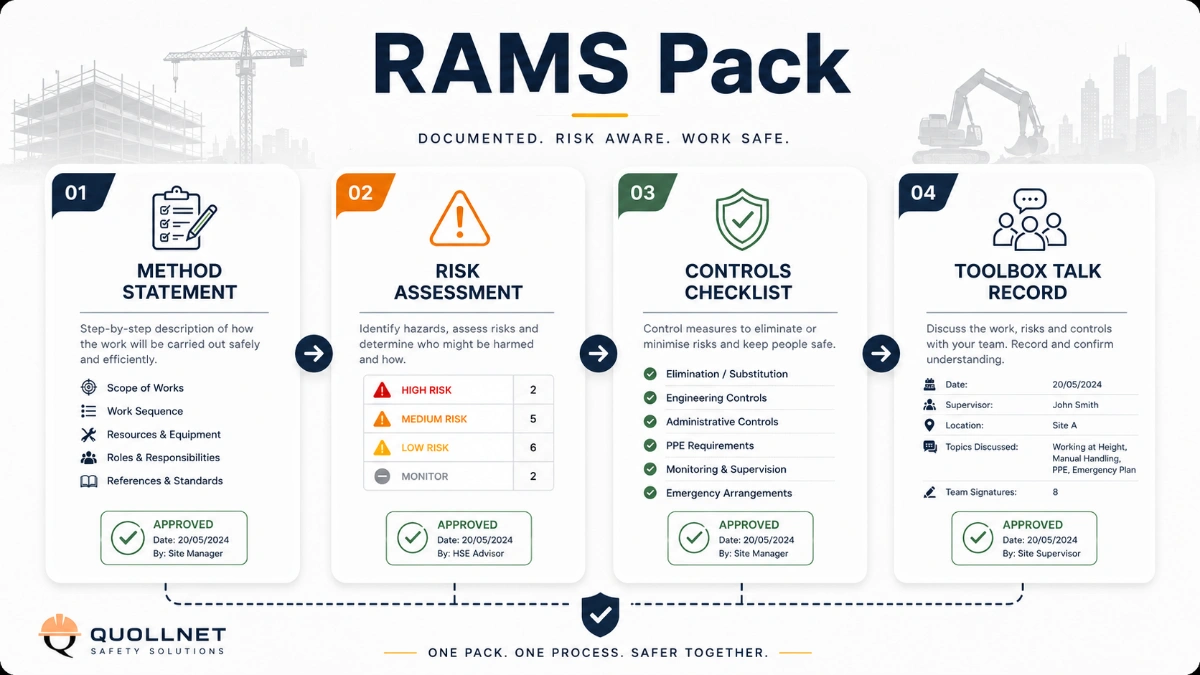
- Approved Method Statement and ITP; task-specific Risk Assessment/Job Hazard Analysis
- Approved concrete mix design and supplier credentials
- Pile layout schedule and sequence plan, including access and craneage study
- Permits: Permit-to-Dig/Excavate, Permit-to-Lift, Hot Work permit if on-site welding [Verify per project HSE plan and local regulations]
Site and Plant Readiness
- Piling platform certified by a geotechnical engineer for bearing capacity and drainage; platform CBR/plate load verified [Verify]
- Utility detection and isolation: updated utility drawings, CAT/Genny scan, trial pits where necessary
- Rig mats/temporary working platforms installed as needed; exclusion zones marked
- Plant certifications current; daily pre-use inspections completed
- Survey control established and verified; pile positions pegged with protection
Materials and Testing Readiness
- Reinforcement cages fabricated/inspected; spacers/centralizers available
- Tremie/trunk cleaned and assembled; pump lines secured and pressure-tested
- Laboratory arrangements for sampling and tests; cube molds and curing boxes prepared
- Concrete delivery schedule aligned to ensure continuous pouring
Contingency (Dry Method Boundaries)
- Acceptable dry condition defined: standing water at base ≤ 50 mm or inflow ≤ 20–50 L/min at time of pour [Verify per project]
- If dry condition cannot be maintained after reasonable casing/cleaning, STOP and escalate to Engineer to switch to alternative method (e.g., extended casing). No slurry use under this method.
Method Sequence
| Step | Activity | Description | Responsibility | Inspection / Hold Point |
|---|---|---|---|---|
| 1 | Setting out and pre-start briefing | Verify survey control and set pile centers with protected pins. Conduct pre-start briefing covering sequence, hazards, and hold points. | Surveyor / Piling Superintendent | ITP Witness |
| 2 | Rig mobilization and platform verification | Position rig over pile; confirm mast verticality and platform stability. Establish exclusion zone and banksman control. | Piling Superintendent | Hold Point |
| 3 | Temporary casing installation (partial) | Advance casing through loose/soft strata to stable layer using vibro/rotary method. Check verticality and top level; secure casing. | Piling Superintendent | Witness |
| 4 | Dry drilling to design depth | Progress drilling with auger/core barrel to design toe. Record strata, depth, torque, spoil type. Avoid water ingress; no slurry used. | Rig Operator | Surveillance |
| 5 | Base cleaning and verification of dry condition | Clean with clean-out bucket; remove loose debris. Verify dryness and cleanliness using weighted tape, camera (if practicable), and spoil inspection. | Piling Superintendent / QA | Hold Point |
| 6 | Reinforcement cage placement | Lift cage with certified crane; check length/splices; install centralizers/spacers for 75 mm cover. Suspend/hang to maintain position. | Lifting Supervisor / Steel Fixers | Witness |
| 7 | Concrete placement (tremie/trunk) | Position tremie/trunk to within ~0.5–1.0 m of toe to minimize free fall; commence continuous pour. Maintain head to avoid segregation. No interruptions. | Concrete Supervisor | Witness |
| 8 | Casing extraction during pour | Withdraw casing progressively while maintaining adequate head of concrete; prevent soil intrusion; vibrate minimally to avoid segregation. | Piling Superintendent | Surveillance |
| 9 | Pile head overcasting and initial curing | Overcast 300–600 mm above cut-off; finish surface; protect and cure (moist cover/curing compound) for ≥ 7 days or per spec. | Concrete Supervisor | Surveillance |
| 10 | Test specimen sampling | Slump, temperature, air (if specified), and make cylinders/cubes at specified frequency. | QC Technician | Witness |
| 11 | Pile head trimming to cut-off | After concrete achieves adequate strength (e.g., ≥ 10–15 MPa), break down overcast to cut-off using appropriate tools. Avoid cage damage. | Piling Superintendent | Surveillance |
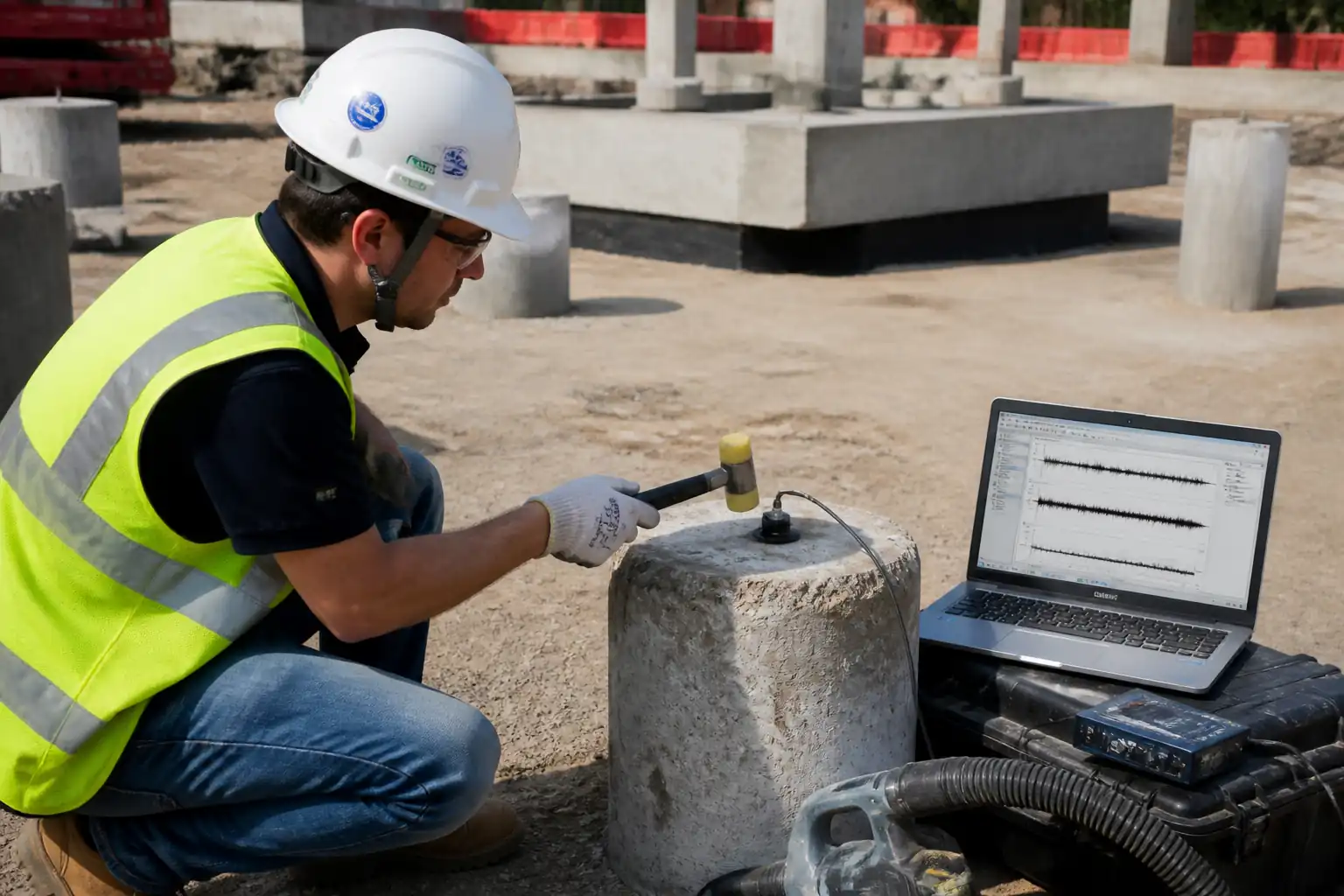
| 12 | Integrity testing (if specified) | Low strain integrity (PIT) or CSL if tubes provided, after minimum curing age per spec. | QC / Specialist | Witness |
| 13 | As-built, records, and demobilization | Compile pile logs, concrete tests, integrity results, and as-built coordinates/levels. Demobilize safely. | QA/QC Manager | Review |
Health, Safety and Environment – Safety Controls
Task-Specific Hazards and Controls
- Hazard: Underground utility strike during setting out/drilling
- Likely consequence: Electrocution, flooding, gas release, project delays
- Engineering/procedural control: Review latest utility maps; CAT/Genny scan; trial pits; Permit-to-Dig; minimum clearance distances; spotter during initial drilling
- Required PPE: Dielectric gloves when probing, safety boots, FR clothing as needed, eye protection
- Collective measure: Physical barriers over known utilities; exclusion zone
-
Inspection/permit/supervision: Permit-to-Dig approval; HSE/Engineer sign-off [Verify per project HSE plan and local regulations]
-
Hazard: Rig instability/overturning on inadequate platform
- Consequence: Fatal crush injuries, asset loss
- Control: Geotechnical certification of platform; bearing capacity checks; rig mats; regular inspection after rain; slew limits per lift plan
- PPE: Hard hat, hi-vis, boots
- Collective: Exclusion zone around rig; banksman control
-
Inspection/permit/supervision: Platform certificate; daily plant checklist; Lifting Supervisor present
-
Hazard: Entanglement with rotating kelly/auger
- Consequence: Amputation/crush
- Control: Guarding; no-go zones; lockout during tool change; only trained personnel near rig
- PPE: Gloves suitable for task, snug clothing
- Collective: Barricades and signalman
-
Inspection/permit/supervision: Toolbox talk; supervisor verification of exclusion zones
-
Hazard: Fall into open borehole
- Consequence: Serious injury/fall from height
- Control: Bore covered or guarded immediately; use rigid covers or barriers; never leave open bore unattended
- PPE: Fall arrest when working near unprotected edges if required
- Collective: Edge protection with hi-vis barricades
-
Inspection/permit/supervision: Supervisor sign-off before breaks/shift changes
-
Hazard: Lifting reinforcement cages and casings
- Consequence: Struck-by, dropped load
- Control: Lift plan; certified crane and slings; tag lines; wind limits per lift plan; no personnel under suspended loads
- PPE: Hard hat with chin strap, gloves, boots
- Collective: Exclusion zone; banksman
-
Inspection/permit/supervision: Permit-to-Lift; pre-lift meeting; daily crane inspection
-
Hazard: Concrete pump line failure/whip
- Consequence: Impact injury, chemical burns
- Control: Secure line with whip checks; pressure test; use clamps and safety pins; maintain safe distance
- PPE: Eye/face protection, gloves, waterproof boots
- Collective: Barriers and signage at discharge area
-
Inspection/permit/supervision: Pump inspection checklist; supervisor authorization
-
Hazard: Cement/concrete chemical exposure
- Consequence: Dermatitis/alkali burns
- Control: Avoid skin contact; washing stations; correct handling of admixtures
- PPE: Alkali-resistant gloves, long sleeves, goggles
- Collective: Welfare facilities with eyewash
-
Inspection/permit/supervision: HSE inspection; SDS available
-
Hazard: Noise and vibration from drilling/casing
- Consequence: Hearing loss, nuisance to neighbors
- Control: Time restrictions; maintained tooling; use hearing protection; monitor levels if required
- PPE: Ear defenders
- Collective: Noise barriers if near receptors
-
Inspection/permit/supervision: Environmental monitoring records
-
Hazard: Night/low-light operations
- Consequence: Poor visibility leading to incidents
- Control: Tower lighting; reflective PPE; task lighting free of glare/shadow
- PPE: Hi-vis, head torch if needed
- Collective: Light tower placement plan
-
Inspection/permit/supervision: HSE night-shift inspection
-
Hazard: Hot works (if welding cages)
- Consequence: Fire, burns
- Control: Hot Work Permit; fire watch; fire blankets/extinguishers; segregated area
- PPE: Welding shield, FR clothing, gloves
- Collective: Fire points
-
Inspection/permit/supervision: Permit; welder qualifications
-
Hazard: Proximity to overhead lines
- Consequence: Electrocution/arc
- Control: Maintain statutory clearances; de-energize where possible; physical goalposts
- PPE: Dielectric PPE where mandated
- Collective: Exclusion zones
-
Inspection/permit/supervision: Permit-to-Work and electrical authority approval
-
Hazard: Manual handling of spacers/small tools
- Consequence: Musculoskeletal injury
- Control: Mechanical aids where feasible; team lifts; weight limits
- PPE: Gloves, boots
- Collective: Handling aids staged at point of use
- Inspection/permit/supervision: Supervisor checks
Note: All controls to be aligned with project HSE plan, local regulations, and client requirements.
Environmental Controls
Environmental Risk Controls
- Spoil management (dry drilling):
- Control: Segregate spoil by type; store on impermeable, bunded area; prevent run-off; test and classify per local waste regs before disposal/reuse.
- Water in bore (minor dewatering):
- Control: If water present within dry criteria, pump to sediment tank/bag; no discharge to stormwater without silt removal and pH check [Verify].
- Dust from dry drilling/spoil handling:
- Control: Light misting (avoid water into bore), covered skips, speed control on haul routes.
- Noise/vibration:
- Control: Limit hours; maintain equipment; install temporary acoustic barriers near receptors; monitoring if required by permit.
- Concrete washout and truck chute cleaning:
- Control: Dedicated lined washout pit with containment; remove hardened waste to licensed facility.
- Fuel, oils, and chemicals:
- Control: Bunded storage; spill kits at refueling; trained spill response; immediate reporting.
- Protection of adjacent structures/trees:
- Control: Exclusion zones and root protection areas; vibration monitoring near sensitive assets if specified.
- Community/traffic management:
- Control: Approved traffic plan; wheel wash; road sweepers; clear signage.
- Materials efficiency:
- Control: Optimize cage fabrication to reduce offcuts; return unused admixtures to supplier.
- Emergency environmental response:
- Control: Spill response plan; emergency contacts posted; drills conducted.
Quality Assurance and Quality Control
QA/QC Strategy
- Hold and Witness Points: As per ITP. Key holds prior to concreting: base cleanliness/dryness, reinforcement inspection, approval to pour.
- Calibration: Survey instruments and concrete thermometers calibrated; pump pressure gauges verified.
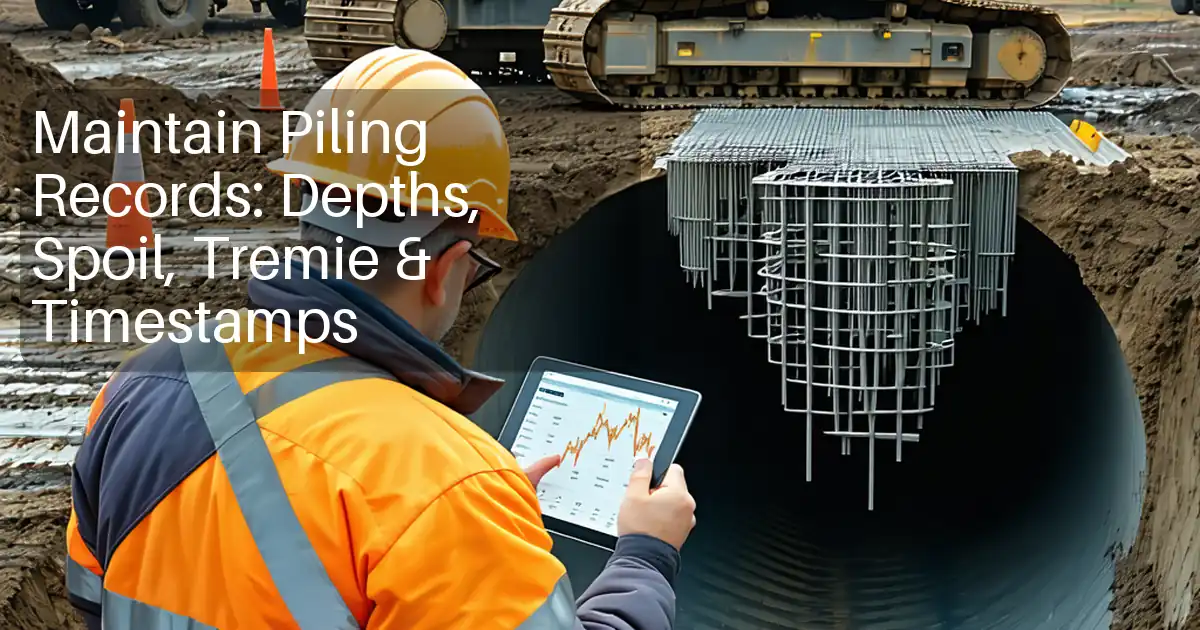
- Documentation: Daily piling log capturing pile ID, coordinates, tool used, casing depth, drilling time, final depth, soil profile, base checks, concrete volumes (theoretical/actual), start/finish times, interruptions, anomalies.
- Tolerances: Location ±75 mm; verticality ≤ 1:200; cover ≥ 75 mm; head cut-off ±10 mm; depth +100/−0 mm [Verify].
- Testing Frequencies [Verify per project]:
- Slump/temperature per truck
- Strength: minimum 1 set (e.g., 6 cylinders or 3 cubes) per 50–75 m³ and at least 1 set per day
- Air content if specified for the mix
- Integrity testing per schedule (PIT/CSL) after age/design strength
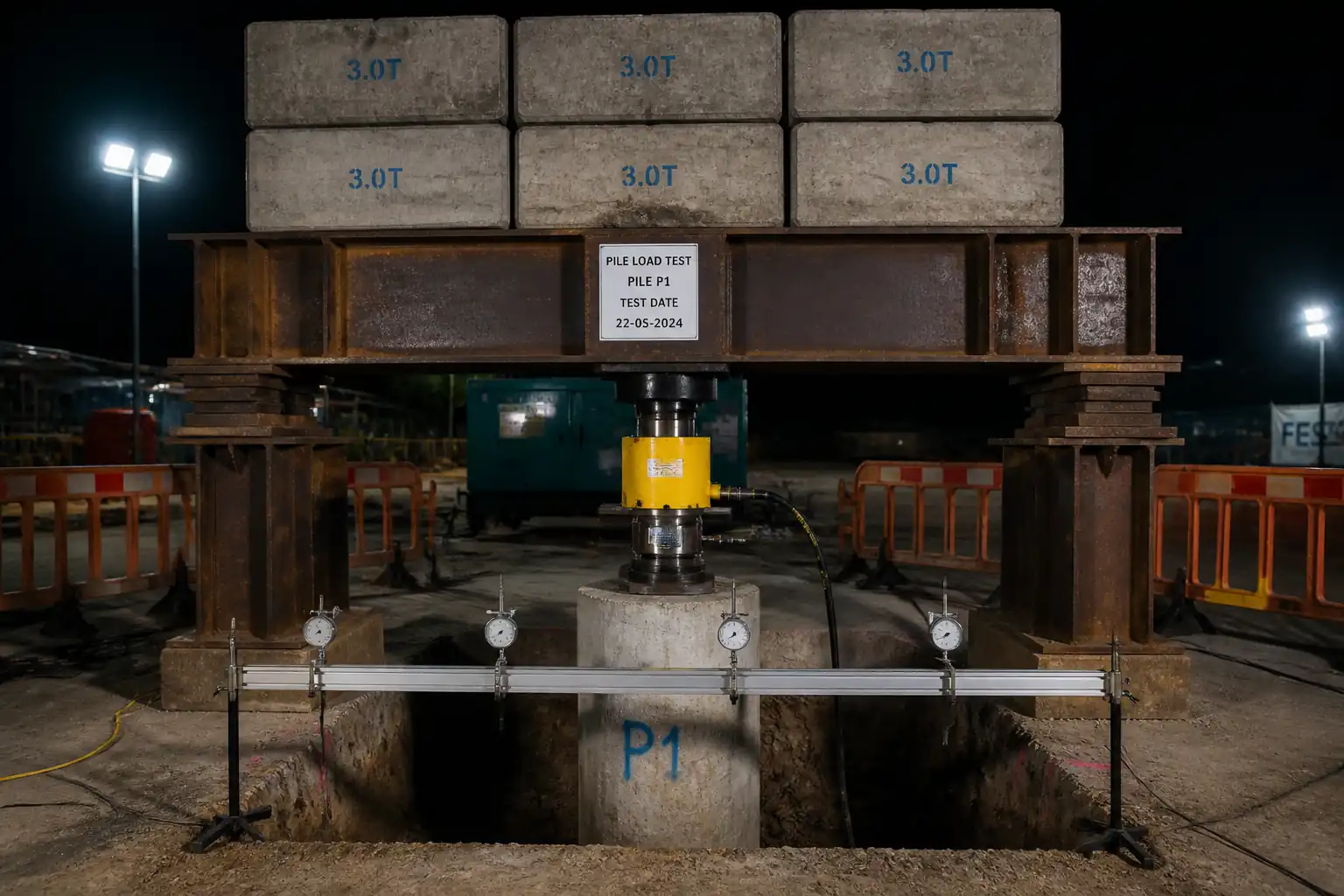
- Nonconformance: Stop work and raise NCR for out-of-tolerance piles; agree remedial actions (e.g., load test, grouting, under-ream, additional pile) with Engineer before proceeding.
- Records and As-builts: Submit pile records within 48 hours; update as-built drawings with final toe levels and coordinates.
Attachments
Typical Attachments
- Approved drawings and bar schedules
- Geotechnical report and pile design schedule
- Concrete mix design approvals and supplier certifications
- Plant certifications (rig, crane, lifting gear) and inspection logs
- Platform certification and utility clearance records
- Daily piling log template and base inspection checklist
- ITP and checklists; RFIs/IRs
- Risk Assessment/Method Statement (RAMS) and permits
- Integrity testing procedures and sample reports
- As-built template and turnover documentation
This content is a read-only public reference. Download or customize to get an editable version.
ITP preview
The first inspection activities from the linked ITP for Method Statement – Bored Cast-in-Place Concrete Piles (Dry Drilling Method):
| Activity | Inspection / Test | Acceptance Criteria | Responsibility | Record |
|---|---|---|---|---|
| Setting out verification | Check pile coordinates vs grid; Witness point | Within ±75 mm of design centerline or per spec | Surveyor / QA | Survey report; IR approval |
| Piling platform certification | Review platform certificate; visual inspection; Hold point | Certified safe bearing and drainage; no soft spots | Contractor / Engineer | Platform certificate; checklist |
| Plant and lifting gear | Verify inspection tags; load charts; daily checklists | Valid certifications; no defects | Contractor / HSE | Plant logs; lifting gear register |
Showing 3 of 12 inspection activities. View full ITP →
Related Inspection and Test Plan
An Inspection and Test Plan (ITP) is available for Method Statement – Bored Cast-in-Place Concrete Piles (Dry Drilling Method). The ITP defines the inspection activities, acceptance criteria, hold and witness points, responsible parties, and records required to verify the work described in this method statement.
View the Method Statement – Bored Cast-in-Place Concrete Piles (Dry Drilling Method) ITP →Frequently asked questions
Continue with related Quollnet resources connected to this method statement.