
Inspection and Test Plan for Method Statement – High‑Strain Dynamic Pile Testing (PDA) with CAPWAP Signal Matching
AI-assisted inspection and test plan connected to a method statement, with PDF and Excel export.
More than a static template
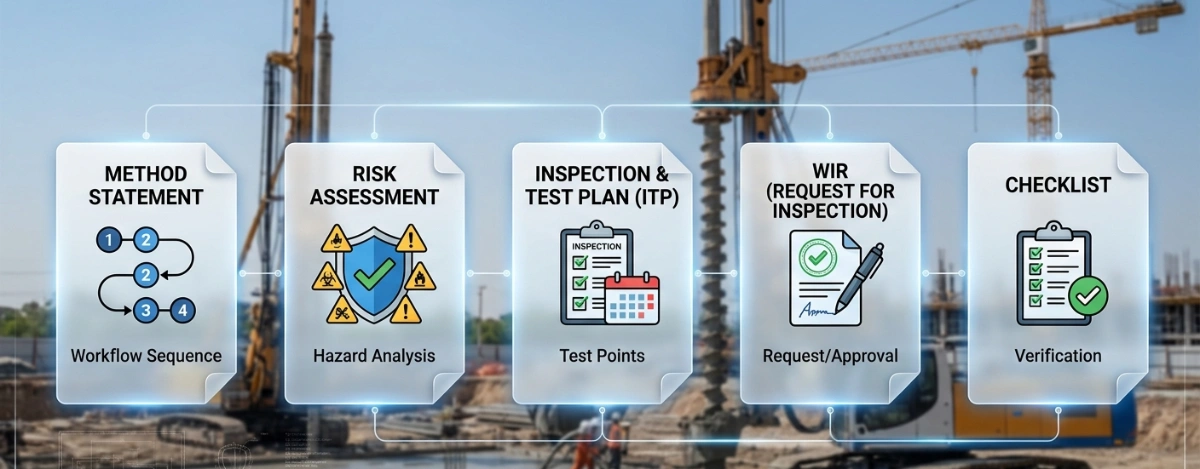
Unlike a downloadable Word or PDF template, this ITP is an AI-assisted editable starting point directly connected to its method statement. Every inspection activity, hold point, and acceptance criterion is structured and ready to adapt to your project.
- AI-assisted customization — Tailor inspection activities and acceptance criteria to your specific project scope.
- Linked method statement — This ITP is connected to the corresponding method statement describing the work sequence.
- Multiple export formats — Download as a formatted PDF or editable Excel spreadsheet.
- Editable starting point, not a final document — Review and verify all content against your project specifications and standards before use.
What you can customize
When you save this ITP to your account, every inspection row becomes editable. You can add, remove, or modify:
- Inspection activity — Description of what is being inspected.
- Inspection type — Hold point (H), Witness point (W), Review (R), or Monitor (M).
- Responsibility — Contractor, subcontractor, engineer, or client.
- Frequency — How often the inspection occurs.
- Acceptance criteria — Referenced standard or specification requirement.
- Records — Forms, test reports, or checklists required as evidence.
Why this ITP is used
To control quality and compliance of PDA testing, ensuring data integrity, safe operations, and acceptance against project criteria.
Who uses this inspection and test plan
Contractor’s QA/QC, PDA specialist, geotechnical engineer, site supervisor, and client’s representative.
When this ITP is prepared and submitted
From pre-test approvals through execution and analysis to final reporting and acceptance.
Who receives or approves this ITP
Client/Engineer for approval and witnessing as defined in the contract.
Inspection scope
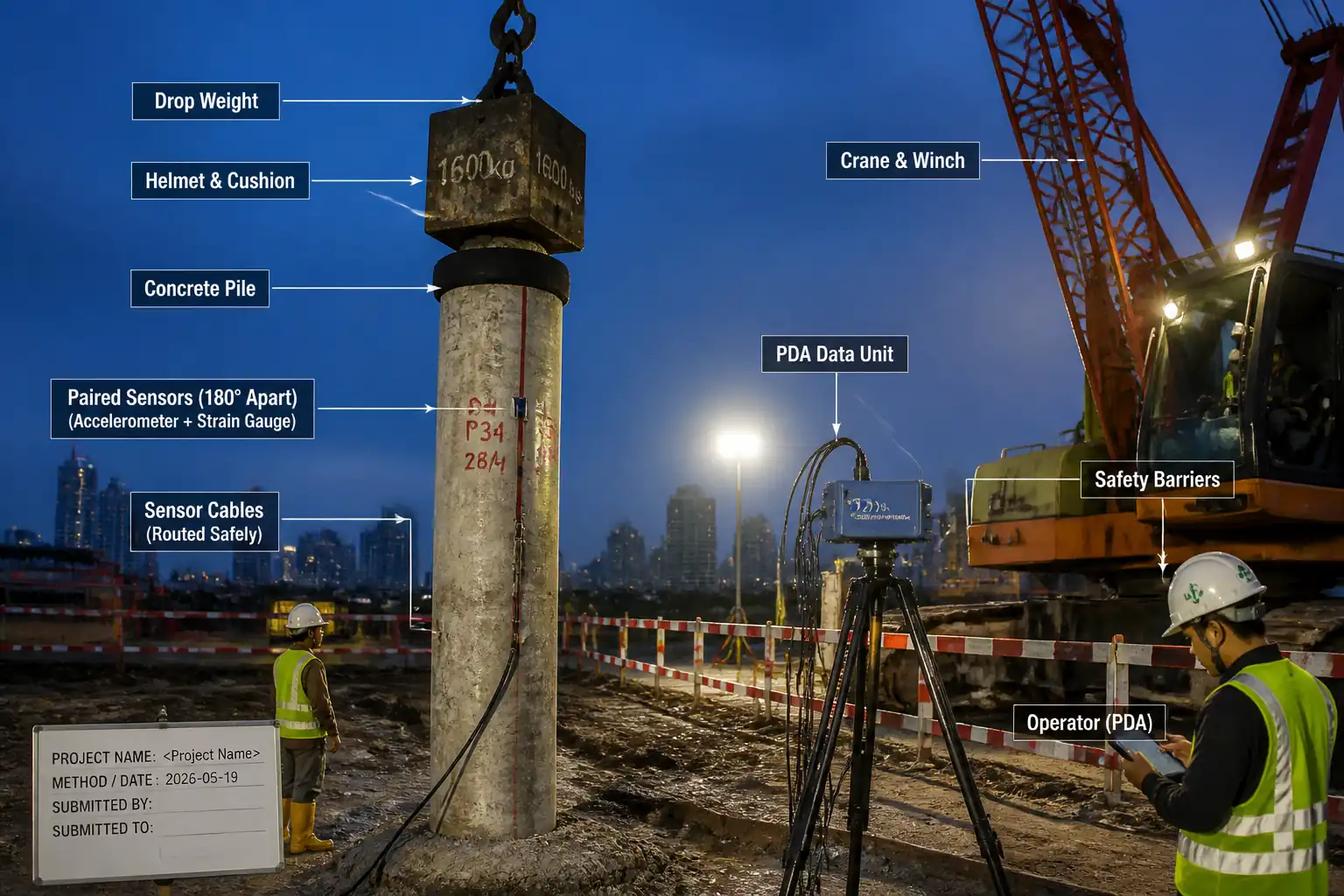
Pre-test documentation, site readiness, pile head prep, sensor mounting, DAQ setup, impact device setup, test execution, CAPWAP analysis, and final reporting.
Typical hold, witness, and review points
Hold: calibration verification, CAPWAP issue, final acceptance. Witness: pile prep, sensor mounting, DAQ setup, impact setup, test blows.
Typical inspection records
Calibration certificates, field logs, trace files, configuration settings, energy/stress summaries, CAPWAP reports, final signed report.
Important approval note
This ITP is an AI-assisted editable starting point, not a pre-approved document. Before use on any project, all inspection activities, hold points, and acceptance criteria must be reviewed and approved by the relevant parties (superintendent, principal contractor, or client representative) in accordance with your contract and project quality plan.
Always verify acceptance criteria against your applicable drawings, specifications, and regulatory requirements. Hold points must be confirmed with the relevant authority before work proceeds past that point.
Inspection and test plan
| Activity | Inspection / Test | Acceptance Criteria | Responsibility | Record |
|---|---|---|---|---|
| Pre-test submittals review | Check method, ITP, calibrations, personnel credentials | Approvals in place; valid calibrations; staff competency verified | Approved submittals pack | |
| Working platform and access | Level, bearing capacity, exclusion zones | Platform certified; access clear; barriers installed | Platform certificate; inspection log | |
| Pile head preparation | Flatness, integrity, uniform section check | Sound head; uniform section ≥2–3D below sensors | Photos; checklist | |
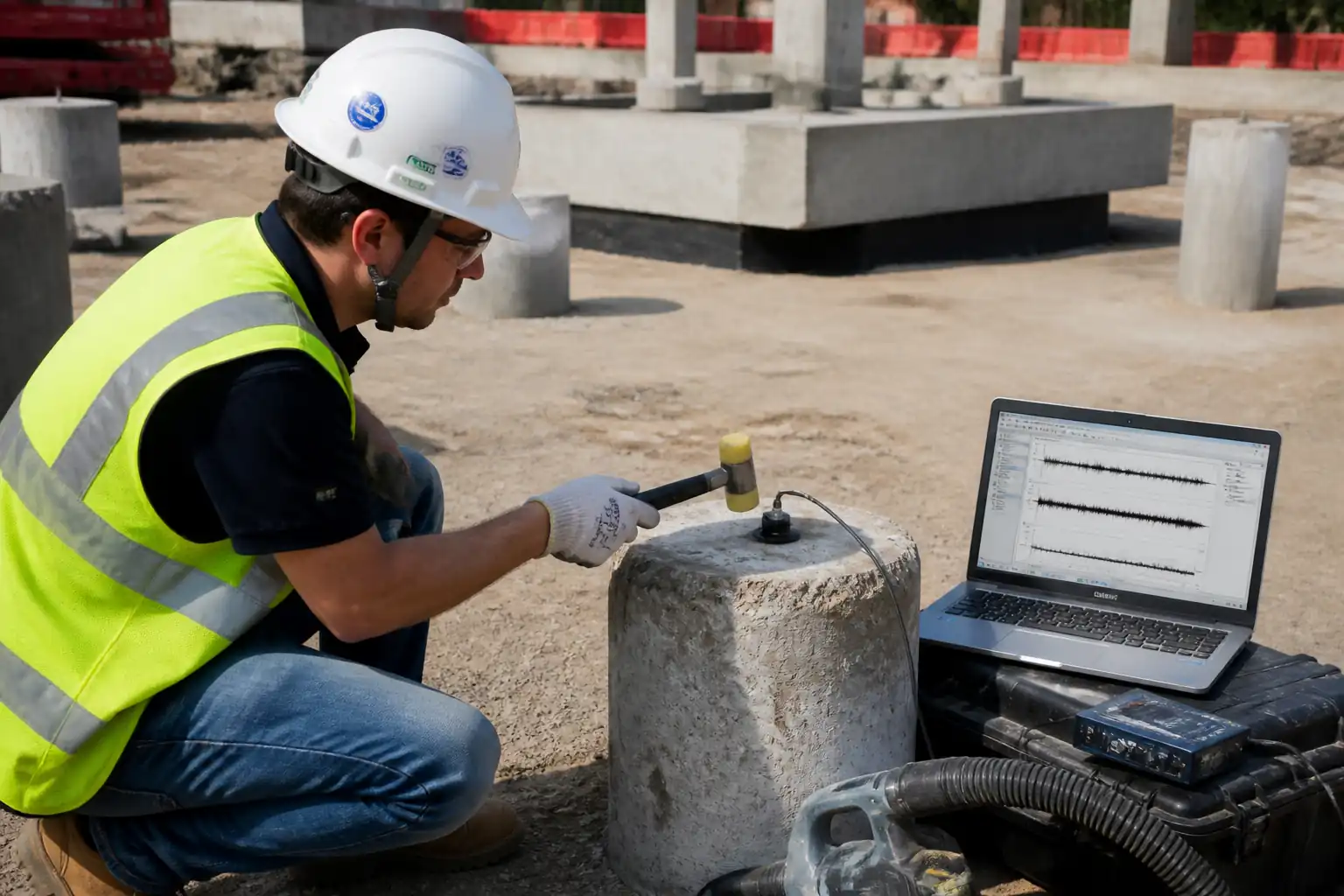
| Sensor mounting | Stud bonding/torque; 180° placement; tap test | Opposite sensors aligned; tap symmetry within ±10% | Setup sheet; torque log | |
| DAQ configuration | Sampling rate, gain, filter, channel zero | Sampling ≥20 kHz; stable baselines; no clipping | DAQ config printout | |
| Impact device setup | Alignment, cushion condition, drop height/hammer setting | Alignment within 3°; cushion fit-for-purpose; energy plan agreed | Energy/cushion log | |
| Test blows execution | Number of blows, signal quality, stresses | ≥3 high-quality blows; stress limits not exceeded | PDA field log; traces | |
| On-site preliminary results | Case Method capacity, Jc selection | Consistent with field signals; parameters recorded | Field summary | |
| Signal matching (CAPWAP) | Matching quality (MQ), parameter stability | MQ ≥0.90; stable capacity and distribution | CAPWAP report | |
| Final report and acceptance | Compliance with standards/spec; capacity vs. requirement | Report complete, signed; acceptance per specification | Approved final report |
This table is a read-only public reference. Download the PDF or Excel version, or customize this ITP to edit it for your project.
Frequently asked questions
Related method statement
This Inspection and Test Plan is associated with the Method Statement – High‑Strain Dynamic Pile Testing (PDA) with CAPWAP Signal Matching method statement, which describes the step-by-step construction sequence, resources, materials, equipment, safety controls, and environmental controls for this activity.
View the Method Statement – High‑Strain Dynamic Pile Testing (PDA) with CAPWAP Signal Matching method statement →Continue with related inspection, method statement, article, and checklist resources.