Restrike Testing Checklist for Pile Capacity Acceptance
Definition: Restrike testing verifies pile capacity after set-up by re-driving selected piles for construction QA teams, focusing on re-drive timing, capacity reassessment, and acceptance without covering initial PDA activities.
- Confirms set-up gains by controlled re-drive after specified waiting time.
- Captures blows, energy, and set to reassess ultimate pile capacity.
- Defines acceptance, contingencies, and documentation per project specifications.
- Interactive, commentable checklist with export and QR code verification.
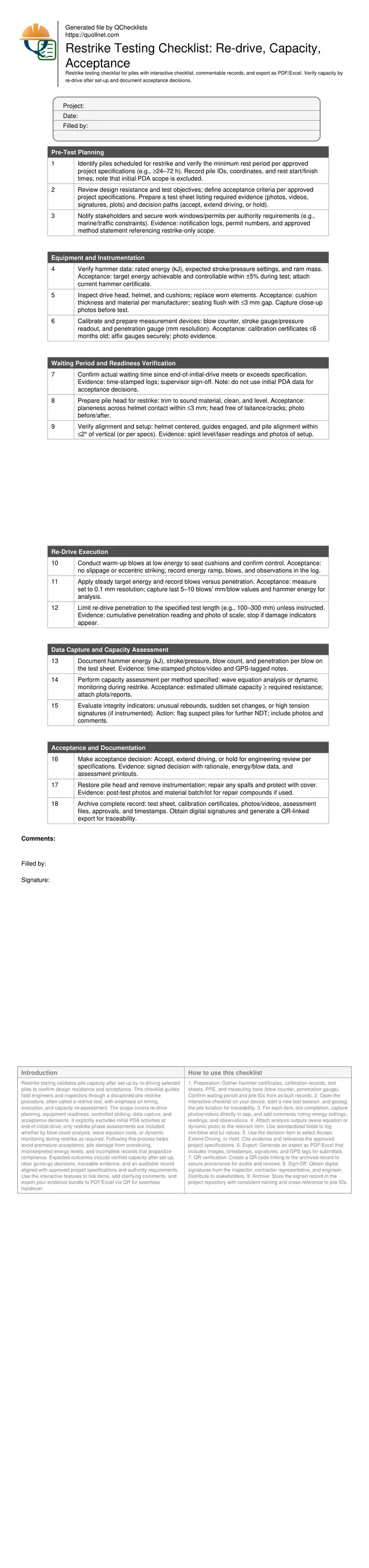
Restrike testing validates pile capacity after set-up by re-driving selected piles to confirm design resistance and acceptance. This checklist guides field engineers and inspectors through a disciplined pile restrike procedure, often called a redrive test, with emphasis on timing, execution, and capacity re-assessment. The scope covers re-drive planning, equipment readiness, controlled striking, data capture, and acceptance decisions. It explicitly excludes initial PDA activities at end-of-initial-drive; only restrike-phase assessments are included, whether by blow count analysis, wave equation tools, or dynamic monitoring during restrike as required. Following this process helps avoid premature acceptance, pile damage from overdriving, misinterpreted energy levels, and incomplete records that jeopardize compliance. Expected outcomes include verified capacity after set-up, clear go/no-go decisions, traceable evidence, and an auditable record aligned with approved project specifications and authority requirements. Use the interactive features to tick items, add clarifying comments, and export your evidence bundle to PDF/Excel via QR for seamless handover.
- Confirm the required waiting period, re-drive with controlled hammer energy, and measure penetration per blow to quantify set-up effects. Capture photos, timestamps, and calibration certificates to support a defensible capacity conclusion.
- Use standardized forms to log blow counts, energy, and set during the final blows, then perform capacity assessment by wave equation or dynamic monitoring at restrike, as specified. Document acceptance, hold points, and any extended driving.
- Mitigate risks of pile damage and misjudged capacity by verifying cushion condition, alignment, and hammer settings, and by maintaining energy within tolerated bands. Record anomalies and trigger integrity checks when atypical signals appear.
- Interactive online checklist with tick, comment, and export features secured by QR code.
Pre-Test Planning
Equipment and Instrumentation
Waiting Period and Readiness Verification
Re-Drive Execution
Data Capture and Capacity Assessment
Acceptance and Documentation
Purpose and Timing of Restrike
Restrike confirms pile capacity after time-dependent set-up improves shaft resistance. The waiting period allows pore pressures to dissipate and friction to recover, particularly in clays and silts. Choosing the right interval is essential: too soon and you under-call capacity; too late and you risk construction delays. Plan restrike windows per approved project specifications and site access constraints, and verify actual rest duration with time-stamped logs. You should also check that no intervening disturbance occurred—no jetting, drilling, or lateral movements that could invalidate results. Warm-up blows help seat the system and verify that energy control is stable before the decisive blows are recorded. Because this checklist excludes initial PDA, do not rely on end-of-initial-drive dynamic data for acceptance; use restrike-phase measurements and analyses only. The outcome is a clear, evidence-backed decision that reflects set-up gains and safeguards against both overdriving and premature acceptance.
- Respect the specified waiting period; verify with timestamps.
- Exclude initial PDA data from acceptance decisions.
- Use warm-up blows to stabilize cushions and energy.
- Avoid disturbance to piles during the waiting period.
- Base decisions on restrike-phase measurements and analysis.
Controlled Re-Drive and Measurement Quality
Capacity reassessment depends on consistent energy delivery and precise penetration measurements. Keep hammer energy within a narrow band so blow count trends reflect soil response, not equipment variability. Verify helmet fit, cushion condition, and alignment to minimize eccentric impacts. During re-drive, log stroke/pressure (or measured energy), penetration per blow in millimetres, and any anomalies such as rebound, cushion smoke, or sudden set changes. Cap the re-drive penetration to the test length to limit damage risk. If dynamic monitoring is specified for restrike, ensure sensors are correctly positioned, cables are secured, and signals are clean before accepting any plots. Immediately annotate observations with photos and short video clips to support interpretations. The goal is traceable, reproducible data that allows reliable wave equation or dynamic analysis and a confident acceptance call aligned with project requirements.
- Maintain target energy within ±5% during test blows.
- Measure set to 0.1 mm resolution on final blows.
- Limit re-drive penetration to the specified test length.
- Document anomalies with photos and comments.
- Verify instrumentation placement and signal quality.
Acceptance, Contingencies, and Recordkeeping
Acceptance must directly reflect restrike-phase results. Compare estimated ultimate capacity to the required resistance defined in the approved project specifications. When capacity is short, plan controlled additional driving at documented energy, then re-evaluate. If integrity concerns arise, trigger non-destructive testing before acceptance. Close out by restoring the pile head, removing instrumentation, and documenting any repairs. Assemble a complete evidence package: hammer certificates, calibration records, blow-by-blow logs, energy readings, penetration data, analysis outputs, photos, videos, and signatures. Store the package in a location accessible to stakeholders, with a QR-linked export to verify authenticity. This rigorous documentation streamlines approvals, supports audits, and reduces disputes by making the acceptance decision transparent and defensible.
- Accept only when restrike capacity meets requirements.
- Plan and document any extended driving actions.
- Trigger NDT if integrity concerns are noted.
- Compile a complete, signed evidence package.
- Provide QR-linked exports for traceability.
How to Use This Restrike Testing Checklist
- Preparation: Gather hammer certificates, calibration records, test sheets, PPE, and measuring tools (blow counter, penetration gauge). Confirm waiting period and pile IDs from as-built records.
- Open the interactive checklist on your device, start a new test session, and geotag the pile location for traceability.
- For each item, tick completion, capture photos/videos directly in-app, and add comments noting energy settings, readings, and observations.
- Attach analysis outputs (wave equation or dynamic plots) to the relevant item. Use standardized fields to log mm/blow and kJ values.
- Use the decision item to select Accept, Extend Driving, or Hold. Cite evidence and reference the approved project specifications.
- Export: Generate an export as PDF/Excel that includes images, timestamps, signatures, and GPS tags for submittals.
- QR verification: Create a QR code linking to the archived record to secure provenance for audits and reviews.
- Sign-Off: Obtain digital signatures from the inspector, contractor representative, and engineer. Distribute to stakeholders.
- Archive: Store the signed record in the project repository with consistent naming and cross-reference to pile IDs.
Call to Action
- Start Checklist Tick off tasks, leave comments on items or the whole form, and export your completed report to PDF or Excel—with a built-in QR code for authenticity.
- Download Excel - Pile Restrike Testing Checklist
- Download PDF - Pile Restrike Testing Checklist
- View Image - Pile Restrike Testing Checklist
Cite & Embed
“Pile Restrike Testing Checklist by Quollnet”
with a link to
this source page.

FAQ
Question: How long should I wait before performing restrike testing?
Question: Do I need dynamic monitoring (PDA) for restrike acceptance?
Question: What if restrike shows capacity below the required resistance?
Question: How many restrike blows should I record for analysis?
Question: How do I prevent pile damage during restrike?
Related Articles
Broader reading and guidance connected to this checklist topic.


Is It Important To Customize Your Qr Code And How To Do It?


Related Checklists
Keep the workflow moving with nearby templates chosen from similar checklist content.