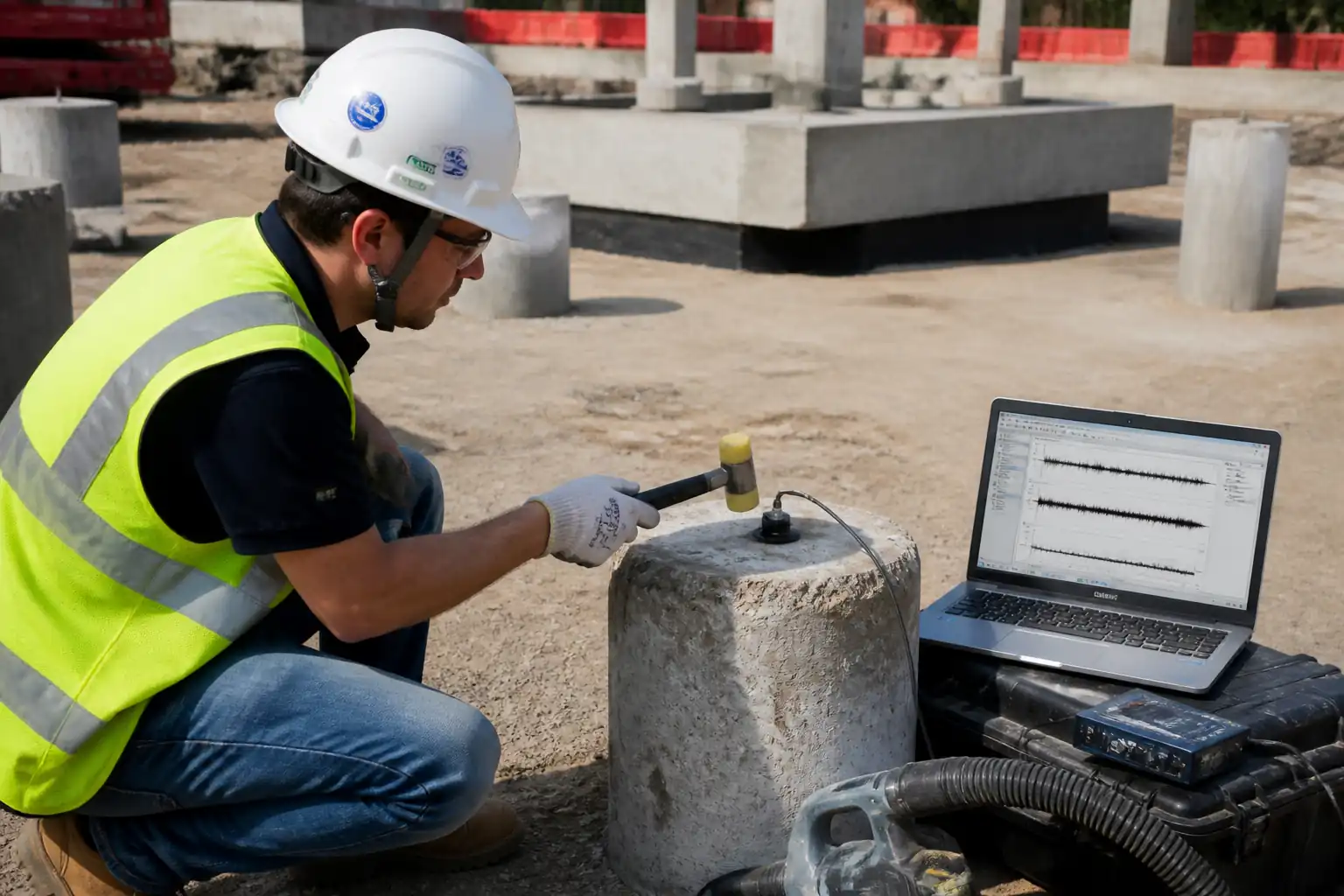

Method Statement: Low-Strain Pile Integrity Testing (PIT) by Sonic Echo Method – Method Statement
AI-assisted method statement with matching ITP, PDF download, and Excel export.
More than a static template
Unlike a downloadable Word or PDF template, this method statement is an AI-assisted editable starting point connected directly to a matching Inspection and Test Plan. Every section is structured, project-adaptable, and ready to export.
- AI-assisted drafting — Customize every section with AI for your specific project scope.
- Linked ITP — A matching inspection and test plan is generated alongside the method statement.
- Multiple export formats — Download as a formatted PDF or editable Excel spreadsheet.
- Editable starting point, not a final document — Review, verify, and adjust all content against your project requirements before use.
Static template vs. Quollnet workflow
| Feature | Static template | Quollnet |
|---|---|---|
| Project-specific content | Manual fill-in required | AI-assisted customization |
| Linked ITP | Separate document, no link | Matching ITP included |
| Export formats | Usually PDF only | PDF and Excel |
| Structured sections | Free-form layout | 13 standardized sections |
| Saved to your account | Local file only | Cloud-saved, reusable |
| Content accuracy | You verify everything | AI-assisted, you still verify |
| Cost | Often free but time-intensive | Free to customize and download |
What you can customize
When you save this method statement to your account, every section becomes editable. The following 13 sections are included:
- Scope — Defines the activity and its boundaries.
- References — Standards, specifications, and drawings.
- Responsibilities — Roles and accountabilities.
- Resources — Labour, plant, and equipment summary.
- Materials — Materials and compliance requirements.
- Equipment — Tools and equipment details.
- Prerequisites — Hold points and pre-conditions.
- Method sequence — Step-by-step construction sequence.
- Safety controls — HSE risk controls and PPE.
- Environmental controls — Environmental mitigation measures.
- QA/QC — Quality inspection and test requirements.
- ITP — Inspection and Test Plan table (has its own page).
- Attachments — Referenced drawings and documentation.
Why this method statement is used
This method statement is used to define and communicate the approved procedure for carrying out method statement: low-strain pile integrity testing (pit) by sonic echo method on site. It ensures the work is planned in advance, the correct resources and controls are in place, and all personnel understand responsibilities, sequence, quality requirements, and safety controls before work begins. It aligns site execution with the documented scope and acceptance expectations.
Who uses this method statement
This method statement is used by contractors, site supervisors, project engineers, QA/QC engineers, HSE officers, consultants, and client representatives. It serves as a shared reference for planning, execution, supervision, inspection, and approval of the activity on site.
When it is prepared and submitted
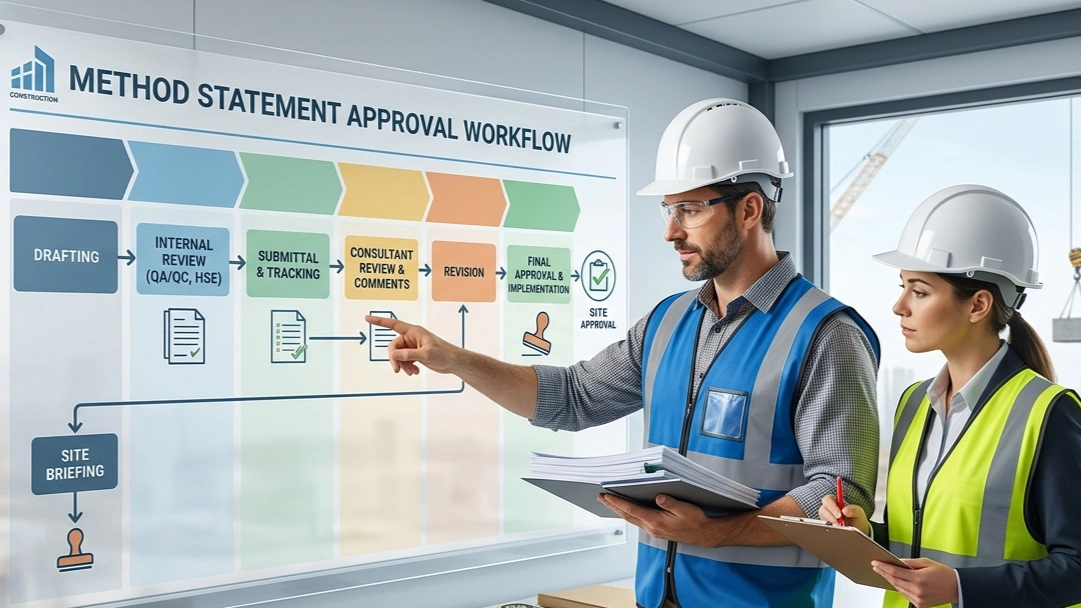
The method statement is prepared before the work activity starts and submitted as part of the pre-construction documentation package for review and approval.
Who reviews or approves it
The method statement is usually submitted to the client representative, consultant, resident engineer, or project management consultant for review and approval before the work commences.
Important approval note
This method statement is an AI-assisted editable starting point, not a pre-approved document. Before use on any project, all content must be reviewed and approved by the relevant parties (superintendent, principal contractor, or client representative) in accordance with your contract and project quality plan.
For example: if your specification requires a departure from a referenced standard, that departure must be documented and approved separately — this method statement will not capture that automatically. Always verify against your applicable drawings, specifications, and regulatory requirements.
Method statement content
Scope
Purpose
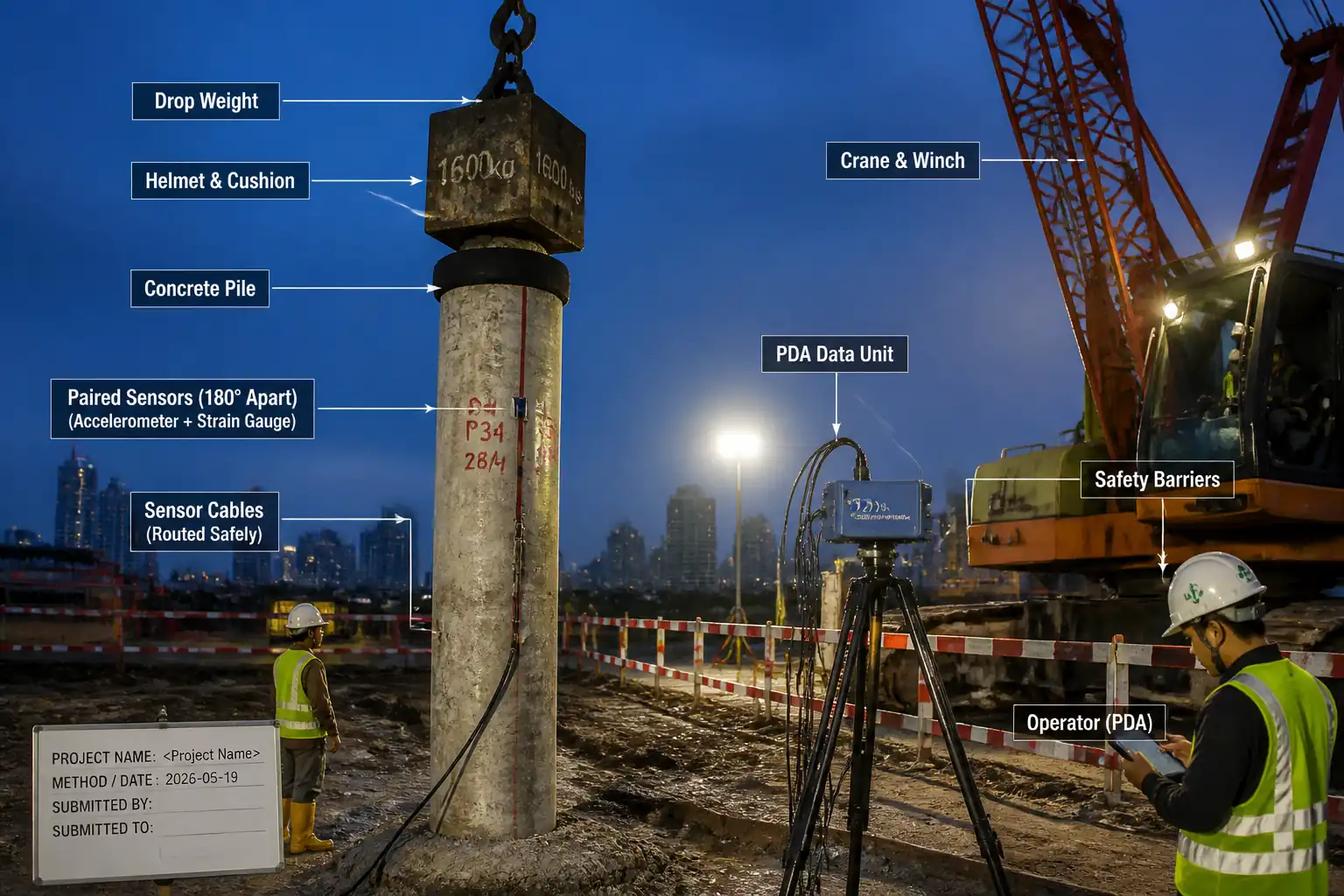
This method defines the procedures for executing Low-Strain Pile Integrity Testing (PIT) using the sonic-echo method to assess pile shaft continuity, detect major defects (necking, bulging, inclusions), estimate pile length, and verify construction quality. It covers pile head preparation and grinding, sensor coupling, handheld hammer impact execution, trace acquisition, data interpretation, classification, reporting, and compliance.
Applicability
- Pile types: Cast-in-place bored piles/shafts, CFA piles, precast driven piles (with accessible head), micro-piles [Verify per project specifications].
- Conditions: Pile heads must be accessible, dry, free of standing water, and prepared to sound concrete. Testing is not for submerged heads or under slurry. For diaphragm walls, use dedicated procedures.
Objectives
- Obtain a sufficient number of high-quality PIT records per pile to enable reliable interpretation.
- Identify reflections indicative of geometric changes or defects.
- Compare measured length to design/constructed length where feasible.
- Issue evidence-based acceptance classifications and recommendations.
References
| Document Type | Reference / Number | Revision | Notes |
|---|---|---|---|
| Standard | ASTM D5882 (latest) | Primary governing test method unless project specifies otherwise. | |
| Standard | BS EN ISO 22477-5 [Verify edition] | UK/EU equivalent guidance for low strain PIT. | |
| Specification | ICE Piling Specification, latest ed. | For UK projects and general specification context. | |
| Standard | ISO/IEC 17025 | Calibration and competence framework for PIT equipment and labs. | |
| Contract | Supersedes general guidance where stricter. |
Responsibilities
| Role | Responsibility | Name / Party |
|---|---|---|
| PM | Ensure approvals, programme, and access. | Contractor |
| Engineer | Approve testing plan and conclusions. | Contractor |
| Technician | Competent person with demonstrable experience. | Specialist Subcontractor |
| Supervisor | Confirm piles prepared per spec before testing. | Contractor |
| QA/QC | Witness tests at hold/witness points. | Contractor |
| HSE | Verify controls implemented. | Contractor |
| Surveyor | Provide pile schedule and locations. | Contractor |
| Client Rep | Hold/witness point attendance. | Employer/Engineer |
Resources
| Resource Type | Description | Quantity | Remarks |
|---|---|---|---|
| Personnel | 1 PIT Specialist + 1 Assistant | 2 | |
| Personnel | 2 laborers for head preparation and access control | 2 | |
| Personnel | 1 person | 1 | |
| Personnel | 1 person (shared resource acceptable) | 1 |
Materials
| Material | Specification / Grade | Quantity | Remarks |
|---|---|---|---|
| Silicone grease | ASTM D5882 guidance | As needed | Keep clean and capped. |
| Paint/Chalk | As needed | ||
| Abrasive | As needed | ||
| Rubber/PU | Spare set |
Equipment
| Equipment | Capacity / Type | Quantity | Inspection Required |
|---|---|---|---|
| Data logger | 1 set | Yes | |
| Accelerometer | 1–2 | Yes | |
| Hammer | 1 | Yes | |
| Grinder | 1 | Yes | |
| Generator | 2–3 kVA | 1 | Yes |
| Assorted |
Prerequisites
- Approved Method Statement and ITP.
- Pile Register with IDs, locations, cut-off levels, design and constructed lengths, diameters, construction dates.
- Access platform safe and level; exclusion zone established.
- Pile heads cured to sufficient strength for impact wave transmission: typically ≥ 10–15 MPa or ≥ 7 days after casting [Verify per project specifications].
- Head exposed: remove weak concrete/laitance and debris; no standing water; dry surface.
- Utilities, services, and obstructions around pile head identified; housekeeping completed.
- Calibrations: accelerometer, data acquisition time base, and impact trigger within validity (≤12 months) with ISO/IEC 17025 traceability, or manufacturer-certified [Verify].
- Permits: Hot works not required; Grinding work authorization and dust/noise controls per site; Night work permit if applicable [Verify per project HSE plan and local regulations].
- Pre-test briefing/TBT with crew covering hammering, dust, noise, and pinch hazards.
- Weather: Avoid heavy rain; ambient temperature typically > 5°C; wind conditions allowing safe shade/tent use near equipment [Verify].
Method Sequence
| Step | Activity | Description | Responsibility | Inspection / Hold Point |
|---|---|---|---|---|
| 1 | Verification and Marking | Confirm pile ID, diameter, design/constructed length, and coordinate; mark pile ID clearly and four impact quadrants (0°, 90°, 180°, 270°). | PIT Specialist / Surveyor | Visual check vs Pile Register |
| 2 | Pile Head Preparation – Grinding | Grind to sound concrete to remove laitance and irregularities, creating a smooth, flat patch near pile center. | Site Prep Crew | Visual and straightedge check |
| 3 | Sensor Mounting and Coupling | Place accelerometer on prepared patch using coupling compound; secure with magnetic base or strap to avoid movement. | PIT Specialist | Seating and cable integrity check |
| 4 | Equipment Setup and Verification | Power on acquisition unit; set sampling rate, record length, filters; verify time base and trigger; perform tap test on concrete block. | PIT Specialist | Functional test trace |
| 5 | Impact Testing – First Quadrant | Hold hammer to avoid double hits; deliver light, vertical, single impacts near center but offset from sensor; collect traces. | PIT Specialist | On-screen trace quality review |
| 6 | Repeat Impacts – Remaining Quadrants | Rotate impact location around head (min. 4 quadrants); acquire sets of acceptable traces per location. | PIT Specialist | On-screen trace quality review |
| 7 | Field Assessment and Re-test (if needed) | If traces are inconsistent or noisy, refresh coupling, adjust hammer tip hardness, dry surface, and repeat impacts. | PIT Specialist | Quality check |
| 8 | Data Processing and Interpretation | Compute average signals; identify key reflections; estimate length using L = c·t/2 with assumed or calibrated wave speed; assess indications (necking/bulging). | PIT Specialist / Geotechnical Engineer | Independent technical review |
| 9 | Classification and Reporting | Classify each pile as: Sound, Questionable (requires additional investigation), or Defective (probable defect) based on trace evidence and consistency. | Geotechnical Lead Engineer | QA review; Client witness (if required) |
| 10 | Handover and Record Control | Submit signed report with electronic trace files, calibration certificates, and as-built updates. | QA/QC Engineer | Document completeness check |
Health, Safety, and Environment (HSE) – Safety Controls
Key Task-Specific Hazards and Controls
- Hazard: Handheld hammer impacts (struck-by or rebound)
- Likely consequence: Hand/finger injury, eye injury from fragments.
- Engineering/procedural control: Use appropriate soft hammer tips; maintain firm stance; designate impact-only zone; two-hand grip; no hands near impact area.
- Required PPE: Safety glasses/face shield, cut-resistant gloves, safety boots, long sleeves.
- Collective measures: Exclusion zone 1.5 m around test point with barriers/cones; clear signage.
-
Inspection/permit/supervision: Pre-use hammer condition check; supervisor oversight.
-
Hazard: Angle grinding for head preparation (flying debris, dust, kickback)
- Likely consequence: Lacerations, eye injury, inhalation of respirable crystalline silica (RCS).
- Engineering/procedural control: Guarded grinder with shroud; HEPA vacuum; wet-wipe/HEPA vacuum cleanup (no dry sweeping); correct disc for concrete; two-hand use; kickback control feature.
- Required PPE: EN166 goggles/face shield, FFP3/N99 respirator, hearing protection (SNR ≥ 27 dB), cut-resistant gloves, long sleeves, safety boots.
- Collective measures: Local dust extraction; wind-direction consideration; screens if near public/operatives.
-
Inspection/permit/supervision: Daily grinder inspection; PAT test valid; grinding permit if required [Verify per project HSE plan and local regulations].
-
Hazard: Noise exposure from grinding/generator
- Likely consequence: Hearing loss.
- Engineering/procedural control: Use low-noise tips; maintain equipment; limit exposure duration; place generator ≥ 7 m away or use acoustic enclosure.
- Required PPE: Ear defenders/earplugs.
- Collective measures: Noise monitoring if required; schedule noisy works off-peak.
-
Inspection/permit/supervision: Spot noise checks; HSE monitoring.
-
Hazard: Slips/trips around rebar cages, uneven ground, cables
- Likely consequence: Sprains, falls.
- Engineering/procedural control: Cable management (mats/ties); housekeeping; anti-slip mats.
- Required PPE: Safety boots with ankle support.
- Collective measures: Tidy workface; route cables overhead or protect with ramps.
-
Inspection/permit/supervision: Supervisor walkdown before testing.
-
Hazard: Manual handling of generator/equipment
- Likely consequence: Strain/musculoskeletal injury.
- Engineering/procedural control: Team lift; use trolleys; keep weights < 25 kg per person [Verify].
- Required PPE: Gloves, boots.
- Collective measures: Mechanical aids provided.
-
Inspection/permit/supervision: Manual handling briefing.
-
Hazard: Electrical shock from powered tools/generator
- Likely consequence: Electric shock, burns.
- Engineering/procedural control: 110 V center-tapped or RCD-protected circuits; intact cables; dry conditions only.
- Required PPE: Dielectric gloves where applicable; dry footwear.
- Collective measures: RCD testing; keep connections off ground, protected.
-
Inspection/permit/supervision: PAT tags valid; pre-use RCD test; competent operator.
-
Hazard: Work near open edges/excavations or at height on pile caps
- Likely consequence: Fall from height.
- Engineering/procedural control: Edge protection/guardrails; do not test within 2 m of unprotected edge; use fall restraint where necessary.
- Required PPE: Full body harness with restraint lanyard if controls require.
- Collective measures: Temporary barriers; spotter.
-
Inspection/permit/supervision: Permit-to-work at height if applicable [Verify].
-
Hazard: Exposure to hot surfaces or sun (outdoor testing)
- Likely consequence: Heat stress, dehydration.
- Engineering/procedural control: Shade tent; work/rest cycles; water breaks.
- Required PPE: Sun protection, breathable clothing.
- Collective measures: Heat stress monitoring.
-
Inspection/permit/supervision: HSE checks during hot conditions.
-
Hazard: Night/low-light operations
- Likely consequence: Trips, poor trace quality, misidentification.
- Engineering/procedural control: Task lighting ≥ 200 lux at test area; reflective barriers.
- Required PPE: High-visibility vest.
- Collective measures: Light towers with spill control.
-
Inspection/permit/supervision: Night work permit; Supervisor present.
-
Note: Implement site emergency response plan and first-aid availability. All controls to be verified per project HSE plan and local regulations.
Environmental Controls
- Concrete dust (RCS) from grinding:
- Control: On-tool HEPA extraction; damp-wipe cleanup; sealed waste bags for dust; no dry sweeping.
- Monitoring: Spot air monitoring if required by project.
-
Disposal: Treat as inert construction waste unless contaminated [Verify].
-
Noise from grinder/generator:
- Control: Acoustic enclosure for generator; maintain distance from receptors; schedule works daytime where possible.
-
Monitoring: Noise checks against project limits [Verify].
-
Waste management:
-
Control: Collect spent hammer tips/discs; segregate general waste/recyclables; remove daily.
-
Spills/drips (oils/grease/couplant):
-
Control: Use minimal couplant; drip trays; spill kit on hand; immediate cleanup.
-
Energy use and emissions:
-
Control: Use electric tools or low-emission generator; turn off idle equipment; consider battery-powered PIT system.
-
Weather protection:
-
Control: Prevent rain ingress on equipment; postpone testing in rain to avoid contaminated runoff and poor data.
-
Environmental permitting:
- Verify any local noise/dust permits and community notifications per project environmental plan and local regulations.
Quality Assurance and Quality Control
Controls and Records
- Calibration: Accelerometer and time base certified ≤ 12 months; retain certificates. Hammer trigger (if used) function-checked daily.
- Personnel competence: PIT Specialist with ≥ 1 year PIT experience and > 2 projects [Verify]. Toolbox briefing held daily.
- Sampling scope: Test frequency per contract; typical 100% of accessible working piles in critical structures, otherwise ≥ 25–50% [Verify per project specifications].
- Trace quality metrics: No saturation; SNR ≥ 3:1; cross-correlation ≥ 0.8 of accepted traces; minimum 10 acceptable traces per pile [Verify].
- Wave speed selection: Use site-specific value derived from good/reference piles or cores; if unavailable, assume 3,800–4,200 m/s and state assumption [Verify].
- Data integrity: Unique file naming scheme: ---. Secure backup daily to server/cloud.
- Independent review: Second qualified engineer reviews interpretations for piles flagged as Questionable/Defective prior to issue.
- Nonconformities: Issue NCR if testing deviates from ITP, or if pile head cannot be prepared; propose corrective actions.
- Deliverables: Field logs, photo records of head prep, raw and processed traces, interpretations, pile summary register, calibration certificates.
- Retention: Maintain records for the duration specified by contract (typ. project duration + 10 years) [Verify].
Attachments
- Sample Field Log Template (Pile ID, Date, Weather, Head Prep Confirmation, Settings, Trace Count, Comments).
- Daily Function Check Sheet (Sampling rate, record length, filters, tap test result).
- Pile Register (from Contractor) with designed and constructed lengths/diameters.
- Calibration Certificates for accelerometer, data acquisition unit, and hammer trigger (if used).
- Example Acceptance Classifications and Typical Trace Annotations.
- Site Layout Plan showing testing sequence and access routes.
- Risk Assessment/Method Statement (RAMS) sign-off sheet and TBT attendance records.
This content is a read-only public reference. Download or customize to get an editable version.
ITP preview
The first inspection activities from the linked ITP for Method Statement: Low-Strain Pile Integrity Testing (PIT) by Sonic Echo Method:
| Activity | Inspection / Test | Acceptance Criteria | Responsibility | Record |
|---|---|---|---|---|
| Review of Method Statement and ITP | Document review and approval | Approved by Contractor and Engineer prior to testing | PM / QA-QC | Approved MS/ITP |
| Equipment Calibration Verification | Check certificates and serial numbers | Valid ISO/IEC 17025 or manufacturer calibration (≤12 months) | QA-QC / PIT Specialist | Calibration Certificates |
| Pile Head Preparation Inspection | Visual flatness and cleanliness check; straightedge check | Flatness ≤ 2 mm over 150 mm; dry; Ø ≥ 150 mm or ≥ 0.3×pile Ø [Verify] | QA-QC / Supervisor | Pre-Test Checklist; Photos |
Showing 3 of 8 inspection activities. View full ITP →
Related Inspection and Test Plan
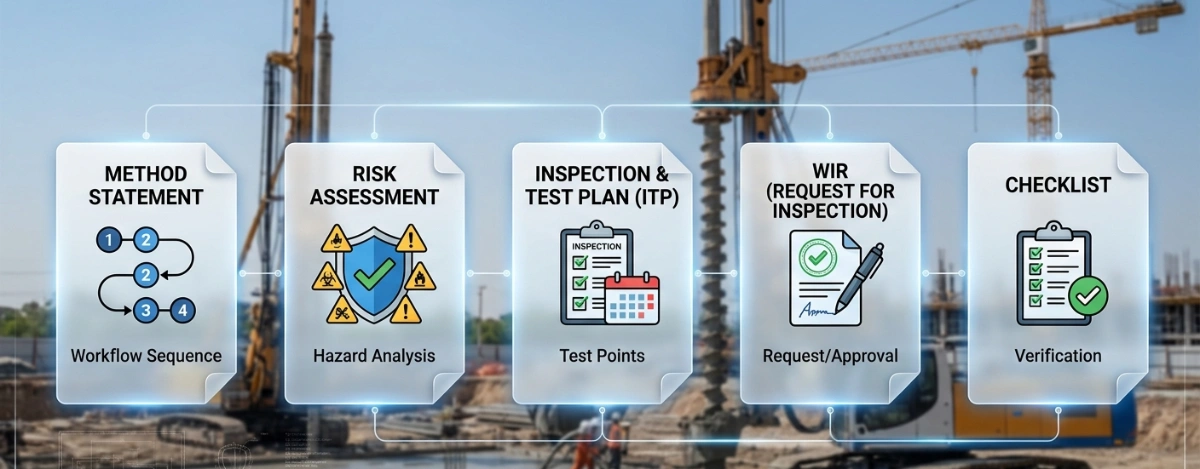
An Inspection and Test Plan (ITP) is available for Method Statement: Low-Strain Pile Integrity Testing (PIT) by Sonic Echo Method. The ITP defines the inspection activities, acceptance criteria, hold and witness points, responsible parties, and records required to verify the work described in this method statement.
View the Method Statement: Low-Strain Pile Integrity Testing (PIT) by Sonic Echo Method ITP →Frequently asked questions
Continue with related Quollnet resources connected to this method statement.