
Inspection and Test Plan for Method Statement – Installation of Street Lighting Columns, Foundations, Wiring, Earthing, and Lux-Level Verification
AI-assisted inspection and test plan connected to a method statement, with PDF and Excel export.
More than a static template
Unlike a downloadable Word or PDF template, this ITP is an AI-assisted editable starting point directly connected to its method statement. Every inspection activity, hold point, and acceptance criterion is structured and ready to adapt to your project.
- AI-assisted customization — Tailor inspection activities and acceptance criteria to your specific project scope.
- Linked method statement — This ITP is connected to the corresponding method statement describing the work sequence.
- Multiple export formats — Download as a formatted PDF or editable Excel spreadsheet.
- Editable starting point, not a final document — Review and verify all content against your project specifications and standards before use.
What you can customize
When you save this ITP to your account, every inspection row becomes editable. You can add, remove, or modify:
- Inspection activity — Description of what is being inspected.
- Inspection type — Hold point (H), Witness point (W), Review (R), or Monitor (M).
- Responsibility — Contractor, subcontractor, engineer, or client.
- Frequency — How often the inspection occurs.
- Acceptance criteria — Referenced standard or specification requirement.
- Records — Forms, test reports, or checklists required as evidence.
Why this ITP is used
To ensure systematic inspection and testing at critical stages, achieving compliance with design, safety, and applicable standards.
Who uses this inspection and test plan
Contractor’s Site/QA teams, Engineer/Client representatives, and independent inspectors.
When this ITP is prepared and submitted
From pre-construction permits through excavation, concrete, erection, electrical testing, night testing, to final handover.
Who receives or approves this ITP
Engineer/Client Representative for approval and witnessing per contract.
Inspection scope
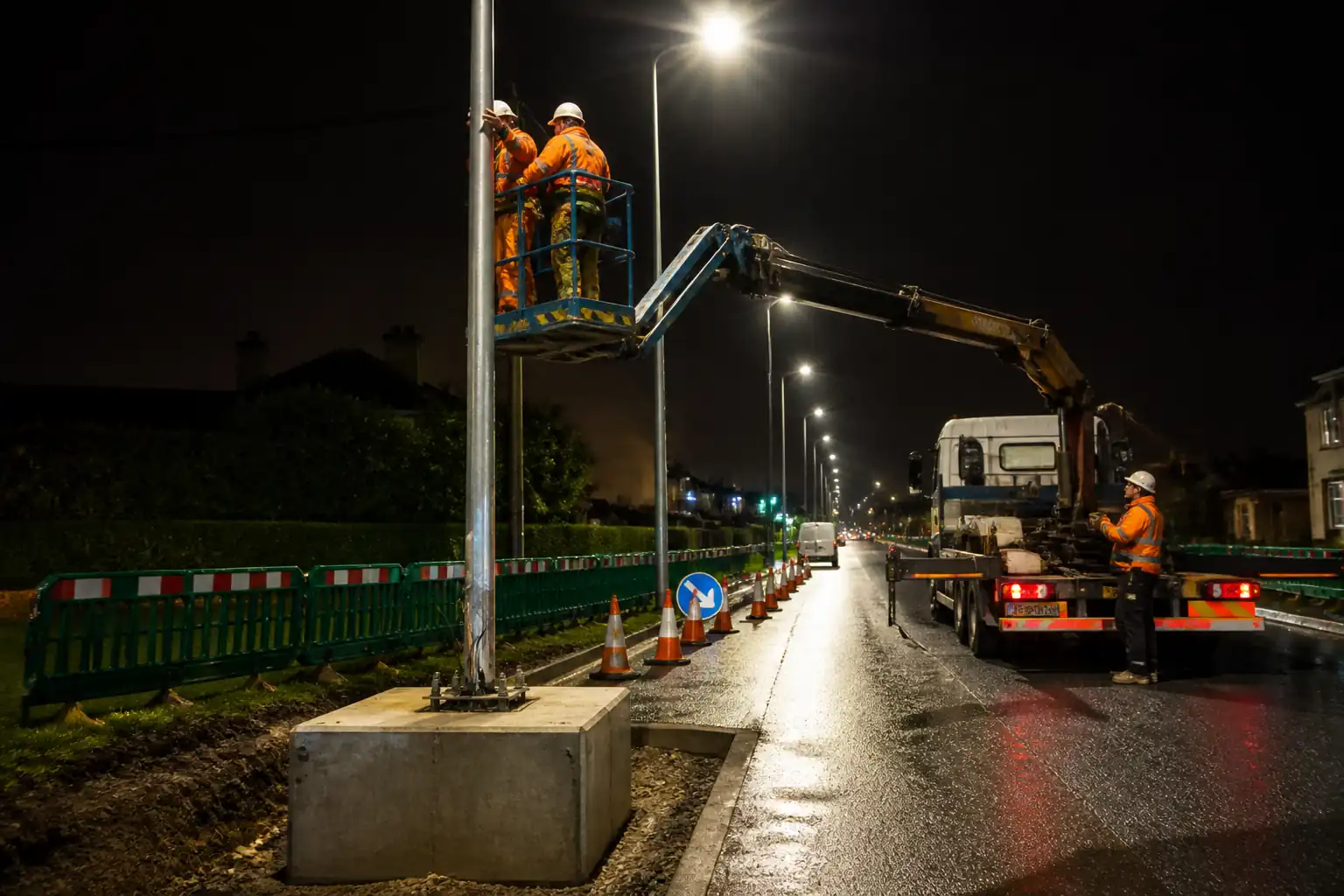
Covers permits, setting out, excavation, formation, ducts/earthing, reinforcement and bolts, concrete, backfill, erection, wiring, electrical tests, energization, and lux/luminance checks.
Typical hold, witness, and review points
Hold: formation approval; rebar/anchor bolts pre-pour; dead tests before energization. Witness: concrete placement, column erection, torque check, lux survey.
Typical inspection records
PTW, utility scans, IRs, concrete test reports, compaction results, torque logs, electrical test sheets, commissioning records, lux survey, as-builts.
Important approval note
This ITP is an AI-assisted editable starting point, not a pre-approved document. Before use on any project, all inspection activities, hold points, and acceptance criteria must be reviewed and approved by the relevant parties (superintendent, principal contractor, or client representative) in accordance with your contract and project quality plan.
Always verify acceptance criteria against your applicable drawings, specifications, and regulatory requirements. Hold points must be confirmed with the relevant authority before work proceeds past that point.
Inspection and test plan
| Activity | Inspection / Test | Acceptance Criteria | Responsibility | Record |
|---|---|---|---|---|
| Permits and utility clearance | Permit-to-dig; utility scan records | PTW approved; utilities marked and protected | Site Engineer / HSE | Approved PTW; scan logs; photos |
| Setting out | Location/orientation check | Position ±10 mm; orientation ±2° [Verify] | Surveyor / QA/QC | Setting-out sheet; IR |
| Excavation and formation | Dimensions, level, ground condition | Plan ±50 mm; depth +0/−20 mm; firm base | Site Engineer / QA/QC | IR; photos |
| Ducts and earthing provisions | Duct alignment/slope; preliminary continuity | Duct integrity; slope to pit; earth bond installed | Electrician / QA/QC | IR; photos; redlines |
| Reinforcement and anchor bolt cage | Survey of bolt circle, projection, level | Bolt circle ±3 mm; projection ±2 mm; verticality ≤1:100; cover ≥50 mm [Verify] | QA/QC Engineer | IR; survey report |
| Concrete – pre-pour and placement | Slump; temperature; cube sampling; visual compaction | Slump 75–150 mm [Verify]; temperature per spec; no segregation; full compaction | QA/QC / Site Engineer | Test reports; pour card; IR |
| Curing and early-age protection | Curing method and duration | Curing maintained for specified period; surface intact | Site Engineer | Curing log; photos |
| Backfill compaction | Field density tests | ≥95% MDD or per spec [Verify] | QA/QC | Compaction test results; IR |
| Column erection and alignment | Plumbness; torque check | Verticality ≤1/500 height [Verify]; torque per manufacturer | Lifting Supervisor / QA/QC | Torque log; survey sheet; IR |
| Wiring and terminations | Visual; preliminary continuity/polarity | Correct cable sizes; proper glands; secure terminations; labeling complete | Electrician | Termination checklist; photos |
| Dead tests (LV) | Continuity, insulation resistance (500 V DC), polarity | IR ≥1 MΩ; correct polarity; continuity within design | Electrician / QA/QC | Electrical test sheets |
| Earth electrode resistance | 3-point or clamp-on test | ≤10 Ω typical unless specified otherwise [Verify] | Electrician / QA/QC | Earth test report |
| Energization and functional test | Operational check; photocell/CMS function | All units operational; correct switching | Electrician / Client Rep | Commissioning report; IR |
| Lux/luminance verification (night test) | EN 13201-4 field measurements | Meets design class averages and uniformities within permitted tolerances [Verify] | Lighting Engineer / QA/QC / Client Rep | Lux survey report; calibration certs |
| As-built documentation and handover | Document completeness review | All records complete and approved | Site Engineer / QA/QC | As-builts; test packs; warranties |
This table is a read-only public reference. Download the PDF or Excel version, or customize this ITP to edit it for your project.
Frequently asked questions
Related method statement
This Inspection and Test Plan is associated with the Method Statement – Installation of Street Lighting Columns, Foundations, Wiring, Earthing, and Lux-Level Verification method statement, which describes the step-by-step construction sequence, resources, materials, equipment, safety controls, and environmental controls for this activity.
View the Method Statement – Installation of Street Lighting Columns, Foundations, Wiring, Earthing, and Lux-Level Verification method statement →Continue with related inspection, method statement, article, and checklist resources.