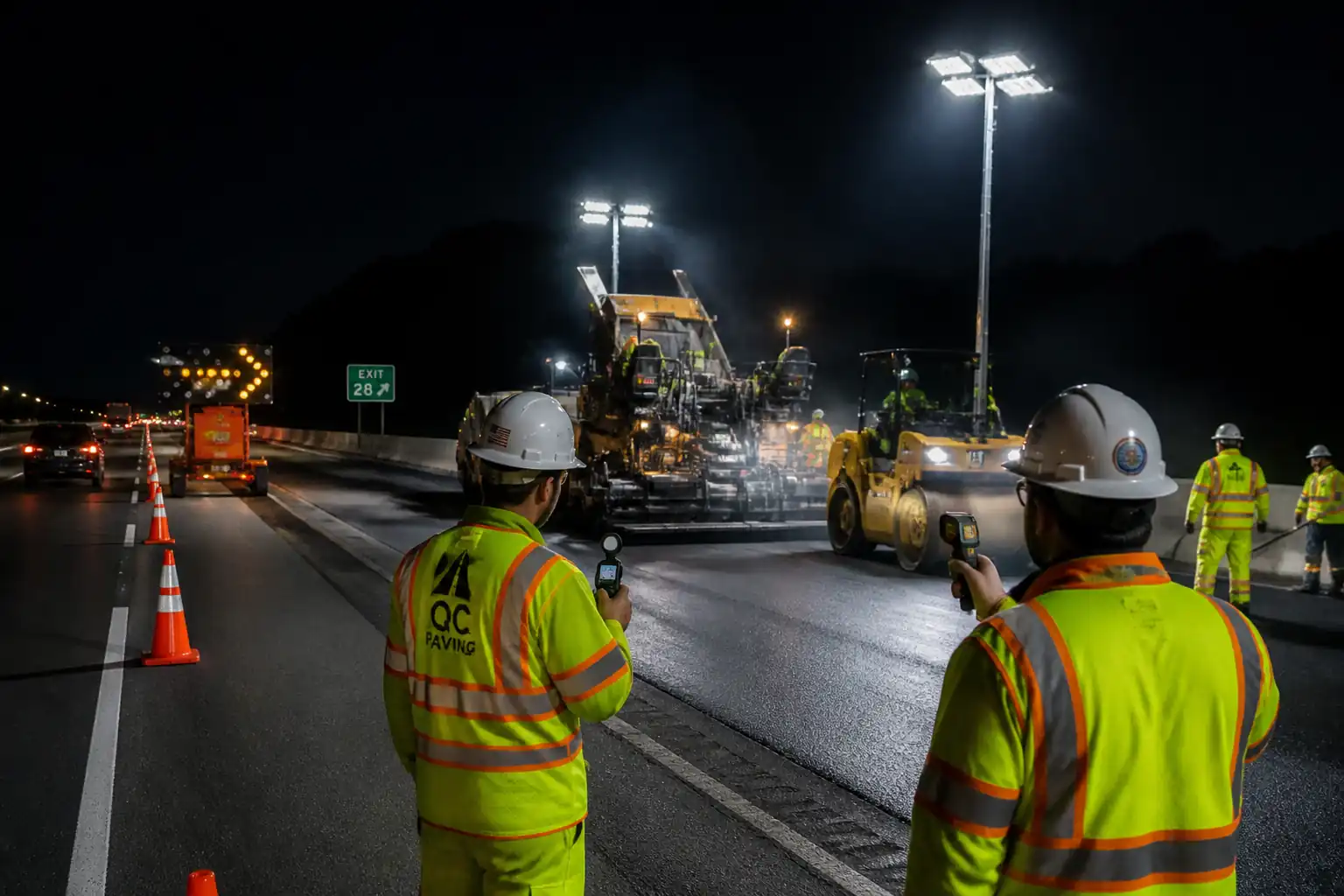

Method Statement: Nighttime Asphalt Paving Operations for Highway Rehabilitation – Method Statement
AI-assisted method statement with matching ITP, PDF download, and Excel export.
More than a static template
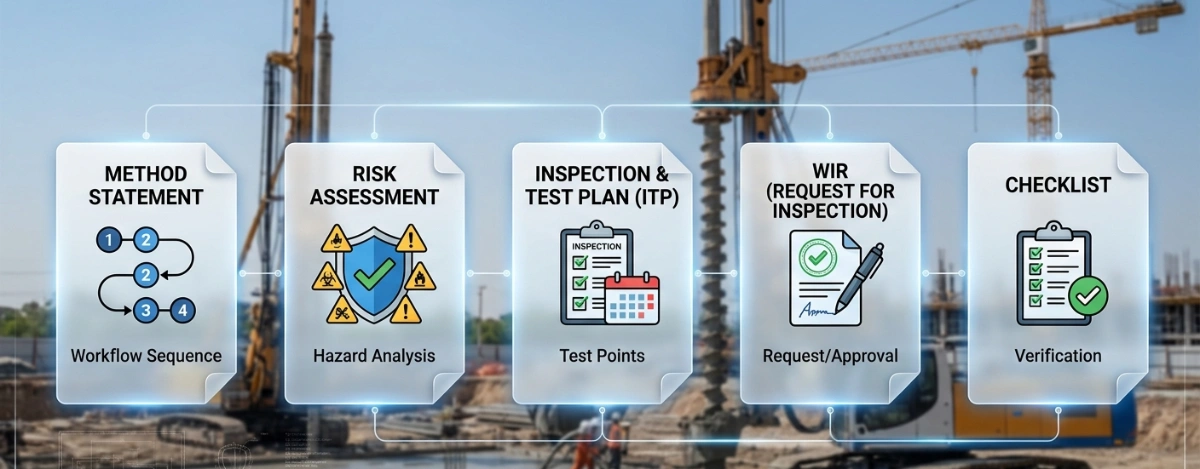
Unlike a downloadable Word or PDF template, this method statement is an AI-assisted editable starting point connected directly to a matching Inspection and Test Plan. Every section is structured, project-adaptable, and ready to export.
- AI-assisted drafting — Customize every section with AI for your specific project scope.
- Linked ITP — A matching inspection and test plan is generated alongside the method statement.
- Multiple export formats — Download as a formatted PDF or editable Excel spreadsheet.
- Editable starting point, not a final document — Review, verify, and adjust all content against your project requirements before use.
Static template vs. Quollnet workflow
| Feature | Static template | Quollnet |
|---|---|---|
| Project-specific content | Manual fill-in required | AI-assisted customization |
| Linked ITP | Separate document, no link | Matching ITP included |
| Export formats | Usually PDF only | PDF and Excel |
| Structured sections | Free-form layout | 13 standardized sections |
| Saved to your account | Local file only | Cloud-saved, reusable |
| Content accuracy | You verify everything | AI-assisted, you still verify |
| Cost | Often free but time-intensive | Free to customize and download |
What you can customize
When you save this method statement to your account, every section becomes editable. The following 13 sections are included:
- Scope — Defines the activity and its boundaries.
- References — Standards, specifications, and drawings.
- Responsibilities — Roles and accountabilities.
- Resources — Labour, plant, and equipment summary.
- Materials — Materials and compliance requirements.
- Equipment — Tools and equipment details.
- Prerequisites — Hold points and pre-conditions.
- Method sequence — Step-by-step construction sequence.
- Safety controls — HSE risk controls and PPE.
- Environmental controls — Environmental mitigation measures.
- QA/QC — Quality inspection and test requirements.
- ITP — Inspection and Test Plan table (has its own page).
- Attachments — Referenced drawings and documentation.
Why this method statement is used
This method statement is used to define and communicate the approved procedure for carrying out method statement: nighttime asphalt paving operations for highway rehabilitation on site. It ensures the work is planned in advance, the correct resources and controls are in place, and all personnel understand responsibilities, sequence, quality requirements, and safety controls before work begins. It aligns site execution with the documented scope and acceptance expectations.
Who uses this method statement
This method statement is used by contractors, site supervisors, project engineers, QA/QC engineers, HSE officers, consultants, and client representatives. It serves as a shared reference for planning, execution, supervision, inspection, and approval of the activity on site.
When it is prepared and submitted
The method statement is prepared before the work activity starts and submitted as part of the pre-construction documentation package for review and approval.
Who reviews or approves it
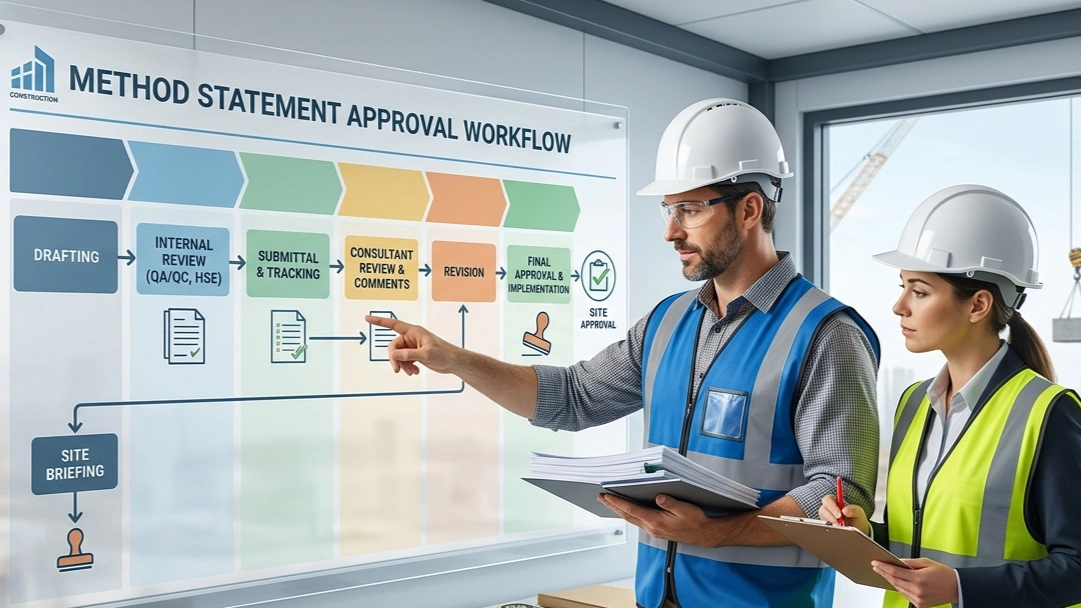
The method statement is usually submitted to the client representative, consultant, resident engineer, or project management consultant for review and approval before the work commences.
Important approval note
This method statement is an AI-assisted editable starting point, not a pre-approved document. Before use on any project, all content must be reviewed and approved by the relevant parties (superintendent, principal contractor, or client representative) in accordance with your contract and project quality plan.
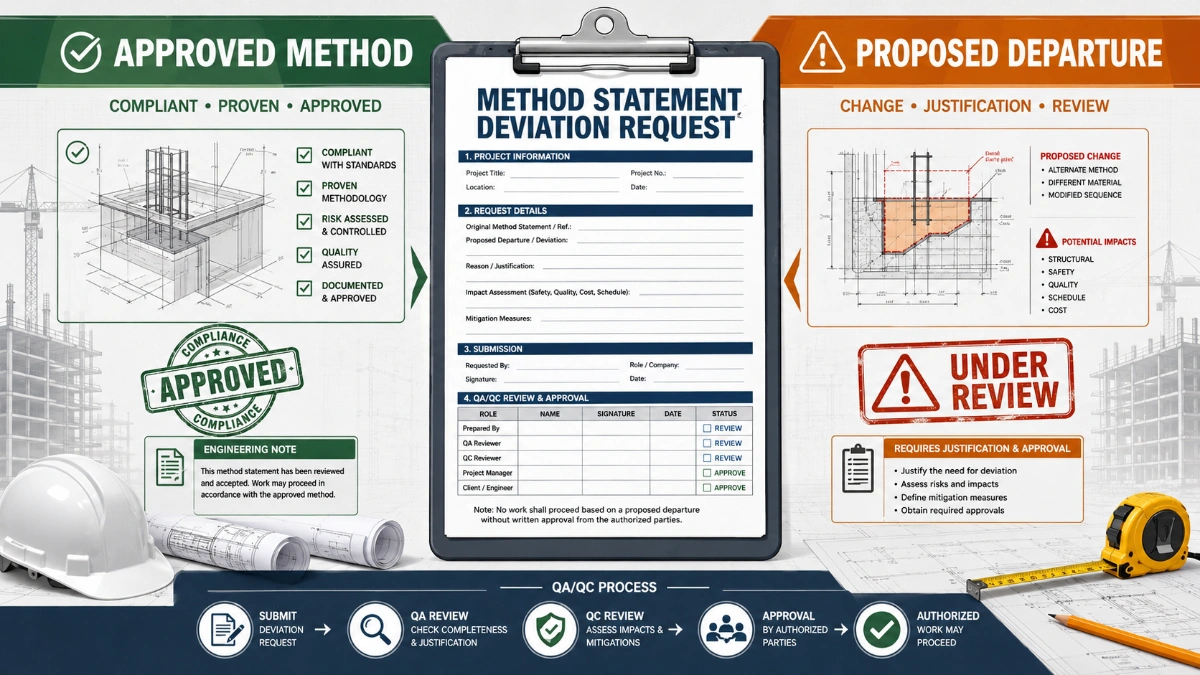
For example: if your specification requires a departure from a referenced standard, that departure must be documented and approved separately — this method statement will not capture that automatically. Always verify against your applicable drawings, specifications, and regulatory requirements.
Method statement content
Front Matter
Document Header
- Method date: 2026-06-18
- Project name:
- Submitted by:
- Submitted to:
- Discipline: Highways / Pavements
- Work type: Nighttime Asphalt Paving Operations (Rehabilitation)
Scope
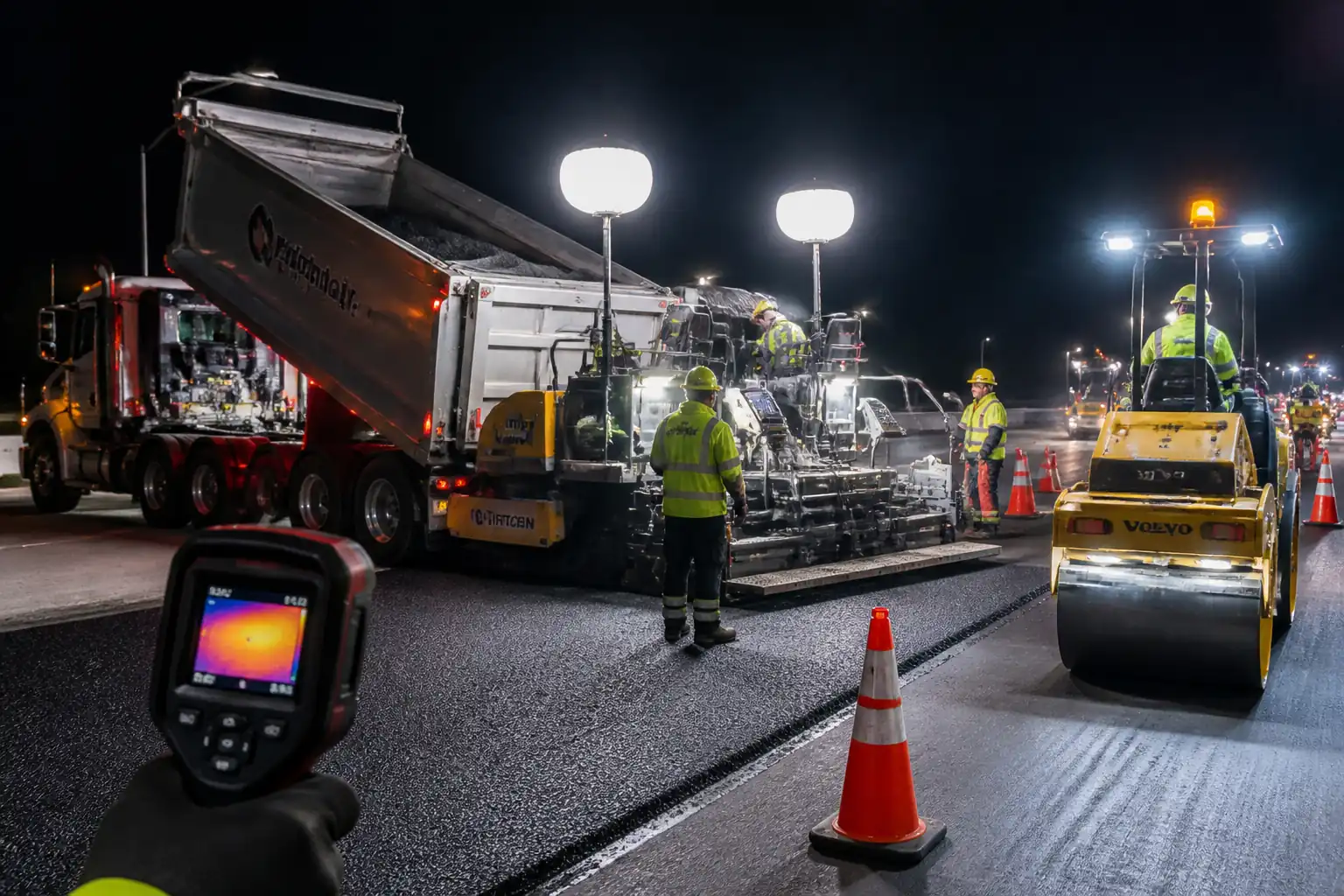
This method statement covers planning, setup, and execution of nighttime hot-mix or warm-mix asphalt (HMA/WMA) paving for highway rehabilitation under live traffic management. It includes:
- Temporary traffic management (TTM) and compliance with permits.
- Artificial lighting design, layout, aiming, glare control, illumination verification.
- Personnel visibility and retroreflective safety clothing requirements.
- Asphalt plant coordination, haul logistics, temperature control in cold night air, and continuous paving.
- Surface preparation, tack application, paving, joint construction (longitudinal/transverse), and compaction.
- Quality control testing (temperature, density, thickness, smoothness, materials compliance) and acceptance.
- Environmental controls (noise, light spill, waste, emissions) and task-specific HSE controls.
Exclusions: Structural base reconstruction, full-depth reclamation, and permanent line marking (unless stated in attachments).
References
| Document Type | Reference / Number | Revision | Notes |
|---|---|---|---|
| Standard | BS 594987 | Verify project edition. | |
| Standard | BS EN 13108 (series) | Verify mix designation per JMF. | |
| Standard | BS EN 12697 (series) | ||
| Standards | AASHTO/ASTM (see description) | Use jurisdiction-appropriate equivalents. | |
| Guideline | MUTCD Part 6 | Or UK: Traffic Signs Manual Chapter 8; [Verify per project jurisdiction]. | |
| Guideline | FHWA Nighttime Work Zone Lighting | Apply IES/EN equivalents where applicable. | |
| Standard | ANSI/ISEA 107 or EN ISO 20471 | Verify class and retroreflective area per spec. | |
| Standard | ISO 9001 | ||
| Regulation | OSHA 1926 / CDM / Local |
Responsibilities
| Role | Responsibility | Name / Party |
|---|---|---|
| PM | Project Manager | Contractor |
| CM | Construction Manager | Contractor |
| Foreman | Night Shift Foreman / Asphalt Supervisor | Contractor |
| QC | QC Engineer / Lab Technician | Contractor |
| Survey | Surveyor | Contractor |
| HSE | HSE Manager / Officer | Contractor |
| TMS | Traffic Management Supervisor | Contractor/Sub |
| PlantMgr | Asphalt Plant Manager | Supplier |
| LightingTech | Lighting Technician / Electrical Supervisor | Contractor |
Resources
| Resource Type | Description | Quantity | Remarks |
|---|---|---|---|
| Personnel | Paver operator, screed operator, 2 rake hands, 2 laborers | 7 | Night shift (10–12 h max) [Verify per labor code]. |
| Personnel | 2 roller operators (breakdown/intermediate), 1 finish roller operator | 3 | |
| Personnel | Traffic marshals, sign/cone crew, TMA operators | 6–10 [Verify] | Depends on closure length and complexity. |
| Personnel | QC engineer, lab tech, coring crew (2 pers) | 3–4 | |
| Personnel | Lighting technician(s), electrician | 2–3 |
Materials
| Material | Specification / Grade | Quantity | Remarks |
|---|---|---|---|
| Bituminous mixture | BS EN 13108 or local; JMF-approved | ||
| Bitumen emulsion | BS EN 13808 or AASHTO M140/M208 | ||
| Joint adhesive | Per project spec [Verify] | ||
| Additive | Per supplier TDS | ||
| Release agent | Project-approved |
Equipment
| Equipment | Capacity / Type | Quantity | Inspection Required |
|---|---|---|---|
| Paver | ≥300 t/h [Verify] | 1 | Daily pre-use checks |
| MTV | ≥300 t/h [Verify] | 1 | Daily checks |
| Roller | 8–12 t, 30–50 Hz | 1 | Daily checks |
| PTR | 20–25 t | 1 | Daily checks |
| Roller | 8–10 t | 1 | Daily checks |
| Lighting | 8–12 h fuel autonomy | As per lighting plan | Pre-shift lux survey |
| TTM | As required | TTM inspection | |
| QC | 1 set | Calibration certs |
Prerequisites
Approvals and Permits
- Approved Method Statement and ITP.
- Approved Traffic Management Plan and lane closure permit.
- Night work permit and lighting plan approved by the Engineer/Authority [Verify per project].
- Approved Job Mix Formula (JMF) and plant compliance certification.
Pre-Shift Planning
- Weather check: ambient ≥5–10°C, surface ≥10°C for HMA (or per WMA guidance), wind <25 km/h; no precipitation forecast for paving/compaction window [Verify per project specifications].
- Lotting plan: define lot/sub-lot sizes (e.g., 500–1000 t per lot) and test frequencies.
- Haul plan: number of trucks, cycle time, staging, tarping, release agent control.
- Workforce plan: fatigue management, breaks, rotation [Verify per HSE plan].
- Utilities and structures: confirm clearance near overhead/underground assets; protection of covers, gratings.
Plant and Equipment Readiness
- Calibrations: plant weigh systems, emulsion sprayer (nozzle rate), nuclear gauge/thermometers/lux meter (valid certificates).
- Paver and rollers pre-checked; screed plates clean, heaters functional; rollers water spray systems operational.
- Light towers serviced; lamps clean; mast/stays inspected; spare bulbs/fuses.
Materials Readiness
- Emulsion and asphalt delivery temperatures per JMF and supplier TDS.
- WMA additive dosage ready (if applicable).
- Joint adhesive available and heated to application temp (if specified).
Briefings and Risk Controls
- Toolbox talk on night hazards, plant/pedestrian interface, lighting glare control, truck exchange choreography.
- PPE check: High-visibility Class 3 garments (ANSI/ISEA 107 or EN ISO 20471), helmets with retroreflective bands, cut-resistant gloves, eye/ear protection, heat-resistant footwear.
- Emergency plan: first aiders, spill kits, fire extinguishers (foam/dry powder), emergency access maintained.
Method Sequence
| Step | Activity | Description | Responsibility | Inspection / Hold Point |
|---|---|---|---|---|
| 1 | TTM setup and verification | Deploy lane closures, signs, cones, TMAs per approved TTM. Conduct drive-through and audit. | Traffic Management Supervisor | TTM inspection checklist; photos |
| 2 | Lighting deployment and lux verification | Position towers to side/back of traffic; aim to illuminate task zones (paver/screed/rollers/joints) with minimal glare to motorists; set generator levels; use diffusers. | Lighting Technician | Lux survey using calibrated meter at working plane ~1 m above surface |
| 3 | Surface preparation | Sweep/mill clean; remove debris; repair soft spots; cover utilities; ensure dry, sound surface. | Foreman / Site Engineer | Visual; moisture check if needed |
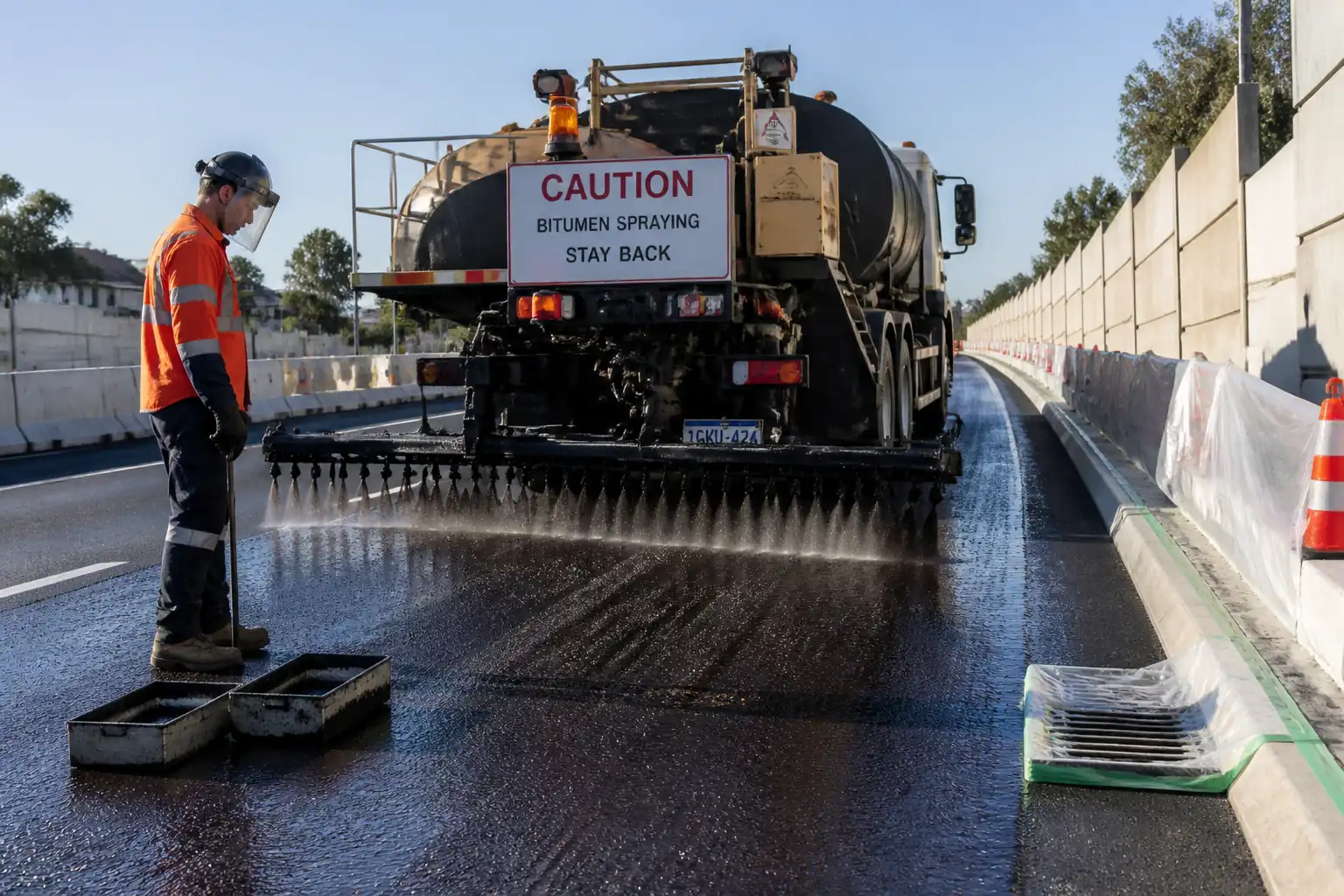
| 4 | Tack coat application | Spray uniform tack with calibrated distributor; protect from traffic; allow break to proper color before paving. | Foreman / Sprayer Operator | Nozzle fan pattern, rate verification |
| 5 | Plant production and logistics | Confirm production temp; load trucks evenly; cover loads; enforce maximum haul time; stagger dispatch for continuous paver feed; use MTV if specified. | Plant Manager / Logistics Coordinator | Ticket review; temperature checks at load and receipt |
| 6 | Paver setup and screed control | Set crown, slope, and thickness; preheat screed; use averaging ski/beam; place starter pad/stringline as needed. | Paver Operator / Surveyor | Level checks; screed temp |
| 7 | Paving operation (continuous) | Maintain constant paver speed; avoid stops; keep head of material constant; use MTV for uniformity; manage truck exchanges with spotter; avoid bumping paver. | Foreman / Paver Operator | Visual for segregation/thermal bands; IR thermal camera scan |
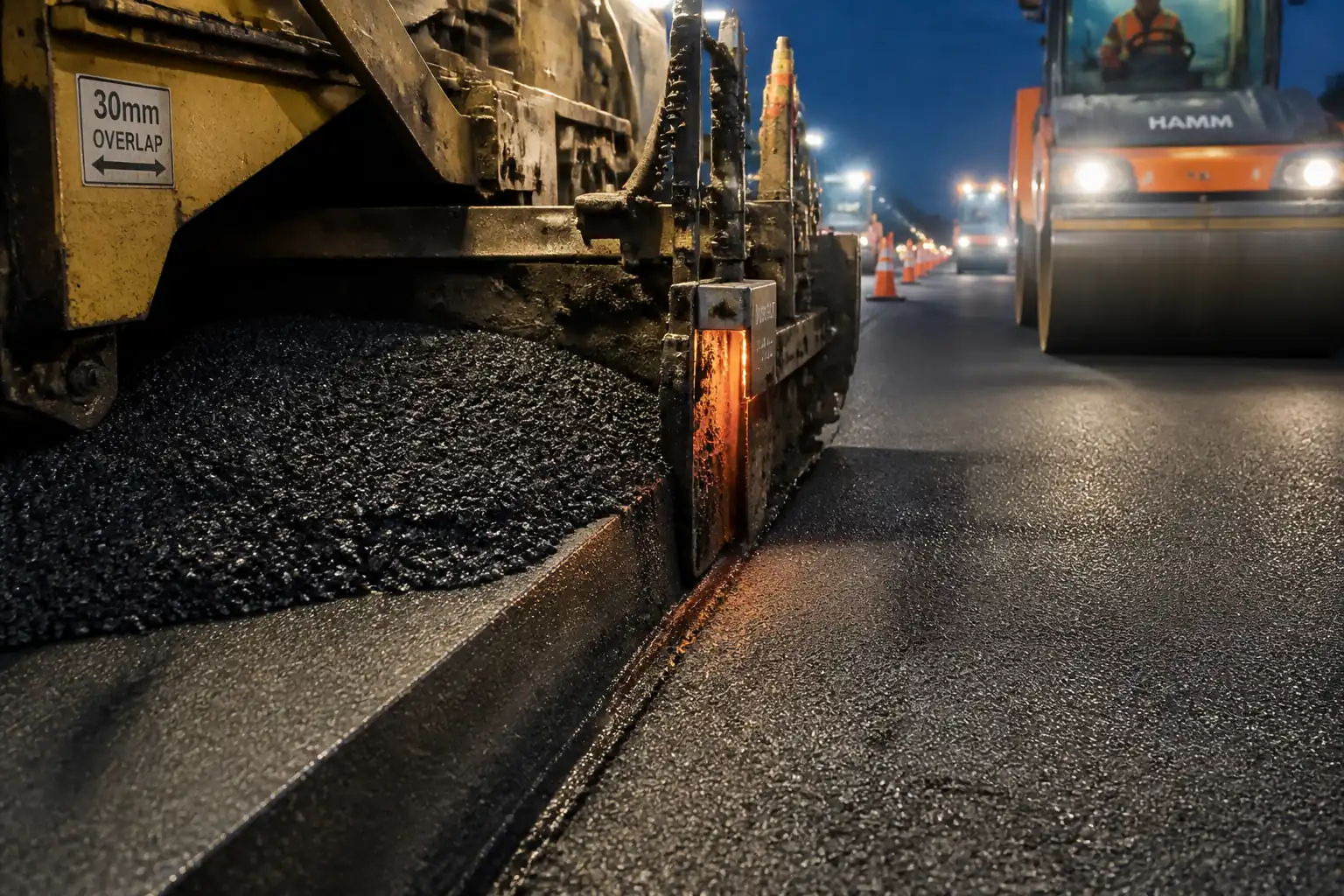
| 8 | Longitudinal joint construction | Use notched-wedge or matched joint; paint/tack the cold edge; overlap 25–40 mm; lute gently; roll from hot side toward joint. | Foreman / Rakers | Joint alignment and prep |
| 9 | Transverse joint construction | Form vertical face; heat joint face (if allowed); ramp removal plate; compact with steel roller starting off joint onto mat; saw-cut if required for tie-in. | Foreman | Face condition; level tie |
| 10 | Compaction sequence | Begin breakdown rolling immediately after paver (mat ≥120–140°C HMA; WMA per TDS). Use 6–10 passes depending on thickness. Intermediate PTR to knead; finish rolling to remove marks. | Roller Operators | Pass count; temp checks; roller settings |
| 11 | Quality control sampling/testing | Perform temperature, density, thickness, air voids, gradation, binder content tests per lot plan. Take random cores after cooling. | QC Engineer / Lab Tech | Witness by Engineer as required |
| 12 | Surface finish and smoothness | Check straightedge longitudinal and transverse; correct minor lows with additional passes while warm. | Surveyor / Foreman | 3 m straightedge; visual |
| 13 | Opening to traffic | Verify cooling, remove loose materials, pick-up TTM in sequence or shift to next work zone. | Construction Manager / TMS | Final inspection walk/drive-through |
| 14 | Demobilization and records | Clear plant; secure lights; fuel and waste managed; submit as-built levels and test results within required timeframe. | PM / QC | Documentation review |
Safety Controls (HSE)
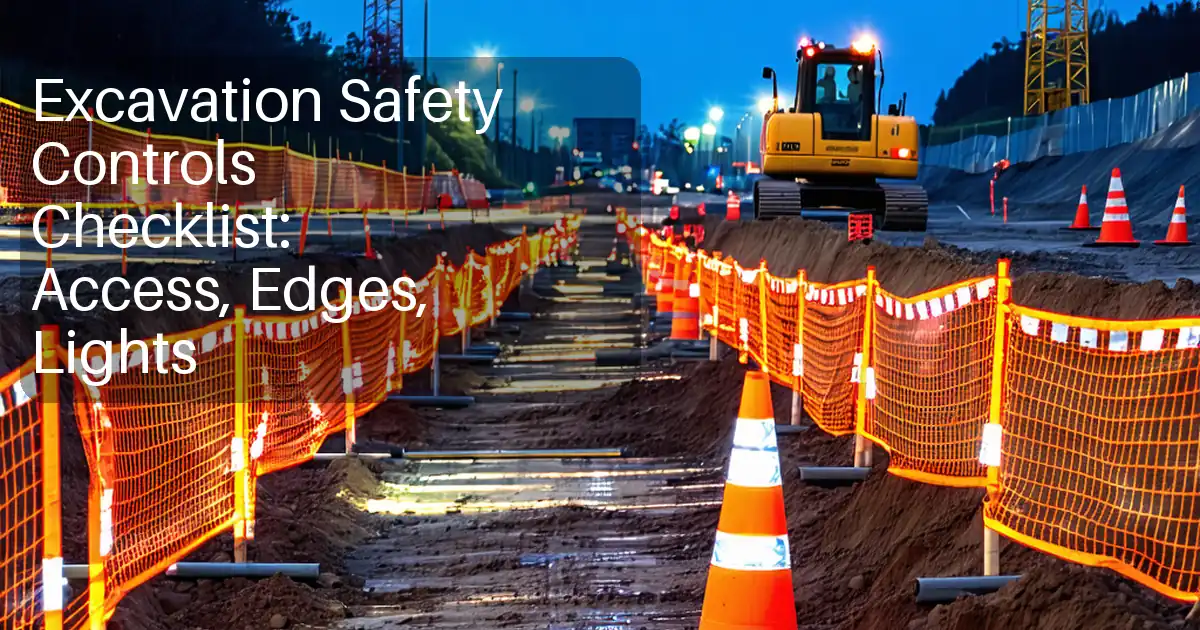
Key Night Work Hazards and Controls
- Hazard: Live traffic incursion into work zone
- Consequence: Struck-by, fatality
- Engineering/Procedural Control: Approved TTM with barriers/TMAs; positive protection where feasible; buffer zones; flagging eliminated in high-speed roads; sequential lighting and reflective devices; drive-through audits every 2 h.
- PPE: Class 3 high-visibility garments (ANSI/ISEA 107 or EN ISO 20471), helmet with reflective band, safety boots.
- Collective Measure: TMAs shadowing work convoy; physical barriers where viable.
-
Inspection/Permit: Lane closure permit; TTM supervisor inspection log; police/authority coordination [Verify per local regulations].
-
Hazard: Poor visibility and glare from work lights
- Consequence: Plant/person interface incidents, driver distraction
- Control: Low-glare LED towers aimed below driver sightline; back/side lighting to tasks; maintain illuminance per plan (task 100–150 lux; general 20–50 lux); uniformity ≤10:1; use shields/diffusers; re-aim as work front moves.
- PPE: Eye protection with anti-glare coating.
- Collective Measure: Zone lighting layout and lux verification before start and mid-shift.
-
Inspection/Permit: Lux meter checks logged; HSE sign-off before paving (Hold Point).
-
Hazard: Reversing trucks and plant movements
- Consequence: Crush injury
- Control: One-way haul route; spotters with radios; proximity alarms; strict truck exchange choreography; no pedestrians in exclusion zones; blue light/white noise alarms at night.
- PPE: High-vis, steel-toe boots, gloves.
- Collective Measure: Painted/exclusive walkways where practicable; plant-pedestrian separation barriers at laydown.
-
Inspection/Permit: Plant pre-use checks; supervisor oversight; behavioral observation program.
-
Hazard: Burns from hot asphalt and equipment
- Consequence: Thermal burns
- Control: Keep safe distance; use long-handled tools; paver/roller guarding; prohibit riding on truck fenders; maintain screed guards; communicate hot surfaces.
- PPE: Heat-resistant gloves, long sleeves, face shield for rakers as needed.
- Collective Measure: Exclusion zones; tool storage racks.
-
Inspection/Permit: Hot work permit near refueling or open flame sources [Verify per HSE plan].
-
Hazard: Fumes and bitumen vapors
- Consequence: Respiratory/eye irritation
- Control: Use WMA to lower temps where specified; position upwind; avoid standing in blue smoke; maintain equipment to prevent overheating.
- PPE: Safety glasses, half-mask with organic vapor filters if required by air monitoring [Verify].
- Collective Measure: Natural ventilation; minimize idling.
-
Inspection/Permit: Air monitoring if mandated; SDS on site.
-
Hazard: Refueling generators/light towers
- Consequence: Fire/explosion
- Control: Shut down and cool before refueling; drip trays; no smoking area; bonding/grounding where required; spill kits.
- PPE: Flame-resistant gloves, goggles.
- Collective Measure: Designated refuel zone away from traffic.
-
Inspection/Permit: Permit-to-work for fueling; extinguisher inspections.
-
Hazard: Fatigue (night shift)
- Consequence: Errors, slower reaction, incidents
- Control: Max shift length limits; scheduled breaks; rotation; fitness-for-duty checks; caffeine/hydration policy.
- PPE: N/A.
- Collective Measure: Welfare facilities; lighting at rest areas.
-
Inspection/Permit: Supervisor fatigue checks; HSE audits; [Verify per project HSE plan].
-
Hazard: Noise and vibration exposure
- Consequence: Hearing loss, HAVS
- Control: Equipment maintenance; restrict time on vibrating tools; noise mapping.
- PPE: Class 5 ear protection where >85 dB(A).
- Collective Measure: Acoustic screens near residents where feasible.
-
Inspection/Permit: Noise monitoring as required by permit.
-
Hazard: Slips, trips, uneven edges at joints and milled surfaces
- Consequence: Sprains, falls
- Control: Good housekeeping; mark edges with reflective cones; provide safe access steps to paver.
- PPE: Ankle-support boots, headlamp if permitted.
- Collective Measure: Edge protection or ramping at pedestrian crossings.
- Inspection/Permit: HSE walkdowns each 2–3 h.
Environmental Controls
- Noise management: Schedule highest noise tasks earlier in the night; maintain equipment; use broadband alarms; adhere to local night noise limits [Verify per permit]; monitor dB(A) if required.
- Light spill and skyglow: Aim lights downward; use shields; keep CCT ~4000–5000 K; avoid illuminating residences; document lux readings at site boundary if required.
- Air quality and emissions: Minimize idling; consider WMA to reduce fumes; ensure trucks are covered; comply with engine tier standards.
- Runoff and spills: Keep drainage paths free; prevent emulsion/asphalt spills; deploy spill kits; protect inlets with booms if necessary; clean up immediately.
- Waste management: Collect cores, milled arisings, and asphalt scraps for recycling; dispose of contaminated absorbents as hazardous waste; keep records.
- Dust control: Sweepers with water spray for milled surfaces; avoid over-wetting before tack.
- Material storage: Store fuels with secondary containment; segregate chemical storage; MSDS available.
- Wildlife/community: Coordinate notifications; maintain access; control lighting toward habitats if specified.
Quality Assurance and Quality Control
QA/QC Plan
- Lotting and sampling: Define lot sizes (e.g., 500–1000 t) and sub-lots; random sampling locations/time using statistical method [Verify per spec].
- Testing frequencies (typical benchmarks):
- Delivery temperature: each truck initially, then 1 in 5 loads.
- Binder content/gradation: 1 per 400–600 t (ignition oven and sieve) [Verify].
- Maximum specific gravity (Gmm): 1 per lot.
- Bulk specific gravity (Gmb) of cores: 1 per 500 m² or 3 per lot minimum [Verify].
- In-place density (gauge): each sub-lot with correlation to cores.
- Thickness: all cores; level checks each 50 m and at edges.
- Smoothness: straightedge every 25 m and at joints.
- Tack rate: 1 tray test per 500 m² minimum.
- Lighting: lux checks at start, after adjustments, and mid-shift.
- Acceptance criteria (typical):
- Density: 92–97% of Gmm or per spec.
- Binder content: within ±0.3–0.5% of JMF.
- Gradation: within project-defined bands.
- Air voids (production): 3–5% [Verify].
- Thickness: −5/+10 mm of design [Verify].
- Smoothness: ≤6 mm in 3 m [Verify].
- Joint density: within 1–2% of mat density; joint straightness ≤10 mm in 3 m [Verify].
- Hold/Witness points: Lighting verification (Hold), first sub-lot compaction pattern (Hold), tack coat application (Witness), opening to traffic (Hold).
- Calibration and correlation: Establish nuclear gauge-to-core correlation before production; re-validate daily or when material changes.
- Nonconformance: Identify segregated/cold areas via IR; mark and rectify (remove/replace or additional compaction if still warm); NCR raised for failed lots; implement corrective actions.
- Records: ITP checklists, test reports, delivery tickets, temperature and lux logs, compaction logs, as-built levels, training and calibration certificates.
Attachments
- Lighting layout and aiming plan with calculated illuminance and glare notes.
- Approved Traffic Management Plan and permit conditions.
- Job Mix Formula approval and supplier TDS (HMA/WMA).
- Emulsion sprayer calibration and nozzle chart; plant calibration certificates.
- Pre-start checklists: TTM, lighting, paver/rollers, HSE.
- Test forms: temperature log, lux log, compaction log, tray test sheet, thermal profiling sheet, density/cores reports.
- SDS/MSDS for bitumen, emulsion, WMA additives, fuels.
- Training and PPE compliance records (high-visibility garments certificates to ANSI/ISEA 107 or EN ISO 20471).
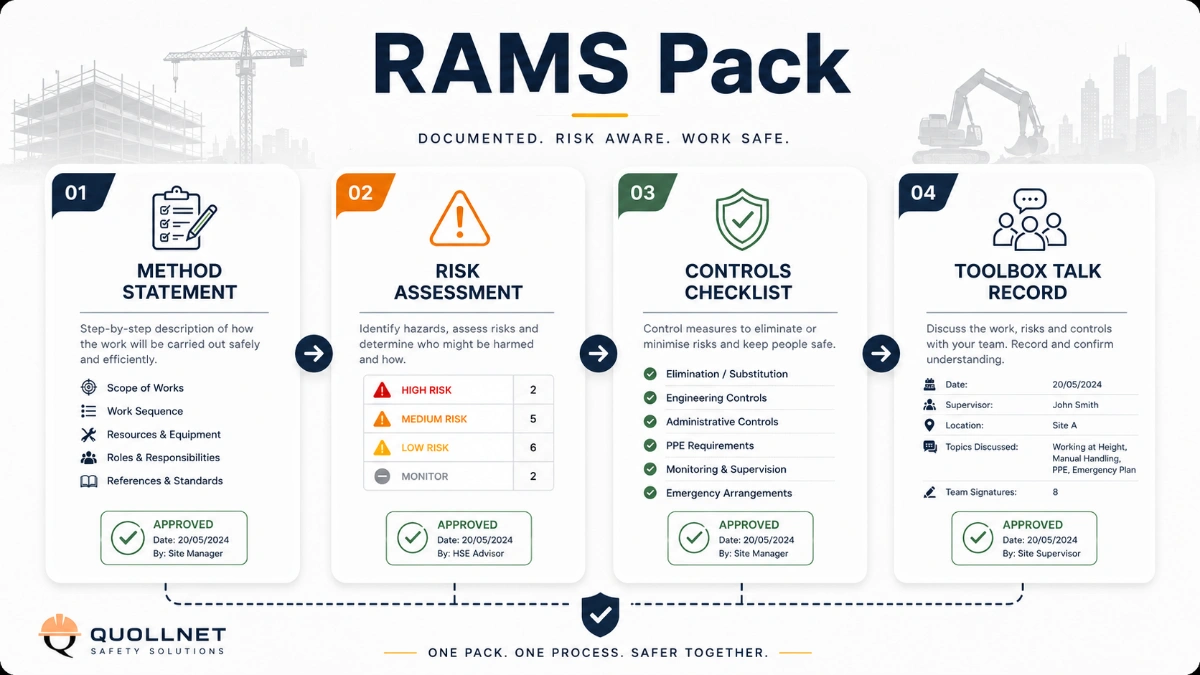
- Risk Assessment/Method Statement (RAMS) for night operations.
- Emergency response plan and contact list.
This content is a read-only public reference. Download or customize to get an editable version.
ITP preview
The first inspection activities from the linked ITP for Method Statement: Nighttime Asphalt Paving Operations for Highway Rehabilitation:
| Activity | Inspection / Test | Acceptance Criteria | Responsibility | Record |
|---|---|---|---|---|
| Pre-start approvals and permits | Verify approved MS/ITP, TTM plan, night work permit, lighting plan | All approvals in place; permit conditions embedded in shift plan | PM / TMS / HSE | Permit pack; pre-start checklist |
| Lighting setup and verification (Hold) | Lux measurements at task, roller, and general zones; glare check from traffic view | Task 100–150 lux; roller 50–100 lux; general 20–50 lux; uniformity ≤10:1; no direct glare [Verify] | Lighting Tech / HSE / Engineer | Lighting verification log; photos |
| Surface condition | Cleanliness/dryness check; repairs complete | Clean, dry, sound; temperature ≥ minimum per spec | Site Engineer / Foreman | Prep checklist |
Showing 3 of 12 inspection activities. View full ITP →
Related Inspection and Test Plan
An Inspection and Test Plan (ITP) is available for Method Statement: Nighttime Asphalt Paving Operations for Highway Rehabilitation. The ITP defines the inspection activities, acceptance criteria, hold and witness points, responsible parties, and records required to verify the work described in this method statement.
View the Method Statement: Nighttime Asphalt Paving Operations for Highway Rehabilitation ITP →Frequently asked questions
Continue with related Quollnet resources connected to this method statement.