
Method Statement: Laying and Compaction of Final Asphalt Wearing Course – Method Statement
AI-assisted method statement with matching ITP, PDF download, and Excel export.
More than a static template
Unlike a downloadable Word or PDF template, this method statement is an AI-assisted editable starting point connected directly to a matching Inspection and Test Plan. Every section is structured, project-adaptable, and ready to export.
- AI-assisted drafting — Customize every section with AI for your specific project scope.
- Linked ITP — A matching inspection and test plan is generated alongside the method statement.
- Multiple export formats — Download as a formatted PDF or editable Excel spreadsheet.
- Editable starting point, not a final document — Review, verify, and adjust all content against your project requirements before use.
Static template vs. Quollnet workflow
| Feature | Static template | Quollnet |
|---|---|---|
| Project-specific content | Manual fill-in required | AI-assisted customization |
| Linked ITP | Separate document, no link | Matching ITP included |
| Export formats | Usually PDF only | PDF and Excel |
| Structured sections | Free-form layout | 13 standardized sections |
| Saved to your account | Local file only | Cloud-saved, reusable |
| Content accuracy | You verify everything | AI-assisted, you still verify |
| Cost | Often free but time-intensive | Free to customize and download |
What you can customize
When you save this method statement to your account, every section becomes editable. The following 13 sections are included:
- Scope — Defines the activity and its boundaries.
- References — Standards, specifications, and drawings.
- Responsibilities — Roles and accountabilities.
- Resources — Labour, plant, and equipment summary.
- Materials — Materials and compliance requirements.
- Equipment — Tools and equipment details.
- Prerequisites — Hold points and pre-conditions.
- Method sequence — Step-by-step construction sequence.
- Safety controls — HSE risk controls and PPE.
- Environmental controls — Environmental mitigation measures.
- QA/QC — Quality inspection and test requirements.
- ITP — Inspection and Test Plan table (has its own page).
- Attachments — Referenced drawings and documentation.
Why this method statement is used
This method statement is used to define and communicate the approved procedure for carrying out method statement: laying and compaction of final asphalt wearing course on site. It ensures the work is planned in advance, the correct resources and controls are in place, and all personnel understand responsibilities, sequence, quality requirements, and safety controls before work begins. It aligns site execution with the documented scope and acceptance expectations.
Who uses this method statement
This method statement is used by contractors, site supervisors, project engineers, QA/QC engineers, HSE officers, consultants, and client representatives. It serves as a shared reference for planning, execution, supervision, inspection, and approval of the activity on site.
When it is prepared and submitted
The method statement is prepared before the work activity starts and submitted as part of the pre-construction documentation package for review and approval.
Who reviews or approves it
The method statement is usually submitted to the client representative, consultant, resident engineer, or project management consultant for review and approval before the work commences.
Important approval note
This method statement is an AI-assisted editable starting point, not a pre-approved document. Before use on any project, all content must be reviewed and approved by the relevant parties (superintendent, principal contractor, or client representative) in accordance with your contract and project quality plan.
For example: if your specification requires a departure from a referenced standard, that departure must be documented and approved separately — this method statement will not capture that automatically. Always verify against your applicable drawings, specifications, and regulatory requirements.
Method statement content
Scope
Overview
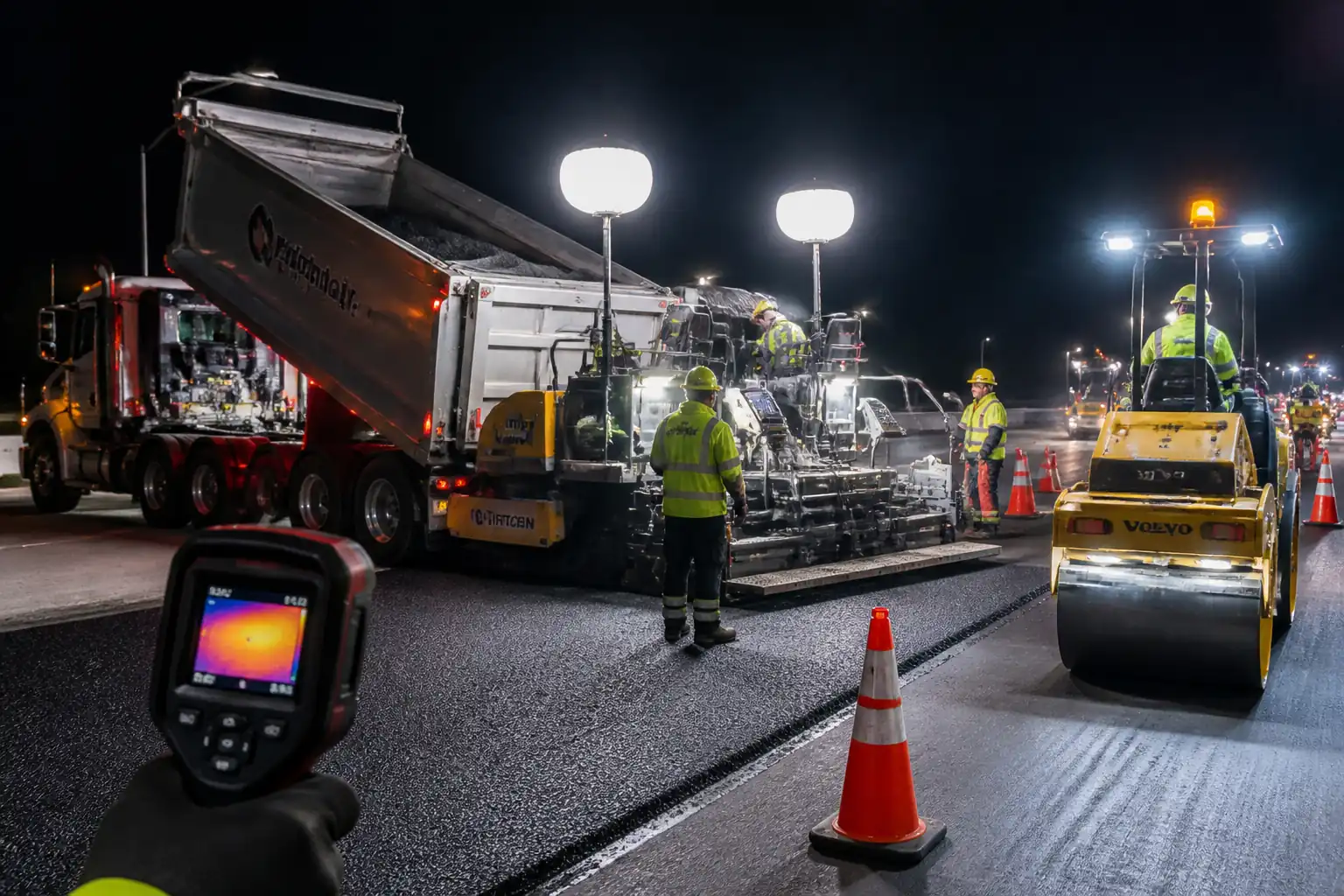
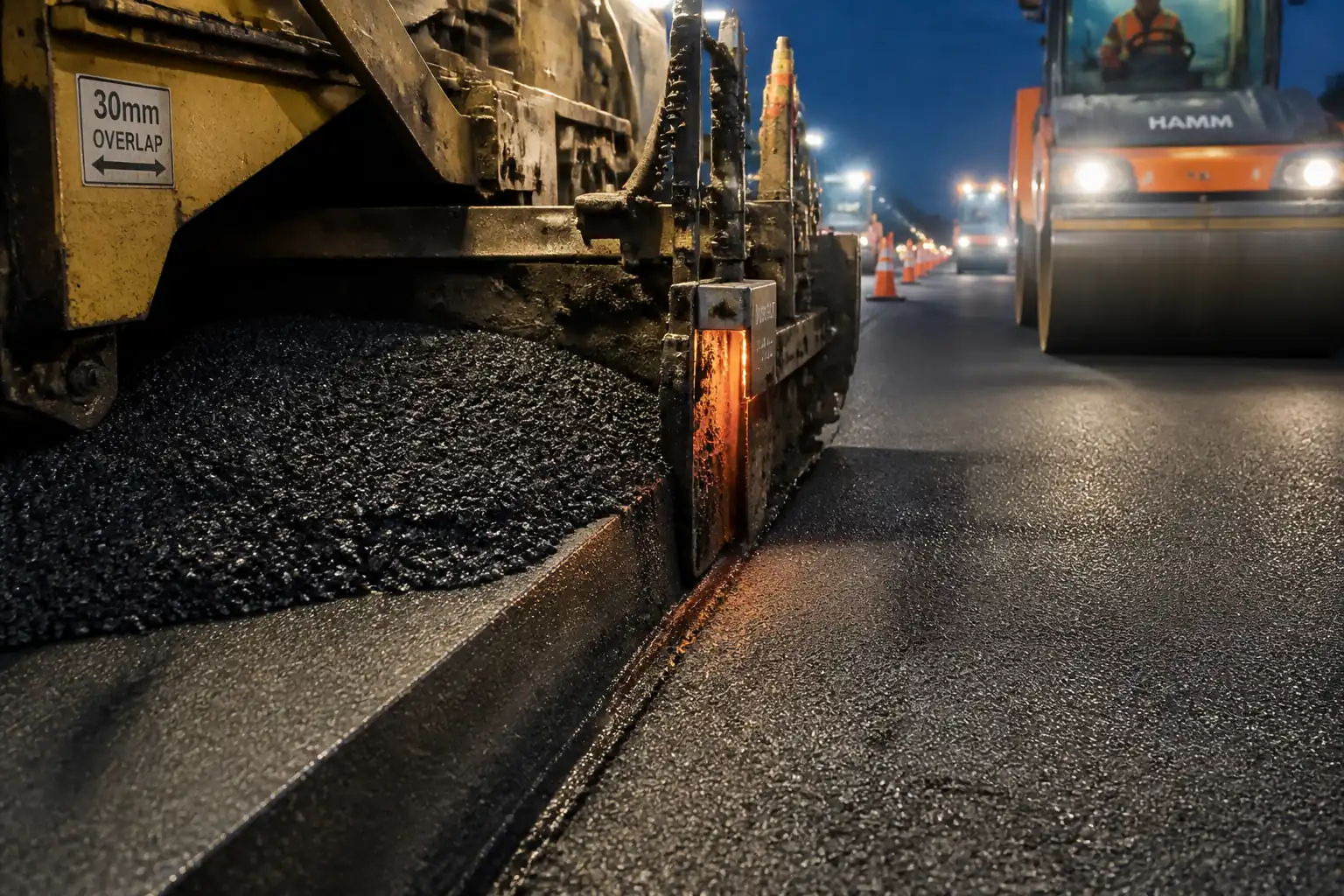
This method statement covers the supply, laying, and compaction of the final asphalt wearing course, including temperature-controlled delivery and placement, non-tracking tack application and truck management, precise paver operation with automatic grade/slope control, seamless longitudinal and transverse joints, steel-wheel and pneumatic-tyre rolling sequences, and post-construction verification of surface texture and riding quality using straightedge, texture tests, and inertial profilometer.
Extents
- Final wearing course for carriageways, ramps, shoulders, and tie-ins.
- Integration with existing asphalt at interfaces and structures (manholes, gullies, bridge joints) [Verify per drawings].
Exclusions
- Base and binder course construction (covered under separate methods).
- Major geometric corrections (>20 mm) prior to wearing course (to be completed before this activity).
Key Objectives
- Achieve target layer thickness and density with uniform texture.
- Construct tight, durable, low-permeability joints.
- Meet smoothness (IRI) and straightedge tolerances.
- Maintain strict thermal regime to avoid segregation, tenderness, flushing, or premature cooling.
References
| Document Type | Reference / Number | Revision | Notes |
|---|---|---|---|
| Standard | AASHTO R 35 / EN 13108-1, -5, -7 | ||
| Standard | AASHTO M 320 (PG) / EN 12591 (Penetration grade) [Verify] | ||
| Standard | AASHTO T 209 / ASTM D2041 | ||
| Standard | AASHTO T 166 (SSD) / AASHTO T 275 (Paraffin) [Verify] | ||
| Standard | AASHTO T 308 / ASTM D2172 & AASHTO T 30 | ||
| Standard | ASTM D3549 / Core thickness by AASHTO T 148 [Verify] | ||
| Standard | ASTM D2950 [Verify local approval] | ||
| Standard | ASTM E965 / EN 13036-1; or MPD by ASTM E1845 | ||
| Standard | BS EN 13036-7 / Project Spec [Verify] | ||
| Standard | ASTM E950 / AASHTO R 57 & R 54 [Profiler operation and acceptance] | ||
| Standard | ISO/IEC 17025 |
Responsibilities
| Role | Responsibility | Name / Party |
|---|---|---|
| Project Manager | Contractor | |
| Construction Manager / Paving Supervisor | Contractor | |
| Site Engineer / Surveyor | Contractor | |
| QA/QC Manager / Lab Technician | Contractor | |
| HSE Officer | Contractor | |
| Traffic Management Supervisor | Contractor | |
| Engineer/Employer’s Representative | Engineer |
Resources
| Resource Type | Description | Quantity | Remarks |
|---|---|---|---|
| Manpower | Paving supervisor, paver operator, two screed operators, two rake/lute hands | 1 crew | |
| Manpower | Roller foreman, 1 breakdown steel operator, 1 pneumatic operator, 1 finish steel operator | 1 crew | |
| Manpower | Site engineer/surveyor, QA/QC technician, sampler/core cutter | 2–3 |
Materials
| Material | Specification / Grade | Quantity | Remarks |
|---|---|---|---|
| HMA/SMA | EN 13108 / AASHTO R 35 | As per BOQ | Target air voids 3–5% [Verify] |
| Bitumen/PMB | AASHTO M 320 / EN 12591 | Per JMF | |
| Emulsion | Project Spec / Manufacturer | 0.25–0.45 kg/m2 residual binder [Verify] | Coverage rate adjusted to substrate |
| Bituminous adhesive | Project Spec / ASTM D6690 (analogy) [Verify] | As required | |
| Release agent | Manufacturer’s instructions | As required |
Equipment
| Equipment | Capacity / Type | Quantity | Inspection Required |
|---|---|---|---|
| Asphalt plant | ≥150 t/h [Verify] | 1 | Yes |
| MTV | ≥300 t storage [Verify] | 1 | Yes |
| Paver | ≥6 m width (extendable) | 1–2 | Yes |
| 8–12 t | 1 | Yes | |
| 25–30 t | 1 | Yes | |
| 8–12 t | 1 | Yes | |
| Emulsion sprayer | 1 | Yes | |
| QA suite | As required | Yes |
Prerequisites
Approvals and Documentation
- Approved Job Mix Formula (JMF), including target volumetrics (VMA, VFA, air voids) and compaction temperatures. [Verify per project specifications]
- Approved Method Statement, ITP, Traffic Management Plan (TMP), and HSE Risk Assessment.
- Asphalt plant calibration certificates (binder, aggregate feeders, scales, thermometers) within validity.
- Trial section completed and approved (if required) to confirm rolling pattern and density.
Site Readiness
- Underlying course: cleaned, sound, dry, and within level/smoothness tolerance; repair defects and isolate soft spots.
- Utilities and ironwork raised/set to finished levels or protected with removable plates.
- Weather: no precipitation; surface temperature ≥10°C and rising; wind <30 km/h; night-time dew risk assessed. [Verify per project specifications]
- Access/egress: haul route approved; segregation/temperature plan for haul time/distance.
Materials & Equipment
- Tack coat (non-tracking) delivered and confirmed compatible with substrate and mix.
- Release agents available; confirm diesel prohibition briefed to all.
- Paver grade/slope controls function test; skis/averaging beams installed as required.
- Rollers fueled, water systems functional (no leaks), scrapers/irrigation mats fitted.
- Calibrated thermometers/thermal camera available; data sheets and lot tags prepared.
Permits & Notices
- Work permits (hot work if applicable), night-work approval, noise permits. [Verify per project HSE plan and local regulations]
- Stakeholder notifications issued where required (residents, road authority).
Method Sequence
| Step | Activity | Description | Responsibility | Inspection / Hold Point |
|---|---|---|---|---|
| 1 | Pre-paving inspection and sign-off | Inspect substrate for cleanliness, dryness, defects; verify levels and crossfall; mark construction joints and tie-ins. | Site Engineer / QA | Hold point |
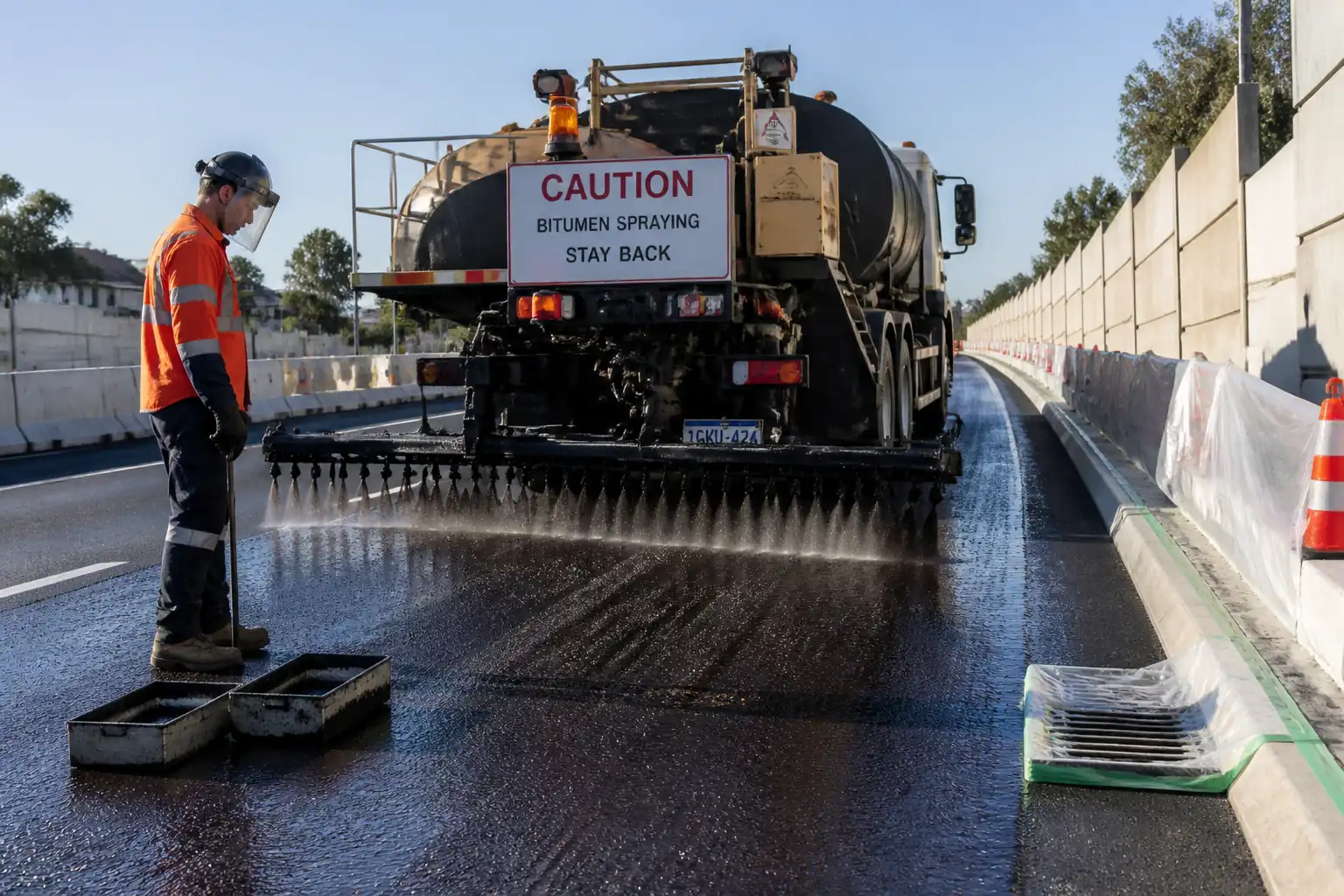
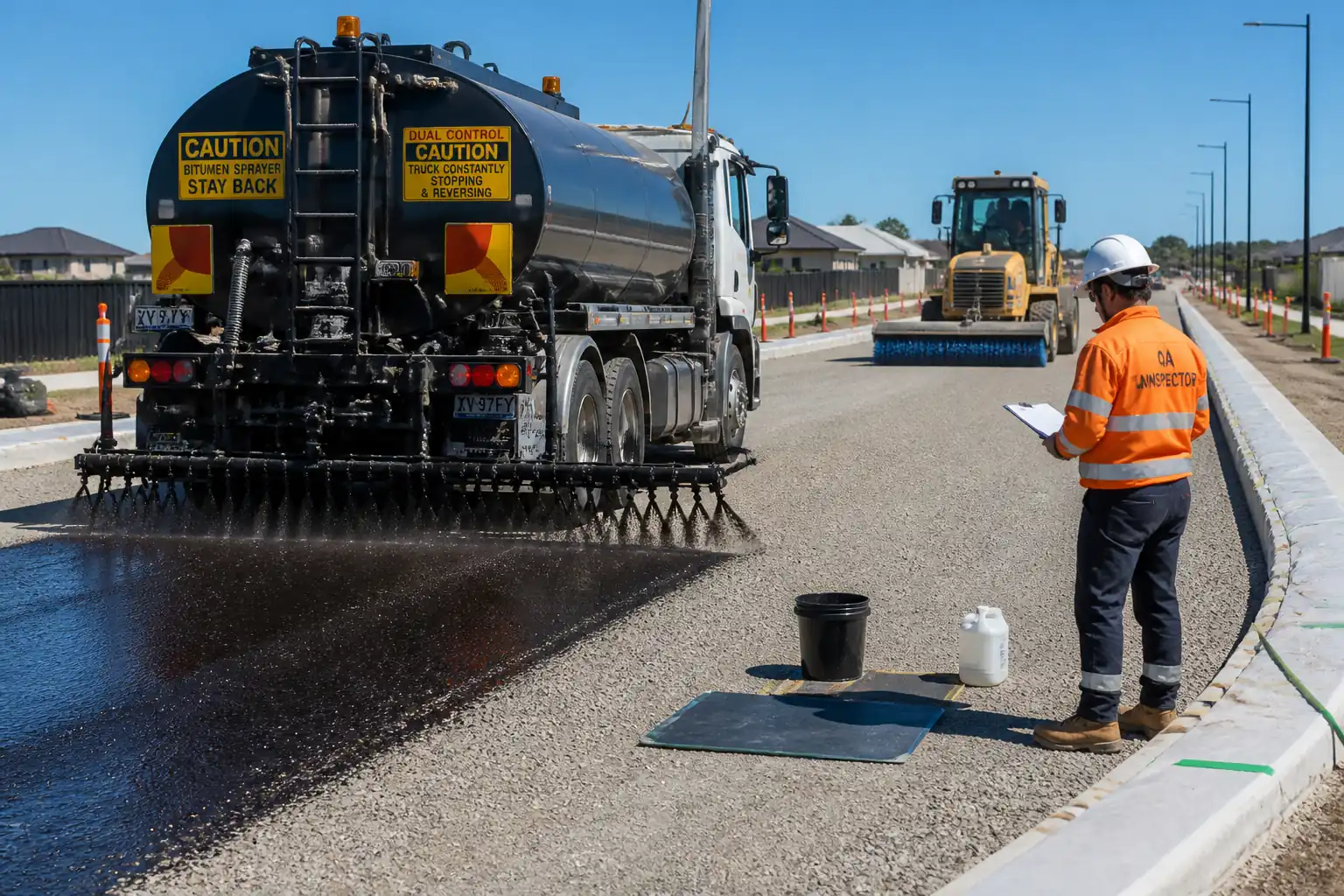
| 2 | Non-tracking tack application | Spray NT tack uniformly using calibrated sprayer; protect kerbs/drains. Restrict traffic on tacked areas to paver/MTV only; use truck paper at approach pad to prevent pickup. | Sprayer Operator / HSE | Witness |
| 3 | Plant production and dispatch | Produce mix per JMF; monitor temps and gradation/asphalt content. Insulated, tarped trucks; apply approved release agent only. | Plant Manager / QA Lab | Witness |
| 4 | Hauling and site delivery (non-tracking) | Stage trucks off tacked surface; use approach mats/paper. Sequence arrivals for continuous paving; no reversing onto mat; deliver via MTV where specified. | Logistics Lead | Surveillance |
| 5 | Paver setup and screed control | Set paving width, crown/crossfall, and automatic grade/slope control (averaging ski/sonic). Preheat screed; set auger height to maintain 1/3–1/2 auger covered; maintain constant head of material. | Paver Operator / Surveyor | Witness |
| 6 | Paving operation | Pave continuously at 3–6 m/min; minimize stops; avoid segregation by keeping augers half-covered and avoiding end-of-load dumping. Keep handwork minimal and only for edges/tie-ins. | Paving Supervisor | Surveillance |
| 7 | Longitudinal joint (hot to cold) | Trim cold edge to straight vertical; apply joint adhesive where specified. Overlap new mat 25–40 mm over cold edge; first roller pass straddles joint 150–200 mm. | Screed Operator / Roller Foreman | Witness |
| 8 | Transverse joint | Form stepped joint; square saw cut; heat joint face if cool; place sufficient overlap and compact starting off cold mat onto new mat. | Paving Supervisor | Hold/Witness |
| 9 | Compaction sequence – breakdown | Start steel vibratory breakdown immediately behind paver when mat 125–145°C [Verify]; 2–4 passes; frequency 45–60 Hz; amplitude low-to-medium; avoid stopping on mat; oscillation near structures if required. | Roller Foreman | Surveillance |
| 10 | Compaction sequence – intermediate (PTA) | Pneumatic-tyre roller with staggered passes; tyre pressure 550–700 kPa [Verify]; 4–8 passes depending on mix; prevent pick-up using water/soap as needed. | Roller Foreman | Surveillance |
| 11 | Compaction sequence – finish | Static steel finish rolling to remove marks and close texture; cease vibration <90°C [Verify]; no water ponding; correct minor blemishes. | Roller Foreman | Surveillance |
| 12 | In-place density and thickness | Lot-based testing by cores or nuclear gauge correlated to cores; one core per 500 m2 minimum or per 200 t [Verify]. | QA/QC Technician | Witness |
| 13 | Surface regularity and texture | 3 m straightedge in wheelpaths and lanes; texture by sand patch (MTD) or MPD; frequency 1 per 200 m per lane [Verify]. | QA/QC Technician | Witness |
| 14 | Ride quality (profilometer) | Survey lanes with inertial profiler after cooling; compute IRI per lane; identify corrective grinding/milling if required. | Specialist Subcontractor / QA | Witness |
| 15 | Opening to traffic | Allow to cool <50°C surface; remove TMP when authorized; clean site; reinstate ironwork and markings as scheduled. | Construction Manager | Hold point |
Health, Safety, and Environment (HSE) – Safety Controls
Principal Hazards and Controls
- Hazard: Hot asphalt, screed, and tack causing burns.
- Consequence: Serious burns, skin damage.
- Engineering/Procedural Control: Thermal barriers on paver; controlled access; use insulated tools; designate exclusion zone 2 m around screed; toolbox talk on burn management; eyewash and burn kit at paver.
- PPE: Heat-resistant gloves, long sleeves, flame-resistant high-vis, safety glasses/face shield, long pants, safety boots.
- Collective Measure: Barriers and spotters to keep non-essential personnel away.
-
Inspection/Permit: Pre-start equipment temperature and guarding check; hot-work permit if heating joints [Verify per project HSE plan and local regulations].
-
Hazard: Mobile plant interface (paver, MTV, rollers, trucks) and reversing movements.
- Consequence: Struck-by, runover, crush injury.
- Engineering/Procedural Control: One-way haul circuit; trained banksman with radio; flashing beacons and white noise reverse alarms; 5 m exclusion around rollers; no walking between roller drums/tyres; spotters at transverse joints.
- PPE: High-vis, steel-toe boots, hard hat.
- Collective Measure: Physical barriers/cones per TMP; lighting towers for night work arranged to avoid glare.
-
Inspection/Permit: Daily TMP inspection; plant pre-use checks; operator licenses verified.
-
Hazard: Bitumen fumes and asphalt vapors.
- Consequence: Respiratory/eye irritation, sensitization.
- Engineering/Procedural Control: Maintain recommended temperatures to minimize fumes; position crew upwind; avoid idling over mat; use fume extraction at paver if available.
- PPE: Safety glasses; disposable respirator (P2/P3) if exposure above limits [Verify per project HSE plan].
- Collective Measure: Rotate tasks to limit exposure duration.
-
Inspection/Permit: Air quality spot checks where required.
-
Hazard: Night work and reduced visibility.
- Consequence: Collisions, slips, trips.
- Engineering/Procedural Control: Task lighting ≥50 lux on work face [Verify]; glare-free arrangement; reflective garments (Class 3).
- PPE: High-vis Class 3, headlamp where needed.
- Collective Measure: Additional marshals; speed reduction in work zone.
-
Inspection/Permit: Night-work permit; lighting inspections.
-
Hazard: Hand-arm vibration and noise (rollers, saws).
- Consequence: HAVS, hearing loss.
- Engineering/Procedural Control: Maintain equipment; limit exposure time; low-vibration tools; damped handles.
- PPE: Hearing protection SNR ≥25 dB; anti-vibration gloves.
- Collective Measure: Job rotation; noise barriers if near receptors.
-
Inspection/Permit: HAV/NV assessments and noise monitoring where required.
-
Hazard: Burns during joint heating/cutting.
- Consequence: Fire, burns.
- Engineering/Procedural Control: Keep LPG cylinders upright with flashback arrestors; fire extinguisher CO2/ABC within 10 m; no heating near spillages.
- PPE: Face shield, heat gloves.
- Collective Measure: Designate hot-work area.
-
Inspection/Permit: Hot-work permit; equipment leak checks.
-
Hazard: Manual handling (lutes, plates, cores).
- Consequence: Strains, crush injuries.
- Engineering/Procedural Control: Use mechanical lifting for coring rigs and plates; team lift cores; keep posture training.
- PPE: Gloves, safety boots.
- Collective Measure: Use trolleys/handles.
-
Inspection/Permit: Manual handling assessment.
-
Hazard: Contact with traffic/public.
- Consequence: Collision and injury.
- Engineering/Procedural Control: TMP per authority; crash attenuator trucks; spotters at access points; clear signage and detours.
- PPE: High-vis PPE as per TMP.
- Collective Measure: Temporary barriers.
- Inspection/Permit: Road occupancy permit; TMP audits.
Environmental Controls
Key Environmental Risks and Mitigations
- Emulsion/tack and bitumen spills
- Impact: Soil/water contamination.
- Controls: Spill trays under sprayer; shutoff valves tested; spill kits at sprayer and paver; drain covers fitted before spraying; immediate granulate/absorbent and scrape recovery.
-
Inspection/Permit: Environmental permit conditions; pre-start spill checklist.
-
Odor and fumes
- Impact: Nuisance to receptors.
- Controls: Maintain mix temperatures within limits; schedule works avoiding temperature inversions/night in sensitive areas; community notification.
-
Inspection/Permit: Complaints log; adherence to local ordinances [Verify].
-
Noise and vibration
- Impact: Disturbance, structural risk near fragile assets.
- Controls: Use low-noise backup alarms; restrict vibrations near structures/utility covers; monitor if required.
-
Inspection/Permit: Noise/vibration monitoring plan.
-
Waste (cores, surplus asphalt)
- Impact: Resource loss, improper disposal.
- Controls: Return excess hot mix to plant; cool and recycle per plant protocol; dispose of cores as inert waste or return for lab.
-
Inspection/Permit: Waste transfer notes.
-
Dust and cleanliness
- Impact: Air quality, skid risk.
- Controls: Sweep substrate before tack; clean haul routes daily; no dry cutting without dust suppression.
-
Inspection/Permit: Street cleanliness logs.
-
Water protection
- Impact: Polluted runoff to drains/waterways.
- Controls: Block gully pots; avoid paving during rain; capture washdown water for proper disposal.
- Inspection/Permit: Drain protection inspection.
Quality Assurance and Quality Control (QA/QC)
Lotting and Sampling
- Define lots by lane, day’s production, or 200–400 t segments [Verify]. Sub-lots for density/air voids per ITP.
- Sampling frequencies:
- Asphalt content/gradation: 1 per 400 t minimum [Verify].
- Gmm (T 209): Once per mix per shift; more if aggregate/binder changes.
- Cores for density/thickness: 1 per 500 m2 or 3 per lot minimum [Verify].
- Surface texture: 1 per 200 m per lane; additional at suspect areas.
- Straightedge: Continuous checks every 25 m and at joints.
- IRI: Each lane after cooling and sweeping.
Acceptance Metrics
- Density: 92–97% of Gmm (or per spec). Joint density within 2% of mat density.
- Thickness: Target per drawings; tolerance ±5 mm unless noted otherwise.
- Temperature: Plant discharge 150–175°C; behind screed 130–160°C; begin rolling 125–145°C; cease vibration <90°C; maximum mix temperature 185°C to limit binder aging [All Verify].
- Texture: MTD 0.5–0.8 mm for dense AC; SMA per JMF/authority [Verify].
- Smoothness: IRI ≤1.5 m/km mainline; ≤2.0 m/km ramps/urban [Verify]. Straightedge ≤3 mm in 3 m.
Controls and Records
- Daily paver/roller setup sheet; thermal logs (every truck + behind screed every 15 min).
- Calibration records for sprayer, thermometers, nuclear gauge, profiler.
- Non-conformance and corrective action records for any failed lots; rework method (additional rolling, heating joint, mill/replace, diamond grind where allowed).
- Hold/Witness Points: Pre-pave substrate sign-off (Hold); first 50 m test strip (Witness/Hold if trial required); opening to traffic (Hold).
Attachments
- Approved Job Mix Formula (JMF) and plant calibration certificates
- Pre-paving inspection checklist and photos
- Thermal monitoring log and templates
- Roller pattern sheet and compaction temperature window chart
- Tack coat spray rate calibration and daily spray logs
- Density, thickness, gradation, asphalt content test reports
- Straightedge and texture test records
- Inertial profiler certification and IRI reports
- Traffic Management Plan and approved permits
- HSE Risk Assessment, toolbox talk records, and emergency response plan
This content is a read-only public reference. Download or customize to get an editable version.
ITP preview
The first inspection activities from the linked ITP for Method Statement: Laying and Compaction of Final Asphalt Wearing Course:
| Activity | Inspection / Test | Acceptance Criteria | Responsibility | Record |
|---|---|---|---|---|
| Substrate pre-paving inspection | Visual, straightedge checks | Clean, dry, defect-free, within level tolerance [Verify] | Site Engineer / QA / Engineer | Pre-pave checklist, photos |
| Tack coat application | Spray rate trays; uniformity check | Residual 0.25–0.45 kg/m2; no tracking/pooling [Verify] | QA/QC Technician / Engineer (Witness) | Spray log, tray test forms |
| Mix temperature at plant and delivery | Probe thermometer + IR gun | Discharge 150–175°C; delivery ≥140–165°C [Verify] | Plant QA / Site QA | Temp logs, tickets |
Showing 3 of 14 inspection activities. View full ITP →
Related Inspection and Test Plan
An Inspection and Test Plan (ITP) is available for Method Statement: Laying and Compaction of Final Asphalt Wearing Course. The ITP defines the inspection activities, acceptance criteria, hold and witness points, responsible parties, and records required to verify the work described in this method statement.
View the Method Statement: Laying and Compaction of Final Asphalt Wearing Course ITP →Frequently asked questions
Continue with related Quollnet resources connected to this method statement.