
Method Statement – Application of Bituminous Tack Coat Between Asphalt Layers – Method Statement
AI-assisted method statement with matching ITP, PDF download, and Excel export.
More than a static template
Unlike a downloadable Word or PDF template, this method statement is an AI-assisted editable starting point connected directly to a matching Inspection and Test Plan. Every section is structured, project-adaptable, and ready to export.
- AI-assisted drafting — Customize every section with AI for your specific project scope.
- Linked ITP — A matching inspection and test plan is generated alongside the method statement.
- Multiple export formats — Download as a formatted PDF or editable Excel spreadsheet.
- Editable starting point, not a final document — Review, verify, and adjust all content against your project requirements before use.
Static template vs. Quollnet workflow
| Feature | Static template | Quollnet |
|---|---|---|
| Project-specific content | Manual fill-in required | AI-assisted customization |
| Linked ITP | Separate document, no link | Matching ITP included |
| Export formats | Usually PDF only | PDF and Excel |
| Structured sections | Free-form layout | 13 standardized sections |
| Saved to your account | Local file only | Cloud-saved, reusable |
| Content accuracy | You verify everything | AI-assisted, you still verify |
| Cost | Often free but time-intensive | Free to customize and download |
What you can customize
When you save this method statement to your account, every section becomes editable. The following 13 sections are included:
- Scope — Defines the activity and its boundaries.
- References — Standards, specifications, and drawings.
- Responsibilities — Roles and accountabilities.
- Resources — Labour, plant, and equipment summary.
- Materials — Materials and compliance requirements.
- Equipment — Tools and equipment details.
- Prerequisites — Hold points and pre-conditions.
- Method sequence — Step-by-step construction sequence.
- Safety controls — HSE risk controls and PPE.
- Environmental controls — Environmental mitigation measures.
- QA/QC — Quality inspection and test requirements.
- ITP — Inspection and Test Plan table (has its own page).
- Attachments — Referenced drawings and documentation.
Why this method statement is used
This method statement is used to define and communicate the approved procedure for carrying out method statement – application of bituminous tack coat between asphalt layers on site. It ensures the work is planned in advance, the correct resources and controls are in place, and all personnel understand responsibilities, sequence, quality requirements, and safety controls before work begins. It aligns site execution with the documented scope and acceptance expectations.
Who uses this method statement
This method statement is used by contractors, site supervisors, project engineers, QA/QC engineers, HSE officers, consultants, and client representatives. It serves as a shared reference for planning, execution, supervision, inspection, and approval of the activity on site.
When it is prepared and submitted
The method statement is prepared before the work activity starts and submitted as part of the pre-construction documentation package for review and approval.
Who reviews or approves it
The method statement is usually submitted to the client representative, consultant, resident engineer, or project management consultant for review and approval before the work commences.
Important approval note
This method statement is an AI-assisted editable starting point, not a pre-approved document. Before use on any project, all content must be reviewed and approved by the relevant parties (superintendent, principal contractor, or client representative) in accordance with your contract and project quality plan.
For example: if your specification requires a departure from a referenced standard, that departure must be documented and approved separately — this method statement will not capture that automatically. Always verify against your applicable drawings, specifications, and regulatory requirements.
Method statement content
Scope
Purpose
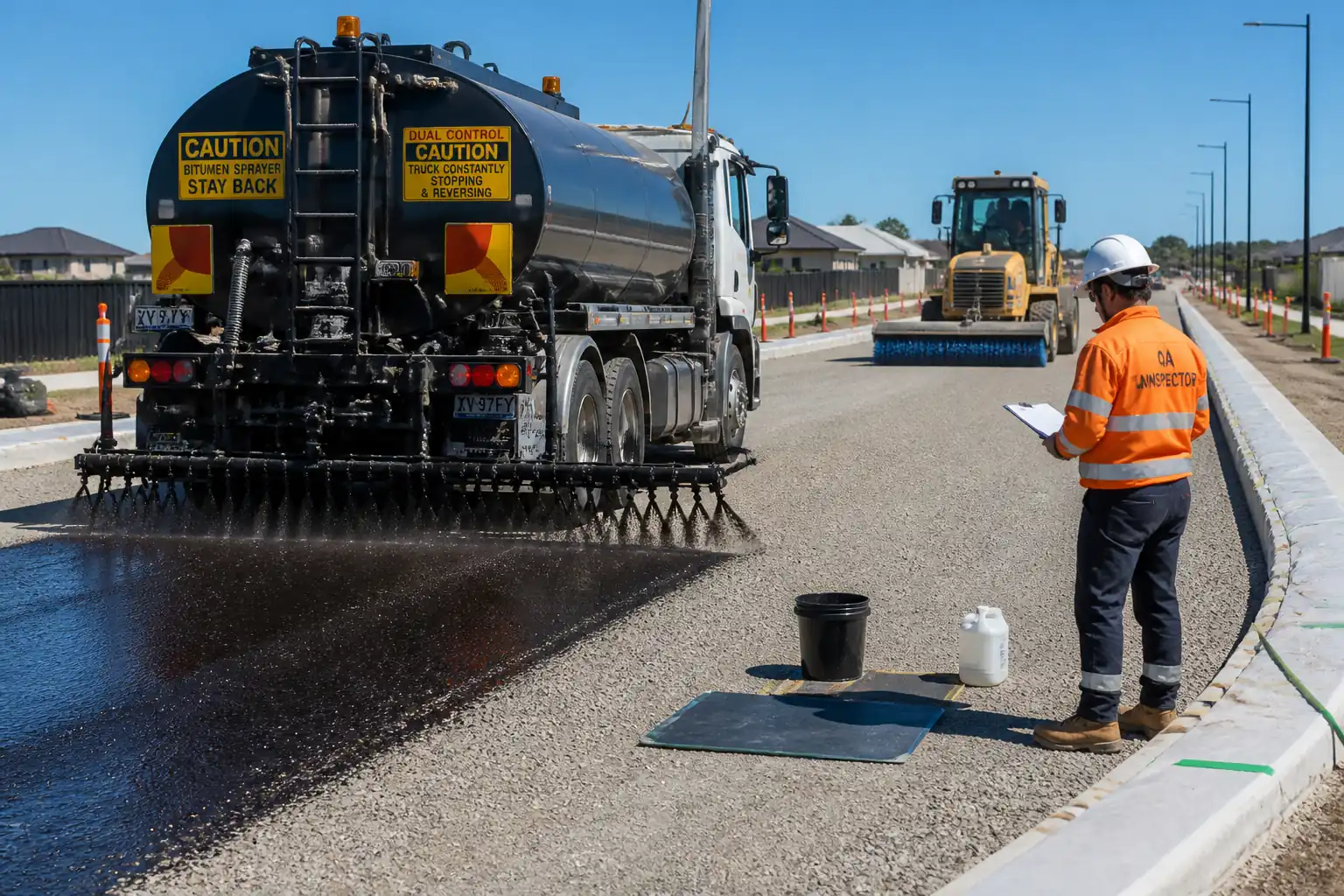
This method statement defines the requirements and procedures for the supply, preparation, calibrated application, inspection, and curing of bituminous tack coat between existing or newly laid asphalt layers to ensure adequate interlayer bond, prevent slippage, and minimize tracking by construction vehicles.
Applicability
- Interlayer bonding between: existing asphalt, milled asphalt surfaces, newly placed dense/ SMA/ open-graded asphalt layers, and asphalt over concrete (where specified).
- Emulsified bitumen tack coats including standard and polymer-modified grades. Dilution only where permitted.
Key Objectives
- Achieve the specified residual binder application rate with transverse and longitudinal uniformity.
- Ensure clean, dry (or surface-dry) substrate free of dust/debris.
- Prevent overspray, drain contamination, and tracking by site traffic.
- Commence overlay only after proper emulsion break/curing is achieved.
References
| Document Type | Reference / Number | Revision | Notes |
|---|---|---|---|
| Standard | ASTM D2397/D2397M | For emulsion grade compliance. [Verify per project specifications] | |
| Standard | ASTM D977 | Applicable if anionic emulsions are specified. [Verify] | |
| Standard | ASTM D244 / AASHTO T59 | For supplier COA and verification testing. | |
| Standard | ASTM D2995 | Primary field check for spray rate and transverse uniformity. | |
| Standard | BS EN 13808 | For European projects or where specified. | |
| Standard | AASHTO M140 / M208 | Where AASHTO material specifications govern. | |
| Standard | BS EN 13036-1 | Optional; used to correlate texture depth to rate selection. | |
| Contract | Values marked [Verify per project specifications] to be confirmed. |
Responsibilities
| Role | Responsibility | Name / Party |
|---|---|---|
| PM | Ensure compliance with contract and standards; approve method/ITP; allocate resources. | Contractor |
| SE | Confirm surface readiness, weather, rates, and edge controls; coordinate with paving team. | Contractor |
| QA/QC | Witness tray tests, verify materials COA, maintain records, raise NCRs if needed. | Contractor |
| HSE | Ensure TTM, hot material handling, spill control, and PPE compliance. | Contractor |
| Operator | Perform start-up checks, tray tests, and maintain uniform application. | Contractor |
| TMS | Deploy signage, cones, spotters; control access to prevent tracking. | Contractor |
| Engineer | Review key stages (surface prep, first application, rate verification). | Client/Engineer |
Resources
| Resource Type | Description | Quantity | Remarks |
|---|---|---|---|
| Manpower | Distributor operator, nozzleman/spotter, broom/vacuum operator, flaggers, QC tech, HSE rep. | 6–10 | |
| Lab | Sampling, emulsion verification, density/viscosity if requested. | As required |
Materials
| Material | Specification / Grade | Quantity | Remarks |
|---|---|---|---|
| Emulsion | |||
| Water | |||
| Paper/Boards | |||
| Sand |
Equipment
| Equipment | Capacity / Type | Quantity | Inspection Required |
|---|---|---|---|
| Distributor | 6,000–12,000 L | 1–2 | Yes |
| Lance | 1 | Yes | |
| Broom/Vac | 1 | Yes | |
| Air Blower | 1–2 | Yes | |
| QC Kit | 1 set | Yes | |
| TTM | As required | Yes |
Prerequisites
- Approved method statement and ITP on file.
- Emulsion supplier COA compliant with ASTM D2397/AASHTO M208 or EN 13808 as applicable.
- Distributor calibration certificate current (≤6 months) and on-site verification per ASTM D2995 prior to production.
- Approved Traffic and Pedestrian Management Plan with permits [Verify per project HSE plan and local regulations].
- Confirm weather: no rain imminent, wind below threshold to prevent drift [Verify], air and surface temperatures within specification (typical minimum 10°C and rising; ≥5°C for some products) [Verify per project specifications].
- Surface repairs complete; utilities/ironmongery identified and protected.
- Toolbox talk covering hot material handling, spray drift control, tracking avoidance, and spill response.
- Communications established between distributor operator, QC, and paving crew (radio/hand signals).
Method Sequence
| Step | Activity | Description | Responsibility | Inspection / Hold Point |
|---|---|---|---|---|
| 1 | Surface Inspection and Cleaning | Inspect substrate for soundness, dryness, and cleanliness. Mechanically sweep and vacuum. Blow off edges/joints with compressed air. Remove oil spots with approved detergent and rinse/dry. | Site Engineer, Broom Operator | Visual; hand swipe for dust |
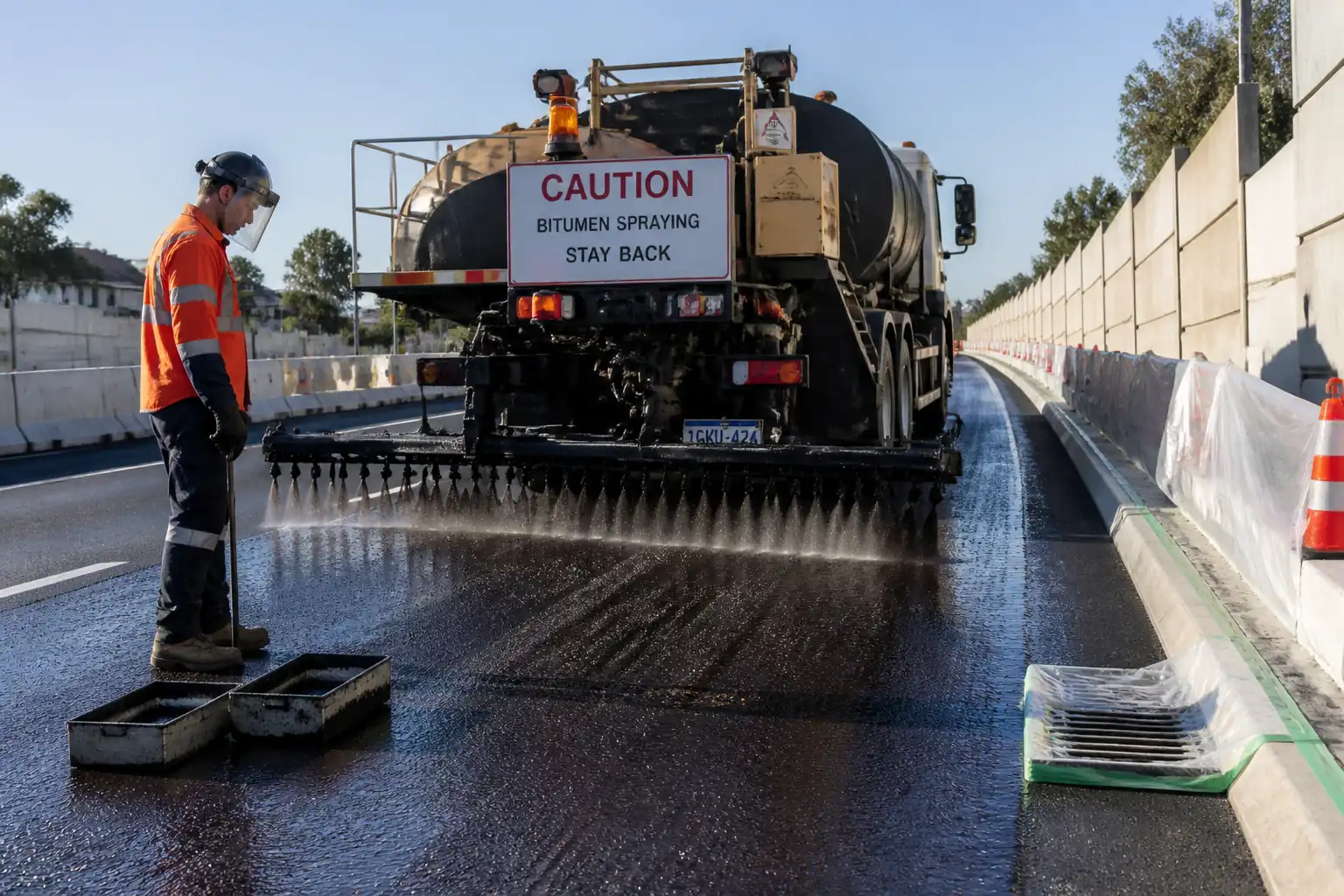
| 2 | Protection/Masking | Mask kerbs, barriers, bridge joints, ironwork; shield drainage inlets; place drip trays under valves. Paper start/stop sheets laid at beginning/end of spray run. | Site Engineer, Crew | Visual |
| 3 | Material Verification and Dilution Check | Check emulsion grade, temp, and batch. Confirm no dilution unless approved. If dilution is allowed, mix using potable water at controlled ratio (typ. ≤1:1 by volume) with gentle circulation—no overheating; record start/end volumes and temperature. | QA/QC, Operator | COA review; temp check |
| 4 | Distributor Setup and Bar Calibration | Set nozzle type/angle (typically 15–30°), spacing, and bar height to achieve triple overlap; set pressure and travel speed for target rate. Check for clogged or worn nozzles. Verify cut-off and end caps for edge control. | Operator, QA/QC | Static spray test onto paper; visual fan check |
| 5 | Trial Spray and Rate Verification | Conduct a short (≥20 m) trial pass and perform tray/pan tests across the full bar width (≥3 trays, including edges). Weigh trays before/after to compute L/m². Adjust pressure/speed/nozzle as needed and repeat until within tolerance. | Operator, QA/QC | Witness by QA/QC; Engineer if hold point |
| 6 | Production Spraying | Spray full width in continuous passes. Maintain constant speed/pressure. Use paper at starts/stops. Keep exclusion zone to prevent traffic tracking. Hand lance tight areas and around ironmongery. | Operator, TTM Supervisor | Continuous supervision |
| 7 | Edge Spray Adjustments | At pavement edges and longitudinal joints use end caps/reduced flow nozzles; adjust bar overlap to avoid overspray. Use hand lance with shields for tie-ins and around structures; avoid application on kerbs/drains. | Operator | Visual |
| 8 | Curing/Break Monitoring | After application, allow emulsion to break. Monitor color change and perform light finger-touch test (tacky, not wet). Measure break time under prevailing weather conditions. | Site Engineer, QA/QC | Visual and tactile checks |
| 9 | Tracking Avoidance | Maintain exclusion until break. Only the paver and essential delivery trucks may enter. Use designated haul routes; install geotextile tracking mats or sand lightly at isolated wet spots if necessary (Engineer approval). Clean any tracked areas; re-tack if contaminated. | TTM Supervisor, Site Engineer | Patrol checks |
| 10 | Pre-Paving Acceptance | Final check of uniformity, protection removed where safe, drains uncovered. Confirm rate records, weather, and break time within limits. Issue clearance to pave. | QA/QC, Engineer | Joint inspection |
Health, Safety and Environment – Safety Controls
Key Task-Specific Hazards and Controls
1) Hazard: Contact with hot emulsified bitumen (50–70°C)
- Likely consequence: Thermal burns to skin/eyes.
- Engineering/procedural control: Maintain tank temp within supplier limits; use guarded hoses; test lance shutoff; keep exclusion zones; no standing on spray bar.
- Required PPE: Heat-resistant gloves, long sleeves, chemical splash goggles/face shield, long pants, safety boots.
- Collective preventive measure: Barriers and spotters to keep crew clear of spray area; emergency eyewash/water nearby.
- Inspection/permit/supervision: Daily pre-start equipment checks; HSE supervision; hot-material handling briefing.
2) Hazard: Pressurized spray system failure/leak
- Likely consequence: Fluid injection injury, burns, slips.
- Engineering/procedural control: Inspect hoses/nozzles; relief valves operative; depressurize before maintenance; use drip trays.
- PPE: Gloves, goggles/face shield, protective clothing.
- Collective measure: Lock-out/isolate during maintenance.
- Inspection/permit/supervision: Pre-start inspection log; supervisor authorization for interventions.
3) Hazard: Vehicle/plant-strike (distributor, trucks, broom)
- Likely consequence: Serious injury/fatality.
- Engineering/procedural control: Approved TTM, segregated pedestrian routes, banksman for reversing, amber beacons, alarms.
- PPE: Hi-vis, safety boots, helmet.
- Collective measure: Cones/barriers, speed limits, one-way flow.
- Inspection/permit/supervision: TTM inspection per shift; competent banksman; work permit near live traffic [Verify per project HSE plan and local regulations].
4) Hazard: Slips and falls on freshly tacked surface
- Likely consequence: Sprains/fractures, contamination.
- Engineering/procedural control: Exclusion until break; clear walkways; use access boards.
- PPE: Slip-resistant boots.
- Collective measure: Barricade and signage.
- Inspection/permit/supervision: Area checks by TMS; HSE walkdowns.
5) Hazard: Spray drift to bystanders/traffic due to wind
- Likely consequence: Property damage, accidents.
- Engineering/procedural control: Set wind threshold; use shields; postpone if exceeded.
- PPE: As above plus eye protection.
- Collective measure: Windbreak screens; relocate discharge direction.
- Inspection/permit/supervision: Weather monitoring log; supervisor authorization to proceed.
6) Hazard: Manual handling of trays/boards and masking
- Likely consequence: Strains, cuts.
- Engineering/procedural control: Team lifting; use lightweight trays; good housekeeping.
- PPE: Work gloves, safety boots.
- Collective measure: Mechanical aids where possible.
- Inspection/permit/supervision: Manual handling training; spot checks.
7) Hazard: Night works/poor visibility
- Likely consequence: Collisions, missed defects.
- Engineering/procedural control: Task lighting to 50–100 lux at workface [Verify]; reflective PPE; illuminated signs.
- PPE: Class 3 hi-vis.
- Collective measure: Light towers positioned to avoid glare.
- Inspection/permit/supervision: Lighting inspection; TTM audit.
8) Hazard: Chemical exposure during cleaning/spill response
- Likely consequence: Dermatitis, eye irritation.
- Engineering/procedural control: Use approved detergents/solvents; SDS available; avoid atomizing sprays.
- PPE: Chemical gloves, goggles.
- Collective measure: Spill kits and containment booms readily available.
- Inspection/permit/supervision: SDS briefed; spill drills; HSE oversight.
Environmental Controls
- Drain and Watercourse Protection: Cover and tape drainage inlets; maintain spill kits and absorbents; no discharge of emulsion or wash water to drains. Remove covers only after area is clean and tack has broken.
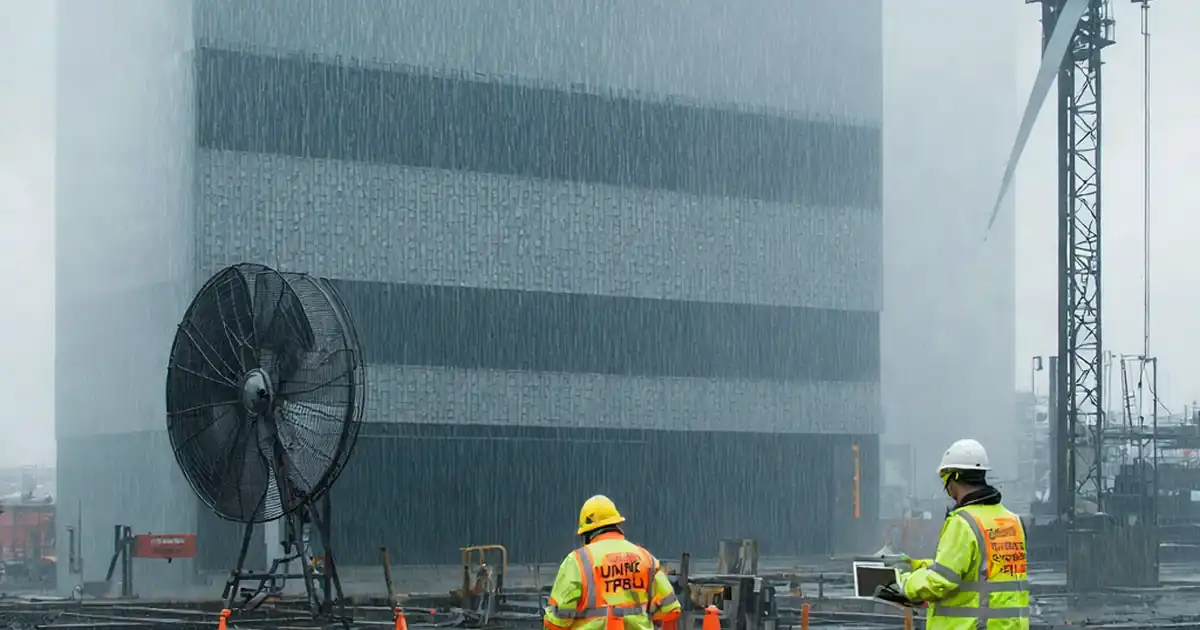
- Weather Constraints: Do not spray if rain is imminent or wind causes drift beyond work zone. Monitor and record wind speed, air and surface temperatures.
- Material Storage: Store emulsions in clean, labeled tanks; prevent cross-contamination; secondary containment sized ≥110% of tank volume [Verify per local regulations].
- Spill Response: Stop source, contain with absorbent; recover using scrapers/absorbents; dispose of wastes via licensed handler; record incident.
- Waste Management: Collect masking papers/boards and contaminated materials; segregate hazardous waste; keep tray washings out of soil/drains.
- Noise and Dust: Operate brooms/vacuums within permitted hours; fit mufflers and dust suppression where needed.
- Resource Efficiency: Optimize spray passes; avoid over-application; return unused emulsion to insulated tank; no on-ground disposal.
- Nuisance Prevention: Clean any tracked material from public roads immediately; notify stakeholders for night works as required.
Quality Assurance and Quality Control
Targets and Typical Ranges [Verify per project specifications]
- Residual binder application rate (guidance):
- New dense asphalt: 0.20–0.35 kg/m² residual (≈0.30–0.55 L/m² of 60–70% residual emulsion).
- Milled/rough or porous surface: 0.30–0.55 kg/m² residual (≈0.50–0.90 L/m² of 60–70% residual emulsion).
- Concrete surfaces (if permitted): 0.35–0.60 kg/m² residual (≈0.55–1.00 L/m² of 60–70% emulsion).
Measurement and Tolerances
- Application rate tolerance: Average within ±10% of target; any single transverse point within ±15% (ASTM D2995 methodology).
- Temperature tolerance: Within supplier recommended spray range, typically 50–70°C for CSS-1h [Verify].
- Uniformity: No streaking, missed areas, or ponding; edges neat without overspray.
Testing and Frequency
- Material COA review: Each delivery batch.
- Distributor on-site verification (tray tests): At start of shift, after adjustments, and at least once per 1,000 m² or once per lane-km, and at rate/width changes [Verify]. Minimum 3 trays across width per check.
- Weather/temperature logging: Hourly or when conditions change.
- Break time logging: Each distinct section or environmental change.
Records
- Material certificates, delivery tickets, dilution logs, distributor calibration, tray test worksheets, weather logs, break time logs, IR/ITP checklists, photos, NCRs and corrective actions.
Nonconformance and Corrective Action
- If rate below tolerance or streaking observed: Adjust pressure/speed/nozzles; re-spray deficient areas. If over-application with pooling: Blot lightly with fine sand (Engineer approval) and adjust settings. If contamination/tracking occurs: Clean affected areas and re-tack prior to paving.
Attachments
- Sample Tray Test Worksheet (ASTM D2995 method, with mass/area calculations)
- Daily Tack Coat Log (weather, temperatures, batch numbers, settings, break times)
- Distributor Pre-Start/Calibration Checklist
- Traffic Management Layout Drawing(s)
- SDS for Emulsified Bitumen and Cleaning Agents
- Spill Response Plan and Contact List
- Manufacturer’s Product Data Sheets and Temperature Guidelines
- Example Photos: acceptable vs. unacceptable spray patterns
This content is a read-only public reference. Download or customize to get an editable version.
ITP preview
The first inspection activities from the linked ITP for Method Statement – Application of Bituminous Tack Coat Between Asphalt Layers:
| Activity | Inspection / Test | Acceptance Criteria | Responsibility | Record |
|---|---|---|---|---|
| Material delivery and COA review | COA vs ASTM D2397/AASHTO M208 or EN 13808 | Conforms to specified grade; residue, viscosity, storage stability within supplier/spec limits. | QA/QC Engineer | COA, Delivery Ticket |
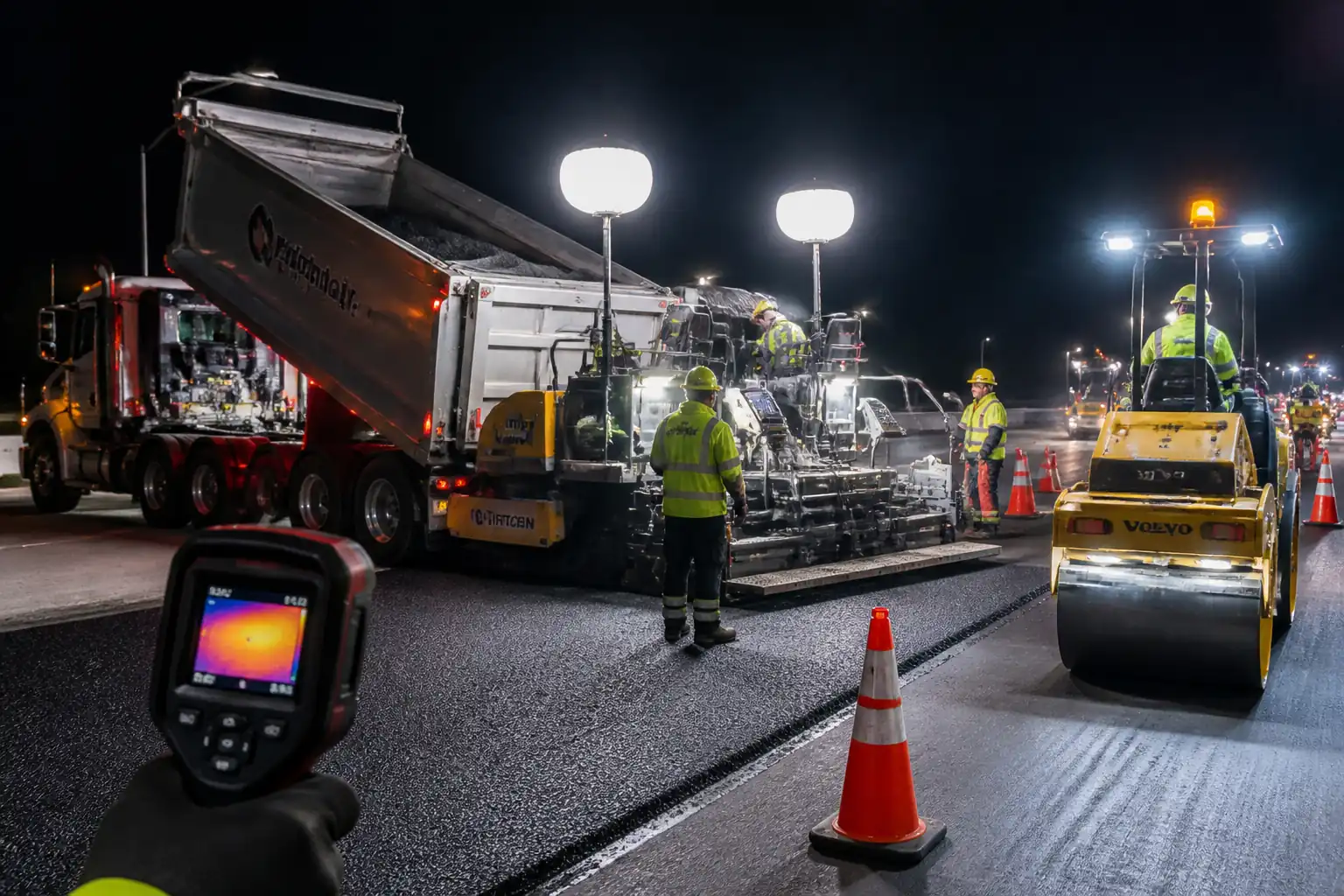
| Emulsion temperature at point of spray | Thermometer/IR gun | Within supplier recommended range (typ. 50–70°C) [Verify]. | Operator / QA/QC | Daily Log |
| Surface cleanliness and dryness | N/A | Dust-free, no free water, no debris or oil contamination. | Site Engineer / QA/QC | IR/Checklist |
Showing 3 of 10 inspection activities. View full ITP →
Related Inspection and Test Plan
An Inspection and Test Plan (ITP) is available for Method Statement – Application of Bituminous Tack Coat Between Asphalt Layers. The ITP defines the inspection activities, acceptance criteria, hold and witness points, responsible parties, and records required to verify the work described in this method statement.
View the Method Statement – Application of Bituminous Tack Coat Between Asphalt Layers ITP →Frequently asked questions
Continue with related Quollnet resources connected to this method statement.