Method Statement
Method Statement: Bituminous Prime Coat on Prepared Aggregate Base Courses
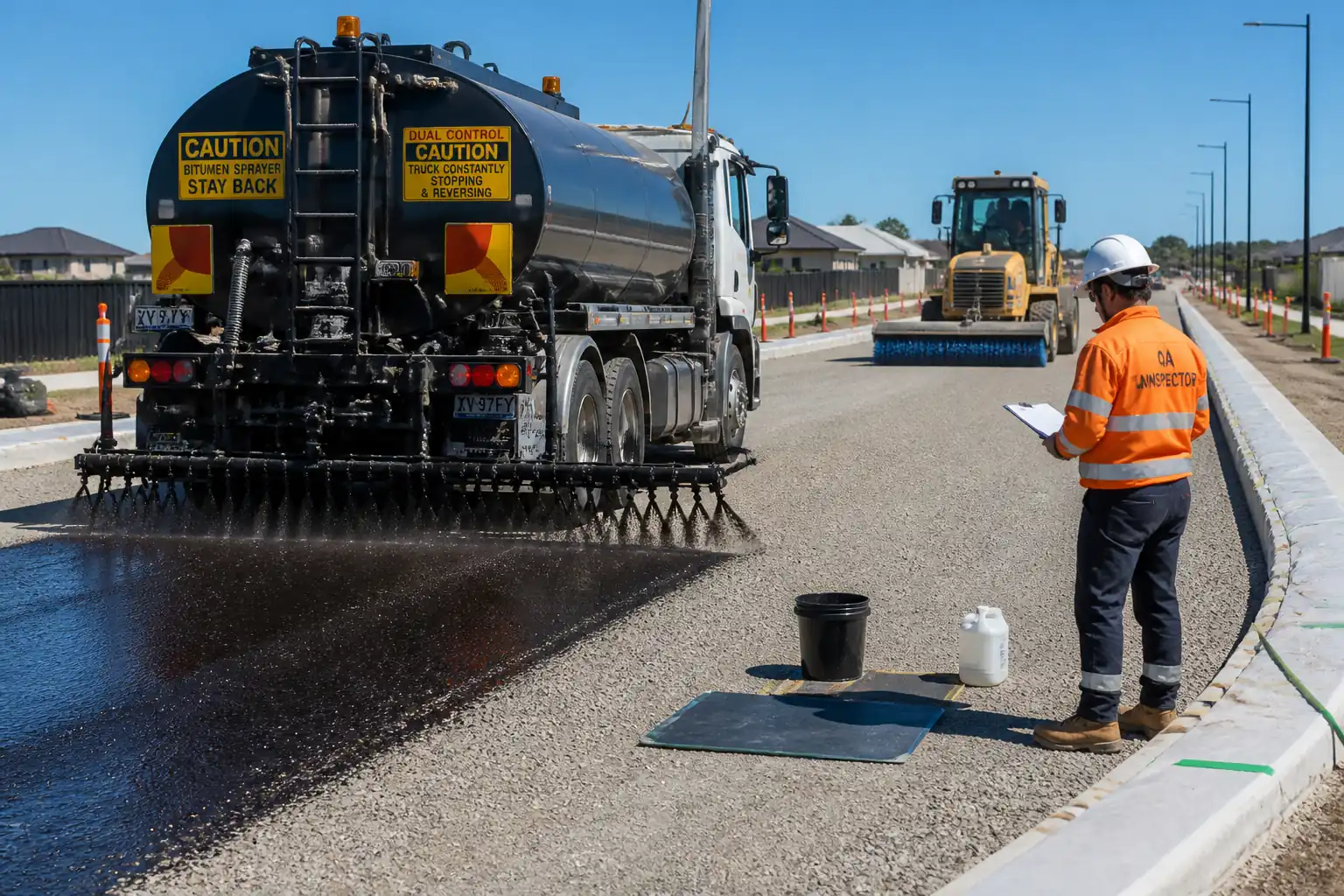
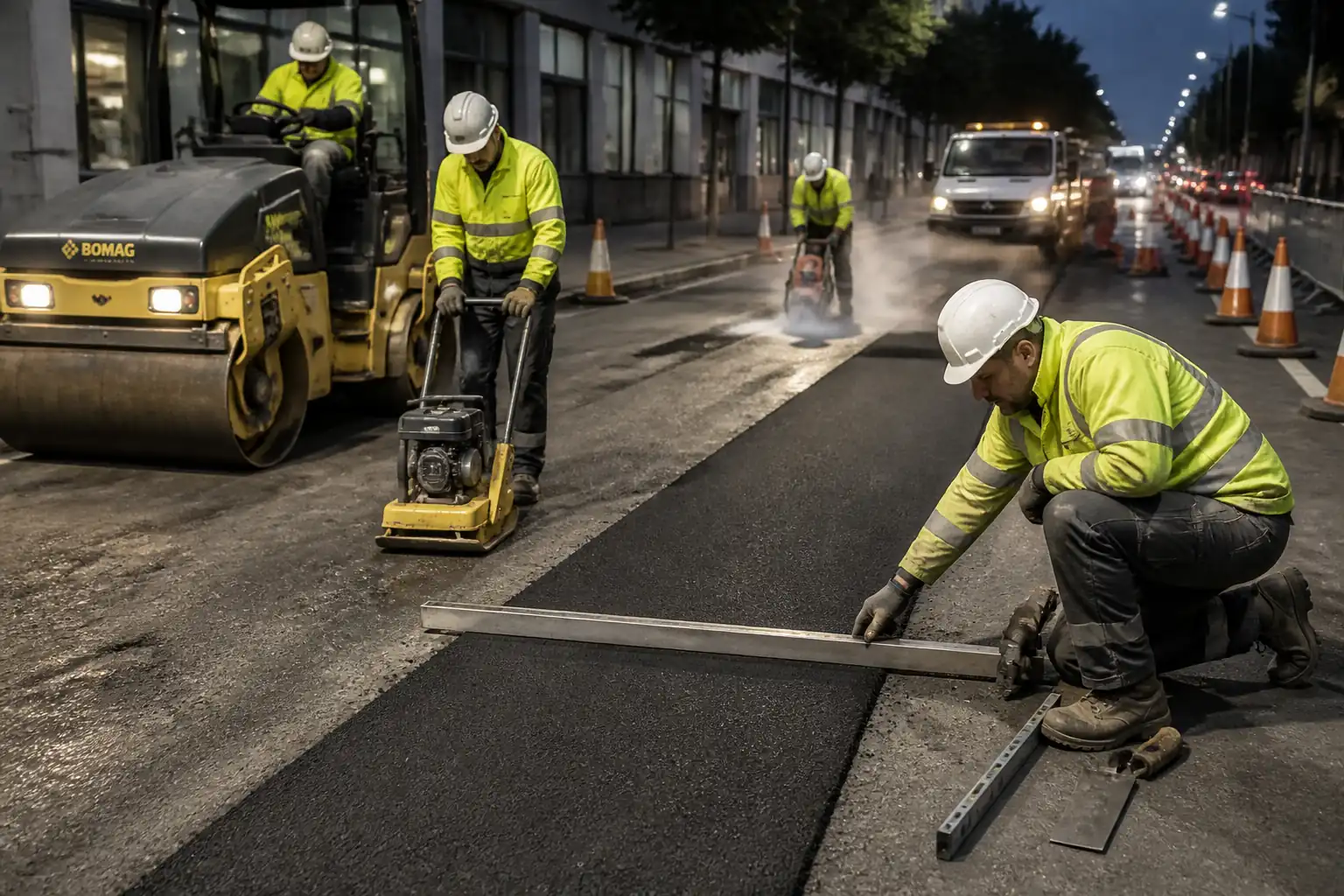
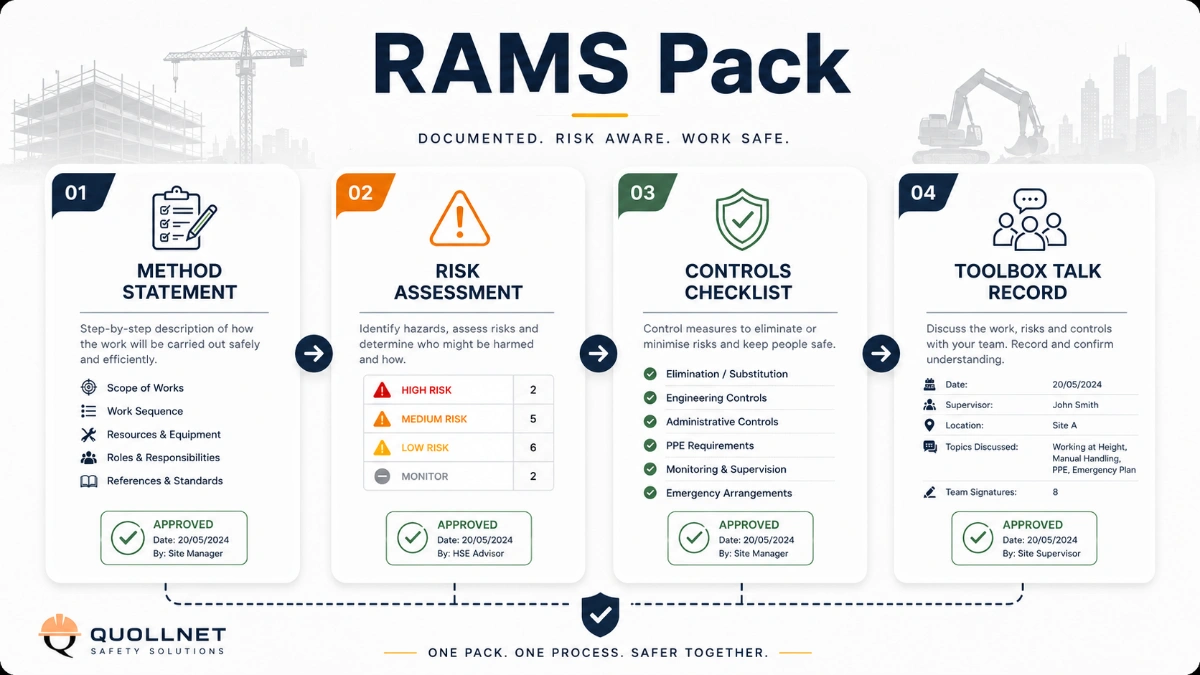
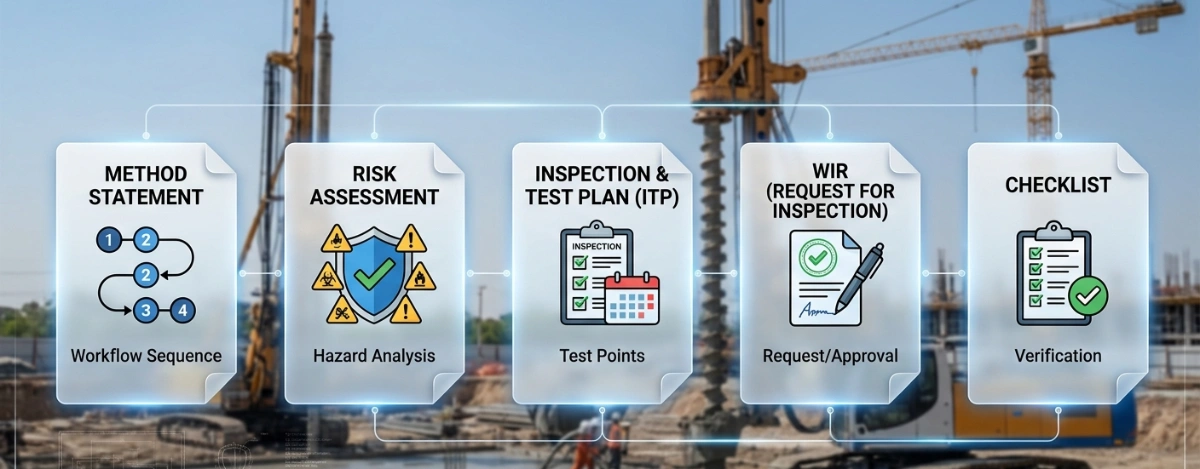
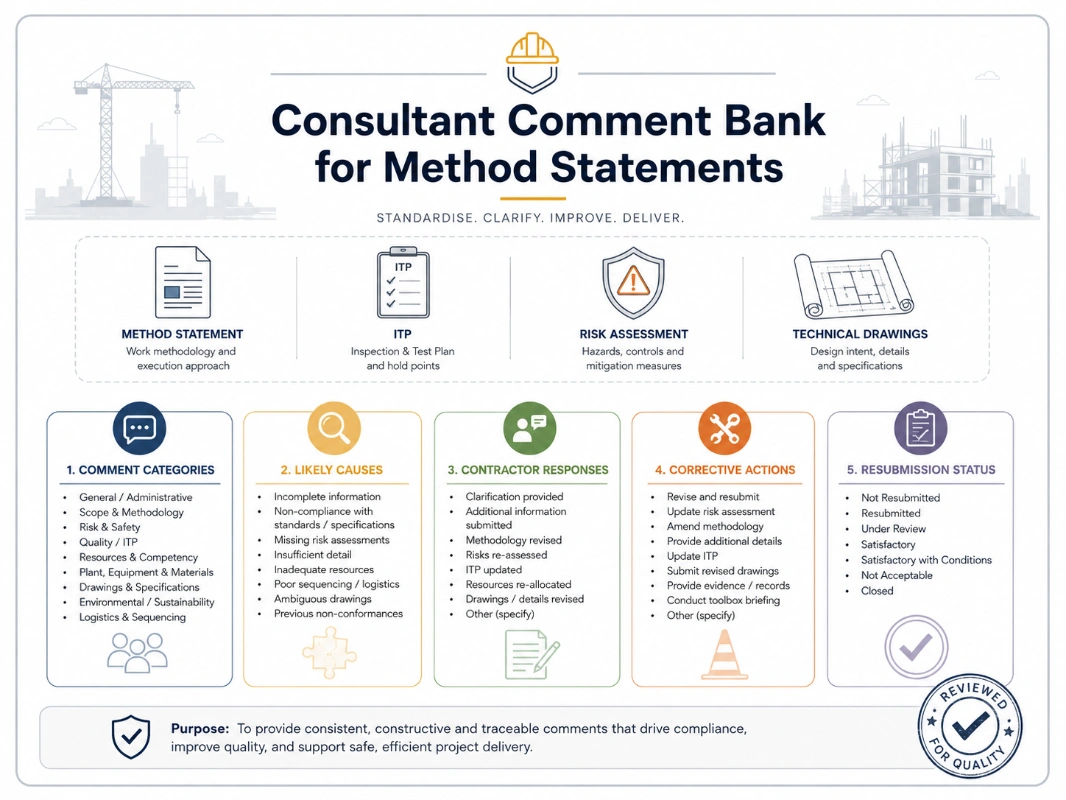
Contract-ready construction method for surface cleaning, heating, distributor calibration, prime coat application, rate monitoring, curing and penetration inspections on aggregate base courses using cutback asphalt or bituminous emulsion prime materials in compliance with international standards and project specifications. Includes HSE controls, QA/QC, and ITP table for site execution and verification. [Verify per project specifications]","method_date":"2026-06-27","project_name":"","submitted_by":"","submitted_to":""},"method_json":{"version":"1.0","sections":[{"key":"scope","title":"Scope","type":"textarea","content":"### Overview\nThis method statement covers the supply, heating, calibration, application, and curing of a bituminous prime coat on prepared, compacted, and approved aggregate base courses (ABC) in advance of tack coat and asphalt surfacing. It includes surface cleaning with power brooms, distributor spray-bar calibration, application rate monitoring per ASTM D2995, curing time control, and penetration depth inspections.\n\n### Inclusions\n- Cleaning and preparation of the aggregate base surface.\n- Receipt, storage, and heating of prime materials (cutback asphalt or emulsified asphalt prime).\n- Distributor truck calibration and application rate verification.\n- Uniform application of prime coat to specified rate.\n- Protection, curing, sand blinding if required, and traffic management.\n- Inspection and testing: temperature, rate, uniformity, curing, and penetration depth.\n- Documentation and quality records.\n\n### Exclusions\n- Base course construction and compaction beyond minor pre-spray rectification.\n- Tack coat and asphalt surfacing.\n- Pavement marking and permanent traffic management beyond work zone control."},{"key":"references","title":"References","type":"table","rows":[{"reference":"ASTM D2027 – Standard Specification for Cutback Asphalt (Rapid-, Medium-, and Slow-Curing Types)","notes":"For MC-30/MC-70 prime materials. [Verify per project specifications]"},{"reference":"ASTM D977 – Standard Specification for Emulsified Asphalt","notes":"For anionic emulsions used as prime (if permitted). [Verify]"},{"reference":"ASTM D2397 – Standard Specification for Cationic Emulsified Asphalt","notes":"For cationic emulsions such as CSS-1 or CSS-1h used/diluted as prime. [Verify]"},{"reference":"ASTM D5 – Penetration of Bituminous Materials","notes":"Material property reference (as applicable)."},{"reference":"ASTM D4402 – Viscosity of Asphalt at High Temperature Using a Rotational Viscometer","notes":"Material handling/heating reference (as applicable)."},{"reference":"ASTM D2995 – Practice for Estimating Application Rate of Bituminous Distributors","notes":"Primary method for verifying spray rate and transverse uniformity (mat/pan test)."},{"reference":"AASHTO T 329 / ASTM D4944 – In-Place Determination of Water Content of Soil by the Calcium Carbide Gas Pressure Tester","notes":"For rapid moisture checks of the top of ABC (if required)."},{"reference":"ISO 9001 Quality Management Systems","notes":"Framework for QA/QC documentation and control."},{"reference":"Project Specifications and Drawings","notes":"Prevail over this method for limits, rates, and acceptance criteria. [Verify]"},{"reference":"Manufacturer’s Data Sheets (MDS) and Safety Data Sheets (SDS)","notes":"Heating, handling, and HSE controls for specific prime materials."}]},{"key":"responsibilities","title":"Responsibilities","type":"table","rows":[{"role":"Project Manager","responsibility":"Overall delivery, approvals, resources, and interface with Engineer."},{"role":"Construction Manager","responsibility":"Execution planning, sequencing, and coordination on site."},{"role":"Site Engineer","responsibility":"Setting out, area measurement, distributor calibration coordination, rate/temperature monitoring, and records."},{"role":"Quality Engineer / Inspector","responsibility":"ITP inspections, sampling, rate verification (ASTM D2995), penetration inspections, and documentation."},{"role":"HSE Manager / Officer","responsibility":"Task-specific risk assessment, permits (flammable liquids), monitoring of controls, and toolbox briefings."},{"role":"Plant Supervisor (Distributor Operator)","responsibility":"Distributor setup, nozzle checks, bar height/speed control, uniformity, and safe operation."},{"role":"Surveyor","responsibility":"Area quantification and demarcation of spray zones and joints."},{"role":"Traffic Management Supervisor","responsibility":"Implement and maintain traffic control and exclusion zones."},{"role":"Material Supplier / Laboratory","responsibility":"Provide CoC, certificates of analysis, and test results for each batch/load; conduct verification tests if required."}]},{"key":"resources","title":"Resources","type":"table","rows":[{"resource_type":"Skilled plant operator (bitumen distributor)","quantity":"1 per distributor","role":"Plant Supervisor"},{"resource_type":"Skilled broom/air compressor operators","quantity":"2–4","role":"Site Crew"},{"resource_type":"General operatives (hand-spray, masking, sand blinding)","quantity":"4–8","role":"Site Crew"},{"resource_type":"Quality inspector/technician","quantity":"1–2","role":"QA/QC"},{"resource_type":"HSE officer","quantity":"1","role":"HSE"}]},{"key":"materials","title":"Materials","type":"table","rows":[{"material":"Cutback asphalt prime (e.g., MC-30 / MC-70)","specification":"Conforming to ASTM D2027; provide CoC with distillation, residue, penetration/viscosity. Storage in compliant, grounded tanks. [Verify]"},{"material":"Bituminous emulsion prime (e.g., CSS-1 or CSS-1h, diluted 1:1 water)","specification":"Conforming to ASTM D2397/D977; dilution water potable/clean; final residual asphalt content per project. [Verify]"},{"material":"Clean, dry blinding sand","specification":"Well-graded fine aggregate, free of clay/organic matter; typical application 0.5–1.0 kg/m² when tracking occurs. [Verify]"},{"material":"Masking paper/boards","specification":"For protecting structures, kerbs, drainage grates from overspray."},{"material":"Fuel and heating media","specification":"As per heater manufacturer; compliant with local regulations. [Verify]"}]},{"key":"equipment","title":"Equipment","type":"table","rows":[{"equipment":"Bitumen distributor truck with calibrated flowmeter and spray-bar","capacity":"6,000–12,000 L","remarks":"Adjustable bar height; full-circulation; individual nozzle shutoff; in-cab rate control."},{"equipment":"Spray nozzles (fan type, matched set)","capacity":"Sized per design rate and viscosity","remarks":"Uniform fan angle; clean and undamaged; spare set available."},{"equipment":"Power broom / mechanical sweeper and air compressor","capacity":"–","remarks":"For thorough surface cleaning; vacuum sweeper preferred in urban areas."},{"equipment":"Inline/tank heaters with thermostatic control and agitator","capacity":"–","remarks":"Capable of controlled heating to target temps without local overheating; with calibrated thermometers."},{"equipment":"Infrared thermometers / calibrated thermowell thermometer","capacity":"–","remarks":"For checking binder temperature at tank and spray line."},{"equipment":"Measuring mats/pans and weighing scale (ASTM D2995)","capacity":"Mats ≥1 m²; scale resolution ≤1 g","remarks":"For application rate and transverse uniformity checks."},{"equipment":"Straightedge, moisture tester (ASTM D4944), and field density tools","capacity":"–","remarks":"To confirm base readiness as required by project specs."},{"equipment":"Traffic control devices","capacity":"–","remarks":"Signs, cones, barriers, lights, flaggers as per approved TMP."},{"equipment":"Hand lance/spray wand","capacity":"–","remarks":"For edges, around structures, and inaccessible areas."},{"equipment":"Spill kits and fire extinguishers (foam/dry powder)","capacity":"–","remarks":"At each tanker/distributor and heating location."}]},{"key":"prerequisites","title":"Prerequisites","type":"textarea","content":"- **Base course approval**: Compaction and levels accepted by Engineer; surface free from ruts, segregation, and loose material. Straightedge tolerance typically ≤10 mm over 3 m. [Verify]\n- **Moisture condition**: Top 10 mm dry to touch; no free surface moisture. If measured, moisture in top layer ≤2% by mass or as specified. [Verify]\n- **Weather**: No rain; surface temp ≥5°C (cutback) or ≥10°C (emulsion). Wind speed typically <25 km/h to prevent drift. Forecast dry for ≥6 hours post-application. [Verify]\n- **Traffic management**: Approved Traffic Management Plan (TMP) in place; exclusion zones installed.\n- **Permits and SDS**: Flammable liquids permit (for cutbacks), task-specific risk assessment, toolbox talk completed; SDS available. [Verify per project HSE plan and local regulations]\n- **Calibration readiness**: Distributor clean, all nozzles of identical size/angle, filters clean, bar height adjustable, tachometer/speedometer functional.\n- **Area measurement**: Net spray area measured/recorded (deduct structures).\n- **Protection/masking**: Drains, kerbs, bridge joints, and appurtenances masked or shielded.\n- **Material verification**: Prime material CoC/MDS, batch numbers, and target application rate confirmed with Engineer."},{"key":"method_sequence","title":"Method Sequence","type":"table","rows":[{"step":"1","activity":"Pre-start briefing and permits","description":"Conduct toolbox talk on hot bitumen hazards, VOCs, traffic interface; verify permits (flammable liquids), TMP, and emergency response. Review method and ITP with crew.","responsibility":"HSE Officer / Construction Manager","inspection_required":"Yes"},{"step":"2","activity":"Surface cleaning","description":"Mechanically broom and vacuum (if available) to remove dust, loose fines, and debris. Blow with oil-free compressed air. Remove local soft spots and rectify prior to priming.","responsibility":"Site Engineer / Crew","inspection_required":"Yes"},{"step":"3","activity":"Base readiness check","description":"Check surface dryness (hand press with tissue—no moisture pickup). Straightedge tolerance ≤10 mm over 3 m [Verify]. Repair defects. Record moisture if required.","responsibility":"QA/QC Inspector","inspection_required":"Yes"},{"step":"4","activity":"Distributor setup and nozzle check","description":"Align nozzles at consistent fan angle (e.g., 15–30° to bar) and orientation. Clean/replace clogged or damaged nozzles. Set bar height for triple overlap based on nozzle spacing (typically 150–300 mm). [Verify]","responsibility":"Plant Supervisor","inspection_required":"Yes"},{"step":"5","activity":"Heating of prime material","description":"Heat binder uniformly to target application temperature: cutback (MC-30/MC-70) typically 45–60°C; do not exceed 85°C. Emulsion 40–60°C (avoid boiling). Maintain gentle agitation. Record temperatures at tank and spray line. [Verify]","responsibility":"Plant Supervisor / QA/QC","inspection_required":"Yes"},{"step":"6","activity":"Trial spray and calibration (ASTM D2995)","description":"Lay pre-weighed 1 m² mats/pans across full spray width. Spray at planned speed/pressure. Weigh collected binder to compute L/m². Adjust speed/pressure/nozzle size to achieve target rate and transverse uniformity (coefficient of variation ≤10%). Document calibration sheet.","responsibility":"Site Engineer / QA/QC","inspection_required":"Yes (Hold Point)"},{"step":"7","activity":"Set out spray lanes and joints","description":"Mark start/stop points and longitudinal joints. Use paper/boards for clean cut-offs and to prevent pooling at starts/stops.","responsibility":"Site Engineer","inspection_required":"No"},{"step":"8","activity":"Production spraying","description":"Spray continuously at constant speed (typ. 3–6 km/h) and stable pressure as established in calibration. Maintain 100–150 mm overlaps between adjacent passes. Avoid overspray onto masked areas.","responsibility":"Distributor Operator","inspection_required":"Yes"},{"step":"9","activity":"Edges and obstacles (hand lance)","description":"Hand-spray inaccessible areas with controlled sweeping motion to match application rate. Avoid puddling at edges and around structures.","responsibility":"Distributor Operator / Crew","inspection_required":"Yes"},{"step":"10","activity":"Application rate monitoring","description":"Verify rate using mat/pan checks at start of shift, at every change in speed/viscosity, and at minimum every 4,000 m² or 2 hours. Acceptance: target ±10% or ±0.10 L/m², whichever is greater. [Verify]","responsibility":"QA/QC Inspector","inspection_required":"Yes"},{"step":"11","activity":"Curing and protection","description":"Close area to traffic until binder cures and does not track under foot/tyres. Typical cure: emulsion 6–24 h; cutback 24–72 h depending on weather. Apply clean sand 0.5–1.0 kg/m² only if pickup occurs. [Verify]","responsibility":"Construction Manager / Traffic Supervisor","inspection_required":"Yes"},{"step":"12","activity":"Penetration depth inspection","description":"At 1 per 1,000 m² (min 3 per day), cut small plug or shallow trench to measure binder penetration into top of base; acceptance typically 3–6 mm (range 3–10 mm) and no pooling. Record with photos. [Verify]","responsibility":"QA/QC Inspector","inspection_required":"Yes"},{"step":"13","activity":"Rectification","description":"If under-application or poor penetration: re-spray at adjusted rate after re-cleaning. If over-application/pooling: blot with sand and remove excess; prevent flushing into drainage.","responsibility":"Construction Manager / QA/QC","inspection_required":"Yes"},{"step":"14","activity":"Pre-paving condition check","description":"Immediately prior to tack coat/paving, ensure primed surface is clean, dry, untracked, and uniformly penetrated; remove excess sand. Obtain Engineer’s release to proceed.","responsibility":"Site Engineer / Engineer","inspection_required":"Yes (Hold/Witness)"}]},{"key":"safety_controls","title":"Health, Safety, and Environment – Task-Specific Safety Controls","type":"textarea","content":"### Principal hazards, consequences, and controls\n- **Hazard**: Hot bitumen/cutback contact and thermal burns.\n - Consequence: Serious burns, scalding.\n - Engineering/procedural control: Use thermostatically controlled heaters; maintain safe fill levels; fit splash guards; no over-pressurization; establish exclusion zone around spray bar; controlled start/stop boards.\n - PPE: Flame-resistant clothing, long sleeves, heat-resistant gauntlet gloves, face shield/goggles, long pants, safety boots.\n - Collective measure: Physical barriers and spotters during spraying; emergency shower/eye-wash within reasonable distance.\n - Inspection/permit: Daily plant inspection checklist; verify thermometer calibration; pre-use checks recorded.\n\n- **Hazard**: Flammable vapors from cutbacks (MC grades).\n - Consequence: Fire/explosion, inhalation injury.\n - Engineering/procedural control: No smoking/ignition sources within 15 m; bond/ground tanks and distributor during transfer; use closed connections; keep foam/dry-powder extinguishers at tanker and workface; monitor for leaks; avoid heating above limits.\n - PPE: FR clothing, anti-static boots, hydrocarbon-resistant gloves.\n - Collective measure: Designated decanting area with spill containment; windward positioning of crew.\n - Inspection/permit: Flammable liquids permit-to-work; LEL monitoring if in enclosed areas; verify SDS. [Verify per project HSE plan and local regulations]\n\n- **Hazard**: VOC exposure (cutbacks) and aerosol/mist (emulsions).\n - Consequence: Respiratory and eye irritation, headaches.\n - Engineering/procedural control: Use low-VOC emulsions where specified; avoid spraying upwind of crew; limit hand-spraying duration; provide local ventilation if semi-enclosed.\n - PPE: Safety glasses, half-mask respirator with organic vapor cartridges when required by exposure assessment.\n - Collective measure: Rotation of tasks and rest breaks.\n - Inspection/permit: Exposure assessment and monitoring records.\n\n- **Hazard**: Moving plant and live traffic.\n - Consequence: Struck-by, runover.\n - Engineering/procedural control: Approved TMP; spotters; reversing alarms; segregated pedestrian routes; UHF/hand signals.\n - PPE: High-visibility clothing, safety boots, hard hat.\n - Collective measure: Barriers, cones, shadow vehicle with TMA where required.\n - Inspection/permit: Daily TMP inspection; flagger certification.\n\n- **Hazard**: High-pressure spray injection.\n - Consequence: Injection injury, burns.\n - Engineering/procedural control: Do not hand-check spray; de-energize system before maintenance; maintain nozzle guards.\n - PPE: FR clothing, gloves, face shield.\n - Collective measure: Exclusion zone behind bar.\n - Inspection/permit: Lockout-tagout during cleaning.\n\n- **Hazard**: Slips on freshly primed surface.\n - Consequence: Falls, contamination transfer.\n - Engineering/procedural control: Maintain exclusion until cured; apply sand only as last resort; clean footwear before re-entering traffic areas.\n - PPE: Slip-resistant boots.\n - Collective measure: Clear signage and barricades.\n - Inspection/permit: Supervisor sign-off before reopening.\n\n- **Hazard**: Heat stress and UV exposure.\n - Consequence: Dehydration, heat exhaustion.\n - Engineering/procedural control: Work/rest cycles; shade and hydration stations; schedule hotter operations early.\n - PPE: Sun protection, breathable FR garments.\n - Collective measure: Buddy system.\n - Inspection/permit: Monitor WBGT where required.\n\n- **Hazard**: Manual handling of mats/pans and sand bags.\n - Consequence: Strains, sprains.\n - Engineering/procedural control: Use trolleys; team lifts; limit bag weight.\n - PPE: Gloves, supportive footwear.\n - Collective measure: Manual handling training.\n - Inspection/permit: Supervisor checks.\n\n[All controls to be verified per project HSE plan and local regulations]"},{"key":"environmental_controls","title":"Environmental Controls","type":"textarea","content":"- **VOC emissions (cutbacks)**: Prefer emulsions if specified; minimize heating; cover tanks; avoid spraying during high winds; maintain tight connections. [Verify regulatory limits]\n- **Spills and soil/water contamination**: Place drip trays at decanting points; keep spill kits on hand; install drain covers/booms; never spray within 1 m of open drains—hand apply with shields if unavoidable.\n- **Overspray and drift**: Cease operations when winds exceed project threshold (typ. 25 km/h). Use boards/masking; adjust bar height to reduce atomization.\n- **Runoff during curing/rain**: Suspend works if rain is probable within 6 h. Protect low spots from pooling; prevent runoff into watercourses.\n- **Waste management**: Collect contaminated sand and masking materials for proper disposal as per SDS/local rules. Recycle empty drums per supplier instructions.\n- **Noise and dust from sweeping**: Use vacuum sweepers where feasible; limit operations to permitted hours; maintain equipment.\n- **Carbon footprint considerations**: Optimize logistics (full loads), avoid overheating binder, and limit rework through robust calibration."},{"key":"qa_qc","title":"Quality Assurance and Quality Control","type":"textarea","content":"### Targets and tolerances\n- **Application rate**: As specified; typical targets: cutback 0.7–1.1 L/m²; emulsion (1:1 diluted) 1.0–1.8 L/m², residual asphalt equivalent 0.5–0.9 L/m². Acceptance: target ±10% or ±0.10 L/m², whichever greater. [Verify]\n- **Transverse uniformity**: Coefficient of variation across bar ≤10% based on ASTM D2995 mats. [Verify]\n- **Penetration depth**: Typically 3–6 mm into ABC, without pooling; acceptance range 3–10 mm depending on spec. [Verify]\n- **Surface evenness**: ≤10 mm over 3 m straightedge unless project specifies otherwise. [Verify]\n\n### Testing and frequency\n- **Temperature checks**: Each load at receipt and hourly during spraying (tank and spray line).\n- **Rate checks (ASTM D2995)**: At calibration, then at start of production, after any change (speed, viscosity, material), and at least every 4,000 m² or 2 hours.\n- **Penetration inspection**: 1 per 1,000 m², minimum 3 per day, after sufficient curing. Photographic record with scale.\n- **Surface condition prior to paving**: Visual acceptance by QA/QC and Engineer.\n\n### Records\n- Daily spray log (date, location chainage, weather, wind, temperatures, rate results, area).\n- Distributor calibration sheet and nozzle condition checklist.\n- Material delivery tickets and CoC.\n- Penetration inspection forms with photos.\n- NCRs and corrective actions if deviations occur.\n\n### Hold/Witness points\n- Hold: Initial calibration/trial spray.\n- Witness: First production lane and pre-paving release. [Verify with ITP]"},{"key":"itp","title":"Inspection and Test Plan (ITP)","type":"table","rows":[{"activity":"Base course acceptance prior to priming","inspection_test":"Visual, straightedge, moisture check (if required)","acceptance_criteria":"Surface clean, dry, and sound; evenness ≤10 mm over 3 m; no loose material; no free moisture.","responsibility":"QA/QC Inspector / Engineer","record":"Base readiness checklist"},{"activity":"Material receipt – prime binder","inspection_test":"Review CoC/MDS, batch/grade verification","acceptance_criteria":"Conforms to ASTM D2027 (cutback) or ASTM D2397/D977 (emulsion); correct grade; within shelf life; SDS available.","responsibility":"QA/QC Inspector","record":"Material CoC, delivery tickets"},{"activity":"Binder temperature – storage and spray line","inspection_test":"Thermometer reading at tank and at spray bar","acceptance_criteria":"Within target range: cutback 45–60°C (max 85°C), emulsion 40–60°C; stable, no local overheating. [Verify]","responsibility":"QA/QC / Plant Supervisor","record":"Temperature log"},{"activity":"Distributor calibration – trial spray","inspection_test":"ASTM D2995 mat/pan test across full width","acceptance_criteria":"Average rate at target; transverse CV ≤10%; nozzles uniform; bar height/speed set. (Hold Point)","responsibility":"QA/QC / Site Engineer / Engineer","record":"Calibration report with calculations"},{"activity":"Production application rate monitoring","inspection_test":"Periodic ASTM D2995 checks during run","acceptance_criteria":"Measured rate within ±10% or ±0.10 L/m² of target, whichever greater; uniform appearance; correct overlaps.","responsibility":"QA/QC Inspector","record":"Rate check forms"},{"activity":"Spray appearance and coverage","inspection_test":"Visual during and after spraying","acceptance_criteria":"Continuous, streak-free film; no pooling; neat edges; protected utilities and structures.","responsibility":"Site Engineer / QA/QC","record":"Daily report with photos"},{"activity":"Penetration depth verification","inspection_test":"Cut plug/trench inspection with scale","acceptance_criteria":"Typical 3–6 mm penetration into ABC; no free binder on surface; no flushing. [Verify]","responsibility":"QA/QC / Engineer","record":"Penetration inspection form, photos"},{"activity":"Curing status prior to opening/overlay","inspection_test":"Foot/tyre pickup check and time/ambient review","acceptance_criteria":"No tacky pickup on paper/tyre; emulsion typically 6–24 h, cutback 24–72 h depending on weather. [Verify]","responsibility":"QA/QC / Site Engineer","record":"Curing log / release to traffic"},{"activity":"Pre-paving condition","inspection_test":"Final visual + Engineer’s witness","acceptance_criteria":"Surface clean, dry, uniformly primed; excess sand removed; Engineer’s consent to proceed (Witness Point).","responsibility":"QA/QC / Engineer","record":"Pre-paving release record"}]} ,{"key":"attachments","title":"Attachments","type":"textarea","content":"- **Template – Distributor Calibration Sheet (ASTM D2995)**: Nozzle spacing, bar height, speed, pressure, mat weights, calculated L/m², CV.\n- **Checklist – Base Readiness Prior to Priming**: Evenness, dryness, cleanliness, defects rectified, masking complete.\n- **Daily Spray Log**: Weather, temperatures, application rates, area, material batch numbers, observations.\n- **Penetration Inspection Form**: Location chainage, cut depth, measured penetration, photos.\n- **SDS and Emergency Response Card**: Binder-specific hazards and first aid.\n- **Traffic Management Plan Extract**: Layout and devices for work zone.\n- **Manufacturer’s Technical Data Sheets**: Heating limits and handling guidance."}],"custom_fields":[]},"method_meta":{"seo_title":"Method Statement for Bituminous Prime Coat on Aggregate Base – Calibration, Application, Curing","meta_description":"Contract-ready method for prime coat on aggregate base: cleaning, heating, distributor calibration, application rate control, curing, and inspections.","keywords":["prime coat","bituminous","aggregate base","ASTM D2995","MC-30","emulsion prime","distributor calibration","pavement construction","QA/QC","method statement"],"ai_snippet":"This method details how to clean the base, heat and handle prime materials, calibrate the distributor, control application rate, and verify curing and penetration. It includes rigorous QA/QC, HSE controls, and a complete ITP.","og_title":"Bituminous Prime Coat Method Statement – Calibration, Application, QA/QC","og_description":"Professional, contract-ready method for prime coat on aggregate base with ASTM-based calibration, curing controls, and penetration inspections.","faq":[{"question":"What prime materials are acceptable for this work?","answer":"Typically cutback asphalt such as MC-30/MC-70 (ASTM D2027) or cationic/anionic emulsions per ASTM D2397/D977 if permitted. Confirm the exact grade and residual content per project specifications."},{"question":"How is the application rate verified on site?","answer":"Using ASTM D2995 mat/pan tests to weigh collected binder and compute L/m². Checks are done at calibration, start of production, after changes, and periodically during works."},{"question":"When can the primed surface be opened to traffic or overlaid?","answer":"After curing with no pickup under tyres/foot. Emulsions commonly cure in 6–24 h; cutbacks may require 24–72 h depending on weather. Verify with the Engineer."},{"question":"What penetration depth is required into the base?","answer":"A typical acceptance is 3–6 mm with a broader acceptable range of 3–10 mm depending on specifications. Confirm with project requirements."},{"question":"How are overlaps and joints handled to avoid pooling?","answer":"Maintain 100–150 mm overlaps, use start/stop boards, and keep bar height/speed constant. Hand-spray edges carefully and blot any excess with clean sand if needed."}]},"itp_meta":{"title":"ITP – Application of Bituminous Prime Coat on Aggregate Base","meta_description":"Inspection and Test Plan for prime coat works: readiness, calibration, rate, curing, and penetration checks.","keywords":"prime coat, ITP, ASTM D2995, MC-30, emulsion, distributor calibration, curing, penetration, QA/QC","ai_snippet":"This ITP defines inspections and tests for prime coat application, including base acceptance, distributor calibration, rate monitoring, penetration depth, and curing status.","why_used":"To ensure the prime coat is applied uniformly at the correct rate, penetrates the base adequately, and cures before overlay, meeting project specifications.","who_uses_it":"Site engineers, QA/QC inspectors, contractors, and the Engineer/Client representative.","when_used":"Before, during, and after prime coat application, from base readiness through pre-paving release.","inspection_scope":"Material verification, temperature control, distributor calibration, application rate, appearance, penetration, and curing prior to overlay.","typical_hold_witness_points":"Hold: Trial spray/calibration. Witness: First production run and pre-paving release.","typical_records":"Calibration sheets, rate check forms, temperature logs, daily spray logs, penetration inspection records, approvals/release forms.","faq":[{"question":"How often are application rate checks required in the ITP?","answer":"At calibration, the start of production, after any operational change (speed, viscosity, material), and at least every 4,000 m² or every 2 hours, unless the specification states otherwise."},{"question":"What constitutes acceptance for penetration depth?","answer":"Typically 3–6 mm into the top of the base with no surface pooling; confirm the exact range with the project specification and the Engineer."}]},"hero_image_prompt":"Photorealistic construction scene of a calibrated bitumen distributor truck applying a prime coat on a clean aggregate base, with visible uniform spray fan, masked kerbs, traffic cones, and crew in FR PPE under bright daylight; include power broom in background and QA inspector using a clipboard with mats for rate checks; high detail, professional tone."}
228 views
123 downloads