
Method Statement: Stone Mastic Asphalt (SMA) Pavement Installation – Method Statement
AI-assisted method statement with matching ITP, PDF download, and Excel export.
More than a static template
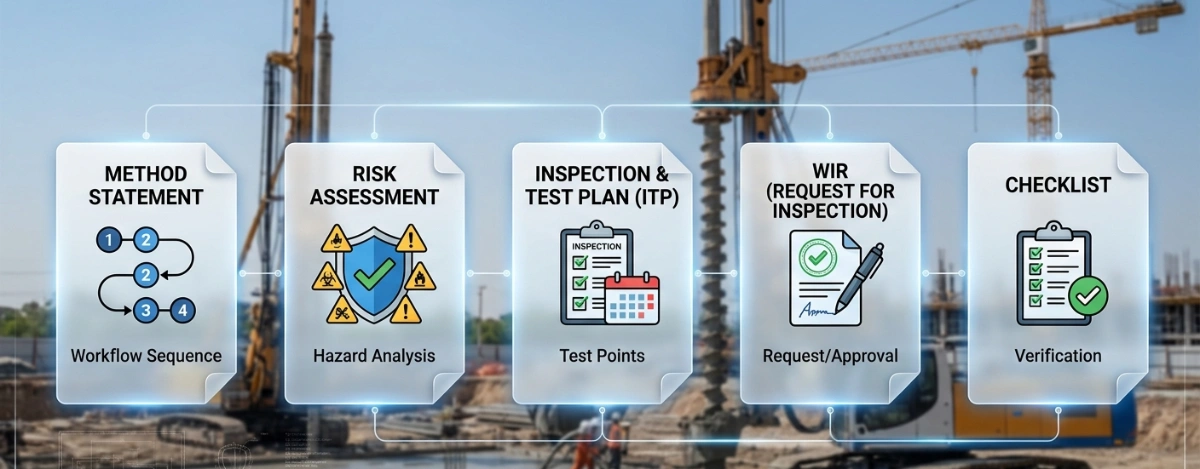
Unlike a downloadable Word or PDF template, this method statement is an AI-assisted editable starting point connected directly to a matching Inspection and Test Plan. Every section is structured, project-adaptable, and ready to export.
- AI-assisted drafting — Customize every section with AI for your specific project scope.
- Linked ITP — A matching inspection and test plan is generated alongside the method statement.
- Multiple export formats — Download as a formatted PDF or editable Excel spreadsheet.
- Editable starting point, not a final document — Review, verify, and adjust all content against your project requirements before use.
Static template vs. Quollnet workflow
| Feature | Static template | Quollnet |
|---|---|---|
| Project-specific content | Manual fill-in required | AI-assisted customization |
| Linked ITP | Separate document, no link | Matching ITP included |
| Export formats | Usually PDF only | PDF and Excel |
| Structured sections | Free-form layout | 13 standardized sections |
| Saved to your account | Local file only | Cloud-saved, reusable |
| Content accuracy | You verify everything | AI-assisted, you still verify |
| Cost | Often free but time-intensive | Free to customize and download |
What you can customize
When you save this method statement to your account, every section becomes editable. The following 13 sections are included:
- Scope — Defines the activity and its boundaries.
- References — Standards, specifications, and drawings.
- Responsibilities — Roles and accountabilities.
- Resources — Labour, plant, and equipment summary.
- Materials — Materials and compliance requirements.
- Equipment — Tools and equipment details.
- Prerequisites — Hold points and pre-conditions.
- Method sequence — Step-by-step construction sequence.
- Safety controls — HSE risk controls and PPE.
- Environmental controls — Environmental mitigation measures.
- QA/QC — Quality inspection and test requirements.
- ITP — Inspection and Test Plan table (has its own page).
- Attachments — Referenced drawings and documentation.
Why this method statement is used
This method statement is used to define and communicate the approved procedure for carrying out method statement: stone mastic asphalt (sma) pavement installation on site. It ensures the work is planned in advance, the correct resources and controls are in place, and all personnel understand responsibilities, sequence, quality requirements, and safety controls before work begins. It aligns site execution with the documented scope and acceptance expectations.
Who uses this method statement
This method statement is used by contractors, site supervisors, project engineers, QA/QC engineers, HSE officers, consultants, and client representatives. It serves as a shared reference for planning, execution, supervision, inspection, and approval of the activity on site.
When it is prepared and submitted
The method statement is prepared before the work activity starts and submitted as part of the pre-construction documentation package for review and approval.
Who reviews or approves it
The method statement is usually submitted to the client representative, consultant, resident engineer, or project management consultant for review and approval before the work commences.
Important approval note
This method statement is an AI-assisted editable starting point, not a pre-approved document. Before use on any project, all content must be reviewed and approved by the relevant parties (superintendent, principal contractor, or client representative) in accordance with your contract and project quality plan.
For example: if your specification requires a departure from a referenced standard, that departure must be documented and approved separately — this method statement will not capture that automatically. Always verify against your applicable drawings, specifications, and regulatory requirements.
Method statement content
Scope
Work Summary
- Supply, transport, lay, and compact Stone Mastic Asphalt (SMA) wearing/binder course over prepared substrate (asphalt base/binder or concrete), including tack/bond coat, longitudinal and transverse joints, level/line control, and surface finishing.
- Controls for high-temperature mix logistics, stabilizer fiber addition monitoring, prohibition of pneumatic-tired rollers to prevent flushing, on-site drain-down testing, and early compaction tracking to secure stone-on-stone contact.
Limits and Interfaces
- From chainage/area: [Insert limits] to [Insert limits].
- Interfaces with: traffic management, utilities, drainage, survey/controls, asphalt plant operations, and HMA transport.
Exclusions
- Structural pavement design, milling/removal, subgrade improvement beyond minor trimming, permanent road markings, and ancillary street furniture.
Key Performance Targets [Verify per project specifications]
- Layer thickness: typically 25–40 mm for SMA wearing course; 40–60 mm for SMA binder course.
- Air voids in compacted mix: 3.0–4.0% (typical).
- Field density: 96–98% of target bulk density or 92–96% of Gmm (max theoretical specific gravity).
- Surface evenness: ≤4 mm under 3-m straightedge (wearing course) or per project spec.
- Texture depth (macrotexture): typically ≥1.0 mm (sand patch) for SMA wearing course.
References
| Document Type | Reference / Number | Revision | Notes |
|---|---|---|---|
| Standard | EN 13108-5 | ||
| Standard | BS 594987 | ||
| Standard | ASTM D6390 / EN 12697-18 | ||
| Standard | ASTM D2041 / AASHTO T209 | ||
| Standard | AASHTO T312 / EN 12697-31 | ||
| Standard | ASTM D6307 | ||
| Standard | ASTM D2950 / EN 12697-6/ -7 | ||
| Standard | ASTM E965 | ||
| Standard | ISO 9001 / ISO 14001 | ||
| Specification | [Insert Project Spec Ref] | Verify all numeric targets per project specifications. |
Responsibilities
| Role | Responsibility | Name / Party |
|---|---|---|
| Contractor | ||
| Contractor | ||
| Contractor | ||
| Contractor | ||
| Contractor | ||
| Contractor | ||
| Supplier | ||
| Engineer |
Resources
| Resource Type | Description | Quantity | Remarks |
|---|---|---|---|
| Manpower | Experienced in SMA; trained in joint management and segregation control. | 5 | |
| Manpower | Steel drum only; competent in temperature-based rolling patterns. | 2 | |
| Manpower | Field density, temp logging, drain-down, sample handling. | 2–3 | |
| Manpower | Truck movement and public interface control. | 2–4 |
Materials
| Material | Specification / Grade | Quantity | Remarks |
|---|---|---|---|
| SMA | EN 13108-5 | ||
| Fibers | EN 13108-5 / Supplier Datasheet | ||
| Emulsion | BS 594987 / Project Spec | ||
| Bituminous | Project Spec | ||
| Release Agent | Project HSE |
Equipment
| Equipment | Capacity / Type | Quantity | Inspection Required |
|---|---|---|---|
| 1 | |||
| 8–12 t | 2–3 | ||
| 1–2 | |||
| 1 | |||
| 1 | |||
| As required |
Prerequisites
Approvals and Documentation
- Approved Job Mix Formula (JMF) including aggregate gradation, binder grade, target binder content, fiber type/dosage, and lab drain-down results.
- Method Statement and ITP approved by the Engineer.
- Calibration certificates (≤6 months) for: plant weigh scales, fiber feeders, emulsion sprayer, paver sensors, thermometers, nuclear gauge, and laboratory equipment.
- Traffic Management Plan and permits [Verify per project HSE plan and local regulations].
Substrate Readiness
- Substrate sound, clean, dry, free of loose material; patched/regulated where required. Milling completed and cleaned.
- Surface temperature ≥10–15°C and rising; no standing water; wind and weather suitable (no precipitation during paving/compaction) [Verify per spec].
- Utilities/covers adjusted to level; metalwork cleaned and primed if required.
Plant and Logistics Readiness
- Asphalt plant briefed on production temperature set-points and fiber dosing; trial run completed.
- Trucks pre-heated or treated with approved release agent; covers available and used.
- Paver, rollers, and survey controls set; roller pattern established via test strip.
Materials Availability
- Confirm stock and certification for aggregates, binder, fibers, emulsion.
- Drain-down test materials and equipment available onsite for start-of-shift checks.
Pre-Start Meeting
- Review sequence, weather window, target output, hold/witness points, communication, and emergency arrangements.
Method Sequence
| Step | Activity | Description | Responsibility | Inspection / Hold Point |
|---|---|---|---|---|
| 1 | Pre-paving Inspection (Hold Point) | Joint inspection of substrate for cleanliness, dryness, level, and defects; check manholes/ironwork levels; verify weather window. | Site Engineer / Client Rep | Visual; straightedge; thermometer |
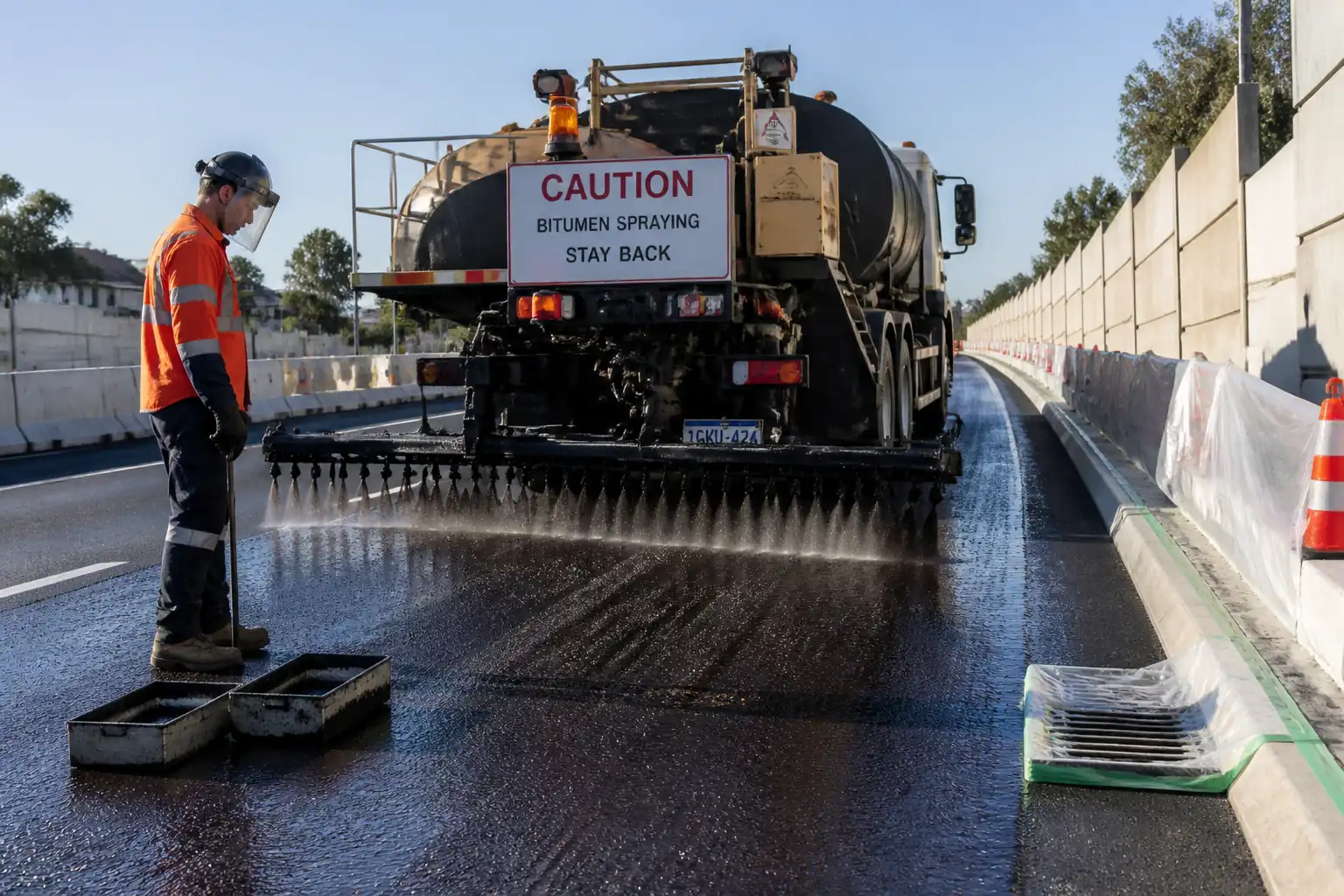
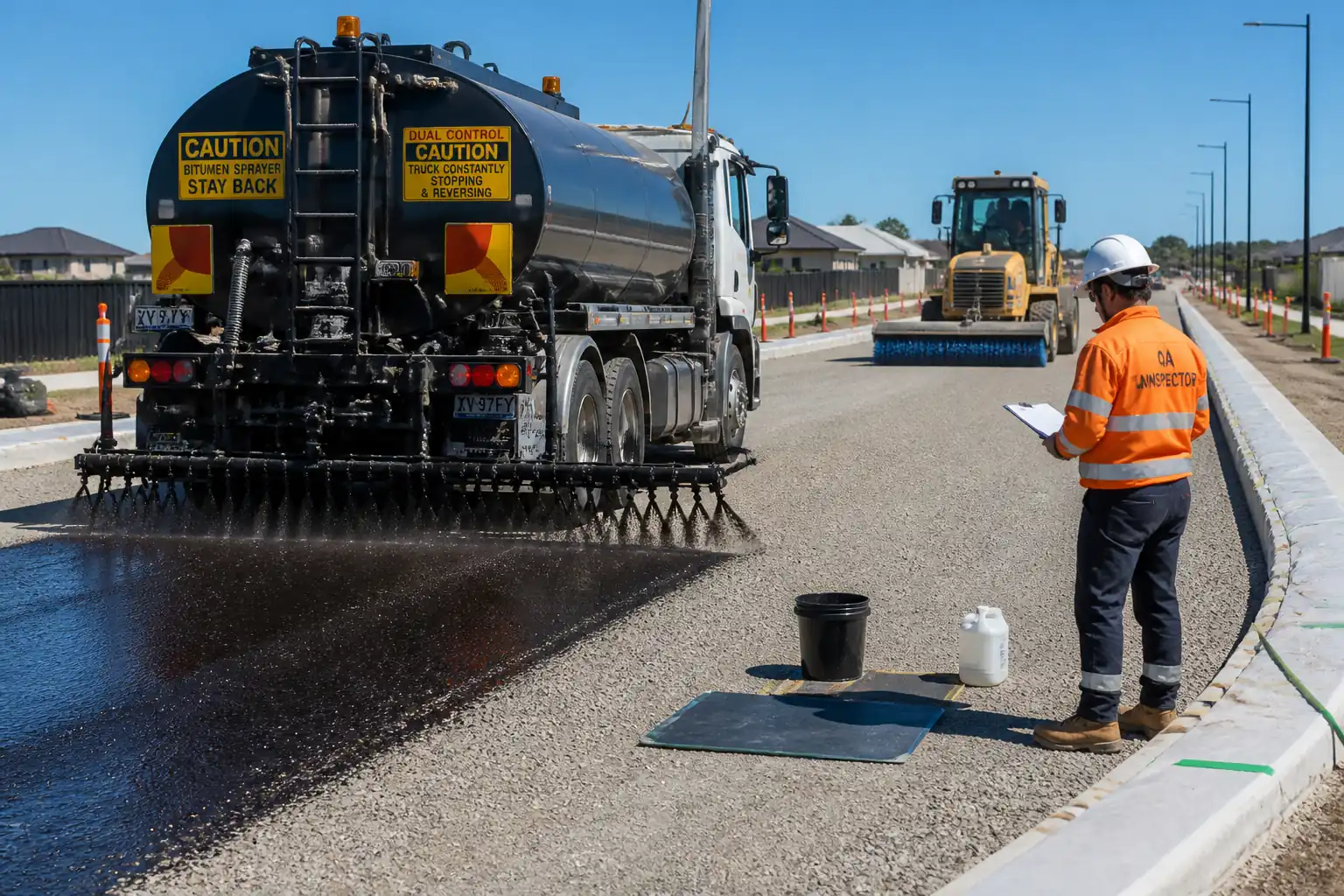
| 2 | Tack/Bond Coat Application | Apply emulsion uniformly at target residual rate using calibrated sprayer. Mask ironwork/kerbs. Allow to break and achieve proper tack (no pick-up). | Paving Supervisor | Nozzle/pressure check; tray test for rate |
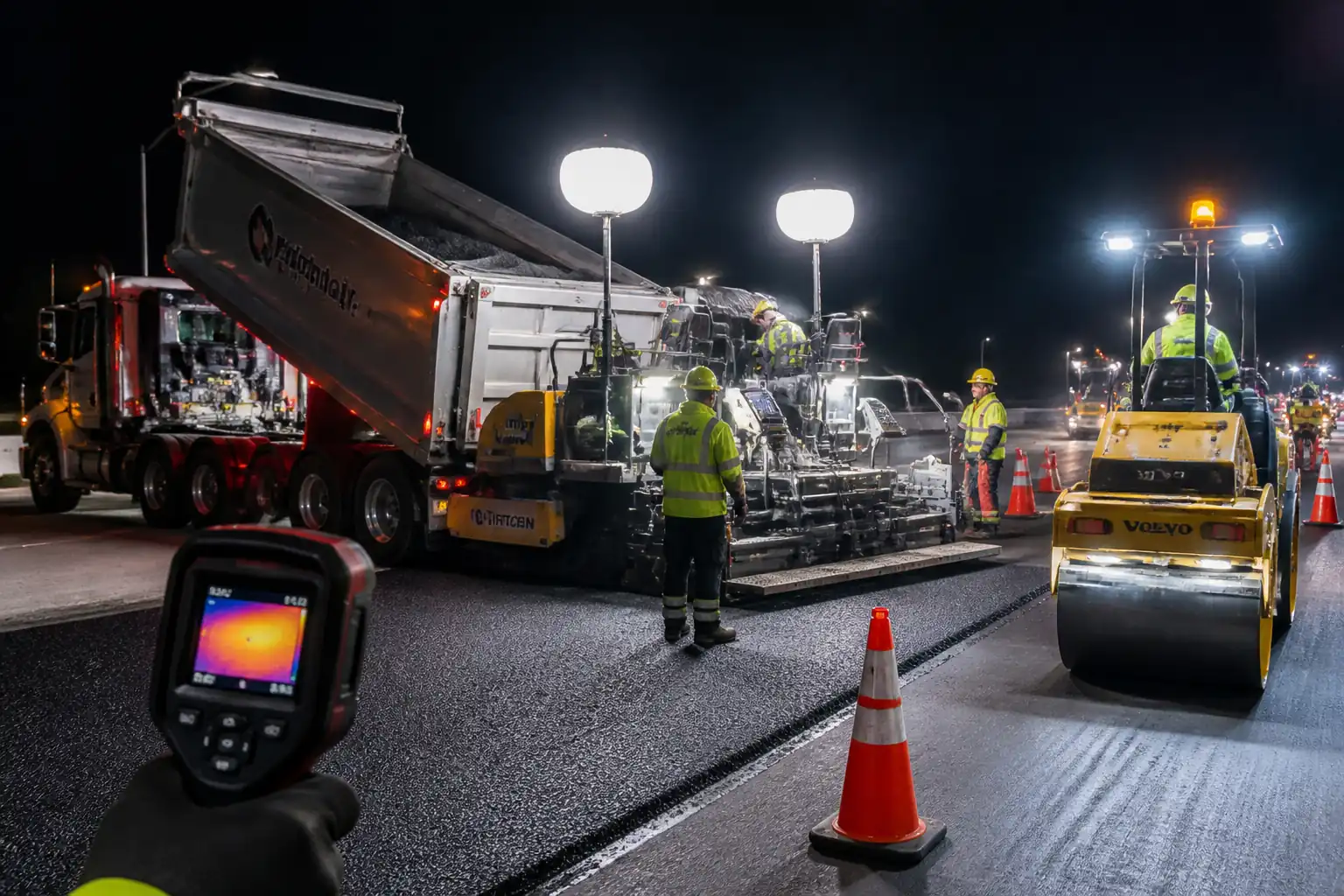
| 3 | High-Temperature Mix Production and Dispatch | Produce SMA per approved JMF. Control mix temperature at plant; verify fiber dosing via calibrated feeder or pre-blended pellets. Load into insulated trucks; cover immediately. Record time of loading and temperature. | Plant Manager | Plant SCADA; temp probe; feeder readouts |
| 4 | Onsite Receipt and Drain-Down Check (Witness Point) | Measure load temperature on arrival; inspect for segregation/contamination. Perform ASTM D6390 drain-down check at start of shift/change and if temperature deviates. Reject loads outside limits. | QC Engineer | Infrared thermometer; sample trays |
| 5 | Paver Setup and Placement | Set screed thickness per layer design; use automatic grade/slope control. Feed continuously (MTV recommended). Maintain head of material uniform; avoid stops. Place longitudinal joint on lane line or offset per drawings. | Paver Operator / Surveyor | Stringline/mmGPS; auger height; end gate heaters |
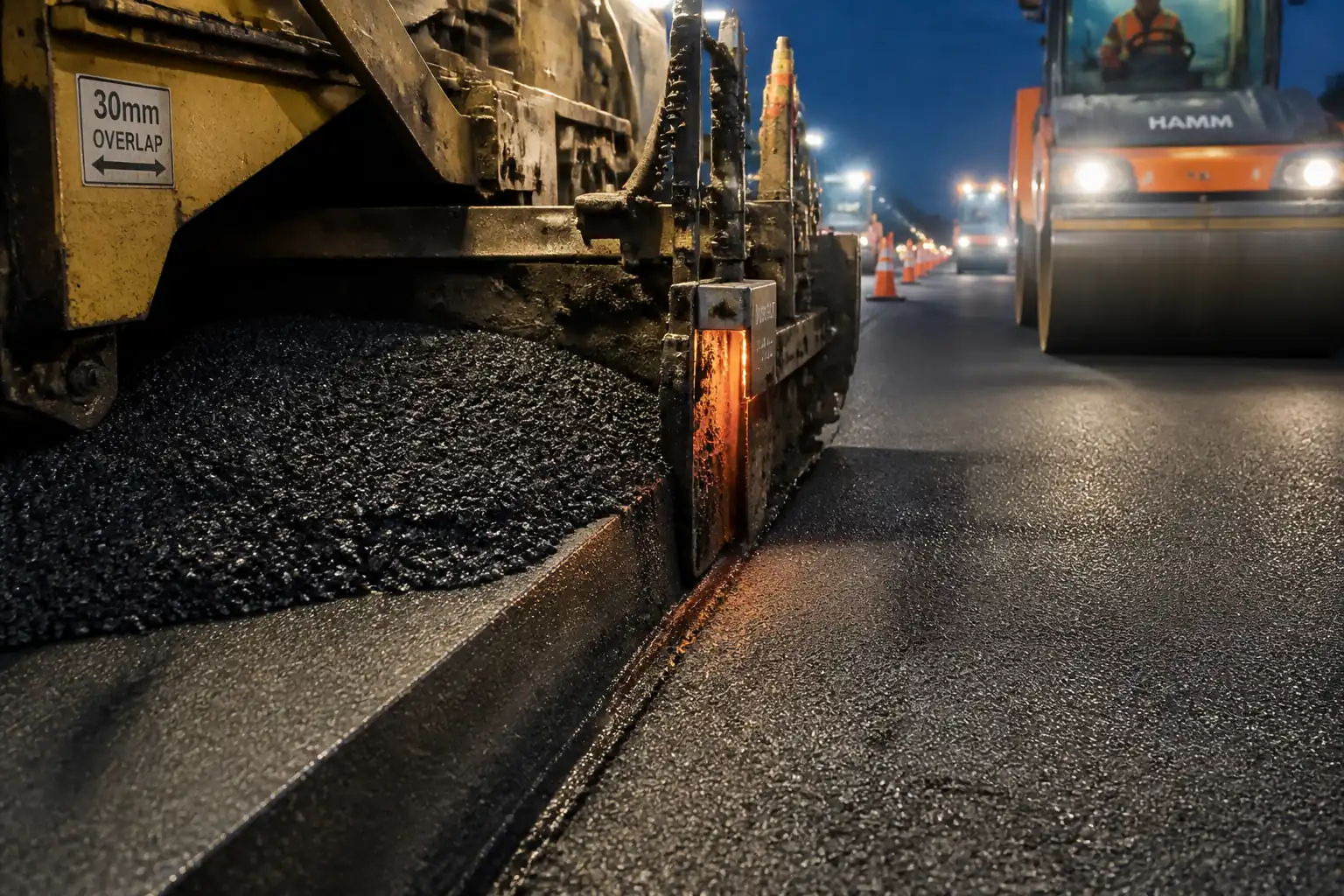
| 6 | Compaction – Breakdown (Early) | Immediately commence rolling with steel drum roller when mat supports roller without displacement. Use low-amplitude vibration or static passes initially to lock stone skeleton; avoid over-vibration that causes flushing. No water added to mat. | Roller Operator | Mat temperature logs; roller settings |
| 7 | Compaction – Intermediate and Finish | Continue with second roller (vibratory/static as per pattern). Finish rolling in static mode to remove marks. Cease compaction when temperature falls below cessation limit or when density achieved. | Paving Supervisor | Thermal readings; density spot checks |
| 8 | Longitudinal and Transverse Joints | Hot joint: compact with 150–200 mm overlap, pinching against supported edge. Cold joint: cut back 25–50 mm to vertical face, clean, heat or paint with joint adhesive, then place and compact against it. | Paving Supervisor | Visual; joint thermometer; straightedge |
| 9 | Surface Quality Checks | Check evenness with 3-m straightedge, texture depth (sand patch), and appearance (no flushing/bleeding). | QC Engineer | Straightedge; sand patch kit |
| 10 | Opening to Traffic (Hold Point) | Allow cooling to minimum surface temperature and completion of all QA checks. Remove loose chippings/debris. Install temporary markings if required. | Engineer / Contractor | Surface temp; visual; QA dossier |
Health and Safety Controls
Principal Task-Specific Hazards and Controls
- Hazard: Hot bitumen and hot mixture (>150°C)
- Likely consequence: Severe burns, scalding.
- Engineering/procedural control: Exclusion zones around paver/rollers; insulated lines; controlled tipping; prohibit manual contact; use shovels with long handles; emergency eyewash/burn kits on site.
- Required PPE: Flame-retardant long sleeves, heat-resistant gloves, high-top safety boots, eye/face protection, hard hat, Hi-Vis.
- Collective measure: Physical barriers and spotters during truck reversing; thermal awareness briefing.
-
Inspection/permit/supervision: Pre-start HSE briefing; supervisor to verify PPE; hot work permit if joint heaters used [Verify per project HSE plan and local regulations].
-
Hazard: Bitumen fumes and vapors
- Likely consequence: Respiratory/eye irritation; potential sensitization.
- Engineering/procedural control: Position crews upwind; minimize standing over screed hopper; maintain burner settings to avoid blue smoke; avoid overheating.
- Required PPE: Safety glasses and disposable respirator (P2/P3) where fumes accumulate.
- Collective measure: Ventilation by wind management; job rotation for prolonged exposure.
-
Inspection/permit/supervision: Monitor temperatures; HSE checks; SDS available.
-
Hazard: Plant/vehicle interface (trucks, paver, rollers)
- Likely consequence: Struck-by, crush injury.
- Engineering/procedural control: One-way system; banksman for reversing; horn-before-move policy; exclusion of pedestrians.
- Required PPE: Hi-Vis, hard hat, safety boots, gloves.
- Collective measure: Barriers and traffic management plan; lighting for night works.
-
Inspection/permit/supervision: Daily traffic management inspection; marshal briefing; permits for work near live traffic.
-
Hazard: Pinch points at paver screed/augers and roller drums
- Likely consequence: Entanglement, crush injury.
- Engineering/procedural control: Guarding; do not clear augers while running; lock-out before maintenance.
- Required PPE: As above; avoid loose clothing.
- Collective measure: Exclusion zones around auger area.
-
Inspection/permit/supervision: Supervisor authorization for maintenance; LOTO records.
-
Hazard: Handling cellulose/synthetic fibers (dust)
- Likely consequence: Respiratory irritation, eye irritation.
- Engineering/procedural control: Keep fiber bags sealed until use; use enclosed feeders; avoid dumping in wind.
- Required PPE: Safety glasses and dust mask (P2).
- Collective measure: Designated fiber handling area.
-
Inspection/permit/supervision: SDS available; housekeeping inspections.
-
Hazard: Emulsion sprayer pressure and slippery surface
- Likely consequence: Injection injury; slips.
- Engineering/procedural control: Pressure relief before nozzle work; mask off; allow full break before trafficking.
- Required PPE: Chemical-resistant gloves, goggles, boots.
- Collective measure: Cones/tape to prevent access until broken.
-
Inspection/permit/supervision: Sprayer calibration and hose inspection.
-
Hazard: Night works/low visibility
- Likely consequence: Struck-by incidents.
- Engineering/procedural control: Task lighting ≥50 lux on work surface; glare-free setup; illuminated PPE.
- Required PPE: Hi-Vis with retroreflective strips.
- Collective measure: Lighting towers positioned out of traffic path.
-
Inspection/permit/supervision: Lighting inspection checklist.
-
Hazard: Heat stress
- Likely consequence: Fatigue, collapse.
- Engineering/procedural control: Work/rest cycles; hydration points; shaded breaks.
- Required PPE: Breathable FR clothing, hydration packs.
- Collective measure: Buddy system.
-
Inspection/permit/supervision: HSE monitor for symptoms; record ambient WBGT if available.
-
Hazard: Operating near live traffic/public
- Likely consequence: Collision.
- Engineering/procedural control: Temporary traffic management per approved plan; speed limits; crash barriers where required.
- Required PPE: Hi-Vis class 3.
- Collective measure: Access control and signage.
-
Inspection/permit/supervision: Permit to work adjacent to carriageway; daily audits.
-
Hazard: Fuel/LPG burners fire risk
- Likely consequence: Fire/explosion.
- Engineering/procedural control: Proper storage; leak checks; no smoking; fire extinguishers (foam/CO2) within 15 m.
- Required PPE: Standard; heat-resistant gloves when handling LPG.
- Collective measure: Designated refueling zone.
- Inspection/permit/supervision: Hot work permit as applicable; extinguisher inspection records.
Environmental Controls
Key Aspects and Mitigations
- Bitumen/fuel spills
- Impact: Soil/water contamination.
- Control: Spill kits at sprayer, paver, and fuel points; drip trays under parked plant; immediate containment with absorbent granules; dispose as hazardous waste.
-
Inspection/permit: Daily plant leak checks; waste transfer notes.
-
Emulsion runoff before break
- Impact: Watercourse contamination.
- Control: Do not spray in rain; protect gullies; use silt socks/booms; allow full break/cure prior to trafficking.
-
Inspection/permit: Weather check record; gully protection inspection.
-
Noise and vibration
- Impact: Nuisance to receptors; structural vibration.
- Control: Working-hour restrictions; low-amplitude rolling; maintain equipment; noise barriers where needed.
-
Inspection/permit: Noise monitoring if required; community notification.
-
Odor/fumes
- Impact: Public complaints.
- Control: Maintain correct mix temperatures; avoid overheating; plan works downwind of sensitive receptors when feasible.
-
Inspection/permit: Temperature logs; complaint register.
-
Waste management
- Impact: Litter from fiber bags; asphalt waste from rejected loads.
- Control: Segregate packaging; return unused sealed fiber bags; cool and recycle conforming asphalt arisings per spec; document disposal routes.
-
Inspection/permit: Waste manifests; recycling tickets.
-
Dust from sweeping and cutting cores
- Impact: Air quality.
- Control: Wet suppression for cores; vacuum sweeping with filters; collect slurry.
-
Inspection/permit: Equipment check; slurry disposal log.
-
Energy and emissions
- Impact: CO2/NOx emissions.
- Control: Optimize paver speed; limit engine idling; schedule deliveries to avoid queuing.
- Inspection/permit: Fuel logs; idling policy enforcement.
QA/QC
Controls and Records
- JMF Approval: Ensure JMF aligns with EN 13108-5; document tolerances for binder, gradation, fiber dosage, and temperatures.
- Test Strip: Establish rolling pattern, pass counts, start/stop temperatures, and expected densities before production paving; record outcomes.
- Sampling and Testing Frequencies [Verify per project specifications]:
- Drain-down (ASTM D6390): at start of each shift and when temperature/material changes.
- Binder content/gradation (ASTM D6307/C136): 1 per 400–600 t or as specified.
- Gmm (ASTM D2041): at least 1 per day.
- In-situ density (ASTM D2950 or cores EN 12697-6/ -7): 1 per 500 m² (min 3 per lot) or as specified.
- Surface evenness (3-m straightedge): continuous checks each lane/shift.
- Texture (ASTM E965): 2 per lane-km or as specified.
- Temperature: each truck at arrival; mat behind screed hourly and at start/end of lots.
- Fiber dosage verification: hourly feeder readout check and reconciliation vs batch tickets.
- Acceptance Criteria [Verify per project specifications]: binder content within JMF tolerance (e.g., ±0.3%); gradation within envelopes; drain-down ≤0.3%; density within 96–98% target or 92–96% Gmm; air voids 3–4%; evenness ≤4 mm/3 m; texture ≥1.0 mm for wearing course.
- Nonconformance: Segregated, cold, or flushed areas to be cut out and replaced; joints failing density to be repaired per Engineer direction.
- Documentation: Daily paving reports, temperature logs, delivery tickets, calibration certificates, test reports, ITP checklists, approvals, NCR/CAR if applicable.
- Traceability: Lot and sub-lot identification by chainage, lane, date/time, truck ID.
- Measuring and Test Equipment: Maintain calibration and field verification (ice bath/boiling point checks for thermometers).
Attachments
- Approved JMF and supporting lab data (gradation, binder content, VMA, VCA, gyratory compaction results).
- Calibration certificates (sprayer, fiber feeder, thermometers, nuclear gauge, paver controls).
- Test strip report (rolling pattern, pass counts, start/stop temperatures).
- Traffic Management Plan and permits.
- HSE Risk Assessment and COSHH/SDS for binder, emulsion, release agents, fibers.
- Manufacturer data sheets (fibers, emulsion, joint adhesive/heater).
- Daily paving report template and ITP checklists.
This content is a read-only public reference. Download or customize to get an editable version.
ITP preview
The first inspection activities from the linked ITP for Method Statement: Stone Mastic Asphalt (SMA) Pavement Installation:
| Activity | Inspection / Test | Acceptance Criteria | Responsibility | Record |
|---|---|---|---|---|
| Pre-paving substrate inspection (HP1) | Cleanliness, dryness, level; surface temp ≥10–15°C [Verify] | Substrate compliant; Engineer releases paving to proceed. | Site Engineer / Client Rep | HP1 checklist signed-off |
| Tack coat application and break | Residual rate verification | Residual 0.3–0.5 L/m² asphalt; 0.4–0.8 L/m² milled/concrete [Verify]; ≥90% coverage; fully broken. | Paving Supervisor / QC | Spray log; photos |
| Plant mix temperature and fiber dosing | Temp at discharge; fiber feeder calibration check | Temp 170–190°C typical [Verify]; fiber dosage within ±10% of target; binder content within JMF tolerance. | Plant Manager / QC | Batch tickets; calibration certs |
Showing 3 of 12 inspection activities. View full ITP →
Related Inspection and Test Plan
An Inspection and Test Plan (ITP) is available for Method Statement: Stone Mastic Asphalt (SMA) Pavement Installation. The ITP defines the inspection activities, acceptance criteria, hold and witness points, responsible parties, and records required to verify the work described in this method statement.
View the Method Statement: Stone Mastic Asphalt (SMA) Pavement Installation ITP →Frequently asked questions
Continue with related Quollnet resources connected to this method statement.