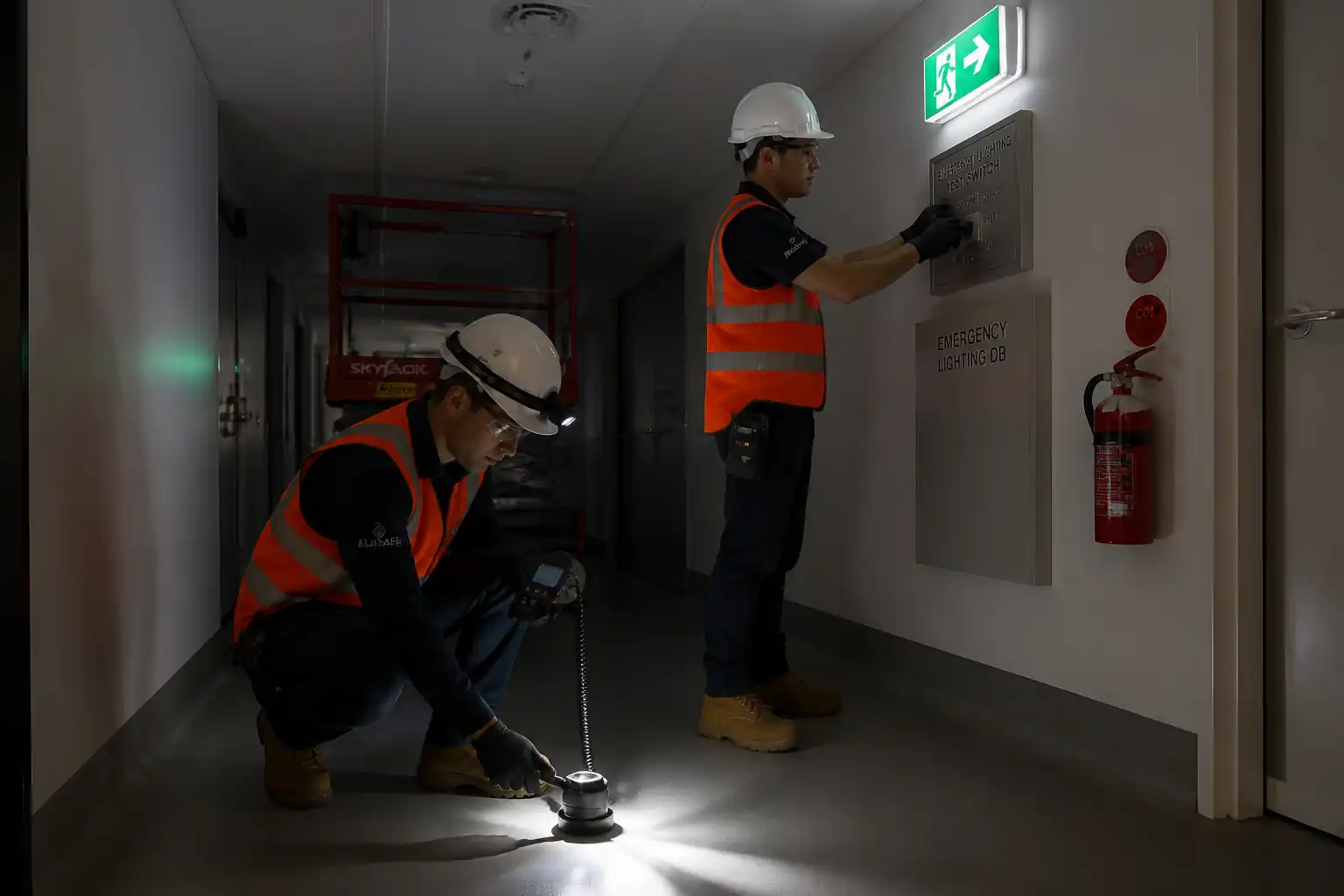

Method Statement: Testing & Commissioning of Emergency Lighting Systems – Method Statement
AI-assisted method statement with matching ITP, PDF download, and Excel export.
More than a static template
Unlike a downloadable Word or PDF template, this method statement is an AI-assisted editable starting point connected directly to a matching Inspection and Test Plan. Every section is structured, project-adaptable, and ready to export.
- AI-assisted drafting — Customize every section with AI for your specific project scope.
- Linked ITP — A matching inspection and test plan is generated alongside the method statement.
- Multiple export formats — Download as a formatted PDF or editable Excel spreadsheet.
- Editable starting point, not a final document — Review, verify, and adjust all content against your project requirements before use.
Static template vs. Quollnet workflow
| Feature | Static template | Quollnet |
|---|---|---|
| Project-specific content | Manual fill-in required | AI-assisted customization |
| Linked ITP | Separate document, no link | Matching ITP included |
| Export formats | Usually PDF only | PDF and Excel |
| Structured sections | Free-form layout | 13 standardized sections |
| Saved to your account | Local file only | Cloud-saved, reusable |
| Content accuracy | You verify everything | AI-assisted, you still verify |
| Cost | Often free but time-intensive | Free to customize and download |
What you can customize
When you save this method statement to your account, every section becomes editable. The following 13 sections are included:
- Scope — Defines the activity and its boundaries.
- References — Standards, specifications, and drawings.
- Responsibilities — Roles and accountabilities.
- Resources — Labour, plant, and equipment summary.
- Materials — Materials and compliance requirements.
- Equipment — Tools and equipment details.
- Prerequisites — Hold points and pre-conditions.
- Method sequence — Step-by-step construction sequence.
- Safety controls — HSE risk controls and PPE.
- Environmental controls — Environmental mitigation measures.
- QA/QC — Quality inspection and test requirements.
- ITP — Inspection and Test Plan table (has its own page).
- Attachments — Referenced drawings and documentation.
Why this method statement is used
This method statement is used to define and communicate the approved procedure for carrying out method statement: testing & commissioning of emergency lighting systems on site. It ensures the work is planned in advance, the correct resources and controls are in place, and all personnel understand responsibilities, sequence, quality requirements, and safety controls before work begins. It aligns site execution with the documented scope and acceptance expectations.
Who uses this method statement
This method statement is used by contractors, site supervisors, project engineers, QA/QC engineers, HSE officers, consultants, and client representatives. It serves as a shared reference for planning, execution, supervision, inspection, and approval of the activity on site.
When it is prepared and submitted
The method statement is prepared before the work activity starts and submitted as part of the pre-construction documentation package for review and approval.
Who reviews or approves it
The method statement is usually submitted to the client representative, consultant, resident engineer, or project management consultant for review and approval before the work commences.
Important approval note
This method statement is an AI-assisted editable starting point, not a pre-approved document. Before use on any project, all content must be reviewed and approved by the relevant parties (superintendent, principal contractor, or client representative) in accordance with your contract and project quality plan.
For example: if your specification requires a departure from a referenced standard, that departure must be documented and approved separately — this method statement will not capture that automatically. Always verify against your applicable drawings, specifications, and regulatory requirements.
Method statement content
Scope
Purpose
Define the systematic procedure to test and commission emergency lighting systems, ensuring compliance with applicable standards and project specifications, and to produce complete records for handover.
System Types Covered
- Self-contained emergency luminaires (maintained and non-maintained)
- Central battery/inverter systems feeding emergency luminaires
- Automatic test systems (ATS), including DALI Emergency (IEC 62386-202) and IEC 62034-compliant systems
Activities Included
- Installation readiness verification and documentation review
- Circuit verification (unswitched supply, polarity, continuity, insulation where applicable)
- Battery/charger checks and initial charge period
- Functional test and changeover performance
- Duration (autonomy) test
- Exit route and area coverage review (photometric checks)
- Labeling, asset registration, and logbook updates
- Interface tests with normal supply failure, ATS/DALI/BMS as applicable
- QA/QC inspections, hold/witness points, and records
- Test certification and handover package preparation
Exclusions
- Corrective repairs to building fabric or major electrical rework beyond minor terminations
- Permanent works design (covered under separate design documents)
Constraints
- Duration test only after batteries reach full charge (typically 24 hours for self-contained, [Verify per project specifications])
- Live testing controls per LOTO and permit-to-work; maintain safe egress at all times during tests [Verify per project HSE plan and local regulations]
References
| Document Type | Reference / Number | Revision | Notes |
|---|---|---|---|
| Standard | BS EN 1838 | Primary photometric criteria. | |
| Standard | BS 5266 (series) | Use latest applicable parts. | |
| Standard | EN 50172 / BS 5266-8 | Regional adoption varies [Verify per project]. | |
| Standard | IEC 60598-2-22 | Construction and performance requirements. | |
| Standard | IEC 60364 / BS 7671 / NEC | Cabling, earthing, protection coordination [Verify jurisdiction]. | |
| Standard | IEC 62034 | ATS/DALI test regimens and reporting. | |
| Standard | IEC 62386-202 | Addressing, commands, reports. | |
| Contract Docs | As approved | Project-specific values prevail. | |
| HSE | As applicable | [Verify per project HSE plan and local regulations]. |
Responsibilities
| Role | Responsibility | Name / Party |
|---|---|---|
| Commissioning Manager | Commissioning Manager | Contractor |
| Senior Electrical Engineer | Senior Electrical Engineer | Contractor |
| QA/QC Engineer | QA/QC Engineer | Contractor |
| Technicians/Electricians | Commissioning Technicians / Electricians | Contractor |
| HSEO / AP(E) | HSE Officer / Authorized Person (Electrical) | Contractor |
| ER/Client | Engineer’s Representative / Client | Engineer/Client |
Resources
| Resource Type | Description | Quantity | Remarks |
|---|---|---|---|
| Manpower | Commissioning Manager, Senior Electrical Engineer, QA/QC Engineer, 2–6 Technicians | As per testing area size [Verify per project] | |
| Manpower | Certified MEWP operator, scaffolder (if tower used) | 1–2 operators | |
| Competent person | LOTO and live test authorization | As required |
Materials
| Material | Specification / Grade | Quantity | Remarks |
|---|---|---|---|
| Luminaires | Manufacturer model per schedule [Verify] | As per drawings | |
| Batteries | Rated autonomy 1 h or 3 h [Verify] | As supplied | |
| Labels | Heat-shrink/engraved traffolyte/UV-stable | Sufficient for all assets | |
| Test modules | Lockable, labeled | Per circuit | |
| Ancillaries | To wiring regulations [Verify] | As required |
Equipment
| Equipment | Capacity / Type | Quantity | Inspection Required |
|---|---|---|---|
| Multimeter | 2 | ||
| IR Tester | 1 | ||
| Illuminance meter | 1–2 | ||
| LOTO | 1 set/crew | ||
| MEWP/Scaffold/Ladders | As required | ||
| Task lights | As required | ||
| DALI/ATS tools | 1 set |
Prerequisites
- Approved for Construction drawings, single-line diagrams, schedules, and latest vendor O&M/manuals.
- Completed installation checks by Electrical Subcontractor; ceilings accessible or access means available.
- Power-on availability to emergency circuits and central battery systems; normal lighting zones identified for staged testing to maintain safe egress.
- Batteries installed and initial charging commenced; minimum charge time achieved before duration test (typically 24 hours for self-contained; central systems per manufacturer) [Verify per project specifications].
- Calibrated meters (lux meter, multimeter, IR tester) with valid certificates.
- Permit-to-Work approved, LOTO applied, and Working at Height plan in place [Verify per project HSE plan and local regulations].
- Room finishes sufficient to avoid significant reflectance changes after photometric checks, or agree re-verification after final finishes.
- Stakeholder notice issued indicating zones, time windows, and any temporary lighting arrangements during tests.
Method Sequence
| Step | Activity | Description | Responsibility | Inspection / Hold Point |
|---|---|---|---|---|
| 1 | Kick-off & Documentation Review | Confirm scope, standards, and approved drawings; review luminaire schedule, battery types, autonomy ratings (1 h/3 h), test methods (manual/ATS/DALI). Hold toolbox talk and confirm permits. | Commissioning Manager | |
| 2 | Installation Readiness Inspection | Room-by-room visual: location, mounting height, orientation, correct type (maintained/non-maintained), signage arrow direction, fixing integrity, IP rating where required, lens clean. Verify circuit IDs and labeling placeholders present. | QA/QC Engineer | |
| 3 | Wiring Verification (Dead Testing) | Apply LOTO. Verify continuity and polarity of unswitched permanent live, neutral, and CPC. IR test on wiring with luminaires disconnected or per manufacturer (typically 500 V DC on wiring-only; 250 V DC max where control gear connected). Reconnect per torque specs. | Electrician / AP(E) | |
| 4 | Power-Up & Live Checks | Remove LOTO as authorized. Energize circuits. Confirm unswitched supplies present at each fitting; verify charging LED indicators; measure charger float voltage/current where accessible per vendor manual. | Electrician / Commissioning Tech | |
| 5 | DALI/ATS Network Setup (if applicable) | Scan bus, address devices, assign groups, map emergency function, set test schedules per IEC 62034. Verify bus wiring continuity and isolation from mains. Backup configuration. | Controls Engineer | |
| 6 | Battery Initial Charge | Allow full charge before autonomy test. Typical: 24 h for self-contained; central systems per vendor. Record start/end. | Commissioning Tech | |
| 7 | Functional Test (Short) | Zone-by-zone simulate mains failure using key switch/ATS/DALI, ensuring safe egress. Confirm each luminaire illuminates and correct mode (maintained/non-maintained). Record response time. | Commissioning Tech | |
| 8 | Exit Route Coverage Review | Verify luminaires/signs cover all escape routes, stairs, final exits, intersections, changes of level/direction, fire equipment, and alarm call points. Confirm sign arrows and visibility at decision points. | QA/QC Engineer | |
| 9 | Photometric Verification | Measure illuminance using calibrated lux meter: escape routes (on floor along centerline at ~1 m intervals), open areas (grid ~3 m or per room size), stair treads, high-risk task areas as applicable. | Commissioning Tech / QA | |
| 10 | Duration (Autonomy) Test | Simulate mains failure for full rated duration (e.g., 1 h or 3 h). Maintain safe egress with portable lighting as needed. Record pass/fail and observed dimming. Do not restore until duration complete. | Commissioning Manager / Tech | |
| 11 | System Interface & Restoration | Verify automatic restoration and recharge; confirm ATS/DALI event logs; verify BMS/alarm interfaces (where specified) do not inhibit emergency function. | Controls Engineer | |
| 12 | Labeling & Asset Registration | Affix permanent labels (circuit ID, luminaire ID, test date/next due, autonomy rating). Update asset register and logbook per BS 5266. | QA/QC Engineer | |
| 13 | Defect Rectification & Retest | Log NCR/SNAGs; correct defects (battery replacement, wiring corrections, repositioning luminaires); retest affected items. | Electrical Subcontractor | |
| 14 | Final Acceptance & Handover | Submit compiled test packs, certificates, ATS/DALI exports, as-builts, O&M, spares list, training. Obtain Engineer’s acceptance. | Commissioning Manager |
Health, Safety, and Environment – Safety Controls
For each significant hazard, apply the following structure.
- Hazard: Live electrical work and inadvertent energization
- Likely consequence: Electric shock, arc flash, burns
- Engineering/procedural control: Permit-to-Work, LOTO with verified isolation; test-before-touch using proving unit; insulated tools; segregate test zones
- Required PPE: Arc-rated clothing (where applicable), electrical gloves (EN 60903), eye/face shield, safety boots
- Collective preventive measure: Barriers and signage to exclude unauthorized persons
-
Inspection/permit/supervision: AP(E) authorization; LOTO audit; supervisor present [Verify per project HSE plan and local regulations]
-
Hazard: Working at height (accessing ceiling luminaires)
- Likely consequence: Falls from height, serious injury
- Engineering/procedural control: Use MEWP/scaffold with valid inspection tags; do not overreach; maintain 3-point contact on ladders for short-duration only; set exclusion zone
- Required PPE: Harness with lanyard when required by MEWP; hard hat with chin strap; non-slip footwear
- Collective preventive measure: Properly erected scaffold/MEWP with guardrails
-
Inspection/permit/supervision: Daily MEWP pre-use check; certified operator; WAH permit
-
Hazard: Battery hazards (VRLA/NiCd/Li-ion)
- Likely consequence: Chemical exposure, thermal runaway, fire
- Engineering/procedural control: Follow vendor MSDS; avoid short circuits; correct polarity; temperature-controlled charging; spill kit available
- Required PPE: Chemical-resistant gloves, goggles, apron for wet-cell work; insulated gloves for terminals
- Collective preventive measure: Ventilation for battery rooms; fire-rated enclosures as specified
-
Inspection/permit/supervision: Battery room inspection; fire extinguishers (CO2/dry powder) available; competency verification
-
Hazard: Loss of normal lighting during tests
- Likely consequence: Trips, falls, panic
- Engineering/procedural control: Stage tests by zone; provide temporary/portable task lighting; brief occupants; restrict access during blackouts
- Required PPE: Hi-vis, head torches as backup
- Collective preventive measure: Marshals at key points; signage indicating test in progress
-
Inspection/permit/supervision: Test schedule approval; floor wardens assigned
-
Hazard: Manual handling of luminaires and batteries
- Likely consequence: Strains, crush injuries
- Engineering/procedural control: Use two-person lift for heavy units; trolleys; follow weight limits
- Required PPE: Gloves, safety boots
- Collective preventive measure: Mechanical aids (trolley/hoist)
-
Inspection/permit/supervision: Manual handling training verification
-
Hazard: MEWP/crane interface with building services
- Likely consequence: Collision with finishes or services
- Engineering/procedural control: Pre-task walkdown; spotter; set travel path clearances
- Required PPE: Helmets, hi-vis
- Collective preventive measure: Barriers around MEWP area
-
Inspection/permit/supervision: MEWP permit; operator license
-
Hazard: Fire alarm/BMS unintended interactions
- Likely consequence: Nuisance alarms, system faults
- Engineering/procedural control: Coordinate with FM/Engineer; isolate only agreed interfaces; restore immediately post-test
- Required PPE: Standard site PPE
- Collective preventive measure: Method statement and permit sign-offs
-
Inspection/permit/supervision: Control room coordination log
-
Hazard: Use of test instruments
- Likely consequence: Instrument failure, false readings leading to unsafe acceptance
- Engineering/procedural control: Use calibrated instruments; function check before use; correct ranges
- Required PPE: Eye protection when near live parts
- Collective preventive measure: Calibration program and labeling
-
Inspection/permit/supervision: QA/QC calibration register review
-
Hazard: Dust/debris falling during ceiling access
- Likely consequence: Eye irritation, slip hazard
- Engineering/procedural control: Use drop sheets; immediate cleanup; eye protection
- Required PPE: Safety glasses, dust mask if required
- Collective preventive measure: Housekeeping plan
- Inspection/permit/supervision: Supervisor inspection before handback of area
Note: All controls to be aligned with local law and the project HSE plan. Deviations require risk assessment and approval.
Environmental Controls
- Battery waste management
- Impact: Hazardous waste (NiCd contains cadmium; Li-ion fire risk)
- Control: Segregate by chemistry; use UN-approved containers; arrange licensed recycling; maintain waste transfer notes
-
Monitoring/inspection: Weekly check of waste store; spill kit available; SDS on file
-
Electronic waste and packaging
- Impact: WEEE non-compliance if landfilled
- Control: Segregate luminaires/control gear; return to vendor take-back where offered; recycle cardboard/plastic
-
Monitoring/inspection: Waste logs; recycler certificates
-
Noise and disturbance during testing
- Impact: Nuisance to occupants
- Control: Schedule off-peak; communicate in advance; short test windows
-
Monitoring/inspection: Complaints log; adherence to schedule
-
Energy use during charging and testing
- Impact: Elevated consumption/heat
- Control: Stagger charge cycles; ventilate battery rooms; monitor charger status
-
Monitoring/inspection: BMS trending where available
-
Light pollution during night tests (external exits)
- Impact: Disturbance to neighbors/wildlife
- Control: Shield temporary lights; limit duration
-
Monitoring/inspection: Site supervisor check
-
Housekeeping and spills
- Impact: Slips, contamination
- Control: Keep areas tidy; immediate cleanup; dispose of wipes/rags as per MSDS
- Monitoring/inspection: Daily inspection checklist
All environmental measures shall comply with local environmental regulations and project EMP [Verify per project HSE plan and local regulations].
QA/QC
Quality Controls
- Calibration: Lux meter, multimeter, IR tester with current calibration certificates (ISO/IEC 17025 traceability where available).
- Test frequencies: 100% of emergency luminaires and associated circuits shall be inspected and tested during commissioning.
- Sampling: Not permitted for duration tests—full population or each circuit segment as specified. ATS/DALI logs accepted as primary evidence if validated with spot checks (≥10% manual verification) [Verify per project specifications].
- Measurement method: Lux readings at floor level; escape routes along centerline at ~1 m spacing; open areas on grid sized to room dimensions (e.g., 3 m) or per design calculation report.
- Tolerances: Acceptance per BS EN 1838 minima; measuring uncertainty accounted for (±5–10% typical lux meter; record meter make/model).
- Documentation: Use standardized test sheets with asset IDs matching as-built drawings. Photos required for representative locations and any defects.
- Nonconformity: Record SNAG/NCR with root cause and corrective action; retest after correction.
- Hold/Witness Points: As identified in ITP (pre-test readiness HP, DALI setup WP, duration test HP, final acceptance HP). Proceed only after Engineer sign-off at HPs.
Records to Produce
- Visual inspection checklists and as-built markups
- Electrical test records (continuity/polarity/IR)
- Functional and duration test sheets (time-stamped), ATS/DALI exports
- Lux survey sheets with calibration references
- Asset register and logbook per BS 5266
- Defect/NCR logs and closures
- Training attendance and O&M manuals
- Completion certificate and manufacturer warranties
Attachments
- Sample forms: Visual inspection checklist; Electrical test sheet; Functional test sheet; Duration test log; Lux survey template; Asset register; BS 5266 logbook template.
- Manufacturer data sheets and commissioning guides for luminaires, batteries, chargers, central systems, DALI/ATS gateways.
- Calibration certificates for lux meter, multimeter, IR tester (copies).
- Risk assessment and method-specific permits (LOTO, WAH, MEWP).
- As-built drawings and single-line diagrams (latest revisions).
- Sample completion certificate and warranty forms.
This content is a read-only public reference. Download or customize to get an editable version.
ITP preview
The first inspection activities from the linked ITP for Method Statement: Testing & Commissioning of Emergency Lighting Systems:
| Activity | Inspection / Test | Acceptance Criteria | Responsibility | Record |
|---|---|---|---|---|
| Document and Permit Review | Verify AFC drawings, schedules, O&M, risk assessments, permits, calibration certs. | Documents approved; permits active; instruments in calibration. | Commissioning Manager / QA/QC | Pre-commissioning checklist; approvals |
| Installation Readiness Visual Inspection | Check luminaire types, locations, fixings, signage orientation, IP ratings where required. | Matches drawings/spec; no damage; correct labels placeholders. | QA/QC Engineer; ER/Client (witness) | Visual inspection checklist; photos |
| Wiring Continuity/Polarity/IR (Dead) | Continuity, polarity; IR at 500 V DC on wiring-only or 250 V DC with control gear as allowed. | Continuity within design limits; IR ≥1 MΩ (or per code) and correct polarity. | Electrician; QA/QC | Electrical test records |
Showing 3 of 13 inspection activities. View full ITP →
Related Inspection and Test Plan
An Inspection and Test Plan (ITP) is available for Method Statement: Testing & Commissioning of Emergency Lighting Systems. The ITP defines the inspection activities, acceptance criteria, hold and witness points, responsible parties, and records required to verify the work described in this method statement.
View the Method Statement: Testing & Commissioning of Emergency Lighting Systems ITP →