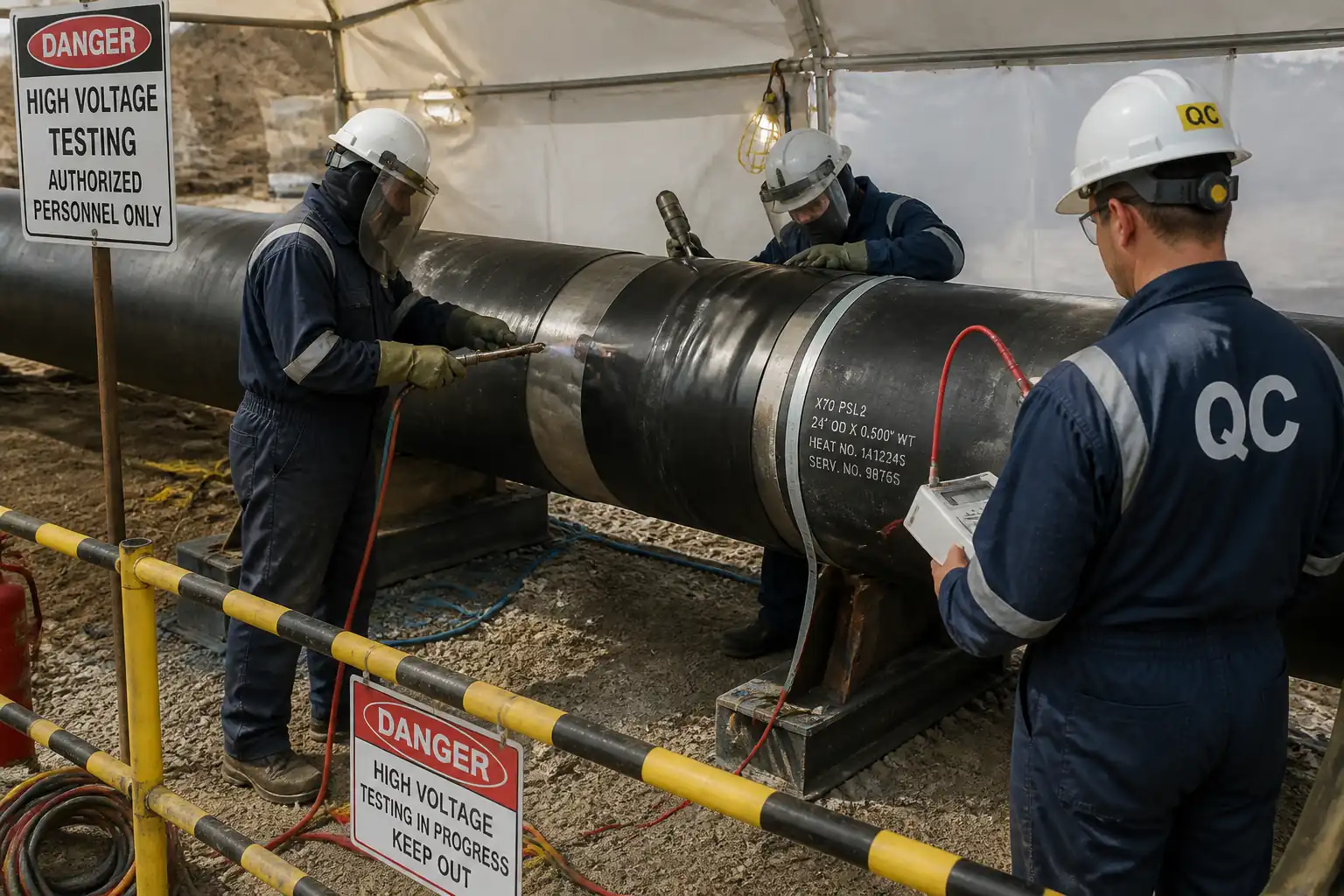

Inspection and Test Plan for Method Statement: Field Joint Coating for Oil & Gas Pipelines
AI-assisted inspection and test plan connected to a method statement, with PDF and Excel export.
More than a static template
Unlike a downloadable Word or PDF template, this ITP is an AI-assisted editable starting point directly connected to its method statement. Every inspection activity, hold point, and acceptance criterion is structured and ready to adapt to your project.
- AI-assisted customization — Tailor inspection activities and acceptance criteria to your specific project scope.
- Linked method statement — This ITP is connected to the corresponding method statement describing the work sequence.
- Multiple export formats — Download as a formatted PDF or editable Excel spreadsheet.
- Editable starting point, not a final document — Review and verify all content against your project specifications and standards before use.
What you can customize
When you save this ITP to your account, every inspection row becomes editable. You can add, remove, or modify:
- Inspection activity — Description of what is being inspected.
- Inspection type — Hold point (H), Witness point (W), Review (R), or Monitor (M).
- Responsibility — Contractor, subcontractor, engineer, or client.
- Frequency — How often the inspection occurs.
- Acceptance criteria — Referenced standard or specification requirement.
- Records — Forms, test reports, or checklists required as evidence.
Why this ITP is used
To verify each field joint achieves required corrosion protection and quality before pipeline lowering-in and backfilling.
Who uses this inspection and test plan
QC Inspectors, Coating Supervisors, Client/TPI, and Site Engineers managing pipeline coating works.
When this ITP is prepared and submitted
Applied after welding/NDE acceptance and before pipeline lowering-in, with post-lowering checks where specified.
Who receives or approves this ITP
Client/Engineer/TPI for approval and surveillance.
Inspection scope
From pre-start document control to final holiday testing and release, including environmental checks, surface prep, DFT, adhesion, and repairs.
Typical hold, witness, and review points
Post-blast inspection (Hold), DFT (Hold), Holiday test (Hold), Adhesion test (Witness), Final document review (Hold).
Typical inspection records
Climate logs, surface prep reports, profile/salt/dust tests, preheat logs, mix logs, DFT, adhesion, holiday logs, repair reports, release certificates.
Important approval note
This ITP is an AI-assisted editable starting point, not a pre-approved document. Before use on any project, all inspection activities, hold points, and acceptance criteria must be reviewed and approved by the relevant parties (superintendent, principal contractor, or client representative) in accordance with your contract and project quality plan.
Always verify acceptance criteria against your applicable drawings, specifications, and regulatory requirements. Hold points must be confirmed with the relevant authority before work proceeds past that point.
Inspection and test plan
| Activity | Inspection / Test | Acceptance Criteria | Responsibility | Record |
|---|---|---|---|---|
| Pre-start documentation | Verify approved MS/ITP, MDS/SDS, calibration certs | All approvals current; instruments within calibration; materials approved | QC Inspector (Hold) / Client (Witness) | Pre-start checklist, approvals register |
| Joint release verification | Check NDE acceptance and joint ID | Joint released for coating; ID traceable | QC Inspector | Weld/NDE release, FJC log |
| Environmental conditions | Measure T/RH/steel temp/dew point (ISO 8502-4) | Steel ≥3°C above dew point; RH ≤85% [Verify] | QC Inspector | Climate log |
| Surface preparation (visual) | ISO 8501-1 visual grade | Sa 2½ achieved | QC Inspector (Hold) / Client (Witness) | Surface prep report, photos |
| Surface profile | ISO 8503-5 replica tape or profilometer | Profile 50–100 µm [Verify] | QC Inspector (Hold) | Profile readings |
| Dust and soluble salts | ISO 8502-3 dust; ISO 8502-6/-9 Bresle | Dust rating ≤2; salts ≤20 mg/m² [Verify] | QC Inspector (Hold) | Cleanliness test forms |
| Preheat verification | Measure steel and overlap temperatures | Within MDS ranges; ≥3°C above dew point | QC Inspector | Preheat log |
| Coating application (FBE) | Observe application; verify coverage/overlap | Uniform film; no exposed steel; proper overlap | QC Inspector / Client (Witness) | FBE application sheet |
| Coating application (Liquid epoxy/PU) | Mix logs; WFT checks; recoat window | Applied per MDS; no runs/sags; stripe coat at edges | QC Inspector / Client (Witness) | Mix log, WFT records |
| Coating application (HSS) | Heat profile; rolling; closure patch | No wrinkles/fishmouths; adhesive flow at edges; ≥100 mm overlap [Verify] | QC Inspector / Client (Witness) | HSS checklist |
| Cure verification | Time/temperature; hardness if specified | Meets minimum cure per MDS | QC Inspector | Cure log |
| DFT measurement | ISO 2808/ASTM D7091; ≥5 locations, 3 readings each | Within specified min/max; no local low readings beyond tolerance | QC Inspector (Hold) / Client (Witness) | DFT report |
| Adhesion test (sampling) | ASTM D4541 / ISO 4624 | ≥5 MPa with cohesive failure [Verify]; HSS per vendor criteria | QC Inspector / Client (Witness) | Adhesion report |
| Holiday detection | NACE SP0274/ASTM G62; voltage set to DFT/type | Zero holidays after repair/retest | QC Inspector (Hold) / Client (Witness) | Holiday log |
| Repairs verification | Visual/DFT/holiday recheck | Repaired areas meet criteria | QC Inspector | Repair report |
| Final documentation review | Check completeness of records | All required records compiled and signed | QC Inspector (Hold) / Client (Hold) | FJC dossier, release certificate |
| Post-lowering holiday test (if specified) | Holiday test after handling/lowering | Zero holidays | QC Inspector / Client (Witness) | Post-lowering holiday report |
This table is a read-only public reference. Download the PDF or Excel version, or customize this ITP to edit it for your project.
Frequently asked questions
Related method statement
This Inspection and Test Plan is associated with the Method Statement: Field Joint Coating for Oil & Gas Pipelines method statement, which describes the step-by-step construction sequence, resources, materials, equipment, safety controls, and environmental controls for this activity.
View the Method Statement: Field Joint Coating for Oil & Gas Pipelines method statement →