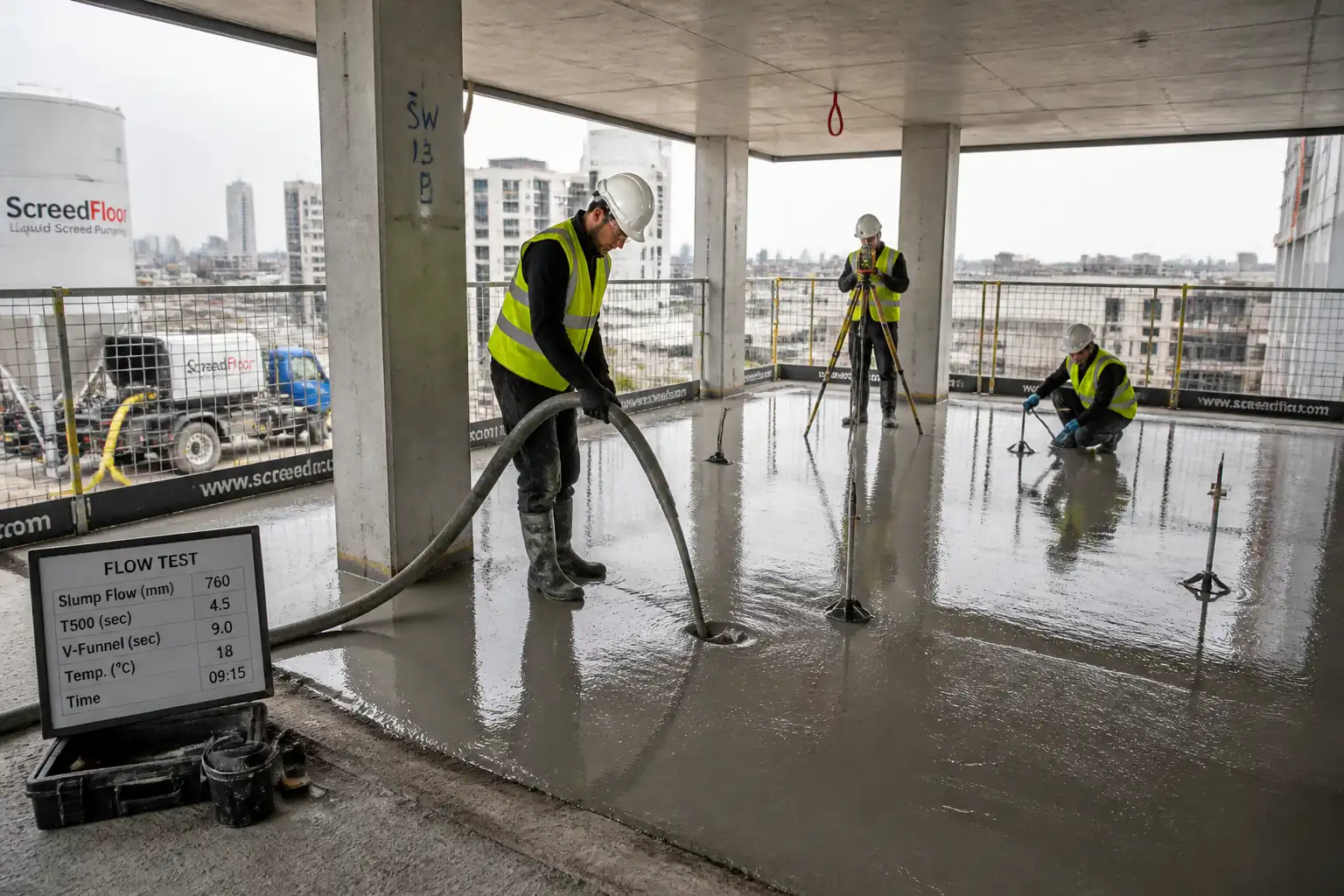

Method Statement: Pump-Applied Screed Works (Multi-Level Projects) – Method Statement
AI-assisted method statement with matching ITP, PDF download, and Excel export.
More than a static template
Unlike a downloadable Word or PDF template, this method statement is an AI-assisted editable starting point connected directly to a matching Inspection and Test Plan. Every section is structured, project-adaptable, and ready to export.
- AI-assisted drafting — Customize every section with AI for your specific project scope.
- Linked ITP — A matching inspection and test plan is generated alongside the method statement.
- Multiple export formats — Download as a formatted PDF or editable Excel spreadsheet.
- Editable starting point, not a final document — Review, verify, and adjust all content against your project requirements before use.
Static template vs. Quollnet workflow
| Feature | Static template | Quollnet |
|---|---|---|
| Project-specific content | Manual fill-in required | AI-assisted customization |
| Linked ITP | Separate document, no link | Matching ITP included |
| Export formats | Usually PDF only | PDF and Excel |
| Structured sections | Free-form layout | 13 standardized sections |
| Saved to your account | Local file only | Cloud-saved, reusable |
| Content accuracy | You verify everything | AI-assisted, you still verify |
| Cost | Often free but time-intensive | Free to customize and download |
What you can customize
When you save this method statement to your account, every section becomes editable. The following 13 sections are included:
- Scope — Defines the activity and its boundaries.
- References — Standards, specifications, and drawings.
- Responsibilities — Roles and accountabilities.
- Resources — Labour, plant, and equipment summary.
- Materials — Materials and compliance requirements.
- Equipment — Tools and equipment details.
- Prerequisites — Hold points and pre-conditions.
- Method sequence — Step-by-step construction sequence.
- Safety controls — HSE risk controls and PPE.
- Environmental controls — Environmental mitigation measures.
- QA/QC — Quality inspection and test requirements.
- ITP — Inspection and Test Plan table (has its own page).
- Attachments — Referenced drawings and documentation.
Why this method statement is used
This method statement is used to define and communicate the approved procedure for carrying out method statement: pump-applied screed works (multi-level projects) on site. It ensures the work is planned in advance, the correct resources and controls are in place, and all personnel understand responsibilities, sequence, quality requirements, and safety controls before work begins. It aligns site execution with the documented scope and acceptance expectations.
Who uses this method statement
This method statement is used by contractors, site supervisors, project engineers, QA/QC engineers, HSE officers, consultants, and client representatives. It serves as a shared reference for planning, execution, supervision, inspection, and approval of the activity on site.
When it is prepared and submitted
The method statement is prepared before the work activity starts and submitted as part of the pre-construction documentation package for review and approval.
Who reviews or approves it
The method statement is usually submitted to the client representative, consultant, resident engineer, or project management consultant for review and approval before the work commences.
Important approval note
This method statement is an AI-assisted editable starting point, not a pre-approved document. Before use on any project, all content must be reviewed and approved by the relevant parties (superintendent, principal contractor, or client representative) in accordance with your contract and project quality plan.
For example: if your specification requires a departure from a referenced standard, that departure must be documented and approved separately — this method statement will not capture that automatically. Always verify against your applicable drawings, specifications, and regulatory requirements.
Method statement content
Scope
Overview
This method statement covers pump-applied screed works for multi-level buildings, including: material receipt and verification, pump setup and commissioning, hose routing through risers/cores, level datum transfer, screed placement and consolidation, prevention of segregation, joints, curing and protection, QA/QC inspections (surface regularity, levels, thickness, moisture), defined hold/witness points, and final acceptance prior to flooring installation.
Inclusions
- Substrate inspection and preparation acceptance.
- Delivery logistics for bulk/bagged screed materials.
- Pump and hose installation, pressure/leak checks, priming, and cleaning.
- Placement sequencing per floor/bay, level/flatness control, bay limits, and jointing.
- Specific controls to prevent segregation and laitance.
- Curing, protection, and access control.
- QA/QC testing and records, including moisture testing for floor finish release.
Exclusions
- Structural slab construction and structural movement joints by others.
- Underfloor heating (UFH) installation/pressure testing by MEP contractor (interfacing and protection included here).
- Permanent DPM/epoxy moisture barriers (unless specified under Materials and approved).
Constraints/Assumptions
- Ambient and substrate temperature 5–30°C during installation and early cure [Verify per product TDS].
- Adequate access, lighting, power, and water available.
- Floors weather-tight prior to screeding (no active water ingress).
References
| Document Type | Reference / Number | Revision | Notes |
|---|---|---|---|
| Standard | BS 8204-1 | ||
| Standard | BS EN 13813 | ||
| Standard | BS 8203 | ||
| Standard | ASTM F2170 | Use only if accepted by Engineer/Specs. | |
| Standard | DIN 18560 | Use as supplementary where aligned with project specs. | |
| TDS/SDS | Per approved submittals | Follow precisely for water addition, flow, curing. | |
| Contract | Project Docs | Values marked [Verify per project specifications]. | |
| ISO | ISO 9001/14001/45001 |
Responsibilities
| Role | Responsibility | Name / Party |
|---|---|---|
| Lead | PM | Main Contractor |
| Engineer | SE | Main Contractor |
| QA/QC | QA/QC | Main Contractor |
| HSE | HSE | Main Contractor |
| Survey | Survey | Main Contractor |
| Supervisor | GF/Supervisor | Main Contractor |
| Specialist | Pump Operator | Screed Subcontractor |
| Logistics | Storekeeper | Main Contractor |
| Independent | Lab | Lab |
| Authority | Client/Consultant | Employer/Engineer |
Resources
| Resource Type | Description | Quantity | Remarks |
|---|---|---|---|
| Manpower | 6–10 operatives incl. pump operator, hoseman, two screeders, finisher, general labor. | 6–10 | |
| Manpower | On-site during pumping and critical operations. | 1 | |
| Manpower | Level transfer and checks. | 1 |
Materials
| Material | Specification / Grade | Quantity | Remarks |
|---|---|---|---|
| Screed | Per approved submittal | ||
| Sand | As mix design | ||
| Water | Potable | ||
| Primer | Approved TDS | ||
| Curing/Protection | Per TDS | ||
| PE membrane | 1000 gauge | ||
| Edge/joint foam | Per spec | ||
| DPM | Approved |
Equipment
| Equipment | Capacity / Type | Quantity | Inspection Required |
|---|---|---|---|
| Pump | 4–8 m3/hr | 1 | Yes |
| Hoses | As required | Yes | |
| Laser | 1 set | Yes | |
| As required | Yes | ||
| 2–3 | No | ||
| 1 set | Yes | ||
| 1–2 | Yes | ||
| 1–2 sets | Yes | ||
| 1 | Yes |
Prerequisites
Approvals and Documentation
- Approved material submittals (screed, primers, curing/protection), ITP, checklists, and risk assessments.
- Latest IFC drawings and floor setting-out with movement joint details approved.
- Calibration certificates for laser, hygrometers, and test equipment.
Substrate Readiness
- Structural concrete age, strength, and moisture fit for screeding; surface structurally sound, clean, and free of laitance, dust, oil, curing agents incompatible with primers.
- For bonded screeds: surface mechanically prepared (e.g., shotblast/scabble) to expose aggregate; vacuum cleaned; moisture within limits for primer per TDS.
- For unbonded/floating: slip membrane installed wrinkle-free with sealed laps and upturns; insulation boards level, tight-butted, and stable.
- Movement and perimeter isolation details installed and coordinated.
Services and UFH
- UFH pipes fixed and pressure-tested to required test pressure (typically 6 bar for 1 hour with no loss) [Verify per project specifications]. Keep under pressure during screeding to reveal leaks.
- MEP penetrations sealed; drains and shafts protected to prevent ingress of screed.
Environment and Access
- Weather-tight enclosures; air movement controlled to prevent rapid drying or dust ingress. Ambient/substrate temperature 5–30°C; avoid direct sunlight and draughts [Verify per TDS].
- Access routes and vertical logistics (hoists/cores) confirmed; load capacity of slabs and temporary platforms verified.
Utilities and Permits
- Adequate water and power for pump and lighting available; spill kits ready.
- Permits: Permit-to-Pump/Work at Height/Hot Work (if any); HSE pre-task briefing and inductions.
Level Control Setup
- Primary benchmarks transferred to each floor; datum elevations agreed.
- Level tripods/pins available; bay layout and pour sequence approved by Engineer/Client (where required).
Method Sequence
| Step | Activity | Description | Responsibility | Inspection / Hold Point |
|---|---|---|---|---|
| 1 | Pre-pour inspection [HOLD POINT] | Joint site walk with Client/Consultant to verify substrate, isolation details, DPM/slip membrane, UFH pressure test, datum/benchmarks, bay layout, and access. | SE/QA/HSE/Client | Checklist completion |
| 2 | Material delivery and verification | Receive materials; verify batch IDs, shelf life, and TDS. For site-mixed, verify sand moisture and adjust water dosage. Store dry, off-ground, weather-protected. | Storekeeper/QA | Delivery docs |
| 3 | Pump setup and priming | Position pump on level ground with spill trays and barriers; inspect hoses/clamps; install whip checks; route hoses via cores/risers and secure at landings. Prime hoses as per TDS (cement grout or manufacturer’s primer slurry). | Pump Operator/Supervisor | Pump checklist; hose routing check |
| 4 | Level pins/tripods setting [WITNESS POINT] | Set tripods/pins to design thickness using laser. Typical thicknesses: Bonded 25–40 mm; Unbonded ≥50 mm; Floating ≥65 mm (domestic) or ≥75 mm (commercial); UFH cover above pipe crown typically 30–45 mm [Verify per project specifications]. | Surveyor/SE | Level sheet |
| 5 | Trial flow/slump and water control [HOLD/WITNESS] | Conduct initial flow/slump test on first batch at point of discharge. Target ranges per TDS: e.g., self-levelling cementitious 240–270 mm flow; pumpable sand-cement 60–80 mm slump. Adjust water at pump in small increments only; record temperature and batch ID. | QA/QC & Client | Witness test |
| 6 | Placement sequencing – start/stop strategy | Place from furthest point retreating to exit. Maintain continuous feed to avoid cold joints. For multi-level, coordinate floor sequence to minimize hose re-routing. Install day joints at doorways/thresholds with foam strip if stoppage exceeds open time. | Supervisor | Workface control |
| 7 | Segregation prevention during discharge | Keep hose tip submerged in fresh screed; avoid free-fall >300 mm; maintain steady pump rate; do not add water to surface; remix by gentle hose movement only. Reject batches showing sand build-up or excessive bleed. | Pump Operator/Screeders | Visual |
| 8 | Level control and finishing | Strike to tripods/pins. For flow screed, roll/dapple in two directions to de-aerate. For sand-cement, rule and close with float (no over-trowelling). Remove tripods and make-good immediately. | Screed Supervisor | Level spot checks |
| 9 | Joints and details | Honor structural/movement joints through screed with matching profiles. Provide perimeter isolation strips. Form day joints square and neat using approved stop-ends/foam. Saw-cutting generally not required for flow screeds unless specified. | SE/Supervisor | Detail check |
| 10 | Curing and early protection | Cementitious: protect from rapid drying for ≥48 h (polythene sheeting or compatible curing compound) [Verify vs finish]. Anhydrite: prevent draughts first 24–48 h, then provide gentle ventilation; do not use curing membranes. Prevent foot traffic until initial set/strength per TDS (often 24–48 h). | Supervisor/QA | Protection check |
| 11 | Post-cure SR and level verification [WITNESS POINT] | After sufficient set (typically 48–72 h or per TDS), check surface regularity using 2 m straightedge on a 2 m grid. Class target: SR1 (3 mm), SR2 (5 mm), or SR3 (10 mm) [Verify per spec]. | QA/QC & Client | SR mapping |
| 12 | Strength/bond/ISCR testing (if specified) | Compressive/flexural tests on prisms/cubes for site-mixed; BRE drop hammer (ISCR) for duty classification; pull-off adhesion for bonded screeds (typ. ≥1.0 MPa) [Verify]. | QA/QC/Lab | Test request |
| 13 | Moisture testing prior to floor finishes [HOLD POINT] | Measure in-situ RH per BS 8203 (or ASTM F2170 if approved). Typical acceptance ≤75% RH for resilient finishes; for anhydrite, alt. CM test ≤0.5%–0.8% CM [Verify per finish and TDS]. | QA/QC & Client | Probe locations agreed |
| 14 | Remedial works (if required) | If SR/levels/moisture not compliant, propose rectification: grinding, local re-skim with compatible smoothing compound, application of approved DPM (if allowed), or sectional replacement. Obtain Engineer approval prior to works. | SE/QA | Method approval |
| 15 | Handover to flooring contractor | Issue close-out pack: SR map, level/thickness records, moisture results, test certificates, curing logs, as-built joint layout, and approval to proceed. | PM/QA | Document review |
Health, Safety, and Environment – Safety Controls
Key Task-Specific Hazards and Controls
1) Pump/line overpressure, hose whip, or burst
- Consequence: Serious injury from striking hose/clamps; splashes causing burns/eye injury.
- Engineering/procedural control: Rated hoses/clamps with whip checks; pressure relief functional; gradual ramp-up; secure vertical lines at each landing; maintain exclusion zones 2 m around hose tip and pump. Do not stand over pressurized couplings.
- PPE: Hard hat, eye protection (goggles/face shield), chemical-resistant gloves, long sleeves, safety boots.
- Collective measure: Barriers and signage; banksman to control access.
- Inspection/permit/supervision: Prestart hose/pressure device inspection; Permit-to-Pump; competent pump operator supervision. [Verify per project HSE plan and local regulations]
2) Cementitious product exposure (alkaline burns) and anhydrite (calcium sulfate) irritation
- Consequence: Skin/eye burns, dermatitis, respiratory irritation.
- Control: Avoid skin contact; use suitable gloves and sleeves; emergency eyewash within 10 m; SDS briefing; safe washdown stations.
- PPE: Alkali-resistant gloves, goggles, coveralls, waterproof boots.
- Collective: Task stations with wash/neutralization materials; designated wet waste bins.
- Inspection/permit: SDS available; HSE inspections of PPE and wash stations.
3) Silica dust during substrate preparation/cleanup
- Consequence: Respiratory disease.
- Control: Wet methods or H-class vacuums with HEPA; sealed chutes; minimize dry sweeping.
- PPE: FFP3 respirators.
- Collective: Local exhaust ventilation; isolation of work area.
- Inspection/permit: Dust control plan; equipment PAT/inspection records.
4) Manual handling and awkward hose routing on multiple levels
- Consequence: Strains, musculoskeletal injury, trips/falls.
- Control: Team lifts, mechanical aids, planned hose routing with fixed anchor points; tidy housekeeping; anti-slip mats at entries.
- PPE: Gloves, ankle-support boots.
- Collective: Clear walkways; cable/line ramps.
- Inspection/permit: Manual handling training records; supervisor checks.
5) Work at edges/risers and open shafts
- Consequence: Falls from height, falling objects.
- Control: Edge protection/guardrails; toe boards; debris nets to cores; tethered tools; no hose movement over unprotected edges.
- PPE: Harness only where collective protection not practicable.
- Collective: Exclusion below; controlled lifting with taglines.
- Inspection/permit: Work-at-height permit; daily checks of edge protection.
6) Noise and vibration from pump and finishing equipment
- Consequence: Hearing damage; nuisance to occupants.
- Control: Position pump away from occupied areas; acoustic barriers where needed; rotate tasks to limit exposure.
- PPE: Hearing protection (SNR-rated).
- Collective: Noise monitoring if required.
- Inspection/permit: Noise assessments; equipment maintenance records.
7) Slips/trips on wet screed
- Consequence: Minor to major injuries.
- Control: Controlled access; non-slip walkboards; clean spills promptly.
- PPE: Slip-resistant boots.
- Collective: Barricades and signage.
- Inspection/permit: Supervisor inspections.
8) Interference with UFH services
- Consequence: Pipe damage, leaks, flooding.
- Control: Keep UFH under pressure; mark manifolds; no mechanical fixings into floor; protect risers.
- PPE: General PPE.
- Collective: Coordination with MEP; isolation valves accessible.
- Inspection/permit: UFH test certificate prior to pour; visual checks during pour.
9) Diesel/electric hazards (pump power and refueling)
- Consequence: Fire, spill, electrocution.
- Control: Refuel in designated area with spill kits; electrical connections by authorized personnel; RCD protection; no smoking zone.
- PPE: Gloves, goggles.
- Collective: Fire extinguisher (foam/CO2) at pump.
- Inspection/permit: Hot-work/energization permits as applicable; daily plant inspection.
10) Confined/poorly ventilated rooms (particularly for anhydrite curing phase)
- Consequence: Build-up of vapors/humidity; discomfort.
- Control: Provide controlled ventilation post-initial set; CO monitors if combustion engines in proximity; avoid heaters that cause rapid drying.
- PPE: As needed.
- Collective: Ventilation fans.
- Inspection/permit: HSE checks; equipment PAT tests.
Note: All controls to be aligned with the Project HSE Plan and local regulations. Toolbox talks daily during pumping and placement phases.
Environmental Controls
Environmental Risks and Controls
- Cement washout and alkaline wastewater
- Risk: Soil/watercourse contamination.
- Control: Designated lined washout pit or IBC; collect first-flush priming slurry for disposal via licensed contractor; never discharge to drains. pH neutralization where required.
-
Inspection: Daily checks of washout integrity; waste transfer notes.
-
Material spillage during pumping/transfer
- Risk: Hard-set waste, blocked drains.
- Control: Spill trays under couplings; bunded pump area; drain covers installed; spill kits ready; immediate clean-up with wet vacs.
-
Inspection: Supervisor inspection each coupling; housekeeping audits.
-
Dust generation from prep/cleanup
- Risk: Air quality degradation.
- Control: Wet methods/H-class vacuum; sealed waste bags; minimal handling of dry powders; closed transfer systems.
-
Inspection: HSE audits; PPE enforcement.
-
Noise impacts
- Risk: Nuisance to neighbors/occupants.
- Control: Schedule within permitted hours; acoustic screens near pump; equipment maintenance.
-
Inspection: Noise logs if required by permit.
-
Waste management
- Risk: Excess waste and improper segregation.
- Control: Segregate bag waste, plastic, metal clamps; return unopened bags to supplier; dispose set screed as inert waste via licensed hauler.
-
Inspection: Skip labeling; waste transfer documentation.
-
Energy and water use
- Risk: Resource inefficiency.
- Control: Optimize batch sizes; shut down idle pumps; low-flow washdown nozzles; leak checks on hoses.
-
Inspection: Supervisor checks; utility logs.
-
Chemical storage (primers, DPMs)
- Risk: Spills/odors.
- Control: Store in bunded, ventilated areas; SDS available; ignition control where solvent-based.
- Inspection: Weekly chemical store inspection.
All measures to comply with ISO 14001 framework and local environmental regulations. [Verify per project HSE plan and local regulations]
Quality Assurance and Quality Control
General
- Works executed per this method, approved submittals, and ITP. Maintain traceability for materials, crews, equipment calibrations, and test results.
Field Tests and Frequencies [Adjust per project specifications]
- Flow/slump: First load, after any water adjustment, then at least every 20–30 minutes or every 20 m3 (whichever sooner). Record temperature and batch ID. Acceptance per TDS.
- Level checks: During placement at pins and intermediate points; tolerance typically ±5 mm from datum [Verify].
- Surface Regularity (SR): After initial cure (48–72 h or per TDS) using 2 m straightedge on 2 m grid. Acceptance per specified SR class (SR1 = 3 mm; SR2 = 5 mm; SR3 = 10 mm).
- Thickness: Core/spot checks at penetrations and edges; acceptance within +10/−5 mm unless otherwise specified.
- Strength: If site-mixed, cast cubes/prisms as specified to verify class (e.g., CT-C25-F5). If proprietary, rely on supplier CoC unless project specifies site testing.
- Bond (bonded screeds): Pull-off adhesion test (typical ≥1.0 MPa) [Verify].
- ISCR (BRE drop hammer): Category per specification (e.g., A for heavy duty, B for general) [Verify].
- Moisture: In-situ RH prior to floor finishes. Typical acceptance ≤75% RH for resilient/impervious finishes, or per finish manufacturer. For anhydrite, CM test limit typically 0.5%–0.8%.
Documentation
- ITP forms; pre-pour checklists; delivery dockets and CoC; flow/slump logs; level/SR maps; strength/ISCR/pull-off reports; moisture test reports; curing/protection logs; NCR/CAR if any; as-built joint drawings; hold/witness point attendance.
Nonconformance and Corrective Actions
- Identify noncompliance (e.g., SR above limit, moisture high). Stop subsequent dependent works; issue NCR; propose CAR (e.g., grinding, smoothing, DPM, or replacement). Re-test and obtain acceptance before release to finishes.
Calibration and Verification
- Maintain current calibration certificates for laser, hygrometers, BRE tester. Daily functional checks recorded.
Interface Control
- Coordinate with MEP (UFH) and flooring contractor; confirm finish tolerance requirements (e.g., resilient vs. tile) and compatibility of primers/adhesives.
Attachments
- Approved material submittals and TDS/SDS for screed, primers, curing/protection, and DPM (if any).
- Pump O&M manual, prestart checklist templates, hose inspection register.
- Pre-pour inspection checklist and hold/witness point forms.
- Flow/slump test sheet, level record sheet, SR survey template, moisture test report template.
- Calibration certificates: laser, hygrometer, BRE drop hammer, pull-off tester.
- Risk Assessment & Method Statement (RAMS), permits (Permit-to-Pump/Work at Height), daily TBT records.
- As-built drawings of joints, pin layouts, and bay sequence plans.
- Waste management plan and washout layout.
- NCR/CAR templates and sample close-out dossier index.
This content is a read-only public reference. Download or customize to get an editable version.
ITP preview
The first inspection activities from the linked ITP for Method Statement: Pump-Applied Screed Works (Multi-Level Projects):
| Activity | Inspection / Test | Acceptance Criteria | Responsibility | Record |
|---|---|---|---|---|
| Substrate and perimeter isolation inspection [HOLD POINT] | Visual and cleanliness check | Sound, clean substrate; isolation/joints installed; DPM/slip membrane continuous | SE/QA/Client | ITR; photos; checklist |
| UFH pressure test verification (if applicable) | Gauge reading/time log | Test pressure held without loss [Verify per project] | MEP/QA | UFH test certificate |
| Equipment and hose integrity check | Visual + low-pressure trial | No leaks; safety devices fitted | Supervisor/Pump Operator | Pump checklist |
Showing 3 of 14 inspection activities. View full ITP →
Related Inspection and Test Plan
An Inspection and Test Plan (ITP) is available for Method Statement: Pump-Applied Screed Works (Multi-Level Projects). The ITP defines the inspection activities, acceptance criteria, hold and witness points, responsible parties, and records required to verify the work described in this method statement.
View the Method Statement: Pump-Applied Screed Works (Multi-Level Projects) ITP →