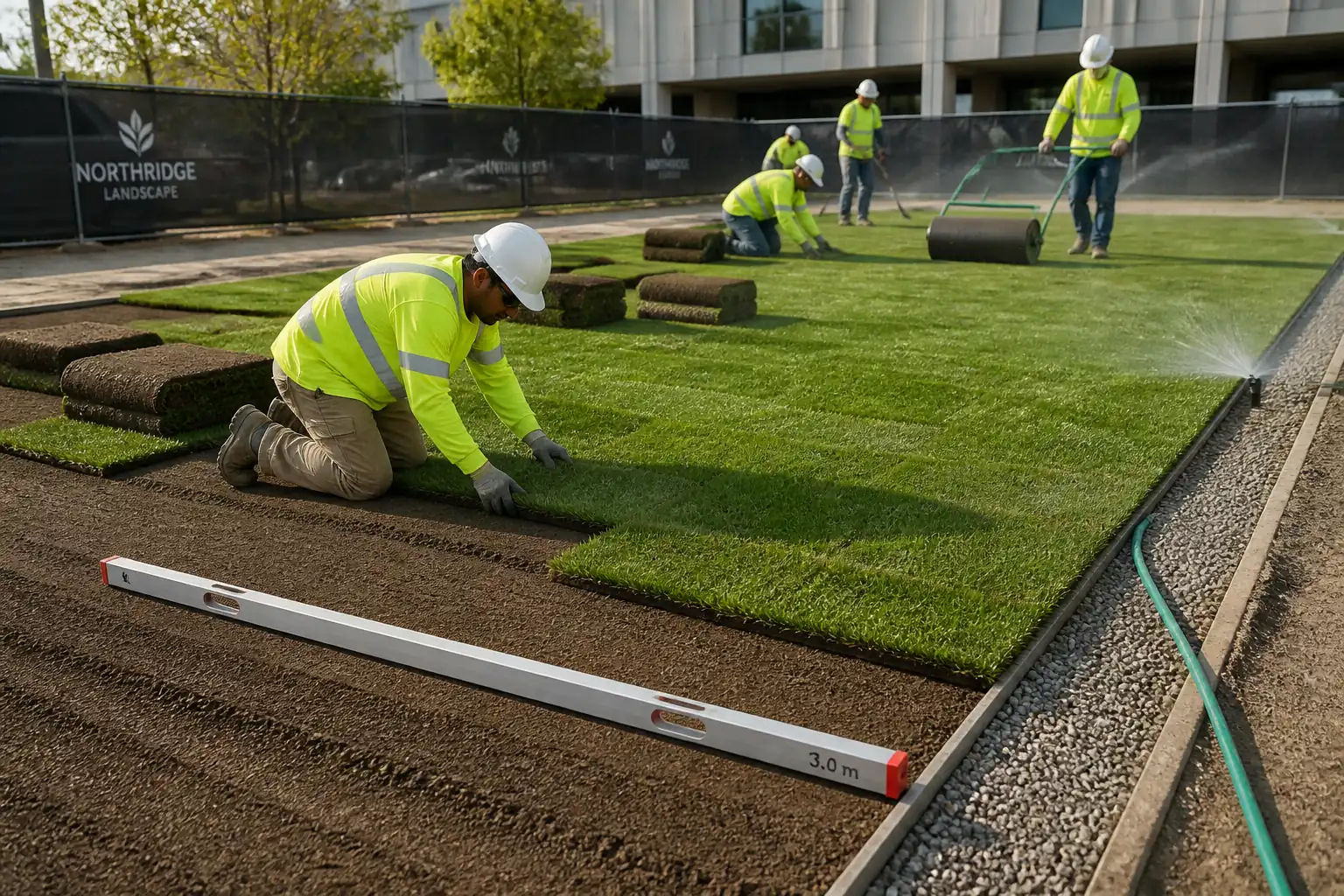

Method Statement – Post-Installation Maintenance of Soft Landscaping During Handover Period – Method Statement
AI-assisted method statement with matching ITP, PDF download, and Excel export.
More than a static template
Unlike a downloadable Word or PDF template, this method statement is an AI-assisted editable starting point connected directly to a matching Inspection and Test Plan. Every section is structured, project-adaptable, and ready to export.
- AI-assisted drafting — Customize every section with AI for your specific project scope.
- Linked ITP — A matching inspection and test plan is generated alongside the method statement.
- Multiple export formats — Download as a formatted PDF or editable Excel spreadsheet.
- Editable starting point, not a final document — Review, verify, and adjust all content against your project requirements before use.
Static template vs. Quollnet workflow
| Feature | Static template | Quollnet |
|---|---|---|
| Project-specific content | Manual fill-in required | AI-assisted customization |
| Linked ITP | Separate document, no link | Matching ITP included |
| Export formats | Usually PDF only | PDF and Excel |
| Structured sections | Free-form layout | 13 standardized sections |
| Saved to your account | Local file only | Cloud-saved, reusable |
| Content accuracy | You verify everything | AI-assisted, you still verify |
| Cost | Often free but time-intensive | Free to customize and download |
What you can customize
When you save this method statement to your account, every section becomes editable. The following 13 sections are included:
- Scope — Defines the activity and its boundaries.
- References — Standards, specifications, and drawings.
- Responsibilities — Roles and accountabilities.
- Resources — Labour, plant, and equipment summary.
- Materials — Materials and compliance requirements.
- Equipment — Tools and equipment details.
- Prerequisites — Hold points and pre-conditions.
- Method sequence — Step-by-step construction sequence.
- Safety controls — HSE risk controls and PPE.
- Environmental controls — Environmental mitigation measures.
- QA/QC — Quality inspection and test requirements.
- ITP — Inspection and Test Plan table (has its own page).
- Attachments — Referenced drawings and documentation.
Why this method statement is used
This method statement is used to define and communicate the approved procedure for carrying out method statement – post-installation maintenance of soft landscaping during handover period on site. It ensures the work is planned in advance, the correct resources and controls are in place, and all personnel understand responsibilities, sequence, quality requirements, and safety controls before work begins. It aligns site execution with the documented scope and acceptance expectations.
Who uses this method statement
This method statement is used by contractors, site supervisors, project engineers, QA/QC engineers, HSE officers, consultants, and client representatives. It serves as a shared reference for planning, execution, supervision, inspection, and approval of the activity on site.
When it is prepared and submitted
The method statement is prepared before the work activity starts and submitted as part of the pre-construction documentation package for review and approval.
Who reviews or approves it
The method statement is usually submitted to the client representative, consultant, resident engineer, or project management consultant for review and approval before the work commences.
Important approval note
This method statement is an AI-assisted editable starting point, not a pre-approved document. Before use on any project, all content must be reviewed and approved by the relevant parties (superintendent, principal contractor, or client representative) in accordance with your contract and project quality plan.
For example: if your specification requires a departure from a referenced standard, that departure must be documented and approved separately — this method statement will not capture that automatically. Always verify against your applicable drawings, specifications, and regulatory requirements.
Method statement content
Scope
Overview
This method covers all post-installation soft landscape maintenance activities during the defects liability/handover period, including:
- Automated irrigation evaluation and adjustment (ET/soil moisture-based scheduling)
- Periodic fertilization (granular and/or liquid as appropriate)
- Weeding (manual and selective herbicide spot treatment)
- Pest and disease monitoring and control (IPM; spraying where required)
- Selective pruning and training of shrubs, groundcovers, hedges, and young trees
- Replacement of dead/declining plants, including watering-in, staking, and mulch reinstatement
- Housekeeping, litter removal, edging, and presentation standards
- Monitoring, reporting, and records to demonstrate compliance for handover
Areas Covered
- Planted beds, groundcovers, shrubs, hedges, trees, palms, and turf within
- Associated automated irrigation systems: controllers, valves, filters, meters, emitters/sprinklers, and driplines
Timeframe and Frequency
- Maintenance spans the entire handover/defects liability period [Typical: 12 months – Verify per contract]
- Minimum frequencies (unless more stringent in project specs):
1. Irrigation check/program update: monthly during growing season; quarterly otherwise
2. Irrigation audit (distribution uniformity/pressure/flow): quarterly
3. Fertilization: 2–4 times/year for shrubs/groundcovers; 3–6 times/year for turf; trees per soil test [Verify per project specifications]
4. Weeding: fortnightly minimum during growing season; monthly otherwise
5. Pest/disease scouting: weekly growing season; biweekly otherwise
6. Pruning: seasonal per species; hedge clipping as required to maintain profile
7. Replacement planting: within 10 working days of identification/approval [Verify]
Performance Targets [Verify per project specifications]
- Irrigation: sprinkler DUlq ≥ 0.60; drip emission uniformity ≥ 0.85; zone pressure within ±10% of design
- Soil moisture (root zone, non-rain days): 60–80% field capacity for beds; 50–70% for turf
- Weeds: ≤2% cover in beds; ≤5 weeds/m² in turf
- Pests/diseases: maintained below economic/aesthetic threshold (e.g., <10% leaf damage or <5% infestation on sample plants) using IPM
- Turf: uniform color/coverage ≥90% with thatch ≤10 mm [Verify]
- Mulch: maintained at 50–75 mm depth; clear 50–75 mm around stems/trunks
- Plant mortality: ≤2% per month and ≤5% cumulative by end of period [Verify]; immediate replacement of failed stock
- Pruning: correct cut placement with collar retained; no topping or flush cuts; max canopy removal per visit ≤25% for shrubs/trees
- Presentation: litter-free; edges neat; stakes/ties intact and not abrading bark
References
| Document Type | Reference / Number | Revision | Notes |
|---|---|---|---|
| Standard | BS 7370 Series | Use applicable parts for turf, shrubs, trees, hedges. | |
| Standard | BS 4428 | ||
| Standard | BS 3882 | ||
| Standard | BS 3936 (Series) | Verify applicable part for trees, shrubs, groundcovers. | |
| Guideline | FAO-56 (Allen et al.) | Use ET0 with landscape coefficients (KL) [Verify per species]. | |
| Guideline | Irrigation Association (IA) Guidelines | Qualified Landscape Irrigation Auditor (QLIA) preferred. | |
| Guideline/Regulation | FAO IPM guidance; Applicable local pesticide regulations [Verify] | Only approved products; licensed applicators as required. | |
| Standards | ISO 9001; ISO 14001; ISO 45001 | ||
| Regulation/Standard | EU Fertilising Products Regulation (EU) 2019/1009 or local equivalent [Verify] | Follow SDS and label instructions. | |
| Guideline | FAO Guidelines for Water Quality in Agriculture | Check EC, SAR, pH if specified by project. |
Responsibilities
| Role | Responsibility | Name / Party |
|---|---|---|
| Project Manager | Contractor Project Manager | Contractor |
| Landscape Manager | Landscape Manager | Contractor |
| Agronomist | Horticulturist/Agronomist | Contractor |
| Irrigation Technician | Irrigation Technician | Contractor |
| Applicator | Licensed Pesticide Applicator / Trained Operative | Contractor |
| QA/QC | QA/QC Engineer | Contractor |
| HSE Officer | HSE Officer | Contractor |
| Engineer | Engineer/Employer’s Representative | Engineer |
Resources
| Resource Type | Description | Quantity | Remarks |
|---|---|---|---|
| Personnel | Gardeners/landscape operatives | As scheduled | |
| Personnel | Arborist for tree pruning over 75 mm diameter; irrigation specialist; agronomist | As needed | |
| Personnel | Planner, document controller for ITP/records | 1–2 |
Materials
| Material | Specification / Grade | Quantity | Remarks |
|---|---|---|---|
| CRF | Nutrient content ±10% of label | As per plan | |
| Liquid fert | As required | ||
| Mulch | To 50–75 mm depth | ||
| Herbicide | As needed | ||
| Pesticides | As needed | ||
| Plants | As required | ||
| Stakes/Ties | As required | ||
| Irrigation spares | Stocked for 5% of installed qty [Verify] |
Equipment
| Equipment | Capacity / Type | Quantity | Inspection Required |
|---|---|---|---|
| Controller tools | As required | Yes | |
| Meters/Gauges | 1 set/crew | Yes | |
| Moisture meter | 1/crew | Yes | |
| Spreaders | As required | Yes | |
| Sprayers | As required | Yes | |
| Pruning tools | Sets per crew | Yes | |
| Access/Safety | As needed | Yes | |
| Locator | 1 shared | Yes |
Prerequisites
- Approved method statement, risk assessment, and ITP
- Approved materials list (fertilizers, pesticides, replacement plants) with SDS
- Latest as-built landscape and irrigation drawings; zone schedules and valve locations
- Weather forecast checked (wind < 15 km/h, no heavy rain within 24 h for spraying/fertilization) [Verify per project HSE plan and local regulations]
- Equipment calibration certificates (sprayers, spreaders, moisture meters, pressure/flow gauges) within validity
- Toolbox talks: task-specific (spraying, pruning, traffic interface, heat stress)
- Permits: Work at Height (if applicable), Chemical Use/Spraying Permit, Traffic Management Plan for roadside works [Verify]
- IPM and fertilization plans approved by Engineer for the season (including thresholds and products)
- Potable/irrigation water supply availability confirmed; backflow prevention functioning where required
- Utility check/scan for any excavation to replace plants; irrigation services located and isolated as necessary
- Waste management and spill response kits available; containment for chemical mixing areas
- Exclusion zones and public protection plan for works in public-access areas
Method Sequence
| Step | Activity | Description | Responsibility | Inspection / Hold Point |
|---|---|---|---|---|
| 1 | Mobilization and area protection | Set up signage/barriers; confirm zones; protect public interface; verify permits and crew briefing. | Landscape Manager | HSE Officer walk-down |
| 2 | Pre-maintenance condition survey | Survey all areas; record plant health, weeds, pests, irrigation issues; mark replacements; photos and geotagging where practicable. | QA/QC Engineer | Engineer may witness |
| 3 | Irrigation audit (quarterly) | Measure static/dynamic pressure, zone flow, and distribution uniformity (catch-can for sprinklers; flow-by-emitter for drip). Identify leaks, clogs, overspray, misting. | Irrigation Technician | QA/QC review |
| 4 | Controller programming | Set seasonal schedules using ET0 × KL or soil moisture triggers; apply cycle-and-soak as needed; time-of-day restrictions observed. | Irrigation Technician | Engineer spot-check |
| 5 | Irrigation hardware maintenance | Clean filters; flush drip laterals; replace clogged/damaged emitters; adjust sprinklers to avoid hardscape. | Irrigation Technician | QA/QC check |
| 6 | Soil testing and nutrient plan | Collect composite soil samples (beds/turf) as per plan; test pH, EC, OM, N-P-K, and texture if required. | Agronomist | Engineer may witness |
| 7 | Fertilizer application | Calibrate spreaders; apply CRF or soluble per plan; irrigate-in as required. | Applicator | QA/QC sampling |
| 8 | Weeding – manual and selective chemical | Hand weed with root removal; spot-apply selective herbicides if approved; shield ornamentals; avoid broadcast use. | Landscape Supervisor | QA/QC check |
| 9 | Pest/disease scouting and thresholds | Weekly scouting; identify pests/diseases; set action thresholds; recommend cultural/biological/chemical controls. | Agronomist | Engineer review (monthly) |
| 10 | Pesticide application (if required) | Prepare approved mix; verify wind < 15 km/h; establish exclusion zone; apply with low-drift nozzles; observe REI/PHI. | Licensed Applicator | HSE Officer/QA to witness |
| 11 | Selective pruning and training | Remove dead/diseased/damaged wood; shape shrubs/hedges; structural training for young trees; disinfect tools between plants as needed. | Arborist/Landscape Supervisor | QA/QC visual |
| 12 | Mulch top-up and soil moisture management | Reinstate mulch to 50–75 mm; rake level; keep clear from stems; adjust irrigation cycle-and-soak to prevent runoff. | Landscape Supervisor | QA/QC check |
| 13 | Dead/declining plant identification and approval | Tag plants for replacement; record species/size/location; propose replacement list to Engineer. | Landscape Manager | Engineer approval |
| 14 | Replacement planting | Excavate minimally; verify utilities/irrigation; set plant with root flare at finished grade; backfill and firm; install stakes/ties; water-in. | Landscape Supervisor | QA/QC and Engineer witness |
| 15 | Establishment irrigation (replacements) | Set temporary increased frequency for 2–4 weeks; gradually taper to standard schedule. | Irrigation Technician | QA/QC spot-check |
| 16 | Cleaning and reporting | Remove green waste; recycle where feasible; submit monthly KPI report and as-built updates for irrigation changes. | Landscape Manager | Engineer review |
Health, Safety and Environment – Task-Specific Safety Controls
Key Hazards and Controls
-
Hazard: Chemical exposure (herbicides/pesticides/fertilizers)
- Likely consequence: Skin/eye irritation, inhalation toxicity, poisoning
- Engineering/procedural control: Use only approved products and doses; mixing in bunded/ventilated area; closed transfer where available; nozzles selected for low drift; avoid spraying in wind > 15 km/h or near watercourses without buffer; maintain REI/PHI; emergency eyewash and spill kit on site [Verify per project HSE plan and local regulations]
- Required PPE: Chemical-resistant gloves (nitrile), goggles/face shield, coveralls, chemical apron for mixing, boots, organic vapor/P2 respirator if label requires
- Collective preventive measure: Exclusion zones with signage; buddy system during spraying; drift shields
- Inspection/permit/supervision: Permit to Spray; SDS on hand; licensed applicator supervision; equipment calibration record -
Hazard: Pressurized irrigation systems (unexpected activation, hose bursts)
- Likely consequence: Struck-by water jets, slips, electrical short if near controllers
- Engineering/procedural control: Isolate zones under service; lockout on controllers during maintenance; depressurize before repair; pressure-rated fittings
- PPE: Waterproof gloves, safety boots, eye protection
- Collective measure: Tag-out controls; barriers around open valve boxes
- Inspection/permit/supervision: Pre-task isolation checklist; supervisor verification -
Hazard: Manual handling (mulch bags, plants, equipment)
- Likely consequence: Strains, sprains, back injury
- Engineering/procedural control: Use mechanical aids/wheelbarrows; team lifts; split loads; plan delivery points to minimize carries
- PPE: Gloves, supportive footwear
- Collective measure: Ergonomic training; rotate tasks
- Inspection/permit/supervision: Manual handling assessment; toolbox talk -
Hazard: Pruning and sharp tools
- Likely consequence: Cuts, punctures, eye injuries
- Engineering/procedural control: Keep blades sharp; two-hand operation policies; maintain safe distances; disinfect tools between plants; use pole tools to avoid ladders where possible
- PPE: Cut-resistant gloves, safety glasses/face shield, long sleeves
- Collective measure: Tool control and storage; exclusion around pruning zone
- Inspection/permit/supervision: Daily tool inspection; Work at Height permit if ladders/platforms required -
Hazard: Work at height for hedge tops or young tree training
- Likely consequence: Falls from height
- Engineering/procedural control: Prefer podium steps/mobile platforms; three points of contact; do not overreach; secure ladders on firm level ground
- PPE: Non-slip footwear, fall restraint if using MEWP (per manufacturer)
- Collective measure: Spotter; barricades
- Inspection/permit/supervision: WAH permit; equipment inspection tags -
Hazard: Public interface/traffic (roadside planting)
- Likely consequence: Struck-by vehicles; public exposure to chemicals/tools
- Engineering/procedural control: Traffic Management Plan; work off-peak; cones, signs, and barriers; chemical works outside public hours where feasible
- PPE: Hi-vis, safety boots, hard hat if required
- Collective measure: Diversions, lookouts
- Inspection/permit/supervision: Traffic permit; supervisor present -
Hazard: Heat stress/UV exposure
- Likely consequence: Heat exhaustion, sunburn
- Engineering/procedural control: Schedule in cooler hours; shaded breaks; hydration plan (250 ml every 15–20 min in heat); acclimatization
- PPE: Sun hat, UV-rated clothing, sunscreen (SPF 30+)
- Collective measure: Shade tents; cooled water stations
- Inspection/permit/supervision: Environmental monitoring; fit-for-work check -
Hazard: Wildlife/nesting birds
- Likely consequence: Legal/environmental non-compliance, bites/stings
- Engineering/procedural control: Pre-pruning wildlife check; defer works if nests active [Verify per local wildlife regs]
- PPE: Gloves, long sleeves
- Collective measure: Exclusion zones
- Inspection/permit/supervision: Ecology approval where applicable -
Hazard: Slips/trips from hoses, uneven ground, wet surfaces
- Likely consequence: Sprains/fractures
- Engineering/procedural control: Route hoses/cables safely; maintain housekeeping; anti-slip footwear
- PPE: Safety boots
- Collective measure: Cord covers/signage
- Inspection/permit/supervision: Supervisor inspections during shift
Environmental Controls
- Chemical stewardship: IPM hierarchy (cultural/biological first); use lowest effective toxicity; no spraying within buffer zones of water bodies unless method approved; drift control nozzles; wind < 15 km/h; avoid rain within 24 h. Collect and dispose triple-rinsed containers per local regulations.
- Water conservation: ET/soil moisture-based scheduling; repair leaks within 48 h; adjust precipitation rate and cycle-and-soak to eliminate runoff; nighttime irrigation unless restricted by local rules.
- Runoff and spill prevention: No chemical mixing near drains; use bunded trays; spill kits carried by spray crews; immediate containment and reporting.
- Soil protection: Avoid over-irrigation causing leaching; prevent compaction by limiting equipment on saturated soils; maintain mulch to reduce evaporation and weeds.
- Waste management: Segregate green waste for composting/mulch where approved; recycle pots, stakes, and packaging; dispose of contaminated waste as hazardous per regulations.
- Biodiversity: Avoid pruning during nesting/breeding seasons unless safety-critical; protect habitat features; retain flowering/seed heads in designated ecological areas if specified by project.
- Noise and air: Maintain equipment; restrict noisy operations to permitted hours; avoid idling of vehicles.
- Water quality monitoring (if specified): Periodic EC/pH checks of irrigation water where salinity risks exist [Verify per project specifications].
Quality Assurance and Quality Control
QA/QC Processes
- Inspections per ITP; hold points before chemical applications and before replacements
- Calibration: sprayers/spreaders/moisture meters/flow and pressure gauges checked before use and at least quarterly; certificates retained
- Records: controller logs, irrigation audits, soil tests, fertilizer logs, spray logs (product, rate, lot, wind, temp, REI), pruning logs, replacement registers, photographs
- Testing frequencies:
- Irrigation DU/pressure/flow: quarterly
- Soil testing: baseline then every 6 months [Verify]
- Water quality (if required): baseline then annually [Verify]
- Acceptance criteria summary [Verify per project specifications]:
- Irrigation: DUlq ≥ 0.60 (sprinklers); EU ≥ 0.85 (drip); pressure ±10% of design; no leaks/overspray
- Soil moisture: beds 60–80% FC; turf 50–70% FC
- Weeds: ≤2% cover in beds; ≤5 weeds/m² turf
- Pests/diseases: below agreed thresholds; no visible phytotoxicity
- Mulch: 50–75 mm depth; clear of stems/trunks by 50–75 mm
- Turf: ≥90% live cover; even color; thatch ≤10 mm
- Pruning: correct cuts; no more than 25% canopy removal per operation; no damage to bark/collars
- Replacement plants: like-for-like; plumb; correct depth with root flare at grade; adequate watering-in; stakes/ties correct; survival after 30 days ≥ 95%
- Nonconformance: Record NCR; implement corrective action within 10 working days or as instructed; re-inspect and close NCR
- Handover documentation: monthly KPI dashboards, maintenance schedules, as-built updates, warranties, and training records for Employer’s O&M team if applicable
Attachments
- A1: Pre-start HSE checklist and Permit to Spray template
- A2: Irrigation audit form (pressure/flow/DU) and controller log template
- A3: Soil sampling protocol and lab chain-of-custody form
- A4: Fertilizer calibration and application record
- A5: IPM scouting sheet and spray application log
- A6: Pruning inspection checklist
- A7: Replacement plant register and planting inspection form
- A8: Monthly KPI dashboard template (weeds, DU, moisture, mortality, pests)
- A9: SDS for all approved chemicals
- A10: Equipment calibration certificates and tool inspection logs
This content is a read-only public reference. Download or customize to get an editable version.
ITP preview
The first inspection activities from the linked ITP for Method Statement – Post-Installation Maintenance of Soft Landscaping During Handover Period:
| Activity | Inspection / Test | Acceptance Criteria | Responsibility | Record |
|---|---|---|---|---|
| Pre-start HSE and permit checks | Pre-start HSE checklist; PTW (as applicable) | All permits valid; controls in place; toolbox talk conducted | HSE Officer / Supervisor | Signed pre-start checklist; TBT record |
| Pre-maintenance condition survey | HP – Survey submitted to Engineer for review | Survey complete with photos and action plan | QA/QC Engineer | Survey report; photos |
| Irrigation audit (quarterly) | DUlq/EU test; pressure and flow readings | Sprinklers DUlq ≥ 0.60; Drip EU ≥ 0.85; pressure ±10% design; no leaks | Irrigation Technician / QA | Audit sheets; meter readings |
Showing 3 of 12 inspection activities. View full ITP →
Related Inspection and Test Plan
An Inspection and Test Plan (ITP) is available for Method Statement – Post-Installation Maintenance of Soft Landscaping During Handover Period. The ITP defines the inspection activities, acceptance criteria, hold and witness points, responsible parties, and records required to verify the work described in this method statement.
View the Method Statement – Post-Installation Maintenance of Soft Landscaping During Handover Period ITP →Frequently asked questions
Continue with related Quollnet resources connected to this method statement.