
Method Statement: Spreading and Final Grading of Topsoil for Landscape Areas – Method Statement
AI-assisted method statement with matching ITP, PDF download, and Excel export.
More than a static template
Unlike a downloadable Word or PDF template, this method statement is an AI-assisted editable starting point connected directly to a matching Inspection and Test Plan. Every section is structured, project-adaptable, and ready to export.
- AI-assisted drafting — Customize every section with AI for your specific project scope.
- Linked ITP — A matching inspection and test plan is generated alongside the method statement.
- Multiple export formats — Download as a formatted PDF or editable Excel spreadsheet.
- Editable starting point, not a final document — Review, verify, and adjust all content against your project requirements before use.
Static template vs. Quollnet workflow
| Feature | Static template | Quollnet |
|---|---|---|
| Project-specific content | Manual fill-in required | AI-assisted customization |
| Linked ITP | Separate document, no link | Matching ITP included |
| Export formats | Usually PDF only | PDF and Excel |
| Structured sections | Free-form layout | 13 standardized sections |
| Saved to your account | Local file only | Cloud-saved, reusable |
| Content accuracy | You verify everything | AI-assisted, you still verify |
| Cost | Often free but time-intensive | Free to customize and download |
What you can customize
When you save this method statement to your account, every section becomes editable. The following 13 sections are included:
- Scope — Defines the activity and its boundaries.
- References — Standards, specifications, and drawings.
- Responsibilities — Roles and accountabilities.
- Resources — Labour, plant, and equipment summary.
- Materials — Materials and compliance requirements.
- Equipment — Tools and equipment details.
- Prerequisites — Hold points and pre-conditions.
- Method sequence — Step-by-step construction sequence.
- Safety controls — HSE risk controls and PPE.
- Environmental controls — Environmental mitigation measures.
- QA/QC — Quality inspection and test requirements.
- ITP — Inspection and Test Plan table (has its own page).
- Attachments — Referenced drawings and documentation.
Why this method statement is used
This method statement is used to define and communicate the approved procedure for carrying out method statement: spreading and final grading of topsoil for landscape areas on site. It ensures the work is planned in advance, the correct resources and controls are in place, and all personnel understand responsibilities, sequence, quality requirements, and safety controls before work begins. It aligns site execution with the documented scope and acceptance expectations.
Who uses this method statement
This method statement is used by contractors, site supervisors, project engineers, QA/QC engineers, HSE officers, consultants, and client representatives. It serves as a shared reference for planning, execution, supervision, inspection, and approval of the activity on site.
When it is prepared and submitted
The method statement is prepared before the work activity starts and submitted as part of the pre-construction documentation package for review and approval.
Who reviews or approves it
The method statement is usually submitted to the client representative, consultant, resident engineer, or project management consultant for review and approval before the work commences.
Important approval note
This method statement is an AI-assisted editable starting point, not a pre-approved document. Before use on any project, all content must be reviewed and approved by the relevant parties (superintendent, principal contractor, or client representative) in accordance with your contract and project quality plan.
For example: if your specification requires a departure from a referenced standard, that departure must be documented and approved separately — this method statement will not capture that automatically. Always verify against your applicable drawings, specifications, and regulatory requirements.
Method statement content
Scope
Extent
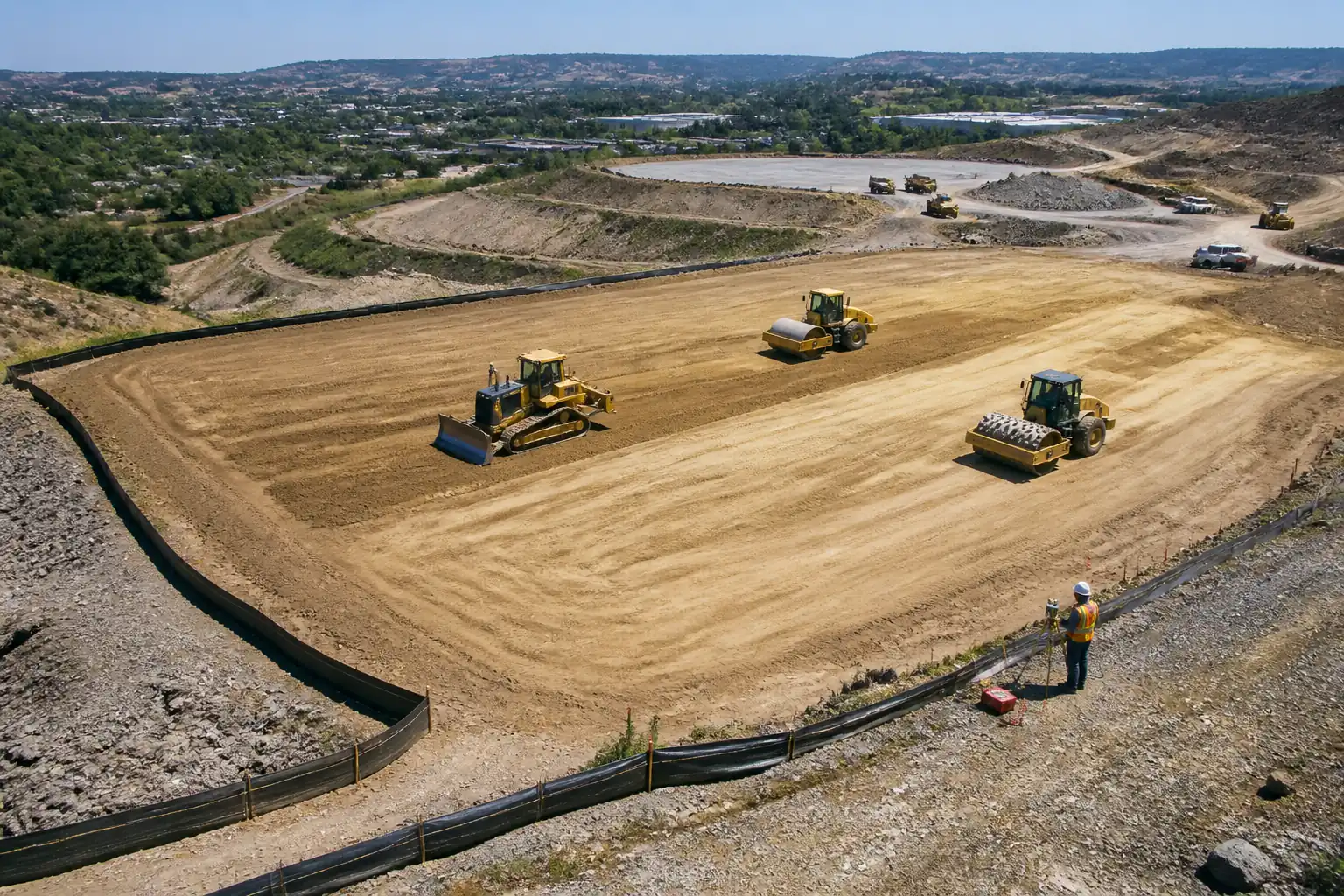
- Spreading, leveling, and final grading of topsoil for landscape areas (lawns/turf, shrub beds, general planting areas) including:
- Subgrade preparation and proofing.
- Weed removal and, if required, pre-plant herbicide application.
- Verification and adjustment of topsoil quality.
- Incorporation of organic ameliorants and soil conditioners as specified.
- Layered placement of topsoil to achieve specified compacted depths.
- Final trimming and grading to lines, levels, and falls.
- Pre-planting light compaction control and surface preparation.
- QA/QC testing and ITP compliance.
- Protection of finished surfaces until handover.
Exclusions
- Planting, turf laying, hydroseeding, mulching (by others unless noted).
- Irrigation installation and testing (by others) except interface checks and protection.
- Tree pit excavation/backfilling beyond protection and topsoil feathering at edges.
Typical Performance Targets [Verify per project specifications]
- Finished topsoil compacted depths (typical benchmarks):
- Lawns/turf: 150 mm (min 120 mm local) after settlement.
- Shrub/groundcover beds: 300–450 mm depending on species/rooting depth.
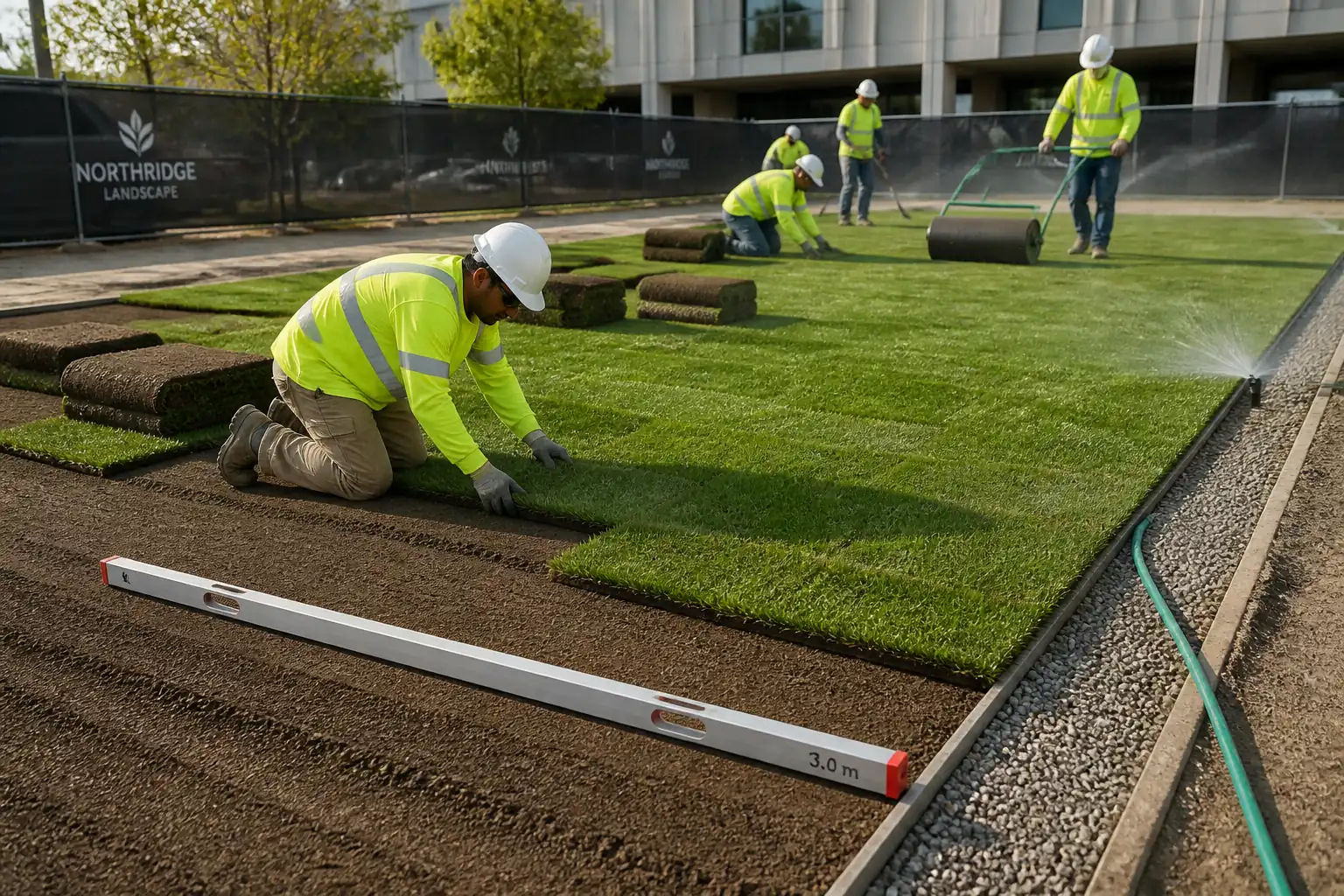
- Finished level tolerance: ±15 mm (lawns) and ±20 mm (beds) relative to design; local irregularities under a 3 m straightedge not exceeding 20 mm.
- Surface falls: 1.5%–3% for lawns where feasible; minimum 1% to avoid ponding unless designed flat.
- Stones/debris at surface: none >50 mm in any dimension; for turf, none >25 mm within top 50 mm.
- Compaction: Soil friable; bulk density within benchmark ranges by texture class [e.g., sandy loam 1.4–1.6 g/cm³; clay loam 1.2–1.5 g/cm³] without impeding root growth [Verify].
- Infiltration: Indicative field infiltration rate ≥25 mm/hr for amenity soils [Verify].
References
| Document Type | Reference / Number | Revision | Notes |
|---|---|---|---|
| Standard | BS 3882:2015 | Use classification and property ranges per project specification. | |
| Standard | BS 8601:2013 | ||
| Standard | BS 4428:1989 | Often referenced for practical guidance where not superseded by project specs. | |
| Standard | BS EN 13037/13038/13039/13040/13041 | Use accredited lab methods; align with BS 3882 property limits. | |
| Standard | ASTM D698, ASTM D1557, ASTM D3385 | Topsoil acceptance focuses on friability, bulk density, penetration resistance, and infiltration rather than percent compaction. | |
| Standard | PAS 100 | Use screened, stable compost; confirm maturity and contaminants limits. | |
| Standard | ISO 9001, ISO 14001, ISO 45001 | Apply project-certified systems. |
Responsibilities
| Role | Responsibility | Name / Party |
|---|---|---|
| Construction Manager | Construction Manager | Contractor |
| Site Engineer / Surveyor | Site Engineer / Land Surveyor | Contractor |
| QA/QC Engineer | QA/QC Engineer | Contractor |
| HSE Officer | HSE Officer | Contractor |
| Engineer/LA | Employer’s Representative / Landscape Architect | Engineer |
| Plant Operator | Plant Operators (certified) | Contractor |
| Landscaping Crew | Skilled Landscapers / Labor Crew | Contractor |
| Specialist | Soil Scientist/Agronomist (external) | Subconsultant |
Resources
| Resource Type | Description | Quantity | Remarks |
|---|---|---|---|
| Personnel | Construction Manager, Site Engineer, Foreman | As required | |
| Personnel | Skilled landscapers, laborers for raking, stone picking, amendments mixing. | 1 crew per 1,000–2,000 m²/day [Verify] | |
| Personnel | Certified operators for loader/skid-steer/roller. | As required |
Materials
| Material | Specification / Grade | Quantity | Remarks |
|---|---|---|---|
| Topsoil | BS 3882:2015 compliant | As per BOQ | |
| Compost | PAS 100 | As per soil report | |
| Sand | Project spec | As required | |
| Lime/Sulfur | Project spec | As required | |
| Fertilizer | Project spec | As specified | |
| Herbicide | Label specific | As required |
Equipment
| Equipment | Capacity / Type | Quantity | Inspection Required |
|---|---|---|---|
| Skid-Steer/Loader | 1–2 m³ bucket | 1–2 units | Yes |
| Grader Attachment | As required | Yes | |
| Tiller | As required | Pre-use check | |
| Roller | ≤1.5 t | As required | Yes |
| Plate Compactor | <100 kg | As required | Yes |
| Water Bowser | 5–10 m³ | As required | Yes |
| Hand Tools | Sets per crew | Pre-use | |
| Test Instruments | As required | Yes |
Prerequisites
Administrative and Technical
- Approved shop drawings/landscape grading plans and latest IFC levels.
- Method Statement and ITP approved.
- Material submittals approved: topsoil source tests, compost certificates, conditioners, herbicides (if any).
- Survey control established; benchmarks verified.
- Coordination: drainage, kerbs/edgings, utility covers set to final levels; irrigation stub-outs located and protected.
- Tree protection zones established and fenced; no plant within RPZ.
Site Condition Requirements
- Subgrade approved (smooth, firm, free-draining, uniform falls), free from ruts >25 mm, debris, and standing water.
- Underground services located/marked. Permit-to-dig in place where required.
- Weather: Do not spread on frozen, waterlogged, or excessively dry/windy conditions causing dust or structure damage.
- Access routes defined with low-ground-pressure paths or protection mats to avoid contamination and compaction.
Testing/Inspection Readiness
- Topsoil pre-acceptance test results available and reviewed.
- Depth pins fabricated/marked for each area; test frequency plan defined.
- Equipment calibrated and pre-start inspections completed.
- HSE documentation: task risk assessment (TRA), TBT conducted, herbicide permit (if used).
Method Sequence
| Step | Activity | Description | Responsibility | Inspection / Hold Point |
|---|---|---|---|---|
| 1 | Prestart Briefing and Permits | Conduct TRA/TBT; confirm competencies, exclusion zones, traffic routes, and utilities. Issue permit-to-work as applicable. | Construction Manager / HSE Officer | HSE walkdown |
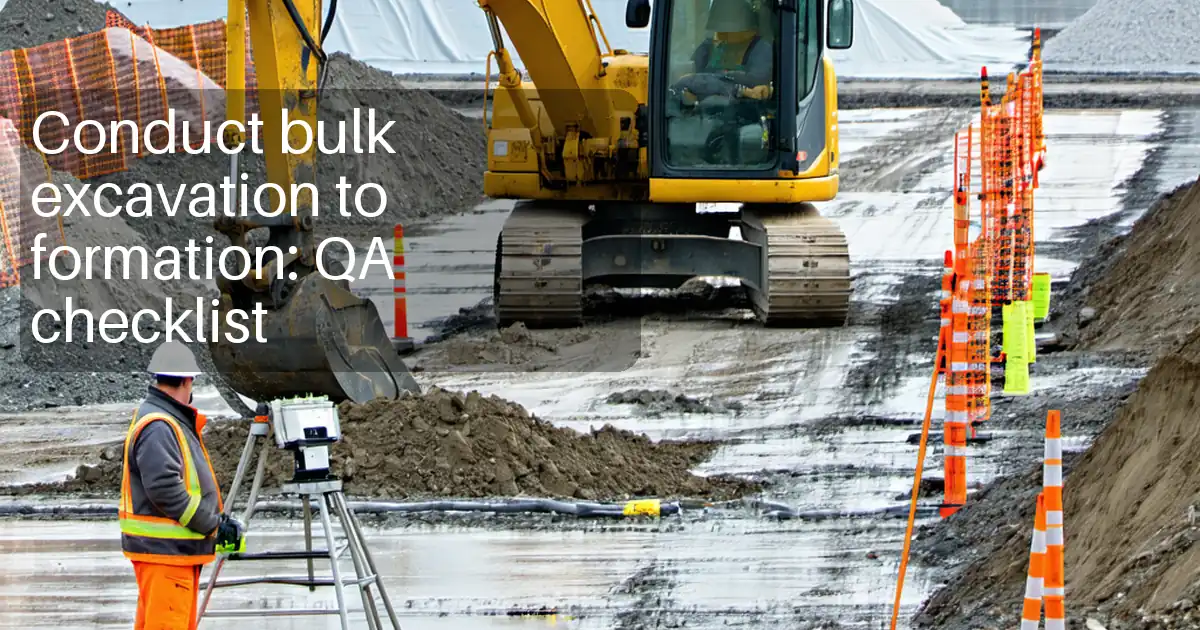
| 2 | Subgrade Verification (Hold Point) | Survey and check formation: levels per design, falls to drainage, firm but not compacted to refusal; remove ruts; trim high spots; fill lows with compatible subsoil. Scarify 75–100 mm where subgrade is sealed to promote percolation. | Site Engineer / QA-QC | Joint inspection with Engineer |
| 3 | Weed and Debris Removal | Hand pick stones/debris >75 mm from subgrade. Mechanically remove weeds and roots. If approved, apply non-residual herbicide to active growth; observe re-entry interval and required wait time before soil works. | Landscaping Crew / Licensed Applicator | HSE and QA checks |
| 4 | Placement of Organic Amendments/Conditioners | Spread compost 25–75 mm uniformly or as per lab recommendation; add sand/conditioners if specified. Avoid mixing when soil is wet/plastic. | Landscaping Crew | Visual coverage check |
| 5 | Initial Tillage and Blending | Rotavate/harrow to 100–150 mm depth to blend amendments with existing topsoil or upper subsoil (if instructed) without bringing subsoil to surface; avoid smearing. | Plant Operator / Landscapers | Supervisor check |
| 6 | Topsoil Delivery and Stockpile Management | Deliver approved topsoil; verify loads; tip on clean hardstanding; stockpiles ≤2.5 m high, side slopes stable; cover to prevent weed ingress and erosion; segregate from subsoil. | Logistics / QA-QC | Visual; random sampling |
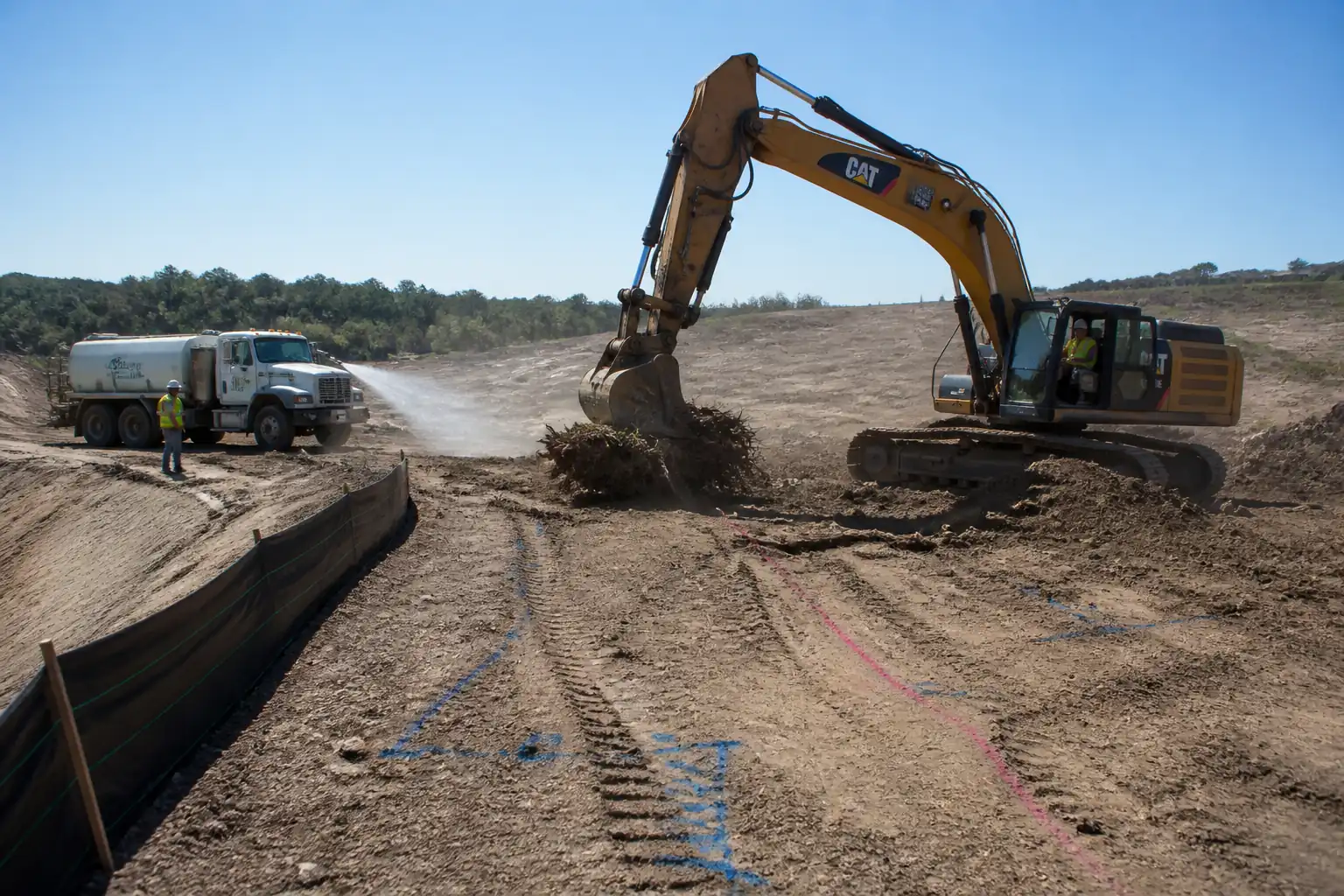
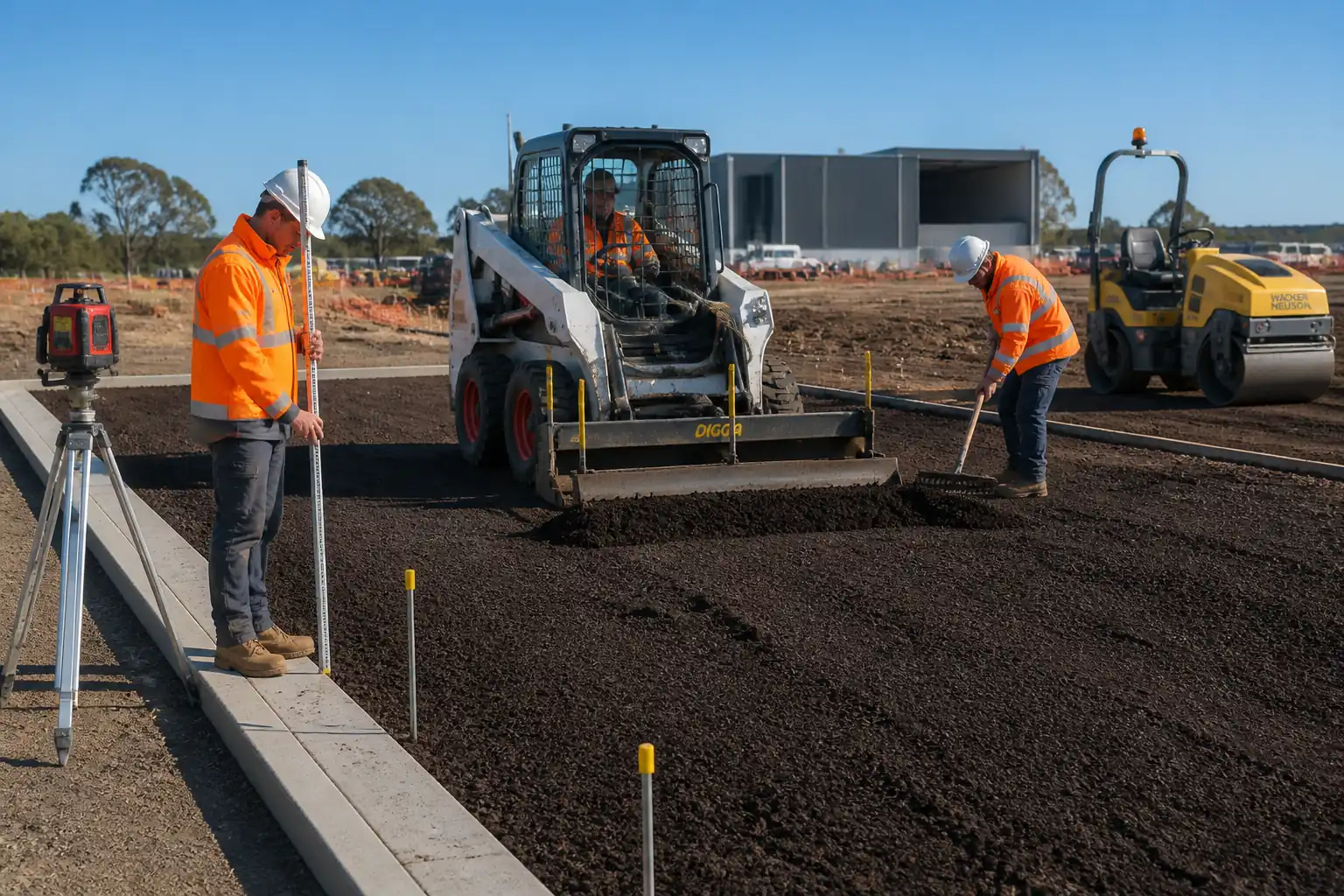
| 7 | Layered Spreading of Topsoil | Spread in thin lifts 100–150 mm loose using low-ground-pressure loader/box blade from stockpiles; avoid pushing across long distances to minimize segregation; keep equipment off finished edges with protection boards/mats. | Plant Operator / Landscapers | Supervisor check; Engineer spot checks |
| 8 | Moisture Conditioning | If dry, lightly irrigate to near field capacity; if wet, allow to drain/dry. Avoid trafficking when plastic or waterlogged. | Landscaping Crew | Supervisor check |
| 9 | Light Settlement and Compaction Control | Apply 1–2 passes of lightweight roller or water settlement; avoid vibration. Along edges/obstructions use hand tampers lightly. Do not exceed bulk density ranges suited to plant growth. | Plant Operator / QA-QC | QA-QC checks |
| 10 | Final Grading and Surface Preparation | Trim to levels/falls using laser/GPS blade; hand rake to remove stones >25–50 mm (per area use), achieve evenness. Form flush interfaces with hardscape allowing for turf/finish thickness. | Site Engineer / Landscapers | Engineer inspection |
| 11 | Pre-Planting Verification (Hold/Witness) | Confirm depths, cleanliness, absence of clods/rills; stones removed to criteria; interfaces neat; RPZ and drainage features intact. | QA-QC / Engineer | Hold/Witness as per ITP |
| 12 | Protection and Handover | Erect barriers/signage; no trafficking; cover with geotextile/protection mats if other trades cross; maintain moisture to prevent crusting; rectify any damage before planting. | Construction Manager / Foreman | Daily inspections |
Health, Safety and Welfare Controls
Principal Task-Specific Hazards and Controls
1) Plant–Pedestrian Interface
- Hazard: Collision with loaders/skid-steers and rollers.
- Consequence: Serious injury/fatality.
- Engineering/Procedural Control: Segregated work zones with barriers; banksman for reversing; one-way routes; flashing beacons and white-noise alarms; exclusion zones ≥5 m around operating plant.
- PPE: Safety boots, hi-vis, hard hat, gloves, safety glasses.
- Collective Measure: Physical barriers and spotters; dedicated plant access.
- Inspection/Permit/Supervision: Daily plant pre-start checks; supervisor to enforce exclusion; permits for work near live traffic [Verify per project HSE plan and local regulations].
2) Ground Instability and Overturning
- Hazard: Plant tipping on soft or sloped ground; stockpile slope failure.
- Consequence: Crush injury, equipment damage.
- Control: Assess ground bearing; use LGP tracks; maintain stockpile height ≤2.5 m with stable slopes (~1V:2H); keep away from edges/voids.
- PPE: As above.
- Collective: Designated stockpile zones with signage; edge protection.
- Inspection/Permit: Foreman to check ground daily; stop work after heavy rain until reassessed.
3) Buried Services Strike
- Hazard: Contact with shallow irrigation, cables, or utilities during scarifying/tilling.
- Consequence: Electrocution, flooding, service outage.
- Control: Utility plans and CAT/Genny scan; permit-to-dig; mark services; reduce tilling depth near services; hand dig within 1 m of marked lines.
- PPE: Dielectric gloves where applicable, safety boots, eye protection.
- Collective: Physical markers and exclusion zones.
- Inspection/Permit: Permit-to-dig; supervisor sign-off; as-built verification before work.
4) Chemical Exposure (Herbicides, Lime/Sulfur)
- Hazard: Skin/eye irritation, inhalation of aerosols/dust.
- Consequence: Burns, respiratory issues.
- Control: Only licensed applicators; follow label/MSDS; use drip-free nozzles; mix in ventilated area; avoid windy conditions; emergency eyewash available.
- PPE: Chemical-resistant gloves, goggles/face shield, long sleeves, respiratory protection if required.
- Collective: Controlled mixing station; spill kits; lockable storage.
- Inspection/Permit: Chemical handling permit; COSHH assessments; supervision; records retained.
5) Manual Handling and Ergonomics
- Hazard: Musculoskeletal injury from raking, lifting bags.
- Consequence: Strains/sprains.
- Control: Mechanical aids; team lifts; limit bag mass per regs; rotate tasks; training in safe raking technique.
- PPE: Gloves, supportive footwear.
- Collective: Use bulk materials and mechanical spreaders where possible.
- Inspection/Permit: Supervisor monitoring; ergonomic assessments.
6) Dust, Bioaerosols, and Particulates
- Hazard: Dust from dry soil/compost; bioaerosols from compost.
- Consequence: Respiratory irritation/asthma sensitization.
- Control: Pre-wet materials; avoid tipping in high winds; minimize drop heights.
- PPE: FFP2/FFP3 mask where dusty.
- Collective: Water bowser suppression; windbreaks.
- Inspection/Permit: Environmental monitoring as required.
7) Noise and Vibration
- Hazard: Prolonged exposure from plant.
- Consequence: Hearing loss, hand–arm vibration issues.
- Control: Use newer low-noise plant; limit exposure durations; maintain equipment.
- PPE: Hearing protection as needed.
- Collective: Job rotation; noise mapping.
- Inspection/Permit: HAVS/noise exposure logs.
8) Work Near Public/Other Trades
- Hazard: Unauthorized access to soft areas or plant zones.
- Consequence: Injury, rework.
- Control: Barriers, signage, marshals for crossings, scheduling to avoid overlaps.
- PPE: Hi-vis.
- Collective: Temporary fencing.
- Inspection/Permit: Daily coordination meetings and permits to access shared corridors.
Environmental Controls
Soil Resource Protection
- Preserve soil structure: No trafficking when wet; use LGP equipment and temporary mats; confine traffic to haul routes.
- Segregate topsoil from subsoil; prevent contamination with concrete washout, fuel, or debris.
- Stockpiles: Height ≤2.5 m; cover or stabilize to prevent erosion and weed colonization; control run-off with silt fencing and toe drains.
Erosion and Sediment Control
- Install silt fences, inlet protection, and berms downslope of work areas; maintain until vegetation established.
- Suspend works during heavy rainfall events to avoid sediment-laden runoff.
Dust and Odor
- Dampen surfaces during dry/windy conditions; adjust operations; cease if dust crosses boundary.
- Manage compost odors by covering and turning only when downwind exposure is minimal.
Invasive and Noxious Weeds
- Inspect incoming topsoil/compost for invasive species; reject contaminated loads.
- Dispose of weed-infested spoil per authority requirements.
Water and Spill Management
- Prevent runoff to watercourses; maintain 10 m buffer from open water [Verify].
- Store fuels/chemicals in bunded areas; spill kits available; report and clean any spill immediately.
Waste
- Segregate packaging, plastic, and stones/debris for appropriate disposal or recycling; maintain records (waste transfer notes).
Tree and Habitat Protection
- Maintain RPZ fencing; no tilling or grading within RPZ without arborist approval; avoid elevation changes over roots.
Compliance
- Follow project CEMP and permits; maintain environmental inspection logs and photographic records. [Verify per project HSE plan and local regulations]
Quality Assurance and Quality Control
Material Approval and Testing
- Topsoil: Pre-acceptance lab testing to BS 3882 property set. Frequency: minimum 1 composite sample per source and 1 per ≤500 m³ delivered, or per spec [Verify].
- Compost: PAS 100 CoC; verify stability/maturity; contaminants per PAS 100 limits.
- Field Verification: Visual and tactile assessment of friability and cleanliness each load.
In-Process Controls
- Depth Checks: Use depth pins and local test pits. Frequency: min 3 checks per 200 m² per layer; additional checks at edges and transitions.
- Levels and Falls: Survey grid ≤10 m spacing for large areas; smaller grids for feature areas [Verify].
- Compaction/Friability: Penetrometer or screwdriver test and bulk density cores as directed. Acceptance focused on rootability and drainage, not percent compaction.
- Infiltration: Double-ring infiltrometer tests at representative locations (1 per 1,000 m² typical) where poor drainage suspected [Verify].
Hold and Witness Points
- HP1: Subgrade approval before any placement.
- HP2: Final grading and pre-planting readiness.
Acceptance Criteria (Typical – Verify)
- Depths: Lawns 150 mm; beds 300–450 mm compacted; local variance ±10 mm.
- Evenness: ≤20 mm deviation under 3 m straightedge.
- Surface: Stones >50 mm removed (lawns >25 mm in top 50 mm), no debris/contaminants.
- Compaction: Friable soil; penetrometer <3,000 kPa at 150 mm; bulk density within texture benchmarks; infiltration ≥25 mm/hr where specified.
Records
- MIRs, delivery tickets, lab test reports, depth/level check sheets, inspection requests and approvals, daily diaries, photos, calibration certs, as-builts.
Attachments
- Approved landscape grading drawings and details.
- Material submittals and approvals (topsoil, compost, conditioners, fertilizers, herbicides).
- Laboratory test reports (BS 3882 compliance, PAS 100, others as applicable).
- Equipment calibration certificates (laser/GPS, infiltrometer where applicable).
- ITP and inspection checklists; hold/witness point notifications.
- TRA/Method-specific Risk Assessment; permits (to dig, chemicals, access).
- Waste management plan; soil stockpile layout and protection details.
- As-built survey records and photographic documentation.
This content is a read-only public reference. Download or customize to get an editable version.
ITP preview
The first inspection activities from the linked ITP for Method Statement: Spreading and Final Grading of Topsoil for Landscape Areas:
| Activity | Inspection / Test | Acceptance Criteria | Responsibility | Record |
|---|---|---|---|---|
| Material approval – topsoil and amendments | Review supplier CoC and lab tests vs BS 3882/PAS 100 | Conform to approved submittal and specified ranges [Verify] | MIR, lab reports, approvals | |
| Subgrade inspection (HP1) | Levels/falls check, surface condition, drainage observation | ±20 mm to design; no ponding; clean and firm | IR with survey report | |
| Weed removal / herbicide application (if used) | Visual check; review application log | No perennial weeds; herbicide per label and permit | Inspection checklist; application log |
Showing 3 of 9 inspection activities. View full ITP →
Related Inspection and Test Plan
An Inspection and Test Plan (ITP) is available for Method Statement: Spreading and Final Grading of Topsoil for Landscape Areas. The ITP defines the inspection activities, acceptance criteria, hold and witness points, responsible parties, and records required to verify the work described in this method statement.
View the Method Statement: Spreading and Final Grading of Topsoil for Landscape Areas ITP →Frequently asked questions
Continue with related Quollnet resources connected to this method statement.