
Method Statement – Installation of Grass Turf Sods – Method Statement
AI-assisted method statement with matching ITP, PDF download, and Excel export.
More than a static template
Unlike a downloadable Word or PDF template, this method statement is an AI-assisted editable starting point connected directly to a matching Inspection and Test Plan. Every section is structured, project-adaptable, and ready to export.
- AI-assisted drafting — Customize every section with AI for your specific project scope.
- Linked ITP — A matching inspection and test plan is generated alongside the method statement.
- Multiple export formats — Download as a formatted PDF or editable Excel spreadsheet.
- Editable starting point, not a final document — Review, verify, and adjust all content against your project requirements before use.
Static template vs. Quollnet workflow
| Feature | Static template | Quollnet |
|---|---|---|
| Project-specific content | Manual fill-in required | AI-assisted customization |
| Linked ITP | Separate document, no link | Matching ITP included |
| Export formats | Usually PDF only | PDF and Excel |
| Structured sections | Free-form layout | 13 standardized sections |
| Saved to your account | Local file only | Cloud-saved, reusable |
| Content accuracy | You verify everything | AI-assisted, you still verify |
| Cost | Often free but time-intensive | Free to customize and download |
What you can customize
When you save this method statement to your account, every section becomes editable. The following 13 sections are included:
- Scope — Defines the activity and its boundaries.
- References — Standards, specifications, and drawings.
- Responsibilities — Roles and accountabilities.
- Resources — Labour, plant, and equipment summary.
- Materials — Materials and compliance requirements.
- Equipment — Tools and equipment details.
- Prerequisites — Hold points and pre-conditions.
- Method sequence — Step-by-step construction sequence.
- Safety controls — HSE risk controls and PPE.
- Environmental controls — Environmental mitigation measures.
- QA/QC — Quality inspection and test requirements.
- ITP — Inspection and Test Plan table (has its own page).
- Attachments — Referenced drawings and documentation.
Why this method statement is used
This method statement is used to define and communicate the approved procedure for carrying out method statement – installation of grass turf sods on site. It ensures the work is planned in advance, the correct resources and controls are in place, and all personnel understand responsibilities, sequence, quality requirements, and safety controls before work begins. It aligns site execution with the documented scope and acceptance expectations.
Who uses this method statement
This method statement is used by contractors, site supervisors, project engineers, QA/QC engineers, HSE officers, consultants, and client representatives. It serves as a shared reference for planning, execution, supervision, inspection, and approval of the activity on site.
When it is prepared and submitted
The method statement is prepared before the work activity starts and submitted as part of the pre-construction documentation package for review and approval.
Who reviews or approves it
The method statement is usually submitted to the client representative, consultant, resident engineer, or project management consultant for review and approval before the work commences.
Important approval note
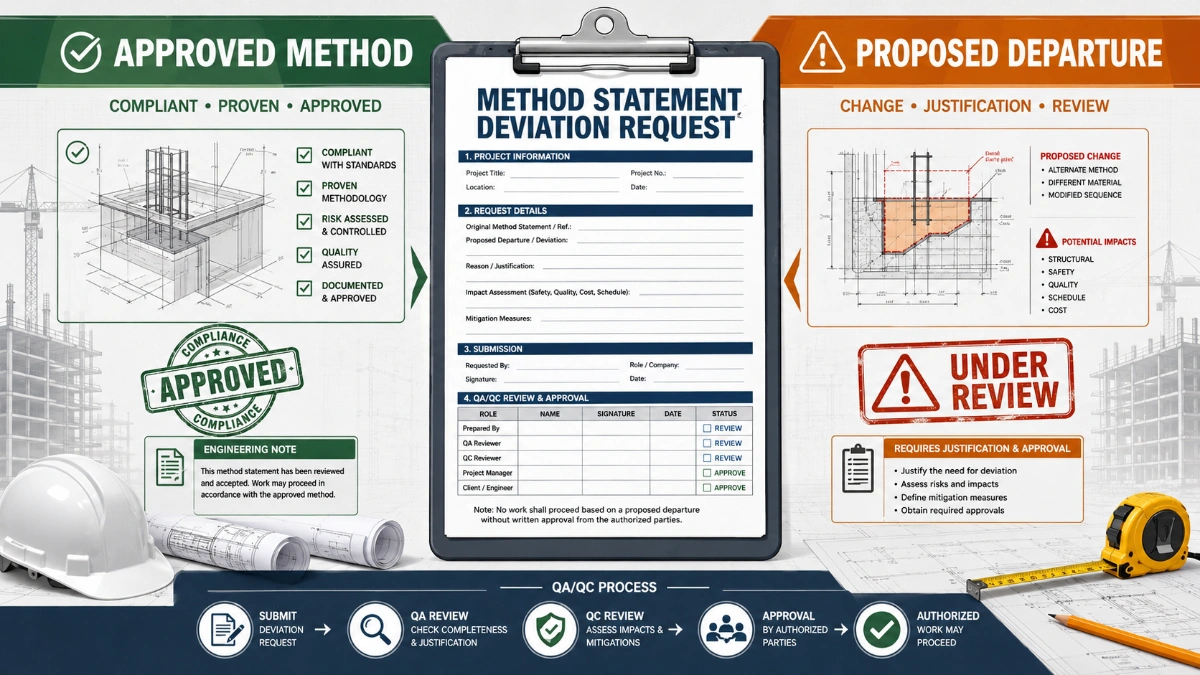
This method statement is an AI-assisted editable starting point, not a pre-approved document. Before use on any project, all content must be reviewed and approved by the relevant parties (superintendent, principal contractor, or client representative) in accordance with your contract and project quality plan.
For example: if your specification requires a departure from a referenced standard, that departure must be documented and approved separately — this method statement will not capture that automatically. Always verify against your applicable drawings, specifications, and regulatory requirements.
Method statement content
Scope
Overview
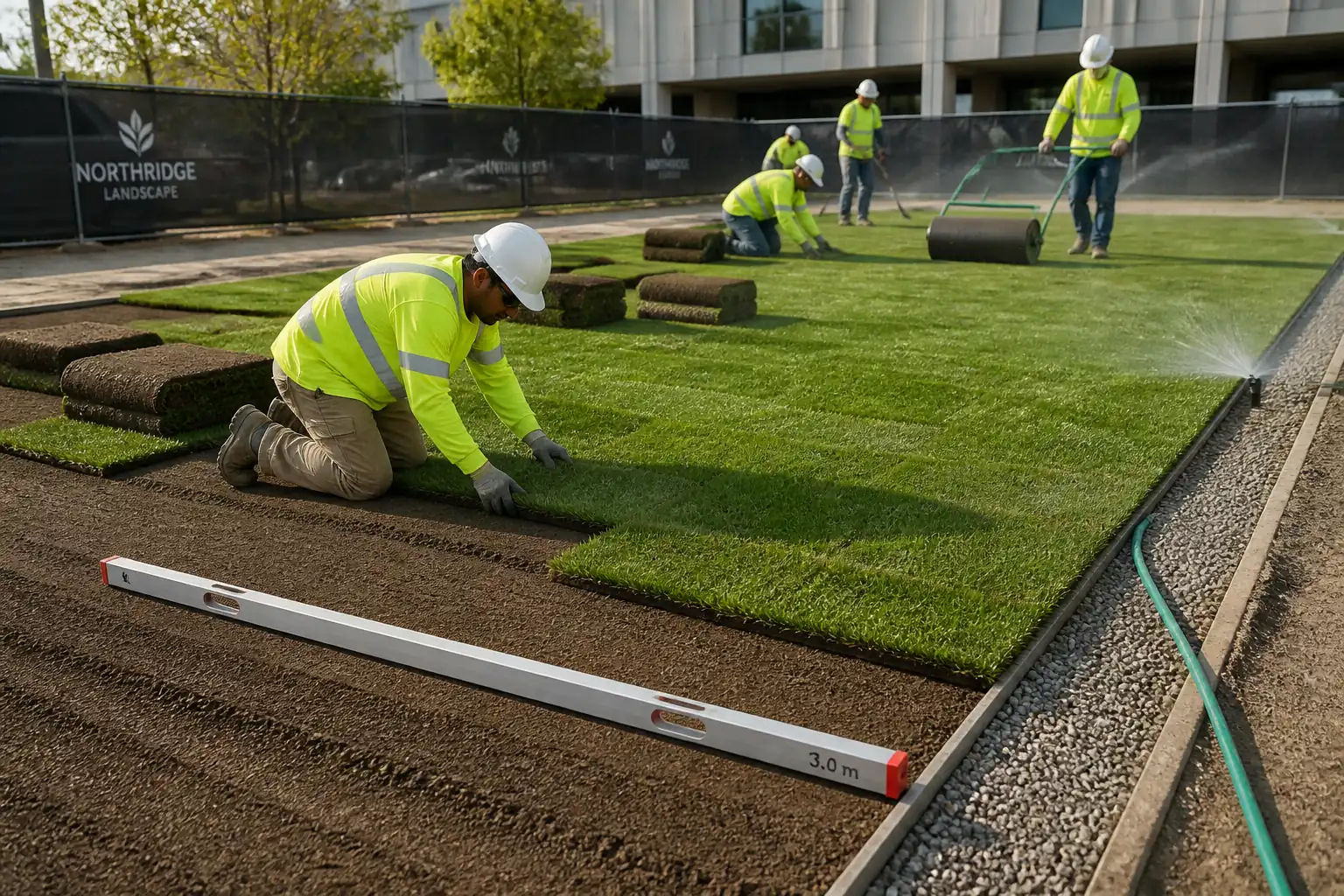
This method statement covers the complete installation of turfgrass sods to prepared landscape areas, including:
- Soil bed conditioning (testing, amendments, tillage, grading, and pre-irrigation)
- Turf sod delivery, storage, laying pattern (staggered/brick-bond), close-jointing, edge restraint
- Light rolling to ensure root/soil contact
- Intensive irrigation scheduling and establishment period care
- Quality checks, acceptance criteria, and documentation for handover
Inclusions
- Subgrade verification and topsoil compliance checks
- Soil laboratory testing and targeted amendments
- Installation on level areas and on slopes up to 1V:3H; anchoring for steeper slopes if required [Verify per project specifications]
- Initial and establishment irrigation setup and scheduling
- First mowing and interim fertilization (if specified)
Exclusions
- Permanent irrigation system installation and commissioning (assumed by others but must be operational prior to sod laying)
- Hard landscape edges/kerbs construction (by others)
- Long-term maintenance beyond the specified establishment period [Verify per project specifications]
References
| Document Type | Reference / Number | Revision | Notes |
|---|---|---|---|
| Standard | BS 4428:1989 | General procedures for soil handling, turfing, finishing. | |
| Standard | BS 3882:2015 | Use for compliance of imported or site-won topsoil [Verify per project specifications]. | |
| Standard | BS 7370-3:2009 | Relevant for establishment and early maintenance. | |
| Standard | ASTM D4972 | Use alongside BS EN 13037 where applicable. | |
| Standard | BS EN 13037 and BS EN 13038 | Applicable to soil improvers and growing media. | |
| Standard | ASTM D2974 | Use where compost or soil organic matter verification is specified. | |
| Guideline | Turfgrass Producers International (TPI) Guideline Specifications | Non-mandatory industry guidance; adopt where aligned to project specs. |
Responsibilities
| Role | Responsibility | Name / Party |
|---|---|---|
| Site Manager | Contractor (Site Manager) | Contractor |
| Engineer | Contractor (Project Engineer / Landscape Engineer) | Contractor |
| QA/QC | Contractor (QA/QC Engineer) | Contractor |
| HSE | Contractor (HSE Officer) | Contractor |
| Engineer | Engineer/Consultant | Employer/Consultant |
| Foreman/Operatives | Foreman & Operatives | Contractor |
Resources
| Resource Type | Description | Quantity | Remarks |
|---|---|---|---|
| Personnel | Technical control and coordination | 1 | |
| Personnel | Daily supervision, sequencing, quality checks | 1 | |
| Personnel | Sod laying, cutting, jointing | 4-8 | |
| Personnel | Material handling, watering, cleanup | 2-6 | |
| Personnel | Task safety, inspections, permits | 1 |
Materials
| Material | Specification / Grade | Quantity | Remarks |
|---|---|---|---|
| Turfgrass sod | As per drawings (m² + 3–5% wastage) | [Verify per project specifications] | |
| Topsoil | As per drawings (m³) | [Verify per project specifications] | |
| Compost | As required (m³) | [Verify per project specifications] | |
| Fertilizer | As required (kg) | [Verify per project specifications] | |
| Lime/Sulfur/Gypsum/Sand | As required | [Verify per project specifications] | |
| Staples | As required | [Verify per project specifications] |
Equipment
| Equipment | Capacity / Type | Quantity | Inspection Required |
|---|---|---|---|
| Tiller | 1–2 | Pre-start checks daily | |
| Hand tools | Set | ||
| Roller | 30–70 kg | 1 | Pre-start checks |
| Knives | Set | ||
| Irrigation kit | As required | Pressure/leak checks | |
| Spreader | 1 | Calibration check prior to use | |
| Moisture meter | 1 | ||
| Plate compactor | 1 | Pre-start checks |
Prerequisites
- Approvals: Material submittals for sod species/cultivar, topsoil source, compost, fertilizers approved by Engineer.
- Survey & utilities: As-built utility plans reviewed; permit-to-dig obtained; services located and marked using cable/pipe locator. Hand-dig within 1 m of known services.
- Irrigation: Permanent or temporary irrigation system installed, pressure-tested, and commissioned in the turf areas. Coverage verified (head-to-head overlap) and controller programmed for establishment schedule.
- Weather: Avoid laying on frozen, waterlogged, or snow-covered ground. Prefer ambient 5–30°C and winds <40 km/h. If >30°C, stage deliveries and increase immediate irrigation.
- Access & protection: Adjacent hardscape, drains, and planting areas protected. Traffic routes and material laydown zones agreed.
- Testing baseline: Soil test results available (pH, EC, texture, organic matter; contaminants if required). Amendment plan approved.
- Mock-up: If specified, complete a 10–20 m² trial area demonstrating finish and jointing for approval.
- Toolbox talk: Conduct task-specific HSE briefing covering manual handling, blades, hoses, rolling, utilities, heat stress, and watering controls.
Method Sequence
| Step | Activity | Description | Responsibility | Inspection / Hold Point |
|---|---|---|---|---|
| 1 | Subgrade verification | Confirm formation is to level, drains installed/functional, no standing water. Remove debris/stones >50 mm. Confirm no over-compaction that prevents infiltration; scarify 50 mm if sealed. | Engineer/Contractor | Visual; infiltration spot check if required |
| 2 | Topsoil placement | Spread compliant topsoil to achieve 100–150 mm finished depth after settlement [Verify]. Avoid trafficking when wet. Stage placement to minimize compaction. | Contractor | Thickness checks (probe) |
| 3 | Soil amendment incorporation | Apply compost 20–40 mm and fertilizer per approved rates; incorporate to 100–150 mm using rotary tiller. Apply lime/sulfur/gypsum per lab recommendations. | Contractor | Visual; spreader calibration; application logs |
| 4 | Fine grading and consolidation | Rake to uniform plane; remove stones >20–30 mm at surface; lightly consolidate (foot tamp or light roller). Achieve smoothness and falls to drains. | Contractor | 3 m straightedge |
| 5 | Moisture conditioning & pre-irrigation | Lightly water the bed 12–24 h prior to laying to reach 60–80% field capacity; ensure surface is firm but not tacky. | Contractor | Moisture meter/hand test |
| 6 | Sod delivery & storage | Schedule just-in-time deliveries. Offload onto shaded pallets or ground sheets; keep moist with fine mist. Lay within 24 h (preferably ≤12 h) of cutting. | Supplier/Contractor | Delivery inspection |
| 7 | Setting out and edge restraints | Snap lines; start along straight edge/kerb. Provide edge restraint at borders (flush kerb/edging). | Contractor | Line and level check |
| 8 | Laying pattern and jointing | Lay sod in staggered brick-bond pattern perpendicular to fall. Butt joints tightly (2–5 mm gaps), do not stretch. Stagger transverse joints ≥300 mm. On slopes lay perpendicular to slope with staples if >1V:3H. | Contractor | Continuous visual surveillance |
| 9 | Cutting and trimming | Cut around obstructions with sharp knife. Avoid small slivers <100 mm width; use larger pieces where possible. | Contractor | Visual |
| 10 | Light rolling for root-soil contact | Roll immediately after laying each area using 30–70 kg roller in two directions. Avoid ruts or squeezing joints. | Contractor | Visual; surface regularity |
| 11 | Initial irrigation (soak-in) | Apply water immediately after rolling to soak through sod and 100 mm of soil beneath. Typical 10–20 L/m² depending on soil and weather [Verify]. | Contractor | Moisture probe at 100 mm |
| 12 | Joint topdressing (if gaps) | Brush in fine sand/soil mix into gaps up to 5 mm after initial watering. | Contractor | Visual |
| 13 | Establishment irrigation schedule | Days 1–14: Keep sod and top 50–75 mm moist; 2–3 light irrigations/day avoiding runoff. Days 15–28: Reduce to 1x/day or every other day, deeper soaks to encourage rooting. Adjust to climate and soil [Verify per project specifications]. | Contractor | Moisture checks; visual stress signs |
| 14 | Traffic restriction and protection | Exclude traffic for minimum 14 days; use barricade tape/signage; boards for access as required. | Contractor | Site walkdowns |
| 15 | First mowing | When grass height reaches 50–60 mm, mow to 35–40 mm (remove ≤1/3 of leaf blade). Use sharp blades; collect clippings if excessive. | Contractor | Measure sward height |
| 16 | Post-lay fertilization (if specified) | Apply light N (e.g., 10–20 g/m² of slow-release N) at 3–4 weeks if growth is pale/slow [Verify]. Water-in. | Contractor | Spreader calibration |
| 17 | Rooting and adhesion check | At 10–14 days perform gentle tug test at random points. | Engineer/Contractor | Tug test |
| 18 | Final inspection and handover | Confirm surface regularity, joint closure, uniform color, no weeds/pests, functional irrigation coverage. Provide O&M and watering regime. | Engineer/Contractor | Joint walkdown |
Safety Controls
Task-specific hazards and controls
- Hazard: Underground utility strike during tilling or staking on slopes
- Likely consequence: Electric shock, gas release, service outage, injury
- Engineering/procedural control: Review utility drawings; scan with cable/pipe locator; mark services; establish exclusion zones; hand tools only within 1 m of known services; Permit-to-Dig system
- Required PPE: Dielectric gloves where relevant, safety boots, eye protection
- Collective preventive measure: Barriers and signage over service corridors
-
Inspection/permit/supervision: Permit-to-Dig; Supervisor sign-off; HSE inspection [Verify per project HSE plan and local regulations]
-
Hazard: Manual handling of sod rolls/pallets (20–25 kg each typical)
- Likely consequence: Musculoskeletal injury, strains
- Engineering/procedural control: Team lifts for rolls; use wheelbarrows or trolleys; limit carry distance; rotate tasks; provide handling training
- Required PPE: Gloves with grip, safety boots
- Collective preventive measure: Mechanical aids for pallets; designated laydown close to workface
-
Inspection/permit/supervision: Manual handling assessment; Foreman supervision
-
Hazard: Cuts from turf knives/edgers
- Likely consequence: Lacerations
- Engineering/procedural control: Use sharp knives with retractable blades; cut away from body; issue cut-resistant gloves; knife control register
- Required PPE: Cut-resistant gloves, long sleeves, eye protection
- Collective preventive measure: Controlled cutting zones; blade disposal containers
-
Inspection/permit/supervision: Toolbox talk; spot checks
-
Hazard: Roller or plate compactor use on soft ground
- Likely consequence: Foot crush, roll-over, operator fall
- Engineering/procedural control: Competent operators; light rollers only (30–70 kg); keep public excluded; avoid gradients beyond safe limits
- Required PPE: Safety boots, high-visibility vest, hearing protection if applicable
- Collective preventive measure: Exclusion zones with barriers
-
Inspection/permit/supervision: Pre-start checks; equipment inspection records
-
Hazard: Slip, trip, and fall due to hoses/wet surfaces
- Likely consequence: Sprains, fractures
- Engineering/procedural control: Route hoses along edges; use hose ramps; clean overspray from hardscape promptly
- Required PPE: Slip-resistant boots
- Collective preventive measure: Housekeeping regime; signage "Wet Surface"
-
Inspection/permit/supervision: Supervisor walkdowns
-
Hazard: Heat stress/UV exposure during summer laying
- Likely consequence: Heat exhaustion, dehydration, sunburn
- Engineering/procedural control: Work-rest cycles; shade; hydration stations; schedule heavy tasks early/late; monitor workers
- Required PPE: Sun hats, sunscreen (SPF 30+), light breathable clothing
- Collective preventive measure: Cool rest area; thermal stress plan
-
Inspection/permit/supervision: HSE monitoring; first-aid readiness
-
Hazard: Noise and flying debris during mowing
- Likely consequence: Hearing loss, eye injury
- Engineering/procedural control: Maintain and inspect mower; ensure guards fitted; keep bystanders 15 m away
- Required PPE: Hearing protection, eye protection, safety boots
- Collective preventive measure: Exclusion zone with cones/signs
-
Inspection/permit/supervision: Pre-use checks; operator competency
-
Hazard: Contact with compost/fertilizers (dust, bioaerosols)
- Likely consequence: Respiratory/skin irritation
- Engineering/procedural control: Dampen dusty materials; avoid handling in strong winds; follow SDS; wash facilities available
- Required PPE: Nitrile gloves, FFP2 mask (as needed), eye protection
- Collective preventive measure: Ventilated handling areas; sealed storage
-
Inspection/permit/supervision: SDS available; COSHH or equivalent assessment
-
Hazard: Water overspray/runoff into live electrical equipment/public roads
- Likely consequence: Electrocution, traffic hazard
- Engineering/procedural control: Use low-angle nozzles; isolate nearby electrical where feasible; install berms to retain water
- Required PPE: Dielectric gloves if isolating electrical, high-vis near roads
- Collective preventive measure: Temporary berms/silt socks at edges
- Inspection/permit/supervision: Pre-irrigation check; permit near roadways [Verify per project HSE plan and local regulations]
Environmental Controls
- Water conservation and runoff control
- Use cyclic irrigation to avoid runoff; adjust for rainfall; restrict watering to early morning/evening. Capture and divert excess with temporary berms. Do not allow discharge to storm drains without silt control.
- Soil and sediment management
- Install silt socks/filters at low points; prevent soil tracking onto pavements; cover stockpiles; avoid works during heavy rain when feasible.
- Fertilizer and chemical stewardship
- Apply at agronomic rates; keep off hardscape; sweep granules immediately; maintain buffer from water bodies per local rules [Verify]. Store under cover with spill kits.
- Material sustainability
- Prefer peat-free compost; source sod locally where possible; recycle pallets and plastic wraps. Dispose of waste sod/soil at licensed facilities.
- Noise and working hours
- Restrict mowing and powered equipment to permitted hours; use well-maintained, quieter equipment.
- Biodiversity and invasive species
- Inspect sod for invasive weeds; reject contaminated loads; remove and bag weeds if identified.
- Fuel and oil management
- Refuel off vegetated areas; use drip trays; keep spill kits available; report and clean any spills immediately.
- Dust suppression
- Lightly moisten dry topsoil during grading; avoid excessive water causing runoff.
QA/QC
Inspection and testing plan (summary)
- Topsoil compliance: Verify against BS 3882 with lab tests (pH 5.5–7.5; EC <2.0 dS/m for turf; organic matter 3–10% typical; texture loam/sandy loam) [Verify per project specifications].
- Surface regularity: ≤10 mm deviation under 3 m straightedge prior to and after rolling.
- Sod quality at delivery: Thickness 12–20 mm; fresh, green; no heating; thatch <10 mm; absence of persistent weeds/pests.
- Jointing: Gaps ≤5 mm; no overlaps; staggered joints.
- Irrigation penetration: Moisture at 100 mm depth after initial soak-in; no runoff/ponding >15 minutes.
- Rooting/adhesion: Gentle tug test at 10–14 days—resistant to lift, visible white roots binding to soil.
- Establishment: Uniform color; no bare patches >0.05 m²; mortality <2% of area.
Records
- Material approvals and delivery tickets
- Soil test reports and amendment calculations
- Equipment calibration (spreader), pre-start checklists
- Daily IRs, photos, irrigation logs, mowing logs
- NCRs and corrective actions where criteria not met
Hold/Witness Points
- Sod delivery inspection (Hold)
- Pre-laying surface/levels (Hold)
- Initial irrigation soak-in (Witness)
- First mowing (Witness)
- Final inspection and handover (Hold)
Tolerances and acceptance
- Levels/regularity: ≤10 mm under 3 m straightedge (local undulations) [Verify per project specifications]
- Edges: Alignment within ±10 mm; edges supported
- Joints: ≤5 mm gaps; closed and seated after rolling
- Drainage: No ponding >15 minutes after a representative irrigation event of 10–15 L/m² [Verify]
- Health: Uniform green sward free of visible pests/diseases; weeds <3 per 10 m² at handover [Verify]
Corrective actions
- Low areas: Lift and bed with screened topsoil; re-lay and re-roll
- Open joints: Topdress with fine sand/soil; irrigate
- Poor sod quality: Remove and replace affected rolls
- Dry spots: Adjust irrigation heads; apply wetting agent if approved
Attachments
- Example checklist: Sod Delivery Inspection (freshness, thickness, pests/weeds, thatch)
- Example checklist: Pre-Lay Surface Regularity (3 m straightedge readings, falls to drains)
- Example log: Irrigation Schedule (dates, times, duration, volume, weather adjustments)
- Example log: Fertilizer Application (product, rate, spreader calibration)
- Manufacturer datasheets: Fertilizers, soil amendments, turf staples
- Risk Assessment & Method Statement (RAMS) including Permit-to-Dig form
- As-built sketches showing irrigated zones and valve IDs
This content is a read-only public reference. Download or customize to get an editable version.
ITP preview
The first inspection activities from the linked ITP for Method Statement – Installation of Grass Turf Sods:
| Activity | Inspection / Test | Acceptance Criteria | Responsibility | Record |
|---|---|---|---|---|
| Topsoil sampling and testing | pH (BS EN 13037/ASTM D4972), EC (BS EN 13038), texture (hydrometer/sieve), organic matter (ASTM D2974) | Meets BS 3882:2015 for intended use; pH 5.5–7.5; EC <2.0 dS/m; contaminants below project limits [Verify] | QA/QC Engineer / Independent Lab | Lab reports, approval |
| Subgrade and drainage verification | Level survey; infiltration spot check if specified | No soft spots; free-draining; tolerance ±20 mm pre-topsoil | Engineer / Site Engineer | IR, survey notes |
| Topsoil placement depth and finish | Depth verification; surface regularity pre-sod | 100–150 mm compacted depth; surface deviation ≤10 mm under 3 m straightedge | Site Engineer | IR, photos |
Showing 3 of 12 inspection activities. View full ITP →
Related Inspection and Test Plan
An Inspection and Test Plan (ITP) is available for Method Statement – Installation of Grass Turf Sods. The ITP defines the inspection activities, acceptance criteria, hold and witness points, responsible parties, and records required to verify the work described in this method statement.
View the Method Statement – Installation of Grass Turf Sods ITP →Frequently asked questions
Continue with related Quollnet resources connected to this method statement.