
Method Statement: Over-Roofing Refurbishment Using Lightweight Metal Sheets Over Existing Corrugated Roofs – Method Statement
AI-assisted method statement with matching ITP, PDF download, and Excel export.
More than a static template
Unlike a downloadable Word or PDF template, this method statement is an AI-assisted editable starting point connected directly to a matching Inspection and Test Plan. Every section is structured, project-adaptable, and ready to export.
- AI-assisted drafting — Customize every section with AI for your specific project scope.
- Linked ITP — A matching inspection and test plan is generated alongside the method statement.
- Multiple export formats — Download as a formatted PDF or editable Excel spreadsheet.
- Editable starting point, not a final document — Review, verify, and adjust all content against your project requirements before use.
Static template vs. Quollnet workflow
| Feature | Static template | Quollnet |
|---|---|---|
| Project-specific content | Manual fill-in required | AI-assisted customization |
| Linked ITP | Separate document, no link | Matching ITP included |
| Export formats | Usually PDF only | PDF and Excel |
| Structured sections | Free-form layout | 13 standardized sections |
| Saved to your account | Local file only | Cloud-saved, reusable |
| Content accuracy | You verify everything | AI-assisted, you still verify |
| Cost | Often free but time-intensive | Free to customize and download |
What you can customize
When you save this method statement to your account, every section becomes editable. The following 13 sections are included:
- Scope — Defines the activity and its boundaries.
- References — Standards, specifications, and drawings.
- Responsibilities — Roles and accountabilities.
- Resources — Labour, plant, and equipment summary.
- Materials — Materials and compliance requirements.
- Equipment — Tools and equipment details.
- Prerequisites — Hold points and pre-conditions.
- Method sequence — Step-by-step construction sequence.
- Safety controls — HSE risk controls and PPE.
- Environmental controls — Environmental mitigation measures.
- QA/QC — Quality inspection and test requirements.
- ITP — Inspection and Test Plan table (has its own page).
- Attachments — Referenced drawings and documentation.
Why this method statement is used
This method statement is used to define and communicate the approved procedure for carrying out method statement: over-roofing refurbishment using lightweight metal sheets over existing corrugated roofs on site. It ensures the work is planned in advance, the correct resources and controls are in place, and all personnel understand responsibilities, sequence, quality requirements, and safety controls before work begins. It aligns site execution with the documented scope and acceptance expectations.
Who uses this method statement
This method statement is used by contractors, site supervisors, project engineers, QA/QC engineers, HSE officers, consultants, and client representatives. It serves as a shared reference for planning, execution, supervision, inspection, and approval of the activity on site.
When it is prepared and submitted
The method statement is prepared before the work activity starts and submitted as part of the pre-construction documentation package for review and approval.
Who reviews or approves it
The method statement is usually submitted to the client representative, consultant, resident engineer, or project management consultant for review and approval before the work commences.
Important approval note
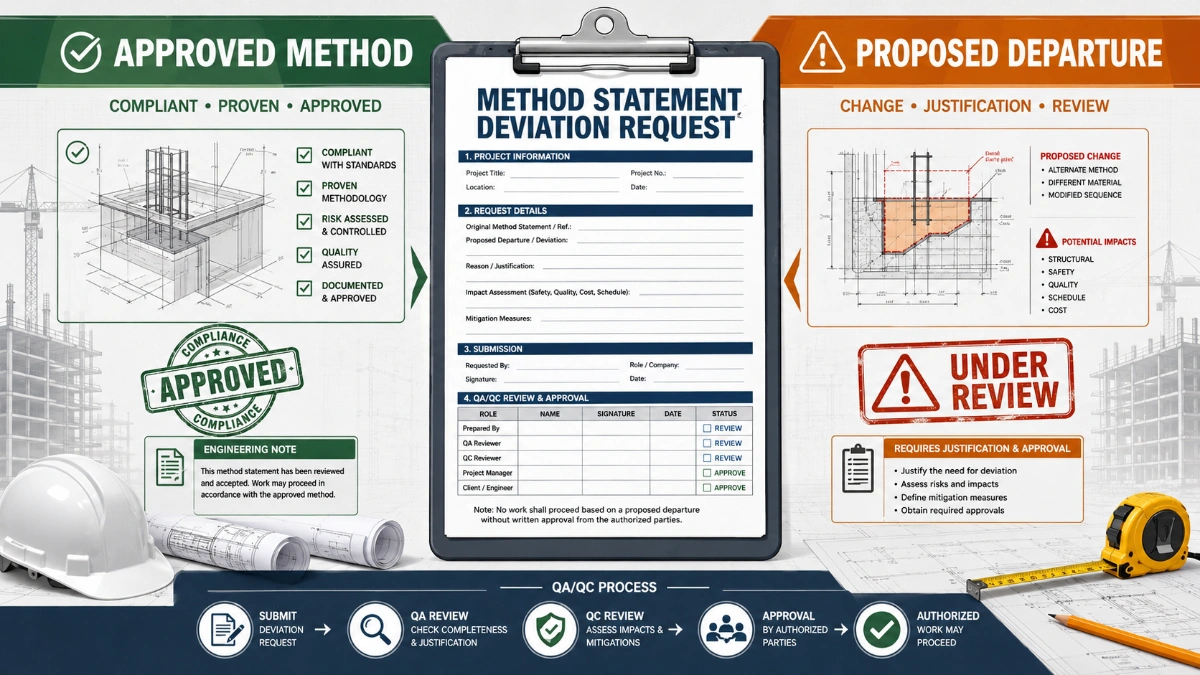
This method statement is an AI-assisted editable starting point, not a pre-approved document. Before use on any project, all content must be reviewed and approved by the relevant parties (superintendent, principal contractor, or client representative) in accordance with your contract and project quality plan.
For example: if your specification requires a departure from a referenced standard, that departure must be documented and approved separately — this method statement will not capture that automatically. Always verify against your applicable drawings, specifications, and regulatory requirements.
Method statement content
Scope
Overview
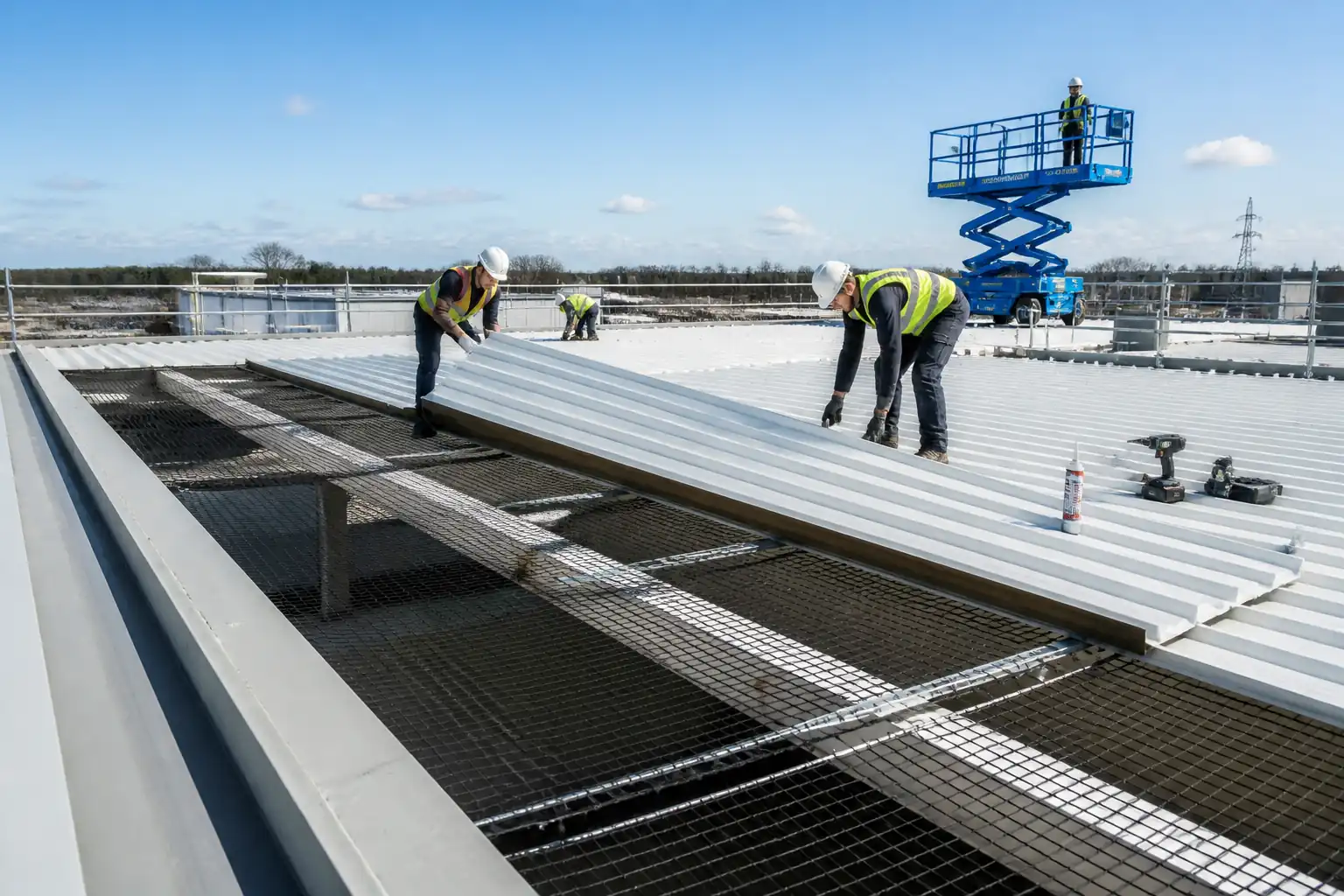
This method covers the over-roofing refurbishment of existing corrugated roofs using lightweight profiled metal sheets installed over a spacer/rail system fixed through the existing roof into the supporting structure (purlins). It includes: structural survey verification; temporary works and access; safety netting installation; spacer bracket/rail (secondary purlin) installation; new cladding panel fixing; flashings and penetrations; QA/QC; and hazardous material/asbestos proximity handling.
Inclusions
- Pre-construction surveys (structural, asbestos/HAZMAT, utilities, roof condition, wind zone verification).
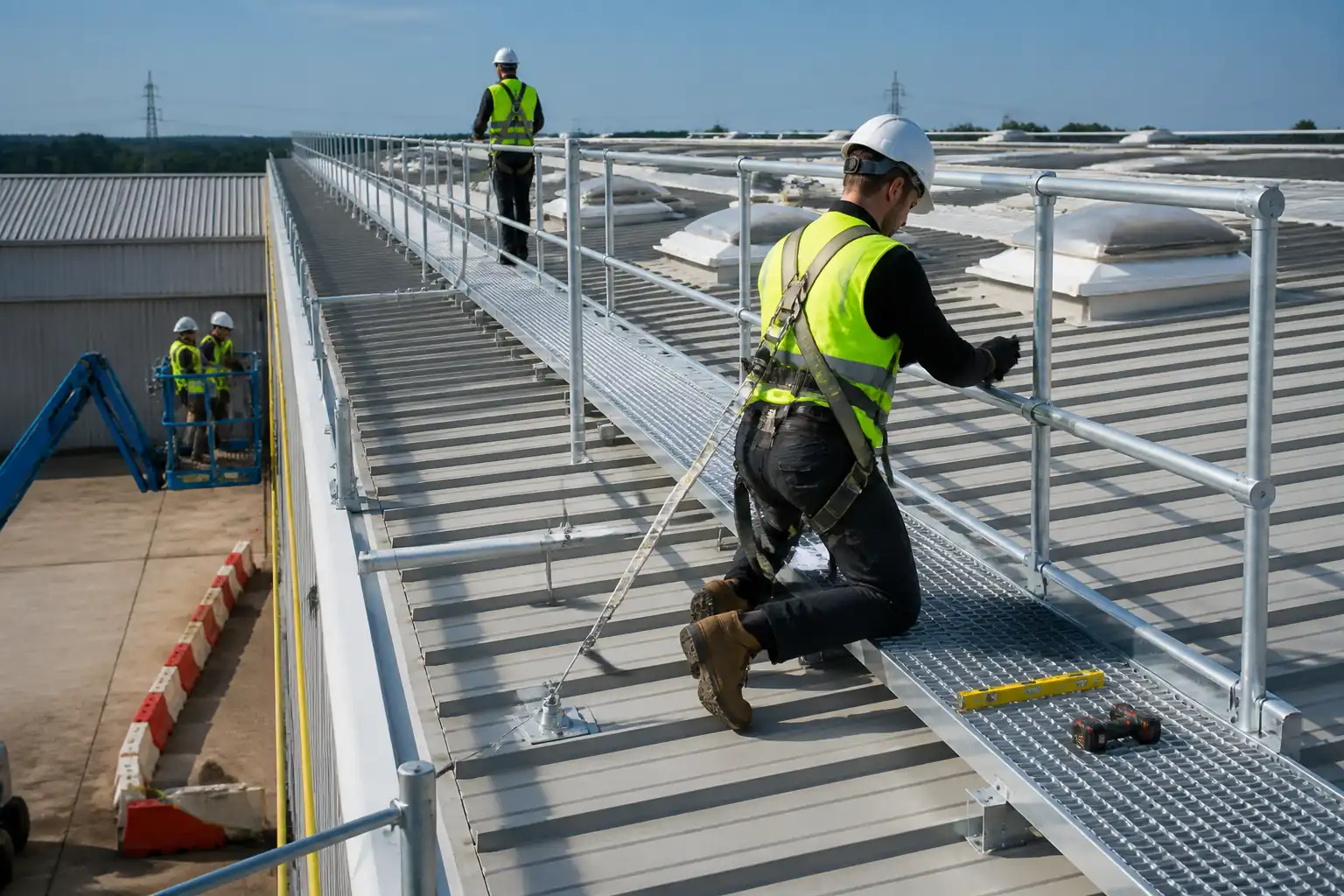
- Temporary works: edge protection, fall arrest systems, safety nets, access walkways/boards, MEWPs.
- Pull-out/fastener resistance testing into existing purlins.
- Installation of spacer brackets/rails, thermal breaks, and optional insulation/VCL as specified.
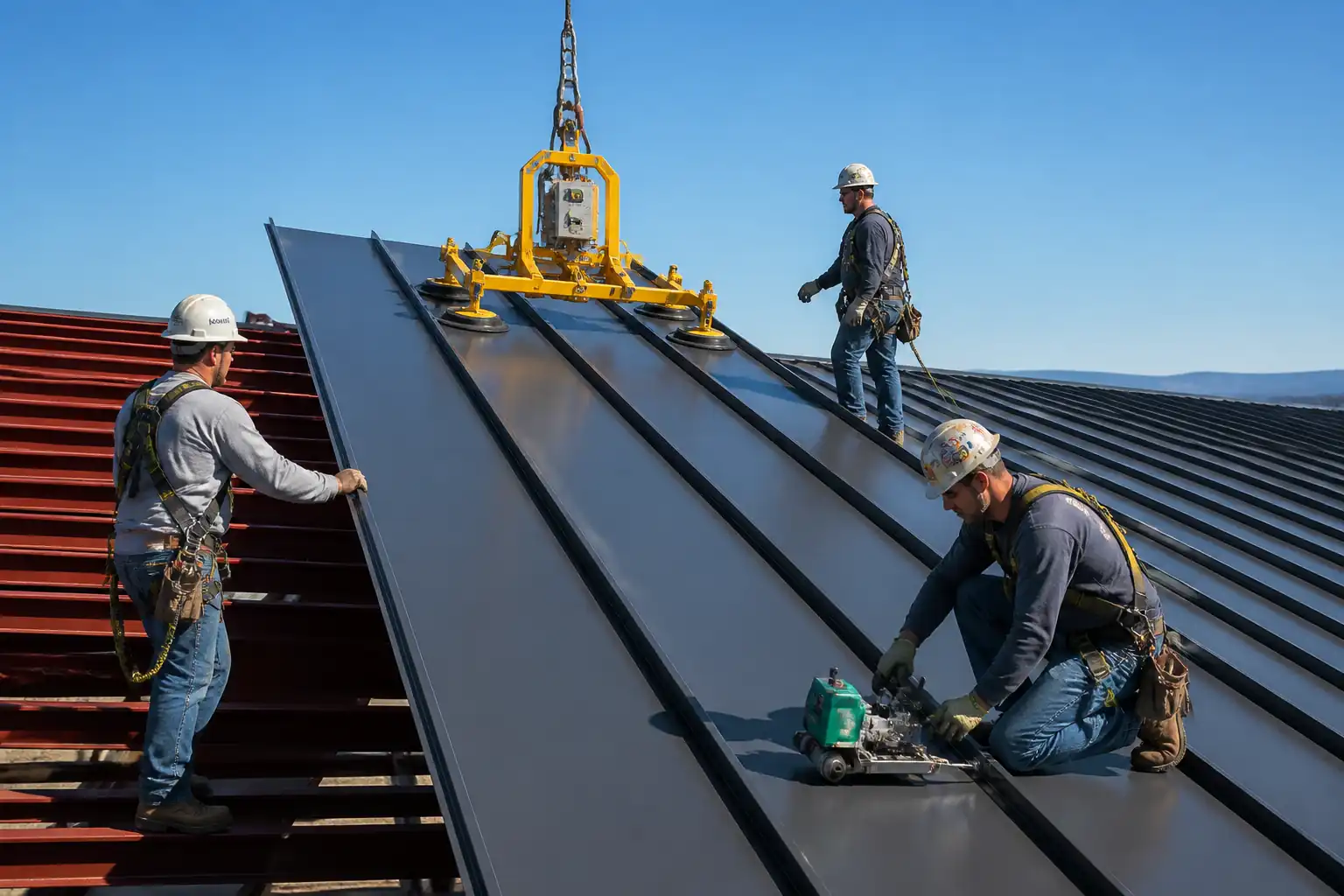
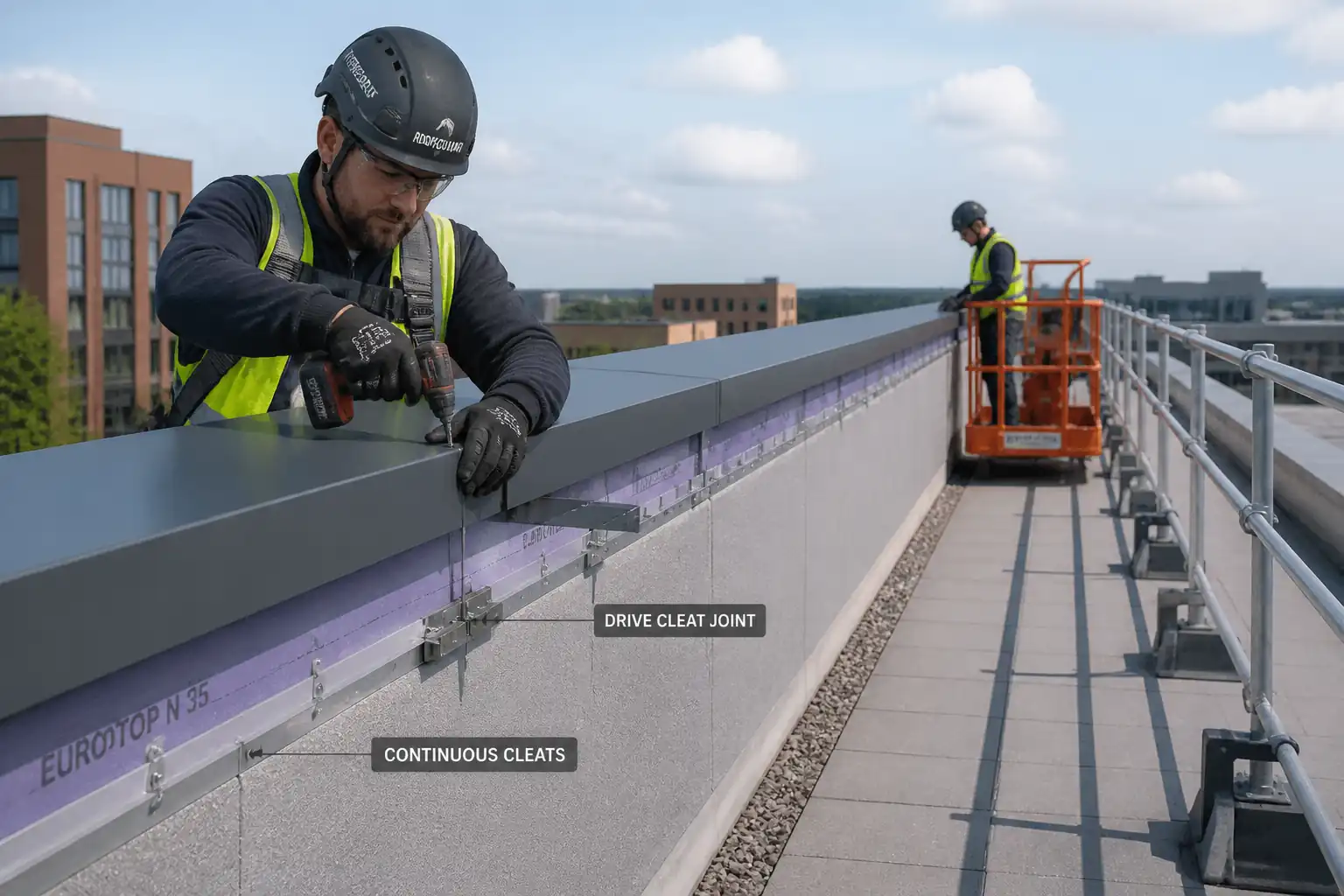
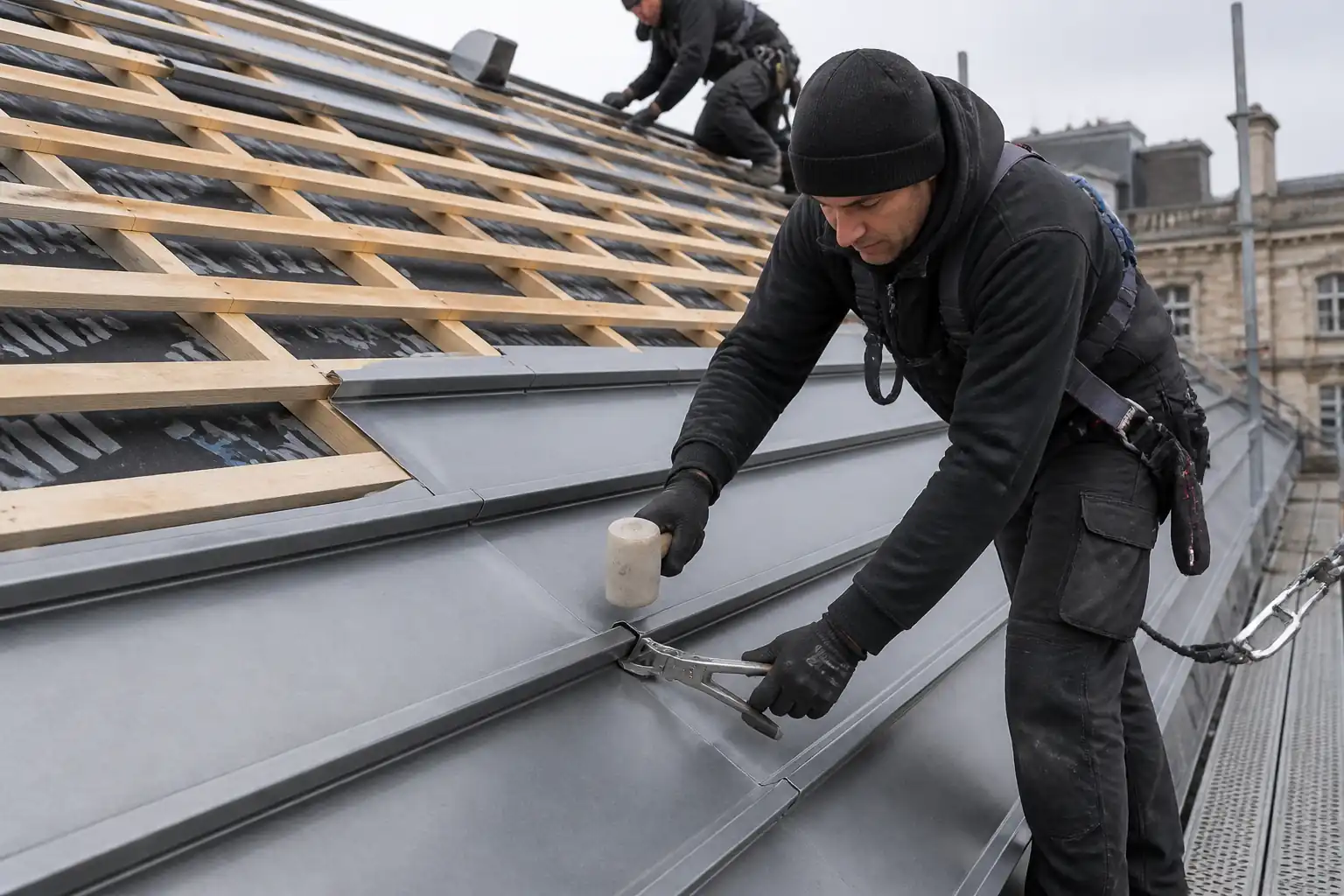
- Installation of new lightweight profiled metal roof sheets, laps, fixings, sealants, and flashings (ridges, verges, eaves, abutments, gutters).
- Treatment of penetrations, rainwater goods interfaces, and terminations.
- QA/QC inspections, documentation, and ITP compliance.
- Cleaning, protection, and handover (as-builts, warranties).
Exclusions
- Structural strengthening beyond minor local repairs unless instructed.
- Full asbestos removal (to be executed by licensed contractor if required).
- Electrical/MEP rerouting, lightning protection alterations, and permanent access systems unless specified.
Constraints and Assumptions
- Works sequenced to maintain building operations/weather tightness.
- No direct foot traffic on fragile existing sheets; load spreaders and designated walkways only.
- Wind/weather limitations enforced for lifting and sheet installation.
- Manufacturer’s fixing schedules govern fastener type/spacing. [Verify per project specifications].
References
| Document Type | Reference / Number | Revision | Notes |
|---|---|---|---|
| Standard | BS EN 1993; BS EN 1090 | ||
| Standard | BS 5427; BS 8000-6 | Use regional equivalent where applicable [Verify]. | |
| Standard | BS EN 14782; BS EN 508-1 | ||
| Standard | BS EN 1991-1-4 | ||
| Guideline | ETA/ETAG; Manufacturer test method | ||
| Standard | ISO 9223; ISO 12944; BS EN 10346 | ||
| Standard | EN 1263-1/-2; EN 795; EN 13374 | ||
| Standard | BS 5250 | ||
| Standard | ISO 45001; ISO 14001 | ||
| Regulation | Asbestos regulations (jurisdiction-specific) |
Responsibilities
| Role | Responsibility | Name / Party |
|---|---|---|
| Project Manager | Project Manager | Main Contractor |
| Construction Manager | Construction Manager | Main Contractor |
| Site Engineer | Site Engineer | Main Contractor |
| TWC | Temporary Works Coordinator (TWC) | Main Contractor |
| Supervisor | Roofing Supervisor | Specialist Subcontractor |
| QA/QC | QA/QC Engineer | Main Contractor |
| HSE | HSE Manager | Main Contractor |
| Specialist | FASET-qualified Netting Contractor | Subcontractor |
| Specialist | Licensed Asbestos Consultant/Contractor | Subcontractor |
| Appointed Person | Appointed Person (Lifting) / Crane Supervisor | Main Contractor |
| Operator | IPAF-certified MEWP Operator | Plant Hire |
Resources
| Resource Type | Description | Quantity | Remarks |
|---|---|---|---|
| Management Team | PM, CM, Planner | 3-4 [Verify] | |
| Technical | Site Engineer, QA/QC | 2 [Verify] | |
| Skilled Operatives | Fixers, mates, sealant applicators | 6–10 depending on area [Verify] | |
| Installers | FASET-qualified installers | 3–5 [Verify] | |
| Consultant/Operatives | Surveyor/analyst; licensed contractor if disturbance | As required [Verify] | |
| Specialist Operatives | Appointed Person, Crane Supervisor, Slinger/Signaller, IPAF Operators | 3–6 [Verify] |
Materials
| Material | Specification / Grade | Quantity | Remarks |
|---|---|---|---|
| Profiled sheet | Corrosion class per ISO 9223 [Verify] | As per BOQ | |
| Rails/Brackets | Section sizes per design | As per layout | |
| Fasteners | Corrosion class C3–C4 [Verify] | Per fixing schedule | |
| Stitch fasteners | Per lap schedule | ||
| Sealants | As required | ||
| Insulation | As per drawings | ||
| Safety Nets | As required | ||
| Flashings | As per drawings |
Equipment
| Equipment | Capacity / Type | Quantity | Inspection Required |
|---|---|---|---|
| MEWP | As required | ||
| Edge Guardrail | Perimeter | ||
| Safety Net System | As required | ||
| Torque Driver | 2–4 | ||
| Drill + H-class Vac | 1–2 | ||
| Walkway Boards | As required | ||
| Lifting Gear | As required | ||
| Hand/Power Tools | As required |
Prerequisites
- Approved for Construction (AFC) drawings, roof layout, fixing schedules, and specifications.
- Structural assessment of existing roof supports confirming adequacy for additional dead and wind loads, including combined actions. Any strengthening detailed and approved prior to works.
- Asbestos Refurbishment & Demolition (R&D) survey of roof area, sample results, and an Asbestos Plan of Work (PoW). Licensed asbestos contractor engaged if disturbance/removal is required. [Verify per project HSE plan and local regulations].
- Temporary Works Design (TWD) for edge protection, netting supports (if any), access routes/walkways, and sheet landing zones; TWC approvals in place.
- Permits to Work: Work at Height, Hot Work (if required), Roof Access, Lifting Operations, Asbestos (if applicable), Electrical Isolation near overhead lines, Confined Space (if any internal work).
- Weather limits established and briefed: sheet installation and lifting stopped if gusts exceed 12 m/s (approx. 27 mph), or MEWP OEM limit if lower; safety netting installation per specialist guidance (typically avoid >10 m/s). [Verify per OEM/manufacturer].
- Calibration records for torque drivers and pull-out test rigs (within 6–12 months) [Verify per project].
- Material approvals and submittals: product data, DoPs/CoCs, fastener ETAs, sealant compatibility, corrosion class per environment category.
- Training/competence: IPAF for MEWP, FASET for netting, asbestos awareness (Category A) minimum for all roof workers; supervisor competency verified.
- Emergency plan: rescue from height, first aid, spill response, asbestos fiber release response; drills briefed to all staff.
- Stakeholder coordination: internal operations schedule, noise windows, protection of plant and public; exclusion zones and signage in place.
Method Sequence
| Step | Activity | Description | Responsibility | Inspection / Hold Point |
|---|---|---|---|---|
| 1 | Pre-start briefing and permits | Conduct site induction, task briefing, review RAMS and permits; confirm weather and exclusion zones. | HSE Manager / Construction Manager | Permit verification |
| 2 | Structural survey verification | Open select roof bays (from safe access) to confirm purlin type/spacing, fixity, condition; document any corrosion/rot and deflections. | Site Engineer / Structural Engineer | Joint inspection |
| 3 | Asbestos control set-up | Verify asbestos survey; if ACM present and disturbance unavoidable, implement PoW: controlled drilling/wetting, H-class vac, P3 RPE, drop sheets, waste controls. If no disturbance, enforce no-contact zones and walkways. | Asbestos Contractor / HSE Manager | Audit |
| 4 | Temporary works and access | Install edge protection to EN 13374; designate roof access via MEWP/tower; lay proprietary crawl boards spanning to purlins; set debris nets as needed. | TWC / Roofing Supervisor | Inspection |
| 5 | Safety netting installation (if required) | Install safety nets below roof per EN 1263; ensure overlaps ≥2 m or lacing per standard; tag nets; verify clear fall distance and anchor suitability. | FASET Netting Contractor | Inspection |
| 6 | Pull-out tests into existing purlins | Undertake on-site fastener pull-out tests through existing sheeting into purlin base material at representative locations (min 1 per 200 m² and per purlin type; ≥6 per roof area) [Verify frequency]. | QA/QC Engineer / Manufacturer Rep | Test |
| 7 | Set-out spacer lines | Mark purlin lines and bracket positions; check straightness, squareness, and datum from eaves; verify tolerances before drilling. | Site Engineer | Survey check |
| 8 | Bracket installation (through existing sheet) | Install spacer brackets through crown or as specified, using controlled low-speed drilling with dust extraction if ACM; fit thermal pads; tighten to torque per manufacturer. | Roofing Supervisor | Inspection |
| 9 | Spacer rail/secondary purlin installation | Fix rails (Zed/Tophat) to brackets; check line/level/camber; install anti-rattle/isolators as specified. | Roofing Supervisor / Site Engineer | Inspection |
| 10 | VCL and insulation (if specified) | Lay VCL over rails with sealed laps; install insulation boards/wool to required thickness; maintain drainage paths and fire breaks. | Roofing Supervisor | Inspection |
| 11 | Sheet lifting and placement | Lift sheets using spreader/cloth slings; use tag lines; stage bundles on stable bearers; place sheets starting leeward to windward. | Appointed Person / Roofing Supervisor | Supervision |
| 12 | Primary fixing of new sheets | Align first sheet at eaves; fix to each rail/purlin line using primary fasteners and sealing washers per schedule; maintain cover widths and straightness. | Roofing Supervisor / QA | Inspection |
| 13 | Side laps and stitch fasteners | Apply continuous butyl to side laps; fix stitch fasteners/rivets at 250–450 mm c/c [Verify per manufacturer]; wipe swarf immediately. | Roofing Supervisor | Inspection |
| 14 | End laps and closures | Provide end lap (typ. 150–200 mm) with double butyl rows; primary fixings at lap support at 150–200 mm c/c [Verify]; install profiled fillers/closures. | Roofing Supervisor / QA | Inspection |
| 15 | Flashings, ridges, verges, eaves, gutters | Install flashings with sealed laps; fixings per detail; fit gutter interfaces and stop ends; ensure falls and outlets clear. | Roofing Supervisor | Inspection |
| 16 | Penetrations and interfaces | Install pipe/duct flashings, curb details; use EPDM/aluminum flashings compatible with coatings; seal per system. | Roofing Supervisor / MEP Coord. | Inspection |
| 17 | Defect rectification and protection | Touch-up minor coating damage with approved paint; remove debris/swarf; install temporary protections at traffic points. | Roofing Supervisor | Inspection |
| 18 | Watertightness checks (selective) | Visual inspection post-rainfall; hose test in sample areas if required and safe; inspect internal for leaks. | QA/QC Engineer | Test/Inspection |
| 19 | Final QA/QC and demobilization | Complete ITP; compile O&M manuals; remove temporary works; restore site; issue warranties and as-builts. | QA/QC Engineer / PM | Final inspection |
Safety Controls (Task-Specific)
For each significant hazard:
1) Hazard: Work at height / falls through fragile roof
- Consequence: Serious injury or fatality.
- Engineering/Procedural Control: Install edge protection to EN 13374; safety nets to EN 1263 where practicable; designate and install proprietary crawl boards/load spreaders spanning to purlins; use fall arrest only where collective measures impracticable; no lone working.
- Required PPE: Safety helmet with chin strap, full-body harness with double lanyard (if using fall arrest), safety footwear, gloves.
- Collective Preventive Measure: Guardrails, safety nets, access platforms.
- Inspection/Permit/Supervision: Work at Height permit; TWC inspection of edge protection weekly; daily pre-use checks recorded; supervisor present. [Verify per project HSE plan and local regulations]
2) Hazard: Handling large roof sheets in wind
- Consequence: Loss of control, falls, striking persons, property damage.
- Engineering/Procedural Control: Lifting plan with tag lines; wind monitoring; stop lifts/installation above 12 m/s gusts or OEM limit; use spreader bars/sheet lifters; sequence leeward to windward; maintain exclusion zones.
- PPE: Gloves cut-resistant, eye protection, helmets.
- Collective Measures: Exclusion zones, banksman control.
- Inspection/Permit/Supervision: Appointed Person-approved lift plan; crane/MEWP LOLER certs; supervisor to authorize weather stop.
3) Hazard: Fragile asbestos cement or aged corrugated sheets
- Consequence: Fall through roof; fiber release.
- Engineering/Procedural Control: No stepping on sheets; only on boards at purlins; minimal disturbance strategy; if drilling into ACM is permitted, apply PoW (wetting, low-speed drilling, H-class vac, shadow vacuum, controlled access); or adopt systems avoiding drilling into ACM (e.g., clamp solutions) where feasible.
- PPE: P3 RPE, disposable coveralls (Type 5/6) if ACM control in place, gloves, eye protection.
- Collective Measures: Safety nets; barriers and signage.
- Inspection/Permit/Supervision: Asbestos permit; licensed contractor supervision; air monitoring/clearance if required; waste consignment notes. [Verify per local regulations]
4) Hazard: Falling objects (tools, fasteners, swarf)
- Consequence: Injury to persons below, equipment damage, leaks from swarf corrosion.
- Engineering/Procedural Control: Toe-boards and debris netting where needed; tool lanyards; magnetic swarf mats; frequent clean-down; exclusion zones below.
- PPE: Helmets with chin straps, eye protection.
- Collective Measures: Debris nets, exclusion zones.
- Inspection/Permit/Supervision: Daily housekeeping inspections; HSE walkthroughs.
5) Hazard: MEWP/crane instability or collision
- Consequence: Tip-over, crushing, entrapment.
- Engineering/Procedural Control: Ground bearing checks; MEWP selection per reach; entrapment prevention plans; spotters; OEM wind limits; harness in booms; set outriggers per OEM.
- PPE: Harness with lanyard (boom), helmet, hi-vis.
- Collective Measures: Barriers and banksman control.
- Inspection/Permit/Supervision: LOLER/annual inspection; pre-use checks; Appointed Person oversight.
6) Hazard: Noise and vibration from drilling/fixing
- Consequence: Hearing loss, HAVS.
- Engineering/Procedural Control: Select low-vibration tools; task rotation; HAVS monitoring; hearing protection zones.
- PPE: Hearing protection EN 352, anti-vibration gloves (as appropriate).
- Collective Measures: Scheduling noisy tasks in windows.
- Inspection/Permit/Supervision: Noise assessments; health surveillance if required.
7) Hazard: Cuts from sheet edges and swarf
- Consequence: Lacerations, infection.
- Engineering/Procedural Control: Use edge protectors during handling; de-burr cuts; prohibit abrasive cutting on roof where possible; provide first-aid kits.
- PPE: Cut-resistant gloves level C–F [Verify], long sleeves.
- Collective Measures: Handling aids; training.
- Inspection/Permit/Supervision: Supervisor checks; incident reporting.
8) Hazard: Weather (rain, lightning)
- Consequence: Slips, loss of control, electrocution.
- Engineering/Procedural Control: Stop outdoor works during lightning proximity; dry working surfaces; postpone during heavy rain; anti-slip footwear.
- PPE: Weather-appropriate PPE.
- Collective Measures: Weather monitoring.
- Inspection/Permit/Supervision: Supervisor weather checks; permit hold during adverse conditions.
9) Hazard: Chemical exposure (sealants/cleaners)
- Consequence: Dermatitis, respiratory irritation.
- Engineering/Procedural Control: Use low-VOC products; follow SDS; provide ventilation; avoid incompatible contact with coatings.
- PPE: Nitrile gloves, goggles, RPE if indicated by SDS.
- Collective Measures: Spill kits.
- Inspection/Permit/Supervision: COSHH assessment; SDS on site.
10) Hazard: Fire from hot works (if any cutting/torch use)
- Consequence: Fire spread into roof void.
- Engineering/Procedural Control: Avoid hot works; if unavoidable, hot work permit, fire watch 60 min, extinguishers, thermal imaging check.
- PPE: Flame-resistant clothing, eye protection.
- Collective Measures: Fire watch; barriers.
- Inspection/Permit/Supervision: Hot Work permit; daily sign-off.
Environmental Controls
- Asbestos/HAZMAT: If ACMs are disturbed, double-bag waste in UN-approved bags; label and store in locked, covered skip; remove by licensed carrier with consignment notes; air monitoring/clearance as specified. [Verify per local regulations]
- Dust control: Use low-speed drilling with on-tool extraction (H-class vac) and wet methods where permitted; no dry sweeping; use damp wipes and HEPA vac.
- Noise management: Schedule noisy tasks; maintain equipment; use acoustic barriers where practical; notify stakeholders of peak activities.
- Waste segregation: Recycle metal offcuts; segregate general waste; collect sealant cartridges, wiping cloths as hazardous if contaminated; maintain waste transfer notes.
- Water protection: Prevent washout/runoff into drainage; seal roof penetrations promptly; use drip trays; protect gutters; do not hose test where it risks ingress into building or ACM disturbance.
- Material storage: Store sheets on level bearers, off ground, covered/ventilated; avoid ponding water on packaging; protect coatings from UV if required by supplier.
- Emissions & spills: Keep spill kits; refuel off-roof in designated area with secondary containment; inspect plant for leaks daily.
- Energy & carbon: Plan lifts and deliveries to minimize movements; consolidate loads; idle-reduction policy.
- Ecology & community: Control lighting and noise near sensitive receptors; maintain clean site hoarding; communicate program with building occupants.
QA/QC
- Submittals: Approvals for sheets, fixings (with ETA), sealants, spacer system, insulation, safety nets, and coatings/corrosion class.
- Mock-up/First-of-kind: Install first bay (~10 m) as benchmark; inspect alignment, lap detailing, fastener torque; obtain sign-off (Hold Point).
- Pull-out tests: Perform per sequence; confirm design resistance and update fixing schedule if required; issue report.
- Dimensional tolerances: Rails straightness ±5 mm in 10 m; sheet alignment ±5 mm at laps; eaves line tolerance ±5 mm; overall level ±5 mm. [Verify per project specs]
- Fastener control: Use torque-limiting drivers; record torque sample checks (min 5% of fasteners per day or 5 per elevation, whichever greater) [Verify frequency].
- Sealants: Check batch numbers and shelf life; verify continuous beads at laps; adhesion check as per manufacturer if requested.
- Coating integrity: Inspect for scratches and swarf; apply approved touch-up paint where acceptable; replace panels for major damage.
- Watertightness: Visual after rainfall; targeted hose tests if specified; rectify any ingress immediately.
- Documentation: ITP sign-offs, material certs (CoC/DoP), calibration certs, net certificates, permits, daily diaries, photographic records, as-built drawings, warranties.
- Nonconformance: Raise NCR/CPAR with corrective actions; track to closure.
Attachments
- Design calculations and AFC drawings (roof layout, fixing schedules, wind loading summary).
- Temporary Works Design (edge protection, safety netting plan, access/landing zones).
- Manufacturer technical data sheets (sheets, fasteners, sealants, insulation) and ETAs.
- Material certificates: CoC/DoP, mill certs, coating specifications.
- Calibration certificates (torque drivers, pull-out test equipment) and LOLER certificates.
- Asbestos documentation: R&D survey, risk assessments, Plan of Work, permits, air monitoring/clearance (if applicable), waste consignment notes.
- Project HSE Plan, RAMS, permits to work, lift plans, daily briefing records.
- ITP forms, checklists, inspection reports, pull-out test results, torque logs, photographic records.
- O&M manuals template, warranties, maintenance guidance, cleaning instructions.
This content is a read-only public reference. Download or customize to get an editable version.
ITP preview
The first inspection activities from the linked ITP for Method Statement: Over-Roofing Refurbishment Using Lightweight Metal Sheets Over Existing Corrugated Roofs:
| Activity | Inspection / Test | Acceptance Criteria | Responsibility | Record |
|---|---|---|---|---|
| Review AFC drawings/specs and RAMS | Document review and approvals | All required approvals in place | PM / QA/QC | Approval Register |
| Structural survey verification | Joint inspection; measurements/photos | Supports adequate per design; remediation plan if required | Site Engineer / Structural Engineer | Survey Report |
| Asbestos survey/PoW confirmation | Permit/PoW; air monitoring plan (if applicable) | Compliance with local asbestos regulations | Asbestos Consultant / HSE | Asbestos Permit; PoW; Clearance (if any) |
Showing 3 of 16 inspection activities. View full ITP →
Related Inspection and Test Plan
An Inspection and Test Plan (ITP) is available for Method Statement: Over-Roofing Refurbishment Using Lightweight Metal Sheets Over Existing Corrugated Roofs. The ITP defines the inspection activities, acceptance criteria, hold and witness points, responsible parties, and records required to verify the work described in this method statement.
View the Method Statement: Over-Roofing Refurbishment Using Lightweight Metal Sheets Over Existing Corrugated Roofs ITP →Frequently asked questions
Continue with related Quollnet resources connected to this method statement.