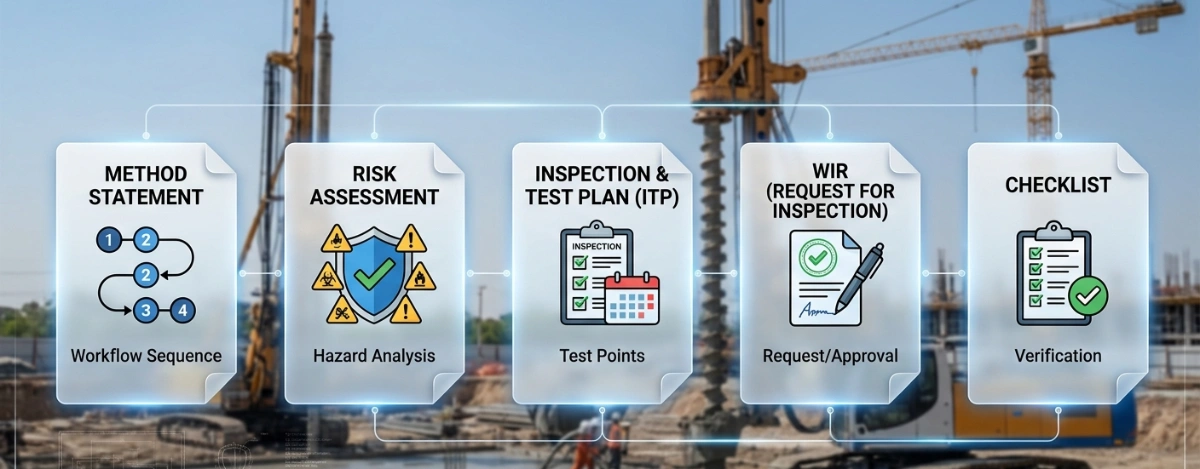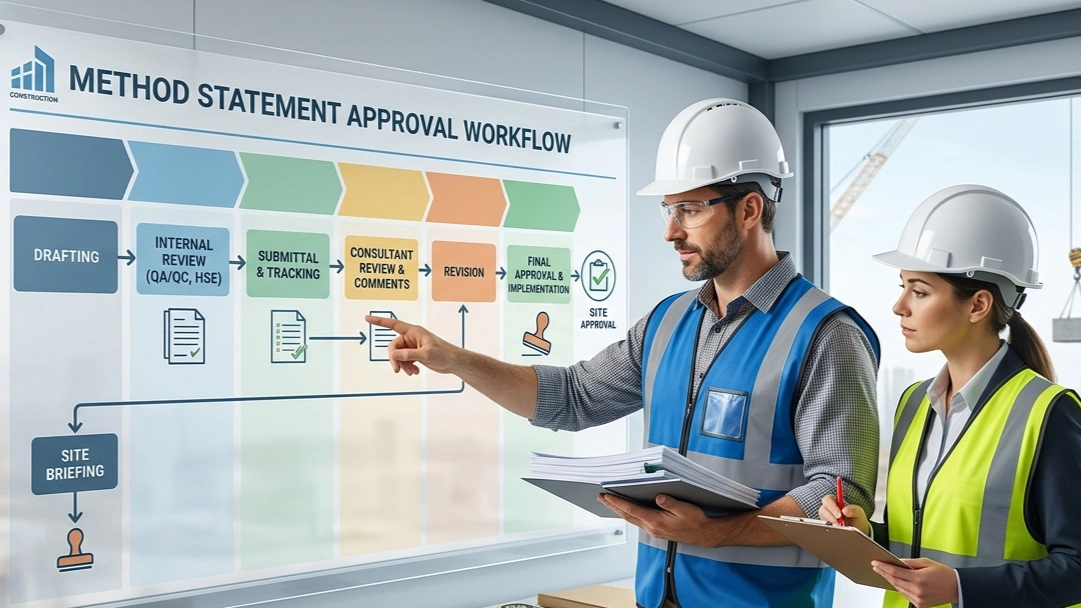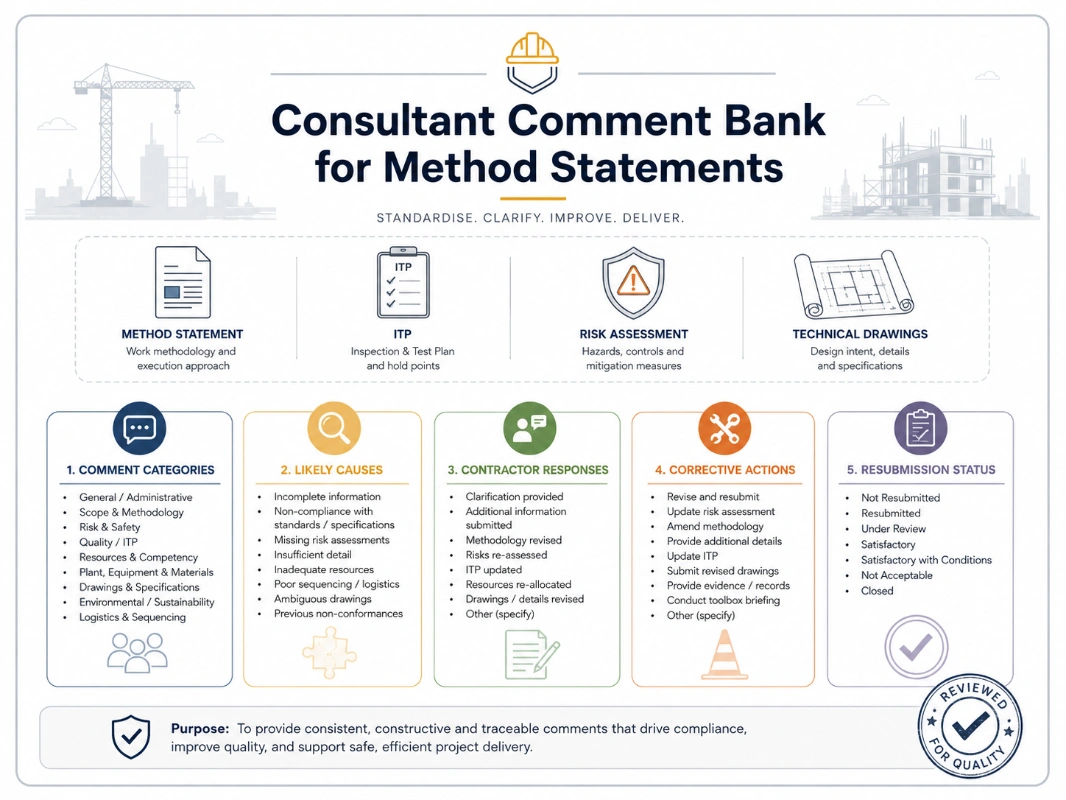

Method Statement: Metering Skid Installation for Oil & Gas Service – Method Statement
AI-assisted method statement with matching ITP, PDF download, and Excel export.
More than a static template
Unlike a downloadable Word or PDF template, this method statement is an AI-assisted editable starting point connected directly to a matching Inspection and Test Plan. Every section is structured, project-adaptable, and ready to export.
- AI-assisted drafting — Customize every section with AI for your specific project scope.
- Linked ITP — A matching inspection and test plan is generated alongside the method statement.
- Multiple export formats — Download as a formatted PDF or editable Excel spreadsheet.
- Editable starting point, not a final document — Review, verify, and adjust all content against your project requirements before use.
Static template vs. Quollnet workflow
| Feature | Static template | Quollnet |
|---|---|---|
| Project-specific content | Manual fill-in required | AI-assisted customization |
| Linked ITP | Separate document, no link | Matching ITP included |
| Export formats | Usually PDF only | PDF and Excel |
| Structured sections | Free-form layout | 13 standardized sections |
| Saved to your account | Local file only | Cloud-saved, reusable |
| Content accuracy | You verify everything | AI-assisted, you still verify |
| Cost | Often free but time-intensive | Free to customize and download |
What you can customize
When you save this method statement to your account, every section becomes editable. The following 13 sections are included:
- Scope — Defines the activity and its boundaries.
- References — Standards, specifications, and drawings.
- Responsibilities — Roles and accountabilities.
- Resources — Labour, plant, and equipment summary.
- Materials — Materials and compliance requirements.
- Equipment — Tools and equipment details.
- Prerequisites — Hold points and pre-conditions.
- Method sequence — Step-by-step construction sequence.
- Safety controls — HSE risk controls and PPE.
- Environmental controls — Environmental mitigation measures.
- QA/QC — Quality inspection and test requirements.
- ITP — Inspection and Test Plan table (has its own page).
- Attachments — Referenced drawings and documentation.
Why this method statement is used
This method statement is used to define and communicate the approved procedure for carrying out method statement: metering skid installation for oil & gas service on site. It ensures the work is planned in advance, the correct resources and controls are in place, and all personnel understand responsibilities, sequence, quality requirements, and safety controls before work begins. It aligns site execution with the documented scope and acceptance expectations.
Who uses this method statement
This method statement is used by contractors, site supervisors, project engineers, QA/QC engineers, HSE officers, consultants, and client representatives. It serves as a shared reference for planning, execution, supervision, inspection, and approval of the activity on site.
When it is prepared and submitted
The method statement is prepared before the work activity starts and submitted as part of the pre-construction documentation package for review and approval.
Who reviews or approves it
The method statement is usually submitted to the client representative, consultant, resident engineer, or project management consultant for review and approval before the work commences.
Important approval note
This method statement is an AI-assisted editable starting point, not a pre-approved document. Before use on any project, all content must be reviewed and approved by the relevant parties (superintendent, principal contractor, or client representative) in accordance with your contract and project quality plan.
For example: if your specification requires a departure from a referenced standard, that departure must be documented and approved separately — this method statement will not capture that automatically. Always verify against your applicable drawings, specifications, and regulatory requirements.
Method statement content
Scope
Overview
This method statement defines the complete installation of a factory-assembled metering skid for oil and gas service, including:
- Receipt inspection, preservation status verification, and storage controls.
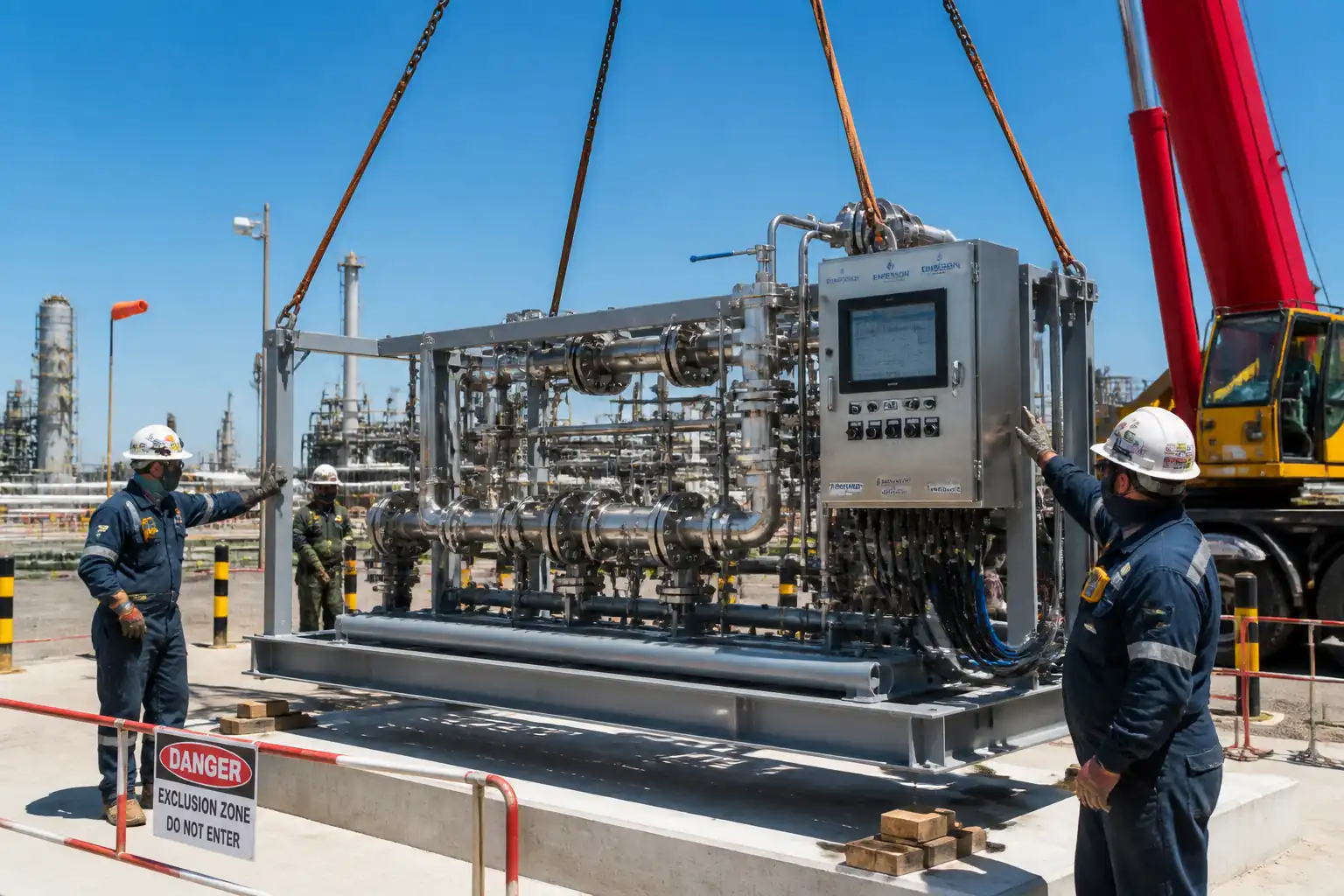
- Engineered lifting, offloading, placement, leveling, shimming, anchoring, and grouting.
- Alignment to pipeline centerlines and verification of flow direction and P&ID orientation.
- Electrical/instrumentation interface (power, signals, earthing/bonding, cable terminations).
- Instrument impulse tubing/fittings, supports, and routing.
- Pressure/leak testing of skid connections and tubing.
- Functional checks, loop checks, and coordination of meter proving/calibration.
- QA/QC inspections, hold and witness points, records, redlines, and turnover dossiers.
Work includes interface with civil foundations, process tie-ins, electrical systems, control systems, and vendor services. Commissioning energization/start-up beyond cold functional checks is by the commissioning team unless otherwise noted.
Exclusions
- Permanent process piping outside skid battery limits (by others unless stated).
- Permanent structures not related to skid foundation.
- Live hydrocarbon introduction and operations (commissioning/start-up team).
References
| Document Type | Reference / Number | Revision | Notes |
|---|---|---|---|
| Code | ASME B31.3 [Verify edition per project] | ||
| Standard | API MPMS [Verify chapter applicability] | ||
| Standard | IEC 60079 series; ATEX 2014/34/EU [Verify zone/class/div] | ||
| Standard | ISO 5167 / AGA reports / ISO 17089 [As applicable] | ||
| Codes/Standards | ACI 318; ACI 355.2/355.4 or EN 1992-4; ASTM C1107 grout; ASTM F1554/A193/A194 fasteners | [Verify anchor design method per project] | |
| Standards | ISO 12944; BS EN ISO 1461 | [Verify coating system class] | |
| Standard | ISO/IEC 17025 | ||
| Project | Latest IFC files and approved vendor docs [Verify revision] |
Responsibilities
| Role | Responsibility | Name / Party |
|---|---|---|
| Construction Manager | Deliver the works per schedule and quality requirements | Contractor |
| Site Engineer | Ensure tolerances, sequence, and method compliance | Contractor |
| Lifting Supervisor | Issue lift plan, ensure certified rigging and exclusion zones | Contractor |
| Instrument Engineer | Install/terminate per drawings and vendor manuals | Contractor |
| QC Inspector | Verify hold/witness points, ITP compliance | Contractor |
| HSE Officer | Permits, toolbox talks, monitoring | Contractor |
| Surveyor | Provide level/position reports | Contractor |
| Vendor Rep | Confirm handling limits, connections, setup | OEM |
| Client/Engineer | Approve ITP, attend hold/witness | Client |
Resources
| Resource Type | Description | Quantity | Remarks |
|---|---|---|---|
| Labour | Certified riggers and signalers | 2–4 | |
| Labour | Anchors, shims, grouting, pipe tie-ins | 3–6 | |
| Labour | Tubing/termination/loop checks | 2–4 | |
| Specialist | Setting out and as-built | 1 | |
| Specialist | Meter proving/calibration supervision | 1 |
Materials
| Material | Specification / Grade | Quantity | Remarks |
|---|---|---|---|
| Anchor bolts | Grade and diameter per design | As per GA | |
| Epoxy/Hybrid adhesive | Temperature/curing per TDS | As required | |
| Cementitious grout | Flowable; final thickness 25–50 mm [Verify] | As required | |
| SS/MS shims | Flatness within 0.2 mm | As required | |
| SS316/316L seamless tubing | Cleaned for oxygen service if req'd [Verify] | As per IFC | |
| SS316 fittings | Pressure rating ≥ design | As required | |
| E&I materials | Flame-retardant, LSZH where spec'd | As per BOQ | |
| N2 / water | Clean, dry; disposal plan for water | As required |
Equipment
| Equipment | Capacity / Type | Quantity | Inspection Required |
|---|---|---|---|
| Hydraulic crane | ~50 t class [Verify] | 1 | Third-party certificate valid |
| Certified rigging | Set | Pre-use inspection | |
| 5–10 t | 1 | Certificate and operator license | |
| Class 1 | Set | Calibration sticker | |
| Up to required Nm | Set | Calibration cert | |
| SDS/diamond core | 2 | PAT test [Verify] | |
| Paddle mixer | 1 | Pre-use check | |
| Up to test pressure | Set | Calibration cert | |
| 4-gas | 2 | Bump test daily | |
| 500 V/1000 V IR | Set | Calibration cert |
Prerequisites
Pre-Start Conditions
- Approved IFC drawings (GA, P&IDs, hook-up details, cable/block diagrams) and vendor manuals available on-site.
- Approved ITP and method statement; risk assessment/JSA completed and briefed to crew.
- Foundations ready: top-of-concrete elevation within ±5 mm; plan position grid verified; concrete compressive strength ≥ design (typically ≥30 MPa) confirmed by test reports; curing period per spec (typically 28 days) before full anchor load [Verify per project specifications].
- Anchor design approved (cast-in or post-installed). Rebar scan completed for drilling locations; utilities cleared.
- Lifting study/lift plan approved with crane selection, rigging configuration, load weights/CG, radius, ground bearing pressure, and exclusion zones.
- Permits: PTW, Lifting Permit, Pressure Test Permit, Electrical Isolation/LOTO, Hot/Cold Work, and Hazardous Area authorization as applicable [Verify per project HSE plan and local regulations].
- Preservation/inspection checklist and damage report templates prepared. OEM attendance scheduled for key stages (receipt, placement, calibration).
- Test instruments and rigging calibrated/certified; certificates available.
- N2 test gas, test gauges, soap solution/helium sniffer, and leak test tools prepared. Hydrotest water source and disposal plan approved if used.
- Interface checks completed with piping/electrical/civil disciplines; tie-in spools and flexible joints available; earthing/bonding scheme approved.
Method Sequence
| Step | Activity | Description | Responsibility | Inspection / Hold Point |
|---|---|---|---|---|
| 1 | Receipt & Preservation Verification | Inspect shipping condition, seals, preservation plugs, desiccants; verify packing list and tag numbers. | QC Inspector, Site Engineer, Vendor Rep (if available) | Visual inspection with photos; check preservation records |
| 2 | Foundation Survey & Setting Out | Verify foundation elevation, flatness, anchor coordinates or drilling marks; confirm drainage slope if any. | Surveyor, Site Engineer | Instrument survey |
| 3 | Lift Preparation | Install certified slings/spreader per OEM lifting drawings; verify lifting points and CG; establish exclusion zone. | Lifting Supervisor | Pre-lift checklist |
| 4 | Offloading & Placement | Offload from trailer, slew to foundation, lower to within 50–100 mm, align to centerlines, set onto shims/sole plates. | Lifting Supervisor, Site Engineer | Visual during placement |
| 5 | Flow Direction & Nozzle Orientation Check | Confirm skid inlet/outlet aligned with pipeline and flow arrows; verify instrument tapping orientation. | Site Engineer, QC | Joint visual check with P&ID |
| 6 | Anchor Layout & Drilling (if post-installed) | Mark hole positions; rebar scan; drill to embedment depth with dust extraction; clean per TDS (blow-brush-blow). | Mechanical Supervisor | Hole depth/diameter gauge; borehole cleanliness check |
| 7 | Anchor Installation & Initial Torque | Inject adhesive; install studs with twist; allow cure; snug-tight to seat baseplates/shims. | Mechanical Supervisor | QC witness adhesive mixing/batch/expiry |
| 8 | Levelling & Pre-Grout Checks | Adjust shims/jack bolts to final level/elevation; seal grout forms; provide grout head/vents. | Site Engineer | Survey level; clearance check |
| 9 | Underbase Grouting | Mix per TDS; place using head box/tremie from one side; ensure continuous flow; cure as recommended. | Mechanical Supervisor | QC monitor flow and voids |
| 10 | Final Anchor Torque/Proof | After grout cure, torque nuts to specified value; mark-up; re-check level. | Mechanical Supervisor | Torque wrench calibration; QC witness |
| 11 | Piping Tie-ins and Flex Connections | Install spools, gaskets, insulation kits (if required), and expansion joints; align flanges. | Mechanical Supervisor | Flange face check; alignment check |
| 12 | Electrical/Instrument Cable Terminations | Install Ex-rated glands, terminate in JB/flow computer/meter transmitter; label and dress cables. | Instrument Supervisor | Continuity/IR tests; gland tightness |
| 13 | Impulse/Signal Tubing Installation | Route per hook-ups; bend with mandrel; install supports; avoid low points unless drain provided. | Instrument Technicians | Visual and dimensional |
| 14 | Leak and Pressure Testing (Tubing/Connections) | Pneumatic test with dry N2; pressurize gradually; soap solution/helium sniff on all joints; monitor pressure. | Instrument Supervisor, QC | Gauge calibration; hold time monitoring |
| 15 | Functional Checks & Loop Checks | Power-up (dead circuit checks first); simulate inputs; verify 4–20 mA/HART/fieldbus signals; alarm/trip paths dry tested. | Instrument Engineer, Commissioning Rep | Loop test procedures |
| 16 | Meter Proving/Calibration Coordination | Coordinate with prover or master meter; stabilize conditions; record K-factor/linearization; repeat runs as required. | Vendor Rep, Client Witness | Witness proving runs |
| 17 | Earthing/Bonding Verification | Verify main earth, bonding jumpers across spools/insulating joints, continuity to skid frame. | Electrical Supervisor | Continuity testing |
| 18 | Coating Touch-up & Preservation | Repair coating damages; apply DFT per system; reinstall protective covers if required. | Paint Supervisor | Holiday/DFT checks as needed |
| 19 | As-built, Punch List & Rectification | Mark redlines; raise punch items; close-out A/B punches; clean work area. | Site Engineer, QC | Punch walkdown |
| 20 | Turnover Dossier Preparation | Compile certificates, OEM docs, ITRs, torque logs, test packs, spares list; submit for acceptance. | QC Lead | Document review |
Safety Controls
Task-Specific Hazards and Controls
- Hazard: Heavy lift/rigging failure
- Consequence: Crush injuries, equipment damage
- Engineering/Procedural Control: Approved lift plan; certified crane/rigging; pre-lift meeting; ground bearing verification; exclusion zone with barriers; taglines
- Required PPE: Hard hat, safety boots, gloves, eye protection, hi-vis
- Collective Measures: Banksman control, radios, spotters
-
Inspection/Permit/Supervision: Lifting Permit; rigging pre-use inspection; Appointed Person supervision
-
Hazard: Skid instability during placement
- Consequence: Skid shift, topple, pinch/crush
- Engineering/Procedural Control: Place on adequately spaced shims/sole plates; do not release hook until temporary stability verified; chock wheels (if any)
- PPE: As above
- Collective Measures: Exclusion zone
-
Inspection/Permit/Supervision: Lift plan adherence; supervision by Site Engineer
-
Hazard: Underground utility strike during anchor drilling
- Consequence: Electrocution, gas release, service outage
- Engineering/Procedural Control: As-built utility drawings; rebar/utility scan; permit to drill; local isolation if required
- PPE: Dielectric gloves where relevant, eye/ear protection
- Collective Measures: Barricade and spotter
-
Inspection/Permit/Supervision: PTW; scan report retained; supervisor sign-off
-
Hazard: Working in hazardous area (flammable atmospheres)
- Consequence: Fire/explosion
- Engineering/Procedural Control: Gas testing (LEL/O2) before and during work; intrinsically safe tools; control of ignition sources; bonding/earthing; hot work controls
- PPE: FR clothing, antistatic footwear, eye/hand protection
- Collective Measures: Zoning signage, fire watch, extinguishers
-
Inspection/Permit/Supervision: Hot/Cold Work Permit; gas test records; HSE oversight; [Verify per project HSE plan and local regulations]
-
Hazard: Pneumatic pressure testing (stored energy)
- Consequence: Violent release, projectiles, hearing damage
- Engineering/Procedural Control: Use calibrated gauges/regulators; gradual pressurization in steps (25%-50%-75%-100%); barricade and evacuate test radius; remote monitoring; relief device set ≤ 1.1 x test pressure
- PPE: Face shield, gloves, hearing protection
- Collective Measures: Physical barriers and signage
-
Inspection/Permit/Supervision: Pressure Test Permit; test plan approved; QC witness hold point
-
Hazard: Chemical exposure (adhesives, grout)
- Consequence: Skin/eye irritation, respiratory issues
- Engineering/Procedural Control: Follow SDS; mixing in ventilated area; spill kits; avoid skin contact
- PPE: Chemical-resistant gloves, goggles, long sleeves
- Collective Measures: Eyewash station nearby
-
Inspection/Permit/Supervision: SDS available; HSE inspection
-
Hazard: Electrical energization during E&I works
- Consequence: Shock, arc flash
- Engineering/Procedural Control: LOTO; dead testing; insulated tools; correct CT/VT secondary handling (shorting as required)
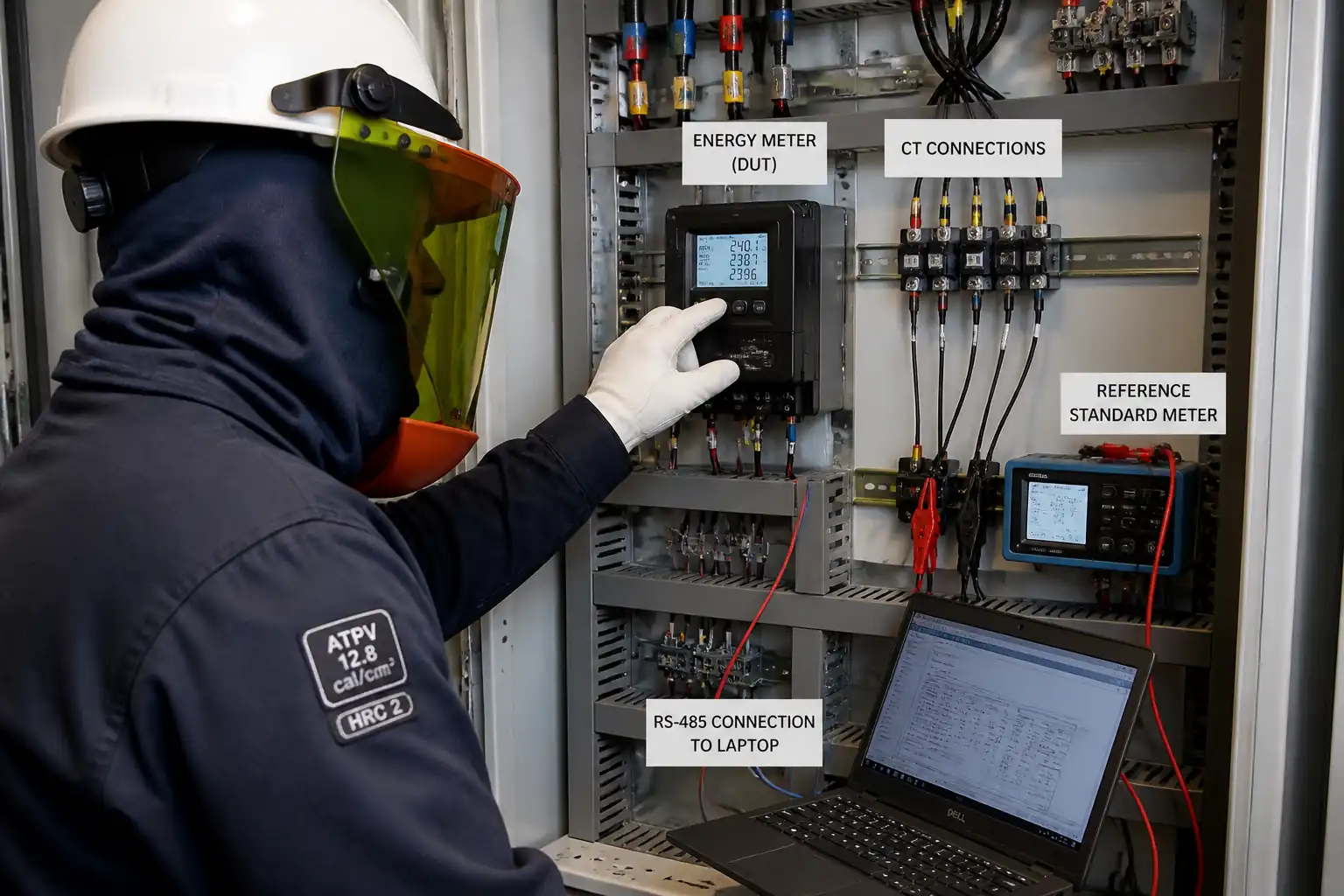
- PPE: Electrical-rated gloves, FR clothing, arc-rated face shield (as applicable)
- Collective Measures: Barriers around live panels (if any)
-
Inspection/Permit/Supervision: Electrical PTW; competent electrician supervision
-
Hazard: Slips, trips, and falls
- Consequence: Sprains, fractures
- Engineering/Procedural Control: Good housekeeping; cable management; non-slip surfaces; adequate lighting
- PPE: Safety boots
- Collective Measures: Walkway delineation
-
Inspection/Permit/Supervision: HSE inspections
-
Hazard: Noise and vibration from tools/crane
- Consequence: Hearing loss, hand-arm vibration
- Engineering/Procedural Control: Select low-vibration tools; limit exposure time; maintain equipment
- PPE: Hearing protection, anti-vibration gloves
- Collective Measures: Noise signage, exclusion at source
-
Inspection/Permit/Supervision: HSE monitoring
-
Hazard: Manual handling of fittings/tubing
- Consequence: Strains
- Engineering/Procedural Control: Use mechanical aids; team lifting; pre-cut benches
- PPE: Gloves, back support if required
- Collective Measures: Work positioning aids
- Inspection/Permit/Supervision: Supervisor oversight
Note: Where exact controls depend on local regulations or project HSE plans, apply [Verify per project HSE plan and local regulations].
Environmental Controls
Environmental Risks and Controls
- Spill of hydrocarbons/preservatives during receipt or tie-ins
- Control: Spill kits at point-of-use; drip trays; quick-connect caps; immediate containment and reporting
-
Monitoring/Permits: Environmental PTW/Spill Response Plan; waste log
-
Grout/adhesive waste and wash water
- Control: Mix only required quantities; collect wash water; dispose via approved facility; no discharge to ground
-
Monitoring/Permits: Waste manifests; SDS compliance
-
Hydrotest water disposal (if used)
- Control: Use treated/filtered water; sample and dispose per permit; use corrosion inhibitor if specified; prevent contaminated discharge
-
Monitoring/Permits: Discharge permit; sampling records
-
Nitrogen venting/asphyxiation risk
- Control: Vent to safe height/location; signage; gas monitoring; avoid confined spaces
-
Monitoring/Permits: PTW with gas test results
-
Noise and dust from drilling
- Control: Wet/dust extraction drilling; schedule during permitted hours; use shrouds
-
Monitoring/Permits: Local authority limits [Verify]; dust/noise logs
-
Stainless steel contamination/corrosion
- Control: Use SS-only tools; segregate carbon steel grinding; remove iron filings
-
Monitoring/Permits: Visual checks; housekeeping audits
-
Waste segregation and documentation
- Control: Segregate metal, wood, plastics; label skips; maintain waste transfer notes
- Monitoring/Permits: Environmental records per ISO 14001 (if applicable)
QA/QC
Quality Controls
- Material traceability: Verify tag numbers, serials, and MTRs (EN 10204 3.1 where required) for meters, transmitters, valves, and pressure parts.
- Calibration certificates: Instruments and test equipment with current ISO/IEC 17025 calibration; torque tools within 6 months [Verify per project].
- Anchor and grout QA: Adhesive batch/expiry, hole cleanliness, embedment depth, curing time, torque records; grout batch, placement log, and compressive strength results.
- Dimensional tolerances: Skid level ≤ 1 mm/m after final set; plan location ±10 mm; flange alignment per ASME PCC-1 guidance.
- Electrical: Continuity/IR test records; Ex integrity checks (gland selection, thread engagement, IP rating).
- Tubing: Bend radius, support spacing, orientation, leak test certificates; no mixed-brand fittings; ferrule make-up per manufacturer torque/turns.
- Testing: Pressure/leak test procedures approved; gauges within ±1% FS accuracy; pneumatic safety measures in place.
- Functional verification: Loop checks with signed ITRs; scaling and range per datasheets; HART/fieldbus device descriptors loaded; timestamps captured.
- Meter proving/calibration: Witnessed runs; K-factor tables uploaded; reports signed by vendor and client; linearity/repeatability within vendor/API limits [Verify].
- Documentation: IRs/ITRs, checklists, punch lists, NCR/CAR management, redline as-builts, MDR index compliance.
Test Frequencies (typical) [Verify per project]
- Anchor pull tests: 2% or minimum 3 per skid if specified by design authority.
- Grout compressive tests: 1 set (3 cubes/cylinders) per batch or per day of pour.
- Tubing leak tests: 100% of new joints.
- Electrical IR/continuity: 100% of terminations.
- Loop checks: 100% of loops associated with skid.
Acceptance Criteria (summary)
- Levelness ≤ 1 mm/m; position ±10 mm.
- Anchor torque per design/spec; no base movement.
- Leak tests: No bubbles; pressure drop ≤ 1% over 10 minutes (typical for pneumatic) [Verify].
- Electrical IR ≥ 1 MΩ at 500 VDC (or as per spec) for LV/controls [Verify].
- Proving: Repeatability ≤ ±0.15%; linearity ≤ ±0.25% (typical) [Verify with OEM/API].
Attachments
- Approved IFC drawings: GA, foundation plan, P&ID, hook-up details, single-line and loop diagrams.
- Vendor documents: Lifting/handling instructions, installation manual, calibration/proving procedures, data sheets, hazardous area certifications (ATEX/IECEx).
- Calculations: Anchor design calculations; crane lift study; ground bearing checks.
- Certificates: Calibration (ISO/IEC 17025) for gauges, torque tools, multimeters; material certificates (EN 10204 3.1) for anchors and tubing; rigging certificates.
- HSE: Risk assessment/JSA; PTWs; gas test logs; SDS for grout/adhesives; pressure test plan.
- QA/QC: ITR/ITP forms; pressure test certificates; grout logs; torque records; coating repair sheets.
- Turnover index (MDR): Document register, redline as-builts, OEM warranties, spare parts list, training records.
Note: Use latest revisions; where values are not specified herein, adopt project-specific requirements. [Verify per project specifications].
This content is a read-only public reference. Download or customize to get an editable version.
ITP preview
The first inspection activities from the linked ITP for Method Statement: Metering Skid Installation for Oil & Gas Service:
| Activity | Inspection / Test | Acceptance Criteria | Responsibility | Record |
|---|---|---|---|---|
| [H] Review of IFC, vendor manuals, lift plan, and ITP | Documents verified current and approved | All documents approved for construction/use; revisions match site issue | Contractor QC / Client | Document review checklist, approvals |
| [W] Receipt inspection & preservation status | Visual inspection, preservation seal check | No damage/corrosion; all ports capped; items match packing list | QC Inspector / Client | Receiving IR, photos |
| [W] Foundation level/position survey | Instrument survey readings | Elevation and plan within tolerances; concrete strength verified | Surveyor / QC / Client | Survey report, concrete test reports |
Showing 3 of 14 inspection activities. View full ITP →
Related Inspection and Test Plan
An Inspection and Test Plan (ITP) is available for Method Statement: Metering Skid Installation for Oil & Gas Service. The ITP defines the inspection activities, acceptance criteria, hold and witness points, responsible parties, and records required to verify the work described in this method statement.
View the Method Statement: Metering Skid Installation for Oil & Gas Service ITP →Frequently asked questions
Continue with related Quollnet resources connected to this method statement.