
Method Statement: Electrical Metering System Commissioning – Method Statement
AI-assisted method statement with matching ITP, PDF download, and Excel export.
More than a static template
Unlike a downloadable Word or PDF template, this method statement is an AI-assisted editable starting point connected directly to a matching Inspection and Test Plan. Every section is structured, project-adaptable, and ready to export.
- AI-assisted drafting — Customize every section with AI for your specific project scope.
- Linked ITP — A matching inspection and test plan is generated alongside the method statement.
- Multiple export formats — Download as a formatted PDF or editable Excel spreadsheet.
- Editable starting point, not a final document — Review, verify, and adjust all content against your project requirements before use.
Static template vs. Quollnet workflow
| Feature | Static template | Quollnet |
|---|---|---|
| Project-specific content | Manual fill-in required | AI-assisted customization |
| Linked ITP | Separate document, no link | Matching ITP included |
| Export formats | Usually PDF only | PDF and Excel |
| Structured sections | Free-form layout | 13 standardized sections |
| Saved to your account | Local file only | Cloud-saved, reusable |
| Content accuracy | You verify everything | AI-assisted, you still verify |
| Cost | Often free but time-intensive | Free to customize and download |
What you can customize
When you save this method statement to your account, every section becomes editable. The following 13 sections are included:
- Scope — Defines the activity and its boundaries.
- References — Standards, specifications, and drawings.
- Responsibilities — Roles and accountabilities.
- Resources — Labour, plant, and equipment summary.
- Materials — Materials and compliance requirements.
- Equipment — Tools and equipment details.
- Prerequisites — Hold points and pre-conditions.
- Method sequence — Step-by-step construction sequence.
- Safety controls — HSE risk controls and PPE.
- Environmental controls — Environmental mitigation measures.
- QA/QC — Quality inspection and test requirements.
- ITP — Inspection and Test Plan table (has its own page).
- Attachments — Referenced drawings and documentation.
Why this method statement is used
This method statement is used to define and communicate the approved procedure for carrying out method statement: electrical metering system commissioning on site. It ensures the work is planned in advance, the correct resources and controls are in place, and all personnel understand responsibilities, sequence, quality requirements, and safety controls before work begins. It aligns site execution with the documented scope and acceptance expectations.
Who uses this method statement
This method statement is used by contractors, site supervisors, project engineers, QA/QC engineers, HSE officers, consultants, and client representatives. It serves as a shared reference for planning, execution, supervision, inspection, and approval of the activity on site.
When it is prepared and submitted
The method statement is prepared before the work activity starts and submitted as part of the pre-construction documentation package for review and approval.
Who reviews or approves it
The method statement is usually submitted to the client representative, consultant, resident engineer, or project management consultant for review and approval before the work commences.
Important approval note
This method statement is an AI-assisted editable starting point, not a pre-approved document. Before use on any project, all content must be reviewed and approved by the relevant parties (superintendent, principal contractor, or client representative) in accordance with your contract and project quality plan.
For example: if your specification requires a departure from a referenced standard, that departure must be documented and approved separately — this method statement will not capture that automatically. Always verify against your applicable drawings, specifications, and regulatory requirements.
Method statement content
Scope
Work Included
- Pre-commissioning and commissioning of electrical metering systems (LV and MV) for revenue and/or energy management.
- Verification of instrument transformer data (CTs/VTs), polarity and burden checks.
- Voltage reference verification, phase rotation, and phasing confirmation at meters.
- Meter configuration/programming (CT/PT ratios, wiring scheme, demand interval, TOU, pulse outputs/inputs, time sync).
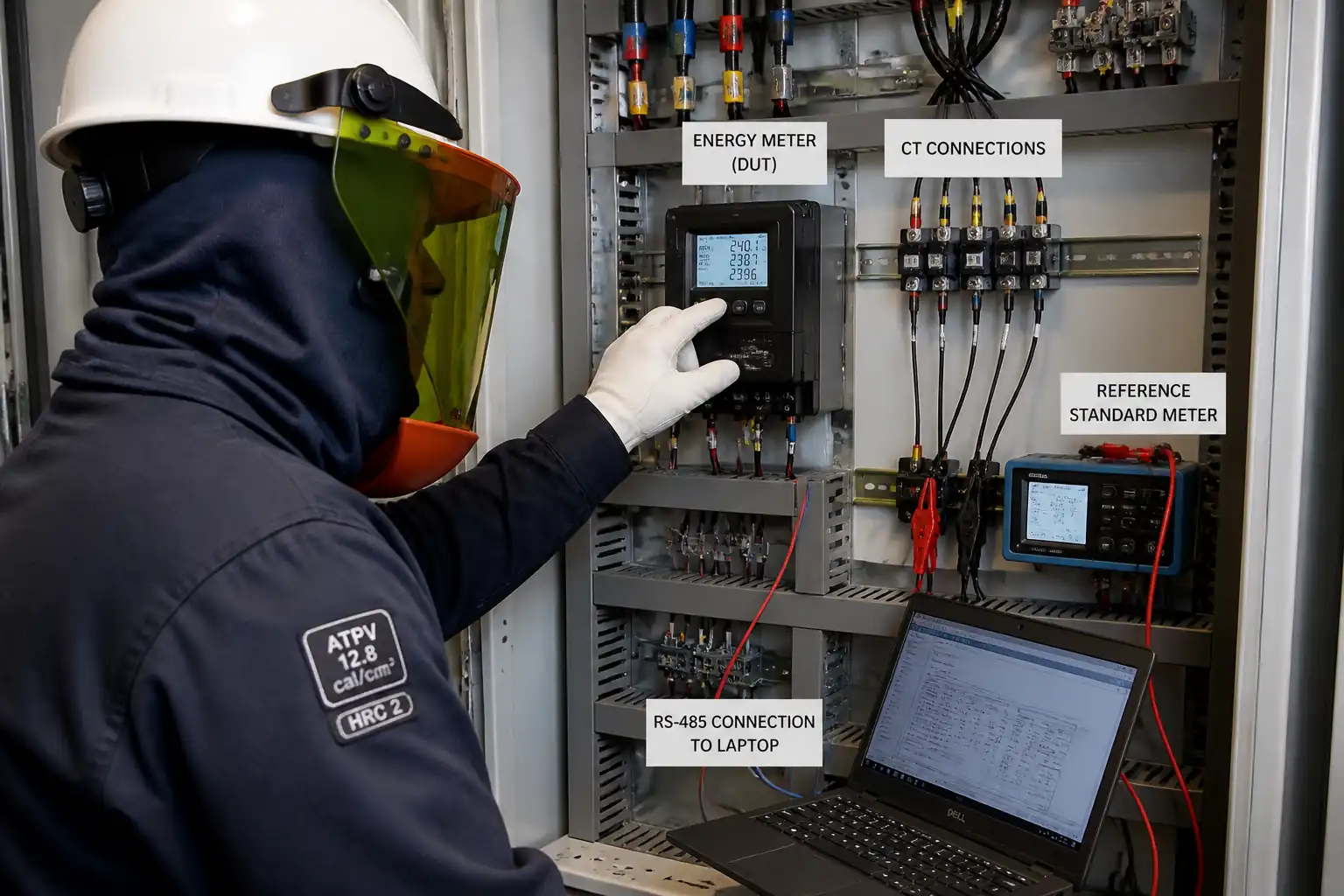
- Communications setup and verification (RS-485/Modbus, Ethernet/TCP-IP, DLMS/COSEM, optical port) including master system polling.
- Functional tests under load with portable reference standard; reading validation and error calculation.
- Event/alarm and tamper feature checks (where applicable).
- Labeling, sealing, QA/QC inspection points, calibration certificates collation.
- Documentation and handover including as-built diagrams and configuration exports.
Exclusions
- Installation of new CTs/VTs or major switchgear modifications (unless specifically instructed).
- Permanent SCADA/BMS programming beyond integration and point verification.
- Utility revenue authority witnessing beyond project scope [Verify per project requirements].
Constraints/Interfaces
- Works may require live testing; permits and arc-flash controls mandatory.
- CT circuits must never be open-circuited while primary current flows.
- Coordination required with utility/owner for outages and witnessing.
- All values and classes to be confirmed by project specifications; typical benchmarks given where noted [Verify per project specifications].
References
| Document Type | Reference / Number | Revision | Notes |
|---|---|---|---|
| Standard | IEC 61869-1/-2/-3 | ||
| Standard | IEC 62053 (e.g., -22, -24) | Acceptance per meter class [Verify] | |
| Standard | IEC 62056 | ||
| Standard | BS EN 50110-1 | Use with project HSE plan | |
| Standard | IEC 60364 | ||
| Standard | IEC 61482-2 / NFPA 70E | [Verify per local regulations] | |
| Standard | ISO/IEC 17025 | Calibration traceability | |
| Manual | Latest OEM editions | Project-approved | |
| Specification | Modbus.org | For RS-485 integration | |
| Contract Docs | Govern precedence |
Responsibilities
| Role | Responsibility | Name / Party |
|---|---|---|
| Contractor | Commissioning Manager | Main Contractor |
| Contractor | T&C Engineer | M&E Subcontractor |
| Contractor | Electrical Supervisor | M&E Subcontractor |
| Contractor | QA/QC Engineer | QC Dept |
| Contractor | HSE Officer | HSE Dept |
| Vendor | Meter Vendor Representative | OEM |
| Client/Engineer | Client/Engineer Representative | Consultant/Owner |
Resources
| Resource Type | Description | Quantity | Remarks |
|---|---|---|---|
| Person | Lead, approvals, coordination | 1 | Certified electrical engineer [Verify] |
| Person | Execute testing/configuration | 1–2 | Authorized Person (AP) electrical [Verify] |
| Person | Panel access, terminations, labeling, safe isolation | 2–3 | Trained in LOTO |
| Person | Permits, audits, arc-flash controls | 1 | |
| Person | Meter OEM technical support | As required | Optional but recommended |
Materials
| Material | Specification / Grade | Quantity | Remarks |
|---|---|---|---|
| Polycarbonate/metal | OEM-approved | Per meter | |
| Engraved traffolyte / heat-shrink ferrules | Min 6 mm text height [Verify] | As required | |
| HRC/MCB | Breaking capacity per fault level [Verify] | As required | |
| As required | |||
| 0.25 W, 1% | Per segment |
Equipment
| Equipment | Capacity / Type | Quantity | Inspection Required |
|---|---|---|---|
| 1 | Yes | ||
| 1 | Yes | ||
| 1+ | Yes | ||
| 1 | Yes | ||
| 1 | Yes | ||
| Set | Yes | ||
| 1 | |||
| 1 | |||
| 1 | Yes |
Prerequisites
- Approved Method Statement and ITP.
- Latest approved single-line diagrams, wiring schematics, and panel schedules available at site.
- Calibration certificates (ISO/IEC 17025 traceable) for all measurement equipment, valid (typically ≤12 months) [Verify per project QA].
- Permits-to-Work issued (Live Electrical Work Permit if applicable) and task-specific risk assessment approved [Verify per project HSE plan and local regulations].
- LOTO plan prepared; isolation points identified; shock/arc-flash boundaries marked; rescue plan in place.
- CT circuits verified safe: shorting links installed before any secondary disconnection; polarity marks P1/P2 and S1/S2 visible and match drawings.
- VT/voltage reference circuits de-energized for checks where possible; fuses/links rating confirmed with drawings; correct earthing verified.
- Panels cleaned; terminations accessible; mechanical fixings tight; ingress protection maintained.
- Meter firmware level identified; OEM passwords/keys and configuration templates available and authorized for use.
- Communications network available and configured (addressing, baud rate, parity, IP scheme, VLANs, firewall rules as applicable).
- Pre-commissioning checklists completed and signed by Supervisor and QA/QC.
- Client/Engineer notification for Witness/Hold points issued as per ITP.
Method Sequence
| Step | Activity | Description | Responsibility | Inspection / Hold Point |
|---|---|---|---|---|
| 1 | Kick-off and Safety Setup | Toolbox talk; review hazards; confirm permits; establish arc-flash boundaries; verify PPE; confirm LOTO where feasible; energization plan agreed. | Electrical Supervisor / HSE Officer | Pre-task audit |
| 2 | Document & Nameplate Verification | Cross-check meter model, firmware, CT/VT nameplates, ratios, classes, and burden vs drawings/specs. Verify CT polarity marks P1→S1 and P2→S2 consistent with power flow. | T&C Engineer | Witness |
| 3 | Mechanical & Terminal Checks | Inspect enclosure integrity, IP rating, meter mounting, terminal tightness using torque tools, and verify no damaged conductors. | Electrician / T&C Engineer | Witness |
| 4 | Continuity & Insulation (De-energized) | Verify continuity of CT secondary circuits (S1 loop, S2 loop) with shorting link closed; perform IR test on voltage circuits to meter (disconnect meter if OEM prohibits IR on terminals). | T&C Engineer | Witness |
| 5 | CT Secondary Burden Estimate | Measure loop resistance S1–S2 at terminal block; calculate burden VA = I²×R for expected secondary current (5 A/1 A) and add meter input burden. | T&C Engineer | Witness |
| 6 | Energize Voltage Reference & Phase Rotation | Energize VT/voltage fuses; verify L-L and L-N voltages, frequency, and phase rotation ABC using tester; confirm correct connection at meter terminals. | Electrician / T&C Engineer | Witness |
| 7 | Meter Power-up & Baseline | Power the meter; check self-diagnostics; set date/time; verify firmware; record serial number; back up factory parameters. | T&C Engineer | Witness |
| 8 | CT Polarity & Phasing Verification | Using secondary injection or live load: inject/measure phase-by-phase. With current entering P1, meter should indicate forward active power for same-phase voltage reference (A-I with A-V, etc.). Confirm vector diagram and power factor sign. | T&C Engineer | Hold |
| 9 | Meter Configuration/Programming | Program CT/PT ratios, wiring scheme (e.g., 3P4W), demand interval (e.g., 15/30 min), TOU tables, pulse constants, direction conventions, loss compensation (if specified), communications (addresses/baud/IP), and time sync (NTP/IRIG-B). Passwords managed per security plan. | T&C Engineer / Vendor Rep | Witness |
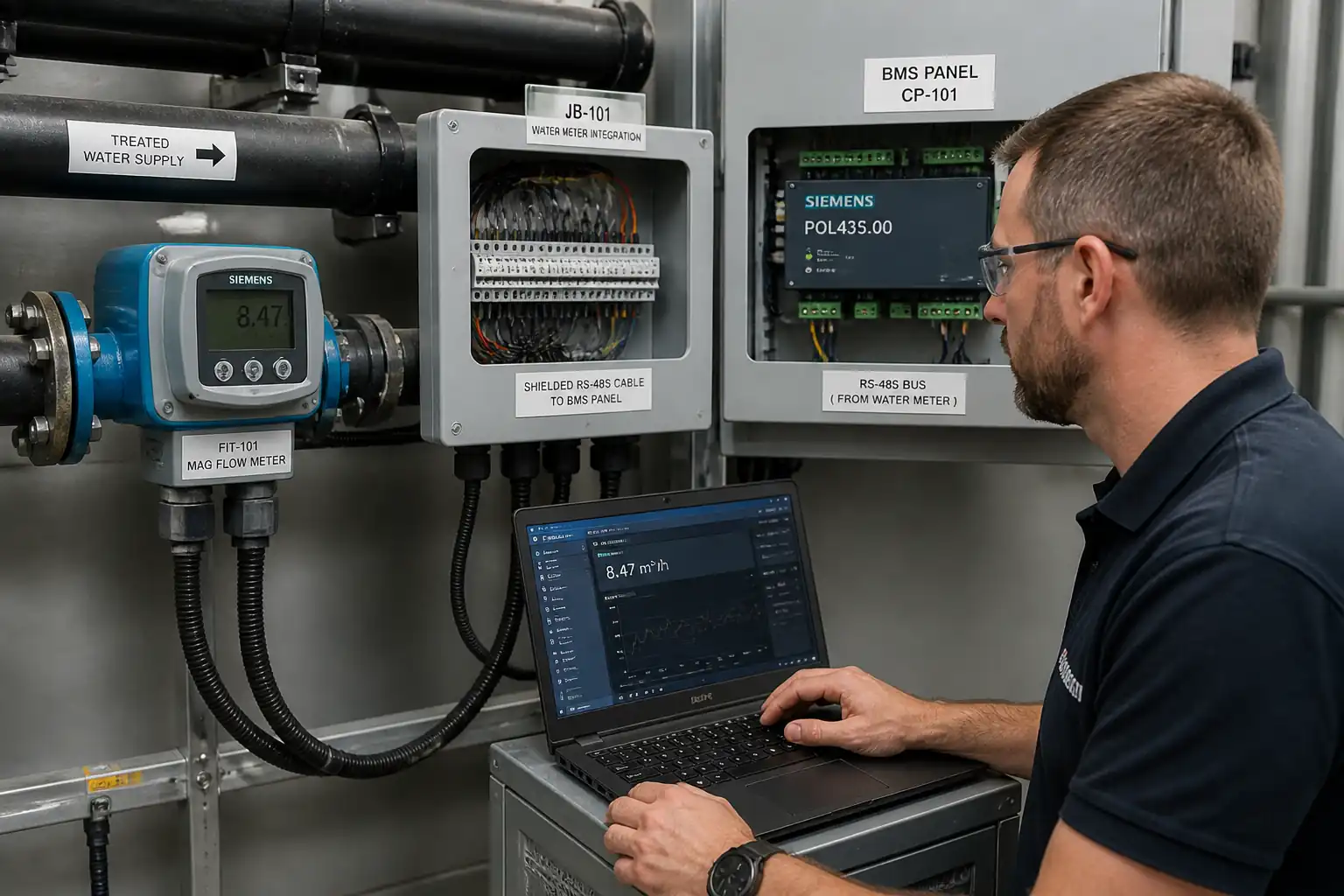
| 10 | Communications Verification | Test RS-485: termination/bias, signal levels, baud/parity; poll with Modbus/DLMS master. Test Ethernet: link, IP, VLAN, latency, firewall. Verify optical port. Confirm master system receives correct data points and scaling. | T&C Engineer / SCADA Engineer | Witness |
| 11 | Functional Accuracy Test Under Load | Connect portable reference standard; measure V/I/PF/Wh at available load steps (target ≥10%, ~50%, and ≥80% of Ib where practicable). Compute meter error = (Meter−Ref)/Ref×100%. | T&C Engineer / Vendor Rep | Hold |
| 12 | Pulse/DI/DO & Event Tests | Verify kWh/kvarh pulse outputs (constant/k-factor), digital inputs (breaker status), and alarms (reverse energy, cover open, power fail/restore). | T&C Engineer | Witness |
| 13 | Thermal Scan at Load | Infrared scan of meter terminals, CT terminal blocks, fuses, and adjacent terminations after ≥15 minutes at steady load. | T&C Engineer | Witness |
| 14 | Labeling & Sealing | Apply permanent labels (meter ID, CT polarity, comms address). Install tamper seals on terminal covers/programming ports as specified. Update seal register. | Electrician / T&C Engineer | Witness |
| 15 | Documentation & Handover | Compile test sheets, calibration certs, as-built drawings, configuration exports, point lists, training records. Close punch items. Obtain final acceptance. | Commissioning Manager / QA-QC | Hold |
Safety Controls
Task-specific Hazards and Controls
1) Hazard: Electric shock/arc flash during live verification
- Likely consequence: Severe burns, cardiac arrest, fatality
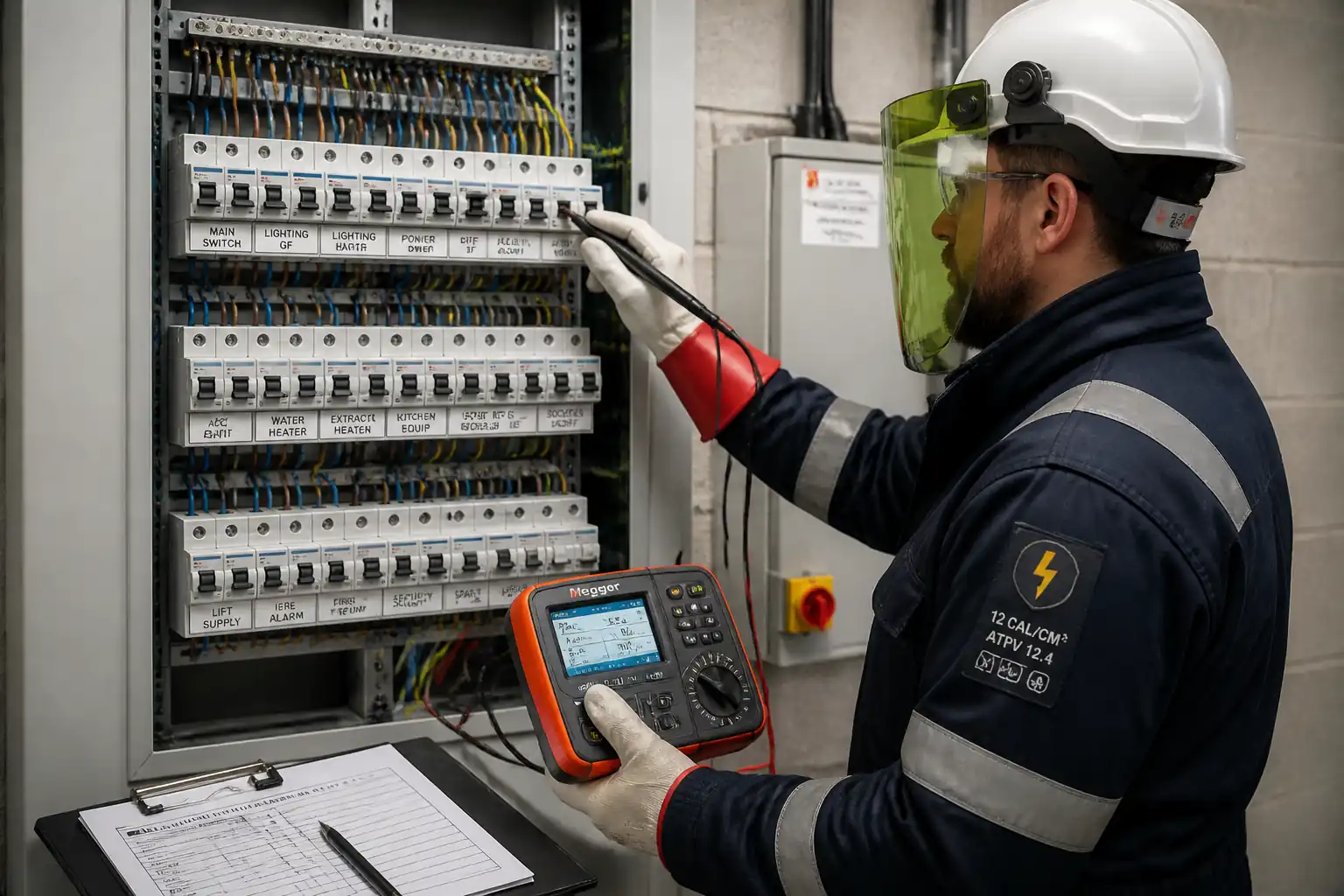
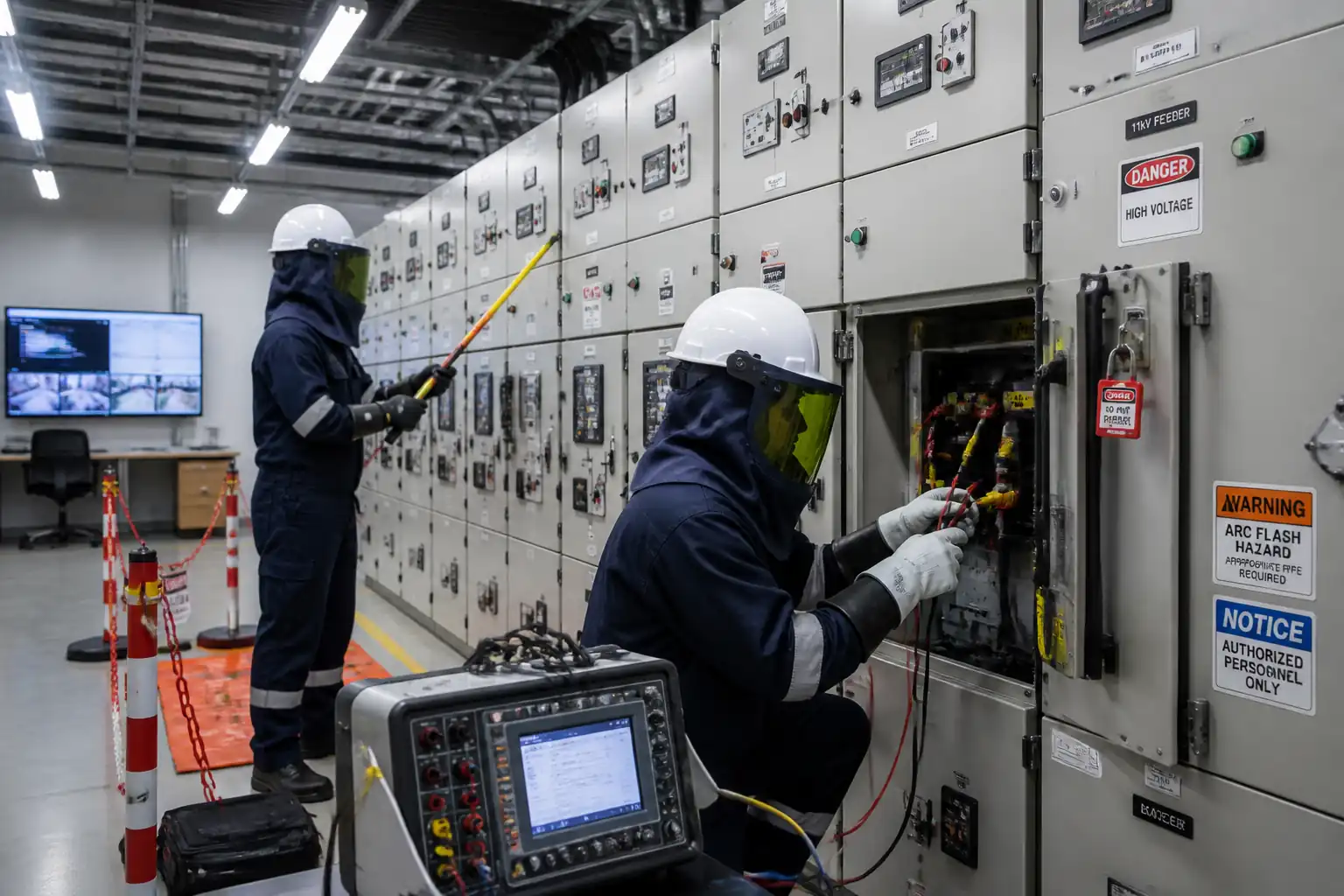
- Engineering/procedural control: Conduct live work only when justified; obtain Live Electrical Work Permit; establish arc-flash boundaries per study or default tables; use insulated tools; keep panels closed except for test; cover adjacent live parts with insulating barriers/mats (IEC 61111); maintain approach distances; use two-person rule for live testing.
- Required PPE: Arc-rated suit per incident energy [Verify], face shield with chin cup, leather/arc-rated gloves (class per voltage), hearing protection, safety footwear, safety glasses.
- Collective preventive measure: Barriers/tape and signage; lock and tag non-required feeders; install temporary insulating shrouds.
- Inspection/permit/supervision: Permit-to-Work; AP/CP authorization; pre-use inspection of PPE; supervisor present for Hold points; test instruments CAT rating verified.
2) Hazard: CT secondary open-circuit under load
- Likely consequence: Dangerous overvoltage, equipment damage, operator injury
- Engineering/procedural control: Always short CT secondaries before any disconnection; verify shorting link integrity; use dedicated CT shorting blocks; sequence: short → disconnect → work → reconnect → unshort.
- Required PPE: Electrical gloves, eye protection, arc-rated clothing if panel live.
- Collective preventive measure: Standardized CT terminal blocks with captive shorting links; procedural signage "Do Not Open CT Secondaries".
- Inspection/permit/supervision: Supervisor check on CT links before work; step recorded on checklist.
3) Hazard: Inadvertent energization/LOTO failure
- Likely consequence: Electric shock, arc flash
- Engineering/procedural control: Apply LOTO per plan; verify absence of voltage with CAT IV meter; try-start test where applicable; keep keys under control; use lockout hasps and tags.
- Required PPE: As per arc-flash boundary when verifying.
- Collective preventive measure: Permit board, LOTO log, independent verification by AP.
- Inspection/permit/supervision: HSE audits; shift handover of LOTO status; periodic field verification.
4) Hazard: Working in front of open panels/awkward access
- Likely consequence: Falls, strains, contact with live parts
- Engineering/procedural control: Maintain clear working area; use insulated platforms; ensure adequate lighting; adopt ergonomic positioning; avoid conductive ladders.
- Required PPE: Helmets, gloves, safety footwear; arc-rated PPE if live parts exposed.
- Collective preventive measure: Task zoning, housekeeping, cable management.
- Inspection/permit/supervision: Pre-task area inspection and sign-off by Supervisor.
5) Hazard: Exposure to noise and hand-arm vibration from test equipment
- Likely consequence: Hearing damage, fatigue
- Engineering/procedural control: Limit exposure time; use low-noise settings; rotate tasks.
- Required PPE: Hearing protection when >80 dB(A) [Verify].
- Collective preventive measure: Barriers or distance from noisy sources.
- Inspection/permit/supervision: HSE monitoring as required.
6) Hazard: Data/cybersecurity breach during configuration
- Likely consequence: Unauthorized access, data tampering
- Engineering/procedural control: Use approved laptops; change default passwords; apply role-based access; disable unused services; follow client cybersecurity policy.
- Required PPE: Not applicable.
- Collective preventive measure: Network segmentation; firewall rules.
- Inspection/permit/supervision: IT/SCADA approval; configuration audit logs retained.
[Verify per project HSE plan and local regulations].
Environmental Controls
- Waste management: Collect and segregate packaging, off-cuts, and replaced fuses per project waste plan; dispose of e-waste (obsolete meters, modems) via licensed recyclers.
- Spill/chemicals: If oil-filled VTs/legacy CTs present, provide spill kits; handle any oil leaks as hazardous waste [Verify per equipment type].
- Noise: Limit testing during sensitive hours; keep panels closed when possible to attenuate sound.
- Dust/cleanliness: Use vacuum, not compressed air, to clean panels; keep optical ports and terminals free from dust.
- Energy efficiency: Minimize duration of injection tests; disconnect test loads promptly.
- Documentation: Store digital records securely; avoid unnecessary printing; provide electronic handover where accepted.
- Environmental incidents: Report and record per project procedures; implement corrective actions.
QA/QC
- Standards compliance: Testing and acceptance aligned to IEC 61869 and IEC 62053 series; communications to IEC 62056/Modbus where applicable.
- Test coverage: 100% of installed meters commissioned and function-tested. Representative communications stability tested for ≥10 minutes per meter or per segment as specified.
- Instrument calibration: All key instruments (reference standard, multimeters, injection sets, thermal cameras) with ISO/IEC 17025 traceable certificates, valid per QA plan (typ. ≤12 months) [Verify].
- Documentation control: Use controlled forms MS-EMC-01 to MS-EMC-14; record serial numbers, firmware versions, parameter sets, and seal IDs.
- Non-conformance: Record NCRs for any deviation; implement corrective actions; retest affected items.
- Acceptance criteria summary:
- Voltage tolerance: nominal ±10% [Verify].
- Phase rotation: ABC consistent across meter and source.
- CT burden: ≤75% of rated burden [Verify]; polarity correct.
- Meter accuracy under load: Within meter class limits per IEC 62053 at tested points.
- Communications: No CRC errors during stability window; latency and time sync within project limits.
- Thermal scan: No abnormal hotspots per criteria.
- Labeling/sealing: Complete, legible, registered.
- Handover: Complete signed ITP, test records, as-builts, configuration exports (machine-readable), calibration certs, O&M manuals, training attendance.
Attachments
- MS-EMC-01: Pre-commissioning checklist (visual/nameplate)
- MS-EMC-02: Torque verification sheet
- MS-EMC-03: Continuity/IR test form
- MS-EMC-04: CT burden calculation sheet
- MS-EMC-05: Voltage and phase rotation sheet
- MS-EMC-06: Meter baseline/config capture sheet
- MS-EMC-07: CT polarity/phasing test record
- MS-EMC-08: Parameterization approval & config export (.xml/.cfg)
- MS-EMC-09: Communications verification log and mapping list
- MS-EMC-10: Accuracy comparison report with reference standard
- MS-EMC-11: I/O and event test record
- MS-EMC-12: Thermal imaging report
- MS-EMC-13: Label and seal register
- MS-EMC-14: Handover dossier index and sign-off
- OEM manuals and data sheets (meters, CTs/VTs, comms devices)
- As-built SLDs and wiring diagrams (PDF + native CAD where permitted)
- Calibration certificates (ISO/IEC 17025 traceable) for all test instruments
- Risk assessment/JSA, Permits-to-Work (including Live Electrical Work Permit if used)
- Training attendance records for operator handover
This content is a read-only public reference. Download or customize to get an editable version.
ITP preview
The first inspection activities from the linked ITP for Method Statement: Electrical Metering System Commissioning:
| Activity | Inspection / Test | Acceptance Criteria | Responsibility | Record |
|---|---|---|---|---|
| Method Statement & ITP Approval | Document review | Approved documents issued for construction/commissioning | QA/QC Engineer / Client Rep | Approved MS & ITP (signatures) |
| Pre-commissioning Visual & Mechanical Checks | Checklist MS-EMC-01/02 | Correct equipment; secure mounting; torque within OEM limits | T&C Engineer / QA-QC | Checklists, torque logs |
| Continuity & Insulation Testing (De-energized) | Ohmmeter & IR test | Continuity confirmed; IR ≥1 MΩ at 500 V DC [Verify] | T&C Engineer | IR/continuity report MS-EMC-03 |
Showing 3 of 14 inspection activities. View full ITP →
Related Inspection and Test Plan
An Inspection and Test Plan (ITP) is available for Method Statement: Electrical Metering System Commissioning. The ITP defines the inspection activities, acceptance criteria, hold and witness points, responsible parties, and records required to verify the work described in this method statement.
View the Method Statement: Electrical Metering System Commissioning ITP →Frequently asked questions
Continue with related Quollnet resources connected to this method statement.