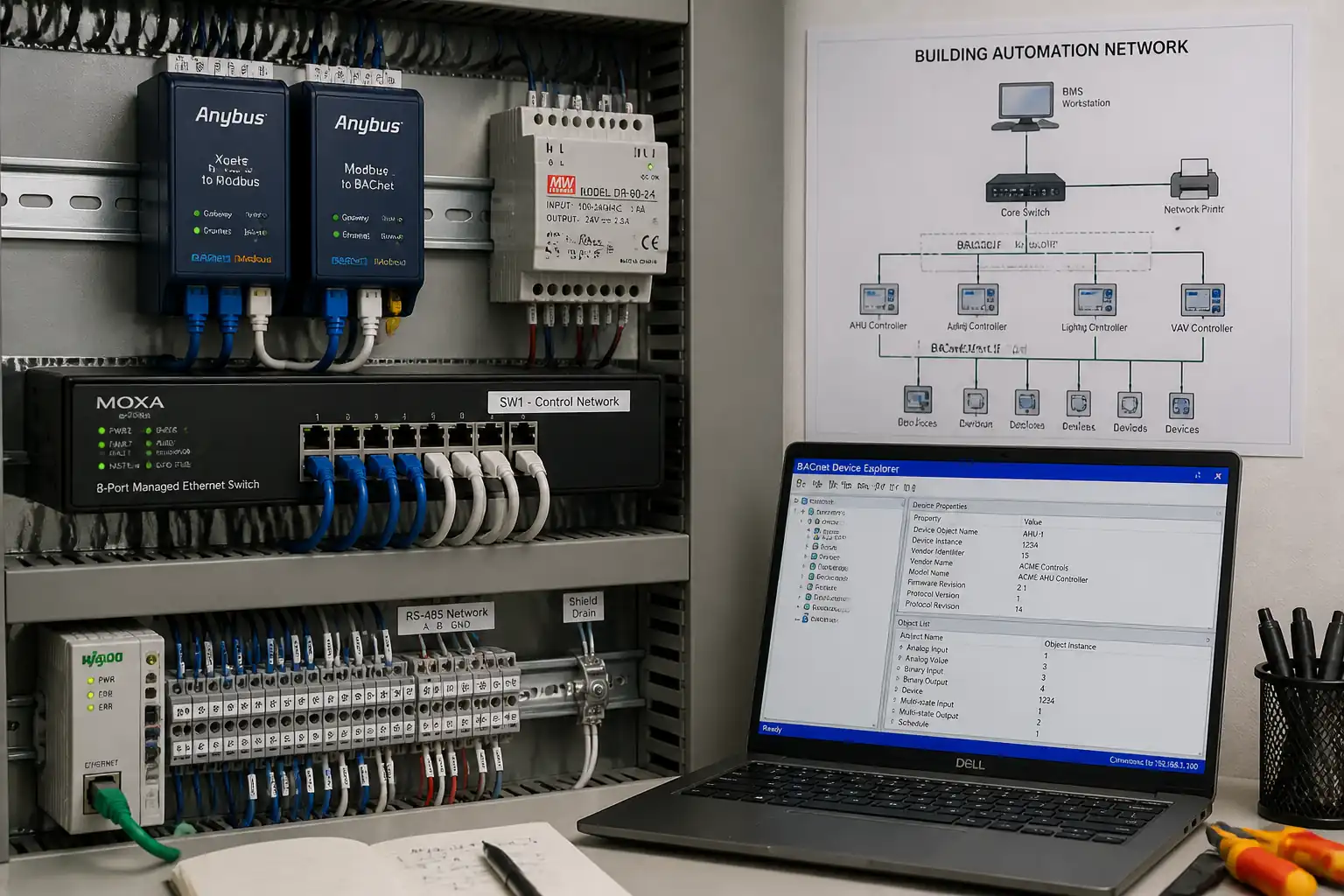

Method Statement – BACnet and Modbus Integration with Third-Party Equipment – Method Statement
AI-assisted method statement with matching ITP, PDF download, and Excel export.
More than a static template
Unlike a downloadable Word or PDF template, this method statement is an AI-assisted editable starting point connected directly to a matching Inspection and Test Plan. Every section is structured, project-adaptable, and ready to export.
- AI-assisted drafting — Customize every section with AI for your specific project scope.
- Linked ITP — A matching inspection and test plan is generated alongside the method statement.
- Multiple export formats — Download as a formatted PDF or editable Excel spreadsheet.
- Editable starting point, not a final document — Review, verify, and adjust all content against your project requirements before use.
Static template vs. Quollnet workflow
| Feature | Static template | Quollnet |
|---|---|---|
| Project-specific content | Manual fill-in required | AI-assisted customization |
| Linked ITP | Separate document, no link | Matching ITP included |
| Export formats | Usually PDF only | PDF and Excel |
| Structured sections | Free-form layout | 13 standardized sections |
| Saved to your account | Local file only | Cloud-saved, reusable |
| Content accuracy | You verify everything | AI-assisted, you still verify |
| Cost | Often free but time-intensive | Free to customize and download |
What you can customize
When you save this method statement to your account, every section becomes editable. The following 13 sections are included:
- Scope — Defines the activity and its boundaries.
- References — Standards, specifications, and drawings.
- Responsibilities — Roles and accountabilities.
- Resources — Labour, plant, and equipment summary.
- Materials — Materials and compliance requirements.
- Equipment — Tools and equipment details.
- Prerequisites — Hold points and pre-conditions.
- Method sequence — Step-by-step construction sequence.
- Safety controls — HSE risk controls and PPE.
- Environmental controls — Environmental mitigation measures.
- QA/QC — Quality inspection and test requirements.
- ITP — Inspection and Test Plan table (has its own page).
- Attachments — Referenced drawings and documentation.
Why this method statement is used
This method statement is used to define and communicate the approved procedure for carrying out method statement – bacnet and modbus integration with third-party equipment on site. It ensures the work is planned in advance, the correct resources and controls are in place, and all personnel understand responsibilities, sequence, quality requirements, and safety controls before work begins. It aligns site execution with the documented scope and acceptance expectations.
Who uses this method statement
This method statement is used by contractors, site supervisors, project engineers, QA/QC engineers, HSE officers, consultants, and client representatives. It serves as a shared reference for planning, execution, supervision, inspection, and approval of the activity on site.
When it is prepared and submitted
The method statement is prepared before the work activity starts and submitted as part of the pre-construction documentation package for review and approval.
Who reviews or approves it
The method statement is usually submitted to the client representative, consultant, resident engineer, or project management consultant for review and approval before the work commences.
Important approval note
This method statement is an AI-assisted editable starting point, not a pre-approved document. Before use on any project, all content must be reviewed and approved by the relevant parties (superintendent, principal contractor, or client representative) in accordance with your contract and project quality plan.
For example: if your specification requires a departure from a referenced standard, that departure must be documented and approved separately — this method statement will not capture that automatically. Always verify against your applicable drawings, specifications, and regulatory requirements.
Method statement content
Scope
Purpose
Provide a complete methodology to integrate third-party equipment and systems with the Building/Industrial Management System (BMS/SCADA) via BACnet (IP or MS/TP) and Modbus (TCP or RTU), ensuring correct physical connectivity, addressing, point data mapping, functional verification (values/trends/alarms), issue management, and final records for handover.
Inclusions
- Review and approval of vendor point lists and integration submittals.
- Communication cabling installation and terminations for BACnet MS/TP (RS‑485), Modbus RTU (RS‑485), and Ethernet for BACnet/IP or Modbus TCP.
- Device addressing and network parameter configuration (Device Instance, MAC, Unit ID, IP schemas, BBMD as applicable).
- Gateway and router configuration (BACnet/IP↔MS/TP; Modbus RTU↔TCP) including VLAN/firewall coordination.
- Data point mapping (object types/registers, scaling, engineering units, enumeration, byte/word order).
- End-to-end value verification, trend validation, and alarm/command functionality tests against approved cause & effect/alarm philosophy.
- QA/QC inspections, ITP hold/witness points, and as-built documentation.
- Issue/Punch list management to closure.
Exclusions
- OEM internal controller programming beyond exposing points as per approved list (unless specifically stated).
- Permanent IT network infrastructure beyond defined integration demarcation.
- Remedial works to third-party equipment internal wiring outside the integration interface.
Deliverables
- Approved point lists and data mapping schedule.
- Tested communication network with certified cabling results and addressing register.
- Test sheets: point-to-point value checks, command tests, alarm functional tests, trend validation.
- Issue log and closure evidence.
- Final integration record set (as-built drawings, network topology, addressing, gateway configs, backups).
References
| Document Type | Reference / Number | Revision | Notes |
|---|---|---|---|
| Standard | ASHRAE 135 / ISO 16484‑5 | BACnet/IP, BACnet/MS/TP object, services, device instance rules. | |
| Standard | Modbus App Protocol v1.1b3; Modbus over Serial Line v1.02 | Modbus TCP (Port 502) and RTU framing/CRC, Unit IDs, registers. | |
| Standard | EIA/TIA‑485‑A (RS‑485) | 120 Ω terminations, biasing, topology constraints. | |
| Standard | ISO/IEC 11801; ANSI/TIA‑568.2‑D; ANSI/TIA‑1152‑A | Cat6/6A performance; maximum 100 m channel length for copper. | |
| Standard | IEEE 802.3; IEEE 802.1Q/1D (VLAN/STP) | Managed switch features, VLAN, RSTP for resiliency [Verify per project]. | |
| Recommended Practice | ISA‑18.2 / IEC 62682 | Priorities, deadbands, shelving, annunciation timing [Verify per project]. | |
| Standard | IEC 62443 series | Account management, network segregation, hardening [Verify per project policy]. | |
| Guideline | ASHRAE Guideline 1.1; CIBSE Commissioning Code M | Point-to-point verification and functional performance testing. | |
| Standard | NTP (RFC 5905) | Central NTP server; allowable skew ≤ ±2 s [Verify per project]. |
Responsibilities
| Role | Responsibility | Name / Party |
|---|---|---|
| Project Manager | Project Manager | Main Contractor |
| Lead Engineer | BMS/Controls Lead Engineer | Specialist Subcontractor |
| Supervisor | Electrical/Controls Supervisor | Specialist Subcontractor |
| IT Engineer | IT/Network Engineer | Main Contractor/Client IT |
| Vendor Representative | Third-Party Equipment Vendor Rep | OEM |
| QA/QC | QA/QC Engineer | Main Contractor |
| HSE | HSE Officer | Main Contractor |
| Client Rep | Client/Engineer’s Representative | Client/Engineer |
Resources
| Resource Type | Description | Quantity | Remarks |
|---|---|---|---|
| Controls Engineer | Integration, mapping, testing, reporting. | 2–3 [Verify] | |
| Technician | Cabling verification, device commissioning, functional tests. | 3–6 [Verify] | |
| IT/Network Engineer | Switching, routing, NTP, security baselining. | 1–2 [Verify] | |
| OEM Specialist | Enable protocol objects/registers; witness integration. | As required [Verify] |
Materials
| Material | Specification / Grade | Quantity | Remarks |
|---|---|---|---|
| RS‑485 STP Cable | EIA/TIA‑485‑A compliant; 120 Ω; flame rating per site | As per cable schedule [Verify] | |
| Category Cabling | ANSI/TIA‑568.2‑D; ISO/IEC 11801 Class E/Ea | As per cable schedule [Verify] | |
| Resistors | 120 Ω, 0.25 W | Per segment (2 pcs) [Verify] | |
| Gateways | Support required objects/registers; throughput ≥ 100 pkt/s [Verify] | As per I/O count [Verify] | |
| Layer-2/3 Switch | IEEE 802.1Q; RSTP; IGMP snooping [Verify] | As per network design [Verify] | |
| Identification | ISO/IEC 14763-2 practices [Verify] | As required |
Equipment
| Equipment | Capacity / Type | Quantity | Inspection Required |
|---|---|---|---|
| Engineering Laptops | Admin rights; latest patches [Verify] | 2+ | |
| Copper Certifier | Cat6/6A Autotest | 1 | |
| 485 Diagnostic Kit | 1–2 | ||
| Multimeter & Tools | As required | ||
| Label Printer | 1 |
Prerequisites
- Approved shop drawings, network topology, and cable schedules.
- Approved point lists from OEMs including object/register IDs, scaling, engineering units, write permissions, alarm priorities, and test methods.
- Confirmed addressing plans:
- BACnet/IP: Subnet, gateway, static IPs, UDP port 47808 (0xBAC0) unless otherwise agreed, BBMD need across L3 boundaries [Verify].
- BACnet MS/TP: MAC addresses 0–127 (unique), Max_Master/Max_Info [Verify], baud 9.6–76.8 kbps [Verify].
- Modbus TCP: IPs, Port 502 open; Modbus RTU: Unit IDs 1–247 (unique), baud/parity/stop bits defined.
- Approved alarm philosophy/cause & effect per ISA‑18.2 [Verify].
- IT coordination: VLAN IDs, trunk/access ports, firewall rules, NTP server, time sync target skew ≤ ±2 s [Verify].
- Availability of OEM/vendor representative for enablement and witnessing.
- Permits: Electrical isolation/energization plan, work-at-height, hot work (if metal supports drilling), network change window approvals [Verify per project HSE plan and local regulations].
- Calibrated test instruments with valid certificates.
- Spare parts and consumables on site (RJ45s, resistors, ferrules, DIN rail accessories).
Method Sequence
| Step | Activity | Description | Responsibility | Inspection / Hold Point |
|---|---|---|---|---|
| 1 | Kickoff & Interface Verification | Confirm scope boundaries, demarcation points, and responsibilities with Client, IT, and OEMs. Freeze integration matrix and point lists. | BMS Lead Engineer | ITP Hold |
| 2 | Material Receipt & Inspection | Receive cables, gateways, switches. Verify model, rating, certificates, and quantities. | QA/QC Engineer | WIR |
| 3 | Cable Route Preparation | Install containment (trays/conduits) and supports. Mark cable paths and pull strings. | Electrical Supervisor | Surveillance |
| 4 | RS‑485 Cabling | Pull shielded twisted pair in daisy-chain (no stubs). Terminate drain and shield at single end (controller or gateway) unless OEM requires otherwise. | Technician | Surveillance |
| 5 | RS‑485 Termination & Bias | Install 120 Ω termination at both physical ends and biasing resistors as required (one location on segment). | Technician | Witness |
| 6 | Ethernet Cabling | Install Cat6/6A; terminate to patch panels and devices; label both ends. | Technician | Witness |
| 7 | Power & Panel Checks | Verify clean power supply to gateways/switches; check earthing and panel environment. | Electrical Supervisor | Surveillance |
| 8 | Device Addressing – Modbus RTU | Set Unit IDs (1–247 unique); configure baud, parity, stop bits as per approved config; document settings. | Controls Engineer | Witness |
| 9 | Device Addressing – BACnet | Assign Device Instance numbers (unique globally), MS/TP MAC addresses, and IP settings. Configure Max_Master/Max_Info as per design. | Controls Engineer | Witness |
| 10 | Gateway/Router Configuration | Load gateway templates; map serial masters/slaves; set BBMD if cross-subnet; set time sync and NTP. | Controls Engineer | Witness |
| 11 | Point Mapping | Map Modbus registers (addressing base, data type, endian) and BACnet objects (object types/IDs); set scaling, units, states text. | Controls Engineer | Hold |
| 12 | Network Health Checks | Verify MS/TP token passing, frame errors; Modbus CRC errors; switch port stats; VLAN membership. | IT/Network Engineer | Surveillance |
| 13 | Point-to-Point Value Verification | For each point, stimulate source (OEM simulator/test mode) and verify value, scaling, units, and update rate at BMS/SCADA. | Commissioning Technician + OEM Rep | Witness |
| 14 | Command & Interlock Testing | Execute safe commands (start/stop, setpoints) under OEM supervision; confirm effect and feedback; verify interlocks. | Commissioning Team | Witness |
| 15 | Alarm Functional Testing | Trigger each configured alarm (sensor trip/simulate) and confirm annunciation, priority, acknowledgment, and reset behaviour. | Commissioning Team + Client Rep | Witness |
| 16 | Trends & Time Sync Validation | Enable trends per spec; verify sampling, retention, and NTP time alignment across devices. | Controls Engineer | Surveillance |
| 17 | Cybersecurity Baseline | Change default credentials; apply role-based access; disable unused services/ports; backup configs. | IT/Network Engineer | Hold |
| 18 | Issue Logging & Closure | Log defects/snags; categorize severity; assign actions; retest after rectification. | QA/QC Engineer | Surveillance |
| 19 | As‑Built & Handover | Compile as-built drawings, network diagrams, addressing registers, mapping schedules, certs, test sheets, OEM approvals, and training records. | Project Manager | Witness |
Health & Safety Controls
Task-specific Hazards and Controls
1) Live Electrical Exposure (panels, power to gateways/switches)
- Hazard: Contact with energized parts (230/400 VAC) during terminations or testing.
- Consequence: Electric shock, burns, arc flash.
- Engineering/Procedural Controls: De-energize and lockout/tagout (LOTO) before work; verify absence of voltage; use insulated tools; segregate LV and ELV; cover adjacent live parts.
- Required PPE: Arc-rated clothing when energized work is unavoidable [Verify], insulated gloves (Class 00), face shield, safety glasses, EH-rated boots.
- Collective Measures: Barriers and lockable panel doors; warning signage; designated test areas.
- Inspection/Permits: Electrical work permit; LOTO checklist; supervisor sign-off; calibrated test meter verification.
2) Working at Height (cable trays, ceilings)
- Hazard: Falls from ladders/scaffolds; dropped objects.
- Consequence: Injury from falls or struck-by.
- Controls: Use certified platforms; maintain 3-point contact; tool lanyards; exclusion zones; install toe boards.
- PPE: Hard hat, safety shoes, gloves, fall arrest if required.
- Collective Measures: Scaffolding handrails; barrier tape; spotter.
- Inspection/Permits: Work-at-height permit; pre-use inspection of ladders/scaffolds.
3) RS‑485/Ethernet Cable Installation
- Hazard: Cuts/abrasions; repetitive strain; cable damage; proximity to moving plant.
- Consequence: Minor injuries; system faults.
- Controls: Proper cable pulling tension limits per manufacturer; use rollers; maintain separation from power; no tight bend radius (≥ 4× cable OD Cat6 typical) [Verify]; avoid sharp edges with grommets.
- PPE: Gloves, safety glasses.
- Collective Measures: Edge protection on trays; housekeeping to prevent trip hazards.
- Inspection/Permits: Supervisor inspections; containment QA checks.
4) Drilling/Anchoring for Containment
- Hazard: Dust, noise, hidden services strike.
- Consequence: Respiratory irritation, hearing loss, utility damage.
- Controls: Scan walls/soffits for services; mark permit drawings; use dust extraction; limit drilling to permitted zones; use stop collars.
- PPE: Dust mask (P2/P3), hearing protection, safety glasses, gloves.
- Collective Measures: Local exhaust ventilation, barriers.
- Inspection/Permits: Hot work permit if required by site; service detection record; work area inspection.
5) Functional Testing of Equipment
- Hazard: Unexpected equipment start/stop; pressure/temperature changes.
- Consequence: Injury, equipment damage, process upset.
- Controls: Coordinate with operations; place systems in test mode; communicate over radio; apply lockouts/bypasses per OEM; display “Under Test” signage.
- PPE: Standard site PPE; task-specific (hearing protection near rotating machinery).
- Collective Measures: Exclusion zones around moving parts; guards in place.
- Inspection/Permits: Commissioning/test permit; OEM supervision records.
6) IT/Cybersecurity Changes
- Hazard: Uncontrolled network changes causing outages/security exposure.
- Consequence: Operational disruption; security breach.
- Controls: Change control with back-out plan; offline staging; apply least-privilege; disable default accounts; secure backups.
- PPE: N/A.
- Collective Measures: Network segregation (VLAN); firewall rules; jump hosts.
- Inspection/Permits: IT change ticket; approvals per Client IT policy.
Note: All controls shall be verified per project HSE plan and local regulations.
Environmental Controls
- Cable Waste Management: Segregate offcuts and packaging; recycle copper and plastics; cardboard to recycling streams.
- E-waste: Dispose of failed electronics (switches/gateways) via licensed e-waste handlers compliant with WEEE/local laws.
- Noise/Dust: Use low-dust drilling methods and dust extraction; schedule noisy works during approved windows; provide hearing protection where levels exceed limits [Verify].
- Energy & Heat Load: Power up network gear only when required; switch off test equipment when not in use.
- Chemical Use: Use low-VOC cleaners; avoid solvent spills; store aerosols in ventilated areas with spill trays.
- Spill Control: Keep drip trays for any HVAC equipment under test that may discharge condensate; prevent discharge to storm drains.
- Documentation: Record environmental incidents and corrective actions per site EMS.
QA/QC
Quality Objectives
- Zero duplicate addresses and consistent naming across the system.
- 100% point-to-point verification and 100% alarm functional testing for critical alarms [Verify sample size per project].
- Certified cabling test results aligning with TIA/ISO.
Controls and Checks
- Submittal approvals recorded before work.
- ITP Hold/Witness points at material receipt, addressing, mapping, value/command testing, and handover.
- Calibration certificates for all test instruments (valid and traceable).
- Change control for configuration updates with revision history and backups.
- Independent QA spot checks (≥10% sample) of completed points prior to Client witnessing.
Acceptance Metrics
- Ethernet: PASS certification to Cat class; latency within LAN typically < 5 ms and packet loss < 0.1% [Verify].
- RS‑485: End-to-end resistance ≈ 60 Ω with both terminators; bias 200–800 mV; frame/CRC error rate < 1% in 15‑min observation [Verify].
- BACnet: Unique Device Instance across site; MS/TP stable token rotation; device discovery shows all devices; time sync skew ≤ ±2 s.
- Modbus: Unique Unit IDs; correct baud/parity; no exception responses in steady state.
- Points: Correct scaling/units/enumerations; commanded states effect and feedback within agreed timeout.
- Alarms: Priority and annunciation time per philosophy (e.g., ≤ 5 s for critical) [Verify].
- Trends: Sampling and retention per spec; no gaps during observation window.
Records
- Material/WIR, Cable Certification PDFs, RS‑485 test sheets, Address registers, Mapping schedules (rev-controlled), Network health reports, Point/Alarm/Functional test sheets, Trend screenshots, Security checklist, Issue logs with closure, As-built drawings, Gateway configs and backups, Training attendance.
Attachments
- Approved Interface Control Document (ICD)
- Approved Point Lists and Mapping Schedules
- Network Topology Diagrams (logical and physical)
- Cable Schedules and As‑Built Drawings
- Cable Test Certificates (TIA/ISO Autotests)
- RS‑485 Termination/Bias Test Sheets
- Addressing Registers (BACnet & Modbus)
- Gateway/Router Configuration Backups and Screenshots
- Point/Alarm/Functional Test Sheets and Trend Evidence
- Issue/Punch List with Closure Evidence; NCR/CAR records
- Training Materials and Attendance Records
- O&M Manuals and OEM Protocol Notes
This content is a read-only public reference. Download or customize to get an editable version.
ITP preview
The first inspection activities from the linked ITP for Method Statement – BACnet and Modbus Integration with Third-Party Equipment:
| Activity | Inspection / Test | Acceptance Criteria | Responsibility | Record |
|---|---|---|---|---|
| Submittals Approval | Review of MS, ITP, point lists, network drawings | All documents approved for construction | BMS Lead / Client Rep | Approved Submittals Register |
| Material Receipt Inspection | Model/ratings vs submittal; certificates; damage | Conformity; no damage; certs provided | QA/QC | Material Inspection Report / WIR |
| Containment Installation Check | Support spacing; segregation; earthing; firestops | As per drawings/spec; separation maintained | Supervisor / QA/QC | Containment QA Checklist |
Showing 3 of 15 inspection activities. View full ITP →
Related Inspection and Test Plan
An Inspection and Test Plan (ITP) is available for Method Statement – BACnet and Modbus Integration with Third-Party Equipment. The ITP defines the inspection activities, acceptance criteria, hold and witness points, responsible parties, and records required to verify the work described in this method statement.
View the Method Statement – BACnet and Modbus Integration with Third-Party Equipment ITP →