
Method Statement – Building Management System (BMS) Testing & Commissioning – Method Statement
AI-assisted method statement with matching ITP, PDF download, and Excel export.
More than a static template
Unlike a downloadable Word or PDF template, this method statement is an AI-assisted editable starting point connected directly to a matching Inspection and Test Plan. Every section is structured, project-adaptable, and ready to export.
- AI-assisted drafting — Customize every section with AI for your specific project scope.
- Linked ITP — A matching inspection and test plan is generated alongside the method statement.
- Multiple export formats — Download as a formatted PDF or editable Excel spreadsheet.
- Editable starting point, not a final document — Review, verify, and adjust all content against your project requirements before use.
Static template vs. Quollnet workflow
| Feature | Static template | Quollnet |
|---|---|---|
| Project-specific content | Manual fill-in required | AI-assisted customization |
| Linked ITP | Separate document, no link | Matching ITP included |
| Export formats | Usually PDF only | PDF and Excel |
| Structured sections | Free-form layout | 13 standardized sections |
| Saved to your account | Local file only | Cloud-saved, reusable |
| Content accuracy | You verify everything | AI-assisted, you still verify |
| Cost | Often free but time-intensive | Free to customize and download |
What you can customize
When you save this method statement to your account, every section becomes editable. The following 13 sections are included:
- Scope — Defines the activity and its boundaries.
- References — Standards, specifications, and drawings.
- Responsibilities — Roles and accountabilities.
- Resources — Labour, plant, and equipment summary.
- Materials — Materials and compliance requirements.
- Equipment — Tools and equipment details.
- Prerequisites — Hold points and pre-conditions.
- Method sequence — Step-by-step construction sequence.
- Safety controls — HSE risk controls and PPE.
- Environmental controls — Environmental mitigation measures.
- QA/QC — Quality inspection and test requirements.
- ITP — Inspection and Test Plan table (has its own page).
- Attachments — Referenced drawings and documentation.
Why this method statement is used
This method statement is used to define and communicate the approved procedure for carrying out method statement – building management system (bms) testing & commissioning on site. It ensures the work is planned in advance, the correct resources and controls are in place, and all personnel understand responsibilities, sequence, quality requirements, and safety controls before work begins. It aligns site execution with the documented scope and acceptance expectations.
Who uses this method statement
This method statement is used by contractors, site supervisors, project engineers, QA/QC engineers, HSE officers, consultants, and client representatives. It serves as a shared reference for planning, execution, supervision, inspection, and approval of the activity on site.
When it is prepared and submitted
The method statement is prepared before the work activity starts and submitted as part of the pre-construction documentation package for review and approval.
Who reviews or approves it
The method statement is usually submitted to the client representative, consultant, resident engineer, or project management consultant for review and approval before the work commences.
Important approval note
This method statement is an AI-assisted editable starting point, not a pre-approved document. Before use on any project, all content must be reviewed and approved by the relevant parties (superintendent, principal contractor, or client representative) in accordance with your contract and project quality plan.
For example: if your specification requires a departure from a referenced standard, that departure must be documented and approved separately — this method statement will not capture that automatically. Always verify against your applicable drawings, specifications, and regulatory requirements.
Method statement content
Scope
Overview
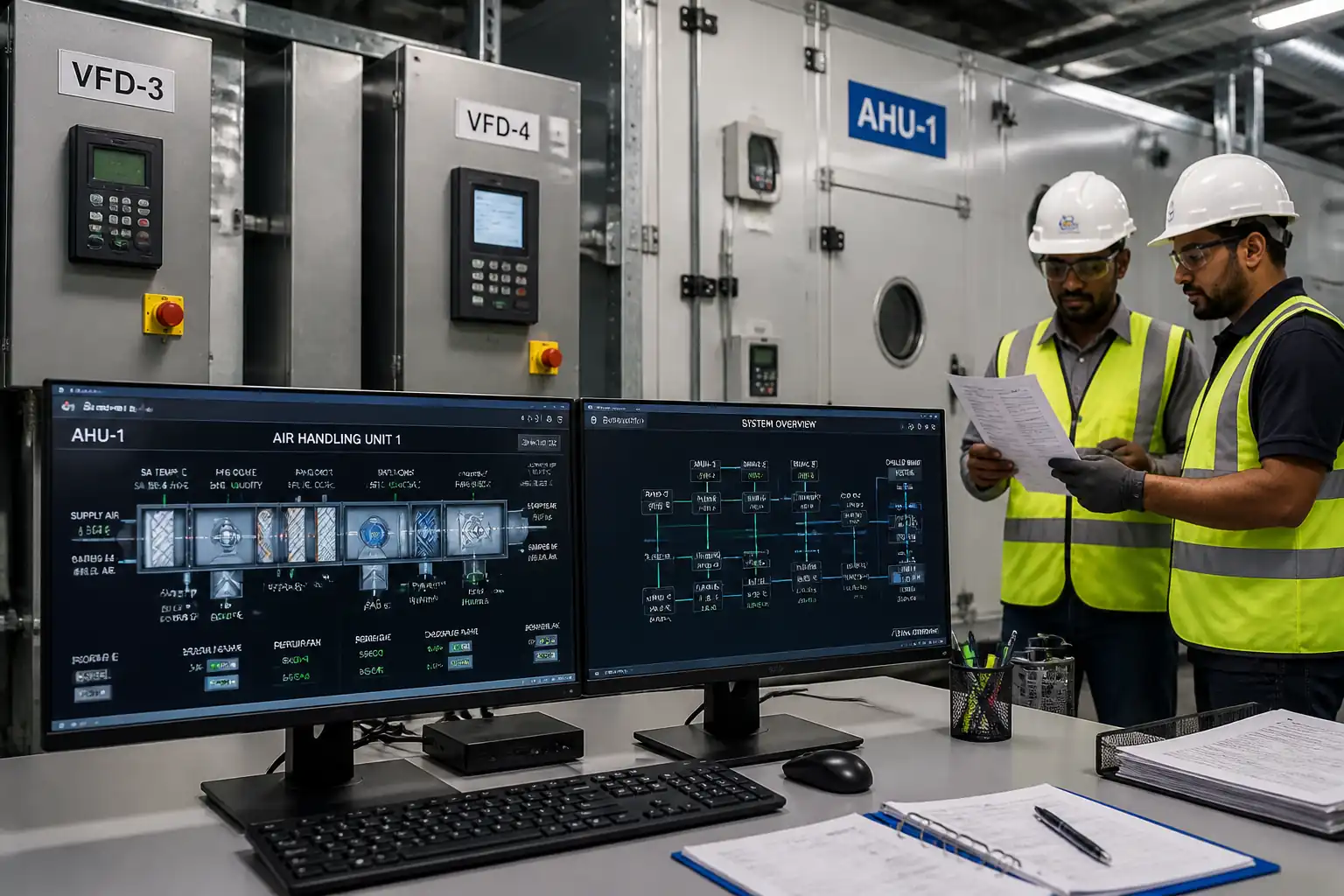
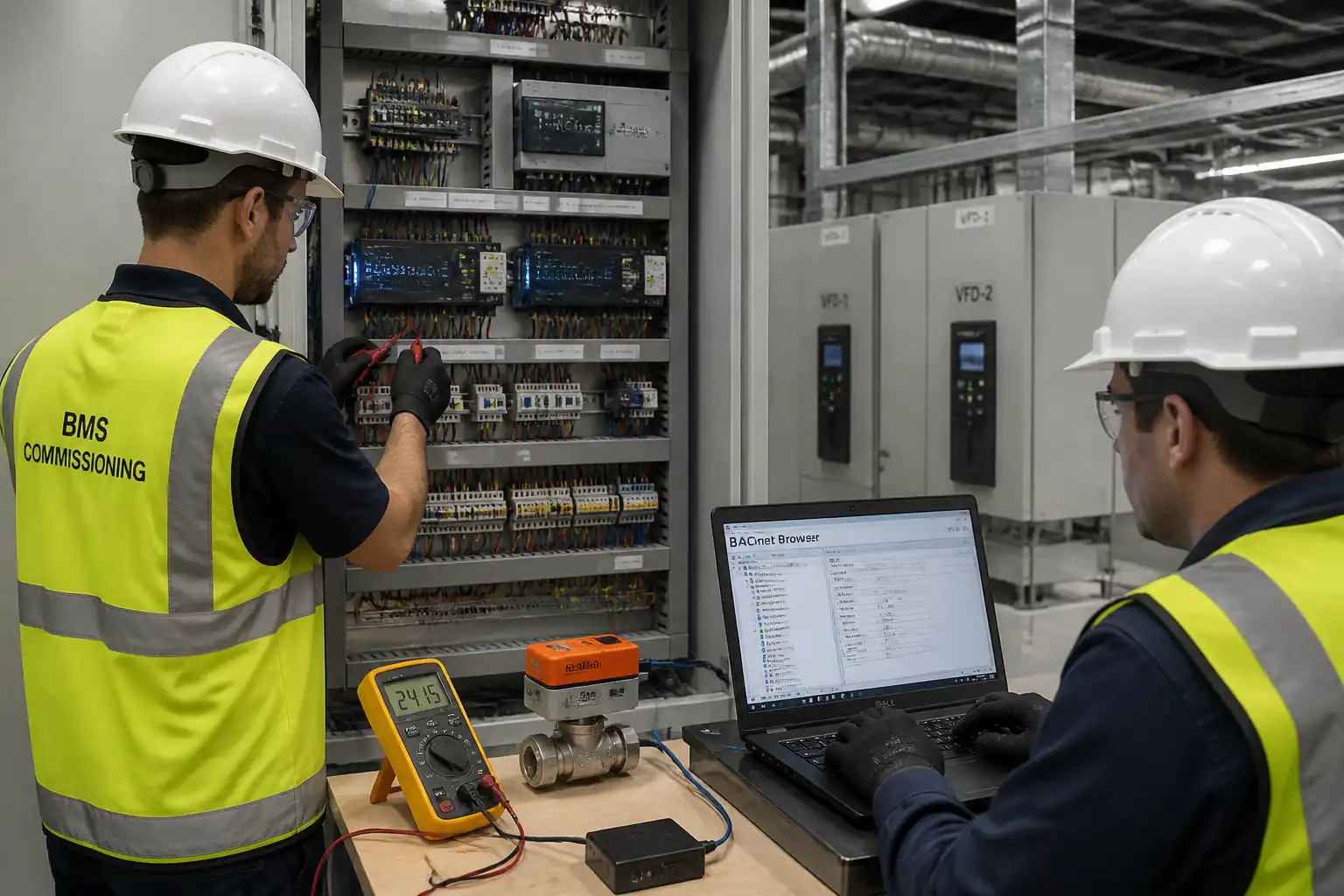
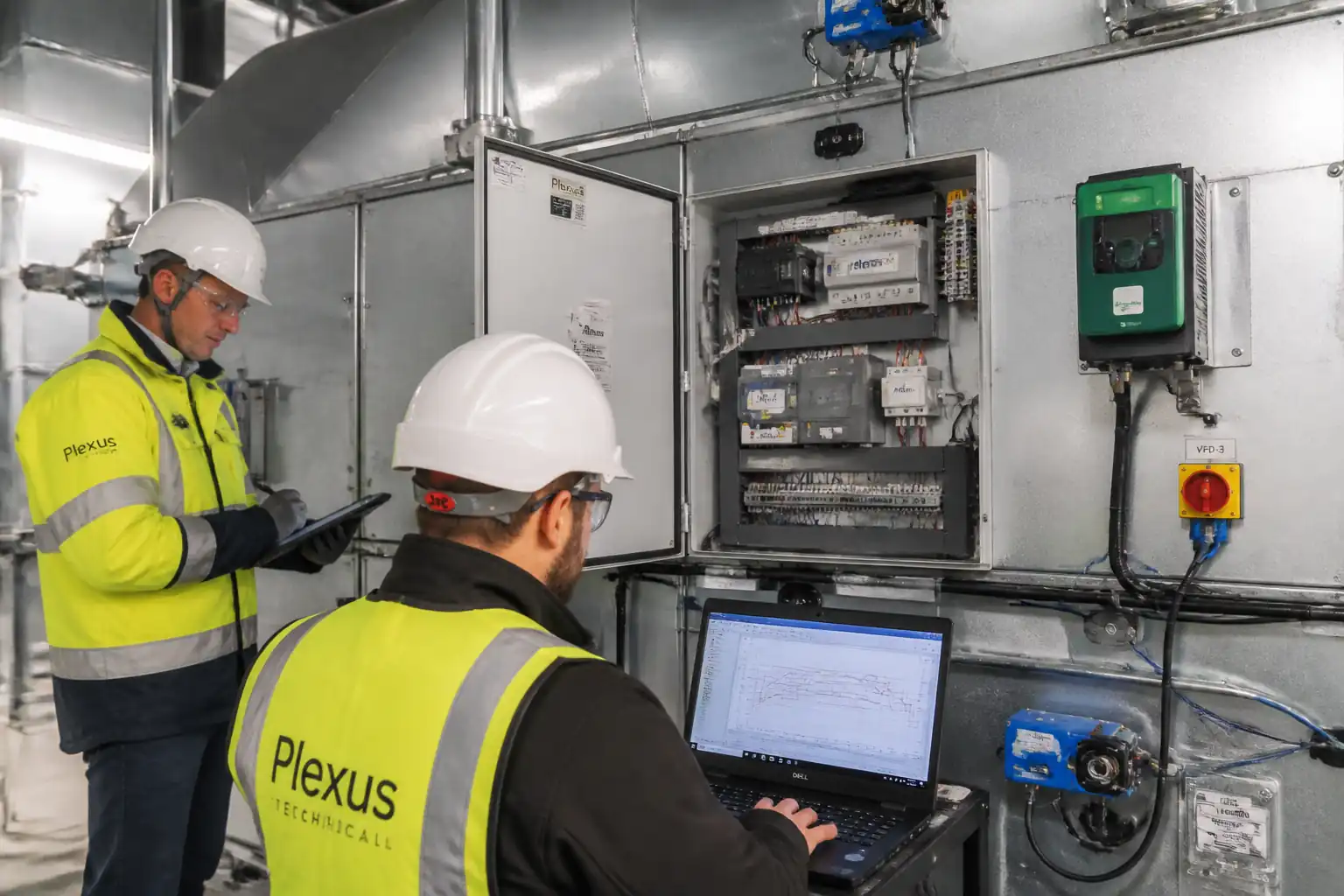
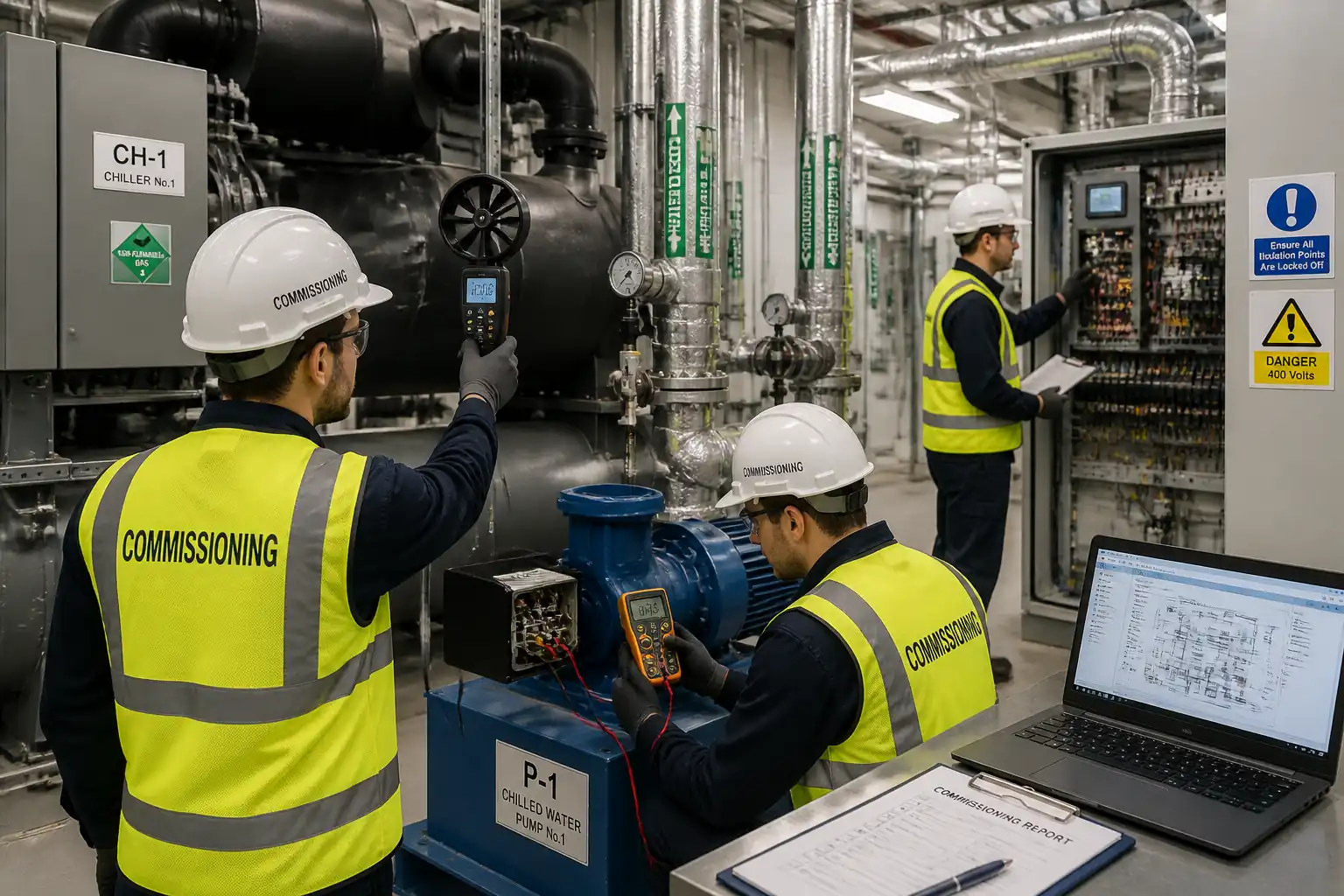
This method statement covers the complete testing and commissioning (T&C) of the Building Management System (BMS), including:
- Pre-commissioning installation readiness (control panels, field devices, cabling, labeling, earthing, network infrastructure).
- Controller power-up, firmware/configuration, addressing, database loading, time sync and backups.
- 100% point-to-point I/O testing and calibration of sensors/actuators.
- Graphics verification, naming conventions, alarm classification/priorities, trend logs (intervals and retention), and schedules (occupancy/holiday).
- Functional Performance Testing (FPT) of sequences of operation for HVAC plant (AHUs, FAHUs, VAVs/FCUs, Chiller/Boiler plants, pumps, cooling towers) and control loops.
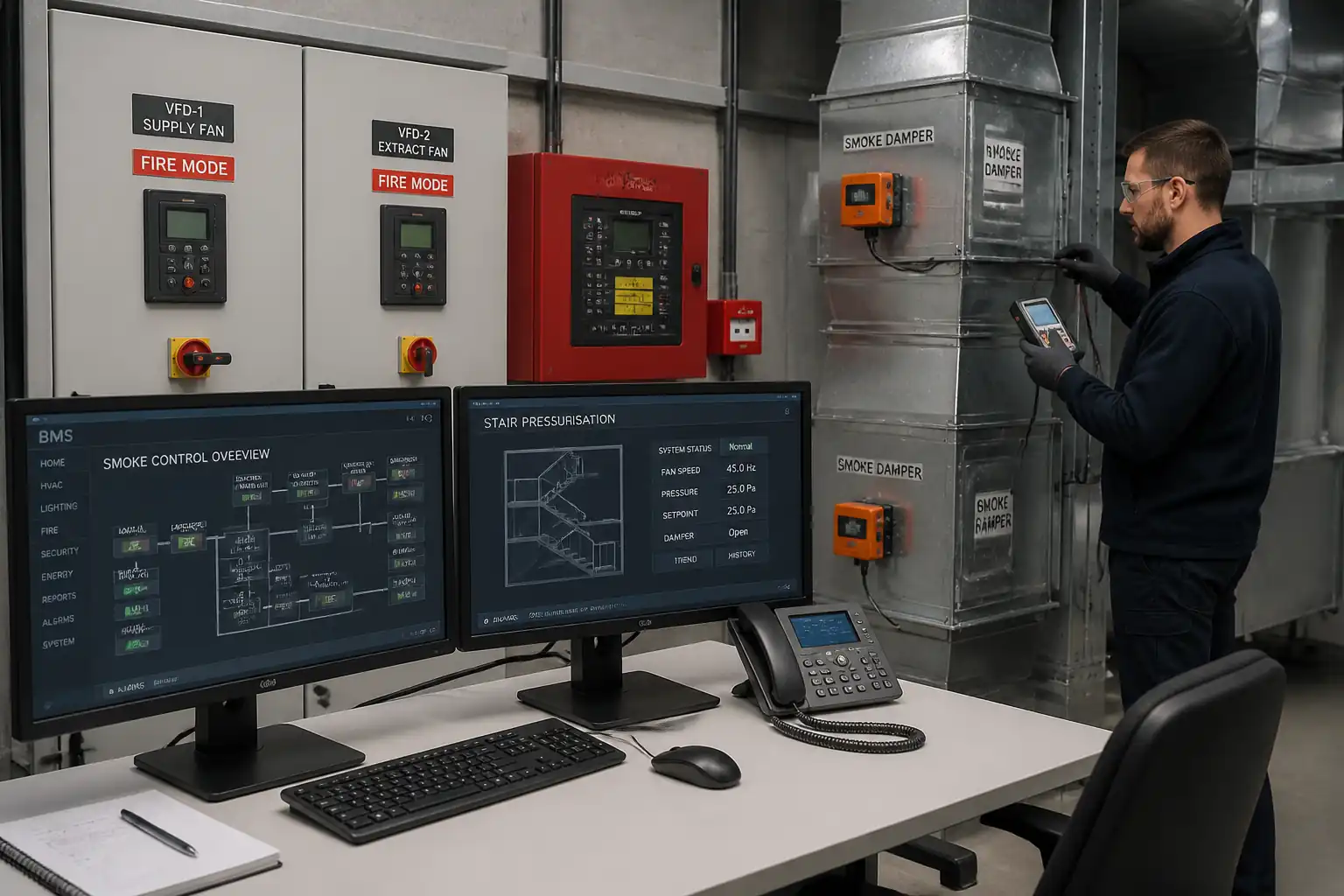
- Third-party interfaces (e.g., BACnet/Modbus devices, fire alarm shutdowns, power meters, elevators status, lighting via gateways) and interlocks.
- Witness testing with Consultant/Employer’s Representative, snag rectification, re-testing, and progressive acceptance.
- Final documentation: as-built controls drawings, point lists, database/graphics source, commissioning records, O&M manuals, training, and handover.
Exclusions
- TAB (Testing, Adjusting, Balancing) of air/water systems (performed by TAB contractor) but coordinated for BMS testing.
- Life-safety system commissioning other than BMS interfaces (e.g., fire alarm cause/effect calibration performed by fire system contractor).
Locations
- BMS head-end/server room(s), BMS panels throughout plant rooms, risers, ceiling voids, and field device locations within the facility.
Systems
- HVAC equipment controlled/monitored by BMS, associated electrical interfaces, metering, and IP/field networks. [Verify per project specifications]
References
| Document Type | Reference / Number | Revision | Notes |
|---|---|---|---|
| Standard | ASHRAE Standard 135 (BACnet) | Device instance uniqueness; BBMD as required; segmentation per vendor guidelines. | |
| Standard | ISO/IEC 11801 / TIA‑568 | Category 6A (LSZH) typical; fiber OM4/OS2 where applicable. [Verify per project specifications] | |
| Standard | IEC 60364 / BS 7671 | Segregation ELV/ LV, earthing/ bonding checks, insulation resistance. | |
| Standard | IEC 61439-2 | Panel construction, busbar ratings, forms of separation. | |
| Standard | ISO/IEC 17025 | Calibration certificates traceable to national standards. | |
| Guideline | CIBSE Commissioning Codes (A, B, C) / BSRIA BG 4/2019, BG 29, BG 50 | Pre-functional checklists, FPT scripts, water-side pre-commission cleaning (by others). | |
| Standard | NFPA 72 or EN 54 series [Verify per project specifications] | Cause/effect matrices, AHU shutdown/SMV control interlocks. | |
| Standard | IEEE 802.3 / RFC 1305 (NTP) | QoS, VLANs, NTP time sync, network segregation for OT. | |
| Standard | AHRI 550/590 (Chillers), EN 12952/12953 (Boilers) [Verify applicability] | Used for reference during integration testing and setpoint tuning. | |
| Project Spec | Project Technical Specifications and Approved Shop Drawings | Supersede typical values where conflicts arise. |
Responsibilities
| Role | Responsibility | Name / Party |
|---|---|---|
| Commissioning Manager | Plan, coordinate, schedule, and report all BMS T&C activities; interface with stakeholders; manage ITP/hold points. | Main Contractor / MEP Contractor |
| BMS Lead Engineer | Develop databases, graphics, alarm strategies, trends; configure controllers; run I/O and FPT tests; rectify snags. | BMS Specialist Subcontractor |
| Electrical Engineer / Electrician | Verify panel power, protection, terminations, earthing/segregation, cable test results. | MEP Contractor |
| Mechanical Engineer / OEM Specialist | Ensure plant readiness (SAT passed), safeties installed, media available; support functional tests and tuning. | MEP Contractor / OEM Vendors |
| IT/OT Network Engineer | Provision VLANs, IP addressing, NTP, user directory integration; implement firewall rules and backups. | Client IT / Contractor IT |
| Consultant / Employer’s Representative | Witness tests, review records, issue comments/punch list, approve stages. | Engineer / Client |
Resources
| Resource Type | Description | Quantity | Remarks |
|---|---|---|---|
| Personnel | Leads commissioning activities | 1 | |
| Personnel | Database, graphics, sequences | 1-2 [Verify per project size] | |
| Personnel | Field checkout & calibration | 3-8 [Verify per project size] | |
| Personnel | Terminations & IR testing | 2-4 | |
| Personnel | LAN, VLANs, NTP, security | 1 | |
| Personnel | Chiller, boiler, FAS, metering | As required |
Materials
| Material | Specification / Grade | Quantity | Remarks |
|---|---|---|---|
| DDCs and I/O | Compliant with ASHRAE 135; operating temp per vendor | As per BOQ | |
| Cat6A U/FTP, RS-485 twisted pair, Fiber | ISO/IEC 11801; impedance 100Ω (Cat6A), 120Ω (RS-485) | As required | |
| BMS Panels, terminal blocks, relays, fuses | IEC 61439 compliant | As per drawings | |
| Managed switches, routers/BBMDs, media converters | IEEE 802.3; support for VLAN, SNTP/NTP | As per network design | |
| UPS | Autonomy ≥ 15 minutes at full load [Verify per project specifications] | 1 per server/critical switch |
Equipment
| Equipment | Capacity / Type | Quantity | Inspection Required |
|---|---|---|---|
| DMM | CAT III 600 V | 2-4 | |
| Process calibrator | ±0.05% FS | 2 | |
| Dry-block / reference thermometer | Range 0–150 °C, ±0.25 °C | 1 | |
| Digital manometer | 0–2,500 Pa, ±1% | 2 | |
| Balometer | 50–3,000 m³/h | 1 | |
| Protocol/packet analyzer | 1 | ||
| Thermal transfer | 1 |
Prerequisites
- Approved shop drawings, I/O schedules, network diagrams, and sequences of operation.
- Installation completed: panels fixed, field devices installed, cabling terminated, labeling complete, earthing verified.
- Electrical test results available: insulation resistance, continuity, functional polarity.
- HVAC plant SAT complete; TAB baseline/initial settings available or scheduled to support sequence tests.
- IT readiness: IP plan, VLANs, firewall rules, NTP source, server OS hardened, backups configured. [Verify per project IT policy]
- Permits to Work: LV electrical works, work at height, ceiling access, hot works (if soldering/heat-shrink with hot-air). [Verify per project HSE plan and local regulations]
- OEM/vendor attendance arranged for integrated systems (chillers, boilers, FAS, metering, lifts, lighting).
- Time windows agreed for disruptive tests (e.g., AHU shutdowns) to avoid occupant impact.
- Commissioning documentation prepared: Pre-Functional Checklists (PFC), Functional Performance Test (FPT) scripts, ITP with hold/witness points.
- Calibrated test instruments with valid certificates (traceable to national standards).
Method Sequence
| Step | Activity | Description | Responsibility | Inspection / Hold Point |
|---|---|---|---|---|
| 1 | Commissioning Planning & Kick-off | Confirm scope, programme, roles, test scripts, and ITP hold/witness points. Coordinate dependencies (TAB, OEMs, IT). | Commissioning Manager | Review meeting minutes and updated programme |
| 2 | Installation Readiness (PFC) | Check panels mounting, IP rating, terminations torque, segregation LV/ELV, earthing, device locations, labels, cable IDs, network topology and terminations. | BMS Lead + Electrical Engineer | Visual and physical checks; sample torque checks |
| 3 | Power-Up & Smoke Test | Energize BMS panels sequentially; verify correct supply voltage, breaker sizes, and no abnormal heating/odour. | Electrical Engineer | Measure supply; thermal camera sweep if available |
| 4 | Controller Configuration | Load firmware, set device instance, MAC/IP, subnet, gateway, BBMD settings; enable NTP; create backups. | BMS Lead Engineer | Review controller list vs IP plan |
| 5 | Database & Graphics Deployment | Load point database to head-end; build graphics per approved templates and floor plans; apply naming convention. | BMS Lead/Graphics Engineer | Peer review of naming and bindings |
| 6 | Point-to-Point Testing – Digital Inputs/Outputs | Simulate/activate each DI/DO; verify status/command at controller and head-end; confirm interposing relays and safeties. | Controls Technicians | Live witnessing; redlining of point list |
| 7 | Analog Inputs Calibration | Verify and calibrate temperature, humidity, pressure, and flow sensors using traceable equipment. | Controls Technicians | Compare readings at two points (span) |
| 8 | Actuator Stroke & Valve Close-off | Drive damper/valve actuators from 0–100%; verify end stops, direction, feedback scaling, and valve close-off under differential pressure. | Controls Technicians + Mechanical | Visual check; feedback trending |
| 9 | Alarms Configuration & Test | Set classes, priorities, deadbands, routing (email/SMS/console), acknowledgement and escalation paths. | BMS Lead Engineer | Review alarm matrix vs SoO |
| 10 | Trend Logs & Historian | Configure intervals, deadbands, and retention; verify storage, roll-over, and export. | BMS Lead/Server Admin | DB size calculation vs storage |
| 11 | Schedules & Time Functions | Set weekly and holiday schedules; verify overrides and DST handling. | BMS Lead | Peer review schedule library |
| 12 | Functional Performance Testing – AHUs/FAHUs | Test start/stop, safeties, VFD control, PID loops, economizer/mixing, coil valve modulation, static pressure/temperature resets. | BMS Lead + Mechanical/OEM | Witnessed FPT per script |
| 13 | Functional Performance – VAV/Terminal Units | Verify airflow control, damper authority, temperature control, occupancy/standby logic. | BMS/Mechanical | Spot measurement with TAB support |
| 14 | Functional Performance – Chilled/Boiler Plants | Lead/lag sequencing, pump VFD control, ΔT optimization, tower control, lockouts, demand limit. | BMS + OEM Specialists | Witness with OEM |
| 15 | Third-Party Interfaces | Integrate and test BACnet/Modbus devices (chillers, meters), FAS shutdowns, lifts status, lighting gateways. | BMS + Respective Vendors | Check mapping vs register lists |
| 16 | Failover & Power Loss Recovery | Test UPS autonomy, graceful shutdown, controller/database auto-restart and time re-sync. | BMS + IT/OT | Simulate mains failure (controlled) |
| 17 | Cybersecurity Baseline | Apply password policy, user roles, disable unused services/ports, confirm backups and patch level. | IT/OT + BMS Lead | Configuration review |
| 18 | Graphics/Documentation Final Verification | Verify as-built tags, floor plans, hyperlinks, equipment datasheets linked, O&M navigation. | BMS Lead + Consultant | Visual walkthrough on head-end |
| 19 | Snag Rectification & Re-testing | Close punch list items, update records, re-test failed items. | BMS + MEP | Consultant verification |
| 20 | Training & Handover | Deliver operator training, O&M manuals, as-built databases, source graphics, licenses, backups. | BMS + Main Contractor | Attendance and competency check |
Health, Safety and Environment – Safety Controls
Task-specific hazards and controls
- Hazard: Live low-voltage work in BMS panels (120/230 VAC, 24 VAC)
- Likely consequence: Electric shock, burns, arc flash (low energy but hazardous)
- Engineering/procedural control: Lock-out/Tag-out (LOTO); verify isolation with approved tester; use insulated tools; cover live terminals; energize only for tests with barriers.
- Required PPE: Electrical gloves (rated), safety glasses, arc-rated clothing proportionate to risk, dielectric footwear.
- Collective preventive measure: Temporary insulating barriers and panel shrouds; RCD-protected supplies.
-
Inspection/permit/supervision: Electrical PTW; supervisor sign-off; pre-use tool inspection. [Verify per project HSE plan and local regulations]
-
Hazard: Work at height/above ceilings to access sensors and actuators
- Likely consequence: Falls from ladders, through ceiling tiles
- Engineering/procedural control: Use podium/approved ladders; three points of contact; do not step on tiles; edge protection where necessary.
- Required PPE: Hard hat, safety boots, gloves; fall arrest if MEWP used per risk assessment.
- Collective preventive measure: Mobile tower scaffold with guardrails; ceiling access panels.
-
Inspection/permit/supervision: Work at Height permit; MEWP inspection; competent operator.
-
Hazard: Ceiling void dust/fibers and silica/mineral wool exposure
- Likely consequence: Respiratory/skin irritation
- Engineering/procedural control: Wet-wipe/HEPA vacuum before work; minimize disturbance; seal openings after works.
- Required PPE: FFP2/FFP3 mask, goggles, long sleeves, gloves.
- Collective preventive measure: Local containment and signage.
-
Inspection/permit/supervision: HSE briefing; housekeeping inspections.
-
Hazard: Plant auto-start during tests (fans, pumps, VFDs)
- Likely consequence: Entanglement, impact injuries, noise exposure
- Engineering/procedural control: Post “Under Test – Do Not Operate” tags; bypass only per SoO; maintain exclusion zones; verify E-stops.
- Required PPE: Hard hat, hearing protection near high dB equipment, gloves.
- Collective preventive measure: Barricades around rotating equipment.
-
Inspection/permit/supervision: Toolbox talk; area supervision during FPT.
-
Hazard: Fire alarm interface testing
- Likely consequence: Unintended building-wide shutdowns or emergency system interference
- Engineering/procedural control: Joint method statement with FAS contractor; test in off-peak; inform building control/monitoring center; isolate cause/effect zones per permit.
- Required PPE: Standard site PPE.
- Collective preventive measure: Controlled access and communication via radios.
-
Inspection/permit/supervision: FAS permit; consultant witness.
-
Hazard: Manual handling of panels/batteries/UPS
- Likely consequence: Musculoskeletal injuries
- Engineering/procedural control: Team lifts; use trolleys; follow weight limits.
- Required PPE: Gloves, safety boots.
- Collective preventive measure: Mechanical aids available.
-
Inspection/permit/supervision: Manual handling training records.
-
Hazard: Server room environmental risks (clean agent release, hot/cold aisles)
- Likely consequence: Asphyxiation, heat stress
- Engineering/procedural control: Briefing on system; do not obstruct airflow; monitor temperature; egress routes clear.
- Required PPE: Standard PPE.
- Collective preventive measure: Access control and occupancy sensors.
-
Inspection/permit/supervision: Access permit; supervision during tests.
-
Hazard: Network configuration errors causing operational outage
- Likely consequence: Loss of monitoring/control
- Engineering/procedural control: Change control, backups before change, test in staging environment.
- Required PPE: N/A (administrative control)
- Collective preventive measure: Read-only accounts for observers.
-
Inspection/permit/supervision: IT change request approval.
-
Hazard: Noise during plant functional tests
- Likely consequence: Hearing damage
- Engineering/procedural control: Limit exposure time; schedule off-peak.
- Required PPE: Ear defenders in plant rooms.
- Collective preventive measure: Acoustic barriers if feasible.
- Inspection/permit/supervision: Noise monitoring if required.
Environmental Controls
- E-waste from replaced controllers and network hardware
- Control: Segregate and dispose via licensed recycler with transfer notes.
-
Monitoring: Waste register; vendor take-back where available.
-
Packaging waste (cardboard, plastics, cable drums)
- Control: Segregate at source; compact and recycle; return drums.
-
Monitoring: Site waste management plan (SWMP).
-
Energy use during prolonged plant testing
- Control: Coordinate tests to minimize runtime; use simulated loads where permissible; schedule off-peak tariffs.
-
Monitoring: Log kWh during tests; report in commissioning summary.
-
Refrigerant/chemical exposure (indirect via integrated OEM tests)
- Control: OEM to handle refrigerants; spill kits available; BMS team to avoid direct contact zones.
-
Monitoring: SDS availability; incident reporting.
-
Noise and vibration impact on occupants
- Control: Notify occupants; limit test hours; isolate vibration where feasible.
-
Monitoring: Complaint log; spot noise checks.
-
Dust from ceiling works
- Control: HEPA vacuum; seal tiles; clean-down after works.
-
Monitoring: Supervisor inspection.
-
Data security and privacy
- Control: Follow client IT policy; no personal data logging; encrypt backups.
- Monitoring: Access audits; backup verification.
Quality Assurance / Quality Control
QA/QC Strategy
- Testing coverage:
- I/O point-to-point: 100% of points.
- Central plant FPT (AHUs, chillers, boilers, pumps, towers): 100% of units.
- Terminal units (e.g., VAV/FCU): 20–100% depending on spec; default 25% representative sample including extremes (top/bottom floors, longest runs). [Verify per project specifications]
-
Third-party interfaces: 100% of mapped points; 100% of cause/effect.
-
Instrument control and calibration:
- All measuring equipment to have valid calibration certificates (≤12 months) traceable to national standards.
-
Field sensors calibrated/verified against traceable references; adjustments recorded in as-built point list.
-
Documentation controls:
- Use controlled forms (PFC, I/O sheets, FPT scripts) with unique IDs, dates, and signatures.
-
Maintain redline as-builts; implement change control for database/graphics.
-
Acceptance metrics (typical benchmarks – verify per project):
- Temperature setpoint control: ±0.5 to ±1.0 °C steady state depending on application.
- Humidity control: ±5% RH general comfort.
- Static pressure control: ±50 Pa.
- Alarm response: ≤5 s critical, ≤60 s non-critical.
- Time synchronization: drift ≤1 min; NTP enabled.
-
Network health: MS/TP retries <2%; utilization <60% on BACnet/IP VLAN.
-
Nonconformance management:
-
Record NCRs and snags with root cause and corrective actions; re-test after rectification.
-
Handover quality:
-
Provide: O&M manuals, SoO, cause/effect, final I/O lists, graphics source files, licenses, network/IP plan, cybersecurity baseline, backups (tested restore), training materials, spare parts list.
-
Warranty support plan:
- Define defect notification, response times, and seasonal commissioning/ re-commissioning visits.
Attachments
- Pre-Functional Checklists (PFC) templates by system
- I/O Point List (as-built) with addressing and scaling
- Functional Performance Test (FPT) scripts for AHUs, VAV/FCU, Chiller/Boiler plants, pumps, towers
- Alarm philosophy and matrix with priorities and recipients
- Trend strategy: point list, intervals, retention, storage sizing
- Network topology: IP plan, VLANs, BBMD, MS/TP segments and terminations
- Cause & Effect matrix (incl. fire alarm, emergency shutdowns)
- Calibration certificates for test instruments
- O&M manuals and sequences of operation (approved)
- Training syllabus and attendance sheets
- HSE risk assessment and method statement (RAMS) specific to BMS T&C
This content is a read-only public reference. Download or customize to get an editable version.
ITP preview
The first inspection activities from the linked ITP for Method Statement – Building Management System (BMS) Testing & Commissioning:
| Activity | Inspection / Test | Acceptance Criteria | Responsibility | Record |
|---|---|---|---|---|
| Installation Readiness (PFC) | Visual, torque sampling, IR/continuity, RS‑485 termination check | Zero critical defects; IR ≥ specified; correct segregation/earthing; labels complete [Verify] | BMS Lead / Electrical Engineer / Consultant (Witness) | PFC checklist; photos; IR test sheets |
| Panel Energization | Voltage measurement; functional indicators; thermal scan (if available) | Correct voltage within tolerance; no trips/abnormalities after 15 min | Electrical Engineer / Consultant (Witness) | Energization record |
| Controller Configuration & Network Verification | BACnet/IP & MS/TP scan; device instance/IP uniqueness; NTP sync | Unique IDs; stable token; time sync ±1 min; network utilization <60% [Verify] | BMS Lead / IT/OT Engineer | Network scan; IP plan; time sync log |
Showing 3 of 16 inspection activities. View full ITP →
Related Inspection and Test Plan
An Inspection and Test Plan (ITP) is available for Method Statement – Building Management System (BMS) Testing & Commissioning. The ITP defines the inspection activities, acceptance criteria, hold and witness points, responsible parties, and records required to verify the work described in this method statement.
View the Method Statement – Building Management System (BMS) Testing & Commissioning ITP →Frequently asked questions
Continue with related Quollnet resources connected to this method statement.