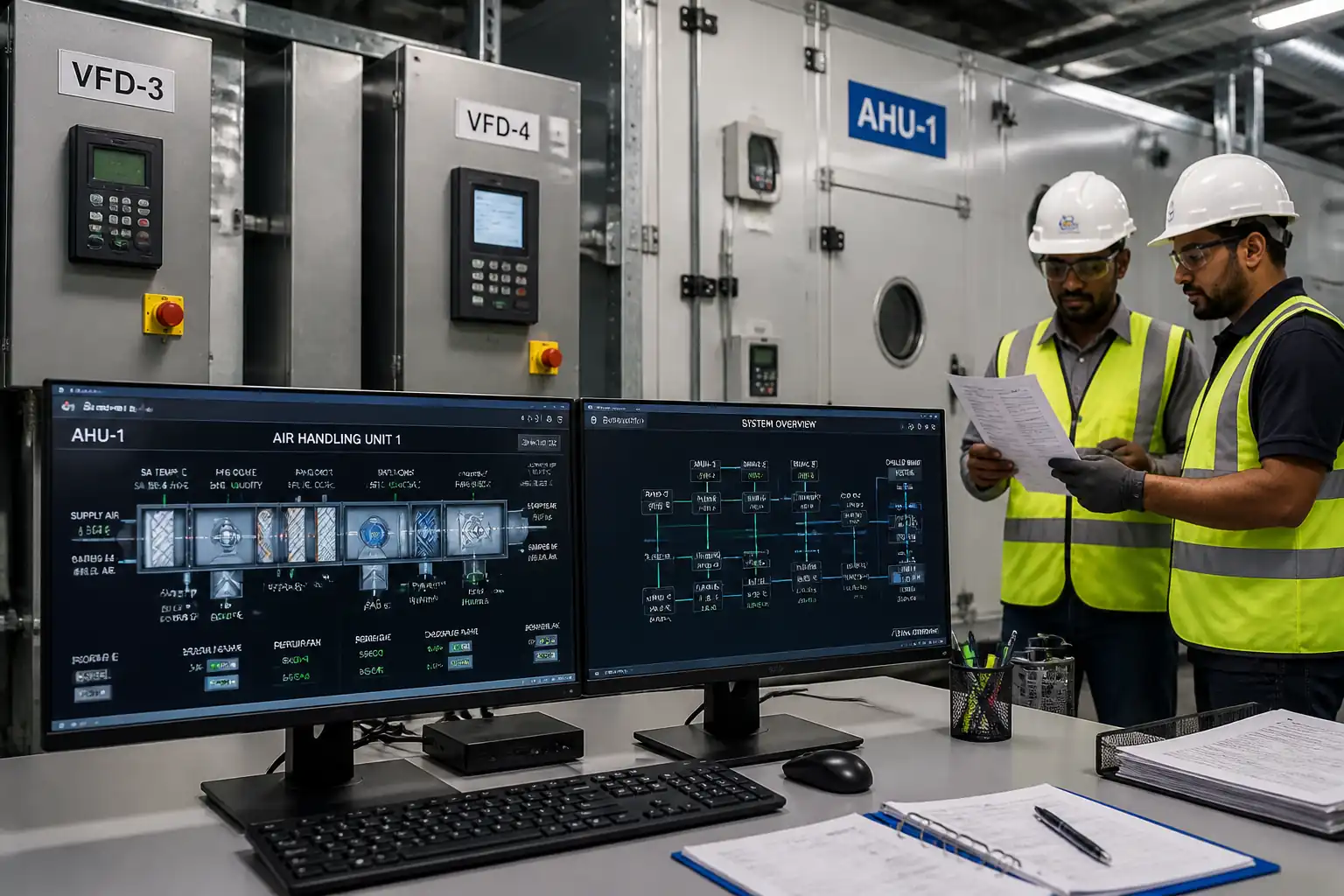

Method Statement: BMS Sequence of Operation Testing for HVAC and Building Systems – Method Statement
AI-assisted method statement with matching ITP, PDF download, and Excel export.
More than a static template
Unlike a downloadable Word or PDF template, this method statement is an AI-assisted editable starting point connected directly to a matching Inspection and Test Plan. Every section is structured, project-adaptable, and ready to export.
- AI-assisted drafting — Customize every section with AI for your specific project scope.
- Linked ITP — A matching inspection and test plan is generated alongside the method statement.
- Multiple export formats — Download as a formatted PDF or editable Excel spreadsheet.
- Editable starting point, not a final document — Review, verify, and adjust all content against your project requirements before use.
Static template vs. Quollnet workflow
| Feature | Static template | Quollnet |
|---|---|---|
| Project-specific content | Manual fill-in required | AI-assisted customization |
| Linked ITP | Separate document, no link | Matching ITP included |
| Export formats | Usually PDF only | PDF and Excel |
| Structured sections | Free-form layout | 13 standardized sections |
| Saved to your account | Local file only | Cloud-saved, reusable |
| Content accuracy | You verify everything | AI-assisted, you still verify |
| Cost | Often free but time-intensive | Free to customize and download |
What you can customize
When you save this method statement to your account, every section becomes editable. The following 13 sections are included:
- Scope — Defines the activity and its boundaries.
- References — Standards, specifications, and drawings.
- Responsibilities — Roles and accountabilities.
- Resources — Labour, plant, and equipment summary.
- Materials — Materials and compliance requirements.
- Equipment — Tools and equipment details.
- Prerequisites — Hold points and pre-conditions.
- Method sequence — Step-by-step construction sequence.
- Safety controls — HSE risk controls and PPE.
- Environmental controls — Environmental mitigation measures.
- QA/QC — Quality inspection and test requirements.
- ITP — Inspection and Test Plan table (has its own page).
- Attachments — Referenced drawings and documentation.
Why this method statement is used
This method statement is used to define and communicate the approved procedure for carrying out method statement: bms sequence of operation testing for hvac and building systems on site. It ensures the work is planned in advance, the correct resources and controls are in place, and all personnel understand responsibilities, sequence, quality requirements, and safety controls before work begins. It aligns site execution with the documented scope and acceptance expectations.
Who uses this method statement
This method statement is used by contractors, site supervisors, project engineers, QA/QC engineers, HSE officers, consultants, and client representatives. It serves as a shared reference for planning, execution, supervision, inspection, and approval of the activity on site.
When it is prepared and submitted
The method statement is prepared before the work activity starts and submitted as part of the pre-construction documentation package for review and approval.
Who reviews or approves it
The method statement is usually submitted to the client representative, consultant, resident engineer, or project management consultant for review and approval before the work commences.
Important approval note
This method statement is an AI-assisted editable starting point, not a pre-approved document. Before use on any project, all content must be reviewed and approved by the relevant parties (superintendent, principal contractor, or client representative) in accordance with your contract and project quality plan.
For example: if your specification requires a departure from a referenced standard, that departure must be documented and approved separately — this method statement will not capture that automatically. Always verify against your applicable drawings, specifications, and regulatory requirements.
Method statement content
Scope
Overview
This method statement details the procedures, controls, inspections, testing, witnessing, documentation, and acceptance for Building Management System (BMS) sequence of operation (SOO) testing for HVAC and related building systems. It covers AHUs/FAHUs, MAUs, VAV/FCU/PIU boxes, chilled/hot water plants, pumps, VFDs, heat exchangers, ventilation/pressurization systems, motorized dampers/valves, sensors, metering, and system integrations (fire alarm/smoke control, security/door release, generators where interfaced) as defined in the approved control narratives and cause-and-effect matrix.
Inclusions
- Review and verification of approved control narratives and point lists
- Pre-functional checks (I/O point-to-point, calibration verification, panel/network checks)
- Functional testing of sequences: start/stop logic, modes (occupied/unoccupied/warm-up/purge), resets (temperature/pressure/flow), economizer, demand control ventilation, lead/lag, fault responses
- Interlocks and life-safety interfaces (fire alarm/smoke control) [Verify per project HSE plan and local regulations]
- Alarm generation, priorities, routing/escalation, acknowledgments, and event logs
- Trend configuration, data integrity, and performance verification
- Graphics/HMI review, units, naming, and navigation
- Witness testing (Consultant/Engineer/Client) with punch-listing, defect correction, and retesting
- QA/QC records, backups, as-builts, training, seasonal testing plan, and final sign-off
Exclusions
- Intrusive mechanical modifications or TAB balancing (performed by others). Coordination with TAB provider for stable baselines is included.
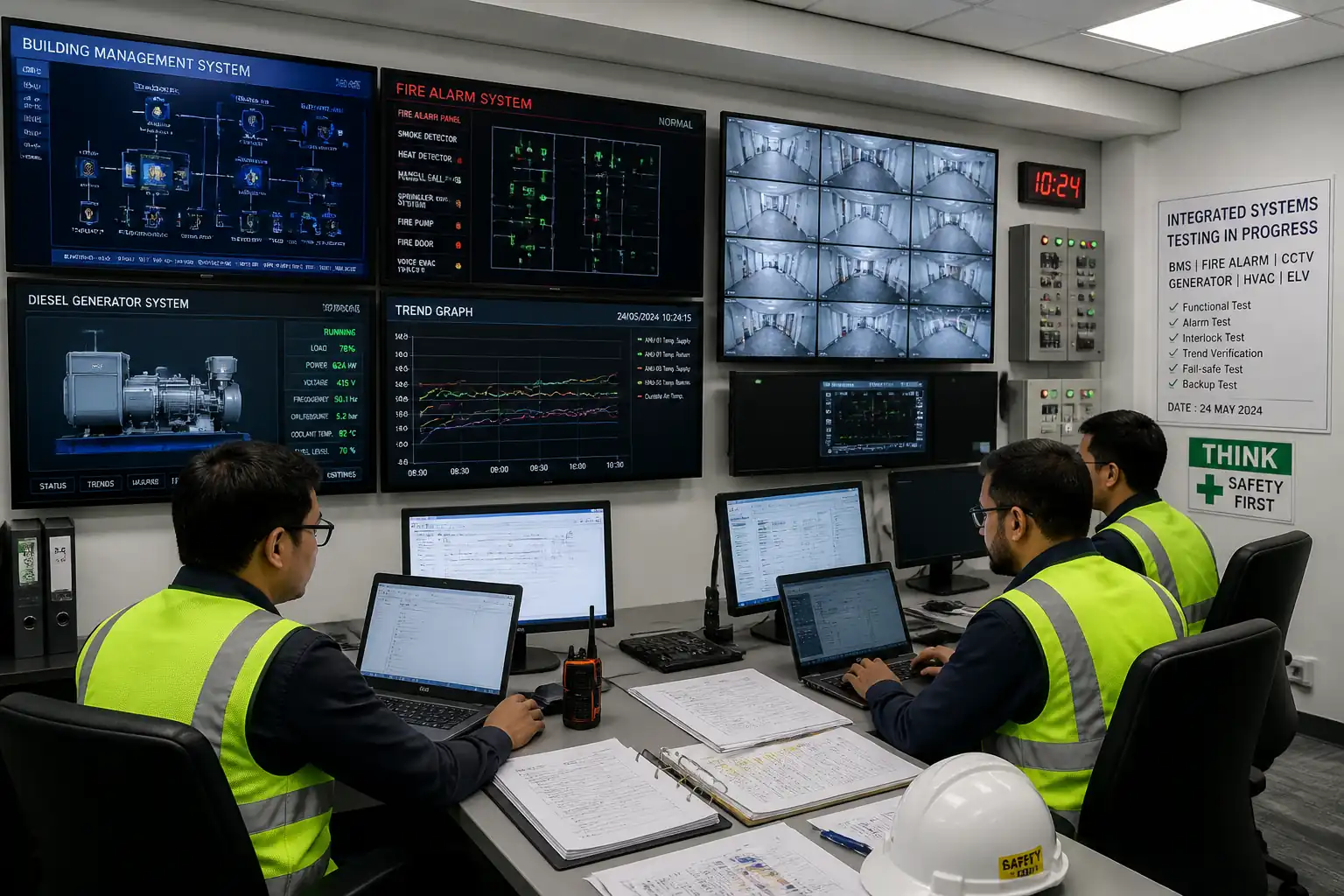
- Functional fire strategy validation beyond interfaces (performed under Integrated Systems Testing).
References
| Document Type | Reference / Number | Revision | Notes |
|---|---|---|---|
| Standard | ASHRAE Guideline 36-2021 | ||
| Standard | ASHRAE 135-2020 / ISO 16484-5 | ||
| Standard | ISO 16484-3:2020 | ||
| Standard | BS EN 15232-1:2017 | ||
| Guideline | ASHRAE Guideline 0-2019 and 1.1-2007 (HVAC&R) | ||
| Guideline | ASHRAE Guideline 13-2015 | ||
| Code/Standard | NFPA 70 (NEC) or IEC 60364; IEC 61010-1 (control equipment) [Verify per local code] | ||
| Standard | BS EN 378 series [Verify applicable parts] | ||
| Guidance | CIBSE Code M; BSRIA BG 39/2014 and BG 29 (context) [Verify applicability] |
Responsibilities
| Role | Responsibility | Name / Party |
|---|---|---|
| Commissioning Manager | Overall control | Main Contractor |
| BMS Lead Engineer | Technical lead | Controls Subcontractor |
| Controls Technician | Execution | Controls Subcontractor |
| TAB Engineer | Coordination | TAB Subcontractor |
| Electrical Supervisor | Electrical safety | M&E Contractor |
| Fire Alarm Engineer | Interface owner | Specialist |
| IT/Network Engineer | Network | Contractor/Client IT |
| Consultant | Independent verification | Engineer of Record |
| HSE Officer | HSE compliance | Main Contractor |
Resources
| Resource Type | Description | Quantity | Remarks |
|---|---|---|---|
| Personnel | Leads execution | 1 | |
| Personnel | Controls lead | 1 | |
| Personnel | Field and software works | 2–6 [Verify per project] | |
| Personnel | Air/water baselines | 1–2 | |
| Personnel | Panels, VFDs, power | 1–2 | |
| Personnel | FAS interface | 1 | |
| Personnel | BMS network | 1 | |
| Personnel | Chillers/Boilers/VFDs | As required |
Materials
| Material | Specification / Grade | Quantity | Remarks |
|---|---|---|---|
| Test gas cylinders | Traceable calibration certificate, within 6 months [Verify] | ||
| Engraved/laminated labels | Heat and UV resistant [Verify] | ||
| Low-smoke halogen-free preferred | IEC/EN compliant [Verify] |
Equipment
| Equipment | Capacity / Type | Quantity | Inspection Required |
|---|---|---|---|
| Laptop + dongles | 2–3 | ||
| ±0.1°C probe; ±0.25% FS pressure | As required | ||
| IEC 61010-1 compliant | 1 set | ||
| MEWP 6–12 m [Verify] | As required | ||
| ±3% reading [Verify] | 1 set | ||
| Managed switch mirror-port | 1 |
Prerequisites
- Approved for Construction (AFC) control narratives, point schedules, panel drawings, network architecture, and cause-and-effect matrix available.
- Power-on and mechanical completion of relevant equipment; TAB baseline readings available or planned.
- BMS software/firmware versions frozen for test window; backup and rollback plan prepared.
- Calibration certificates for test instruments valid and traceable.
- Permits and authorizations: Permit-to-Work, LOTO (as applicable), Working at Height, Hot Works (if any), and FAS interface testing permits. [Verify per project HSE plan and local regulations]
- IT readiness: Dedicated BMS VLAN/IP ranges, time synchronization (NTP), BBMD configuration (if multi-subnet), cybersecurity approvals.
- Seasonal commissioning plan drafted for out-of-season sequences. [Verify per project]
- Test scripts and ITP approved by Consultant/Engineer; witness dates agreed and communicated via look-ahead program.
- Manufacturer OEM representatives scheduled where warranty impact is possible (e.g., chillers/boilers/VFDs).
Method Sequence
| Step | Activity | Description | Responsibility | Inspection / Hold Point |
|---|---|---|---|---|
| 1 | Document and software readiness review | Confirm approved control narratives, point list, graphics list, and test scripts align. Verify controller firmware, database naming standards, and time sync. Freeze code baseline and take pre-test backups. | BMS Lead / Commissioning Manager | Document check |
| 2 | Panel and power inspection | Inspect BMS panels, I/O modules, fusing, earthing, segregation, and labeling. Verify power quality and voltage levels at controllers and field devices. | Electrical Supervisor / Controls Tech | Visual/electrical tests |
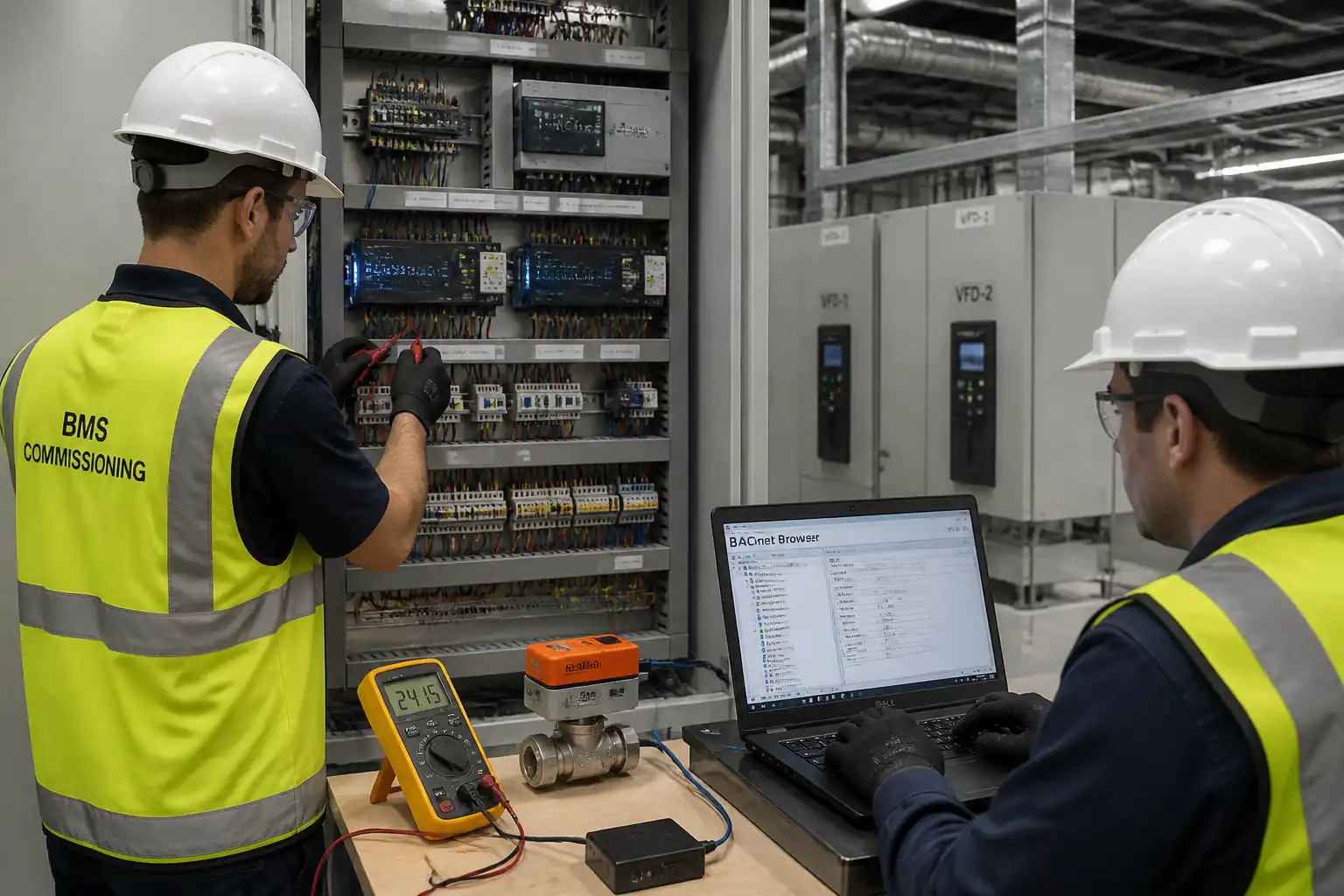
| 3 | Point-to-point I/O verification | Check 100% of I/O: simulate inputs (resistance/current/voltage), observe BMS readings; command outputs and verify field response (indicator/fan jog with safeguards). | Controls Tech | Multimeter/calibrator |
| 4 | Sensor calibration/validation | Validate field sensor accuracy against calibrated references at operating conditions. Adjust as required. | Controls Tech / BMS Engineer | Spot/100% per criticality |
| 5 | Actuator and drive verification | Stroke dampers/valves 0–100% confirm direction, range, end-switches, and fail-safe action. Verify VFD enable/command/feedback including min/max speed limits. | Controls Tech / Electrical | Functional |
| 6 | Network health and cybersecurity | Verify BACnet device IDs unique, routing/BBMD correct, time sync via NTP, no excessive retries. Confirm VLANs and credentials per IT policy. | IT/Network / BMS Engineer | Packet capture |
| 7 | Safety interlocks and protections | Verify freezestat trips, low-temp cut-outs, differential pressure switches, filter dirty alarms, condensate pan float switches, and E-stops. Simulate safely. | BMS Engineer / OEM / HSE | Functional with LOTO as needed |
| 8 | Start/stop logic and scheduling | Verify time schedules, occupancy modes, optimal start/stop, and night purge. Confirm minimum on/off times and anti-short-cycle logic. | BMS Engineer | Functional |
| 9 | AHU/VAV control sequences | Verify supply air temp/pressure control, economizer changeover (dry-bulb/enthalpy), CO2 DCV, heating/cooling staging, and VAV box flow/position control. | BMS / TAB | Functional with airflow readings |
| 10 | Chilled/Hot water plant sequences | Verify enable conditions, pump/VFD control, differential pressure reset, lead/lag, staging, supply temperature reset, and fault responses with OEM present as required. | BMS / OEM | Functional |
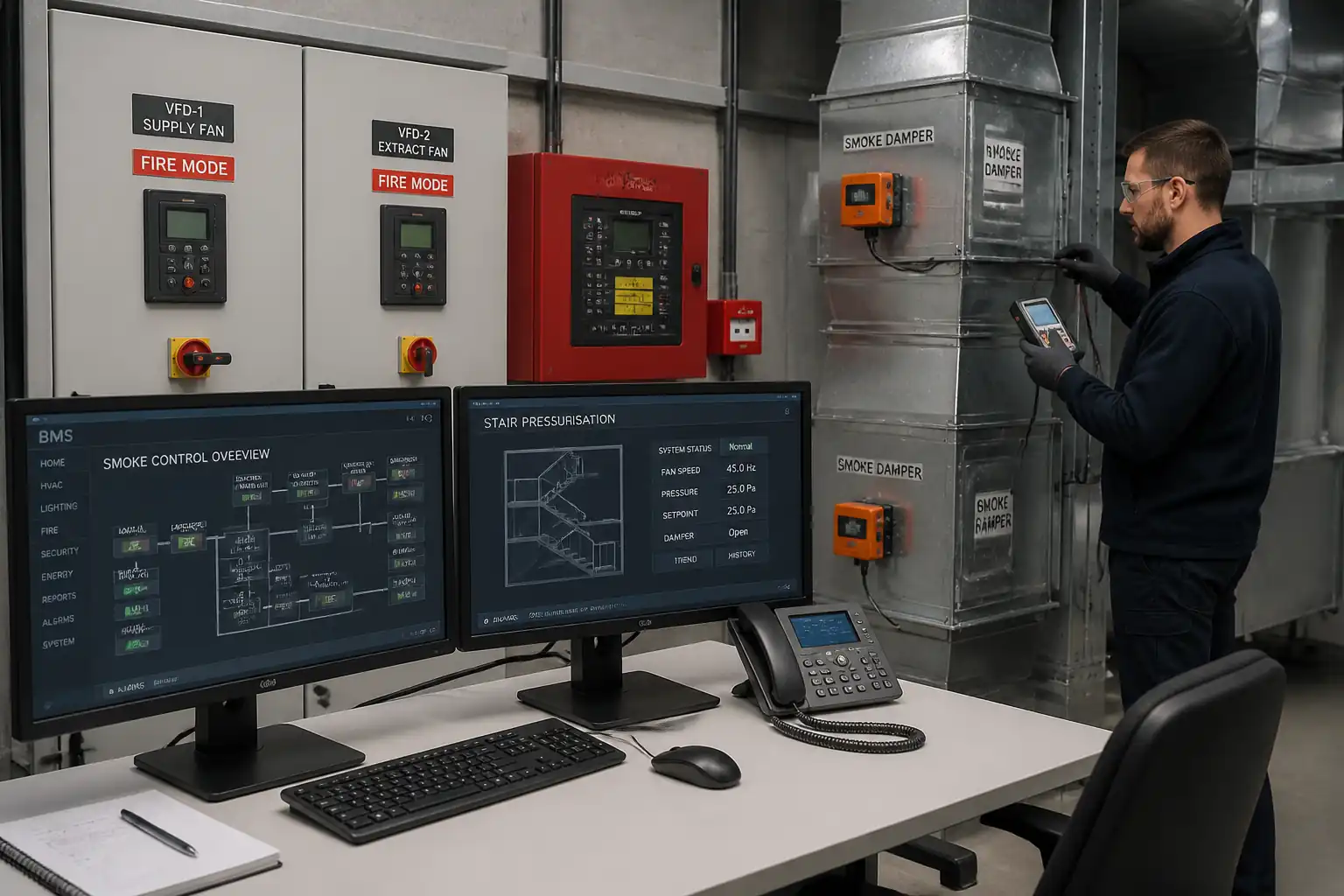
| 11 | Life-safety interfaces (FAS/Smoke control) | Simulate FAS signals; verify AHU shutdown, smoke/fire damper actions, pressure/relief modes per cause-and-effect. Coordinate under Integrated Systems Testing plan. | FAS Engineer / BMS / HSE | Integrated test |
| 12 | Alarm functionality and routing | Check alarm thresholds, delays, priorities, notifications (email/SMS if used), acknowledgment workflow, and escalation. | BMS Engineer | Functional |
| 13 | Trend configuration and verification | Configure key point trends (temps, pressures, flows, energy meters, modes). Verify sampling, retention, and continuity; export sample datasets. | BMS Engineer | Data review |
| 14 | Graphics/HMI verification | Verify page navigation, live values, units, scaling, alarm/trend links, and user permissions. | BMS Engineer / Client FM | Visual functional |
| 15 | Defects logging and rectification | Record issues in punch list/NCR; apply corrections (software/field); manage configuration control; retest affected sequences. | BMS Lead / QA | QA review |
| 16 | Witness testing and sign-off | Perform witnessed runs per approved scripts; capture signatures and comments; compile dossier. | Commissioning Manager / Consultant | Witness |
| 17 | Training and handover | Deliver operator training on sequences, alarms, trends, and backups; submit as-builts and O&M manuals. | BMS Lead / Commissioning | Attendance records |
| 18 | Seasonal testing | Plan and execute out-of-season verification or simulation for heating/cooling sequences. | Commissioning Manager / BMS | Deferred test |
Safety Controls
Task-specific hazards and controls
- Hazard: Live electrical work in MCC/VFD/BMS panels
- Likely consequence: Electric shock, arc flash, burns
- Control: De-energize and LOTO where possible; if live testing required for measurement, use insulated tools, barriers, and a competent authorized person; keep hands clear of busbars.
- PPE: Arc-rated clothing (per incident energy study or CAT 2 minimum [Verify]), insulated gloves class 00, face shield, safety boots
- Collective measure: Panel interlocks/guards, restricted access zones
-
Inspection/Permit: Electrical Permit-to-Work; panel pre-use inspection; supervisor authorization
-
Hazard: Moving machinery (fans, belts, dampers, actuators)
- Likely consequence: Entanglement, pinch/crush injuries
- Control: Prove zero-energy where needed, fit guards, jog only under supervision, maintain safe distances; verify end-switches before full-stroke testing
- PPE: Gloves, safety glasses, long sleeves
- Collective measure: Machine guards, signage, barriers
-
Inspection/Permit: LOTO documentation; supervisor sign-off
-
Hazard: Working at height (ceilings/roof plant)
- Likely consequence: Falls from height
- Control: Use certified ladders/MEWPs, three points of contact, tie-off where required, maintain exclusion zones
- PPE: Full body harness with lanyard (when required), helmet with chinstrap
- Collective measure: MEWP with guardrails, spotter, barricades
-
Inspection/Permit: Working at Height permit; MEWP pre-use checklist
-
Hazard: Fire alarm and smoke control interface testing
- Likely consequence: Unintended building evacuation or impaired life-safety if mismanaged
- Control: Pre-test notification, disable/re-enable outputs per plan, simulate signals through approved test modes, have Fire/Life Safety engineer present
- PPE: Standard site PPE
- Collective measure: Control room coordination, temporary signage
-
Inspection/Permit: Integrated Systems Testing plan; Fire system permit; authority notification [Verify]
-
Hazard: Use of calibration gases for sensor bump tests
- Likely consequence: Exposure, asphyxiation in confined/poorly ventilated areas
- Control: Use minimal volumes, in open/ventilated spaces; follow SDS; fit regulators and check for leaks; no ignition sources for flammable gases
- PPE: Safety glasses, nitrile gloves
- Collective measure: Local ventilation, gas detection if required
-
Inspection/Permit: COSHH/SDS review; HSE approval
-
Hazard: Noise and vibration in plant rooms during functional tests
- Likely consequence: Hearing damage
- Control: Limit simultaneous plant operation; rotate personnel; monitor dB levels
- PPE: Hearing protection (ear defenders/plugs)
- Collective measure: Acoustic doors closed, signage
-
Inspection/Permit: HSE monitoring
-
Hazard: Network/security configuration changes
- Likely consequence: Loss of control, cyber exposure, service outage
- Control: Change control approvals, maintenance window, backups, rollback plan, IT supervision
- PPE: N/A
- Collective measure: Read-only access for witnesses; enforce RBAC
-
Inspection/Permit: IT change request ticket; authorization [Verify per project HSE plan and local regulations]
-
Hazard: Manual handling of panels/laptops/equipment
- Likely consequence: Strains/sprains
- Control: Use trolleys, team lift, proper posture
- PPE: Gloves, safety boots
- Collective measure: Mechanical aids
-
Inspection/Permit: Toolbox talk and supervision
-
Hazard: Roof work and environmental exposure
- Likely consequence: Heat stress, dehydration, slips
- Control: Work/rest cycles, hydration, weather monitoring, non-slip footwear
- PPE: Weather-appropriate PPE
- Collective measure: Shade breaks, winterization as needed
- Inspection/Permit: HSE plan review
[All controls to be verified per project HSE plan and local regulations.]
Environmental Controls
- Energy management during testing: Sequence tests planned to minimize simultaneous full-load operation; switch off equipment immediately after each test.
- Refrigerant handling: No venting; any leak detector testing uses small-volume surrogate test gases when allowed by manufacturer; follow F-Gas/local regulations.
- Noise: Schedule loud tests during permitted hours; use acoustic enclosures/close plant room doors.
- Waste: Collect and dispose of defective sensors, wiring offcuts, and gas cylinders via licensed waste streams; maintain waste transfer notes.
- IAQ: Avoid prolonged AHU shutdowns in occupied areas; coordinate with facilities to maintain minimum ventilation.
- Water discharge: Prevent condensate pan overflows during trip tests; ensure drains operational.
- Data protection: Secure BMS backups; remove portable data after handover; comply with Client IT policy.
- Spill prevention: Use drip trays under calibration gases and oils; keep spill kits available.
QA/QC
QA/QC Controls
- Submittals: Control narratives, point lists, panel drawings, network diagrams, test scripts, and ITP approved prior to testing.
- Calibration: Instruments with valid, traceable certificates; record IDs and expiry on forms.
- Measurement tolerances: Unless otherwise specified, use typical acceptance: Temp ±0.5°C; RH ±3%RH; Pressure ±1%FS; VFD feedback ±2%; SAT ±0.5°C; static pressure ±12 Pa; VAV flow ±10% of setpoint. [Verify per project]
- Sampling: 100% I/O verified; functional tests per each unit; trending for minimum 24–72 hours for stability where required. [Verify]
- Hold/Witness points: As flagged in method sequence and ITP; no proceed without sign-off.
- Documentation: Use standardized test forms; record timestamps, setpoints, measured values, alarms, screenshots, and trend extracts.
- Software configuration control: Version baseline before tests; change log maintained; post-rectification backups and final golden image delivered to Client.
- Nonconformities: Log NCRs and punch items; categorize (A-critical/B-major/C-minor); rectify and retest with traceability.
- Time synchronization: All BMS devices, servers, and clients synchronized via approved NTP; verify drift within ±2 s.
- Training and O&M: Include as-built control narratives, point lists, alarm/trend lists, network details, and backup/restore procedures.
- Seasonal commissioning: Document plan and trigger; include simulated testing method where live conditions unavailable.
Attachments
- Approved Control Narratives (system-by-system)
- I/O Point Lists and Addressing Maps
- BMS Network Architecture Diagrams and IP Plan
- Panel Schematic Drawings and Schedules
- Cause-and-Effect Matrix (including life-safety interfaces)
- Test Scripts and Checklists (pre-functional and functional)
- Calibration Certificates (test instruments and critical sensors)
- TAB Baseline Reports
- OEM Attendance/Commissioning Certificates
- Witness Sign-off Forms
- NCR/Punch List Logs
- Final Backups and Golden Image Manifest
- Training Materials and Attendance Records
This content is a read-only public reference. Download or customize to get an editable version.
ITP preview
The first inspection activities from the linked ITP for Method Statement: BMS Sequence of Operation Testing for HVAC and Building Systems:
| Activity | Inspection / Test | Acceptance Criteria | Responsibility | Record |
|---|---|---|---|---|
| Approval of control narratives, point list, test scripts | Document review and approval | All documents AFC; revision controlled; alignment across narratives, points, and graphics lists | Commissioning Manager / Consultant | Approved submittals, transmittals |
| Panel and power inspection | Visual/electrical checks | Correct labeling; fusing; earth continuity; supply within device spec | Electrical Supervisor / QA | Panel inspection checklist |
| Point-to-point I/O verification (100%) | Simulate inputs; command outputs | Correct mapping/scaling/polarity; no missing/orphan points | Controls Tech / BMS Engineer | I/O verification sheets, redlines |
Showing 3 of 16 inspection activities. View full ITP →
Related Inspection and Test Plan
An Inspection and Test Plan (ITP) is available for Method Statement: BMS Sequence of Operation Testing for HVAC and Building Systems. The ITP defines the inspection activities, acceptance criteria, hold and witness points, responsible parties, and records required to verify the work described in this method statement.
View the Method Statement: BMS Sequence of Operation Testing for HVAC and Building Systems ITP →Frequently asked questions
Continue with related Quollnet resources connected to this method statement.