
Inspection and Test Plan for Method Statement: Water Meter Integration with Building Management System (BMS)
AI-assisted inspection and test plan connected to a method statement, with PDF and Excel export.
More than a static template
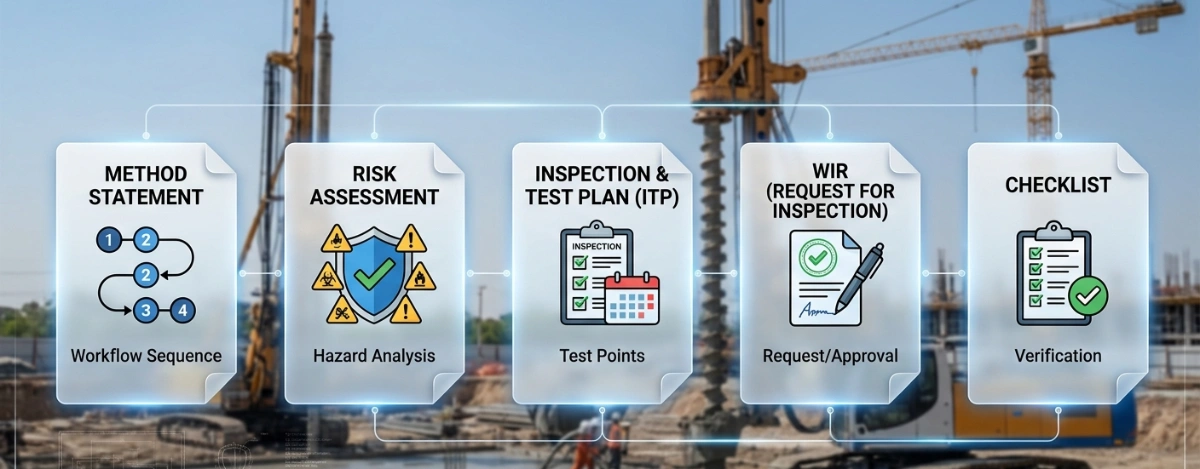
Unlike a downloadable Word or PDF template, this ITP is an AI-assisted editable starting point directly connected to its method statement. Every inspection activity, hold point, and acceptance criterion is structured and ready to adapt to your project.
- AI-assisted customization — Tailor inspection activities and acceptance criteria to your specific project scope.
- Linked method statement — This ITP is connected to the corresponding method statement describing the work sequence.
- Multiple export formats — Download as a formatted PDF or editable Excel spreadsheet.
- Editable starting point, not a final document — Review and verify all content against your project specifications and standards before use.
What you can customize
When you save this ITP to your account, every inspection row becomes editable. You can add, remove, or modify:
- Inspection activity — Description of what is being inspected.
- Inspection type — Hold point (H), Witness point (W), Review (R), or Monitor (M).
- Responsibility — Contractor, subcontractor, engineer, or client.
- Frequency — How often the inspection occurs.
- Acceptance criteria — Referenced standard or specification requirement.
- Records — Forms, test reports, or checklists required as evidence.
Why this ITP is used
To ensure installations meet project specifications and standards, delivering accurate, reliable metering integrated with BMS.
Who uses this inspection and test plan
BMS engineers, ELV technicians, QA/QC inspectors, Plumbing supervisors, and the Client/Consultant for verification.
When this ITP is prepared and submitted
From pre-installation through commissioning and prior to handover, with hold/witness points at key stages.
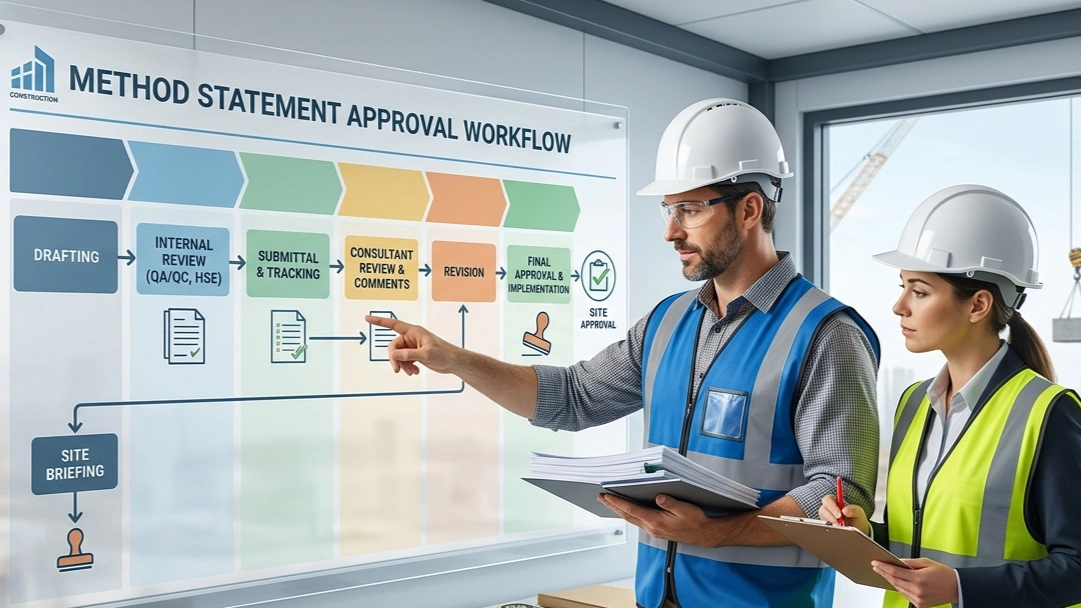
Who receives or approves this ITP
Consultant/Client Representative for review and approvals.
Inspection scope
Materials approval, routing/segregation, testing, configuration, protocol mapping, accuracy checks, alarms, trends, and documentation.
Typical hold, witness, and review points
Hold: cable concealment, pre-energization, functional accuracy test, final handover. Witness: tagging, parameter setup, trend verification, stability run review.
Typical inspection records
Approved submittals, IRs, cable test results, parameter sheets, mapping sheets, functional test records, alarm/trend evidence, 72‑hour report, as-builts.
Important approval note
This ITP is an AI-assisted editable starting point, not a pre-approved document. Before use on any project, all inspection activities, hold points, and acceptance criteria must be reviewed and approved by the relevant parties (superintendent, principal contractor, or client representative) in accordance with your contract and project quality plan.
Always verify acceptance criteria against your applicable drawings, specifications, and regulatory requirements. Hold points must be confirmed with the relevant authority before work proceeds past that point.
Inspection and test plan
| Activity | Inspection / Test | Acceptance Criteria | Responsibility | Record |
|---|---|---|---|---|
| Material Submittals Approval | Review datasheets for cables, JBs, isolators, converters | Compliant with specs/standards; approvals received | QA/QC, Consultant | Approved submittals, MIRs |
| Meter Verification & Tagging | Check meter make/model/serial, output type, location; apply tags | Matches approved schedule; unique IDs; photos recorded | BMS/Plumbing, QA/QC | Meter register, photos |
| Cable Routing & Segregation Inspection | Visual inspection before concealment | Separation maintained; fixings correct; bends within limits; IP maintained | ELV, QA/QC, Consultant | IR, inspection checklist, photos |
| Pre-Connection Cable Tests | Continuity and insulation testing | Continuity <1 Ω/100 m; Insulation ≥1 MΩ at 250 VDC [Verify] | ELV, QA/QC | Test reports (signed) |
| Terminations & Shielding Check | Polarity, torque, shield bond, gland seals | Correct cores; no exposed strands; shield grounded single-end; gland tightness IP rating met | ELV/BMS, QA/QC, Consultant | Termination checklist, photos |
| Controller & Network Configuration | Addressing, baud, bias/termination, network scan | No duplicate IDs; stable comms; error rate <1% over 30 min [Verify] | BMS, QA/QC | Config printouts, scan logs |
| Pulse Input Configuration | Debounce/filter, pulse value, edge selection | Matches meter datasheet/plate; no spurious counts during 10‑min no-flow | BMS, QA/QC, Consultant | Parameter sheet, screenshots |
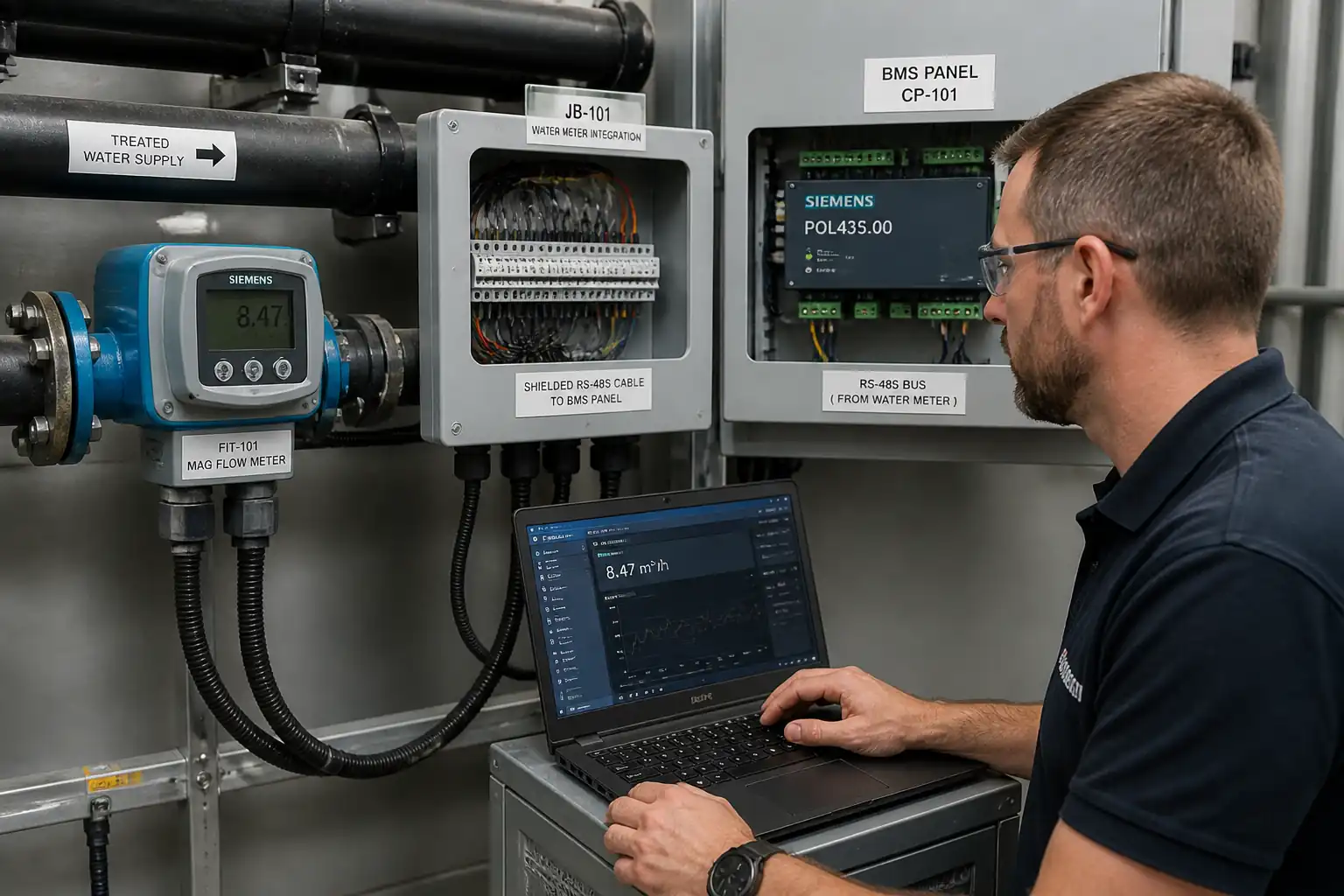
| Protocol Mapping (Comms) | Read meter registers/objects via M‑Bus/Modbus/BACnet | Values align with local display within resolution; correct units/scaling | BMS, QA/QC | Mapping sheet, screenshots |
| Functional Flow Accuracy Test | Pass known volume and compare BMS vs meter register | BMS within ±1% or 1 digit of least count [Verify] | BMS/Plumbing, QA/QC, Consultant | Test sheet with signatures |
| Zero-Flow & Leak Alarm Test | Valve closed; simulate leak thresholds | No counts at zero-flow; alarms trigger/reset per setpoints | BMS/Plumbing, QA/QC | Alarm test records |
| Trend & Time Sync Verification | Trend interval/retention, NTP time check | Trend interval set (typ. 15 min); retention ≥13 months; time offset ≤±2 s [Verify] | BMS, QA/QC | Trend config, NTP screenshot |
| 72‑Hour Stability Run Review | Data continuity and comms error review | No gaps >1 interval; comms errors within limits; totals plausible | BMS, Consultant | 72‑hr trend report |
| Documentation & Handover | Completeness of as-builts, point list, O&M, training | All documents approved; snags closed/NCRs cleared | BMS/Main Contractor, Consultant | Handover dossier, approvals |
This table is a read-only public reference. Download the PDF or Excel version, or customize this ITP to edit it for your project.
Frequently asked questions
Related method statement
This Inspection and Test Plan is associated with the Method Statement: Water Meter Integration with Building Management System (BMS) method statement, which describes the step-by-step construction sequence, resources, materials, equipment, safety controls, and environmental controls for this activity.
View the Method Statement: Water Meter Integration with Building Management System (BMS) method statement →Continue with related inspection, method statement, article, and checklist resources.