
Inspection and Test Plan for Method Statement: Water Leak Detection System Installation for Data Center Raised Floors
AI-assisted inspection and test plan connected to a method statement, with PDF and Excel export.
More than a static template
Unlike a downloadable Word or PDF template, this ITP is an AI-assisted editable starting point directly connected to its method statement. Every inspection activity, hold point, and acceptance criterion is structured and ready to adapt to your project.
- AI-assisted customization — Tailor inspection activities and acceptance criteria to your specific project scope.
- Linked method statement — This ITP is connected to the corresponding method statement describing the work sequence.
- Multiple export formats — Download as a formatted PDF or editable Excel spreadsheet.
- Editable starting point, not a final document — Review and verify all content against your project specifications and standards before use.
What you can customize
When you save this ITP to your account, every inspection row becomes editable. You can add, remove, or modify:
- Inspection activity — Description of what is being inspected.
- Inspection type — Hold point (H), Witness point (W), Review (R), or Monitor (M).
- Responsibility — Contractor, subcontractor, engineer, or client.
- Frequency — How often the inspection occurs.
- Acceptance criteria — Referenced standard or specification requirement.
- Records — Forms, test reports, or checklists required as evidence.
Why this ITP is used
To ensure compliant installation, complete functional verification, and proper integration of the WLD system prior to handover.
Who uses this inspection and test plan
Contractors, QA/QC engineers, commissioning teams, consultants, and facility managers.
When this ITP is prepared and submitted
From pre-start through installation, commissioning, and final handover of the WLD system.
Who receives or approves this ITP
Consultant/Engineer for review and approval; Client/FM for witnessing key tests.
Inspection scope
Material verification, routing/installation checks, terminations/labeling, controller setup, 100% zone functional testing, and BMS interface verification.
Typical hold, witness, and review points
Wet-cloth functional testing per zone (Witness); BMS integration tests (Witness); controller power-up and configuration (Hold/Witness as specified).
Typical inspection records
Checklists, photos, baseline readings, functional test sheets, BMS integration reports, as-built drawings, calibration certificates.
Important approval note
This ITP is an AI-assisted editable starting point, not a pre-approved document. Before use on any project, all inspection activities, hold points, and acceptance criteria must be reviewed and approved by the relevant parties (superintendent, principal contractor, or client representative) in accordance with your contract and project quality plan.
Always verify acceptance criteria against your applicable drawings, specifications, and regulatory requirements. Hold points must be confirmed with the relevant authority before work proceeds past that point.
Inspection and test plan
| Activity | Inspection / Test | Acceptance Criteria | Responsibility | Record |
|---|---|---|---|---|
| Pre-start documentation and permits | Review and verify permits, MOP, drawings, material approvals | All approvals in place; risk assessment communicated; toolbox talk conducted | Project Manager / HSE | Pre-start checklist, permits, TBT record |
| Material delivery inspection | Visual inspection, model verification vs. submittals | Correct models; no damage; certificates available | QA/QC Engineer | Material inspection report, photos |
| Underfloor route readiness | Check cleanliness, obstructions, airflow paths, and tile support | Area clean; safe access; airflow not obstructed | Site Engineer / HSE | Area readiness checklist |
| Controller mounting and power | Visual and dimensional check; power ON checks | Mounting height 1.4–1.6 m; secure; voltage within tolerance; labels fixed | QA/QC Engineer | Controller installation checklist |
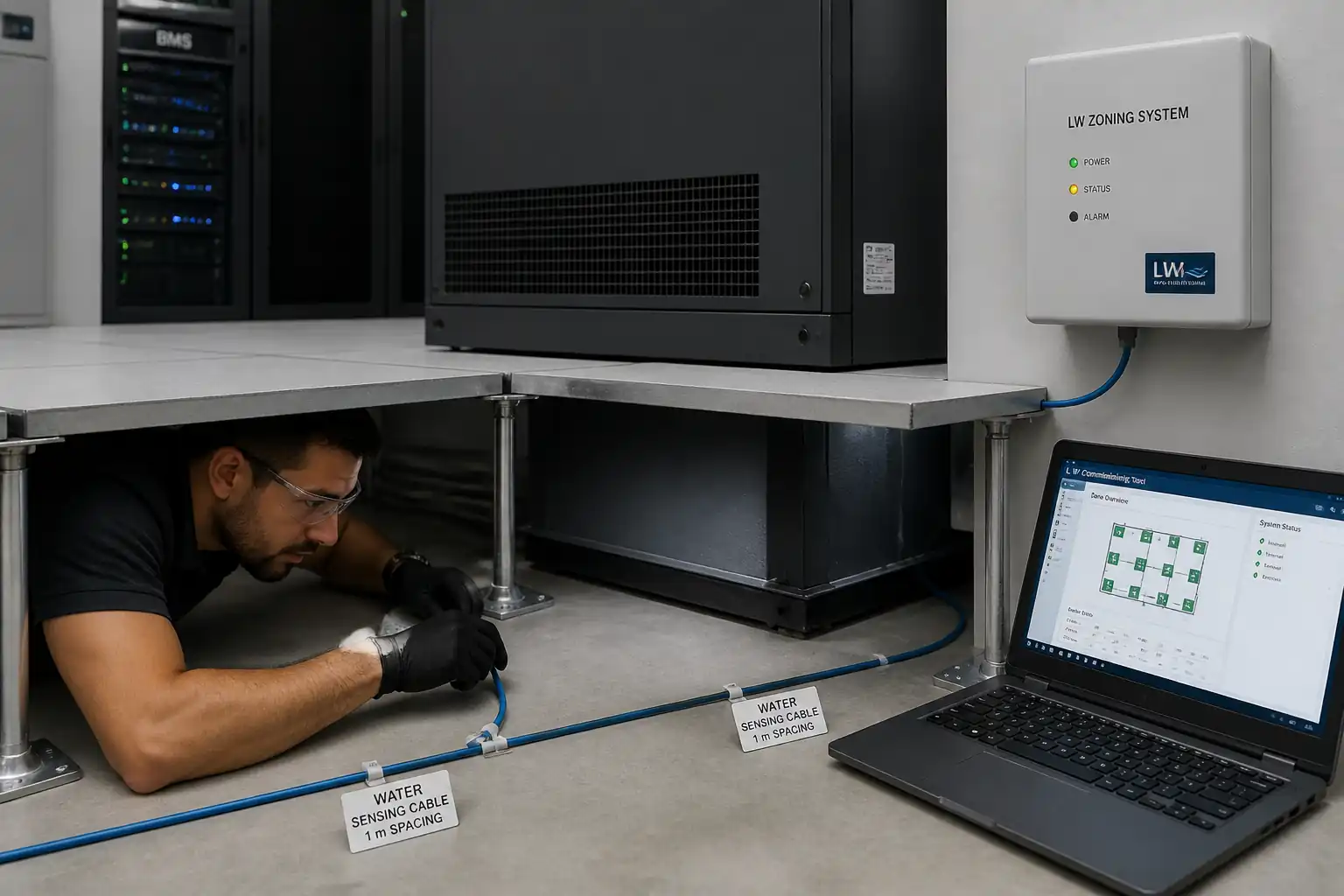
| Leader/sensing cable routing (in-process) | Check clip spacing, bend radius, separation, protection at edges | Clip spacing ≤1.0 m; bend radius ≥5× OD; separation ≥50 mm from power | QA/QC Engineer | In-process inspection log, photos |
| Terminations and labeling | Verify polarity; EOL kit installed; labels per schedule | Terminations tight; EOL installed; labels legible and correct | QA/QC Engineer | Termination/label checklist |
| Controller configuration and baseline | Set zones/addresses; record baseline readings | No faults; baseline recorded; event log clear | Commissioning Engineer | Commissioning checklist, baseline log |
| Wet-cloth functional test (per zone) | Apply wet cloth; observe alarm and location | Alarm ≤60 s; correct zone; locating accuracy within ±1 m or ±2% [Verify] | Commissioning Engineer / Consultant (Witness) | Functional test sheets with timestamps |
| BMS/DCIM interface test | Point-to-point verification; alarm/ack/reset sequence | Correct mapping, descriptors, priorities, and logging | Commissioning Engineer / BMS Engineer | BMS integration report |
| As-built and labeling verification | Compare drawings to field; verify chainage and tags | As-builts accurate; labels consistent; photos archived | QA/QC Engineer / Consultant | As-built sign-off, photo log |
This table is a read-only public reference. Download the PDF or Excel version, or customize this ITP to edit it for your project.
Frequently asked questions
Related method statement
This Inspection and Test Plan is associated with the Method Statement: Water Leak Detection System Installation for Data Center Raised Floors method statement, which describes the step-by-step construction sequence, resources, materials, equipment, safety controls, and environmental controls for this activity.
View the Method Statement: Water Leak Detection System Installation for Data Center Raised Floors method statement →Continue with related inspection, method statement, article, and checklist resources.