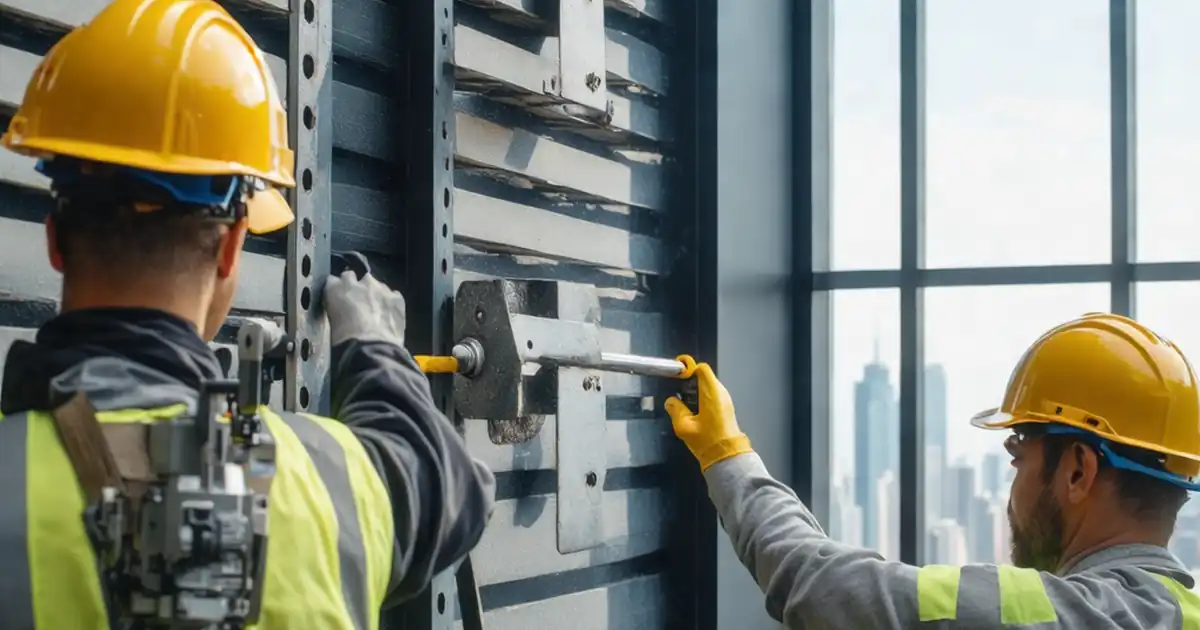
Inspect dynamic façade control cabling and protected routing
Definition: Inspect dynamic façade control cabling and protected routing for construction quality teams, covering cable specifications, separation, protection, terminations, testing, and documentation to ensure safe, reliable façade movement and maintainable building automation.
- Verify control cable type, protection, separation, termination, and labeling.
- Prevent moisture ingress, signal noise, abrasion, and unplanned façade movement.
- Field measurements, torque tools, continuity/IR tests, photo evidence, sign-offs.
- Interactive, commentable checklist with export and QR code traceability.
Inspect dynamic façade control cabling and protected routing to verify safe, reliable movement and durable signal integrity. This checklist focuses on façade actuator wiring, control cable routing, weatherproof conduits, and protected penetrations from equipment cabinets to moving façade elements such as louvers or shading panels. You will confirm cable type, UV resistance, enclosure IP ratings, support spacing, bend radius, and separation from power that can induce interference. The process also covers termination quality, earth bonding, surge protection, and complete verification testing—continuity, insulation resistance, and functional jogs—per approved project specifications and authority requirements. Outcomes include fewer service faults, mitigated moisture ingress, reduced noise coupling, and traceable documentation for commissioning closeout. Use it at pre-cover, post-routing, and pre-commissioning stages to capture evidence before concealment. Start the interactive checklist now—tick items, add comments with photos, and export PDF/Excel with a project QR code for sign-off and archiving.
- Comprehensive, field-ready steps verify cable specification, protected routing, separation, and termination quality for dynamic façades. Practical tolerances, measurable acceptance criteria, and photo evidence reduce rework and prevent signal faults or unsafe façade movements during operation.
- Interactive online checklist with tick, comment, and export features secured by QR code. Technicians capture readings, torque values, batch numbers, and enclosure IP confirmations while supervisors and consultants review in real time and sign digitally for commissioning milestones.
- Structured tests cover continuity, insulation resistance, and controlled functional jogs to validate actuator circuits without risking damage. The checklist enforces labeling, as-built updates, and traceable documentation—supporting warranty claims and long-term maintenance planning across zones and elevations.
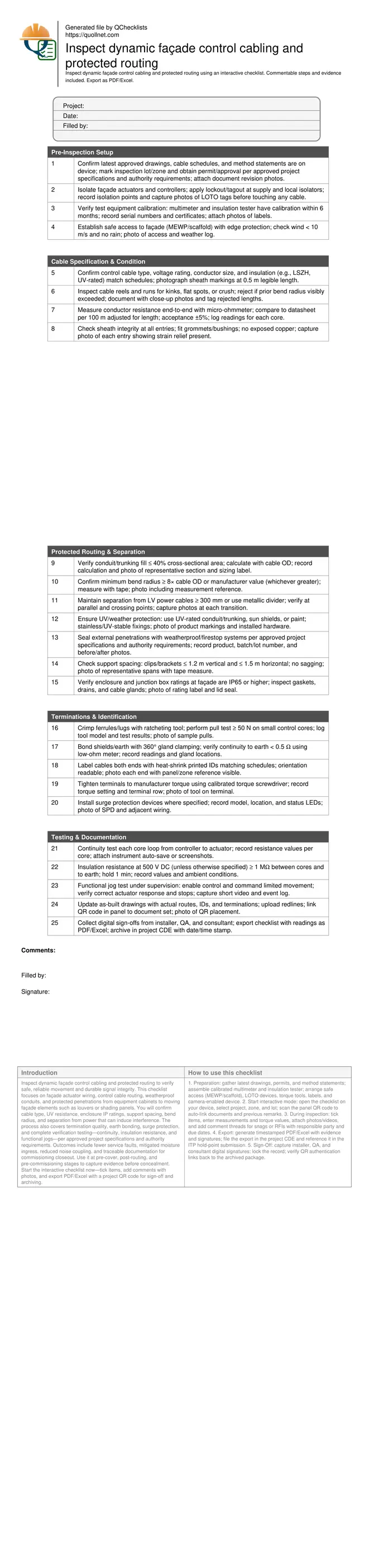
Pre-Inspection Setup
Cable Specification & Condition
Protected Routing & Separation
Terminations & Identification
Testing & Documentation
Plan the inspection and verify layouts before concealment
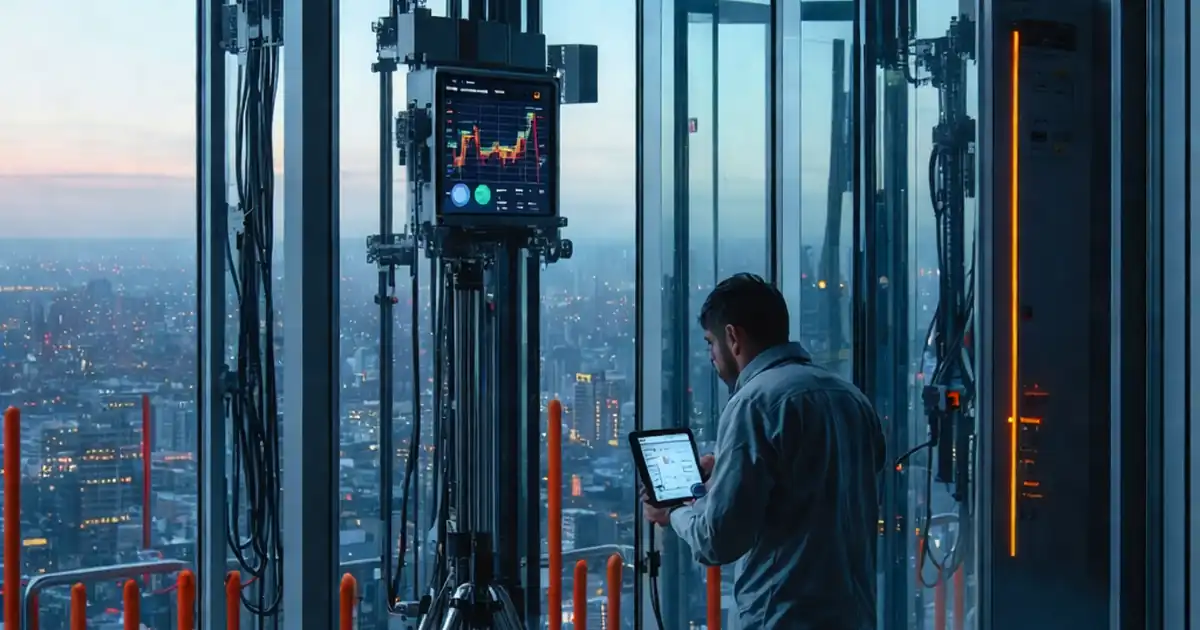
Success begins with accurate references. Use the latest cable schedules, routing drawings, and panel terminations to confirm every planned run and gland location prior to enclosure closure or cladding installation. Walk the route end-to-end, checking that designated conduits and trunking are accessible, sized correctly, and installed on the façade side that matches actuator access and maintenance paths. Confirm separation from power early to avoid rework; measure available space near vertical mullions, corners, and moving joints. Pay special attention to bend radii where cables transition from fixed structure to articulated arms—small radius errors here quickly degrade insulation and shielding. Establish safe access with MEWPs or scaffold and verify weather conditions to protect open enclosures. A short pre-inspection huddle reduces ambiguity: agree on acceptance criteria, evidence to capture, and test sequence, then identify hold points for consultant review. Finally, tag your inspection lot to a QR code linking drawings and checklists.
- Use current drawings and schedules; confirm revision dates.
- Walk routes end-to-end before any concealment work.
- Measure separation and bend radii at tight areas.
- Agree acceptance criteria and hold points up front.
- Link inspection lot to a QR code for traceability.
Protect routing against weather, movement, and abrasion
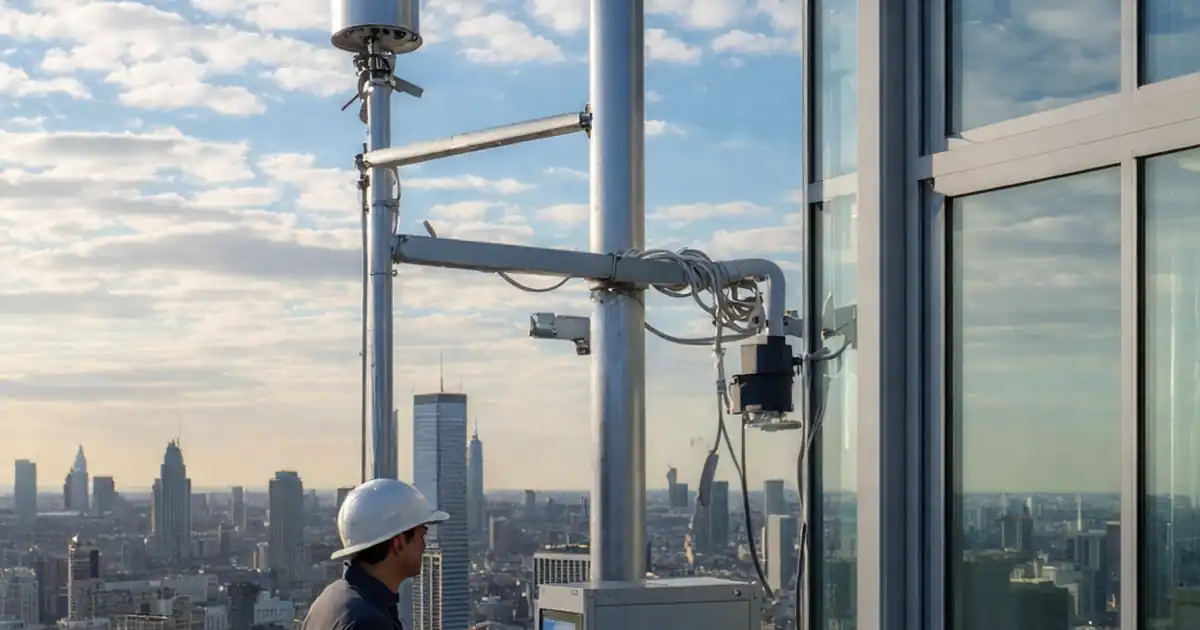
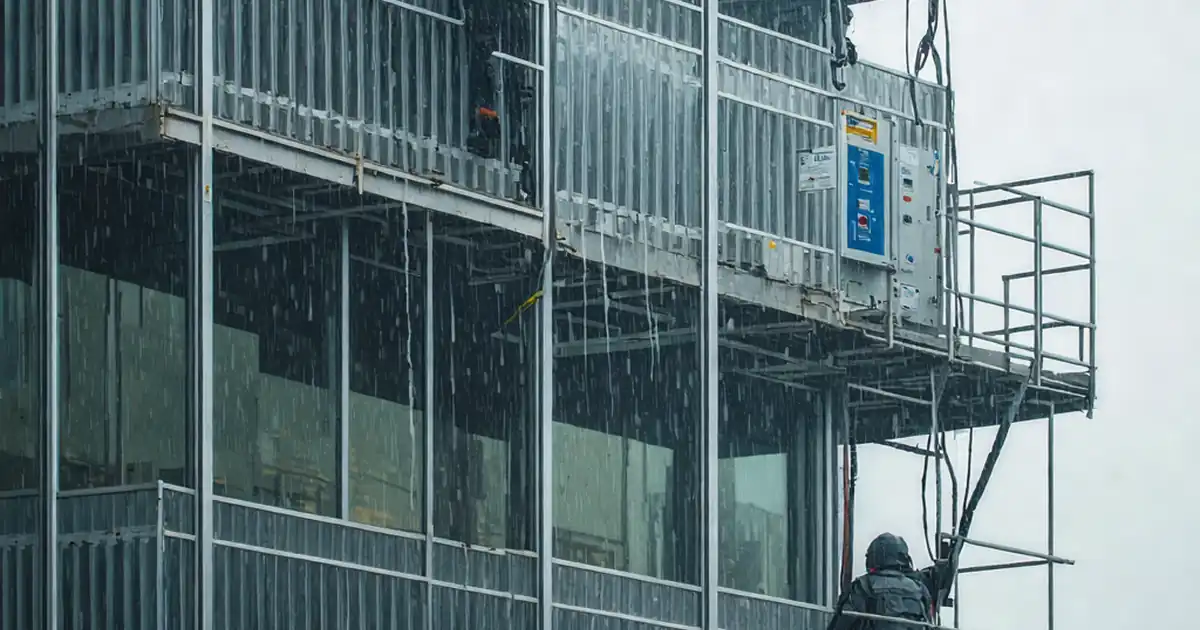
Dynamic façades face UV, wind-driven rain, vibration, and repeated articulation. Choose UV-rated conduits and junction boxes with IP65 or higher where exposed. Clips and brackets should be stainless or UV-stable polymer, with spacing that prevents sag and fretting. Penetrations through the building skin require compatible weatherproof and, where needed, firestop systems—record product names and batch numbers. At moving interfaces, use flexible conduits or energy chains sized for displacement, maintaining manufacturer bend radius. Provide strain relief at both fixed and moving ends so that terminations do not carry load. Where power and control share routes, maintain separation or install metallic dividers to mitigate electromagnetic interference, especially near drives and motors. Glands must clamp 360° around braided shields to maintain screening effectiveness. Small protective details now will save actuators and controllers from corrosion, moisture ingress, and intermittent signals later.
- Select UV-rated conduit and IP65+ enclosures.
- Maintain clip spacing to avoid sag and fretting.
- Seal penetrations; record batch numbers and photos.
- Use flexible systems at moving joints; protect bend radius.
- Bond shields with 360° glands for effective screening.
Terminate, test, and document for reliable commissioning
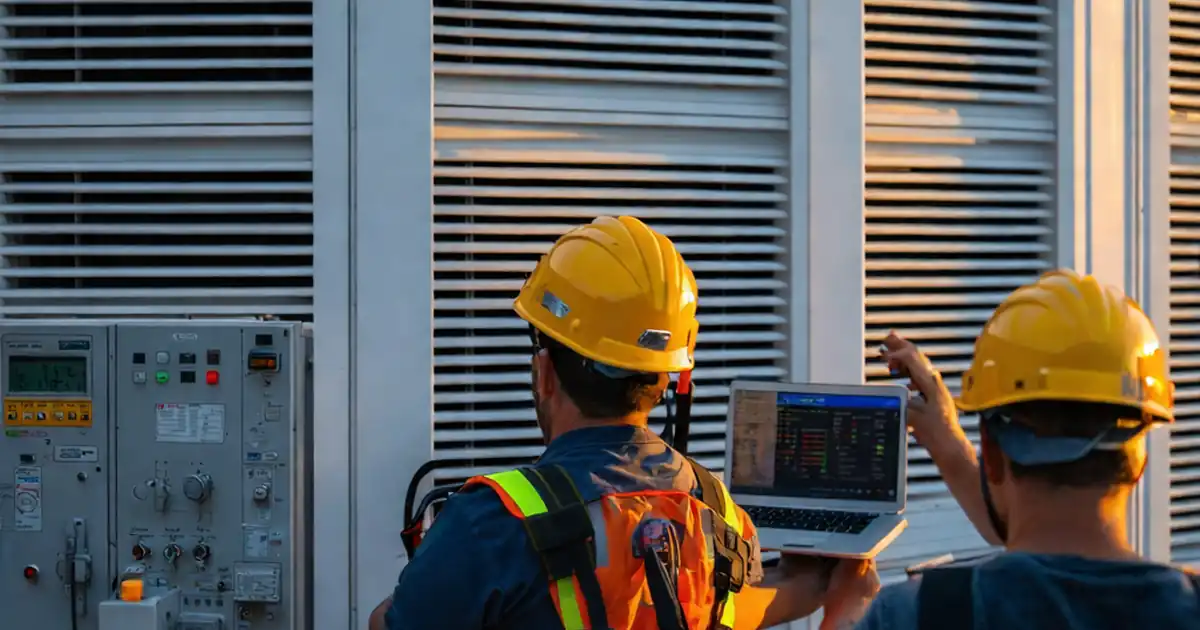
Quality terminations underpin stable automation. Crimp with ratcheting tools, verify with pull tests, and torque terminals per manufacturer data. Label both ends with durable, printed identifiers matching schedules and as-builts. Test continuity for each core to catch cross-overs early. Perform insulation resistance at an appropriate test voltage—commonly 500 V DC for 300/500 V cables—holding for a full minute to reveal moisture or micro-cracks; never test through connected electronics. After re-energizing, complete a controlled functional jog with spotters, confirming correct direction and end-stop behavior. Capture photos of labels, glands, IP ratings, and support details, plus screenshots of meter readings. Update redlined drawings to reflect the real route and QR-link them in the panel. Finish with digital sign-offs and export the checklist to PDF/Excel so commissioning can proceed with traceable, verified records.
- Crimp, pull test, and torque with calibrated tools.
- Label both ends; match schedules and as-builts.
- Record continuity and insulation resistance values.
- Jog test safely with spotters and limited travel.
- Export evidence and sign-offs to PDF/Excel.
How to Use This Interactive Façade Cabling Inspection Checklist
- Preparation: gather latest drawings, permits, and method statements; assemble calibrated multimeter and insulation tester; arrange safe access (MEWP/scaffold), LOTO devices, torque tools, labels, and camera-enabled device.
- Start interactive mode: open the checklist on your device, select project, zone, and lot; scan the panel QR code to auto-link documents and previous remarks.
- During inspection: tick items, enter measurements and torque values, attach photos/videos, and add comment threads for snags or RFIs with responsible party and due dates.
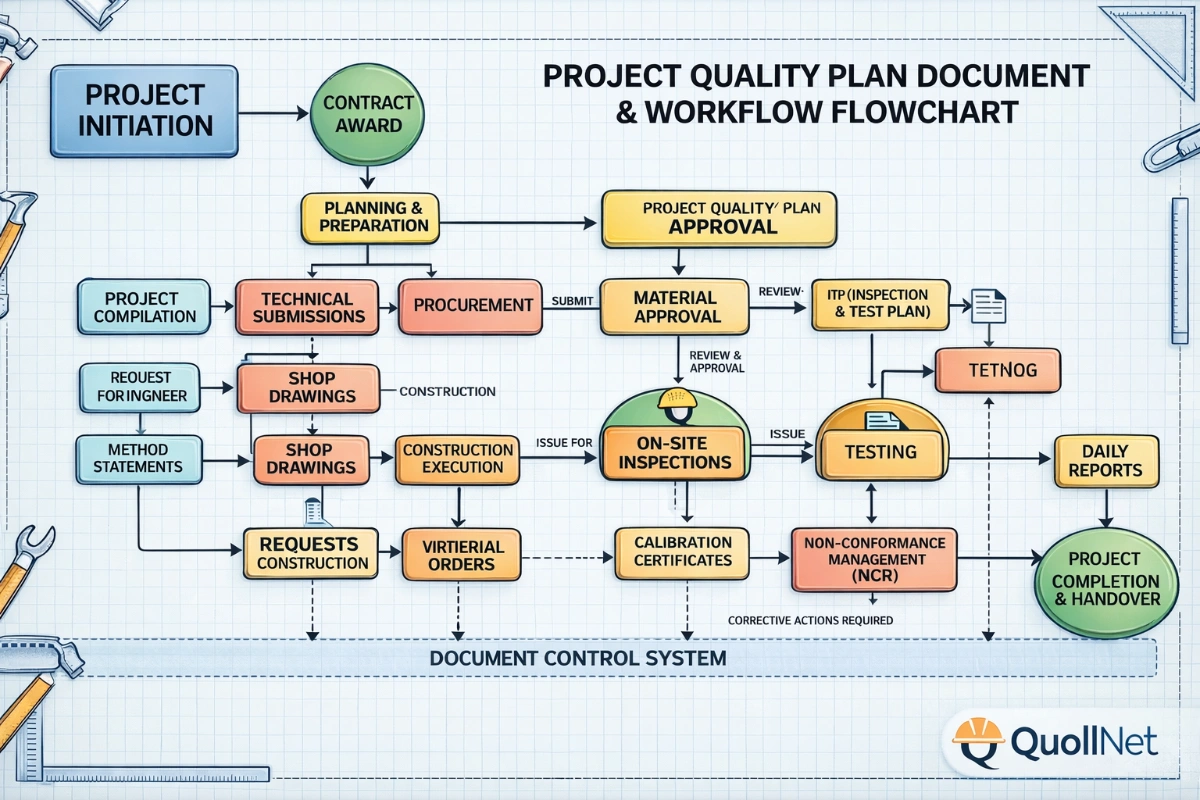
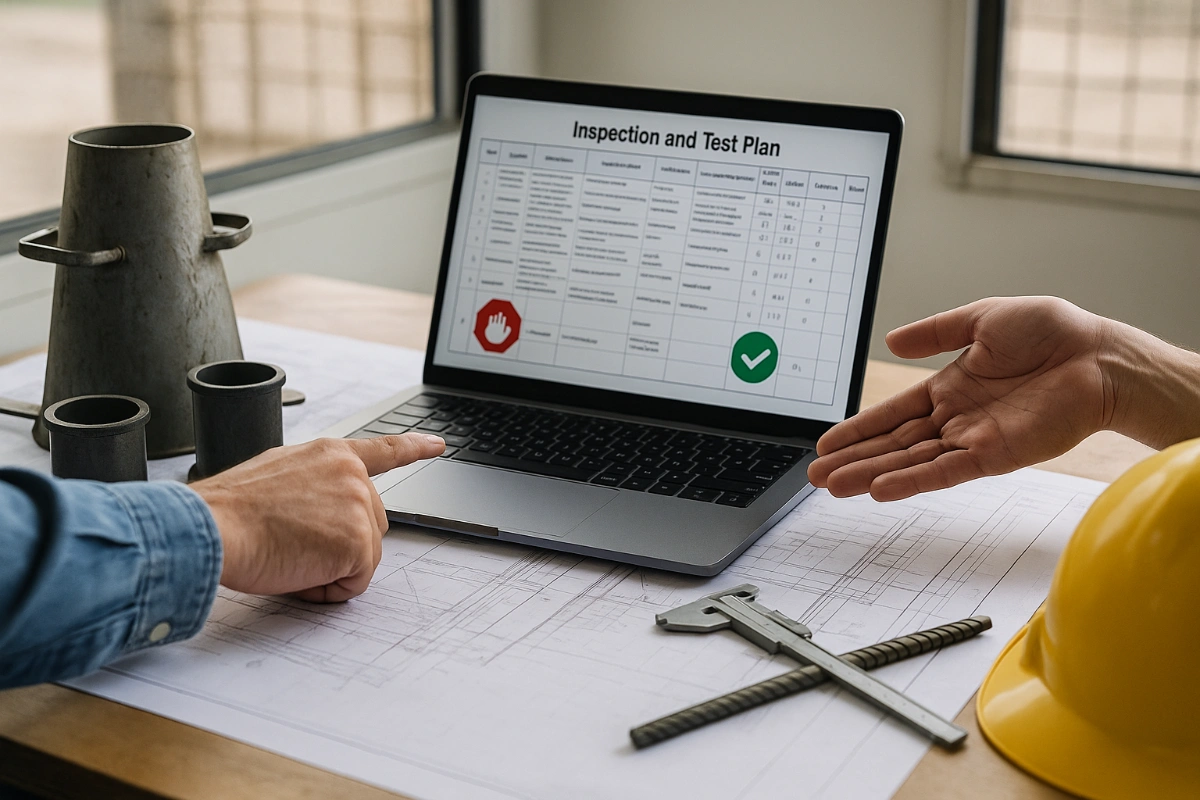
- Export: generate timestamped PDF/Excel with evidence and signatures; file the export in the project CDE and reference it in the ITP hold-point submission.
- Sign-Off: capture installer, QA, and consultant digital signatures; lock the record; verify QR authentication links back to the archived package.
Call to Action
- Start Checklist Tick off tasks, leave comments on items or the whole form, and export your completed report to PDF or Excel—with a built-in QR code for authenticity.
- Download Excel - Dynamic Façade Cabling & Protected Routing Inspection
- Download PDF - Dynamic Façade Cabling & Protected Routing Inspection
- View Image - Dynamic Façade Cabling & Protected Routing Inspection
Cite & Embed
“Dynamic Façade Cabling & Protected Routing Inspection by Quollnet”
with a link to
this source page.

FAQ
Question: How far should façade control cables be separated from power circuits?
Question: What bend radius is acceptable for dynamic façade control cabling?
Question: What insulation resistance test should I perform on control cables?
Question: How do I control façade movement hazards during inspection?
Related Articles
Broader reading and guidance connected to this checklist topic.

Concrete Cube Curing: Site Storage, Water Tank & Laboratory Requirements

Master Construction Project Cashflow With Cashflowpot
Related Checklists
Keep the workflow moving with nearby templates chosen from similar checklist content.