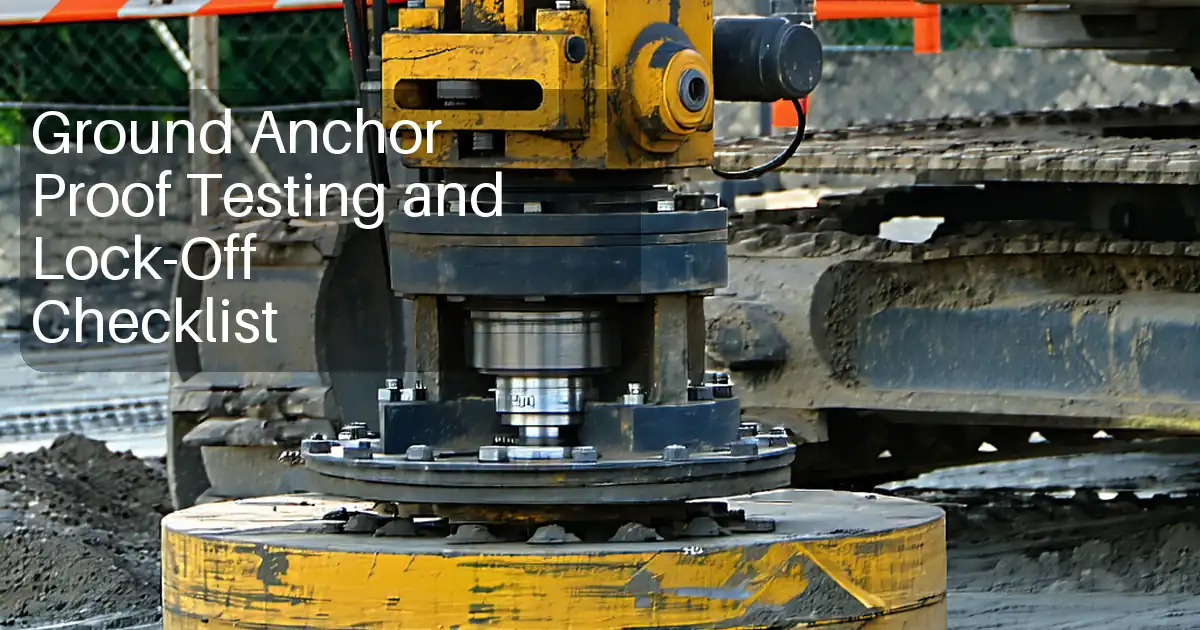
Reaction System Verification (Kentledge, Reaction Piles, Beams)
Definition: Verify Reaction Systems guides site engineers to confirm kentledge, reaction piles, and beams meet capacity, stability, and instrumentation requirements before load testing, excluding any load application procedures.
- Validate reaction capacity, stability, and geometry against approved design.
- Confirm calibration and independence of load and displacement instrumentation.
- Capture evidence: photos, readings, certificates, and signed approvals.
- Interactive, commentable checklist with export and QR code sign-off.
Verify Reaction Systems is a focused checklist for confirming the capacity, stability, and instrumentation of kentledge, reaction piles, and reaction beams before any load is applied. It covers reaction system checks, kentledge verification, and anchor/reaction pile readiness without entering into load test execution. By systematically reviewing design capacity, bearing and bracing, alignment and clearances, and the entire data chain (jack, gauges, load cells, LVDTs, and logger), you reduce the risk of catastrophic instability, under-capacity, eccentric loading, or misleading measurements. The outcome is a stable, compliant, and traceably documented reaction arrangement that is ready for the separate load test procedure. This checklist is tailored to site engineers, QA/QC leads, and third-party inspectors working on static load test setups for foundations and structures. Use it to standardize evidence capture, accelerate approvals, and prevent costly rework. Start in interactive mode to tick items, add comments, attach photos and certificates, and export to PDF/Excel with a QR-secured record.
- Ensure reaction systems are safe, stable, and capacity-compliant before any load application by verifying design calculations, materials, geometry, bracing, and bearing pressures with traceable field evidence and approvals.
- Reduce measurement risk by confirming calibrated instrumentation, independent displacement references, correct channel mapping, and adequate data sampling rates, avoiding errors that can invalidate the subsequent load test.
- Interactive online checklist with tick, comment, and export features secured by QR code.
- Standardize communication among contractors, consultants, and authorities using photos, torque logs, calibration certificates, and stamped drawings, accelerating pre-test readiness reviews per approved project specifications and authority requirements.
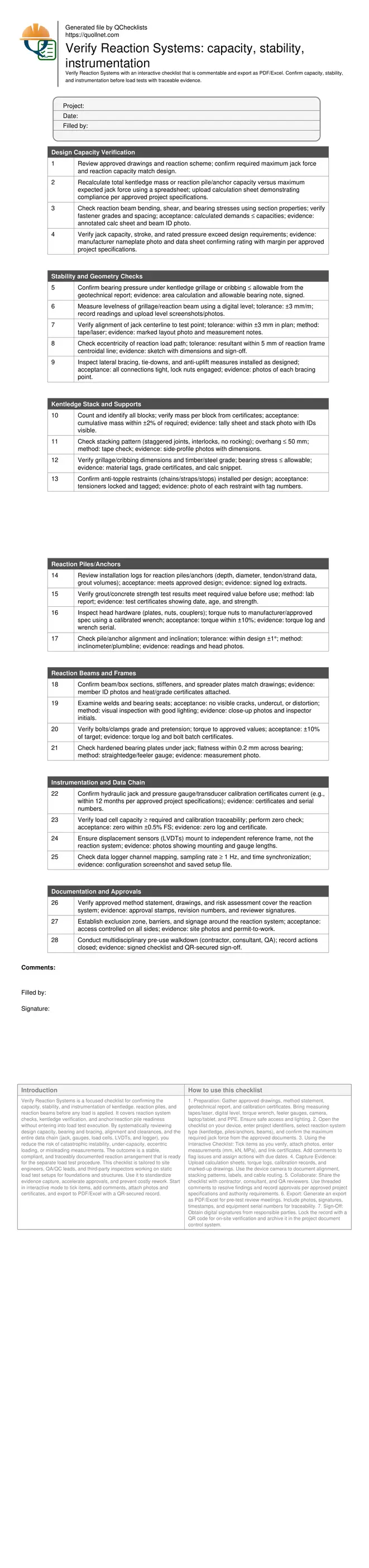
Design Capacity Verification
Stability and Geometry Checks
Kentledge Stack and Supports
Reaction Piles/Anchors
Reaction Beams and Frames
Instrumentation and Data Chain
Documentation and Approvals
Why reaction system verification prevents failures
Reaction systems must resist test forces safely and without unintended movement. Failures usually stem from under-estimated capacity, inadequate bearing, misalignment, or unsecured components. Before any load is applied, confirm the design basis, calculate real capacities for the assembled configuration, and compare against the maximum jack force. Field geometry matters: even small eccentricities can amplify bending in reaction beams and uplift on anchors. Levelness controls load distribution across grillage and blocks; lateral bracing prevents sway that can shift the jack. Document every check with traceable evidence—photos, measurements, serial numbers, and approvals—so that stakeholders share a single, auditable record. On real jobs, issues often include missing stiffeners, overhanging blocks beyond tolerance, or uncalibrated gauges. Catching these early prevents rework and protects personnel. Acceptance cues include capacity calculations matching approved specs, measured level within tolerance, locked restraints, and valid calibrations for all force and displacement devices.
- Confirm capacities meet or exceed approved design requirements.
- Keep levelness within ±3 mm/m across bearing surfaces.
- Align jack centerline within ±3 mm to test point.
- Lock all restraints; no looseness or rocking allowed.
- Upload photos, readings, and certificates for traceability.
Kentledge, reaction piles, and beams: targeted checks
Kentledge stacks demand verified block masses, correct stacking patterns, and bearing checks to ensure allowable ground or grillage pressures are not exceeded. Reaction piles and anchors require compliant installation logs and sufficient grout/concrete strength before clamping. Head hardware must be torqued to specification and aligned to avoid bending. Reaction beams need confirmation of section grade, weld integrity, and proper bearing plates under the jack. Across all systems, maintain clear access and safe exclusion zones. Practical examples include reconfiguring stacks to reduce overhang, adding cribbing to distribute load, replacing undersized clamps, or installing stiffeners where design shows high flange stresses. Ensure all changes are reflected on marked-up drawings and rechecked. Acceptance is evidenced by updated calculations, torque logs within tolerance, block tallies within ±2% mass, and signed drawings matching the built condition.
- Block mass total within ±2% of required.
- Torque bolts/nuts within ±10% of target.
- Inclination within ±1° for piles/anchors.
- Use hardened, flat bearing plates under jacks.
- Update and sign marked-up as-built drawings.
Instrumentation integrity and independent measurement
Reliable measurements need a calibrated force path and independent displacement references. Confirm jack, pressure gauge, and load cell calibrations are current and traceable. Perform zero checks before use and record serial numbers. Displacement sensors (LVDTs) must mount to a stable frame independent of the reaction system to avoid false readings from reaction movement. Validate data logger configuration: channel mapping, sampling rate, and time sync. Ensure secure cable routing, strain relief, and protected connectors to prevent intermittent signals. Provide power redundancy with a UPS to bridge outages during testing. On site, common issues include miswired channels, expired calibration certificates, and LVDTs fixed to the reaction beam. Correct these before the separate load test begins. Acceptance cues include valid certificates, zero within tolerance, confirmed independence of references, documented configuration, and a successful dry-run data capture without applying structural load.
- Maintain valid calibration certificates for all sensors.
- Mount LVDTs to independent references only.
- Set sampling rate ≥ 1 Hz with synced time.
- Secure cables with strain relief and labeling.
- Record zero checks and channel mapping.
How to use this interactive reaction system verification checklist
- Preparation: Gather approved drawings, method statement, geotechnical report, and calibration certificates. Bring measuring tapes/laser, digital level, torque wrench, feeler gauges, camera, laptop/tablet, and PPE. Ensure safe access and lighting.
- Open the checklist on your device, enter project identifiers, select reaction system type (kentledge, piles/anchors, beams), and confirm the maximum required jack force from the approved documents.
- Using the Interactive Checklist: Tick items as you verify, attach photos, enter measurements (mm, kN, MPa), and link certificates. Add comments to flag issues and assign actions with due dates.
- Capture Evidence: Upload calculation sheets, torque logs, calibration records, and marked-up drawings. Use the device camera to document alignment, stacking patterns, labels, and cable routing.
- Collaborate: Share the checklist with contractor, consultant, and QA reviewers. Use threaded comments to resolve findings and record approvals per approved project specifications and authority requirements.
- Export: Generate an export as PDF/Excel for pre-test review meetings. Include photos, signatures, timestamps, and equipment serial numbers for traceability.
- Sign-Off: Obtain digital signatures from responsible parties. Lock the record with a QR code for on-site verification and archive it in the project document control system.
Call to Action
- Start Checklist Tick off tasks, leave comments on items or the whole form, and export your completed report to PDF or Excel—with a built-in QR code for authenticity.
- Download Excel - Reaction System Verification (Pre-Load Test)
- Download PDF - Reaction System Verification (Pre-Load Test)
- View Image - Reaction System Verification (Pre-Load Test)
Cite & Embed
“Reaction System Verification (Pre-Load Test) by Quollnet”
with a link to
this source page.

FAQ
Question: What is included in reaction system verification, and what is excluded?
Question: How do I decide acceptable factors of safety for the reaction system?
Question: Do I need a load cell if I already have a calibrated pressure gauge?
Question: When should verification be completed relative to the test date?
Question: What evidence should I capture to satisfy third-party reviewers?
Related Articles
Broader reading and guidance connected to this checklist topic.
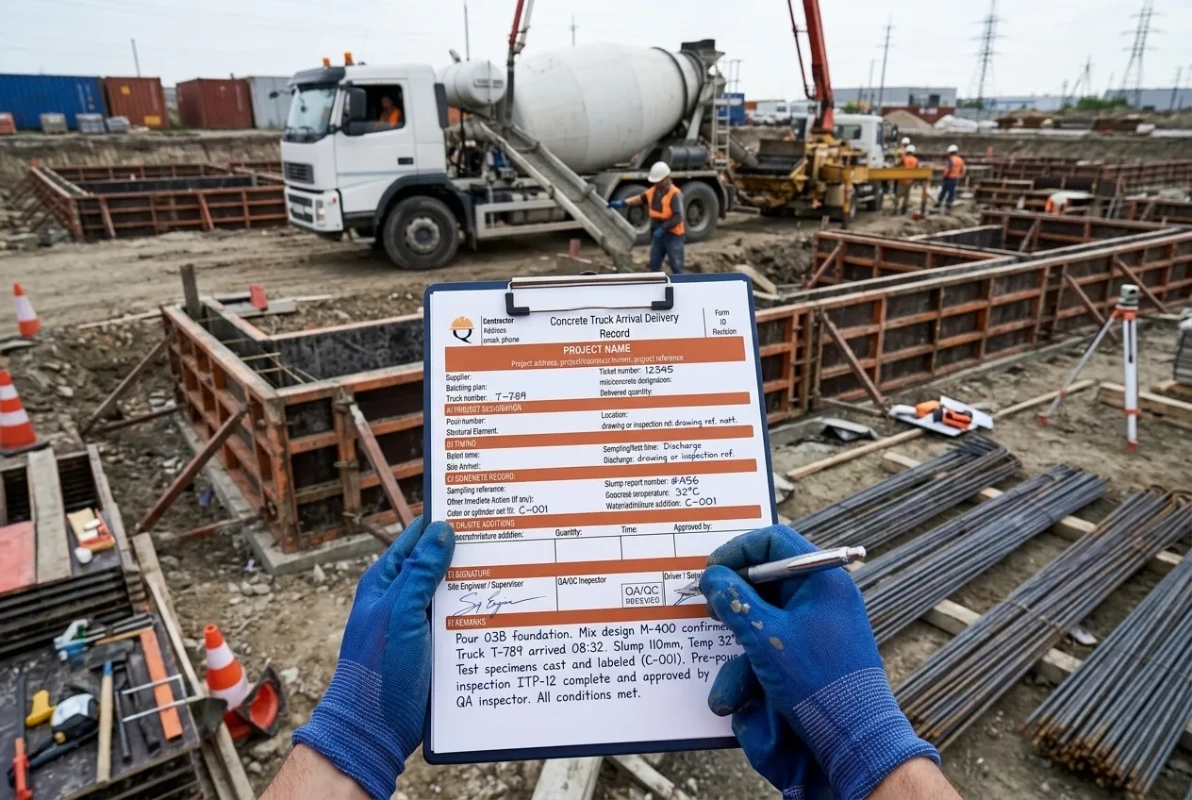
Concrete Truck Arrival & Delivery Record Template

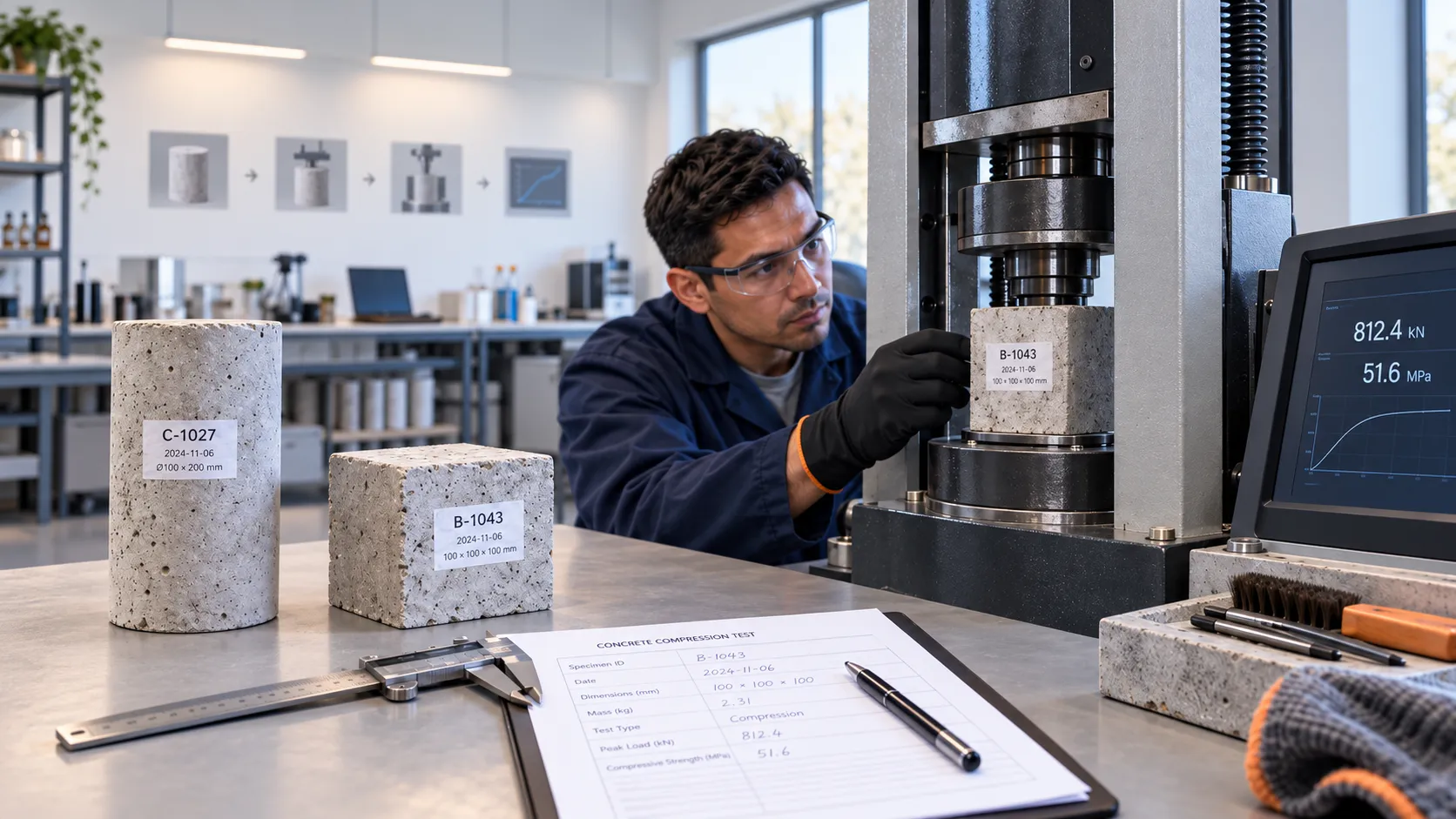
How To Perform a Concrete Compressive Strength Test: Cubes & Cylinders
Improper Concrete Specimen Curing: Impact On Cube & Cylinder Test Strength
Related Checklists
Keep the workflow moving with nearby templates chosen from similar checklist content.