
Inspection and Test Plan for Method Statement – IP Telephone System Installation and Commissioning
AI-assisted inspection and test plan connected to a method statement, with PDF and Excel export.
More than a static template
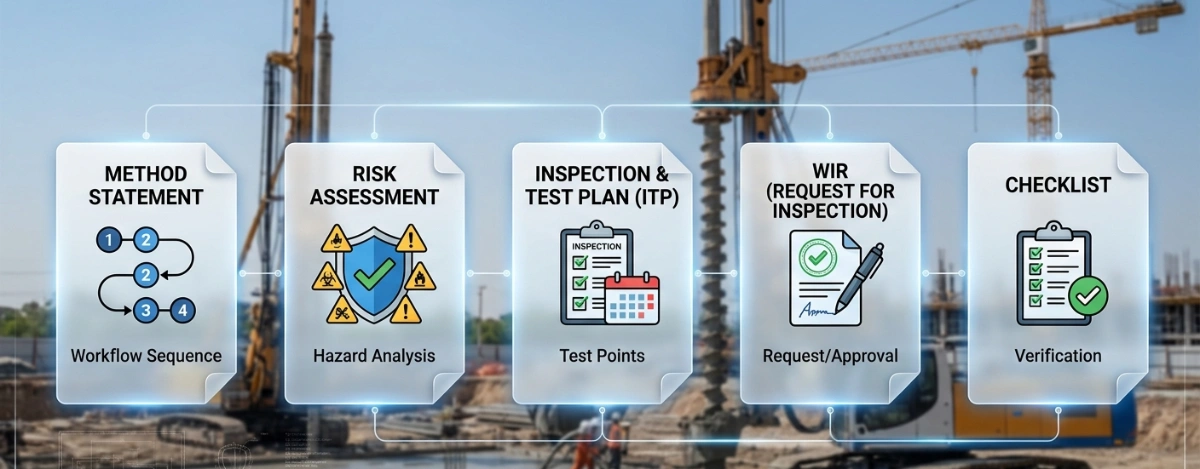
Unlike a downloadable Word or PDF template, this ITP is an AI-assisted editable starting point directly connected to its method statement. Every inspection activity, hold point, and acceptance criterion is structured and ready to adapt to your project.
- AI-assisted customization — Tailor inspection activities and acceptance criteria to your specific project scope.
- Linked method statement — This ITP is connected to the corresponding method statement describing the work sequence.
- Multiple export formats — Download as a formatted PDF or editable Excel spreadsheet.
- Editable starting point, not a final document — Review and verify all content against your project specifications and standards before use.
What you can customize
When you save this ITP to your account, every inspection row becomes editable. You can add, remove, or modify:
- Inspection activity — Description of what is being inspected.
- Inspection type — Hold point (H), Witness point (W), Review (R), or Monitor (M).
- Responsibility — Contractor, subcontractor, engineer, or client.
- Frequency — How often the inspection occurs.
- Acceptance criteria — Referenced standard or specification requirement.
- Records — Forms, test reports, or checklists required as evidence.
Why this ITP is used
To control quality and compliance of IP telephony installation and commissioning activities through defined inspections and tests.
Who uses this inspection and test plan
QA/QC engineers, site supervisors, Client/IT representatives, and consultants.
When this ITP is prepared and submitted
From material receipt through installation, testing, commissioning, and final handover.
Who receives or approves this ITP
Client/Consultant for approval and witnessing.
Inspection scope
Materials, pathways, terminations, certification tests, labeling, switch configuration, functional calls, emergency tests, firestops, and documentation.
Typical hold, witness, and review points
Hold: pathway readiness, emergency call tests, final handover. Witness: terminations, certification tests, labeling, firestops.
Typical inspection records
MIRs, ITRs, certified test reports, labeling registers, change tickets, call test sheets, firestop records, as-builts, acceptance certificates.
Important approval note
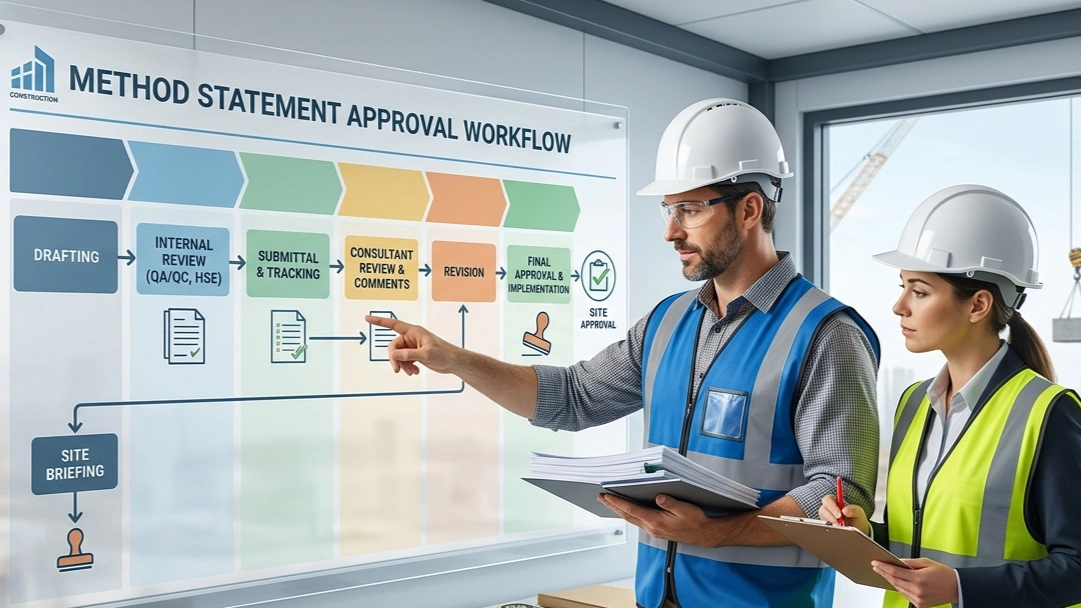
This ITP is an AI-assisted editable starting point, not a pre-approved document. Before use on any project, all inspection activities, hold points, and acceptance criteria must be reviewed and approved by the relevant parties (superintendent, principal contractor, or client representative) in accordance with your contract and project quality plan.
Always verify acceptance criteria against your applicable drawings, specifications, and regulatory requirements. Hold points must be confirmed with the relevant authority before work proceeds past that point.
Inspection and test plan
| Activity | Inspection / Test | Acceptance Criteria | Responsibility | Record |
|---|---|---|---|---|
| Material receipt inspection | Check against approvals; verify certificates and condition | Compliant with approved submittals; no damage; correct categories (Cat6/6A) | QA/QC Engineer | Material Inspection Report (MIR) |
| Pathway and TR readiness | Walkdown of pathways, separations, racks, power/UPS, bonding points | Per TIA-569-D/EN 50174-2; segregation maintained; TR environment within spec | QA/QC + Consultant | Pre-Installation Checklist (signed) |
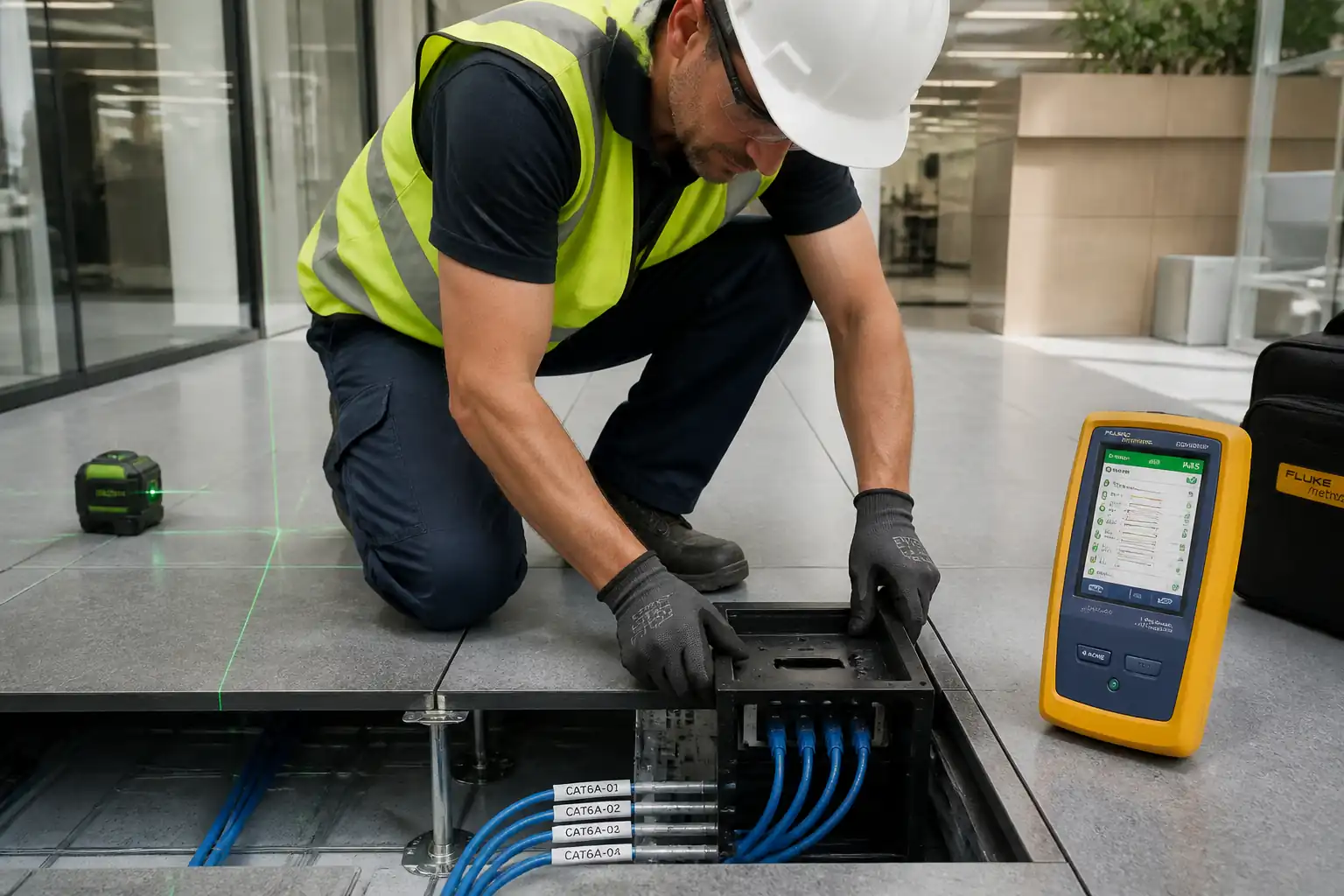
| Cable pulling (in-process) | Observe handling, bend radius, pull tension methods | No sheath damage; bend radius ≥4x OD (UTP)/≥8x OD (shielded); no over-tight ties | Supervisor/QA | In-Process Inspection Sheet |
| Work-area terminations | Visual inspection; optional continuity check | T568A/B consistent; untwist ≤13 mm; secure jack seating | QA/QC | Termination ITR |
| Patch panel terminations | Visual; tug test gently; check dressing and labeling | Cables dressed; strain relief; labels applied; no cable weight on jacks | QA/QC/Consultant | Panel Termination ITR |
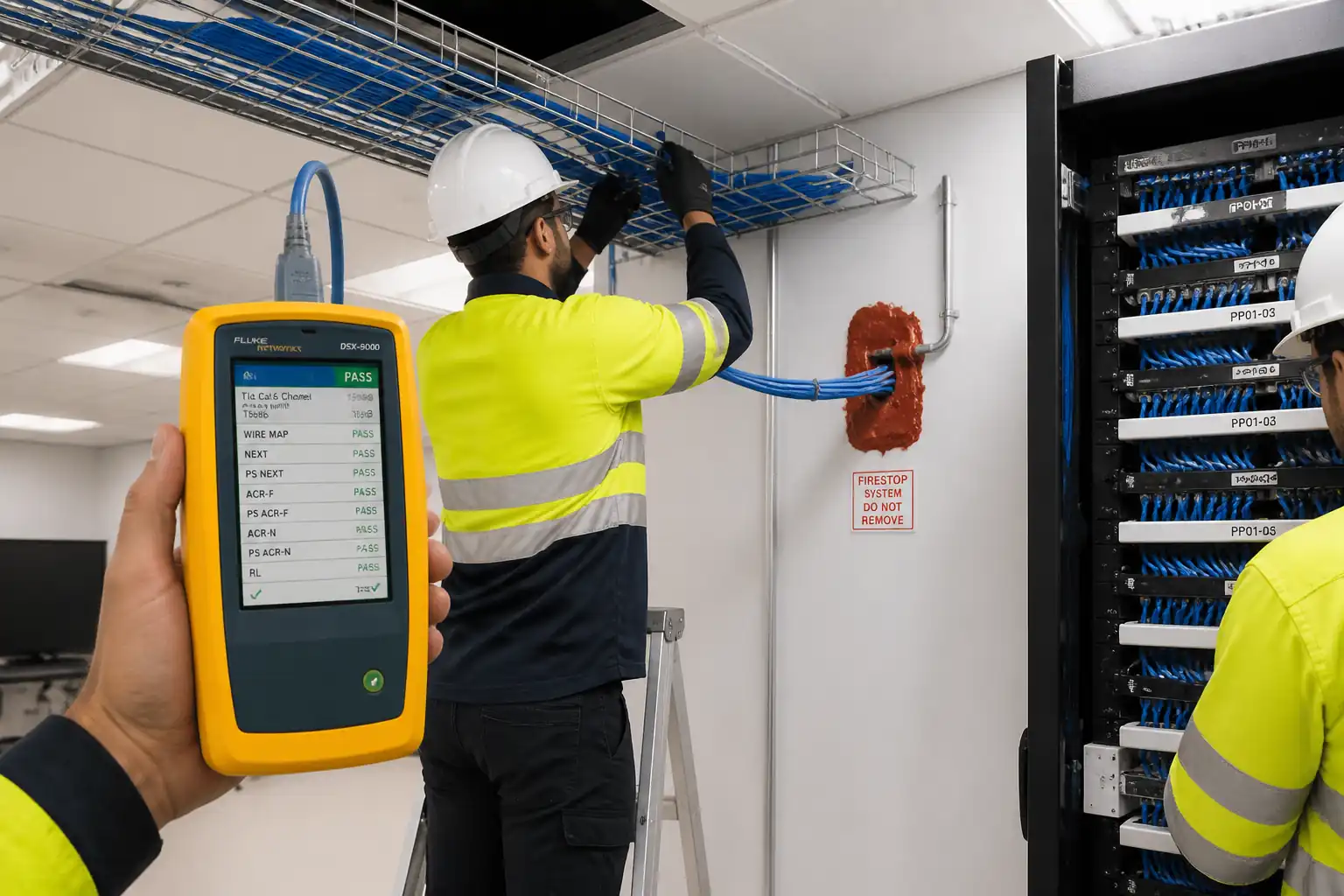
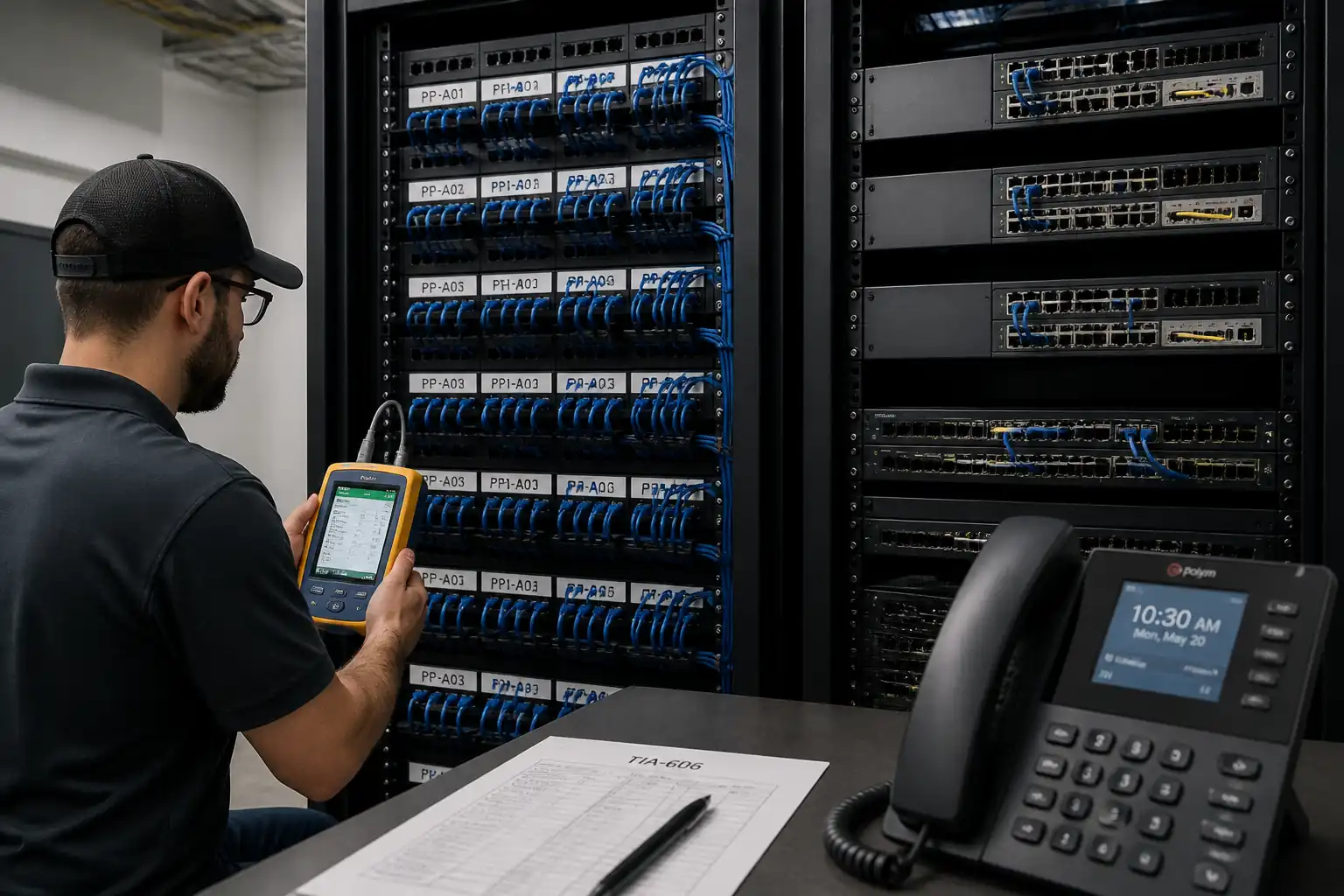
| Permanent link certification | Level V accuracy autotest to ISO/IEC Class E/EA or TIA Cat6/6A | PASS with margins ≥0 dB across parameters; length within design; alien crosstalk if specified [Verify] | Test Technician + Witness | Certified Test Reports (PDF/XML) |
| Labeling verification | Spot-check 10% or minimum 10 labels per area [Verify] against register | Conforms to TIA-606-C scheme; readable and durable | QA/QC | Labeling Verification Sheet |
| Switch port configuration | Review VLAN/QoS/LLDP/PoE settings; apply config to designated ports | Ports configured per approved plan; change ticket approved/closed | Client Network Admin + QA/QC | Change Ticket; Config Backup |
| IP phone provisioning and call test | Power-up via PoE; registration; in/out/internal calls; feature tests | Successful registration; clear audio; feature operation as specified | T&C Technician + Client Witness | Call Test Sheets; Device Register |
| Emergency/priority extension test | Dial to emergency/control room; verify location string/ALI | Connection established; correct location/ID; response confirmed [Verify per regulations] | T&C + HSE + Client | Emergency Call Test Record |
| Firestopping inspection | Visual check vs listed system details; labeling | Matches UL/EN system; annular space and thickness per datasheet | QA/QC + Consultant | Firestop ITR; Photos |
| As-built documentation and handover | Review completeness of drawings, registers, test packs | All records complete, signed, and accepted; training delivered | ICT Lead/Doc Control | Handover Dossier; Acceptance Certificate |
This table is a read-only public reference. Download the PDF or Excel version, or customize this ITP to edit it for your project.
Frequently asked questions
Related method statement
This Inspection and Test Plan is associated with the Method Statement – IP Telephone System Installation and Commissioning method statement, which describes the step-by-step construction sequence, resources, materials, equipment, safety controls, and environmental controls for this activity.
View the Method Statement – IP Telephone System Installation and Commissioning method statement →Continue with related inspection, method statement, article, and checklist resources.