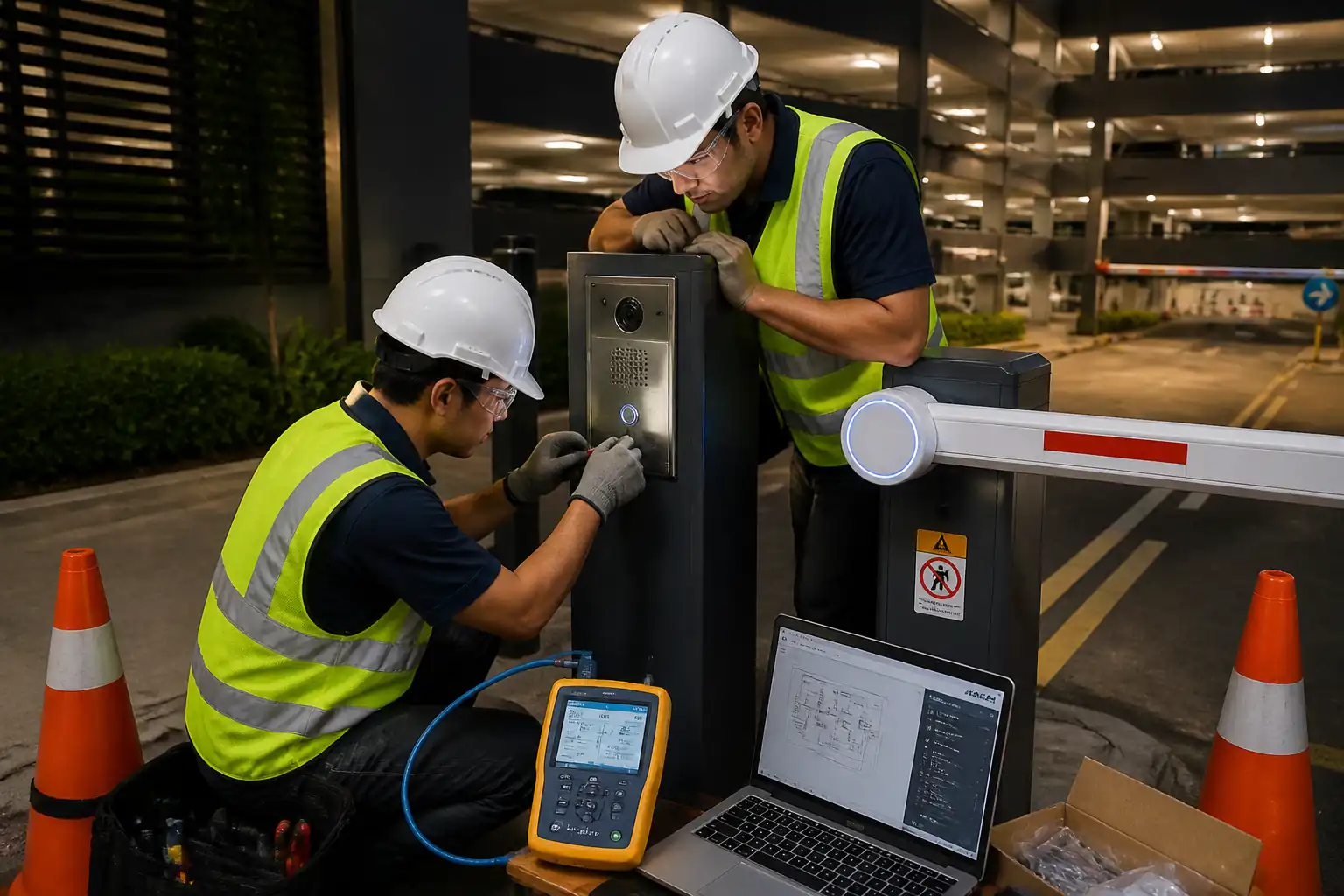

Inspection and Test Plan for Method Statement: Installation and Commissioning of Parking Guidance Intercom Points at Entry/Exit Lanes and Payment Machines
AI-assisted inspection and test plan connected to a method statement, with PDF and Excel export.
More than a static template
Unlike a downloadable Word or PDF template, this ITP is an AI-assisted editable starting point directly connected to its method statement. Every inspection activity, hold point, and acceptance criterion is structured and ready to adapt to your project.
- AI-assisted customization — Tailor inspection activities and acceptance criteria to your specific project scope.
- Linked method statement — This ITP is connected to the corresponding method statement describing the work sequence.
- Multiple export formats — Download as a formatted PDF or editable Excel spreadsheet.
- Editable starting point, not a final document — Review and verify all content against your project specifications and standards before use.
What you can customize
When you save this ITP to your account, every inspection row becomes editable. You can add, remove, or modify:
- Inspection activity — Description of what is being inspected.
- Inspection type — Hold point (H), Witness point (W), Review (R), or Monitor (M).
- Responsibility — Contractor, subcontractor, engineer, or client.
- Frequency — How often the inspection occurs.
- Acceptance criteria — Referenced standard or specification requirement.
- Records — Forms, test reports, or checklists required as evidence.
Why this ITP is used
To control quality and compliance of intercom installations, ensuring reliable operation, intelligible audio, and seamless PMS/control room integration.
Who uses this inspection and test plan
Contractor QA/QC, ELV engineers, commissioning team, IT/network specialists, and the Consultant/Client for witnessing and acceptance.
When this ITP is prepared and submitted
Applied from material receipt through installation, pre-commissioning, commissioning, and final handover.
Who receives or approves this ITP
Consultant/Client for approval before commencement and for sign-off at defined points.
Inspection scope
Material verification, setting-out, recess/back box installation, cabling, penetrations/firestopping, terminations, PoE/network, acoustic measurements, and functional tests.
Typical hold, witness, and review points
Hold: Recess/back box, penetrations/firestopping. Witness: STIPA intelligibility test, voice link/PMS integration functional test. [Verify per ITP matrix].
Typical inspection records
MIRs, WIRs, cable certification PDFs, PoE/network logs, noise and STIPA reports, functional test sheets, as-builts, and completion certificate.
Important approval note
This ITP is an AI-assisted editable starting point, not a pre-approved document. Before use on any project, all inspection activities, hold points, and acceptance criteria must be reviewed and approved by the relevant parties (superintendent, principal contractor, or client representative) in accordance with your contract and project quality plan.
Always verify acceptance criteria against your applicable drawings, specifications, and regulatory requirements. Hold points must be confirmed with the relevant authority before work proceeds past that point.
Inspection and test plan
| Activity | Inspection / Test | Acceptance Criteria | Responsibility | Record |
|---|---|---|---|---|
| Material receipt and verification | Check model, IP rating, stainless grade, certificates | Matches approved submittal; no damage; certificates present | QA/QC | MIR, photos |
| Setting out and mounting height | Measure location and AFFL height | Within ±10 mm horizontally; 1000 ± 50 mm AFFL [Verify] | Site Supervisor/QA | WIR, measurement sheet |
| Back box recess and fixing | Dimensional/plumb check; surface flushness | Flush tolerance 0 to +1 mm; level/plumb ≤2 mm/1 m | QA/QC | WIR, photos |
| Conduit/penetrations and firestopping | Visual; rating verification | Firestop rating matches barrier; neat, labeled if required | QA/QC/Firestop specialist | WIR, firestop cert |
| Cable installation | Visual; segregation; bend radius | No sheath damage; radius ≥4xOD; supports per spec | QA/QC | Photos, cable schedule |
| Termination and labeling | Pinout check; label verification | T568B pinout; labels per TIA-606-C | QA/QC | WIR, label log |
| Cat6 certification test | Permanent link certification | PASS to TIA-568-C.2 Cat6; length ≤90 m; NEXT/RL within limits | QA/QC | Certifier PDF report |
| Faceplate installation | Visual; torque check | Faceplate flush ±1 mm; M4 torque 2.0–2.5 N·m [Verify] | QA/QC | WIR, torque log |
| Network/PoE verification | Link speed, PoE voltage/class, VLAN | 100/1000 Mbps; PoE 44–57 Vdc; correct VLAN/QoS | IT/QA | Tester logs, switch snapshot |
| Background noise measurement | SLM LAeq,1min at user position | Recorded and within design assumptions; used for tuning | Commissioning | Noise log |
| Intelligibility (STIPA) test | STIPA per IEC 60268-16 | STIPA ≥ 0.5 or per project spec [Verify] | Commissioning/Consultant | STIPA report |
| Voice link and PMS integration | Call setup, duplex, latency, PMS event | Call ≤3 s; latency ≤300 ms [Verify]; correct routing and logging | ELV/IT/Operations | Functional test sheet, PMS log |
| Final inspection and documentation | Visual, labeling, O&M completeness | All snags closed; records complete; area clean | QA/QC | Completion dossier checklist |
This table is a read-only public reference. Download the PDF or Excel version, or customize this ITP to edit it for your project.
Frequently asked questions
Related method statement
This Inspection and Test Plan is associated with the Method Statement: Installation and Commissioning of Parking Guidance Intercom Points at Entry/Exit Lanes and Payment Machines method statement, which describes the step-by-step construction sequence, resources, materials, equipment, safety controls, and environmental controls for this activity.
View the Method Statement: Installation and Commissioning of Parking Guidance Intercom Points at Entry/Exit Lanes and Payment Machines method statement →