Method Statement – Stone Surface Polishing and Restoration Works – Method Statement
AI-assisted method statement with matching ITP, PDF download, and Excel export.
More than a static template
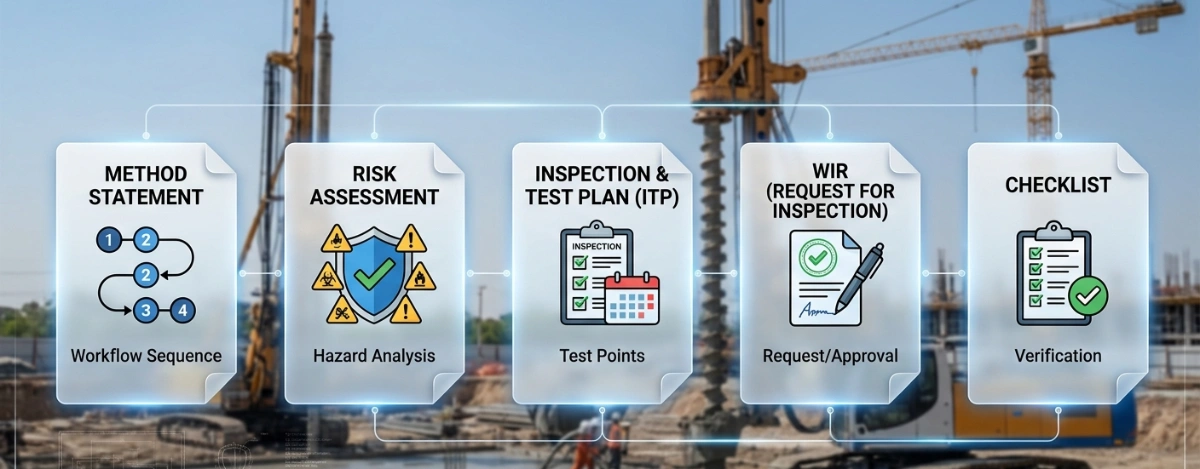
Unlike a downloadable Word or PDF template, this method statement is an AI-assisted editable starting point connected directly to a matching Inspection and Test Plan. Every section is structured, project-adaptable, and ready to export.
- AI-assisted drafting — Customize every section with AI for your specific project scope.
- Linked ITP — A matching inspection and test plan is generated alongside the method statement.
- Multiple export formats — Download as a formatted PDF or editable Excel spreadsheet.
- Editable starting point, not a final document — Review, verify, and adjust all content against your project requirements before use.
Static template vs. Quollnet workflow
| Feature | Static template | Quollnet |
|---|---|---|
| Project-specific content | Manual fill-in required | AI-assisted customization |
| Linked ITP | Separate document, no link | Matching ITP included |
| Export formats | Usually PDF only | PDF and Excel |
| Structured sections | Free-form layout | 13 standardized sections |
| Saved to your account | Local file only | Cloud-saved, reusable |
| Content accuracy | You verify everything | AI-assisted, you still verify |
| Cost | Often free but time-intensive | Free to customize and download |
What you can customize
When you save this method statement to your account, every section becomes editable. The following 13 sections are included:
- Scope — Defines the activity and its boundaries.
- References — Standards, specifications, and drawings.
- Responsibilities — Roles and accountabilities.
- Resources — Labour, plant, and equipment summary.
- Materials — Materials and compliance requirements.
- Equipment — Tools and equipment details.
- Prerequisites — Hold points and pre-conditions.
- Method sequence — Step-by-step construction sequence.
- Safety controls — HSE risk controls and PPE.
- Environmental controls — Environmental mitigation measures.
- QA/QC — Quality inspection and test requirements.
- ITP — Inspection and Test Plan table (has its own page).
- Attachments — Referenced drawings and documentation.
Why this method statement is used
This method statement is used to define and communicate the approved procedure for carrying out method statement – stone surface polishing and restoration works on site. It ensures the work is planned in advance, the correct resources and controls are in place, and all personnel understand responsibilities, sequence, quality requirements, and safety controls before work begins. It aligns site execution with the documented scope and acceptance expectations.
Who uses this method statement
This method statement is used by contractors, site supervisors, project engineers, QA/QC engineers, HSE officers, consultants, and client representatives. It serves as a shared reference for planning, execution, supervision, inspection, and approval of the activity on site.
When it is prepared and submitted
The method statement is prepared before the work activity starts and submitted as part of the pre-construction documentation package for review and approval.
Who reviews or approves it
The method statement is usually submitted to the client representative, consultant, resident engineer, or project management consultant for review and approval before the work commences.
Important approval note
This method statement is an AI-assisted editable starting point, not a pre-approved document. Before use on any project, all content must be reviewed and approved by the relevant parties (superintendent, principal contractor, or client representative) in accordance with your contract and project quality plan.
For example: if your specification requires a departure from a referenced standard, that departure must be documented and approved separately — this method statement will not capture that automatically. Always verify against your applicable drawings, specifications, and regulatory requirements.
Method statement content
Scope
Overview
This method covers stone surface restoration and polishing for marble, limestone, granite, terrazzo, and engineered stone floors, stairs, and skirtings. Works include condition survey, mock-up, progressive grinding/honing/polishing, edge and corner treatment, joint and minor crack repairs, cleaning/neutralization, sealing, surface protection, and final QA/QC verification.
Included Activities
- Pre-cleaning, stain identification and localized poultice treatment.
- Lippage removal and surface flattening where required.
- Progressive wet grinding and honing with diamond abrasives.
- Polishing using resin abrasives and approved polishing compounds or crystallization (stone-dependent).
- Edge, corner, and staircase nosing treatment with hand tools; profile preservation.
- Joint/grout repairs and pinhole filling.
- Dust/silica control via wet method and HEPA extraction; slurry containment and disposal.
- Final clean, sealing/impregnation, protection, and handover.
Exclusions
- Structural stone replacement or substrate structural repairs.
- Large crack injection beyond cosmetic patching.
- Substrate re-levelling outside stone thickness allowance.
Interfaces
- Coordinate with adjacent trades (joinery, MEP, painting) to sequence protection and access.
- Confirm operations schedule to avoid contamination or damage from concurrent works.
References
| Document Type | Reference / Number | Revision | Notes |
|---|---|---|---|
| Standard | ASTM C97/C97M | Use to infer porosity and sealer type [Verify]. | |
| Standard | ASTM C241/C241M | Reference only; do not test on finished floors. | |
| Standard | ASTM D523 | Use calibrated gloss meter; record ambient conditions. | |
| Standard | BS EN 16165 (methods inc. pendulum) / ASTM E303 | Project may specify minimum PTV/DCOF [Verify]. | |
| Standard | EN 60335-2-69 (dust class M/H extractors) | Use H-class for respirable crystalline silica where dry tasks occur. | |
| Guideline/Regulation | OSHA 29 CFR 1926.1153 / EU Directive 2017/2398 [Verify local] | Adopt wet methods and RPE per risk assessment. | |
| Standard | IEC 60364 / local electrical code [Verify] | All 230/120 V tools via 30 mA RCD. | |
| Guideline | Local environmental discharge permits; ISO 14001 principles [Verify] | pH neutralization and solids capture required. |
Responsibilities
| Role | Responsibility | Name / Party |
|---|---|---|
| PM | Project Manager | Contractor |
| SE | Site Engineer | Contractor |
| QA/QC | QA/QC Engineer | Contractor |
| HSE | HSE Officer | Contractor |
| Supervisor | Site Supervisor/Foreman | Contractor |
| Technician | Stone Polishers/Technicians | Contractor |
| Electrician | Electrician | Contractor |
| Env. Coord. | Environmental/Waste Coordinator | Contractor |
| Engineer | Consultant/Engineer | Employer/Consultant |
Resources
| Resource Type | Description | Quantity | Remarks |
|---|---|---|---|
| Manpower | Overall lead | 1 [Verify] | |
| Manpower | Quality and testing | 1 [Verify] | |
| Manpower | HSE oversight | 1 [Verify] | |
| Manpower | Grinding, polishing, edge works | 2–6 per shift [Verify] | |
| Manpower | Slurry handling, protection, logistics | 2–4 [Verify] |
Materials
| Material | Specification / Grade | Quantity | Remarks |
|---|---|---|---|
| Diamond abrasives | Manufacturer data; segment match to stone hardness [Verify] | ||
| Diamond pads | Compatible with machine and stone; wet-use rated | ||
| Powders/compounds | pH and use per SDS; manufacturer instructions [Verify] | ||
| Crystallization liquid | Apply via steel wool pad machine per data sheet [Verify] | ||
| Sealer | Compatible with stone; coverage 8–20 m²/L typical [Verify] | ||
| Epoxy/polyester filler | Low-shrink, polishable; curing per data sheet | ||
| Plastic sheeting, tapes, edge guards | Low-tack on sensitive finishes | ||
| Detergent | Non-foaming for wet vac | ||
| Absorbent powder + reagent | Follow SDS; trial patch first |
Equipment
| Equipment | Capacity / Type | Quantity | Inspection Required |
|---|---|---|---|
| Planetary grinder | 400–650 mm head, 2–4 kW | 1–3 [Verify] | Pre-use check |
| Angle/edge polisher | 100–150 mm pads | 2–4 [Verify] | Pre-use check |
| Vacuum extractor | >300 m³/h, H13/H14 HEPA | As required | Filter integrity |
| Wet vac | 80–100 L tank | 2–3 [Verify] | Daily check |
| Foam/rubber dams | As required | Before wet works | |
| Gloss meter | ASTM D523 compatible | 1 | Calibration cert |
| Measuring tools | 2 sets | Pre-use check | |
| PPE | Per person | Daily |
Prerequisites
- Approvals: Method Statement, ITP, SDS, mock-up plan approved by Engineer.
- Permits: Hot works (if any), work at height (stairs/edges), confined space (if plant rooms), waste/water discharge permits [Verify per project HSE plan and local regulations].
- Services: Confirm temporary power with RCD/GFCI 30 mA; route cables overhead or ramped.
- Area Handover: Confirm extents, access, protected routes, drain locations, and isolation of fire alarms if dust could trigger detectors.
- Mock-up: Minimum 2–5 m² in representative area including edge/obstruction. Obtain written acceptance of sequence, chemicals, and target gloss before proceeding.
- Tools & Calibration: Gloss meter calibration certificate (current), RCD test record, vacuum HEPA integrity check, PAT where applicable.
- Protection: Install dust barriers, signage, edge protection to adjacent finishes; cover air returns if needed.
- Materials: Verify compatibility with stone type via small test patch; confirm no darkening/etching unless enhancement is specified.
- Training: Operators competent on specific machines and chemicals; toolbox talk conducted.
- Emergency: Spill kit for acids/alkalis; eyewash station; first aiders available.
Method Sequence
| Step | Activity | Description | Responsibility | Inspection / Hold Point |
|---|---|---|---|---|
| 1 | Initial survey and marking | Identify stone type, defects, lippage, cracks, stains; map onto plan and mark with removable tape/chalk. | Site Engineer / QA-QC | Visual survey |
| 2 | Mock-up (HOLD) | Carry out full sequence on mock-up incl. edges. Record parameters (RPM, water flow, passes) and target gloss. | Supervisor / QA-QC | Engineer review |
| 3 | Protection and isolation | Install barriers, signage, drain covers, bunds; mask vertical finishes; isolate sensitive equipment/alarms if needed. | Supervisor | HSE inspection |
| 4 | Pre-clean & stain treatment | Neutral cleaner scrub and wet vac. Apply targeted poultice to stains per SDS; dwell as recommended; rinse thoroughly. | Technicians | Visual |
| 5 | Lippage removal/flattening (if required) | Wet grind with metal-bond 30/50 then 60/80, 120 grit. RPM 300–600; water feed ~1–2 L/min per head; 30–50% overlap; cross-hatch passes. Check with 2 m straightedge each 10–20 m². | Technicians | In-process check |
| 6 | Joint/grout and minor crack repairs | Vacuum dry; fill with colour-matched epoxy/polyester; allow cure; flush-trim and level. | Technicians | QA/QC |
| 7 | Honing sequence | Resin pads 200 → 400 → 800 grit wet. 2–3 passes per grit; maintain uniform slurry; squeegee and inspect between grits under raking light. | Technicians | Witness |
| 8 | Edge, corner, stair nosing treatment | Hand/edge polisher follow same grit sequence; maintain nosing radius/profile; protect adjacent skirting. | Technicians | In-process |
| 9 | Polishing stage | Resin 1500 → 3000 grit, then apply approved polishing compound (stone-appropriate). Keep slurry creamy, avoid burning. For crystallization (if approved), apply per data sheet with steel wool under controlled passes. | Technicians | Witness |
| 10 | Neutralization and rinse | Thoroughly neutralize surfaces after acidic compounds; wet vac and rinse until runoff pH 6–9. | Technicians | QA/QC |
| 11 | Sealing/impregnation (if specified) | Apply thin, even coat with microfiber; allow dwell; buff off excess to avoid streaking. Coverage 8–20 m²/L [Verify]. | Technicians | Witness |
| 12 | Final cleaning and protection | Final dusting/burnish (if dry) with clean pad; install breathable floor protection and signage; restrict access per cure time. | Supervisor | Handover check |
| 13 | Final QA/QC and handover (HOLD) | Gloss meter readings; uniformity mapping; defect snagging; slip testing if specified; documentation submission. | QA/QC Engineer | Engineer inspection |
Safety Controls
Key Task-Specific Hazards and Controls
1) Hazard: Respirable crystalline silica (RCS) from grinding/polishing (especially dry or edge work)
- Likely consequence: Silicosis, COPD, lung cancer.
- Engineering/procedural control: Prefer wet grinding; if dry, use on-tool H-class HEPA extraction and local containment; limit duration; exposure monitoring [Verify per project HSE plan and local regulations].
- Required PPE: Fit-tested RPE P3/P100, safety goggles/face shield, nitrile gloves, long sleeves.
- Collective preventive measure: Segregate area with barriers and negative air (if indoors); signage "RCS Control Area".
- Inspection/permit/supervision: HSE officer to verify extractor class and filter integrity; permit-to-work for dust-generating tasks if required.
2) Hazard: Slip and trip from wet floors and slurry
- Likely consequence: Falls, sprains.
- Engineering/procedural control: Bund and squeegee management; route hoses/cables overhead or use cable ramps; maintain housekeeping; immediate wet vac.
- PPE: Slip-resistant safety boots.
- Collective measure: Barricades and warning signage; dedicated walkways with matting.
- Inspection/permit: Supervisor hourly checks; HSE walkdowns.
3) Hazard: Chemical exposure (acids in polishing powders, crystallizers, sealers/solvents)
- Likely consequence: Skin/eye burns, respiratory irritation, VOC exposure.
- Engineering/procedural control: Use least hazardous products; decant in drip trays; forced ventilation; follow SDS; prohibit mixing incompatible chemicals; neutralize residues.
- PPE: Chemical goggles, face shield for mixing, acid-resistant gloves (nitrile/neoprene), aprons.
- Collective measure: Spill kits and eyewash within 10 m; sealed, labelled containers.
- Inspection/permit: COSHH assessments/SDS on site; chemical use permit if required; supervisor sign-off.
4) Hazard: Electrical shock from wet operations with powered tools
- Likely consequence: Electrocution, burns.
- Engineering/procedural control: 30 mA RCD/GFCI on all circuits; IP-rated connectors; elevate joints; visual inspection before use; lockout/tagout for maintenance.
- PPE: Dielectric gloves when inspecting leads; dry-hand policy.
- Collective measure: Temporary distribution boards with RCD test; cable management.
- Inspection/permit: Daily RCD test record; PAT tags; electrician verification.
5) Hazard: Noise and vibration from grinders
- Likely consequence: Hearing loss, HAVS.
- Engineering/procedural control: Use compliant machinery; maintain pads/bearings; rotate operators; track HAV exposure time.
- PPE: Hearing protection SNR/NRR rated for measured dB.
- Collective measure: Noise signage; schedule noisy tasks off-hours.
- Inspection/permit: Noise surveys; HAVS monitoring records.
6) Hazard: Manual handling of machines, water, and waste drums
- Likely consequence: Strains, crush injuries.
- Engineering/procedural control: Use dollies/handles; team lifts; decant to smaller containers; keep within safe loads.
- PPE: Back support as required, gloves, boots.
- Collective measure: Mechanical aids staging area.
- Inspection/permit: Manual handling training records.
7) Hazard: Flying debris/segments during tool change or pad failure
- Likely consequence: Eye/face injury, lacerations.
- Engineering/procedural control: Isolate tools from power; follow manufacturer torque specs; inspect pads/segments for wear and cracks.
- PPE: Face shield, cut-resistant gloves.
- Collective measure: Exclusion zone during spin-up tests.
- Inspection/permit: Supervisor sign-off after tool change.
8) Hazard: Work at edges/stairs
- Likely consequence: Falls from height on stair flights.
- Engineering/procedural control: Temporary handrails/edge protection; use harness only where anchor points are certified.
- PPE: Non-slip boots, gloves.
- Collective measure: Close stairway to traffic; signage.
- Inspection/permit: Work-at-height permit; daily inspection of barriers.
9) Hazard: Confined/poorly ventilated rooms (chemical vapours)
- Likely consequence: Dizziness, asphyxiation, explosion (solvents).
- Engineering/procedural control: Continuous ventilation or extraction; LEL monitoring for solvents if applicable; no ignition sources.
- PPE: Appropriate RPE/organic vapour cartridges if required.
- Collective measure: Entry control and buddy system.
- Inspection/permit: Confined space or restricted space permit where applicable.
10) Hazard: Wastewater/slurry discharge to drains
- Likely consequence: Blockage, environmental harm, regulatory breach.
- Engineering/procedural control: Drain covers; solids separation; pH neutralization; licensed disposal.
- PPE: Gloves, goggles.
- Collective measure: Centralized slurry station.
- Inspection/permit: Waste management plan; disposal records.
Environmental Controls
Slurry and Wastewater
- Contain all process water using foam/rubber bunds and drain covers.
- Collect with wet vac; pass through filter socks/bags (e.g., 5–20 µm) to remove fines; store solids in sealed containers.
- Neutralize acidic/alkaline effluent to pH 6–9 before disposal; do not discharge to storm drains. Obtain approval/permit for sanitary discharge or use licensed waste hauler [Verify per project HSE plan and local regulations].
Dust, Noise, and Odour
- Prefer wet methods; for any dry edge work use H-class HEPA extraction and local containment.
- Maintain equipment to minimize noise; schedule high-noise operations during permitted hours and provide notice to stakeholders.
- Use low-VOC sealers where feasible; ensure cross-ventilation.
Materials and Storage
- Store chemicals in secondary containment trays; segregate acids/alkalis and oxidizers; keep SDS available.
- Manage steel wool waste (from crystallization) as potentially contaminated; prevent rust staining.
Spill and Incident Response
- Keep spill kits (acid/alkali neutralizers, absorbents) at mixing areas; train crew.
- Report and log any environmental incident within project timeframes.
Resource Efficiency
- Optimize pad life; reuse process water where permitted after filtration; target water use of 1–2 L/min per head during wet grinding [Verify].
- Plan logistics to reduce transport and idling of generators if used.
QA/QC
Inspection and Testing Plan Summary
- Hold Points: Mock-up acceptance; final QA gloss/finish; any change in material/sealer chemistry.
- Witness Points: After coarse grinding (120 grit), before each grit change; during sealer application; during crystallization if used.
Acceptance Criteria [Verify per project specifications]
- Lippage: ≤0.5 mm across adjacent tiles in public areas; stricter where specified.
- Flatness: No gap >2 mm under 2 m straightedge in any direction unless otherwise specified.
- Scratch Pattern: No visible scratches from previous grit under raking light at 1 m.
- Gloss: Typical targets at 60° geometry:
- Marble/Limestone/Terrazzo: ≥75 GU (mock-up defines final value).
- Granite: ≥55 GU (mock-up defines final value).
- Uniformity: ±5 GU within each 10 m² zone.
- Colour/Appearance: Even tone; no burn marks, orange peel, or holograms; edges match field finish.
- Sealer: Even application with no streaks/residue; water drop test beads for ≥60 s (indicative) unless natural finish specified.
- Stains/Repairs: Stain removal to agreed level; fills sound, flush, colour-matched; no sticky/soft areas.
- Slip Resistance (if required): Achieve specified PTV/DCOF per contract.
Testing Frequency
- Gloss: Minimum 1 reading per 10 m², not less than 5 per room/area; at least 300 mm from edges/joints and away from lights causing glare.
- Lippage/Flatness: At grid 2 m centers and at transitions/thresholds.
- pH of Rinse/Slurry: Each area after polishing compounds and before sealing.
Instruments and Calibration
- Gloss meter compliant with ASTM D523; calibration certificate valid; daily zero/reference tile checks recorded.
- Straightedge and feeler gauges checked for damage; RCD test monthly; HEPA extractor DOP/PAO or manufacturer integrity test intervals per supplier.
Documentation
- Pre-start checklist; Mock-up approval; Daily activity logs; Grit change checklists; Gloss maps; pH logs; Waste transfer notes; SDS; IRs and approvals; NCR/Corrective actions if needed.
Attachments
- Approved Mock-up Record with parameters (RPM, passes, water flow, compounds, sealer type).
- Product Data Sheets and SDS for all chemicals (polishing powders, crystallizer, sealers, cleaners, poultice reagents).
- Equipment calibration and inspection records (gloss meter, RCD/GFCI, HEPA extractor integrity).
- Waste Management Plan and evidence of licensed disposal (filter bags, slurry solids, wastewater logs/pH logs).
- Drawings/Area Plans indicating zones, measurement points, and sequence.
- Daily Reports, Grit Change Checklists, Gloss Maps, IRs/Approvals, NCRs/Corrective Actions (if any).
- Toolbox Talk records and Training/Competency certificates for operators.
This content is a read-only public reference. Download or customize to get an editable version.
ITP preview
The first inspection activities from the linked ITP for Method Statement – Stone Surface Polishing and Restoration Works:
| Activity | Inspection / Test | Acceptance Criteria | Responsibility | Record |
|---|---|---|---|---|
| Area handover and protection installed | Check barriers, signage, bunds, drain covers | Access control effective; drains covered; power/RCD available | Supervisor / HSE | Pre-start checklist |
| Stone identification and condition survey | Visual mapping; defect/stain register | Survey approved; scope confirmed | QA/QC Engineer | Survey log, photos |
| Mock-up execution and approval (HOLD) | Process parameters + gloss readings (≥ target) | Mock-up signed off; sequence/materials fixed | QA/QC / Engineer | IR/approval form |
Showing 3 of 13 inspection activities. View full ITP →
Related Inspection and Test Plan
An Inspection and Test Plan (ITP) is available for Method Statement – Stone Surface Polishing and Restoration Works. The ITP defines the inspection activities, acceptance criteria, hold and witness points, responsible parties, and records required to verify the work described in this method statement.
View the Method Statement – Stone Surface Polishing and Restoration Works ITP →Frequently asked questions
Continue with related Quollnet resources connected to this method statement.