Inspection and Test Plan for Method Statement – Stone Surface Polishing and Restoration Works
AI-assisted inspection and test plan connected to a method statement, with PDF and Excel export.
More than a static template
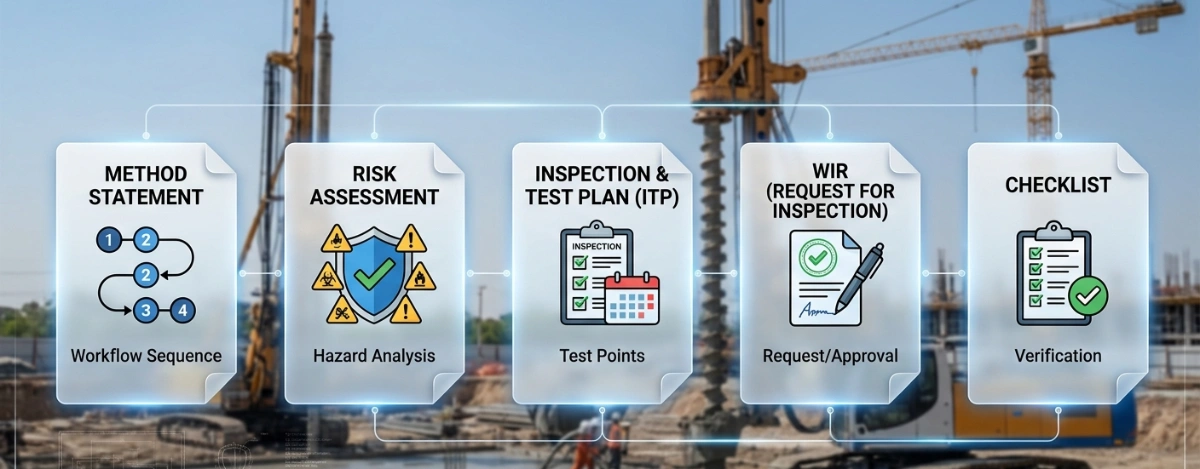
Unlike a downloadable Word or PDF template, this ITP is an AI-assisted editable starting point directly connected to its method statement. Every inspection activity, hold point, and acceptance criterion is structured and ready to adapt to your project.
- AI-assisted customization — Tailor inspection activities and acceptance criteria to your specific project scope.
- Linked method statement — This ITP is connected to the corresponding method statement describing the work sequence.
- Multiple export formats — Download as a formatted PDF or editable Excel spreadsheet.
- Editable starting point, not a final document — Review and verify all content against your project specifications and standards before use.
What you can customize
When you save this ITP to your account, every inspection row becomes editable. You can add, remove, or modify:
- Inspection activity — Description of what is being inspected.
- Inspection type — Hold point (H), Witness point (W), Review (R), or Monitor (M).
- Responsibility — Contractor, subcontractor, engineer, or client.
- Frequency — How often the inspection occurs.
- Acceptance criteria — Referenced standard or specification requirement.
- Records — Forms, test reports, or checklists required as evidence.
Why this ITP is used
To control quality and verify the finished stone surface meets specified appearance, flatness, and gloss while managing HSE-critical stages.
Who uses this inspection and test plan
Contractor supervisors and QA/QC engineers for execution; the Engineer/Consultant for witnessing and approval.
When this ITP is prepared and submitted
From area handover through final gloss verification and protection, repeated per zone or room.
Who receives or approves this ITP
Engineer/Consultant for approval and witnessing.
Inspection scope
Preconditions, mock-up, grinding/honing, polishing/crystallization, neutralization, sealing, final gloss, and optional slip resistance.
Typical hold, witness, and review points
Hold: Mock-up, final gloss/finish, sealer if specified. Witness: After coarse grind, before grit changes, during compound/crystallization.
Typical inspection records
Survey logs, mock-up approvals, grit change checklists, gloss maps, pH logs, sealer application records, IRs, NCRs, waste transfer notes.
Important approval note
This ITP is an AI-assisted editable starting point, not a pre-approved document. Before use on any project, all inspection activities, hold points, and acceptance criteria must be reviewed and approved by the relevant parties (superintendent, principal contractor, or client representative) in accordance with your contract and project quality plan.
Always verify acceptance criteria against your applicable drawings, specifications, and regulatory requirements. Hold points must be confirmed with the relevant authority before work proceeds past that point.
Inspection and test plan
| Activity | Inspection / Test | Acceptance Criteria | Responsibility | Record |
|---|---|---|---|---|
| Area handover and protection installed | Check barriers, signage, bunds, drain covers | Access control effective; drains covered; power/RCD available | Supervisor / HSE | Pre-start checklist |
| Stone identification and condition survey | Visual mapping; defect/stain register | Survey approved; scope confirmed | QA/QC Engineer | Survey log, photos |
| Mock-up execution and approval (HOLD) | Process parameters + gloss readings (≥ target) | Mock-up signed off; sequence/materials fixed | QA/QC / Engineer | IR/approval form |
| Coarse grinding/lippage removal | 2 m straightedge; feeler gauges | Lippage ≤0.5 mm [Verify] | Supervisor / QA/QC | Inspection sheet |
| Grit change 120→200 (Witness) | Raking light check for deep scratches | No coarse scratches remain | QA/QC | Grit change checklist |
| Honing completion 200→800 | Uniformity check; edge match | Uniform matte sheen; edges consistent | QA/QC | In-process report |
| Polishing sequence 1500→3000 | Swirl/orange peel check under raking light | No swirl/orange peel | QA/QC | In-process report |
| Polishing compound/crystallization application (Witness) | Compound type; dwell; pad condition | As per approved mock-up and SDS | Engineer / QA/QC | Witness record |
| Neutralization and rinse | pH of rinse/slurry | pH 6–9 before sealing | QA/QC | pH log |
| Sealer application (Witness/HOLD if specified) | Coverage rate; dwell; wipe-off | Even application; no residue | Engineer / QA/QC | Sealer record |
| Final gloss and uniformity (HOLD) | ASTM D523 gloss meter; mapping | Marble/Limestone/Terrazzo ≥75 GU; Granite ≥55 GU; ±5 GU uniformity [Verify] | QA/QC / Engineer | Test report, drawings |
| Slip resistance (if required) | Pendulum/DCOF per spec | Meets project-specified value | QA/QC / Specialist | Slip test report |
| Final area protection and handover | Protection installed; access control | Protection intact; signage in place | Supervisor / QA/QC | Handover checklist |
This table is a read-only public reference. Download the PDF or Excel version, or customize this ITP to edit it for your project.
Frequently asked questions
Related method statement
This Inspection and Test Plan is associated with the Method Statement – Stone Surface Polishing and Restoration Works method statement, which describes the step-by-step construction sequence, resources, materials, equipment, safety controls, and environmental controls for this activity.
View the Method Statement – Stone Surface Polishing and Restoration Works method statement →Continue with related inspection, method statement, article, and checklist resources.