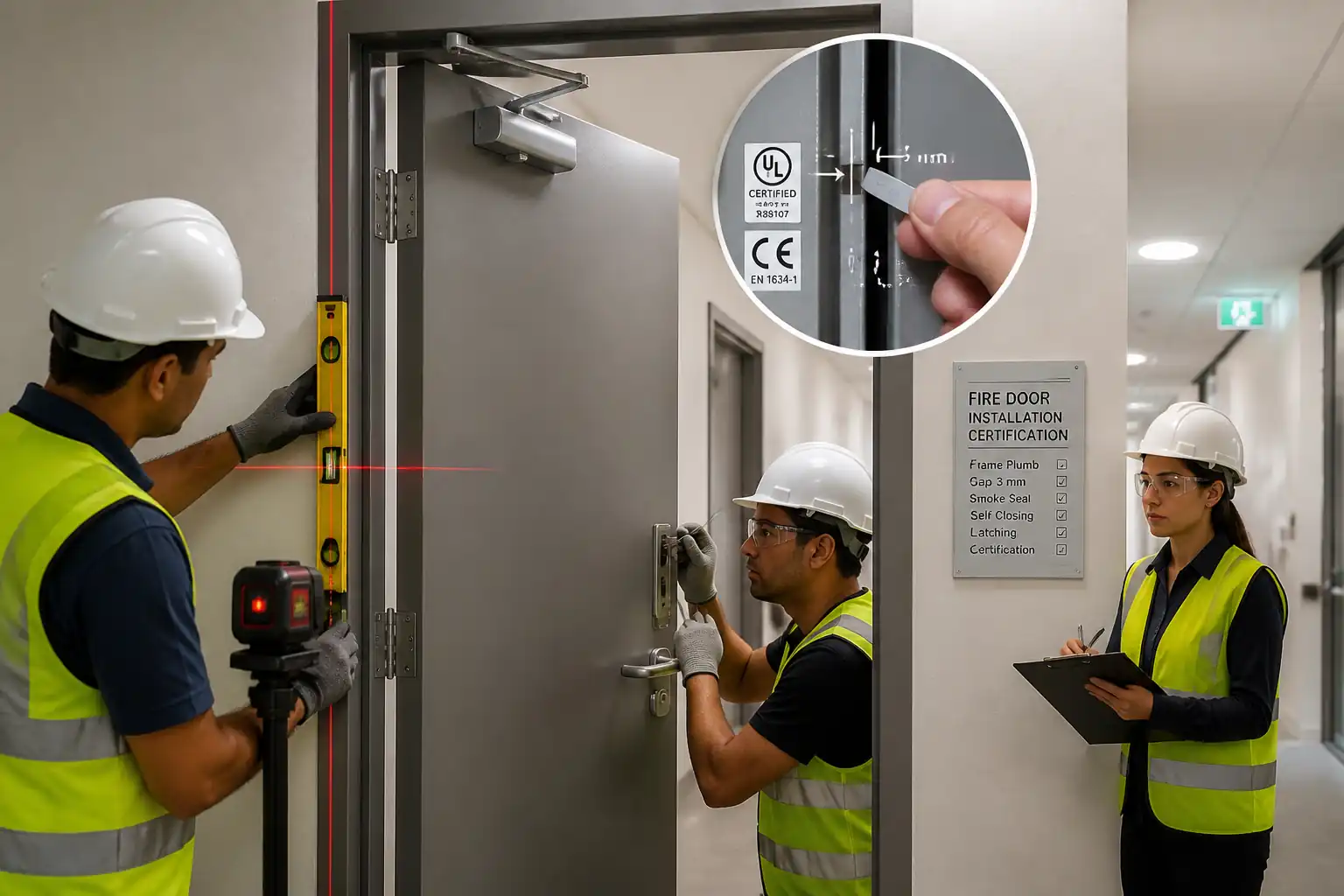

Method Statement – Installation of Fire-Rated Doors and Frames with Certified Hardware, Smoke/Intumescent Seals, Interfaces and Testing – Method Statement
AI-assisted method statement with matching ITP, PDF download, and Excel export.
More than a static template
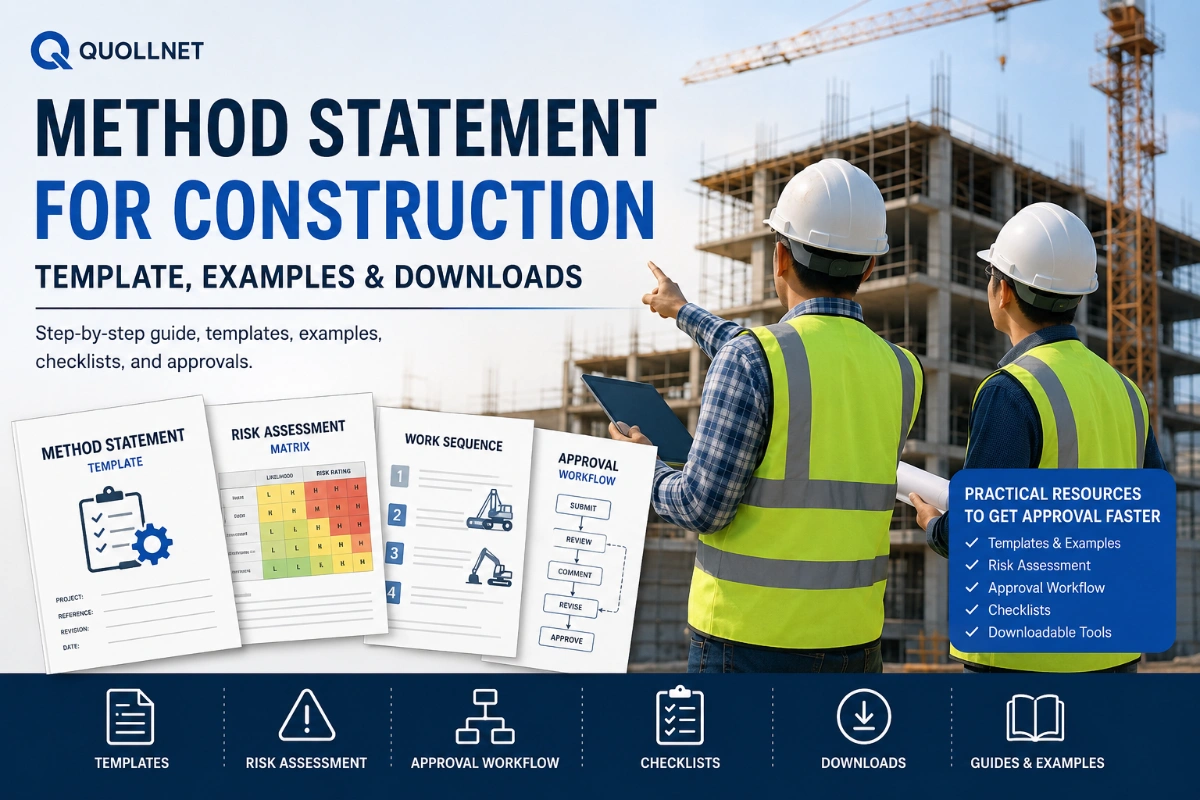
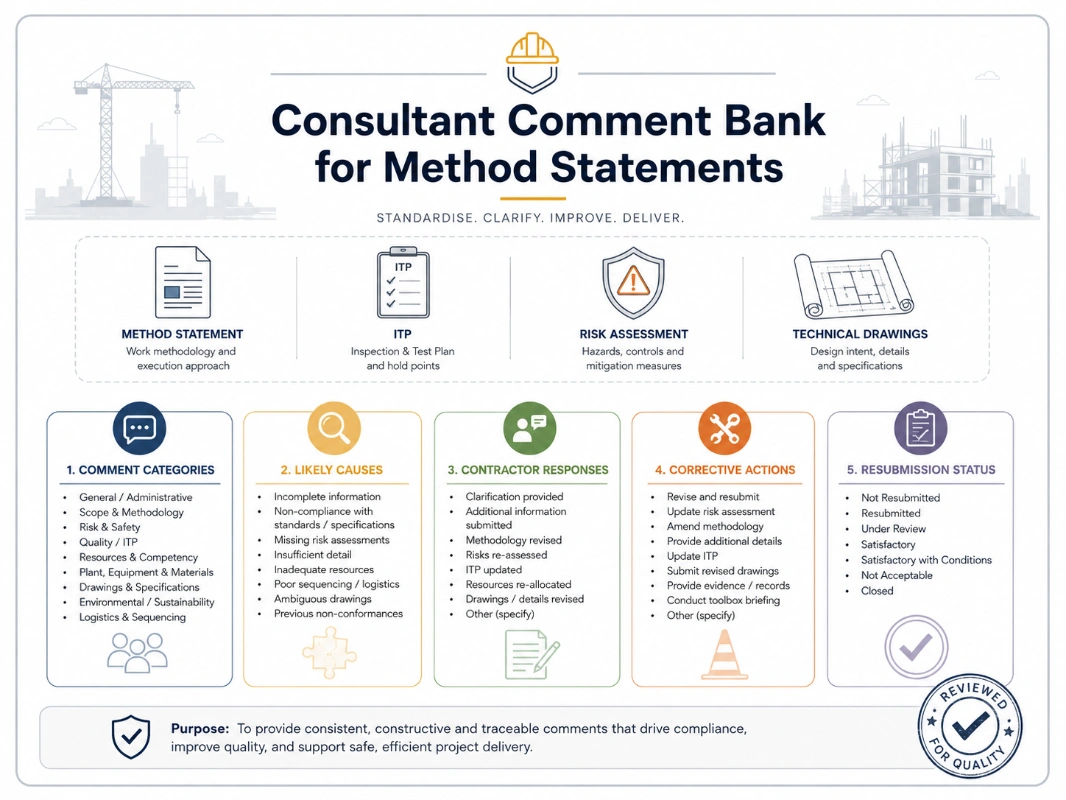
Unlike a downloadable Word or PDF template, this method statement is an AI-assisted editable starting point connected directly to a matching Inspection and Test Plan. Every section is structured, project-adaptable, and ready to export.
- AI-assisted drafting — Customize every section with AI for your specific project scope.
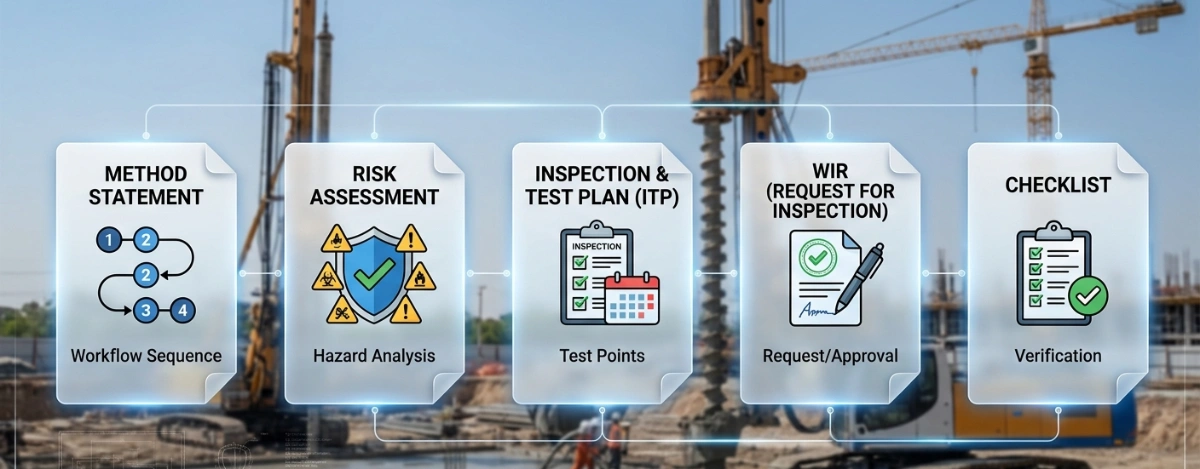
- Linked ITP — A matching inspection and test plan is generated alongside the method statement.
- Multiple export formats — Download as a formatted PDF or editable Excel spreadsheet.
- Editable starting point, not a final document — Review, verify, and adjust all content against your project requirements before use.
Static template vs. Quollnet workflow
| Feature | Static template | Quollnet |
|---|---|---|
| Project-specific content | Manual fill-in required | AI-assisted customization |
| Linked ITP | Separate document, no link | Matching ITP included |
| Export formats | Usually PDF only | PDF and Excel |
| Structured sections | Free-form layout | 13 standardized sections |
| Saved to your account | Local file only | Cloud-saved, reusable |
| Content accuracy | You verify everything | AI-assisted, you still verify |
| Cost | Often free but time-intensive | Free to customize and download |
What you can customize
When you save this method statement to your account, every section becomes editable. The following 13 sections are included:
- Scope — Defines the activity and its boundaries.
- References — Standards, specifications, and drawings.
- Responsibilities — Roles and accountabilities.
- Resources — Labour, plant, and equipment summary.
- Materials — Materials and compliance requirements.
- Equipment — Tools and equipment details.
- Prerequisites — Hold points and pre-conditions.
- Method sequence — Step-by-step construction sequence.
- Safety controls — HSE risk controls and PPE.
- Environmental controls — Environmental mitigation measures.
- QA/QC — Quality inspection and test requirements.
- ITP — Inspection and Test Plan table (has its own page).
- Attachments — Referenced drawings and documentation.
Why this method statement is used
This method statement is used to define and communicate the approved procedure for carrying out method statement – installation of fire-rated doors and frames with certified hardware, smoke/intumescent seals, interfaces and testing on site. It ensures the work is planned in advance, the correct resources and controls are in place, and all personnel understand responsibilities, sequence, quality requirements, and safety controls before work begins. It aligns site execution with the documented scope and acceptance expectations.
Who uses this method statement
This method statement is used by contractors, site supervisors, project engineers, QA/QC engineers, HSE officers, consultants, and client representatives. It serves as a shared reference for planning, execution, supervision, inspection, and approval of the activity on site.
When it is prepared and submitted
The method statement is prepared before the work activity starts and submitted as part of the pre-construction documentation package for review and approval.
Who reviews or approves it
The method statement is usually submitted to the client representative, consultant, resident engineer, or project management consultant for review and approval before the work commences.
Important approval note
This method statement is an AI-assisted editable starting point, not a pre-approved document. Before use on any project, all content must be reviewed and approved by the relevant parties (superintendent, principal contractor, or client representative) in accordance with your contract and project quality plan.
For example: if your specification requires a departure from a referenced standard, that departure must be documented and approved separately — this method statement will not capture that automatically. Always verify against your applicable drawings, specifications, and regulatory requirements.
Method statement content
Scope
Overview
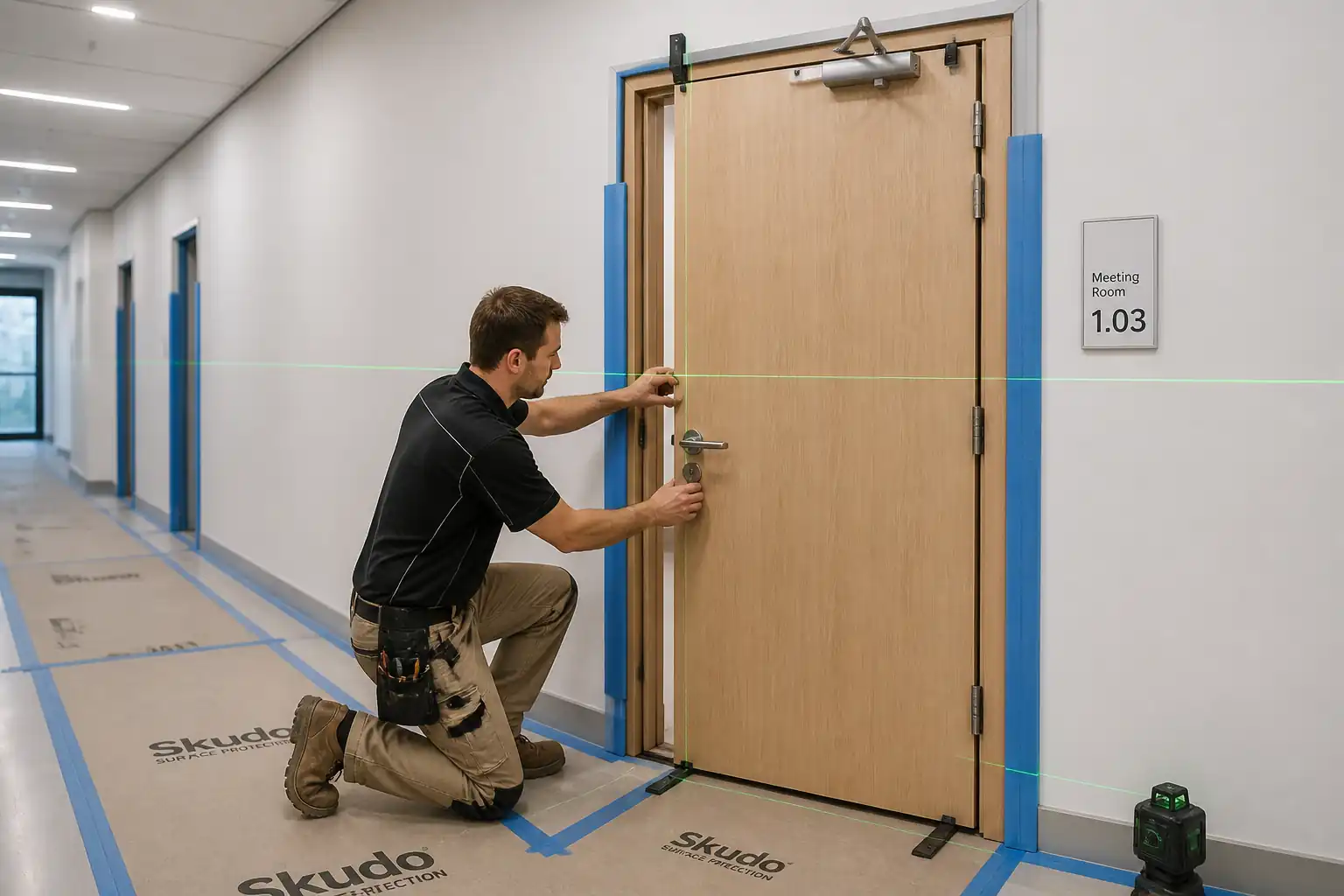
This method statement covers end-to-end installation of fire-rated door assemblies (timber or steel leaves and frames) including:
- Verification of approvals, labels, and product certification (UL/Intertek/CE/UKCA as applicable)
- Frame setting, anchorage, and plumb/level/square control
- Installation of leaves, certified ironmongery/door hardware (hinges, latches/locks, closers, panic hardware, hold-open devices)
- Installation of intumescent and smoke seals, drop/threshold seals, and fire-stopping at frame-to-wall interfaces strictly in accordance with tested details
- Coordination with passive fire protection works and fire alarm interfaces (where electromagnetic hold-opens or door monitoring are used)
- Functional checks, QA/QC inspections, ITP hold/witness points, as-built documentation, and authority (AHJ) compliance checks
Inclusions
- Single and double leaf doors, with or without vision panels
- Timber, steel, or composite frames compatible with the approved test evidence
- Associated signage, door viewers (if permitted by certification), kick plates/edge guards (only if permitted by certification)
- Finishes (paint/veneer) that do not compromise certification [Verify per project specifications]
Exclusions
- Structural modifications to openings
- Fire alarm system modifications beyond field testing of door hardware interfaces
- Builder’s work in connection (unless specifically assigned)
Key Performance Criteria
- Verified certification/labeling matches door schedule and fire strategy
- Perimeter gaps to specified tolerances (see Method Sequence and ITP)
- Correct, compatible hardware per the primary test evidence/assessment reports
- Full continuity of smoke and intumescent seals without paint bridging
- Perimeter fire-stopping compliant with tested details and FR of surrounding wall
- Functional self-closing and latching from any opening angle permitted by design
- Completion of ITP hold/witness points and close-out records ready for AHJ/Client handover.
References
| Document Type | Reference / Number | Revision | Notes |
|---|---|---|---|
| Standard | EN 16034 / BS EN 16034 | ||
| Standard | BS EN 1634-1 / ISO 834 / NFPA 252 / ASTM E152 | Regional equivalence acceptable [Verify per project specifications]. | |
| Standard | BS EN 1634-3 / NFPA 105 | ||
| Standard | BS 8214 | ||
| Standard | EN 1935, EN 1154/1155, EN 12209, EN 1125/179, EN 1303 | ||
| Standard | BS EN 1366 / BS 476 / Primary test evidence | ||
| Project Docs | Approved Shop Drawings / O&M / Door Schedule | ||
| Authority | Local Code / AHJ | [Verify per project HSE plan and local regulations]. |
Responsibilities
| Role | Responsibility | Name / Party |
|---|---|---|
| PM | Project Manager | Main Contractor |
| SE | Site Engineer | Main Contractor |
| QA/QC | QA/QC Engineer | Main Contractor |
| Installer | Certified Fire Door Installer | Specialist Subcontractor |
| Specialist | Fire Stopping Specialist | Specialist Subcontractor |
| HSE | HSE Officer | Main Contractor |
| E/FA | Electrical/Fire Alarm Engineer | MEP Subcontractor |
| AHJ | Authority Having Jurisdiction (AHJ) | Authority |
Resources
| Resource Type | Description | Quantity | Remarks |
|---|---|---|---|
| Manpower | 2–4 per team depending on door size/weight | 2–4 | |
| Manpower | 1–2 per team | 1–2 | |
| Manpower | Dedicated during hold/witness points | 1 | |
| Manpower | Setout and dimensional control | 1 |
Materials
| Material | Specification / Grade | Quantity | Remarks |
|---|---|---|---|
| Door leaf | [Verify per project specs] | As per schedule | |
| Frame | [Verify per project specs] | As per schedule | |
| Intumescent | [Verify per project specs] | Per door | |
| Smoke seal | [Verify per project specs] | Per door | |
| Ironmongery | [Verify per project specs] | Per door | |
| Fire-stopping | [Verify per project specs] | Perimeter linear gap | |
| Anchors/Shims | [Verify per project specs] | Per frame | |
| Signs | [Verify per project specs] | Per door |
Equipment
| Equipment | Capacity / Type | Quantity | Inspection Required |
|---|---|---|---|
| Sets per team | |||
| As required | |||
| As required | |||
| Per QA/QC | |||
| As required |
Prerequisites
- Approvals: Submittals, shop drawings, hardware schedule, test evidence/assessment reports approved by the Engineer/AHJ.
- Environmental: Storage 10–30°C, RH 40–60% for timber doors; acclimatize 48 h minimum before installation. Keep labels intact.
- Openings: Wall/partition FR and construction verified; opening size, plumb, and level surveyed; substrate compressive strength and thickness confirmed for anchor selection.
- Services: Utility/MEP clearance in partitions where drilling occurs; obtain Permit to Drill where required. [Verify per project HSE plan and local regulations]
- Coordination: Confirm finished floor level/threshold details; ensure reinforcement/grounds in gypsum/metal stud walls installed; confirm door handing and swing.
- Tools/Calibrations: Measuring devices and torque tools calibrated; inspection forms prepared.
- HSE: Task-specific risk assessment and method statement (RAMS) briefed; permits (Work at Height, Drill/Hot Work if applicable) arranged.
- Mock-Up (if required): Conduct and obtain approval before rolling works.
Method Sequence
| Step | Activity | Description | Responsibility | Inspection / Hold Point |
|---|---|---|---|---|
| 1 | Pre-installation verification | Verify door schedule vs. labels; confirm rating, size, handing, hardware set, and compatibility to primary test evidence/assessment. Reject damaged or unlabeled products. | QA/QC Engineer | Document check |
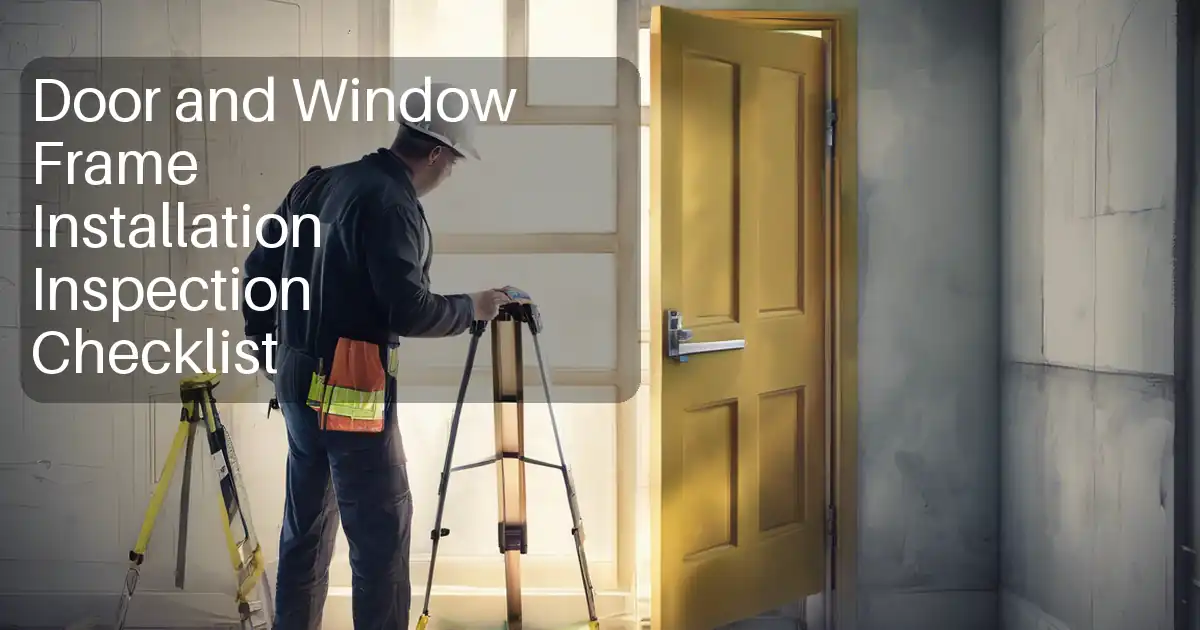
| 2 | Survey openings | Measure width/height at 3 points; check plumb/level and squareness; confirm wall FR and substrate suitable for anchors. | Site Engineer | Dimensional survey |
| 3 | Frame positioning and temporary fixing | Assemble/sleeve frame if required; install non-combustible shims/packers; set frame to line and level with spreaders; avoid twist. | Installer | Visual and level check |
| 4 | Frame anchorage | Drill and install anchors per manufacturer/test evidence. Typical spacing ≤600 mm c/c and within 150–250 mm from each corner/hinge zone. Maintain edge distances. | Installer | Hold Point – before concealment |
| 5 | Perimeter fire-stopping at frame/wall | Install mineral wool backing (typ. 80–100 kg/m³) compressed ~10–20%; apply intumescent sealant both sides to required depth (e.g., 10–15 mm) as per tested detail; tag and record. | Fire Stopping Specialist | Hold Point – after prep, before closing finishes |
| 6 | Hang door leaves | Fit intumescent hinge pads (if required); install hinges (typically 3 hinges per leaf > 44 mm thick or > 2.1 m height); check swing; avoid field trimming beyond allowance. | Installer | Witness Point |
| 7 | Install hardware (locks/latches/closers/panic/hold-open) | Fix per hardware schedule and manufacturer templates; use specified screws; protect finishes; connect hold-open to FA system if applicable. | Installer / Electrical Engineer | Witness Point |
| 8 | Smoke and drop/threshold seals | Fit continuous smoke seals around head/jambs; install drop seal; align for continuous contact without drag; no paint over. | Installer | Witness Point |
| 9 | Vision panels / glazing (if applicable) | Install listed fire-resistant glazing and beads/intumescent liners per tested detail; set blocks/spacers as specified. | Installer | Witness Point |
| 10 | Signage and accessories | Install mandatory signs both sides as required; accessories only if allowed by certification. | Installer | Visual check |
| 11 | Functional testing and adjustments | Cycle doors (≥5–10 times); verify self-closing and latching; adjust closer speed/latching; confirm panic hardware; test hold-open release via fire alarm. | QA/QC + Electrical Engineer | Hold/Witness Point |
| 12 | Final QA, cleaning, and protection | Remove debris; protect finished doors; compile as-builts and O&M; request AHJ/Engineer inspection for acceptance. | QA/QC Engineer | Final inspection |
Health, Safety and Environment – Safety Controls
Task-Specific Hazards and Controls
- Hazard: Struck-by/crush injury when hanging heavy door leaves
- Likely consequence: Hand/foot injuries, musculoskeletal strain
- Engineering/procedural control: Team lift with correct handling aids; use temporary door jacks/spreaders; set exclusion zone; sequence lifting with clear command
- Required PPE: Safety boots with toe protection, cut-resistant gloves, long sleeves
- Collective preventive measure: Use mechanical aids where feasible; keep floor clear of trip hazards
-
Inspection/permit/supervision: Supervisor present during hanging; pre-use inspection of lifting aids; toolbox talk
-
Hazard: Drilling into concealed services in partitions/walls
- Likely consequence: Electric shock, flooding, service outage
- Engineering/procedural control: Drawings review and cable/pipe detector scan; Permit to Drill; mark safe drilling zones
- Required PPE: Insulated gloves (as required), safety glasses, hearing protection
- Collective preventive measure: Lock-out/tag-out (where applicable); barriers and signage
-
Inspection/permit/supervision: Permit to Drill; Supervisor sign-off; records retained [Verify per project HSE plan and local regulations]
-
Hazard: Working at height (top hinge/closer installation)
- Likely consequence: Falls from steps/podiums
- Engineering/procedural control: Use podium steps with guardrails; maintain three points of contact; no overreaching
- Required PPE: Non-slip footwear, fall-arrest only if MEWP used
- Collective preventive measure: Task-specific Work at Height plan; spotter to foot the ladder if permitted
-
Inspection/permit/supervision: Pre-use inspection tags; Work at Height permit where required
-
Hazard: Power tool use and flying debris
- Likely consequence: Eye injuries, lacerations, noise-induced hearing loss
- Engineering/procedural control: Use guards, correct drill bits, dust extraction; maintain torque settings; keep both hands on tools
- Required PPE: Safety glasses/face shield, hearing protection, gloves
- Collective preventive measure: Designated cutting/drilling area; cord management
-
Inspection/permit/supervision: PAT testing (where required); supervisor spot checks
-
Hazard: Dust and silica from drilling masonry
- Likely consequence: Respiratory irritation, long-term illness
- Engineering/procedural control: On-tool extraction and wet suppression if feasible; limit drilling duration
- Required PPE: FFP2/FFP3 (or N95/N99) respirator as required
- Collective preventive measure: Ventilation; restrict access
-
Inspection/permit/supervision: Airborne dust checks (spot), HSE audits
-
Hazard: Chemical exposure (intumescent sealants/adhesives/PU foams)
- Likely consequence: Skin/eye irritation, VOC exposure
- Engineering/procedural control: Follow SDS; use low-VOC products where possible; avoid PU foam unless tested detail permits
- Required PPE: Chemical-resistant gloves, safety glasses
- Collective preventive measure: Local ventilation; spill kits
-
Inspection/permit/supervision: SDS available at point of use; COSHH assessment [Verify per project HSE plan and local regulations]
-
Hazard: Pinch points and sudden closer action
- Likely consequence: Finger injuries
- Engineering/procedural control: Keep hands away from hinge/closing edges; adjust closer speed gradually; signage during testing
- Required PPE: Gloves, eye protection
- Collective preventive measure: Exclusion zone during testing
-
Inspection/permit/supervision: Supervisor oversight during functional tests
-
Hazard: Fire alarm interface testing
- Likely consequence: False alarms, uncontrolled releases
- Engineering/procedural control: Coordinate with FM/Client; isolate zones as permitted; announce tests; restore settings post-test
- Required PPE: Standard PPE
- Collective preventive measure: Test plan and communication protocol
-
Inspection/permit/supervision: Permit-to-Test/Authorization by AHJ/Client
-
Hazard: Manual handling of frames and glass (vision panels)
- Likely consequence: Strains, cuts, glass breakage
- Engineering/procedural control: Use glass carrying aids and edge protection; correct lifting postures
- Required PPE: Cut-resistant gloves, safety glasses
- Collective preventive measure: Team lifts; clear route
- Inspection/permit/supervision: Supervisor oversight; condition check of glass and protection prior to moving
[All controls to be verified per project HSE plan and local regulations.]
Environmental Controls
- VOC and Odour Control: Use low-VOC sealants/adhesives where possible; ensure ventilation when applying intumescent products; keep containers closed.
- Dust/Noise: Employ on-tool extraction and dampening; schedule noisy drilling during permitted hours; use acoustic barriers if required.
- Waste Management: Segregate packaging (cardboard/plastic), metal offcuts, timber fragments, empty cartridges; dispose of chemical waste per SDS; no washout to drains.
- Protection of Finishes: Use protective films on doors post-install; floor protection mats to prevent scratching during handling.
- Storage/Handling: Store timber doors flat on level dunnage in dry conditions; avoid sunlight/heat that may warp leaves.
- Spill Prevention: Keep spill kits; tray/liner under sealant/adhesive stations; immediate cleanup of drips.
- Resource Efficiency: Pre-cut shims and fixings to reduce rework; verify openings to avoid abortive drilling.
Quality Assurance / Quality Control
Controls and Inspections
- Verification: 100% label and certification check against door schedule prior to installation.
- Calibration: Measuring tools, torque tools, pressure gauges calibrated; records maintained.
- Dimensional Checks: Record plumb/level/square of frames; gap gauges for head/jamb/threshold per door.
- Hardware Compatibility: Cross-check hardware sets with test evidence; no substitutions without Engineer/AHJ approval.
- Fire-Stopping: Only tested/assessed perimeter systems; record material batch numbers and tag each opening where required.
- Documentation: Maintain a unique Door ID with traceability to materials, installers, inspections, and photos.
- Sampling/Frequency: 100% inspection at key hold/witness points; random re-check 10% post-completion to verify no drift.
- Nonconformance: Raise NCR for damaged, relabeled, or modified doors outside permitted limits; agree remedial actions with manufacturer and Engineer.
- Handover: ITP signed, as-builts, O&M manuals, warranties, training records; AHJ close-out where applicable.
Attachments
- Approved shop drawings and door/hardware schedules
- Primary fire test reports and assessment/extended application reports (e.g., EN 15269 series)
- Manufacturer installation manuals and field modification limits
- ITP forms: receipt/label check, frame set-out, gap gauge log, hardware torque log, seal continuity checklist, fire-stopping records
- Calibration certificates for gauges/meters/torque tools
- Risk assessments, method statements, and permits (Work at Height, Permit to Drill, Permit-to-Test fire alarm)
- Material certificates: intumescent/sealants, mineral wool, anchors, hardware certifications
- As-built records with Door ID matrix, photos, and AHJ inspection reports
This content is a read-only public reference. Download or customize to get an editable version.
ITP preview
The first inspection activities from the linked ITP for Method Statement – Installation of Fire-Rated Doors and Frames with Certified Hardware, Smoke/Intumescent Seals, Interfaces and Testing:
| Activity | Inspection / Test | Acceptance Criteria | Responsibility | Record |
|---|---|---|---|---|
| Materials receipt and label verification | Check labels, ratings, sizes, handing against schedule; record serial numbers. | 100% match to approved submittals; labels intact and legible. | QA/QC Engineer | Material receipt/label log, photos |
| Openings survey and substrate verification | Measure opening, plumb/level/square; verify substrate for anchors; confirm wall FR. | Opening-to-frame clearance 10–20 mm [Verify]; plumb ≤3 mm/2 m; head level ≤3 mm. | Site Engineer | Survey report |
| Frame positioning and anchorage (Hold Point) | Verify shims/packers non-combustible; anchors type/spacing/torque; frame plumb/level/diagonals. | Spacing ≤600 mm c/c and within 150–250 mm of corners; plumb ≤2 mm/1 m; diagonals ≤3 mm difference; torque per manufacturer [Verify]. | QA/QC + Installer | Anchor log, calibration certs, photos |
Showing 3 of 10 inspection activities. View full ITP →
Related Inspection and Test Plan
An Inspection and Test Plan (ITP) is available for Method Statement – Installation of Fire-Rated Doors and Frames with Certified Hardware, Smoke/Intumescent Seals, Interfaces and Testing. The ITP defines the inspection activities, acceptance criteria, hold and witness points, responsible parties, and records required to verify the work described in this method statement.
View the Method Statement – Installation of Fire-Rated Doors and Frames with Certified Hardware, Smoke/Intumescent Seals, Interfaces and Testing ITP →Frequently asked questions
Continue with related Quollnet resources connected to this method statement.