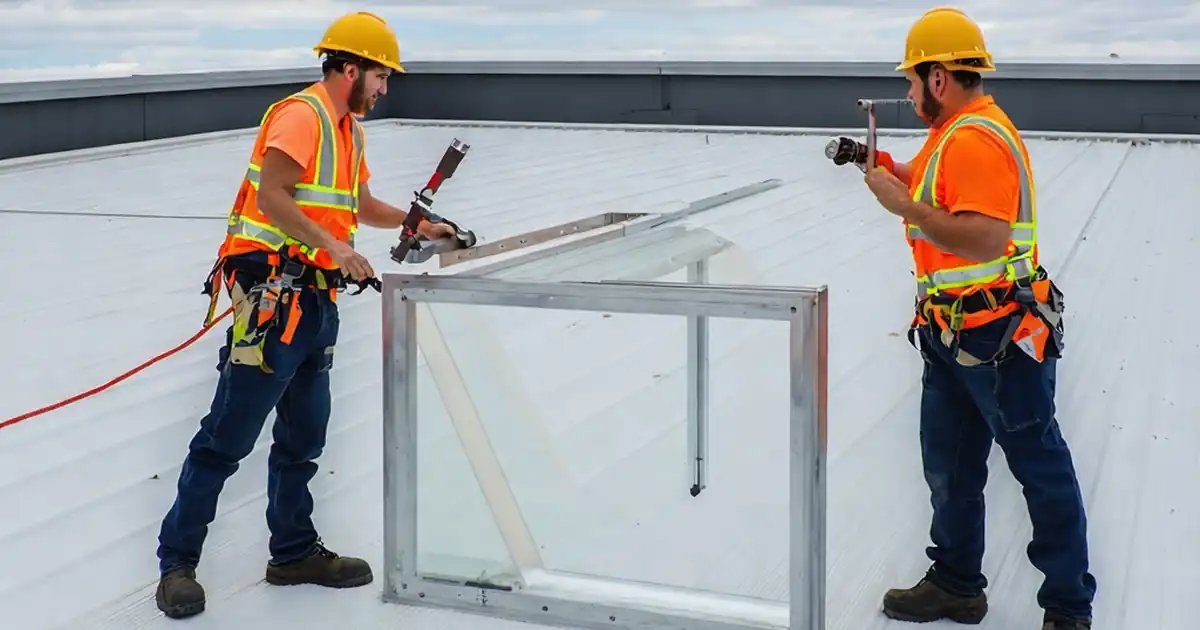
Inspect façade interface with curtain wall access doors
Definition: Inspect façade interface with curtain wall access doors guides inspectors, contractors, and consultants through door-to-curtainwall transition checks to ensure anchorage, weatherproofing continuity, safe operation, and traceable documentation.
- Verify structural fixings, thresholds, and sealants meet project acceptance criteria
- Prove airtight, watertight, and thermal continuity at the interface
- Test door hardware, clearances, weeps, and sill pans under real conditions
- Interactive, commentable checklist with export and QR code verification
Inspect façade interface with curtain wall access doors is a focused field procedure for verifying the transition between a curtainwall system and its integrated access doors. This checklist targets the façade-to-door interface, including perimeter anchorage, air and water barrier tie-ins, sill pan flashing, gaskets, and operational hardware. By concentrating on the curtainwall door interface rather than general façade works, it reduces leaks, binding leaves, thermal bridges, and undocumented deviations. Inspectors validate structural fixings, continuity of membranes and insulation, pressure-equalization paths, and alignment tolerances while capturing calibrated readings and photo evidence. The outcome is a durable, safe, and maintainable access point that performs under wind-driven rain and daily operation, with complete traceability per approved project specifications and authority requirements. Start in interactive mode to tick items, add comments with photos and readings, and export your verified record to PDF/Excel with a QR link for authentication.
- This checklist gives a disciplined, field-proven sequence for inspecting the curtain wall access door interface. It emphasizes structural anchorage, perimeter seals, sill pan geometry, and operational hardware to prevent leaks, binding, and premature failures while documenting all findings with calibrated evidence.
- Air, water, vapor, and thermal continuity are verified at the transition between door frame and curtainwall framing. Inspectors check membranes, insulation, fire-stopping where specified, and pressure-equalized drainage, confirming unobstructed weeps and correct slopes so water exits to the exterior under service conditions.
- Interactive online checklist with tick, comment, and export features secured by QR code. Teams can capture photos, readings, and lot numbers; flag snags for rework; and instantly generate shareable PDF/Excel reports that support handover, warranty registration, and future maintenance planning.
- Operational checks cover hinges, pivots, closers, locks, clearances, thresholds, and gaskets. Measured tolerances and controlled water spray tests confirm performance, while labels and documentation close the loop for warranties and compliance, ensuring durable, safe, and traceable installations.
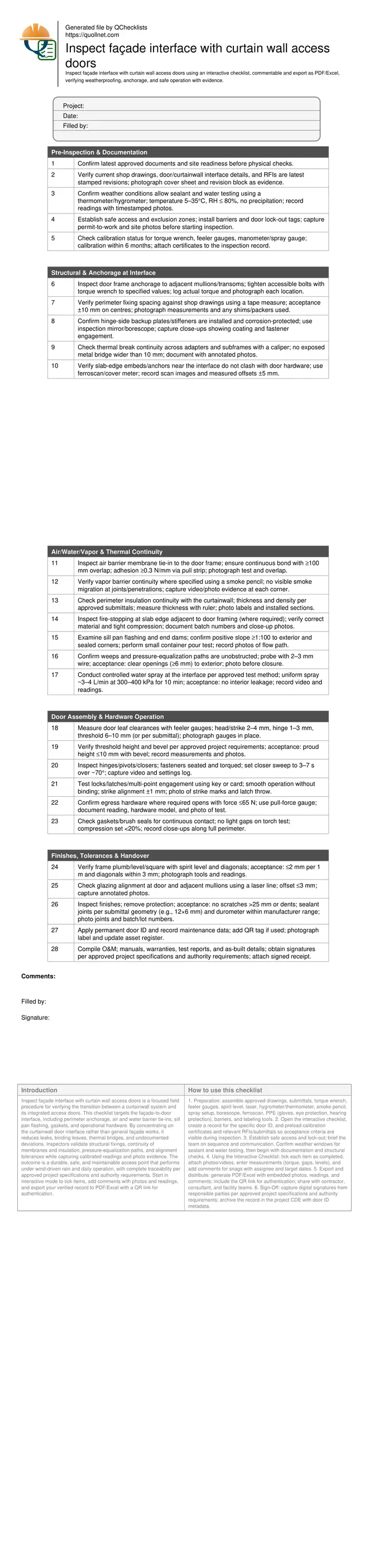
Pre-Inspection & Documentation
Structural & Anchorage at Interface
Air/Water/Vapor & Thermal Continuity
Door Assembly & Hardware Operation
Finishes, Tolerances & Handover
What to Inspect at the Door–Curtainwall Interface
The interface between a curtainwall and its access door concentrates loads, movement, and weather exposure. Prioritize structural anchorage at jambs and transoms, ensuring correct fastener type, spacing, and torque with documented values. Check thermal breaks and adapters to avoid metal-to-metal bridges that cause condensation. Verify continuity of air and vapor barriers around the frame with adequate overlaps and adhesion. At the sill, a correctly sloped pan with sealed end dams diverts water outward; combine this with clear weeps and pressure-equalized cavities. Operationally, measure door clearances, threshold height and bevel, and set closers for controlled closing without slam. Finally, review finish quality and alignment with adjacent mullions, and capture all evidence—photos, measurements, batch numbers—so findings are traceable for handover and warranty.
- Anchorages torqued and spaced per submittals, with recorded readings
- Thermal breaks continuous; no exposed metal bridges
- Membrane overlaps ≥100 mm with proven adhesion
- Sill pans sloped ≥1:100; end dams sealed
- Doors close smoothly; clearances within stated ranges
Proving Weather-Tightness and Continuity
Weather performance depends on uninterrupted barriers and controlled drainage. Inspect and gently test air and vapor membranes for continuity at corners, thresholds, and penetrations. Confirm insulation continuity to eliminate cold spots. Ensure weeps remain open after trims are installed. Execute a controlled water spray over the interface following the approved project test method; record nozzle pressure/flow and duration, and inspect interiors for any ingress. Combine the spray test with sill pan pour checks to verify positive outflow. Where fire-stopping is specified at the slab edge, confirm material type, compression, and identification labels. Document results thoroughly with photos, videos, and readings to support acceptance and future maintenance.
- Smoke/spray tests confirm no leakage paths
- Weeps unobstructed; minimum clear opening maintained
- Insulation continuous with labeled products
- Fire-stopping installed and tagged where required
- Complete visual and video evidence captured
Operational Performance and Tolerances
Functionality is proven by measured tolerances and smooth operation. Use feeler gauges to confirm head, hinge, and strike clearances; adjust hinges or strikes as needed. Verify threshold proud height and bevel meet the project’s accessibility requirements. Set closers for controlled sweep, latch, and backcheck, avoiding rebound under typical wind pressure. Check gaskets and brush seals using a torch/light test to spot gaps. Validate locksets, cylinders, and multi-point mechanisms for synchronized throw. Finally, measure frame plumb, level, square, and alignment to adjacent mullions with a level and laser. Record all readings and settings so future technicians can restore performance after maintenance.
- Measure and adjust door clearances precisely
- Threshold height/bevel verified and recorded
- Closer timing set; fasteners torqued
- Gasket contact continuous; no light gaps
- Frames within plumb/level/square tolerances
How to Use the Interactive Door–Curtainwall Interface Checklist
- Preparation: assemble approved drawings, submittals, torque wrench, feeler gauges, spirit level, laser, hygrometer/thermometer, smoke pencil, spray setup, borescope, ferroscan, PPE (gloves, eye protection, hearing protection), barriers, and labeling tools.
- Open the interactive checklist, create a record for the specific door ID, and preload calibration certificates and relevant RFIs/submittals so acceptance criteria are visible during inspection.
- Establish safe access and lock-out; brief the team on sequence and communication. Confirm weather windows for sealant and water testing, then begin with documentation and structural checks.
- Using the Interactive Checklist: tick each item as completed, attach photos/videos, enter measurements (torque, gaps, levels), and add comments for snags with assignee and target dates.
- Export and distribute: generate PDF/Excel with embedded photos, readings, and comments; include the QR link for authentication; share with contractor, consultant, and facility teams.
- Sign-Off: capture digital signatures from responsible parties per approved project specifications and authority requirements; archive the record in the project CDE with door ID metadata.
Call to Action
- Start Checklist Tick off tasks, leave comments on items or the whole form, and export your completed report to PDF or Excel—with a built-in QR code for authenticity.
- Download Excel - Façade–Curtain Wall Access Door Interface Inspection
- Download PDF - Façade–Curtain Wall Access Door Interface Inspection
- View Image - Façade–Curtain Wall Access Door Interface Inspection
Cite & Embed
“Façade–Curtain Wall Access Door Interface Inspection by Quollnet”
with a link to
this source page.

FAQ
Question: What evidence should I capture to prove the interface is watertight and airtight?
Question: How do I handle inspections during cold or wet weather?
Question: Which tolerances matter most for door operation at a curtainwall interface?
Question: When should I conduct the controlled water spray test at the interface?
Related Articles
Broader reading and guidance connected to this checklist topic.

Is The Crack You See On Your Wall Serious Or Minor Cosmetic Issue?



Major Construction Defects That Needs Immediate Attention

Related Checklists
Keep the workflow moving with nearby templates chosen from similar checklist content.