Inspect Curtain Wall Spandrel Zones and Back-Pan Installation
Definition: Inspect curtain wall spandrel zones and back-pan installation helps facade inspectors and site engineers verify thermal, fire, and moisture performance during fabrication, handling, and on-site assembly.
- Verify materials, clearances, seals, and firestopping in spandrel bays
- Prevent condensation, smoke spread, rework, and potential glass breakage
- Measure, test, photograph, and document with tolerances and traceability
- Interactive, commentable checklist with export and QR code verification
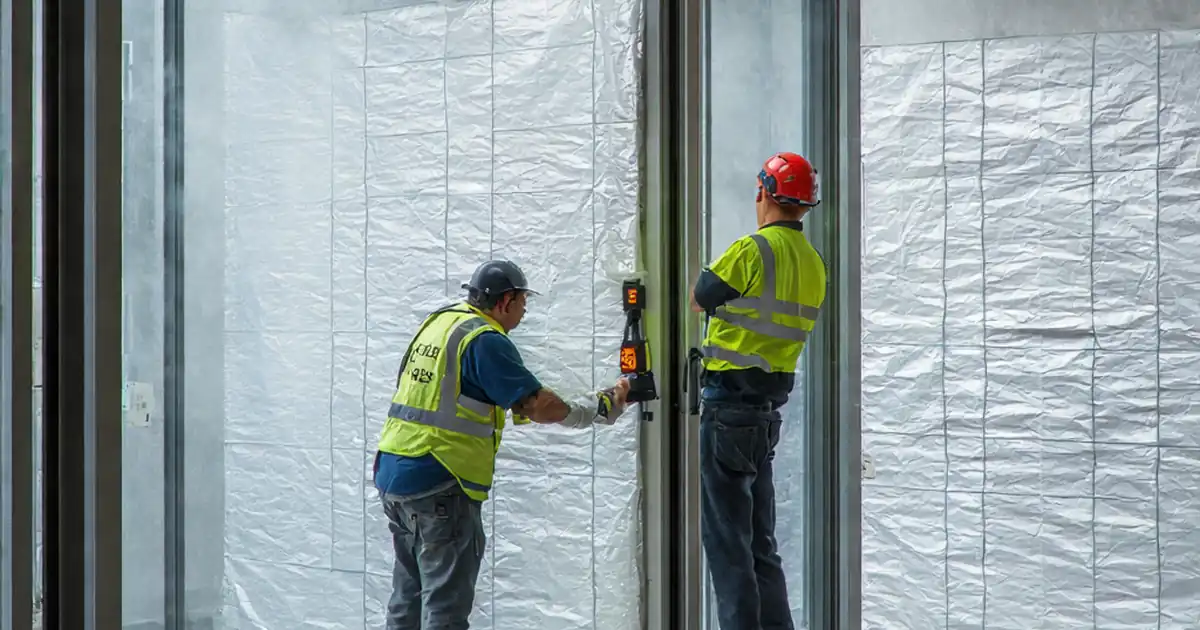
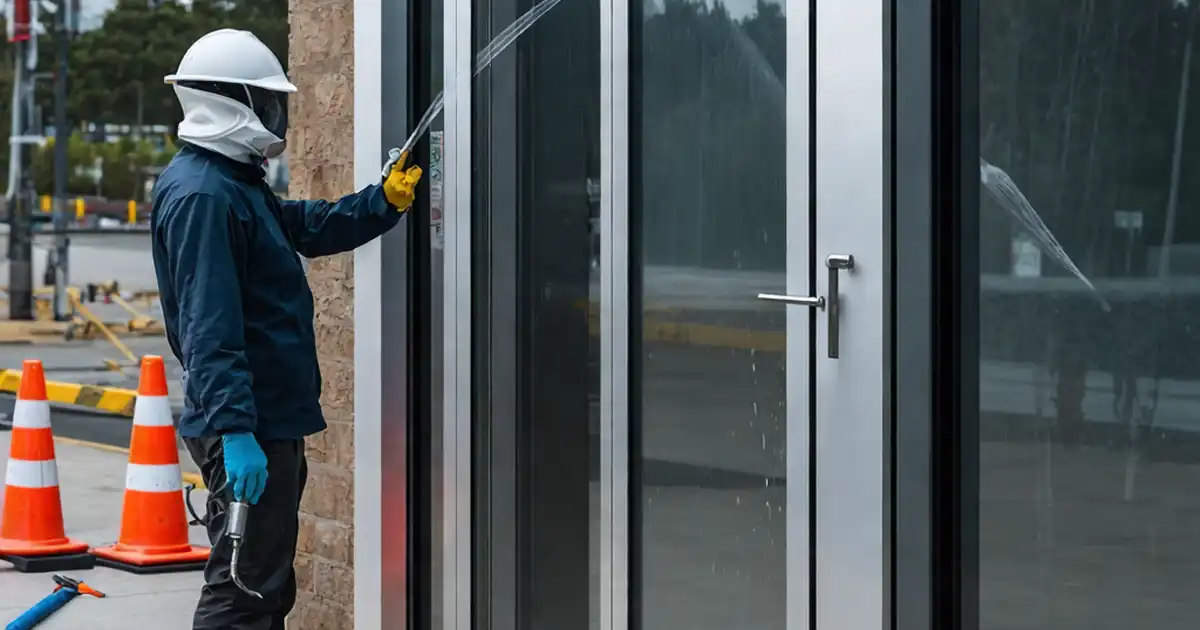
Inspect curtain wall spandrel zones and back-pan installation is critical for safeguarding thermal, fire, and moisture performance within the opaque zones of a facade. This checklist focuses on the spandrel panel assembly, including back-pan fabrication, insulation fit, fire safing, air/vapor barrier continuity, and interfaces to mullions and adjacent construction. It supports precise curtain wall back-pan inspection practices to avoid condensation, smoke migration, oil-canning, and costly rework. You will verify material thicknesses, coating coverage, fastener types and spacing, lap joints, drainage paths, and transition membranes, while documenting evidence for traceability. The scope excludes vision glazing, structural calculations, and unrelated curtain wall anchorage, except where fasteners directly connect the back-pan to frame members. Use this guide to achieve compliant, durable, and acoustically effective spandrel zones that protect interiors, conceal floor lines, and maintain aesthetic intent. Start the interactive mode to tick items, add comments by gridline, and export your records to PDF/Excel with a secure QR.
- This specialized checklist targets spandrel zones and back-pans, guiding inspectors through materials verification, correct fabrication details, compliant fire safing, and airtight, vapor-tight seals. It reduces risk of condensation, glass breakage, and rework while improving traceability and acceptance confidence.
- Clear acceptance cues and measurable tolerances streamline on-site decisions. Tools and methods are specified for each task, enabling consistent inspections across teams and shifts, and capturing objective evidence such as readings, batch numbers, and geotagged photographs for every bay.
- Interactive online checklist with tick, comment, and export features secured by QR code.
- Coordinated interfaces—back-pan to mullions, transition membranes to adjacent WRB, and unobstructed drainage—are emphasized. The result is a robust, maintainable spandrel assembly delivering thermal continuity, smoke control, and moisture management per approved project specifications and authority requirements.
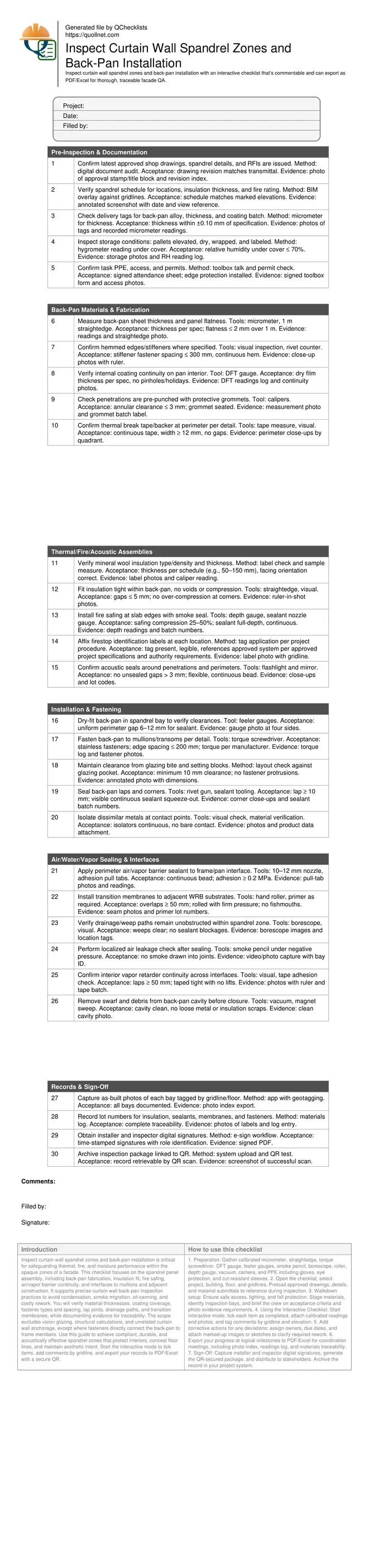
Pre-Inspection & Documentation
Back-Pan Materials & Fabrication
Thermal/Fire/Acoustic Assemblies
Installation & Fastening
Air/Water/Vapor Sealing & Interfaces
Records & Sign-Off
Why Spandrel Zones and Back-Pans Matter
Spandrel zones conceal floor lines while delivering thermal continuity, fire separation, and moisture control. The back-pan acts as a durable liner behind spandrel glass or opaque infills, directing drainage, containing insulation, and supporting air/vapor barrier transitions. Poorly fabricated or installed pans trigger costly issues: oil-canning, glass bowing, condensation streaking, smoke leakage, and delamination around hot spots. This paragraph clarifies functional requirements and typical pitfalls so inspections remain targeted and objective. Inspectors should prioritize pan thickness and flatness, proper stiffeners, continuous coatings on the warm-side face, and tight-fitting insulation. Look for slab-edge fire safing compressed to the right density and fully sealed smoke barriers. A real-world example: a misaligned back-pan flange contacted the glazing pocket, telegraphing as a visual distortion; rework required demounting two bays. Catching such interference during dry-fit prevents facade damage and schedule hits.
- Confirm pan flatness to avoid telegraphing and oil-canning
- Keep fasteners clear of glazing bite and setting blocks
- Seal corners and laps to block smoke and air movement
- Fit insulation tight; avoid voids and over-compression
Methods, Measurements, and Acceptance Cues
Reliable inspections depend on measurable criteria and repeatable methods. Use micrometers for sheet thickness, straightedges for flatness, and DFT gauges to verify coating coverage. Feeler gauges confirm perimeter sealant gaps, while torque screwdrivers assure fastener consistency. Borescopes help verify unobstructed drainage paths inside narrow cavities. For air/vapor performance, apply pull tabs to confirm adhesion and run a localized smoke test under temporary negative pressure. Document evidence for each bay with gridline references and time stamps. Practical acceptance cues include continuous sealant squeeze-out at corners, uniform 6–12 mm sealant gaps, overlap dimensions on membranes, and labeled firestop tags. Deviations should be recorded with clear photos, marked dimensions, and proposed corrections agreed with the site team before closure.
- Use calibrated tools and record actual readings
- Photograph labels, batch codes, and test locations
- Target uniform gaps; avoid oversized tolerances
- Verify drainage and weeps remain unobstructed
Interfaces, Coordination, and Documentation
Back-pans interact with mullions, transoms, slab edges, and adjacent weather-resistive barriers. Effective coordination ensures thermal breaks at contact points, prevents galvanic corrosion with isolation pads, and maintains continuous air/vapor lines across substrates. Transition membranes must bridge movement joints and bond properly with primers where required. Fire safing and smoke seals must remain intact after follow-on trades. Before closing the cavity, remove swarf and debris to prevent rattles, water retention, and punctures. Comprehensive records—photos, readings, lot numbers, and signatures—build traceability for warranty and authority inspection. The interactive workflow assigns notes by gridline, links photos to each bay, and exports a clean package for handover. This reduces disputes and accelerates approvals.
- Coordinate sequences to protect installed fire safing
- Use isolation pads between dissimilar metals
- Bridge gaps with primed membranes and firm rolling
- Clean cavities thoroughly before final closure
- Link evidence to gridlines for rapid retrieval
How to Use This Spandrel & Back-Pan Inspection Checklist
- Preparation: Gather calibrated micrometer, straightedge, torque screwdriver, DFT gauge, feeler gauges, smoke pencil, borescope, roller, depth gauge, vacuum, camera, and PPE including gloves, eye protection, and cut-resistant sleeves.
- Open the checklist, select project, building, floor, and gridlines. Preload approved drawings, details, and material submittals to reference during inspection.
- Walkdown setup: Ensure safe access, lighting, and fall protection. Stage materials, identify inspection bays, and brief the crew on acceptance criteria and photo evidence requirements.
- Using the Interactive Checklist: Start interactive mode, tick each item as completed, attach calibrated readings and photos, and tag comments by gridline and elevation.
- Add corrective actions for any deviations: assign owners, due dates, and attach marked-up images or sketches to clarify required rework.
- Export your progress at logical milestones to PDF/Excel for coordination meetings, including photo index, readings log, and materials traceability.
- Sign-Off: Capture installer and inspector digital signatures, generate the QR-secured package, and distribute to stakeholders. Archive the record in your project system.
Call to Action
- Start Checklist Tick off tasks, leave comments on items or the whole form, and export your completed report to PDF or Excel—with a built-in QR code for authenticity.
- Download Excel - Curtain Wall Spandrel & Back-Pan Inspection
- Download PDF - Curtain Wall Spandrel & Back-Pan Inspection
- View Image - Curtain Wall Spandrel & Back-Pan Inspection
Cite & Embed
“Curtain Wall Spandrel & Back-Pan Inspection by Quollnet”
with a link to
this source page.
FAQ
Question: What is a curtain wall back-pan and why is it required?
Question: How can I verify fire safing and smoke seal continuity at slab edges?
Question: What causes condensation or streaking in spandrel zones, and how do I prevent it?
Question: What tolerances should I apply for gaps, fasteners, and coatings?
Related Articles
Broader reading and guidance connected to this checklist topic.
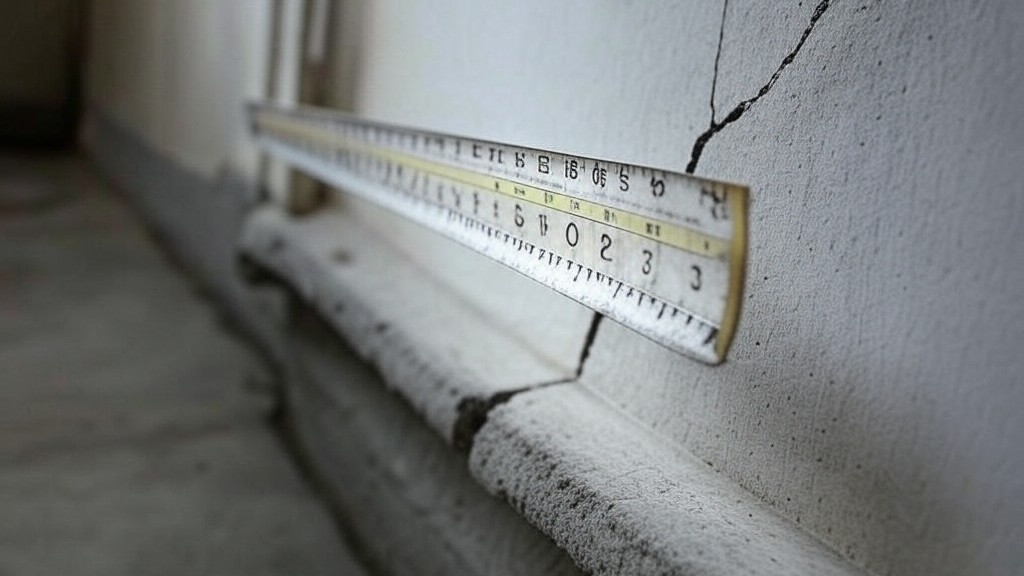
Is The Crack You See On Your Wall Serious Or Minor Cosmetic Issue?

3d Printed Concrete Qa/qc: Inspection, Process Control & Acceptance

Master Construction Project Cashflow With Cashflowpot
Related Checklists
Keep the workflow moving with nearby templates chosen from similar checklist content.