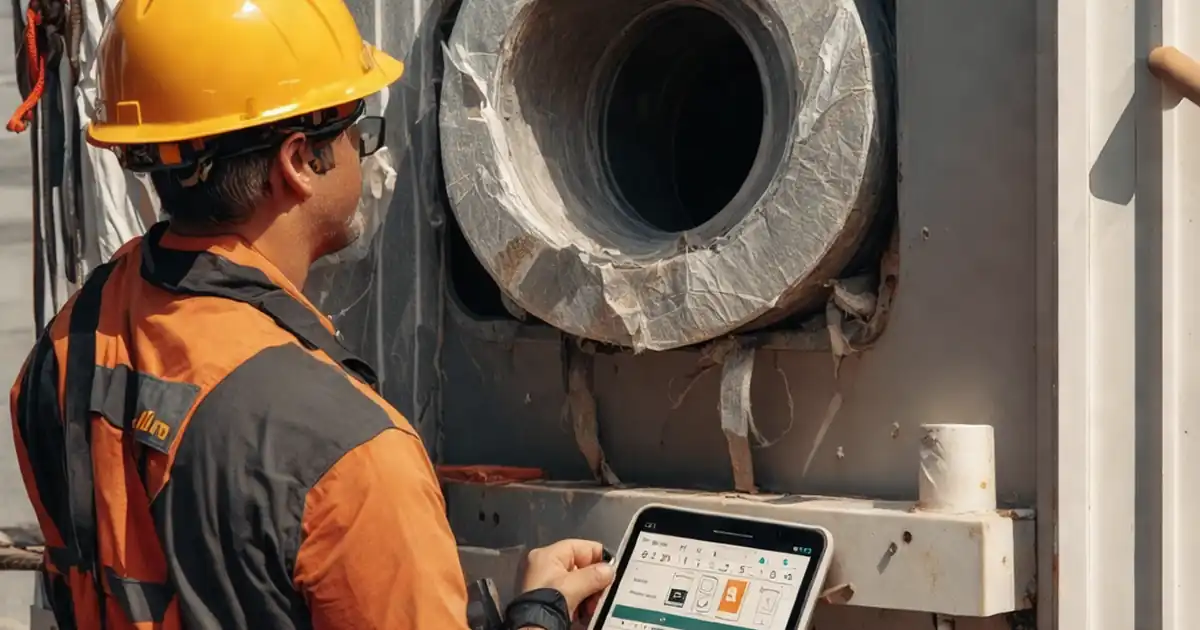
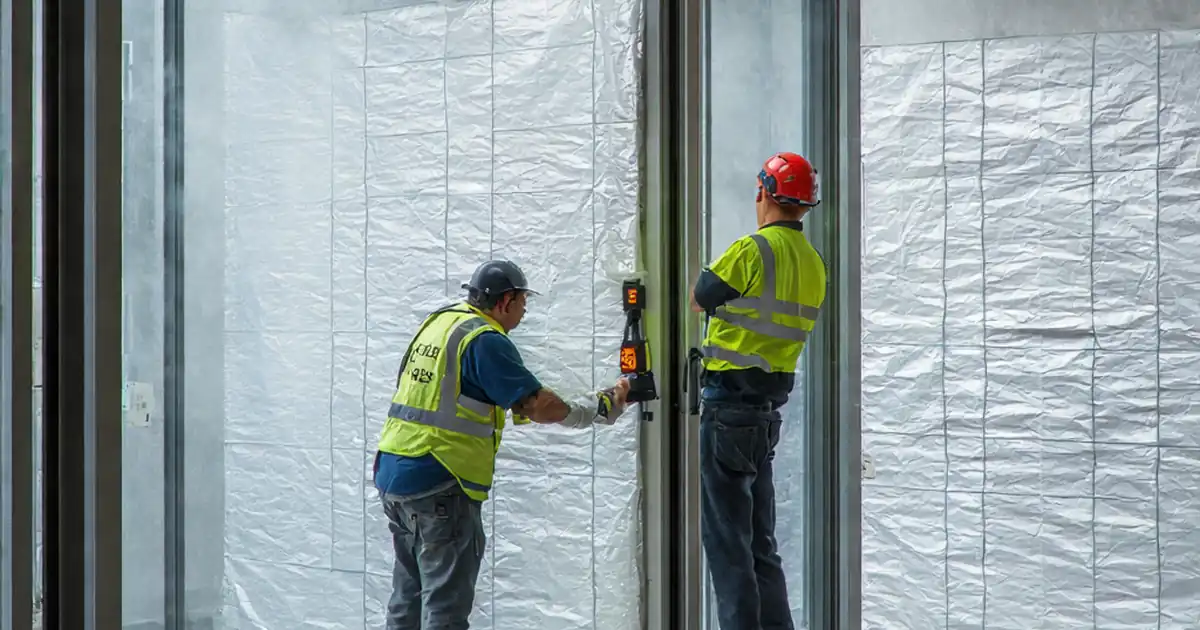
Inspect Curtain Wall Air Barrier Continuity at Slab Edge
Definition: Inspect curtain wall internal air barrier continuity at slab edge for site inspectors and façade managers, verifying materials, transitions, penetrations, and documentation to ensure airtight, durable interfaces.
- Verify substrate prep, membrane laps, and sealed terminations meet specs.
- Control air leakage at slab edge to reduce energy loss and drafts.
- Use smoke pencil and manometer to confirm airtight continuity.
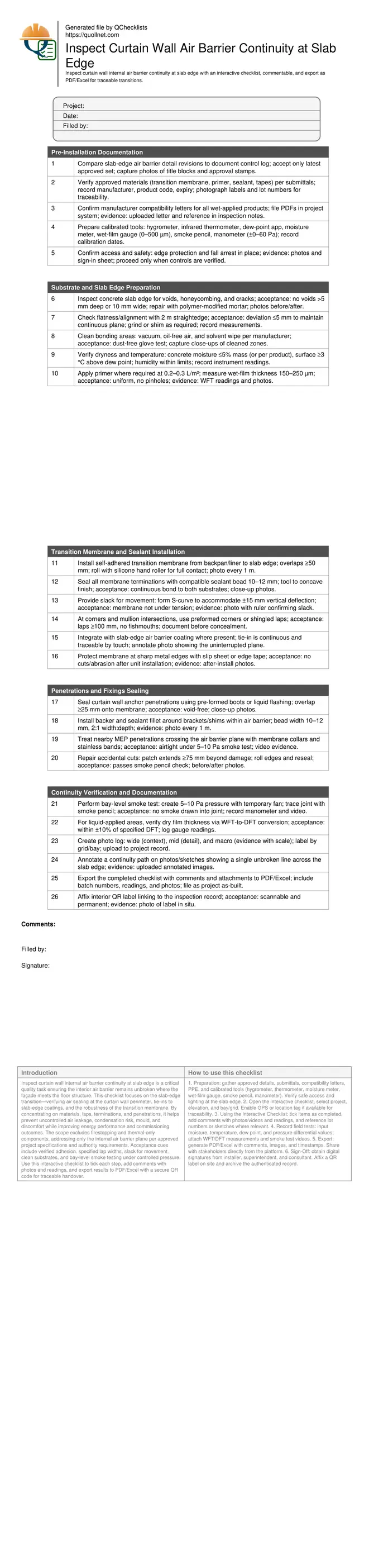
- Interactive, commentable checklist with export and QR code traceability.
Inspect curtain wall internal air barrier continuity at slab edge is a critical quality task ensuring the interior air barrier remains unbroken where the façade meets the floor structure. This checklist focuses on the slab-edge transition—verifying air sealing at the curtain wall perimeter, tie-ins to slab-edge coatings, and the robustness of the transition membrane. By concentrating on materials, laps, terminations, and penetrations, it helps prevent uncontrolled air leakage, condensation risk, mould, and discomfort while improving energy performance and commissioning outcomes. The scope excludes firestopping and thermal-only components, addressing only the internal air barrier plane per approved project specifications and authority requirements. Acceptance cues include verified adhesion, specified lap widths, slack for movement, clean substrates, and bay-level smoke testing under controlled pressure. Use this interactive checklist to tick each step, add comments with photos and readings, and export results to PDF/Excel with a secure QR code for traceable handover.
- Ensure an unbroken, verifiable air barrier at the slab edge by validating substrate readiness, membrane overlaps, sealed terminations, and penetration treatments. Capture readings and photos, aligning with approved project specifications and authority requirements without relying on ambiguous visual checks.
- Interactive online checklist with tick, comment, and export features secured by QR code. Use it to record moisture, temperature, and pressure readings; annotate continuity paths; attach batch labels; and produce time-stamped, signed reports for quick closeout and transparent stakeholder communication.
- Reduce air leakage, drafts, and interstitial condensation by confirming adhesion, slack for movement, and compatibility of wet-applied products. Bay-level smoke testing at 5–10 Pa verifies continuity before concealment, limiting costly rework and ensuring reliable results during whole-building airtightness commissioning.
Pre-Installation Documentation
Substrate and Slab Edge Preparation
Transition Membrane and Sealant Installation
Penetrations and Fixings Sealing
Continuity Verification and Documentation
Why slab-edge air barrier continuity matters for curtain walls
The slab edge is a common weak point for façade airtightness because multiple materials converge: concrete, backpans, brackets, and membranes. Any discontinuity at this interface can create pathways for air leakage, leading to drafts, noise transmission, energy loss, and interstitial condensation that damages finishes. This inspection narrows focus to the internal air barrier at the curtain wall slab edge, ensuring the transition membrane, laps, and sealant terminations are continuous and bonded to prepared substrates. Acceptance cues include clean, dry surfaces; overlaps meeting minimum dimensions; sealant beads fully contacting both substrates; and slack to accommodate movement without stressing the membrane. Penetrations for anchors and nearby services are treated with boots, collars, or liquid flashing to maintain the plane. Early verification—before concealment—prevents rework and improves building airtightness commissioning results. Field-friendly tools such as wet-film gauges, hygrometers, smoke pencils, and manometers allow objective checks and clear evidence capture that stands up in closeout reviews.
- Target the internal air barrier at the slab edge only.
- Verify laps and sealant dimensions with a ruler or gauge.
- Ensure substrates are clean, dry, and primed as specified.
- Allow slack for structural and thermal movement.
- Treat all penetrations to maintain a continuous plane.
Practical methods, tolerances, and acceptance cues on site
Concrete preparation is foundational. Grind high spots and repair voids so the air barrier membrane can lie flat; a 2 m straightedge should show ≤5 mm deviation. Clean with vacuum and solvent per the product data sheet, then verify moisture (≤5% mass or within limits) and surface temperature at least 3 °C above dew point. Primers, when required, go down at 0.2–0.3 L/m² with wet-film thickness 150–250 µm for uniform coverage. Install self-adhered membranes with ≥50 mm overlaps, rolling firmly to remove fishmouths. Seal terminations with a 10–12 mm bead, tooled to a concave finish. At corners and mullions, use preformed corners or 100 mm shingled laps. Provide a gentle S-curve to accommodate ±15 mm deflection. For penetrations, use boots or liquid flashing with ≥25 mm overlap. These quantifiable checks transform subjective inspections into reliable, repeatable quality assurance actions.
- Flatness tolerance: ≤5 mm over 2 m at slab edge.
- Membrane laps: ≥50 mm; corner laps: ≥100 mm.
- Sealant bead: 10–12 mm; smooth concave profile.
- Dryness: ≤5% mass or per manufacturer limits.
- Surface temperature: ≥3 °C above dew point.
Field verification, defect control, and documentation
Before concealment, run a bay-level diagnostic using a temporary fan and smoke pencil. With 5–10 Pa pressure differential measured by a manometer, trace the slab-edge joint to confirm no smoke is drawn in. Where liquid-applied coatings are present, correlate wet-film to dry-film thickness and record readings within ±10% of specification. Repair cuts or voids with patches extending at least 75 mm beyond the damaged area, then re-test. Maintain a structured photo log—wide, mid, macro—with scales and annotations that clearly show the continuous air barrier path across substrates. Export checklists with comments, batch labels, readings, and signatures to PDF/Excel for a robust as-built record. Affix a QR label in a discreet interior location to link the physical work to the digital record, simplifying future maintenance and audits.
- Smoke test at 5–10 Pa with manometer confirmation.
- DFT within ±10% of specified thickness when applicable.
- Patch damages with ≥75 mm overlap and re-test.
- Photo log: wide, mid, macro with scale and labels.
- Export and QR-link records for long-term traceability.
How to Use This Interactive Checklist
- Preparation: gather approved details, submittals, compatibility letters, PPE, and calibrated tools (hygrometer, thermometer, moisture meter, wet-film gauge, smoke pencil, manometer). Verify safe access and lighting at the slab edge.
- Open the interactive checklist, select project, elevation, and bay/grid. Enable GPS or location tag if available for traceability.
- Using the Interactive Checklist: tick items as completed, add comments with photos/videos and readings, and reference lot numbers or sketches where relevant.
- Record field tests: input moisture, temperature, dew point, and pressure differential values; attach WFT/DFT measurements and smoke test videos.
- Export: generate PDF/Excel with comments, images, and timestamps. Share with stakeholders directly from the platform.
- Sign-Off: obtain digital signatures from installer, superintendent, and consultant. Affix a QR label on site and archive the authenticated record.
Call to Action
- Start Checklist Tick off tasks, leave comments on items or the whole form, and export your completed report to PDF or Excel—with a built-in QR code for authenticity.
- Download Excel - Curtain Wall Air Barrier at Slab Edge Inspection
- Download PDF - Curtain Wall Air Barrier at Slab Edge Inspection
- View Image - Curtain Wall Air Barrier at Slab Edge Inspection
Cite & Embed
“Curtain Wall Air Barrier at Slab Edge Inspection by Quollnet”
with a link to
this source page.
FAQ
Question: What materials are acceptable for the slab-edge air barrier transition?
Question: How do I verify continuity before the façade is concealed?
Question: What if the concrete slab edge is uneven or damp?
Question: How is the air barrier different from perimeter firestopping at the slab edge?
Related Articles
Broader reading and guidance connected to this checklist topic.

Open Ncrs At Taking-over / Dlp: What Happens At Handover And How To Escalate

Is It Important To Customize Your Qr Code And How To Do It?
Fidic Site Instruction Form – Free Download And Usage Tips


Related Checklists
Keep the workflow moving with nearby templates chosen from similar checklist content.