
Method Statement – Installation of External Roof Rainwater Gutters and Downspouts – Method Statement
AI-assisted method statement with matching ITP, PDF download, and Excel export.
More than a static template
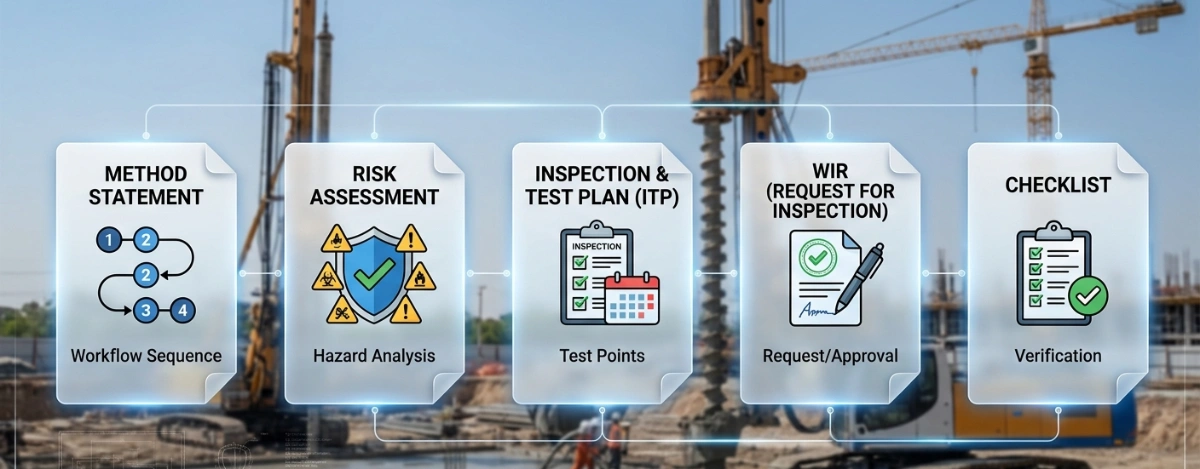
Unlike a downloadable Word or PDF template, this method statement is an AI-assisted editable starting point connected directly to a matching Inspection and Test Plan. Every section is structured, project-adaptable, and ready to export.
- AI-assisted drafting — Customize every section with AI for your specific project scope.
- Linked ITP — A matching inspection and test plan is generated alongside the method statement.
- Multiple export formats — Download as a formatted PDF or editable Excel spreadsheet.
- Editable starting point, not a final document — Review, verify, and adjust all content against your project requirements before use.
Static template vs. Quollnet workflow
| Feature | Static template | Quollnet |
|---|---|---|
| Project-specific content | Manual fill-in required | AI-assisted customization |
| Linked ITP | Separate document, no link | Matching ITP included |
| Export formats | Usually PDF only | PDF and Excel |
| Structured sections | Free-form layout | 13 standardized sections |
| Saved to your account | Local file only | Cloud-saved, reusable |
| Content accuracy | You verify everything | AI-assisted, you still verify |
| Cost | Often free but time-intensive | Free to customize and download |
What you can customize
When you save this method statement to your account, every section becomes editable. The following 13 sections are included:
- Scope — Defines the activity and its boundaries.
- References — Standards, specifications, and drawings.
- Responsibilities — Roles and accountabilities.
- Resources — Labour, plant, and equipment summary.
- Materials — Materials and compliance requirements.
- Equipment — Tools and equipment details.
- Prerequisites — Hold points and pre-conditions.
- Method sequence — Step-by-step construction sequence.
- Safety controls — HSE risk controls and PPE.
- Environmental controls — Environmental mitigation measures.
- QA/QC — Quality inspection and test requirements.
- ITP — Inspection and Test Plan table (has its own page).
- Attachments — Referenced drawings and documentation.
Why this method statement is used
This method statement is used to define and communicate the approved procedure for carrying out method statement – installation of external roof rainwater gutters and downspouts on site. It ensures the work is planned in advance, the correct resources and controls are in place, and all personnel understand responsibilities, sequence, quality requirements, and safety controls before work begins. It aligns site execution with the documented scope and acceptance expectations.
Who uses this method statement
This method statement is used by contractors, site supervisors, project engineers, QA/QC engineers, HSE officers, consultants, and client representatives. It serves as a shared reference for planning, execution, supervision, inspection, and approval of the activity on site.
When it is prepared and submitted
The method statement is prepared before the work activity starts and submitted as part of the pre-construction documentation package for review and approval.
Who reviews or approves it
The method statement is usually submitted to the client representative, consultant, resident engineer, or project management consultant for review and approval before the work commences.
Important approval note
This method statement is an AI-assisted editable starting point, not a pre-approved document. Before use on any project, all content must be reviewed and approved by the relevant parties (superintendent, principal contractor, or client representative) in accordance with your contract and project quality plan.
For example: if your specification requires a departure from a referenced standard, that departure must be documented and approved separately — this method statement will not capture that automatically. Always verify against your applicable drawings, specifications, and regulatory requirements.
Method statement content
Scope
Work Summary
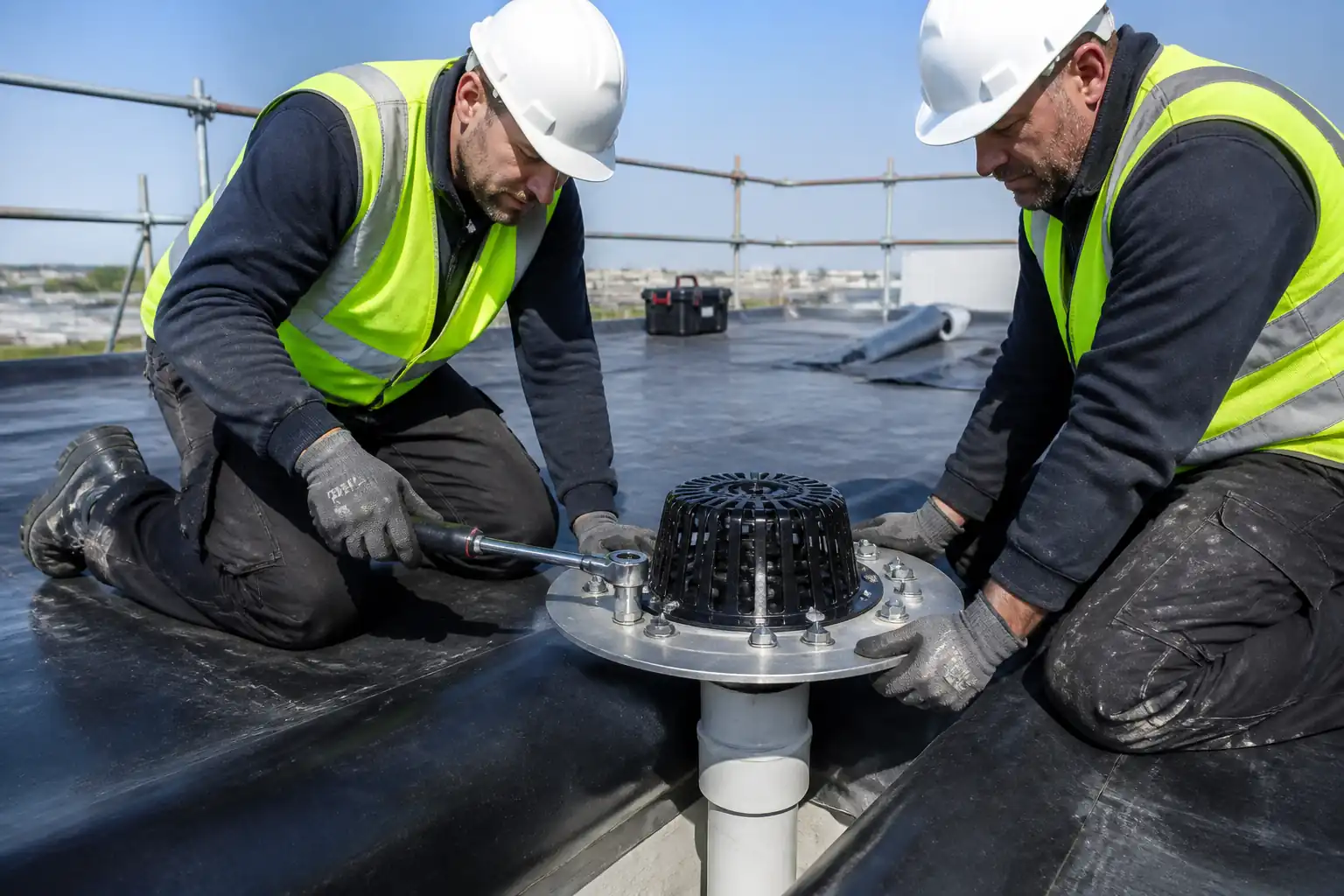
- Installation of external eaves gutters, union/expansion joints, stop-ends, drop outlets, and downspouts including offsets, shoes/splays, and associated brackets/straps.
- Alignment and gradient setting of gutter supports; slope calculations and mark-out.
- Cutting, forming, and joining of gutter segments using sealed rivets or compatible sealants per manufacturer.
- Positioning and fixing of downspouts to external walls with approved anchors/straps.
- Final cleaning and controlled water flow testing; punch-list closure and handover documentation.
Exclusions
- Structural timber/steel fascia installation or repair (by Others unless stated).
- Underground drainage connection beyond downspout shoe or hopper (by Others unless stated).
- Lightning protection, heat tracing, snow guards (by Others unless specified).
Key Technical Targets [Verify per project specifications]
- Gutter fall: typically 1:300 to 1:500 (3.3–2.0 mm per metre). Minimum continuous fall without backfalls.
- Bracket spacing (centres):
- PVC-U: 600–800 mm
- Aluminum/steel: 800–1000 mm
- Additional brackets within 150 mm of joints/outlets/angles.
- Downspout straps: max 2.0 m vertical spacing; strap at every joint and within 150 mm of fittings.
- Plumb tolerance (downspouts): ±5 mm per 3 m.
- Line tolerance (gutter front edge): ≤5 mm deviation over 10 m.
- Joint sealing: 100% continuous bead; no visible voids; leak-free under test.
- Expansion: provide expansion unions/gaps per manufacturer; typical allowance:
- PVC-U: 10–12 mm per 3 m for ΔT ≈ 40–50°C
- Aluminum/steel: 3–5 mm per 3 m for ΔT ≈ 40–50°C
- Fasteners: Stainless steel A2/A4 or coated; avoid bimetallic corrosion.
- Anchor proof-testing: 2% of anchors per substrate/elevation, minimum 3 tests [Verify].
- Water test: 10–15 minutes continuous hose flow; no leaks/overflows; residual ponding <5 mm.
References
| Document Type | Reference / Number | Revision | Notes |
|---|---|---|---|
| Standard | BS EN 12056-3 | Used for sizing downpipes/outlets and layout. [Verify per project] | |
| Standard | BS EN 607 | Applicable for PVC-U gutters/fittings. | |
| Standard | BS EN 612 | Applicable for metal gutters/downpipes. | |
| Standard | BS EN 1462 | Defines gutter bracket performance requirements. | |
| Standard | BS EN 12200-1 | For PVC-U downpipes and fittings. | |
| Standard | ISO 1461 | For galvanized steel components/repairs. | |
| Standard | ISO 3506 (series) | For stainless fasteners classes A2/A4. | |
| Standard | ISO 11600 | Select sealant class compatible with substrate (e.g., F/G-25 LM). | |
| Guideline | SMACNA (latest) | For sheet-metal fabrication and joints. [If applicable] | |
| Manufacturer Data | Approved Submittal | Project-specific; governs tolerances/details where stricter. |
Responsibilities
| Role | Responsibility | Name / Party |
|---|---|---|
| Project Manager | Project Manager | Contractor |
| Site Engineer / Supervisor | Site Engineer / Construction Supervisor | Contractor |
| QA/QC | QA/QC Inspector | Contractor |
| HSE | HSE Officer | Contractor |
| Engineer/Consultant | Engineer/Consultant | Employer/Engineer |
Resources
| Resource Type | Description | Quantity | Remarks |
|---|---|---|---|
| Manpower | Team lead for gutter and downspout installation | 1 | |
| Manpower | Skilled installers for measuring, cutting, fixing and jointing | 3–6 | |
| Manpower | Operate MEWP/scissor lift as required | 1 | |
| Manpower | Erection/adjustment of scaffold/edge protection | As required | |
| Manpower | Quality verification, ITP checks, documentation | 1 | |
| Manpower | Permit to work, supervision for WAH/MEWP, audits | 1 |
Materials
| Material | Specification / Grade | Quantity | Remarks |
|---|---|---|---|
| Gutter sections (half-round/ogee/box profile) | Profile and size per IFC/shop drawings [Verify] | ||
| Gutter brackets/hangers | Load class per manufacturer for local snow/wind [Verify] | ||
| Downpipes and fittings | Material/profile to match gutter system [Verify] | ||
| Union/expansion joints & stop-ends | Manufacturer system components | ||
| Rivets | Ø4.0–4.8 mm; sealed type; material compatible | ||
| Sealant/adhesive tapes | Manufacturer-recommended; UV and weather resistant | ||
| Fixing screws/bolts | ISO 3506; sizes per calc/manufacturer [Verify] | ||
| Wall anchors for straps/brackets | ETA/ETAG or EAD compliant; embedment per data sheet [Verify] | ||
| Zinc-rich primer/paint | ISO 1461-compatible repair coating | ||
| Isolation pads/washers | Non-absorptive, UV-stable |
Equipment
| Equipment | Capacity / Type | Quantity | Inspection Required |
|---|---|---|---|
| Mobile Elevated Work Platform (boom/scissor) | Working height per elevation | Yes | |
| Independent scaffolding/edge protection | NA | Yes | |
| Extension ladders/roof ladders | Up to 150 kg | Yes | |
| Drills and bits (masonry/metal) | Ø4–12 mm typical | Yes | |
| Shears/snips/mitre saw (as applicable) | Per material thickness | Yes | |
| Rivet gun (manual/pneumatic) | Ø4–4.8 mm | Yes | |
| Laser level/string line/chalk line | NA | Yes | |
| Power supply/cordless chargers | 110–240 V | Yes | |
| HEPA vacuum/magnetic sweeper | NA | Yes | |
| Water hose/supply | ~10–20 L/min | No |
Prerequisites
- Approved shop drawings showing gutter profiles, bracket spacing, outlet positions, expansion details, and downspout routing.
- Approved material submittals with certificates of conformity; anchors with ETA/ICC reports; sealant technical data sheets and compatibility statements.
- Method Statement and ITP approved by Engineer.
- Access equipment (scaffold/MEWP/ladders) erected/inspected; valid tags and certificates.
- Permit-To-Work for Work at Height and MEWP; Task Risk Assessment briefed to crew [Verify per project HSE plan and local regulations].
- Services/utility scan for wall fixings; as-built review; Permit to Drill where applicable.
- Weather: dry, wind ≤12 m/s for handling long members; ambient ≥5°C for sealant application [Verify per manufacturer].
- Substrates (fascia/walls) sound, true, and capable of taking design loads; defective areas rectified.
- Calibrated measuring equipment available; sealant back-up tapes/cleaners available.
- Mock-up (if specified) completed and approved.
Method Sequence
| Step | Activity | Description | Responsibility | Inspection / Hold Point |
|---|---|---|---|---|
| 1 | Set-out and survey | Verify eaves straightness and datum. Establish outlet low points. Confirm gutter run lengths and downspout locations as per drawings. Mark control datums using laser level and chalk line. | Site Engineer | |
| 2 | Slope calculation and bracket level marks | Calculate required fall: Fall (mm) = Run length (m) × target mm/m (e.g., 3 mm/m at 1:333). Mark start and end bracket elevations accordingly; distribute intermediate bracket heights uniformly. | Site Engineer | |
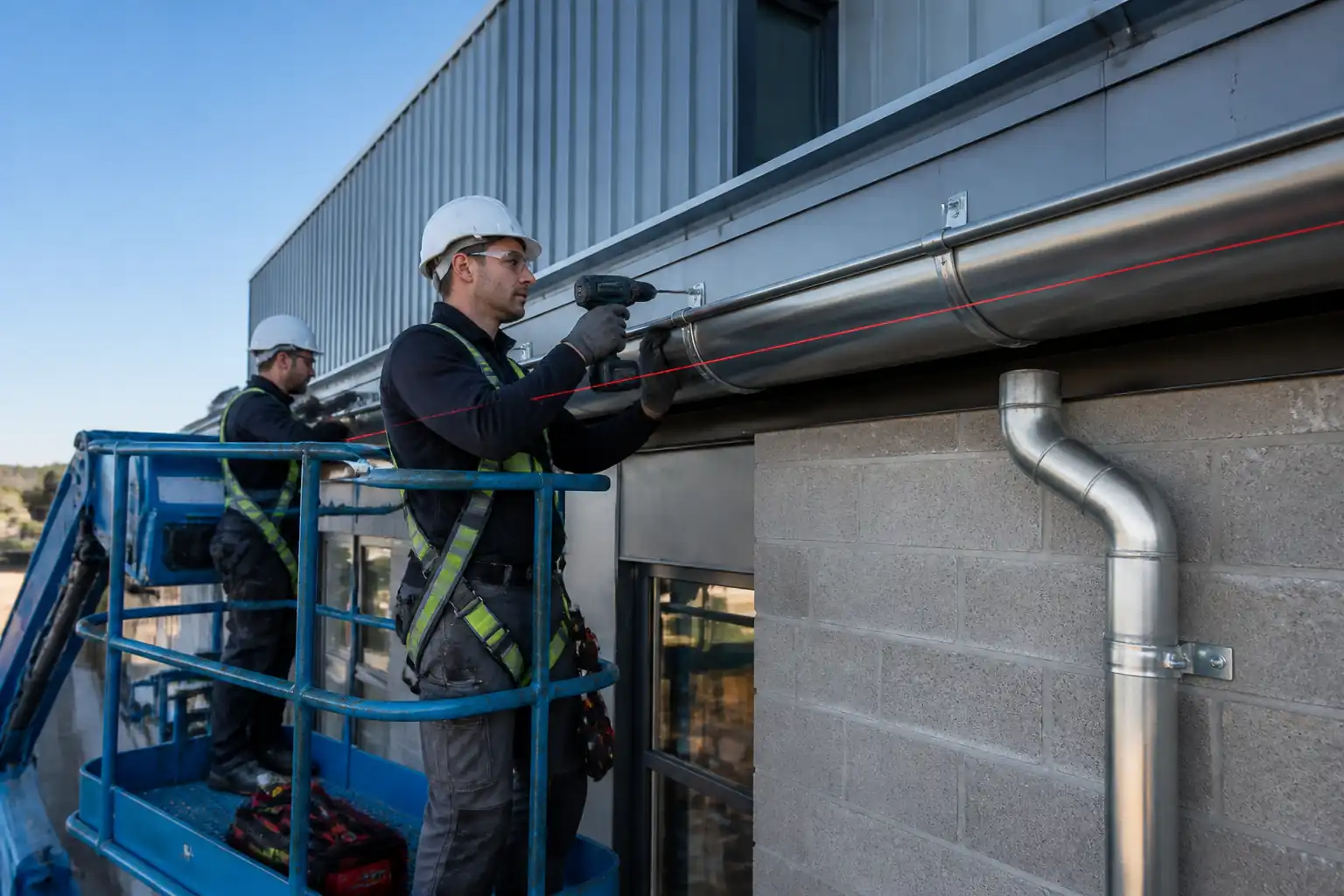
| 3 | Install gutter brackets/hangers | Fix first and last brackets at marked levels; string line between. Fix intermediates at specified spacing (PVC-U 600–800 mm; metal 800–1000 mm). Provide extra brackets within 150 mm of joints/outlets/angles. Use stainless screws into timber fascia (≥5×50–70 mm) or ETA anchors for masonry (M6–M8; embedment per data sheet). Fit isolation pads where needed. | Installers | |
| 4 | Form/openings for drop outlets | Mark outlet centers at low points. Cut apertures cleanly (use hole saw/nibbler). Deburr edges; apply zinc-rich paint to cut steel. Fit outlet piece with sealant/tape per system. | Installers | |
| 5 | Cut and trial-fit gutter segments | Measure and cut to length allowing for expansion gaps per manufacturer. Dry assemble in brackets to confirm alignment, mitres at corners, and union positions. | Installers | |
| 6 | Jointing with rivets/sealant | Clean dry surfaces. Apply 6–8 mm continuous bead of compatible sealant or butyl tape. Overlap per system (typically 25–50 mm). Fix with sealed blind rivets Ø4–4.8 mm at 50–75 mm centers staggered; do not over-clamp. Tool sealant squeeze-out to continuous fillet. Wipe excess. | Installers | |
| 7 | Install stop-ends and expansion joints | Fit stop-ends with sealant/rivets as specified. Provide expansion unions at prescribed intervals (PVC-U ~6 m; metals ~10–12 m) and at building movement joints. Mark sliding side. Do not bridge movement joints with rigid connections. | Installers | |
| 8 | Secure gutters to brackets | Locate assembled gutters into brackets; close clips/straps per manufacturer. Ensure uniform bearing; no point loads. Maintain designed fall along the run. | Installers | |
| 9 | Anchors/fasteners verification | For wall anchors and critical bracket anchors, carry out proof tests: 2% of installed anchors per type/substrate/elevation, min 3 tests. Test load = 1.5× service tension load [Verify]. Record torque for mechanical anchors as per data sheet. | QA/QC with Installer | |
| 10 | Install downspouts and fittings | From outlet, assemble offsets to wall line. Fix downpipes plumb with straps at ≤2.0 m spacing and within 150 mm of fittings/joints. Use ETA anchors appropriate for substrate. Provide shoes/hoppers/splays to drainage point as detailed. Isolate dissimilar metals. | Installers | |
| 11 | Sealant cure/adhesive set | Allow sealant/adhesive to cure per TDS (typically 24 h at 20°C, RH 50%). Protect from movement and rain until cured. | Installers | |
| 12 | Water flow testing | Block outlet temporarily to fill 25–50 mm depth, then release; or run hose at ~10–20 L/min along run for ≥10–15 min. Observe joints, outlets, and downspouts for leaks/overflows. Confirm no backfalls and residual ponding <5 mm. | QA/QC with Engineer | |
| 13 | Finishing and protection | Touch-up coatings on cut steel edges with zinc-rich paint. Clean debris, swarf, mandrels. Install leaf guards (if specified). Label as-built outlet references if required. | Installers | |
| 14 | Handover documentation | Submit as-builts (dimensions, outlet positions), product data, warranties, ITP records, test reports, and O&M instructions. | QA/QC |
Health, Safety and Environment – Safety Controls
Principal Hazards and Controls
1) Work at height (eaves/MEWP/scaffold)
- Consequence: Fall from height causing serious injury or fatality.
- Engineering/Procedural Controls:
- Use scaffold with double guardrails/toe-boards or MEWP with proper outreach; do not work off unprotected edges.
- MEWP pre-use inspection; ground suitability and exclusion zone; certified operator only.
- Ladder use limited to short-duration tasks (<15 min), tied-off, 3-point contact; no cutting/drilling from ladders above shoulder height.
- Fall protection: full body harness with short lanyard in MEWP; fall arrest where required within 2 m of roof edge.
- Weather hold points: cease lifting/handling long sections when wind >12 m/s; no work on icy/wet slippery surfaces.
- PPE: Helmet with chin strap, harness (EN 361), lanyard with energy absorber, non-slip safety boots, gloves, eye protection.
- Collective Measures: Edge protection, MEWP guardrails, exclusion zones below.
- Inspection/Permit: Work at Height permit; MEWP logbook; scaffold weekly tag; HSE supervision. [Verify per project HSE plan and local regulations]
2) Drilling into masonry/concrete (anchors/straps)
- Consequence: Striking concealed services; silica dust inhalation; eye injury.
- Controls:
- Permit to Drill; review as-builts; scan walls with cable/pipe detector and rebar scanner where required; mark no-drill zones.
- Use SDS drill with dust extraction; wet suppression where permissible; depth stop to avoid over-drilling.
- Follow anchor manufacturer’s hole cleaning (blow–brush–blow) and curing times (for chemical anchors).
- PPE: Safety glasses/face shield, cut-resistant gloves, hearing protection, FFP2/FFP3 respirator for dust.
- Collective: Task enclosure/spotter to control area; debris collection sheets.
- Inspection/Permit: Anchor installation checklists; pull-testing as per ITP; Permit to Drill authorization.
3) Manual handling of long gutter lengths
- Consequence: Musculoskeletal injuries; loss of control in wind leading to strikes.
- Controls:
- Team lifts with tag lines; store materials on level supports; handle facing downwind; pre-assemble in manageable lengths.
- Use mechanical aids (material hoists) where feasible.
- PPE: Work gloves, safety boots.
- Collective: Designated handling zone with barriers; clear communication.
- Inspection/Permit: Manual handling briefing; supervisor oversight.
4) Cutting and riveting sheet/sections
- Consequence: Lacerations, flying mandrels; eye injury; noise exposure.
- Controls:
- Use guarded snips/mitre saw with non-ferrous blade and clamped work; collect rivet mandrels with catcher.
- Maintain tool condition; GFCI/RCD-protected power.
- PPE: Cut-resistant gloves, safety glasses/face shield, hearing protection, long sleeves.
- Collective: Screens for bystander protection; clean workbench area.
- Inspection/Permit: PAT/tool checks; hot works permit if any grinding/soldering is used.
5) Electrical hazards (portable tools)
- Consequence: Electric shock, burns.
- Controls:
- Use battery tools where possible; otherwise 110–120 V center-tapped or 230 V with RCD/GFCI; cable management off wet surfaces.
- PPE: Dielectric gloves if required, dry gloves, eye protection.
- Collective: Power distribution boards with RCDs; signage.
- Inspection/Permit: Electrical inspection tag; pre-use checks.
6) Falling objects to public/operatives below
- Consequence: Head injuries.
- Controls:
- Exclusion and debris netting where necessary; tool lanyards; toe-boards.
- PPE: Hard hats for all in zone.
- Collective: Barriers and spotter.
- Inspection/Permit: Daily area inspection by supervisor.
7) Chemical exposure (sealants/cleaners)
- Consequence: Dermatitis, respiratory irritation, flammability (solvent-based).
- Controls:
- Use neutral-cure/MS polymer where specified; ensure ventilation; avoid ignition sources.
- PPE: Nitrile gloves, eye protection, respirator if specified in SDS.
- Collective: Spill kit; sealed waste containers.
- Inspection/Permit: SDS available; COSHH assessment/chemical handling permit where applicable.
8) Weather and lightning
- Consequence: Slips, falls, wind-blown materials, electrocution.
- Controls:
- Stop work during thunderstorms; secure materials; dry conditions for sealant application.
- PPE: Weather-appropriate non-slip footwear and clothing.
- Collective: Temporary covers and tie-downs.
- Inspection/Permit: Supervisor weather checks.
Environmental Controls
- Prevent debris entry to storm drains: fit temporary drain covers during cutting/drilling; collect swarf and rivet mandrels with HEPA vacuum/magnetic sweeper.
- Noise and dust: use low-noise blades, maintain tools; employ on-tool extraction; observe permitted working hours [Verify per local regulations].
- Waste management: segregate recyclable metals (Al/steel) and PVC-U; dispose of sealant tubes/chemical containers as per SDS; keep records of disposal tickets.
- Runoff control: do not discharge sealant-contaminated water; perform water test with controlled flow and collect discharge if required by site EMS.
- Storage: store gutters on padded racks; protect from dirt/UV; keep sealants within shelf life and under shade.
- Pollution prevention: use drip trays under generators; immediate cleanup of spills; no painting/coating over bare soil.
- Wildlife and façade protection: avoid nesting areas where relevant; use non-staining cleaners; do not lean metal directly on finished façades—use soft pads.
- Carbon and energy: prioritize cordless tools and shared MEWP usage; plan single continuous runs to reduce rework.
Quality Assurance / Quality Control
QA Planning
- Use approved manufacturers and maintain current TDS/installation manuals at workface.
- Calibrate laser level per QA plan (e.g., monthly) and verify before use.
Inspections and Tests
- Material Inspection: verify profiles, finishes, fastener grades, anchors (ETA), and sealant class (ISO 11600). Record batch numbers and shelf lives.
- Bracket Setting: check spacing and alignment; verify fall using laser. Tolerance: fall within 1:300–1:500; line deviation ≤5 mm/10 m.
- Jointing: verify surface prep, bead size (6–8 mm), overlap (25–50 mm), rivet spacing (50–75 mm). No voids. Compatibility confirmed.
- Expansion: verify union locations and movement allowance (PVC-U 10–12 mm/3 m; metals 3–5 mm/3 m) and markers for sliding sides.
- Anchors: proof-test sample (2% per type/substrate/elevation, minimum 3); torque checks per data sheet.
- Downspouts: plumb ±5 mm/3 m; straps ≤2.0 m spacing; secure within 150 mm of fittings.
- Water Test: hose test for ≥10–15 min; confirm no leaks/overflows; residual ponding <5 mm.
Records
- MIR, IR, ITP checklists, anchor test logs, torque logs, water test reports, photo records, as-built sketches of outlet/downspout positions, warranties.
Acceptance
- All ITP points passed; nonconformities closed; surfaces clean; no damage to finishes; safe access removed; documentation submitted and approved.
Attachments
- Approved shop drawings and marked-up as-builts (outlet positions, slopes, downspout routing)
- Manufacturer data sheets and installation manuals (gutter system, sealants, anchors)
- Certificates: ISO 3506 fasteners, ISO 1461 galvanizing, ETA/ICC anchor approvals, warranties
- Calculations: bracket spacing, slope calculation sheets, anchor selection
- HSE: Task Risk Assessment, Work at Height Permit, MEWP inspection records, toolbox talk attendance
- QA/QC: ITP checklists, MIR/IR templates, anchor pull-test and torque logs, water test report template
- Photographic records (before/during/after)
This content is a read-only public reference. Download or customize to get an editable version.
ITP preview
The first inspection activities from the linked ITP for Method Statement – Installation of External Roof Rainwater Gutters and Downspouts:
| Activity | Inspection / Test | Acceptance Criteria | Responsibility | Record |
|---|---|---|---|---|
| Material delivery and storage | Verify profiles, finishes, fastener grade, ETA anchors, sealant class/expiry | Conforms to approved submittals/standards; no damage; certificates available | QA/QC Inspector | MIR; Delivery inspection photos |
| Access equipment inspection | Scaffold tag valid; MEWP certification; harness inspection | Compliant and tagged | HSE Officer / Supervisor | Access inspection checklist |
| Set-out and slope calculation | Laser level readings at start/end/intermediate brackets | Fall 1:300–1:500; no backfall | Site Engineer / QA/QC | Set-out sheet; IR |
Showing 3 of 11 inspection activities. View full ITP →
Related Inspection and Test Plan
An Inspection and Test Plan (ITP) is available for Method Statement – Installation of External Roof Rainwater Gutters and Downspouts. The ITP defines the inspection activities, acceptance criteria, hold and witness points, responsible parties, and records required to verify the work described in this method statement.
View the Method Statement – Installation of External Roof Rainwater Gutters and Downspouts ITP →Frequently asked questions
Continue with related Quollnet resources connected to this method statement.