
Method Statement – Imported Fill Acceptance, Classification, Source Testing, Stockpile Sampling, Rejection Protocol, and Delivery Docket Reconciliation – Method Statement
AI-assisted method statement with matching ITP, PDF download, and Excel export.
More than a static template
Unlike a downloadable Word or PDF template, this method statement is an AI-assisted editable starting point connected directly to a matching Inspection and Test Plan. Every section is structured, project-adaptable, and ready to export.
- AI-assisted drafting — Customize every section with AI for your specific project scope.
- Linked ITP — A matching inspection and test plan is generated alongside the method statement.
- Multiple export formats — Download as a formatted PDF or editable Excel spreadsheet.
- Editable starting point, not a final document — Review, verify, and adjust all content against your project requirements before use.
Static template vs. Quollnet workflow
| Feature | Static template | Quollnet |
|---|---|---|
| Project-specific content | Manual fill-in required | AI-assisted customization |
| Linked ITP | Separate document, no link | Matching ITP included |
| Export formats | Usually PDF only | PDF and Excel |
| Structured sections | Free-form layout | 13 standardized sections |
| Saved to your account | Local file only | Cloud-saved, reusable |
| Content accuracy | You verify everything | AI-assisted, you still verify |
| Cost | Often free but time-intensive | Free to customize and download |
What you can customize
When you save this method statement to your account, every section becomes editable. The following 13 sections are included:
- Scope — Defines the activity and its boundaries.
- References — Standards, specifications, and drawings.
- Responsibilities — Roles and accountabilities.
- Resources — Labour, plant, and equipment summary.
- Materials — Materials and compliance requirements.
- Equipment — Tools and equipment details.
- Prerequisites — Hold points and pre-conditions.
- Method sequence — Step-by-step construction sequence.
- Safety controls — HSE risk controls and PPE.
- Environmental controls — Environmental mitigation measures.
- QA/QC — Quality inspection and test requirements.
- ITP — Inspection and Test Plan table (has its own page).
- Attachments — Referenced drawings and documentation.
Why this method statement is used
This method statement is used to define and communicate the approved procedure for carrying out method statement – imported fill acceptance, classification, source testing, stockpile sampling, rejection protocol, and delivery docket reconciliation on site. It ensures the work is planned in advance, the correct resources and controls are in place, and all personnel understand responsibilities, sequence, quality requirements, and safety controls before work begins. It aligns site execution with the documented scope and acceptance expectations.
Who uses this method statement
This method statement is used by contractors, site supervisors, project engineers, QA/QC engineers, HSE officers, consultants, and client representatives. It serves as a shared reference for planning, execution, supervision, inspection, and approval of the activity on site.
When it is prepared and submitted
The method statement is prepared before the work activity starts and submitted as part of the pre-construction documentation package for review and approval.
Who reviews or approves it
The method statement is usually submitted to the client representative, consultant, resident engineer, or project management consultant for review and approval before the work commences.
Important approval note
This method statement is an AI-assisted editable starting point, not a pre-approved document. Before use on any project, all content must be reviewed and approved by the relevant parties (superintendent, principal contractor, or client representative) in accordance with your contract and project quality plan.
For example: if your specification requires a departure from a referenced standard, that departure must be documented and approved separately — this method statement will not capture that automatically. Always verify against your applicable drawings, specifications, and regulatory requirements.
Method statement content
Scope
Purpose
Define the procedures and controls to accept, classify, test, sample, track, and either approve or reject imported fill materials prior to placement, and to reconcile delivery documentation for full traceability.
Scope of Work
- Imported general fill, select structural fill, granular sub-base/backfill, and engineered embankment materials prior to placement.
- Activities include: source approval, visual-manual classification, sampling and testing (Proctor, gradation, Atterberg limits, organic content, moisture), stockpile lot control, rejection/quarantine, and delivery docket reconciliation.
- Interfaces with placement/compaction works (covered by separate Earthworks Placement Method Statement). This document stops at lot release for placement.
Exclusions
- Compaction procedures and in-situ density/compaction verification of placed material (see Earthworks Placement MS/ITP).
- Geosynthetics acceptance (separate MS if applicable).
Definitions
- Lot: A discrete volume of stockpiled imported fill grouped for acceptance (typically 500 m³; adjust per specification). [Verify per project specifications]
- Select/Structural fill: Higher quality envelope with tighter gradation/plasticity limits for structural zones. [Verify per project specifications]
- General fill: Material used outside structural influence zones with broader limits. [Verify per project specifications]
References
| Document Type | Reference / Number | Revision | Notes |
|---|---|---|---|
| Standard | ASTM D2487, ASTM D2488, BS 5930, BS EN ISO 14688 | ||
| Standard | ASTM D698, ASTM D1557, AASHTO T99, AASHTO T180, BS 1377-4 | ||
| Standard | ASTM D6913, ASTM D7928, BS EN ISO 17892-4 | ||
| Standard | ASTM D1140, BS 1377-2 | ||
| Standard | ASTM D4318, BS EN ISO 17892-12 | ||
| Standard | ASTM D2216, ASTM D4944, BS 1377-2 | ||
| Standard | ASTM D3665, ASTM D75, AASHTO T2, ASTM D4220, BS EN ISO 22475-1 | Select appropriate practice per material type and specification. | |
| Standard | ISO 45001, ISO 14001, Local Regulations [Verify] | ||
| Standard | ISO/IEC 17025 |
Responsibilities
| Role | Responsibility | Name / Party |
|---|---|---|
| Engineer | Engineer/Principal’s Representative | Client/Consultant |
| Contractor | Contractor QA/QC Manager | Contractor |
| Contractor | Materials Engineer / Site Engineer | Contractor |
| Contractor/Lab | Field Technician / Laboratory Technician | Contractor/Independent Lab |
| Contractor | Materials Engineer | Contractor |
| Contractor | HSE Manager / Supervisor | Contractor |
Resources
| Resource Type | Description | Quantity | Remarks |
|---|---|---|---|
| Personnel | QA/QC Manager, Materials Engineer, Site Engineer, Surveyor, Field/Lab Technicians, Storekeeper/Materials Controller, Truck Marshals/Spotters, HSE Officer. | As required | |
| Service | ISO/IEC 17025 accredited for soils/aggregates testing within scope. | 1 |
Materials
| Material | Specification / Grade | Quantity | Remarks |
|---|---|---|---|
| Soil | |||
| Granular/low PI soil | |||
| Crushed aggregate |
Equipment
| Equipment | Capacity / Type | Quantity | Inspection Required |
|---|---|---|---|
| Set | |||
| As required | |||
| As required | |||
| As required |
Prerequisites
- Approved Method Statement and ITP.
- Approved list of sources/borrow pits/quarries with supplier quality plans and evidence of permits and legal compliance.
- Laboratory accreditation certificates (ISO/IEC 17025) and current equipment calibrations.
- Sampling and testing plan with lots defined (default lot size 500 m³ unless specified otherwise). [Verify per project specifications]
- Traffic Management Plan for delivery vehicles and stockpile area layout with designated quarantine zone.
- HSE risk assessment, permits (e.g., mobile plant interaction, radiation if using nuclear gauge), and daily pre-starts.
- Surveyed and signed-off stockpile pads with drainage, perimeter controls, and segregation signage.
- Forms: delivery docket log, sample register and chain-of-custody (COC), lot release/NCR templates.
Method Sequence
| Step | Activity | Description | Responsibility | Inspection / Hold Point |
|---|---|---|---|---|
| 1 | Source Qualification | Review supplier data; conduct initial sampling at source. Tests: classification (ASTM D2487/D2488), LL/PL (ASTM D4318), gradation (ASTM D6913), organic content (e.g., loss on ignition or wet oxidation per spec), sulfate/chloride if required, and Proctor (ASTM D698 for general, D1557 for structural/pavement zones). | Materials Engineer | Hold Point HP1 – No deliveries until source approved |
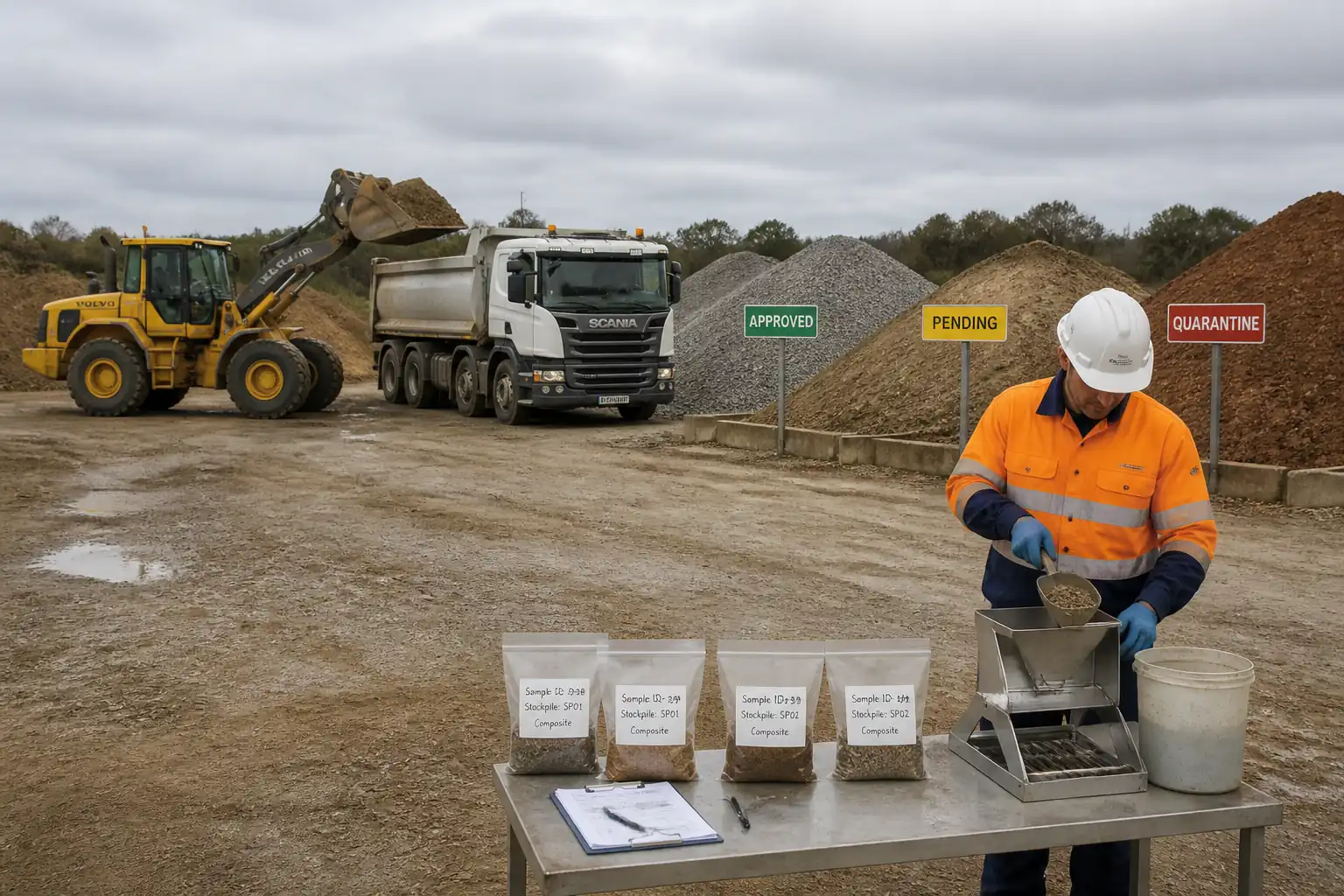
| 2 | Set Up Stockpile Area | Prepare drained, firm pad; install signage for Approved, Pending, and Quarantine piles; define lot boundaries; implement surface water controls and traffic routes. | Site Engineer | Inspection prior to first delivery |
| 3 | Delivery Verification & Visual Classification | At gate or stockpile: check each truck’s docket for supplier, source ID, material type, date/time, vehicle reg, gross/tare/net. Visually inspect material for color change, odor, organics, C&D debris, oversize, or moisture condition. Classify visually per ASTM D2488 and compare with approved source profile. | Materials Controller / Site Engineer | 100% of loads |
| 4 | Stockpiling & Segregation | Tip and build stockpiles in thin layers, advancing face to minimize segregation. Keep different material classes separated by barriers and signage. No trafficking on piles except for sampling access platform. | Foreman | Routine surveillance |
| 5 | Lot Identification and Mapping | Assign unique Lot IDs to stockpile volumes (default 500 m³). Install tags and geo-reference with survey pick-ups. Record link to delivery docket numbers. | Site Engineer / Surveyor | Check lot tags and records |
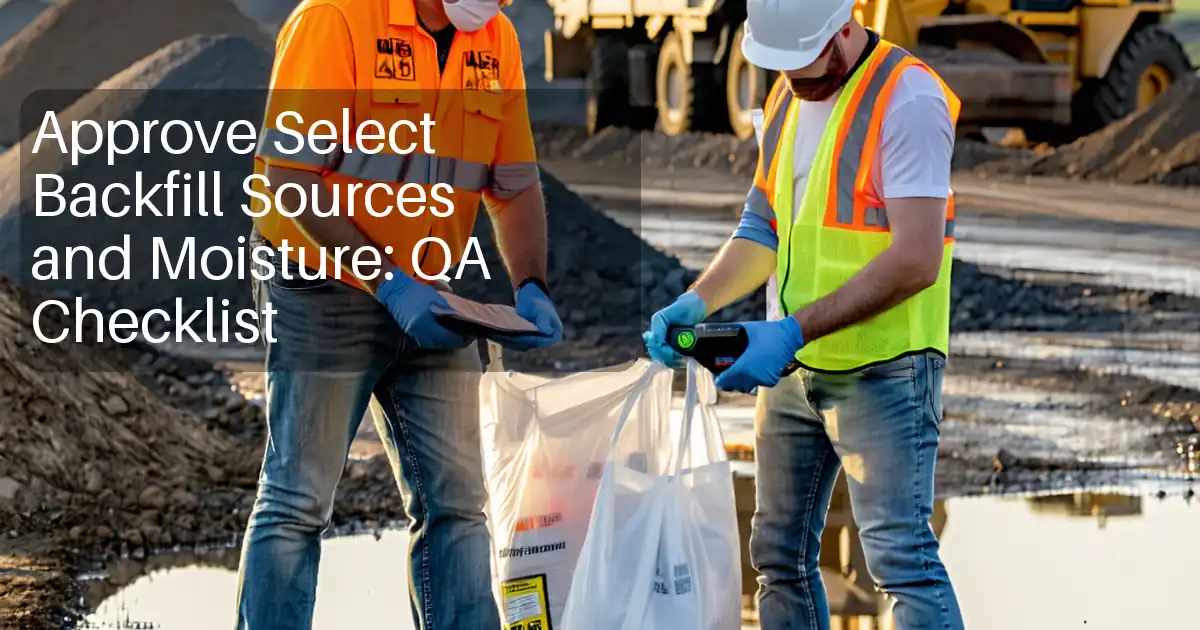
| 6 | Stockpile Sampling – Composite | For each lot: collect minimum 5 increments at evenly distributed locations and depths 0.5–1.0 m into the pile face (top, mid, toe, both flanks). Avoid surface crust. Combine to 25–30 kg composite. Reduce using riffle/rotary splitter for test portions. | Field Technician | Witness Point WP1 – Sampling may be witnessed by Engineer |
| 7 | Laboratory Testing – Verification | Perform: gradation (ASTM D6913), wash fines (ASTM D1140), Atterberg limits (ASTM D4318), moisture (ASTM D2216), Proctor (ASTM D698 or D1557 as specified). Additional tests if required (e.g., organic content, sulfate/chloride). | Independent Laboratory | Lab QA/QC |
| 8 | Testing Frequency – Minimum | - Proctor (MDD/OMC): 1 per source and material type at approval, then 1 per 2,000–3,000 m³ or when visual change occurs. [Verify] - Gradation: 1 per 500 m³ for granular; 1 per 1,000 m³ for cohesive/soil fills. [Verify] - Atterberg limits: 1 per 1,000 m³ or when change detected. [Verify] - Moisture content: 1 per 250 m³ at receipt or per lot prior to placement. [Verify] - Additional (organics/sulfates): at approval then 1 per 5,000 m³ or change. [Verify] | QA/QC Manager | Audit of frequency adherence |
| 9 | Assessment & Lot Release | Compare test results with acceptance criteria. If compliant, issue Lot Release Certificate authorizing placement. If not, proceed to Step 10 (Rejection/Rectification). | QA/QC Manager | Hold Point HP2 – No placement before release |
| 10 | Rejection / Rectification Protocol | Trigger when loads/lots show: organics/debris > allowable; oversize > limit; PI/LL outside limits; gradation off-envelope; moisture unsuitable; unapproved source; odor/discoloration suggesting contamination. Actions: Segregate to Quarantine Zone; tag as NCR; notify supplier; option to reprocess (scalping/drying/blending) and retest, or remove from site. Maintain chain-of-custody. | QA/QC Manager | Engineer notified; may require witness |
| 11 | Delivery Docket Reconciliation | Daily reconcile dockets against Lot IDs and survey volumes. Check cumulative tonnage vs theoretical bulk density to estimate m³. Verify weighbridge calibration is current. Investigate discrepancies >5%. | Materials Controller / Quantity Surveyor | Daily |
Health, Safety, and Environment – Task-Specific Safety Controls
Key Hazards, Consequences, and Controls
1) Mobile plant–truck interaction at stockpile pad
- Consequence: Crushing/struck-by incidents, collisions.
- Engineering/procedural control: Implement Traffic Management Plan with one-way circuits, dedicated tip and load zones, spotters for reversing, plant–people separation (3–5 m minimum exclusion). Use radios and beacons.
- PPE: High-vis, safety boots, hard hat, gloves.
- Collective measure: Physical barriers/cones, plant segregation lines, designated pedestrian walkways.
- Inspection/permit: Daily pre-start, spotter in place, supervisor verification. [Verify per project HSE plan and local regulations]
2) Stockpile face collapse during sampling
- Consequence: Burial/asphyxiation, fractures.
- Control: No climbing faces >1.5 m; use excavator to flatten or create benches; sample from safe platforms; maintain 1:1 temporary angle if access needed.
- PPE: Hard hat, gloves, eye protection, boots.
- Collective: Mobile elevating work platform or portable access platform with guardrails where needed.
- Inspection/permit: Supervisor to authorize sampling setup; exclusion zone established.
3) Dust and respirable crystalline silica (RCS)
- Consequence: Respiratory irritation, long-term lung disease.
- Control: Water cart misting; limit drop heights; cover loads; cease work if wind exceeds threshold; rotate tasks.
- PPE: P2/N95 respirator when visible dust present.
- Collective: Fixed water points, speed limits to reduce dust plumes.
- Inspection/permit: Environmental dust monitoring as required; toolbox briefings.
4) Manual handling of samples
- Consequence: Strains/sprains.
- Control: Use mechanical aids, split samples into smaller containers (<15 kg each), team lifts; ergonomics training.
- PPE: Gloves, boots.
- Collective: Trolleys and benches for splitting.
- Inspection/permit: Supervisor checks for manual handling plan.
5) Hidden contamination in imported material
- Consequence: Health exposure, environmental harm.
- Control: Source due diligence; olfactory/visual checks; immediate quarantine of suspect loads; use VOC meter if specified.
- PPE: Gloves, eye protection, respirator if fumes/odors.
- Collective: Clearly signed quarantine area; spill kits.
- Inspection/permit: Environmental officer inspection; notification per plan.
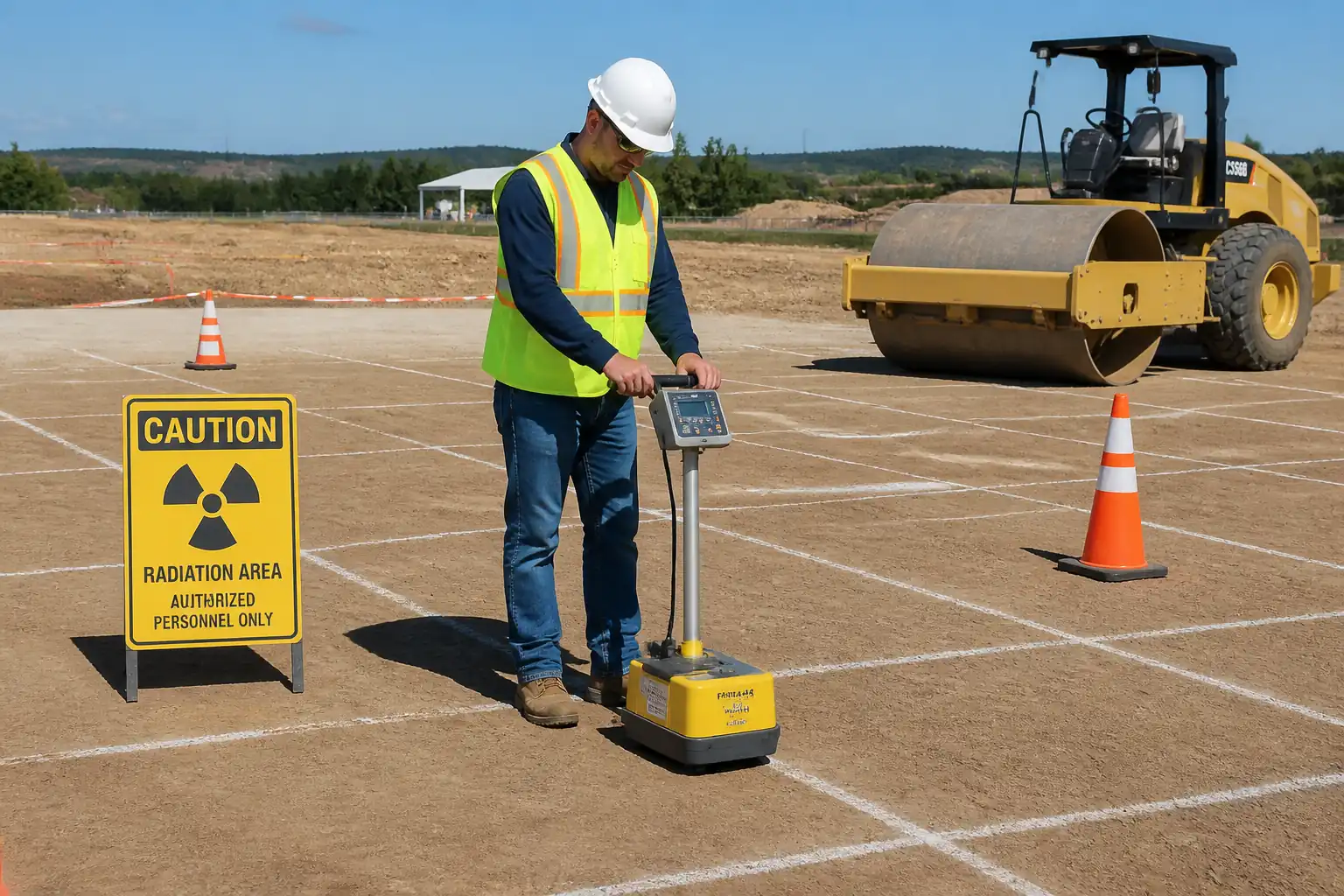
6) Radiation hazard (if nuclear gauge used for moisture)
- Consequence: Radiation exposure.
- Control: Authorized and trained operators only; daily standard counts; secure storage.
- PPE: Dosimeter as required.
- Collective: Controlled area signage.
- Inspection/permit: Radiation permit and log maintenance.
7) Working near public roads during deliveries
- Consequence: Traffic crash risk.
- Control: Approved TMP; certified traffic controllers; wheel wash to prevent mud tracking; lighting for night deliveries if allowed.
- PPE: High-vis, hard hat.
- Collective: Barriers, signage per road authority.
- Inspection/permit: Road permits and audits.
Note: Where legal requirements vary, adopt the stricter of project HSE plan and local regulations. [Verify per project HSE plan and local regulations]
Environmental Controls
- Sediment/runoff: Grade stockpile pads to perimeter drains; deploy silt socks/sediment basins; no discharge of turbid water without treatment.
- Dust management: Water carts, speed limits, cover loads, cease work during high winds per trigger levels. Record dust suppression in daily logs.
- Noise/vibration: Limit hours; maintain equipment; position stockpiles as acoustic shields where practical. [Verify per local regulations]
- Contamination management: Quarantine suspect materials; take confirmatory tests; dispose/recycle via licensed facilities only; maintain waste transfer notes.
- Spill prevention: Park refueling away from drains; spill kits at pad; report and clean immediately.
- Invasive species/weed control: Require clean trucks; inspect and reject if contaminated with soils/vegetation from infested areas where applicable. [Verify per project environmental plan]
- Public road cleanliness: Wheel wash and street sweeper as needed; no track-out beyond site access.
- Material conservation: Minimize double handling; segregate by type to avoid downgrading; maintain moisture to reduce wastage by drying/crusting.
Quality Assurance and Quality Control
Lotting and Traceability
- Default lot size 500 m³; adjust if specified. Each lot tagged and mapped with GPS coordinates and linked to delivery dockets.
Testing Plan and Frequencies
- As per Method Sequence Step 8. Project-specific frequencies supersede these. Maintain a live log comparing delivered volumes vs tests performed.
Acceptance Criteria (Typical Benchmarks – Verify per project specifications)
- General fill: LL ≤ 45; PI ≤ 20; Organic ≤ 2% m/m; Max size ≤ 150 mm (≤ 2/3 lift); Gradation within approved envelope.
- Select/Structural fill: PI ≤ 12; LL ≤ 35; Fines (P0.075 mm) typically 2–15% unless specified; Max size ≤ 75 mm; Gradation within approved envelope.
- Aggregates/backfill: Per approved gradation envelope (e.g., 0/31.5 mm Type 1) and durability indices.
Nonconformance Control
- Immediate quarantine of suspect lots; raise NCR; perform root cause with supplier; corrective action may include scalping, drying/blending, or removal. Engineer to approve disposition.
Records and Calibration
- Maintain: source approvals, delivery docket register, sample register/COC, lab reports, lot release certificates, NCR/CAR, calibration certificates (scales, moisture testers, nuclear gauge), personnel qualifications, daily diaries and photos.
Chain-of-Custody
- Use tamper-evident seals, unique sample IDs with Lot linkage, timestamps, and courier logs. Preserve samples per ASTM D4220 and project requirements.
Attachments
- Example Lot Release Certificate template (with Lot ID, volume, linked dockets, test summary, approvals).
- Delivery Docket Reconciliation Sheet (daily tally, tonnage-to-volume conversion, variance tracker).
- Sampling Checklist and Chain-of-Custody Form.
- Stockpile Layout Plan and Signage Legend (Approved/Pending/Quarantine).
- NCR/CAR Template for Unsuitable Material.
- Calibration Certificates Index (moisture tester, scales, nuclear gauge if used).
- Traffic Management Plan extract for stockpile area and delivery route.
This content is a read-only public reference. Download or customize to get an editable version.
ITP preview
The first inspection activities from the linked ITP for Method Statement – Imported Fill Acceptance, Classification, Source Testing, Stockpile Sampling, Rejection Protocol, and Delivery Docket Reconciliation:
| Activity | Inspection / Test | Acceptance Criteria | Responsibility | Record |
|---|---|---|---|---|
| Source qualification (initial) | Classification (ASTM D2487/D2488), LL/PL (ASTM D4318), Gradation (ASTM D6913), Moisture–Density (ASTM D698/D1557), organics/sulfates if required | Meets approved envelopes and thresholds; lab accredited; Engineer approval issued | Contractor QA/QC + Independent Lab; Witness: Engineer | Source Approval Report, test certificates |
| Delivery visual inspection and docket check (each load) | Visual per ASTM D2488; docket verification; quick moisture (ASTM D4944) as needed | Approved source; correct material; no visible contamination/oversize; documentation complete | Site Engineer/Materials Controller | Docket log with inspection stamp, photos of suspect loads |
| Stockpile lot setup and identification | Layout and signage check; survey pick-up | Lot IDs installed; segregation ensured; drainage in place | Site Engineer/Surveyor | Lot register, survey records, photos |
Showing 3 of 10 inspection activities. View full ITP →
Related Inspection and Test Plan
An Inspection and Test Plan (ITP) is available for Method Statement – Imported Fill Acceptance, Classification, Source Testing, Stockpile Sampling, Rejection Protocol, and Delivery Docket Reconciliation. The ITP defines the inspection activities, acceptance criteria, hold and witness points, responsible parties, and records required to verify the work described in this method statement.
View the Method Statement – Imported Fill Acceptance, Classification, Source Testing, Stockpile Sampling, Rejection Protocol, and Delivery Docket Reconciliation ITP →Frequently asked questions
Continue with related Quollnet resources connected to this method statement.